Middle East Cable Market Size, Share, Trends, And Growth Forecast Report, Segmented By Type, Fuel, Sales Chanel, Vehicle Size, and Country (KSA, UAE, Israel, South Africa, And Ethiopia, Kenya, Egypt, Sudan, Rest of GCC Countries, and Rest of MEA), Industry Analysis From 2026 to 2034
Market Size, 2025
$5.73 BnMarket Estimate, 2026
$6.08 BnMarket Forecast, 2034
$9.79 BnCAGR, 2026–2034
6.13%Executive Summary: Middle East Cable Market
- Market Scope: Regional Middle East cable market analysis covering cable types, voltage categories, end-user segments, country leadership frameworks, and electrical infrastructure adoption metrics.
- Market Valuation: Valued at USD 5.73 billion in 2025, estimated at USD 6.08 billion in 2026, and projected to reach USD 9.79 billion by 2034, registering a CAGR of 6.13% from 2026 to 2034.
- Primary Growth Drivers: Accelerated urbanization and mega-city development projects, expansion of renewable energy infrastructure and grid modernization, alongside rising investments in smart cities, power transmission, and fiber-optic networks.
Key Market Segment Metrics (2026–2034)
| Category | Leading Segment (Position) | Fastest-Growing / Key Growth Segment |
|---|---|---|
| By Type & Voltage Segment | Underground Cables (largest type) & Medium Voltage (MV) (largest voltage segment) | Submarine Cables (fastest-growing type) & High Voltage (HV) (fastest-growing voltage segment) |
| By End-User Segment | Energy and Power (largest end-user segment) | IT and Telecommunication (fastest-growing end-user segment) |
| By Technology & Innovation | Standard electrical wiring and traditional power transmission lines | XLPE-insulated and armored cables, fiber-optic networks, and smart grid solutions |
| By Region / Country | Saudi Arabia (leading country with 31.6% market share in 2025) | United Arab Emirates (fastest-growing country market) |
Major Market Players & Market Structure
Market Structure: Highly competitive Middle Eastern cable sector characterized by underground and submarine cable technology investments, high-voltage and fiber-optic portfolio expansions, and strategic partnerships supporting renewable energy and smart grid projects.
Key Companies: Nexans, Sumitomo Electric Wiring Systems, Huawei Technologies, Furukawa, Polycab, ABB, General Cable, KEI Industries, Prysmian Cables Systems, and Axon Cable.
Middle East Cable Market Size
The Middle East cable market size was valued at USD 5.73 billion in 2025 and is anticipated to reach a valuation of USD 6.08 billion in 2026 and USD 9.79 billion by 2034, growing at a CAGR of 6.13%, from 2026 to 2034.
Cable covers power, fiber-optic, and specialty cables critical to energy transmission, telecommunications, and infrastructure development across the region. This sector supports the backbone of modern urbanization, industrial expansion, and digital transformation, particularly in rapidly growing economies such as Saudi Arabia, the UAE, and Qatar. The region’s extreme climatic conditions, frequent sandstorms, and temperatures exceeding 50°C necessitate cables with enhanced thermal resistance and corrosion protection.
MARKET DRIVERS
Accelerated Urbanization and Mega-City Development Projects
Large-scale urban development initiatives are a primary catalyst for cable demand across the Middle East, particularly in Saudi Arabia and the UAE. Projects such as NEOM, The Line, and Dubai South require vast underground power and fiber-optic networks to support smart city infrastructure. These developments mandate extensive low-, medium-, and high-voltage cabling for residential, commercial, and transportation systems. In the UAE, Etihad Rail’s national freight and passenger network, which spans 1,200 km across seven emirates, requires signaling and power cables. The shift from overhead to underground cabling in cities like Riyadh and Abu Dhabi further amplifies demand for armored, heat-resistant cables capable of withstanding desert conditions.
Expansion of Renewable Energy Infrastructure and Grid Modernization
The rapid deployment of solar and wind energy installations is driving significant demand for specialized cabling across transmission and distribution networks. Saudi Arabia’s National Renewable Energy Program aims to generate 50% of its electricity from renewables by 2030, with 27.6 GW of solar and wind capacity under development. Additionally, grid modernization efforts, including smart substations and high-voltage direct current (HVDC) links between GCC countries, are increasing demand for fire-resistant, low-smoke cables. As per the Gulf Cooperation Council Interconnection Authority, cross-border power interconnectivity has risen since 2020, further intensifying regional cabling requirements.
MARKET RESTRAINT
Volatility in Raw Material Prices, Particularly Copper and Aluminum
Fluctuations in global commodity prices significantly impact production costs and project feasibility in the Middle East cable market. Aluminum prices, another key input, surged due to energy constraints in primary producing regions. These cost pressures are particularly acute in the n region, where budget-constrained infrastructure projects face delays or downsizing. The absence of regional raw material reserves forces manufacturers to rely on imports, exposing them to exchange rate fluctuations and supply chain disruptions, thereby constraining profit margins and long-term investment planning.
Proliferation of Substandard and Non-Compliant Cable Imports
The influx of low-quality, non-certified cables from unregulated suppliers undermines safety standards and distorts market competition. These substandard products increase the risk of electrical fires, system failures, and infrastructure damage, particularly in high-load environments. The lack of consistent enforcement across regional markets allows non-compliant products to enter via free zones and re-export networks. Also, only some GCC countries have fully implemented mandatory conformity assessment programs, leaving regulatory gaps that compromise long-term infrastructure reliability and investor confidence.
MARKET OPPORTUNITY
Underground Cabling Mandates in Smart City and Sustainable Infrastructure Projects
Government mandates for underground cabling in urban centers are creating a structural shift in demand, favoring high-performance, durable cable solutions. In Dubai, all new developments must implement underground power and telecom networks, as stipulated by the Dubai Electricity and Water Authority (DEWA). These projects require cables with enhanced mechanical strength, moisture resistance, and longevity. The trend is expanding to secondary cities such as Dammam and Al-Ahsa, where municipal upgrades are underway. This regulatory-driven shift presents a long-term growth avenue for manufacturers specializing in XLPE-insulated and armored cables compliant with regional environmental challenges.
Digital Transformation and Fiber-Optic Network Expansion for 5G and IoT
The rollout of 5G networks and the proliferation of Internet of Things (IoT) applications are accelerating demand for high-capacity fiber-optic cabling. According to the Telecommunications Regulatory Authority of the UAE, 5G coverage now exceeds 95% of populated areas in Dubai and Abu Dhabi, requiring extensive fiber backhaul and fronthaul infrastructure. In Saudi Arabia, millions of 5G subscriptions were active by mid-2023, necessitating a tenfold increase in fiber-to-the-home (FTTH) deployment. This digital infrastructure boom is driving demand for bend-insensitive, high-density fiber cables capable of supporting multi-gigabit speeds and low-latency applications.
MARKET CHALLENGE
Harsh Environmental Conditions Impacting Cable Longevity and Performance
The Middle East’s extreme climate poses significant technical challenges for cable performance and durability. Prolonged exposure to temperatures exceeding 50°C, intense UV radiation, and abrasive sandstorms accelerates insulation degradation and conductor corrosion. Also, above-ground cables in desert regions experience a faster rate of thermal aging compared to temperate climates. Additionally, high humidity in coastal cities like Jeddah and Dammam increases the risk of moisture ingress and electrochemical treeing in medium-voltage systems. These environmental stressors necessitate the use of advanced materials such as cross-linked polyethylene (XLPE), UV-stabilized sheathing, and double-armored designs, increasing production complexity and cost while demanding rigorous quality assurance protocols.
Fragmented Regulatory Standards and Certification Requirements Across Countries
The absence of a unified regional certification framework complicates compliance and increases time-to-market for cable manufacturers. Each GCC country enforces distinct technical standards and testing protocols, despite nominal alignment with IEC norms. In Bahrain and Kuwait, cables must undergo local type testing even if certified by SASO or DEWA, as documented by the Gulf Cable and Electrical Accessories Association. This regulatory fragmentation increases operational costs and discourages smaller manufacturers from entering multiple markets. Furthermore, inconsistent enforcement of labeling and traceability requirements enables counterfeit products to circulate, undermining trust in certified supply chains and hindering the development of a cohesive, reliable regional market.
REPORT COVERAGE
| REPORT METRIC | DETAILS |
| Market Size Available | 2025 to 2034 |
| Base Year | 2025 |
| Forecast Period | 2026 to 2034 |
| CAGR | 6.13% |
| Segments Covered | By Type, Voltage, End-User, and Region. |
| Various Analyses Covered | Global, Regional, Country-Level Analysis, Segment-Level Analysis, DROC, PESTLE Analysis, Porter’s Five Forces Analysis, Competitive Landscape, Analyst Overview of Investment Opportunities |
| Regions Covered | KSA, UAE, Israel, the rest of GCC countries, South Africa, Ethiopia, Kenya, Egypt, Sudan, the rest of MEA |
| Market Leaders Profiled | Nexans, Sumitomo Electric Wiring Systems, Huawei Technologies, Furukawa, Polycab, ABB, General Cable, KEI Industries, Prysmian Cables Systems, Axon Cable |
SEGMENTAL ANALYSIS
By Type Insights
The Underground segment dominated the Middle East cable market by accounting for 47.5% in 2025. This dominance is driven by urban planning mandates and the region’s shift toward aesthetically integrated, resilient infrastructure. In Dubai, the Dubai Electricity and Water Authority (DEWA) requires all new residential and commercial developments to implement underground cabling, eliminating visual clutter and reducing storm-related outages. Similarly, Saudi Arabia’s Ministry of Municipal and Rural Affairs has enforced underground power networks in all new urban zones under Vision 2030. Underground systems also offer superior protection against sandstorms and extreme heat, which degrade overhead lines. As cities expand and smart infrastructure proliferates, the preference for concealed, durable networks continues to solidify the segment’s leadership.
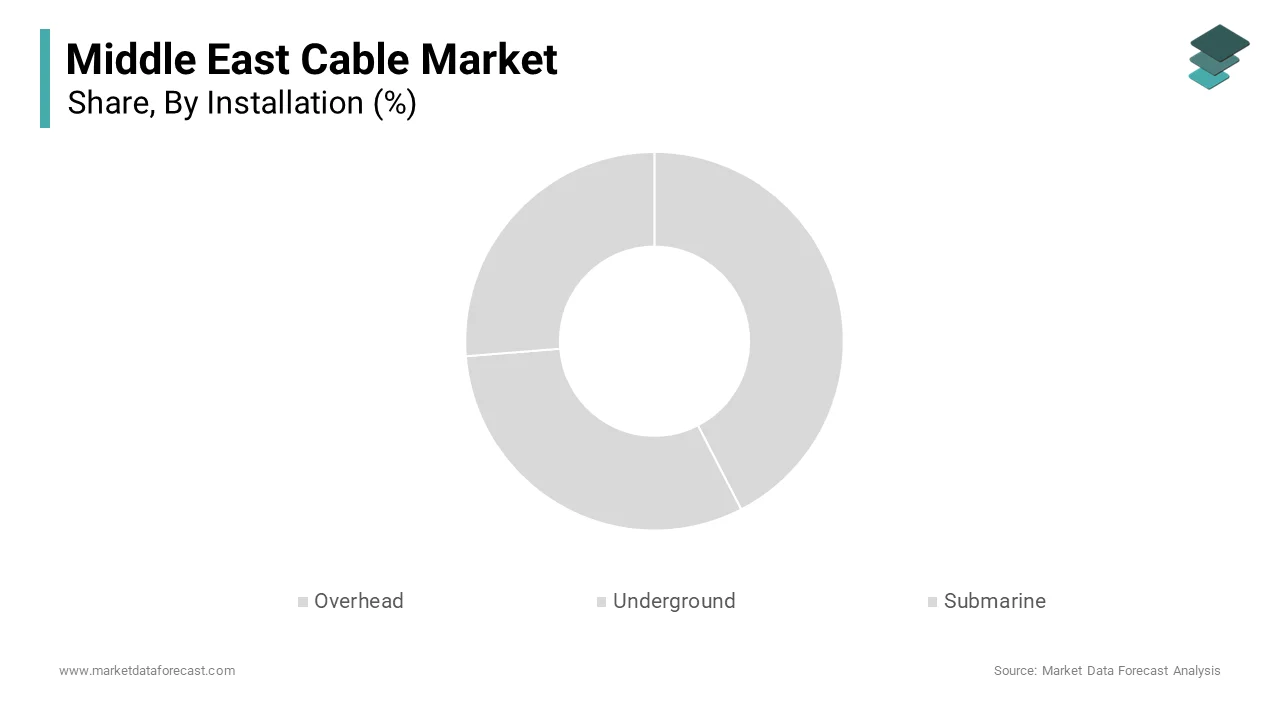
The Submarine cable segment is the fastest-growing and is projected to expand at a CAGR of 9.8% from 2025 to 2033. This growth is fueled by cross-border power interconnections and offshore energy projects. The GCCIA has completed multiple submarine links, including the 500 kV submarine cable between Saudi Arabia and Bahrain, capable of transmitting 3,000 MW, enhancing regional grid stability. Additionally, offshore oil and gas platforms in the Arabian Gulf require robust subsea power and control cables; ADNOC operates over 120 offshore installations, each reliant on specialized armored cables. With increasing investments in offshore wind and floating solar projects, particularly in Kuwait and Qatar, demand for high-voltage, corrosion-resistant submarine cables is accelerating across the region.
By Voltage Insights
The Medium Voltage (MV) segment commanded the Middle East cable market by capturing 42.7% of total demand in 2025. This growth is because of its critical role in urban power distribution, industrial supply, and renewable energy integration. MV cables (1 kV to 36 kV) are extensively used in feeding electricity from substations to commercial complexes, residential districts, and industrial parks. In Egypt, it has emphasized grid expansion projects between 2020 and 2023, involving MV networks to support new cities. The segment benefits from rapid urbanization and the decentralization of power generation, making it the backbone of modern electrical infrastructure across both public and private sectors.
The High Voltage (HV) segment is growing at the fastest rate, projected to achieve a CAGR of 8.6% from 2025 to 2033. This surge is driven by large-scale power transmission projects and the integration of utility-scale renewable energy. Saudi Arabia’s Al-Jouf Solar Project, with a capacity of 1.5 GW, requires 400 kV transmission lines to deliver power to urban centers, necessitating hundreds of kilometers of HV cables. Similarly, the UAE’s Barakah Nuclear Energy Plant relies on 400 kV underground and overhead HV links to distribute electricity across the northern emirates. The development of ultra-high-voltage (UHV) corridors and HVDC submarine links further amplifies demand, positioning HV cables as essential enablers of regional energy security and decarbonization.
By End User Insights
The Energy and Power segment led the Middle East cable market by representing 39.1% in 2025. This dominance is credited to the region’s massive investments in electricity generation, transmission, and distribution infrastructure. Saudi Arabia’s Ministry of Energy plans to invest over USD 60 billion in grid modernization by 2030, including the deployment of smart substations and automated distribution networks. In the UAE, DEWA’s Shams Dubai initiative has integrated over 60,000 rooftop solar systems into the grid, requiring extensive cabling for bidirectional power flow. The proliferation of gigawatt-scale solar parks and nuclear energy facilities further intensifies demand for high-performance power cables, solidifying this segment as the market’s primary driver.
The IT and Telecommunication segment is the fastest-growing and is projected to expand at a CAGR of 10.3% from 2025 to 2033. This rapid growth is driven by 5G rollout, data center expansion, and fiber-to-the-home (FTTH) deployment. As per the Communications, Space and Technology Commission of Saudi Arabia, over 22 million 5G subscriptions were active by 2025, requiring dense fiber backhaul networks. Additionally, hyperscale data centers in Bahrain, Qatar, and NEOM are driving demand for high-bandwidth, low-latency fiber cables. As per the International Telecommunication Union, internet penetration in the Middle East reached 76% in 2023, up from 62% in 2020, accelerating the need for scalable, future-ready telecom infrastructure and positioning fiber optics as a critical growth vector.
COUNTRY ANALYSIS
Saudi Arabia secured the most influential position in the Middle East cable market by representing 31.6% of regional demand in 2025. The country’s market is defined by its aggressive infrastructure modernization under Vision 2030, with over USD 150 billion allocated to energy, transportation, and urban development. Projects such as NEOM and the Red Sea Global developments require fully underground, smart-grid-compatible cabling systems. Additionally, the National Grid Company has initiated multiple HV interconnection projects, including a 500 kV link with Jordan. These initiatives, combined with strict SASO certification requirements, are driving demand for high-quality, compliant cables and positioning Saudi Arabia as the region’s largest and most strategically evolving market
United Arab Emirates is another key player in the MEA cable market. The UAE serves as a regional logistics and innovation hub, hosting major industrial zones and free trade areas that attract global cable manufacturers. The UAE’s growth in renewable energy is also a key driver. Additionally, the country’s 5G coverage exceeds 95%, necessitating extensive fiber-optic deployment. With stringent quality enforcement and a focus on smart infrastructure, the UAE sets technical benchmarks that influence procurement trends across the broader region.
Egypt commands a significant share of the Middle East and Africa cable market. As the most populous country in the region, Egypt faces immense demand for reliable power and telecommunications infrastructure. Despite economic challenges, donor-funded projects from the World Bank and African Development Bank are enabling large-scale cabling upgrades, gradually improving grid resilience and digital access.
Israel holds a notable share of the MEA cable market. The country stands out for its advanced grid infrastructure and high adoption of smart technologies. Israel’s Electricity Authority mandates underground cabling in all new developments. The country has one of the highest densities of fiber-optic networks per capita. Additionally, Israel’s offshore natural gas fields, such as Tamar and Leviathan, require specialized subsea power and control cables, driving demand for high-performance solutions. The integration of distributed solar generation and battery storage systems has increased the need for flexible, bidirectional cabling. Its regulatory alignment with EU standards and strong R&D ecosystem make Israel a model for integrated, future-ready infrastructure deployment.
KEY MARKET PLAYERS
Nexans, Sumitomo Electric Wiring Systems, Huawei Technologies, Furukawa, Polycab, ABB, General Cable, KEI Industries, Prysmian Cables Systems, Axon Cable. Are the market players that are dominating the Middle East cable market?
Top Players In the Market
Nexans
Nexans maintains a strong presence in the Middle East, delivering high-performance power and fiber-optic cables for energy, infrastructure, and telecommunications projects. The company operates a regional technical center in Dubai and has supplied critical cabling for landmark developments such as the Mohammed bin Rashid Al Maktoum Solar Park and NEOM’s utility corridors. The company has also expanded its local manufacturing capabilities in Abu Dhabi through its joint venture with Emirates Cable, enabling faster delivery and compliance with UAE and SASO standards. Nexans has intensified its focus on sustainability, introducing low-carbon cable solutions and recyclable insulation materials, aligning with regional decarbonization goals and enhancing its reputation as a technologically advanced and environmentally responsible supplier.
Prysmian Group
Prysmian Group is a leading global cable manufacturer with deep integration into the Middle East’s energy and telecom infrastructure. The company has executed major projects across the region, including the supply of subsea power cables for the Bahrain-Saudi Arabia interconnector and high-voltage links for Qatar’s Lusail City. The company operates a logistics hub in Jebel Ali Free Zone, enabling rapid deployment across GCC countries. It has also partnered with Saudi Aramco to develop customized cables for harsh oil and gas environments, featuring enhanced thermal and chemical resistance. Through its “Prysmian University” initiative, the company conducts technical training for engineers and contractors, strengthening after-sales support and fostering long-term client relationships across utilities, EPC firms, and government agencies.
KEC International
KEC International, a leading Indian cable manufacturer, has significantly expanded its footprint in the Middle East through strategic project wins and localized service networks. The company has supplied overhead transmission lines and underground distribution cables for major power projects in Oman, Kuwait, and Jordan, including the 500 kV OHL network in southern Oman. The company has established a regional office in Dubai to streamline operations and enhance customer engagement. KEC has also introduced its KEC Green Cables range, designed for solar parks and smart grids, meeting international standards such as IEC 60502 and BS 6622. With a focus on cost-effective, high-reliability solutions, KEC is positioning itself as a preferred partner for EPC contractors and government entities seeking timely and compliant cabling infrastructure.
Top Strategies Used By Key Market Participants
Key players in the Middle East cable market are deploying targeted strategies to strengthen their regional foothold. Localization is a core focus, with companies establishing regional manufacturing units, logistics hubs, and technical centers to ensure faster delivery and regulatory compliance. Firms are increasingly engaging in direct partnerships with national utilities and EPC contractors to secure large infrastructure tenders. Investment in R&D is accelerating, particularly in heat-resistant, fire-retardant, and eco-friendly cable materials suited to desert environments. Companies are also expanding technical training programs for engineers and installers to improve product adoption and reduce field failures. Additionally, strategic alliances with renewable energy developers and smart city planners are enabling early involvement in mega-projects. These multifaceted approaches allow manufacturers to differentiate beyond price, emphasizing reliability, compliance, and lifecycle performance in a highly competitive and technically demanding market.
COMPETITION OVERVIEW
The competition in the Middle East cable market is intensifying, shaped by a convergence of global multinationals, regional manufacturers, and emerging Asian suppliers. Established players such as Nexans, Prysmian, and LS Cable dominate high-value segments, including high-voltage underground and subsea systems, leveraging technological expertise and international certifications. However, regional producers and joint ventures are gaining traction by offering faster turnaround and localized support. Market rivalry is further amplified by government-led infrastructure programs in Saudi Arabia, the UAE, and Egypt, which prioritize quality, compliance, and timely execution. The rise of renewable energy and smart cities is compelling companies to innovate beyond traditional cabling into integrated, future-ready solutions. With regulatory standards evolving and procurement increasingly centralized, competitors must balance technical excellence, cost efficiency, and supply chain resilience to maintain a sustainable advantage across this dynamic and high-growth region.
RECENT HAPPENINGS IN THE MARKET
- In March 2023, Nexans supplied high-voltage underground cables for the Al-Jouf Solar Project in Saudi Arabia, reinforcing its leadership in renewable energy infrastructure and supporting the Kingdom’s clean energy transition.
- In July 2023, Prysmian Group delivered fire-resistant power cables for the expansion of Dubai Metro Route 2020, enhancing safety and reliability in high-density urban transit networks across the UAE.
- In October 2023, KEC International secured a contract to provide medium-voltage distribution cables for Egypt’s New Administrative Capital, strengthening its presence in large-scale urban development projects.
- In January 2025, Nexans inaugurated a new technical training center in Dubai, aimed at improving installer proficiency and ensuring proper deployment of high-performance cables in complex infrastructure environments.
- In May 2025, Prysmian Group partnered with Saudi Aramco to co-develop specialized oil and gas cables with enhanced thermal stability, expanding its industrial footprint and aligning with national energy sector requirements.
MARKET SEGMENTATION
This is a research report on the Middle East Cable Market is segmented and sub-segmented into the following categories.
By Installation Type
- Overhead
- Underground
- Submarine
By Voltage Type
- High
- Medium
- Low
By End-User Type
- Industrial
- Aerospace and Defense
- Oil and Gas
- Energy and Power
- IT and Telecommunication
- Others
By Country
- KSA
- UAE
- Israel
- Rest Of The GCC Countries
- South Africa
- Ethiopia
- Kenya
- Egypt
- Sudan
- Rest Of MEA
Frequently Asked Questions
What is driving growth in the Middle East cable market?
Rising urbanization, smart city initiatives, and expanding telecom infrastructure are boosting demand for high-capacity cables across the region.
How are governments influencing the cable market?
National digital transformation plans like Saudi Vision 2030 and UAE’s smart infrastructure projects are funding large-scale cable deployments.
What role does fiber optic cable play in the region?
Fiber optics are the backbone of 5G rollout and broadband expansion, offering faster speeds and reliable connectivity for businesses and homes.
Are renewable energy projects affecting cable demand?
Yes, solar and wind farm integrations require specialized power cables to connect remote plants to national grids efficiently.
What challenges do cable suppliers face in the Middle East?
Harsh desert climates and coastal humidity demand durable, corrosion-resistant cabling solutions for long-term reliability.
How is the data center boom impacting the market?
Explosive growth in hyperscale data centers across Dubai and Riyadh is increasing demand for high-performance structured cabling.
Is there a shift toward locally manufactured cables?
Yes, countries like UAE and Saudi Arabia are investing in local production to reduce import reliance and support economic diversification.
What standards regulate cable quality in the region?
Cables must comply with international (IEC, IEEE) and regional (SASO, ESMA) standards to ensure safety and performance.
How are submarine cables shaping connectivity?
Strategic undersea cable landings in Oman and Bahrain are positioning the region as a global digital connectivity hub.
What’s the outlook for the Middle East cable market?
Steady growth is expected through 2030, fueled by digitalization, energy projects, and cross-border infrastructure collaborations.
Related Reports
Access the study in MULTIPLE FORMATS
Purchase options starting from
$ 1600
Didn’t find what you’re looking for?
TALK TO OUR ANALYST TEAM
Need something within your budget?
NO WORRIES! WE GOT YOU COVERED!
Call us on: +1 888 702 9696 (U.S Toll Free)
Write to us: sales@marketdataforecast.com