- Product Description Description
- Table of Contents TOC
- List of Table & Figure LOT
- Get Free Sample PDF Sample PDF
Market Size, 2025
$0.08 BnMarket Estimate, 2026
$0.09 BnMarket Forecast, 2034
$0.28 BnCAGR, 2026–2034
15.35%Middle East and Africa Astaxanthin Market Size
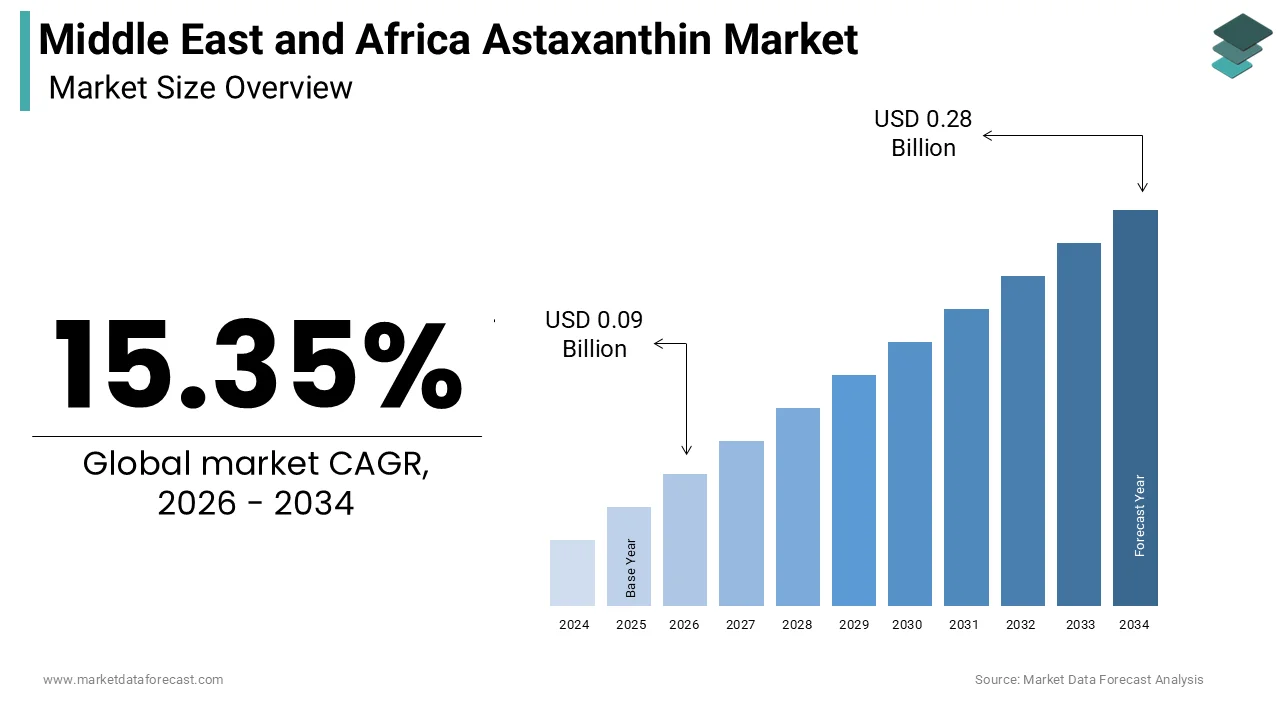
The Astaxanthin market size in the Middle East and Africa was calculated to be USD 0.08 billion in 2025 and is anticipated to be worth USD 0.28 billion by 2034, from USD 0.09 billion in 2026, growing at a CAGR of 15.35% during the forecast period.
Astaxanthin is a keto-carotenoid, which is a colourful, liquid-soluble pigment. It is found in many natural sources such as salmon, trout, microalgae, yeast, krill, shrimp, crayfish, and crustaceans, among others. While Astaxanthin is a naturally available component of the diet, it is also used as a food supplement. It is generally used for animal, human, and aquaculture consumption. It is widely available in red-coloured aquatic foods. The primary source of Astaxanthin in aquatic food sources is algae. In species like shellfish, it is concentrated in the shells, while it is also available in the flesh at lower concentrations. However, most of the commercially available Astaxanthin is produced synthetically.
The driving factors of the Middle East and Africa Astaxanthin market are the adoption of advanced technologies during various stages of the production of Astaxanthin, such as cultivation, extraction, microalgae harvesting, extraction and drying, growing geriatric population, and rising demand for cosmetic products like antioxidant creams and anti-ageing creams, among others. Astaxanthin has been found in many studies to be skin-friendly as it offers various advantages. Because of this, it is being used extensively by cosmeceutical manufacturers and wellness spa owners.
This research report on the Middle East and Africa Astaxanthin Market has been segmented and sub-segmented based on the following categories.
Middle East and Africa Astaxanthin Market By Source
- Plants
- Yeast & Microbes
- Marine And Petroleum
Middle East and Africa Astaxanthin Market By Form
- Dry
- Liquid
Middle East and Africa Astaxanthin Market By Application
- Supplements
- Animal Feed
- Cosmetics
- Food
Middle East and Africa Astaxanthin Market By Method of Production
- Fermentation
- Microalgae Cultivation
- Extraction
- Chemical Synthesis
In the Astaxanthin market, the petroleum segment has the largest market share, and microalgae is expected to be the fastest-growing segment.
Middle East and Africa Astaxanthin Market By Region
- KSA
- UAE
- Israel
- Rest of GCC Countries
- South Africa
- Ethiopia
- Kenya
- Egypt
- Sudan
- Rest Of MEA
Factors such as the rising geriatric population and the adoption of various technologies during production are expected to drive the market growth in the region.
KEY MARKET PLAYERS
Some of the major players in the market are Koninklijke DSM N.V. (Netherlands), BASF SE (Germany), Cyanotech Corporation (U.S.), Otsuka Pharmaceutical Co., Ltd. (Japan), Valensa International (U.S.), Fuji Chemical Industries Co., Ltd. (Japan), Divis Laboratories (India), Beijing Ginko Group (China), Igene Biotechnology, Inc. (U.S.), Piveg, Inc. (U.S.), Fenchem Biotek Ltd. (U.S.), Algatechnologies (Israel), Cardax, Inc. (U.S.), and Supreme Biotechnologies (U.S.).