- Product Description Description
- Table of Contents TOC
- List of Table & Figure LOT
- Get Free Sample PDF Sample PDF
Market Size, 2025
$81.24 BnMarket Estimate, 2026
$115.95 BnMarket Forecast, 2034
$1,997 BnCAGR, 2026–2034
42.73%Executive Summary: Mobile 3D Market
- Market Scope: Comprehensive global mobile 3D industry analysis covering consumer electronics application sectors, auto-stereoscopic display technologies, regional leadership frameworks, strategic corporate developments, and competitive landscapes.
- Market Valuation: Valued at USD 81.24 billion (2025), estimated at USD 115.95 billion (2026), and projected to reach USD 1,997 billion by 2034, registering an explosive CAGR of 42.73% (2026–2034).
- Primary Growth Drivers: High-definition video content proliferation, mobile gaming dominance, auto-stereoscopic glasses-free 3D display advancements, immersive entertainment demand, and processor/memory innovation. Restraints include high device costs, increased power consumption, and low-light content creation challenges.
Key Market Segment Metrics (2026–2034)
| Category | Leading Segment (Position) | Fastest-Growing Segment |
|---|---|---|
| By Application Segment | Gaming application segment (accounts for the largest market share globally) | Immersive mobile gaming and interactive 3D entertainment media |
| By Region / Geography | North America (holds highest share of the global market due to numerous industry giants) | Asia Pacific (exhibits highest growth rate driven by smartphone manufacturers in China and India) |
Major Market Players & Market Structure
Market Structure: Highly competitive global mobile technology and consumer electronics ecosystem driven by auto-stereoscopic hardware design, specialized processor integration, and interactive defense/gaming applications.
Key Companies: 3M, Hitachi Ltd., Nvidia Corporation, Imagination Technologies, Movidius, NTT Docomo, Intel Corporation, Samsung Electronics, LG Electronics Inc., Amobee Inc., MasterImage 3G, Apple Inc., Microvision Inc., EON Reality, Toshiba Corporation, Qualcomm Inc., Sharp Corporation, YUVsoft, and Sitrion.
Global Mobile 3D Market Size
The global mobile 3D market was worth USD 81.24 billion in 2025. The global market is anticipated to register a whopping CAGR of 42.73% from 2026 to 2034 and be worth USD 1,997 billion by 2034, from USD 115.95 billion in 2026.
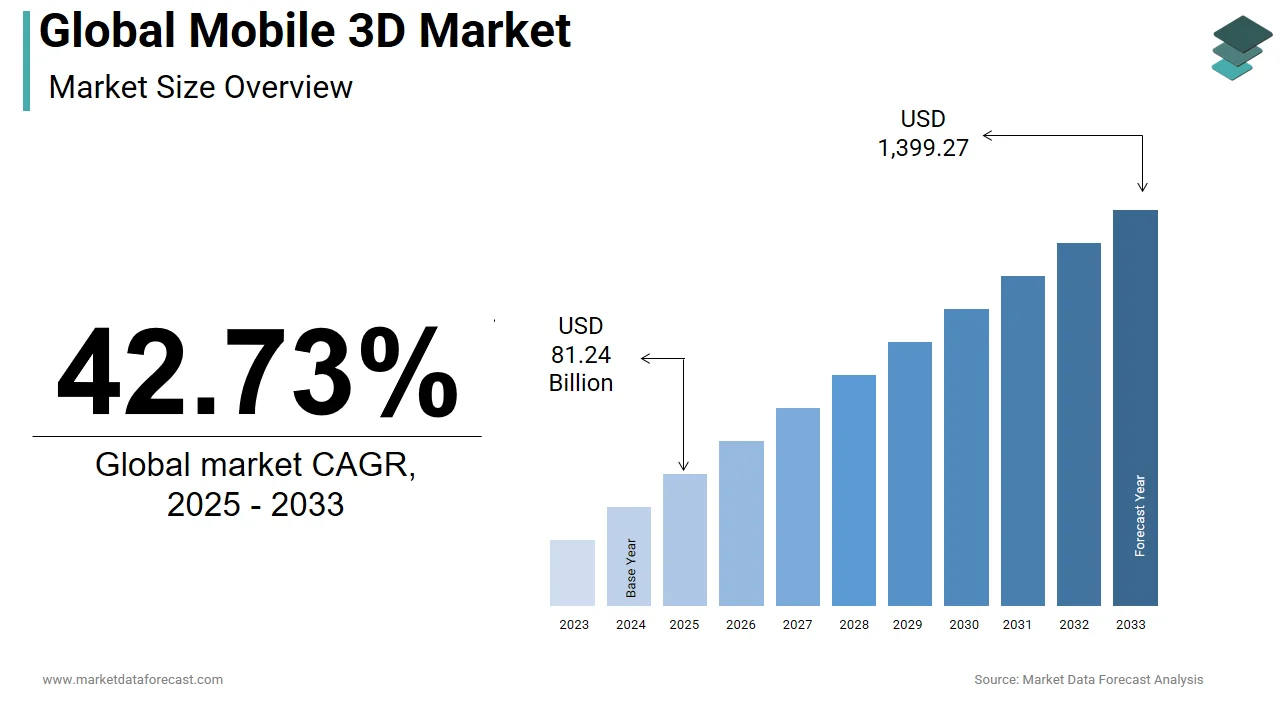
Mobile 3D refers to the creation, rendering, viewing, or capturing of three-dimensional graphics and objects using smartphones, tablets, and portable devices. It brings depth, interactive models, and spatial computing to the palm of your hand without needing a heavy computer. This domain has evolved from novelty stereoscopic displays to functional spatial computing infrastructure integrating LiDAR, photogrammetry, neural radiance fields and real-time mesh reconstruction directly into smartphone and tablet form factors. According to the European Commission, the strategic rollout of advanced connectivity and secure ICT infrastructures under the Digital Decade framework accelerates the deployment of edge-computing capabilities across new mobile architectures in member states. As per Eurostat, forty per cent of European Union citizens between the ages of 16 and 74 lacked basic or above-basic overall digital capabilities during recent reporting cycles. According to the European Union Agency for Cybersecurity, the modern threat environment evaluated in their 2025 assessment landscape features rapid vulnerability exploitation across four thousand eight hundred seventy-five analysed cyber incidents. Furthermore, as per UNESCO, the global cultural sector utilises digital documentation platforms and shared virtual asset tracking infrastructures to implement international monitoring protocols against the illicit trafficking of physical artefacts. This evolution signifies that mobile 3D technology serves as a democratised spatial interface bridging physical and digital environments while navigating complex privacy, accuracy and accessibility considerations unique to European regulatory and cultural contexts.
MARKET DRIVERS
Proliferation of Native Depth Sensing Hardware
The widespread integration of dedicated depth sensors, LiDAR scanners, and stereo camera arrays into mainstream mobile devices creates foundational hardware availability, which propels the global mobile 3D market. This built-in hardware eliminates the need for external accessories and enables mass-market 3D application development. According to the European Commission, the strategic rollout of advanced connectivity and secure infrastructure under the Digital Decade framework expands edge-computing capabilities across new mobile device architectures in Western Europe. As per the European Commission, the deployment of standardised digital infrastructure frameworks across member states accelerates the cross-border integration of spatial data architectures and localised computing components. This hardware ubiquity allows developers to assume baseline 3D capability across a substantial installed base, reducing fragmentation risks that historically limited mobile 3D adoption to niche flagship users. Professional field workers in construction, insurance, and real estate leverage built-in sensors for instant room measurement volume calculation and damage documentation, replacing dedicated laser scanners. According to the European Union Agency for Cybersecurity, the modern threat environment processed under the 2025 assessment landscape features rapid vulnerability exploitation across four thousand eight hundred seventy-five analysed cyber incidents. Consumer applications benefit from seamless user experience without dongle calibration or learning curves associated with external peripherals. Organisations recognise that native sensor integration transforms mobile 3D from experimental feature to reliable tool, enabling sustained ecosystem growth through removing the primary adoption barrier of specialised hardware acquisition.
E-Commerce Product Visualisation and Return Reduction Imperatives
Retailers face mounting pressure to reduce return rates and increase conversion through immersive product experiences, which in turn fuels the expansion of the global mobile 3D market. This drives structural demand for mobile 3D content creation, viewing, and commerce integration capabilities. As per Eurostat, 40% of European Union citizens between the ages of 16 and 74 lacked basic or above-basic overall digital capabilities during recent reporting cycles. According to the European Commission, electronic commerce ecosystems operating within member states utilise interoperable cloud processing nodes to handle transactional data volumes during peak retail periods. As per the European Commission, the Ecodesign for Sustainable Products Regulation establishes the framework for a Digital Product Passport to share product origin, materials, environmental data, compliance, and end-of-life guidance. Consumer expectations shaped by gaming and social media create demand for interactive product exploration. According to Eurostat, cross-border digital consumer transactions within the internal market expand continuously alongside targeted investments in localised high-capacity telecommunications networks. Mobile 3D enables this at scale without requiring consumers to download dedicated apps or own specialised hardware. This convergence of regulatory pressure, economic necessity and generational expectation creates powerful non-discretionary demand, ensuring sustained mobile 3D growth tied directly to retail operational efficiency rather than discretionary marketing spend.
MARKET RESTRAINTS
Privacy Regulations Constraining Biometric and Environmental Capture
Mobile 3D technologies trigger stringent privacy frameworks because they inherently capture spatial, environmental, and potentially biometric data, which restricts the growth of the Mobile 3D market. Consequently, these regulations limit permissible use cases, increase compliance costs, and fuel consumer hesitation. According to the European Data Protection Board, artificial intelligence-supported facial recognition frameworks deployed within the internal market require systematic compliance audits regarding biometric classification thresholds and prohibited emotion inference practices. As per the European Union Agency for Cybersecurity, the modern threat environment features rapid vulnerability exploitation across four thousand eight hundred seventy-five analysed cyber incidents. According to the Commission Nationale de l'Informatique et des Libertés, data protection compliance measures in enforcement cycles feature targeted sanctions against subcontractor data retention failures and non-compliant cookie tracking configurations. The proposed EU AI Act classifies certain real-time biometric identification and emotion recognition applications as high risk or prohibited. As per the European Commission, the Artificial Intelligence Act establishes strict regulatory prohibitions against real-time biometric categorisation systems and emotion recognition applications deployed in high-risk operational environments. Organisations must navigate complex requirements where the same sensor enables valuable functionality yet creates liability exposure if misconfigured or misunderstood by users. This regulatory friction suppresses innovation velocity and market expansion, particularly for startups lacking legal resources to navigate compliance complexity across multiple jurisdictions.
Computational Limitations and Battery Drain Tradeoffs
Mobile processors still face strict thermodynamic and battery limits despite modern hardware advances, which impedes the growth of the global mobile 3D market. This creates a persistent experience gap, reducing real-time 3D processing quality, duration, and usability compared to desktop or cloud alternatives. According to Qualcomm, flagship system-on-chip mobile platforms incorporate integrated hardware caches to achieve up to a 35% optimisation in graphical processing energy efficiency over preceding architectural generations. As per the European Commission, electronic commerce ecosystems operating within member states utilise interoperable cloud processing nodes to handle transactional data volumes during peak retail periods. Thermal management constraints cause performance degradation. Cloud offloading introduces latency, privacy, and connectivity dependencies, negating mobility advantages for many use cases. Consumer tolerance for battery drain remains low. This physical limitation constrains addressable use cases to short duration or low fidelity scenarios, preventing mobile 3D from replacing dedicated equipment for demanding professional applications despite sensor capability parity.
MARKET OPPORTUNITIES
Cultural Heritage Digitisation and Public Access Democratisation
Cultural institutions face an urgent mandate to digitise collections, preserve endangered heritage, and expand public access, which is anticipated to drive the growth of the global mobile 3D market. This creates a substantial opportunity for mobile 3D as an affordable, scalable capture and dissemination platform aligned with policy priorities. According to the European Commission, the Recovery and Resilience Facility channels substantial funding toward digital transformation and the preservation of cultural sectors across EU member states. As per UNESCO, official heritage documentation initiatives leverage advanced geospatial and imaging technologies to optimise recording accuracy and structural assessments at international historic sites. According to Europeana, the digital repository coordinates the cross-border ingestion of cultural heritage assets from verified institutional data partners to expand shared European open science infrastructure. Educational applications enable students to interact with artefacts remotely, supporting curriculum alignment and inclusive access for disabled or geographically isolated learners. According to the Network of European Museum Organisations, European museums expand their digital engagement frameworks to improve accessibility, online public interaction, and museum visitor information systems. This convergence of funding availability, policy alignment and demonstrated efficacy creates powerful structural opportunity, transforming mobile 3D from consumer gadget to essential cultural infrastructure.
Construction Field Documentation and BIM Integration Workflows
The construction industry faces mandatory Building Information Modelling (BIM) adoption and urgent productivity demands, which are predicted to boost the expansion of the mobile 3D market. This shift creates a pathway for mobile 3D technology to serve as an on-site verification and documentation tool integrated with professional BIM platforms. According to the European Construction Industry Federation, construction enterprises deploy Building Information Modelling protocols to ensure unified design workflows and data-driven management across infrastructure projects. As per the European Commission, the integration of advanced three-dimensional scanning and digital imaging systems within European engineering projects accelerates asset verification and site surveying procedures. According to the European Parliament, the revised Construction Products Regulation establishes standardised legal parameters for structural product data collection and environmental lifecycle traceability across the single market. As per the European Commission, technical interoperability between cloud-based mobile engineering platforms and open architectural database systems minimises data conversion gaps within regional public works workflows. This workflow integration transforms mobile 3D from a novelty capture tool to an essential construction productivity enabler, unlocking an addressable market beyond consumer and creative segments.
MARKET CHALLENGES
Accuracy Variability and Professional Trust Deficits
Inconsistent capture accuracy across devices, lighting conditions, and operator skill levels creates a trust deficit among professional users, which slows down the growth of the mobile 3D market. This requires reliable measurements and documented tolerances that mobile 3D cannot consistently guarantee without extensive validation protocols. According to the National Physical Laboratory, advanced dimensional metrology research provides calibrated frameworks to reduce measurement uncertainties and establish traceable standards for industrial surface topography applications. As per the Royal Institution of Chartered Surveyors, international built environment professional frameworks advance sustainability reporting architectures and standardise compliant financing criteria for European real estate projects. Device manufacturers provide minimal accuracy specifications or certification, making cross-device consistency impossible to verify or guarantee for multi-device project teams. Professional liability concerns arise when mobile-captured data informs structural decisions, cost estimates or compliance certifications, with potential legal consequences if errors are discovered post hoc. Mobile 3D lacks market-wide accuracy standards, third-party certification programs, and uncertainty reporting conventions. Because of this, it remains a supplementary tool rather than a primary professional one, which limits its expansion into high-value regulated applications
Content Fragmentation and Interoperability Barriers
The proliferation of proprietary file formats, capture algorithms, and platform-specific ecosystems creates content fragmentation, which prevents seamless asset exchange, reuse, and long-term archival, and ultimately constrains the expansion of the global mobile 3D market. This undermines the fundamental value proposition of 3D as a universal spatial medium. According to the Khronos Group, international asset creation working groups establish standard glTF asset specifications to remove deployment barriers and optimise 3D asset presentation across diverse consumer commerce platforms. As per CARARE, European institutional repositories collaborate with national networks to enhance metadata ingestion schemas and aggregate archival datasets within shared digital cultural frameworks. Platform holders Apple, Google, and Meta maintain walled gardens, optimising capture pipelines for proprietary ecosystems while providing limited export fidelity or documentation discouraging cross-platform workflows. Long-term digital preservation requires stable open formats with comprehensive metadata, yet most mobile apps prioritise compression and real-time performance over archival integrity, creating future accessibility risks. Without coordinated standardisation efforts and preservation-aware application design, mobile 3D risks generating ephemeral content silos. This approach, rather than durable, reusable spatial data infrastructure, limits societal and economic value realisation.
REPORT COVERAGE
| REPORT METRIC | DETAILS |
| Market Size Available | 2025 to 2034 |
| Base Year | 2025 |
| Forecast Period | 2026 to 2034 |
| Segments Covered | By Type, Application, and Region. |
| Various Analyses Covered | Global, Regional, and Country-Level Analysis, Segment-Level Analysis, Drivers, Restraints, Opportunities, Challenges; PESTLE Analysis; Porter’s Five Forces Analysis, Competitive Landscape, Analyst Overview of Investment Opportunities |
| Countries Covered |
|
| Market Leaders Profiled | 3M, Hitachi Ltd., Nvidia Corporation, Imagination Technologies, Movidius, NTT Docomo, Intel Corporation, Samsung Electronics, LG Electronics Inc., Amobee Inc., MasterImage 3G, Apple Inc., Microvision Inc., Google LLC, EON Reality, Toshiba Corporation, Qualcomm Inc., Sharp Corporation, and YUVsoft. |
SEGMENTAL ANALYSIS
By Type Insights
The 3D-enabled smartphones segment maintained the lead in the mobile 3D market and captured a significant share in 2025. This leading position of the segment was attributed to near-universal ownership, high replacement cycles, and the native integration of depth-sensing hardware that transforms everyday devices into accessible 3D capture and viewing platforms. According to research, the European smartphone market experienced a moderate shipment recovery led by premium flagship device performance across Western Europe. As per sources, global smartphone shipments demonstrate stabilised baseline growth volumes driven by entry-level upgrade cycles and broader iOS market acceleration. The always-carried nature of smartphones enables spontaneous 3D capture in field retail education and cultural contexts where dedicated equipment or tablets are impractical or unavailable. Consumer familiarity with smartphone interfaces reduces learning curves for 3D applications compared to specialised devices requiring separate training and workflow adaptation. Organisations recognise that smartphone ubiquity eliminates the primary adoption barrier of specialised hardware acquisition, enabling sustained ecosystem growth through leveraging existing device refresh cycles rather than requiring incremental capital expenditure for dedicated 3D equipment across consumer and professional user segments worldwide.
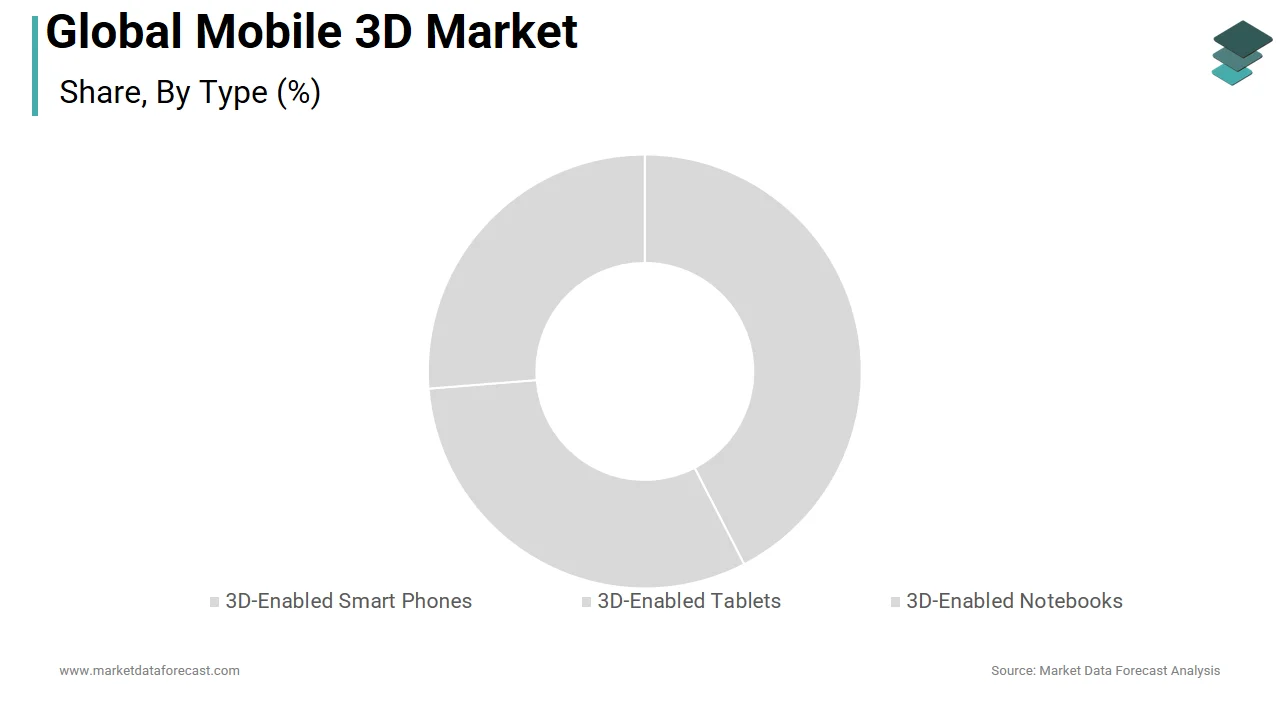
Smartphones dominate mobile 3D content because they deeply link with social media, messaging, and online shopping apps. This connection creates instant sharing and fast discovery that tablets and laptops lack, even before looking at hardware differences. As per Meta, digital advertising solutions and personalised business marketing architectures drive cross-border economic output and job growth throughout the European Union. Native camera app integration on iOS and Android enables instant 3D capture, sharing and viewing without third-party app downloads, reducing friction for casual users and enabling viral content propagation through existing social graphs. According to Statista, European digital commerce landscapes continue to expand through mobile-optimised checkout integrations and shifting digital consumer browsing preferences. This ecosystem integration ensures smartphones maintain disproportionate influence as both creation and consumption platforms, creating network effects where content availability drives device adoption and device ubiquity attracts content investment in a self-reinforcing cycle that tablets and notebooks cannot replicate due to lower usage frequency and platform fragmentation.
The 3D-enabled tablets segment is likely to experience the fastest CAGR of 24.7% during the forecast period, owing to professional field workflows requiring larger screens, extended battery life, and stylus input for precise 3D annotation, measurement, and client presentation that smartphones cannot accommodate ergonomically. According to McKinsey, European technological deployment focus centres on scaling agentic artificial intelligence applications and optimising digital cross-border commerce architectures. As per Canalys, commercial computing hardware procurement across European enterprise markets shifts heavily toward productivity-focused endpoints and localised premium business deployments. Larger displays enable simultaneous viewing of 3D models, reference documents, and measurement tools. According to Autodesk, synchronised cloud-based construction management workflows improve field operations data precision and minimise physical material rework overhead. Extended battery capacity supports full workday 3D capture sessions without recharging constraints, limiting smartphone usability for professional applications. Stylus integration enables precise markup, dimension annotation, and sketch overlay on captured meshes, supporting design review and client approval workflows impossible on touch-only smartphone interfaces. This professional specialisation ensures tablets maintain exceptional growth serving use cases where screen real estate, precision, and endurance outweigh portability advantages of smartphones, creating a sustainable niche unthreatened by phone capability improvements.
Tablets are growing rapidly in education and training, moving well beyond standard professional use. Their large screens, ease of collaborative viewing, and hands-on interaction meet learning goals much better than smartphones can. According to the European Commission, the Digital Education Action Plan channels strategic funding across member states to maximise digital competence, build institutional computing infrastructure, and support systemic educational resilience. As per Jisc, United Kingdom higher education networks upgrade cross-campus digital ecosystems and institutional data repositories to enhance academic delivery standards. Shared tablet viewing enables instructor-led exploration and group discussion around 3D models, supporting collaborative learning methodologies central to European education frameworks, whereas smartphones promote isolated individual consumption. Tactile manipulation of 3D objects on larger screens develops spatial reasoning and motor skills, particularly valuable for surgical training, mechanical assembly and archaeological reconstruction disciplines. This educational validation transforms tablets from consumer media devices to essential pedagogical infrastructure, ensuring sustained growth through public sector investment and curriculum integration independent of consumer upgrade cycles.
By Application Insights
The gaming segment remained the largest in 2025 and occupied a commanding share of the Mobile 3D Market. This prominence of the segment was supported by established monetisation models, mature development toolchains, and consumer willingness to pay for immersive experiences that drive sustained investment in 3D asset creation, rendering optimisation, and distribution infrastructure. According to studies, mobile gaming continues to command a dominant share of the global games market, driven primarily by live-ops optimisation and localised consumer monetisation strategies. As per Sensor Tower, global app ecosystem metrics demonstrate steady growth in user spending across premium action and strategy mobile titles utilising immersive gameplay systems. Mature engines including Unity, Unreal, and proprietary middleware provide optimised mobile 3D pipelines reducing development risk and enabling smaller studios to produce console-quality experiences on smartphones. In-app purchase advertising and subscription models generate predictable recurring revenue streams supporting ongoing content updates and technical improvements that sustain player engagement over multi-year lifecycles. Consumer acceptance of microtransactions and battle pass models creates a sustainable economic foundation absent in other 3D application categories still seeking viable monetisation. This combination of proven economics, mature tools and consumer spending willingness solidifies gaming dominance as the primary commercial engine funding broader mobile 3D ecosystem development.
Platforms like social AR and user-generated 3D content expand gaming's footprint by merging play, creation, and social networking. This synergy generates unmatched engagement and content volume compared to standard utility apps. As per TikTok, short-form creative video formats drive multi-layered consumer engagement metrics, viral trend velocity, and organic algorithmic reach across international creator ecosystems. User-generated content eliminates production cost barriers while generating authentic peer-to-peer discovery mechanisms more trusted than branded advertising or editorial curation. Social platforms provide built-in distribution monetisation through creator funds, brand partnerships and virtual goods sales, creating economic incentives for continuous 3D content innovation. According to the Influencer Marketing Hub, contemporary user-generated content strategies deliver optimised marketing engagement outcomes compared to legacy production methodologies. This social UGC ecosystem transforms gaming from an isolated entertainment category to a pervasive cultural medium, ensuring sustained dominance through network effects where content abundance drives user engagement and user participation attracts creator investment in a self-reinforcing cycle extending far beyond traditional gaming demographics.
The projections and spatial visualisation segment is expected to exhibit a noteworthy CAGR of 31.2% from 2026 to 2034, due to construction, manufacturing, and interior design industries adopting mobile 3D for on-site verification, client presentation, and design validation, replacing expensive dedicated equipment and time-consuming physical mockups. According to the European Construction Industry Federation, regional building enterprises scale automated digital collaboration workflows and digital transformation frameworks to advance structural efficiency. As per McKinsey, European engineering and physical infrastructure ecosystems prioritise systemic artificial intelligence optimisation, structural decarbonization, and digitised operational value streams. On-site AR overlay enables direct comparison of as-built conditions against design models, identifying discrepancies before costly construction errors propagate through project timelines. As per Autodesk, collaborative visual building information modelling environments reduce project design ambiguities and enhance coordination accuracy across multi-disciplinary construction fields. This industrial validation transforms projections from novelty demonstration to essential productivity tool, ensuring exceptional growth through measurable operational ROI rather than discretionary marketing spend.
Sales in this segment grow faster when customers use interactive tools to customise products. By letting buyers view personalised items in real-world settings before they buy, businesses cut down on returns and increase average order values for custom items. According to Deloitte, modern commercial operations adapt to shifting millennial and Gen Z shopping expectations by integrating personalised experiential digital assets within core multi-channel environments. As per Shopify, modern merchant ecosystems grow commercial conversion baselines by deploying adaptive product displays and cross-device interface enhancements. Furniture, automotive, fashion, and eyewear categories lead adoption where fit, scale, colour, and material selection significantly impact satisfaction and return likelihood. Real-time rendering of custom configurations eliminates imagination gaps that cause post-purchase disappointment and returns. Integration with manufacturing systems enables direct transmission of configured specifications to production, eliminating transcription errors and reducing lead times. This commercial validation ensures projection applications maintain exceptional growth through solving fundamental e-commerce pain points rather than providing optional enhancement.
REGIONAL ANALYSIS
North America Mobile 3D Market Analysis
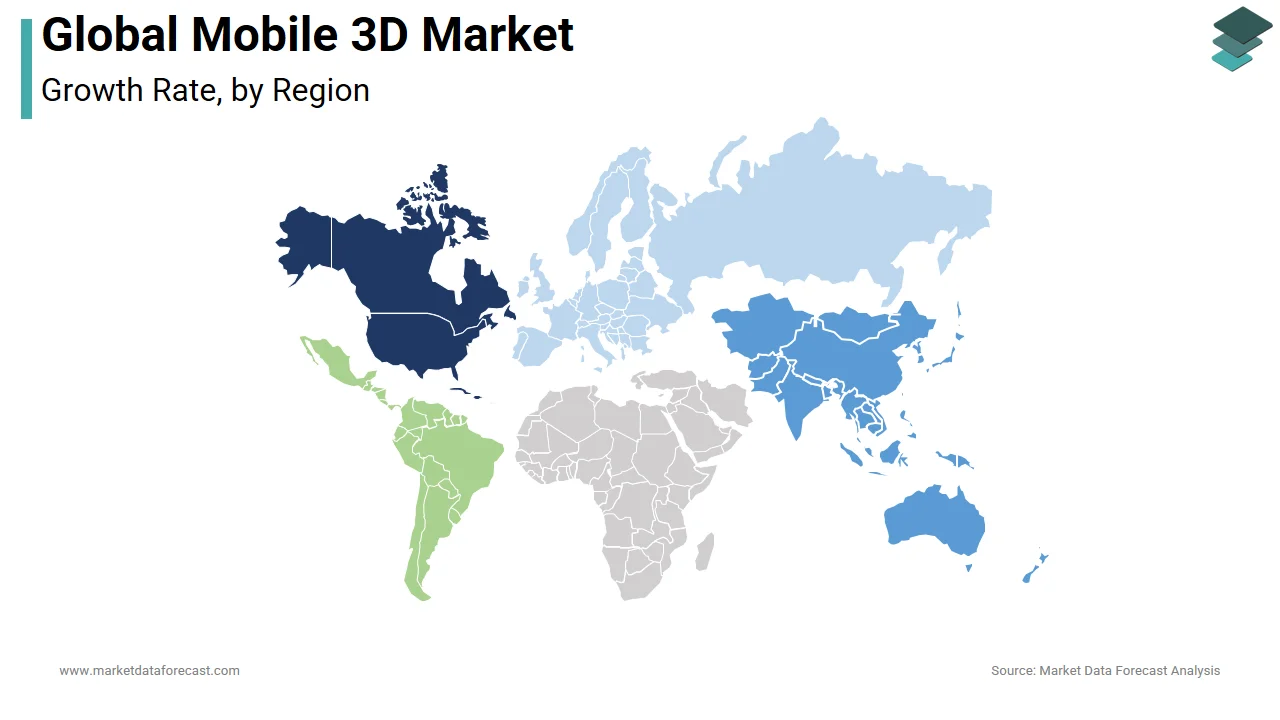
North America dominated the global Mobile 3D market and accounted for a 34.4% share in 2025. This dominance of the region in the global market was driven by early smartphone sensor adoption, mature app store ecosystems, concentrated technology hubs, and strong venture capital backing for spatial computing startups. United States market benefits from proximity to Apple and Google headquarters, enabling earliest access to new SDKs, developer tools, and hardware capabilities, creating innovation feedback loops unavailable elsewhere. According to the Bureau of Economic Analysis, comprehensive satellite account frameworks measure the long-term expansion of the domestic digital economy by tracking specialised hardware manufacturing and software infrastructure services. As per the National Science Foundation, federal research agencies issue targeted institutional grants to advance spatial computing architectures, visual datasets, and simulation methodologies across administrative and clinical environments. Canadian organisations leverage mobile 3D for natural resource surveying, indigenous cultural preservation, and bilingual education applications reflecting regional priorities. Major retailers pioneered mobile 3D product visualisation, setting global standards and consumer expectations. Mature creator economy and influencer marketing ecosystems accelerate content discovery and viral adoption. This combination of technological proximity, capital availability, and commercial maturity solidifies North America as an undisputed global leader, serving as trendsetter and proving ground for concepts subsequently adapted worldwide.
Europe Mobile 3D Market Analysis
Europe was the next prominent region in the global Mobile 3D Market and captured a 28.7% share in 2025. This position of the European market was supported by cultural heritage digitisation mandates, GDPR privacy frameworks, and EU digital transformation funding, creating unique demand drivers different from the North American entertainment and commerce focus. According to Eurostat, cross-border digital infrastructure investments within Western Europe centre primarily on regional commercial hubs to scale corporate communications architectures and technical asset management frameworks. As per the European Commission, member states scale general Recovery and Resilience Facility allocations to advance broad digital inclusion goals and modernise administrative public service technologies. According to UNESCO, official heritage monitoring frameworks deploy unified spatial recording standards to secure the structural documentation and physical preservation of protected global landmarks. GDPR compliance requirements shape application design favoring on-device processing and privacy-preserving architectures distinct from cloud-dependent North American approaches. This unique combination of public funding, regulatory alignment, and cultural mission positions Europe as a sophisticated, differentiated market emphasising societal value alongside commercial objectives.
Asia Pacific Mobile 3D Market Analysis
Asia Pacific is rapidly expanding in the global Mobile 3D Market because of manufacturing digitalisation, super app integration, and government-led smart city initiatives. China, Japan, South Korea, India, and Southeast Asian nations represent diverse submarkets with distinct characteristics yet share common momentum toward mobile 3D adoption. Chinese market grows at unprecedented scale, supported by domestic smartphone manufacturers integrating depth sensors across mid-tier devices and super apps WeChat and Alipay embedding 3D commerce and social features natively. According to the Ministry of Industry and Information Technology, China accelerates the deployment of integrated 5G-Advanced infrastructures and deepens artificial intelligence industrial applications across major regional manufacturing clusters. Japanese organisations focus on ageing society accessibility, anime IP monetisation, and disaster preparedness visualisation through mobile 3D. Indian market expands through affordable smartphone proliferation, vernacular content creation, and vocational training applications. As per the Ministry of Electronics and Information Technology, India scales its domestic mobile application development sector through targeted digital public infrastructure investments and unified digital service access expansion. Southeast Asian nations leverage mobile 3D for tourism, cultural preservation, and SME e-commerce enablement. Unlike Western markets constrained by privacy regulations, Asia Pacific organisations implement mobile 3D with fewer restrictions, enabling faster experimentation and deployment. This combination of manufacturing scale, super app integration and regulatory flexibility positions Asia Pacific as a future growth engine reshaping global geography through speed and application diversity.
Middle East and Africa Mobile 3D Market Analysis
The Middle East and Africa region is moving ahead steadfastly in the global Mobile 3D Market, due to economic diversification agendas, smart city mega projects, and leapfrog adoption bypassing legacy 2D digital infrastructure. As per the Saudi Communications, Space and Technology Commission, Gulf Cooperation Council member states expand national telecommunications investments to scale robust cloud architecture capacities and accelerate cross-sector economic diversification frameworks. According to the Communications, Space and Technology Commission, Saudi Arabia expands its digital infrastructure networks by deploying advanced 5G installations and integrated cognitive technologies across major urban development zones. According to the Telecommunications and Digital Government Regulatory Authority, the United Arab Emirates scales its federal electronic government initiatives by integrating consolidated cloud portals and AI-driven municipal public assistance platforms. South Africa serves as a regional hub for mobile 3D education, healthcare, and mining applications leveraging relatively mature smartphone penetration and mobile money infrastructure. North African nations Egypt, Morocco, and Tunisia pursue francophone and arabophone mobile 3D localisation, creating niche opportunities. Sub-Saharan markets leapfrog to mobile 3D, bypassing desktop 3D adoption entirely. Development finance institutions fund digital skills and content creation capacity building. This region’s growth centres on nation building and economic diversification, distinguishing adoption drivers from mature markets and creating unique vendor requirements around localisation, affordability and offline capability.
Latin America Mobile 3D Market Analysis
The Latin American region holds a notable share of the global Mobile 3D Market, though economic volatility acts as a restraint. However, expansion is fast-tracked by cultural content creation, fintech tools, and a heavily mobile-first internet population. As per Eurostat, international computing infrastructure spending within Latin America centres heavily on Brazil and Mexico, mirroring the relative scale of regional enterprise telecommunications investments. Brazilian organisations deploy mobile 3D extensively for e-commerce product visualisation, agricultural field documentation, and cultural heritage preservation, creating concentrated demand. According to Fundação Getulio Vargas, Brazilian corporate enterprises optimise operations by implementing cloud-managed resource planning databases and expanding customer-facing omni-channel retail technologies. Mexican companies leverage mobile 3D for nearshoring manufacturing documentation, tourism promotion, and indigenous language educational content, creating culturally specific applications. Chilean education and mining sectors drive sophisticated adoption benefiting from a stable institutional environment and university research partnerships. Colombian fintech and creator economy expansion drives mobile 3D social commerce and virtual event applications. Regional trade agreements and the Pacific Alliance digital agenda promote cross-border content sharing and interoperability. Currency fluctuations create headwinds yet also increase demand for cost-effective mobile solutions versus imported dedicated equipment. Latin American growth reflects pragmatic adaptation emphasising mobile-first inclusion and cultural relevance rather than technology push narratives, creating distinctive dynamics requiring tailored approaches around affordability, localisation, and offline functionality.
COMPETITIVE LANDSCAPE
Competition in the Mobile 3D Market exhibits intense multidimensional rivalry among smartphone manufacturers, chipset vendors, platform operators, and specialized software developers, each pursuing distinct value propositions and control points within a rapidly evolving spatial computing ecosystem. Hardware leaders leverage sensor integration and vertical stack optimization to defend positions while platform providers compete through developer tools distribution channels and cross-device compatibility, attracting application creators and content producers essential for user engagement. Competitive differentiation increasingly centers on real-time processing efficiency, privacy-preserving architectures, and open standards support rather than raw sensor specifications as baseline hardware capability achieves parity across major vendors and price segments. Ecosystem lock-in versus interoperability tensions create strategic bifurcation, with some players pursuing walled garden approaches maximizing control and margin while others champion open standards, sacrificing exclusivity for broader adoption and content availability. Geographic expansion, particularly in Asia Pacific and Europe, creates regional battlegrounds where local players challenge global incumbents through cultural localization, regulatory alignment, and government partnership strategies tailored to national digital transformation priorities. Talent acquisition wars for computer vision engineers, graphics programmers, and spatial UX designers constrain innovation velocity and increase operational costs across all competitors, limiting entry barriers and favoring well-capitalized incumbents with established R&D infrastructure. User retention emerges as a critical success factor as novelty wears off, forcing vendors to demonstrate continuous utility through practical workflows, measurable ROI, and habitual integration rather than relying on technological fascination alone for sustainable competitive advantage in this transitioning market phase.
KEY MARKET PLAYERS
The leading companies operating in the global mobile 3D market include:
- 3M
- Hitachi Ltd.
- NVIDIA Corporation
- Imagination Technologies
- Movidius
- NTT Docomo
- Intel Corporation
- Samsung Electronics
- LG Electronics Inc.
- Amobee Inc.
- MasterImage 3G
- Apple Inc.
- MicroVision Inc.
- Google LLC
- EON Reality
- Toshiba Corporation
- Qualcomm Inc.
- Sharp Corporation
- YUVsoft
TOP PLAYERS IN THE MARKET
- Apple Inc significantly influences the global Mobile 3D landscape through its integration of LiDAR sensors across iPhone Pro and iPad Pro lines, establishing a hardware baseline for consumer and professional spatial capture applications. The company strengthens its position by continuously advancing RealityKit and ARKit frameworks, enabling developers to create high-fidelity 3D experiences with optimized performance and privacy-preserving on-device processing. Recent initiatives focus on expanding USDZ format adoption and Object Capture API improvements, democratizing photogrammetric asset creation for e-commerce, cultural heritage, and education use cases without specialized equipment. Apple invests heavily in developer education, documentation, and App Store curation, ensuring quality ecosystem growth while maintaining strict privacy standards aligned with European GDPR requirements. This vertical integration of hardware, software, and distribution creates a defensible competitive advantage through seamless user experience and consistent capability across device generations, enabling sustained engagement through technological leadership rather than price competition alone, shaping industry standards for mobile spatial computing worldwide.
- Google LLC advances the Mobile 3D Market through the Android platform ARCore framework and Scene Viewer technology, enabling cross-device 3D visualization and augmented reality experiences across the fragmented Android ecosystem serving billions of users globally. The company recently enhanced Geospatial API and Depth API capabilities, improving outdoor AR accuracy and real-world occlusion for navigation, tourism, and retail applications at planetary scale. Google focuses on open standards promotion, including glTF and USD support, reducing vendor lock-in and enabling interoperable asset exchange across platforms and applications. Strategic partnerships with Samsung, Qualcomm, and chipset manufacturers ensure ARCore optimization across diverse hardware configurations, addressing fragmentation challenges unique to the Android ecosystem. By positioning 3D as an integral component of Search, Maps, and Shopping experiences, Google embeds spatial computing into daily utility workflows rather than standalone applications, creating habitual usage patterns. This platform-level integration combined with open standards advocacy ensures sustained relevance through enabling broad ecosystem participation rather than controlling end-to-end experience, distinguishing Google’s approach from vertically integrated competitors while driving mass market 3D adoption across diverse geographic and economic segments.
- Qualcomm Technologies Inc contributes substantially to the global Mobile 3D ecosystem through Snapdragon platform integration of dedicated AI accelerators, GPU architectures, and sensor fusion engines enabling real-time 3D processing, computer vision, and neural rendering on mobile devices without cloud dependency. The company recently strengthened its market position by launching the Snapdragon Spaces XR Platform, providing a unified development framework for cross-device 3D and AR applications with optimized power efficiency and thermal management. Qualcomm emphasizes reference design partnerships with OEMs, ensuring consistent 3D capability across price tiers from flagship to mid-range devices, expanding the addressable market beyond premium segments. Recent enhancements focus on neural processing unit acceleration for on-device mesh reconstruction and semantic understanding, reducing latency and battery consumption versus CPU- or GPU-only approaches. By enabling silicon-level 3D optimization, Qualcomm creates foundational infrastructure that application developers and device manufacturers depend upon for viable mobile spatial computing experiences. This upstream positioning ensures sustained influence through enabling the entire ecosystem rather than competing at the application or device level, shaping performance, power, and capability trajectories for mobile 3D across global markets independent of individual brand success or failure.
TOP STRATEGIES USED BY KEY MARKET PARTICIPANTS
Key players in the Mobile 3D Market prioritize hardware sensor integration and software framework development as dual strategic imperatives, embedding depth sensing LiDAR and neural processing capabilities directly into mobile chipsets while providing robust developer tools, SDKs, and APIs that reduce creation friction and enable consistent experiences across device generations. Vendors aggressively pursue open standards adoption, including USD glTF and OpenXR, to reduce ecosystem fragmentation, enable asset interoperability, and prevent vendor lock-in concerns that historically limited 3D content reuse and long-term archival viability across platforms and applications. Strategic partnerships with e-commerce platforms, social media networks, and cultural institutions create immediate distribution channels and use case validation, demonstrating practical utility beyond gaming entertainment to drive mainstream adoption among non-technical users and enterprise buyers. Privacy-preserving on-device processing architectures address European GDPR and global regulatory concerns by minimizing data transmission and enabling local computation, creating competitive differentiation against cloud-dependent alternatives requiring personal data transfer. Developer ecosystem cultivation through documentation, tutorials, certification programs, and revenue-sharing incentives attracts content creators and application builders whose output drives user engagement and platform value creation in self-reinforcing network effects. Vertical industry specialization for construction, retail, education, and healthcare creates domain-specific workflows and ROI justification, transforming mobile 3D from novelty to an essential productivity tool, ensuring sustained demand independent of consumer discretionary spending cycles. These interconnected strategies collectively shape competitive dynamics, defining success factors in the contemporary Mobile 3D landscape where sustainable advantage requires balancing technological capability, ecosystem openness, regulatory compliance, and commercial viability simultaneously across diverse stakeholder expectations worldwide.
MARKET SEGMENTATION
This research report on the global mobile 3D market has been segmented and sub-segmented based on type, application and region.
By Type
- 3D-Enabled Smartphones
- 3D-Enabled Tablets
- 3D-Enabled Notebooks
- Others
By Application
- Gaming
- Advertisements
- Projections
- Others
By Region
- North America
- Europe
- Asia-Pacific
- Latin America
- Middle East and Africa