- Product Description Description
- Table of Contents TOC
- List of Table & Figure LOT
- Get Free Sample PDF Sample PDF
Market Size, 2025
$3.11 BnMarket Estimate, 2026
$3.66 BnMarket Forecast, 2034
$13.48 BnCAGR, 2026–2034
17.70%Global Mobile Ticketing Market Size, Growth, Trends & Forecast (2026–2034)
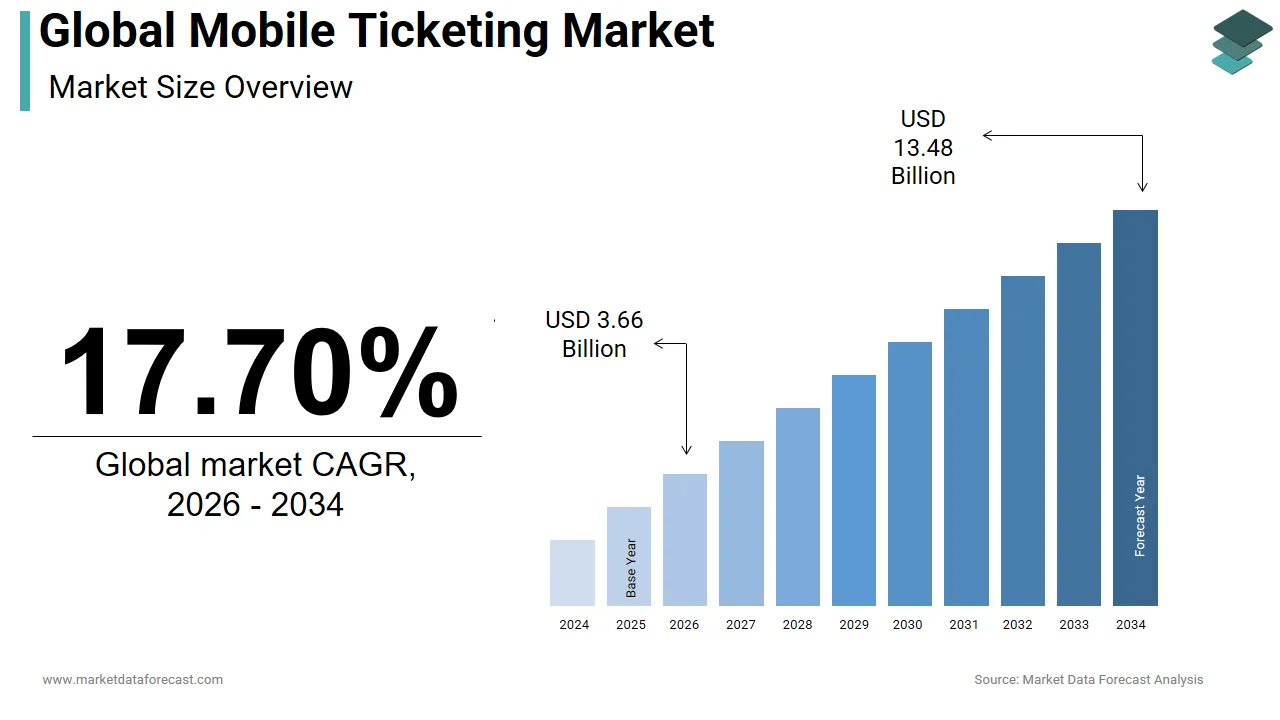
The global mobile ticketing market size was valued at USD 3.11 billion in 2025, is predicted to reach USD 3.66 billion in 2026, and is projected to scale up to USD 13.48 billion by 2034, registering a compound annual growth rate (CAGR) of 17.70% during the forecast period from 2026 to 2034. Propelled by surging smartphone adoption, widespread shift toward cashless and digital payment ecosystems, and the convenience of reserving sports, entertainment, and travel tickets on-the-go, the market continues to experience robust structural expansion worldwide.
Key Executive Metrics (At-a-Glance)
- 2025 Base Valuation: USD 3.11 Billion
- 2026 Current Valuation: USD 3.66 Billion
- 2034 Forecast Valuation: USD 13.48 Billion
- Compound Annual Growth Rate (CAGR): 17.70% (2026–2034)
- Dominant Type Segment: Mobile Applications (offering secure interfaces, rich data, and direct online banking integration)
- Dominant Technology Segment: 2D Barcodes and QR Codes (preferred for fast, cost-effective scanning at venues and transport turnstiles)
- Dominant Regional Market: North America (leading baseline adoption driven by heavy digital entertainment and travel booking apps)
- Fastest-Growing Regional Market: South Asia and Pacific / Asia-Pacific (propelled by accelerated urbanization, massive transit investments, and rising smartphone penetration)
Core Market Drivers
- Smartphone & Internet Penetration: Plummeting hardware costs and widespread mobile connectivity have accelerated consumer transition from feature phones to smart devices.
- Urbanization & Busy Lifestyles: Growing urban populations look for instant, queue-free reservation mechanisms for public transport, movies, and events.
- Cashless Economy Initiatives: Government backing for digital wallets and connected bank transactions reduces friction and administrative overhead.
Primary Market Restraints & Challenges
- Connectivity Barriers: Unreliable or absent internet connectivity in developing or rural regions limits broader consumer reach for mobile ticketing vendors.
- Complex Registration Processes: Intricate data input and privacy concerns regarding personal information can deter casual users.
Global Mobile Ticketing Market Segmentation Breakdown
| Segment Category | Leading Sub-Segment | Growth Dynamics |
|---|---|---|
| By Type | Mobile Applications (primary revenue driver for rich user interfaces) | SMS Ticketing remains an alternative text-based channel for basic transactions. |
| By Technology | 2D Bar Code (widely deployed due to universal display and low infrastructure hurdles) | OCR and NFC are expanding rapidly in high-throughput transit and secure access checkouts. |
| By Application | Travel & Entertainment Tickets (led by soaring sports, movie, and flight reservations) | Hotels Booking and tourism services capture rising consumer preference for all-in-one mobile itineraries. |
| By Region | North America (market leader in historical share and digital entertainment booking) | South Asia & Pacific (APAC) poised to post the highest growth rates during the forecast window. |
Major Industry Players Profiled
Key enterprises shaping the global mobile ticketing market include Rapidsoft Systems, Inc., Digital Management, Inc., AEP Ticketing Solutions Srl, Moovel Group GmbH, Masabi Ltd, Scheidt & Bachmann GmbH, Gemalto NV, inmodo AB, ShowClix Inc., and Margento BV.
Global Mobile Ticketing Market Size
The global mobile ticketing market was worth USD 3.11 billion in 2025. The global market is predicted to reach USD 3.66 billion in 2026 and USD 13.48 billion by 2034, growing at a CAGR of 17.70% from 2026 to 2034.
The global Mobile Ticketing market is growing with the increasing demand for mobile sports, entertainment, and tourism tickets. Mobile ticketing is a process that allows you to reserve tickets for any transportation, event, or entertainment show through your mobile device without using paper. Tickets are purchased through SMS messages and traditional methods such as apps and phones or provider websites. Mobile ticketing is preferred over paper ticketing because it reduces production and distribution costs and increases customer convenience. You can easily buy tickets with mobile ticketing. Mobile tickets can be obtained through secure mobile applications, text messages, voice calls, online pages, and WAP. This increases the likelihood that consumers will spend on mobile ticketing applications for a variety of purposes, such as airline tickets, bus tickets, and movie tickets, increasing the potential revenue from mobile ticketing applications.
MARKET DRIVERS
Mobile ticketing apps can be easily installed and operated from a smartphone. Also, the widespread use of smartphones has profoundly impacted the growth of the global mobile ticketing market.
This trend will continue throughout the forecast years as it provides ease of use, details, and up-to-date information. It eliminates commuting to the box office due to a busy lifestyle without queues. Additionally, the companies are expected to gradually work with the large ticket sellers to develop an online portal for customers to log in anytime, anywhere, to book tickets online conveniently. These factors are expressly driving the global demand for mobile ticketing. Increased urbanization in developed and developing countries has complemented market growth. The adoption of Mobile Ticketing has increased because the itinerary of people who do not have time to travel to the ticket offices is constantly busy. Additionally, increasing urbanization has resulted in numerous companies offering online portals for booking tickets via the Internet to transform operations digitally. This, in turn, is supposed to accelerate the growth of the global Mobile Ticketing market during the foreseen period. Several companies have recognized the provision of online portals to book movie or hotel tickets over the Internet to transform their operations digitally. Due to their busy lifestyles, people do not have enough time to physically travel to specific locations to book tickets for planes, buses, trains, movies, or other recreational or entertainment activities. Market demand for mobile tickets is estimated to increase over the anticipated years as customers' propensity to use technology to conveniently obtain, confirm, and purchase tickets increases. Additionally, lower distribution and production costs compared to traditional paper ticketing channels will further accelerate market growth over the expected period. With the increase in internet penetration, the adoption of smartphones has increased around the world.
Also, the presence of various smartphone manufacturers around the world has caused a significant drop in smartphone prices in the recent past. Consequently, consumers have switched from feature phones to smartphones. Mobile ticketing applications can be easily installed and operated from a smartphone, enhancing the ticket-buying experience. The mobile ticketing application uses online transactions through the user's respective connected bank. This allows users to pay without charging at a bank or ATM. This payment method is rapidly gaining attention and is supported by the governments of several countries to support a cashless economy. Therefore, promoting the ticketing app is expected to provide significant business opportunities for ticket sellers during the forecast period. Sports and concert organizers can use mobile ticketing apps to provide convenient and sophisticated ticket reservations to increase revenue from ticket sales. This organizer can provide a profitable offer to consumers when booking tickets, allowing them to book tickets anywhere. It also reduces the time required for reservations, paperwork, and human errors and improves accessibility. Therefore, adopting mobile ticketing applications will likely create significant growth opportunities soon.
MARKET RESTRAINTS
Mobile ticketing systems require a smooth and uninterrupted internet connection to complete the entire reservation process. However, in many regions, especially emerging economies, Internet connectivity is relatively poor or non-existent in some areas. Because of this, ticket sellers in the region do not have access to a significant consumer base, which is supposed to limit the global mobile ticketing market during the outlook period. High upfront costs can limit the development of the market. In addition, the number of cashless transactions has increased. Another major factor hampering market growth is the low public perception of the benefits of ticketing apps. Additionally, the process of registering and providing personal information to reserve tickets is complex and time-consuming. This, in turn, is foreseen to challenge the global mobile ticketing market during the conjecture period.
REPORT COVERAGE
| REPORT METRIC | DETAILS |
| Market Size Available | 2025 to 2034 |
| Base Year | 2025 |
| Forecast Period | 2026 to 2034 |
| CAGR | 17.70% |
| Segments Covered | By Type, Technology, Application, and Region. |
|
Various Analyses Covered | Global, Regional, & Country Level Analysis, Segment-Level Analysis, DROC, PESTLE Analysis, Porter’s Five Forces Analysis, Competitive Landscape, Analyst Overview on Investment Opportunities |
| Regions Covered | North America, Europe, APAC, Latin America, Middle East & Africa |
|
Market Leaders Profiled | Rapidsoft Systems, Inc., Digital Management, Inc., AEP Ticketing Solutions Srl, Moovel Group GmbH, Masabi Ltd, Scheidt & Bachmann GmbH, Gemalto NV, inmodo AB, ShowClix Inc. and Margento BV and Others. |
REGIONAL ANALYSIS
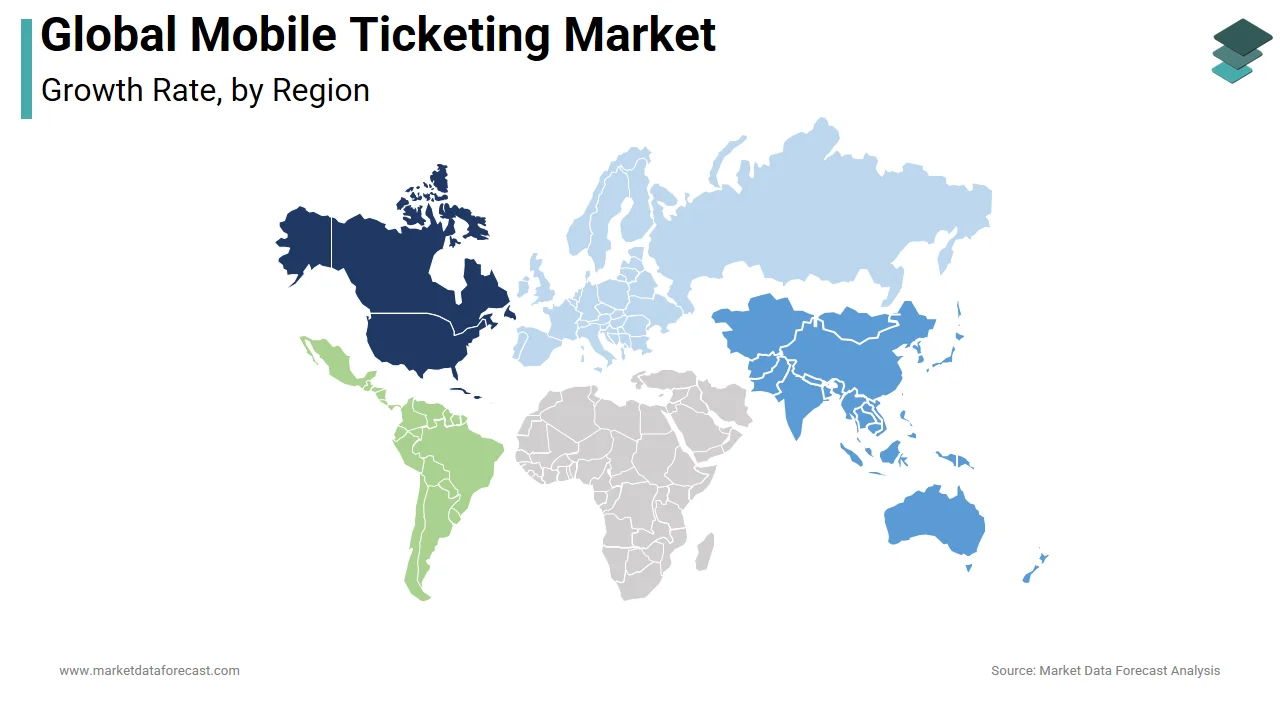
North America led the global mobile ticketing market share in 2020. The widespread use of mobile end-user ticketing applications to book entertainment tickets such as movies and concerts, book flights, and other transportation facilities is a significant factor boosting the growth of mobile ticketing applications in this area. The South Asia and Pacific markets are foreseen to post the highest growth rates during the projection period. Asian countries have witnessed rapid urbanization and high spending on public transport systems in recent years, resulting in an increasing number of consumers looking to use mobile ticketing applications for travel and entertainment.
KEY MARKET PARTICIPANTS
The key companies operating in the global mobile ticketing market include Rapidsoft Systems, Inc., Digital Management, Inc., AEP Ticketing Solutions Srl, Moovel Group GmbH, Masabi Ltd, Scheidt & Bachmann GmbH, Gemalto NV, Edmodo AB, ShowClix Inc., and Magento BV.
RECENT MARKET HAPPENINGS
-
Israel launched its nationwide ticketing mobile app in 2020. Moovit and Pango provide this app as a mobility as a service. These companies have partnered to use public transportation.
MARKET SEGMENTATION
This research report on the global mobile ticketing market has been segmented and sub-segmented based on the type, technology, application, and region.
By Type
-
Mobile Applications
-
SMS Ticketing
By Technology
-
2D Bar Code
-
OCR and NFC
By Application
-
Entertainment Tickets
-
Hotels Booking
-
Travel Tickets
By Region
-
North America
-
The United States
-
Canada
-
Rest of North America
-
-
Europe
-
The United Kingdom
-
Spain
-
Germany
-
Italy
-
France
-
Rest of Europe
-
-
The Asia Pacific
-
India
-
Japan
-
China
-
Australia
-
Singapore
-
Malaysia
-
South Korea
-
New Zealand
-
Southeast Asia
-
-
Latin America
-
Brazil
-
Argentina
-
Mexico
-
Rest of LATAM
-
-
The Middle East and Africa
-
Saudi Arabia
-
UAE
-
Lebanon
-
Jordan
-
Cyprus
-