- Product Description Description
- Table of Contents TOC
- List of Table & Figure LOT
- Get Free Sample PDF Sample PDF
Market Size, 2025
$8.95 BnMarket Estimate, 2026
$9.60 BnMarket Forecast, 2034
$16.76 BnCAGR, 2026–2034
7.22%Global Molecular Spectroscopy Market Size
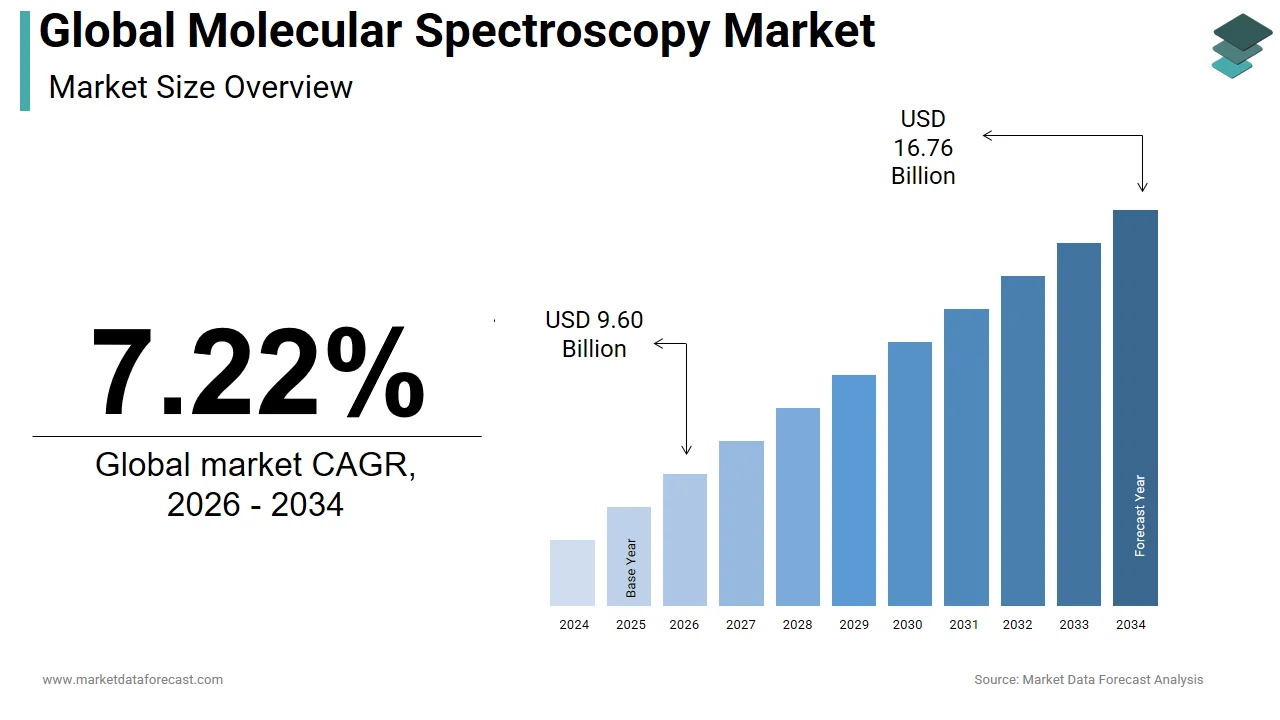
The size of the global molecular spectroscopy market was worth USD 8.95 billion in 2025. The global market is anticipated to grow at a CAGR of 7.22% from 2026 to 2034, reaching USD 16.76 billion by 2034, up from USD 9.60 billion in 2026.
Molecular spectroscopy is a branch of quantum physics that deals with the interaction of electromagnetic radiation with materials to produce a spectrum, which can be used to deduce structural or compositional information. Infrared (IR) spectroscopy uses stimulation of molecular movement or vibration, while ultraviolet/visible spectroscopy uses the excitation of an electron in a higher orbital. Spectroscopy is one of the most advanced and well-known analytical techniques, with applications ranging from healthcare to industry. The measurement of the interaction between radiated energy emitted by certain substances is called spectroscopy.
MARKET DRIVERS
The rising use of hybrid imaging technologies such as PET/CT, ongoing development and innovation in molecular spectroscopy technologies and growing population are the primary growth drivers of the molecular Spectroscopy market.
Food safety concerns, the pharmaceutical and biotechnology industries' growth, technological advancements in molecular spectroscopy, and the use of molecular spectroscopy in environmental screening are a few factors promoting the development of the global molecular spectroscopy market. Near-infrared spectroscopy is one of the molecular spectroscopy types used in the R&D of pharmaceuticals and other biotechnology products. It is one of the molecular spectroscopy types utilized in R&D. NIR spectroscopy has acquired widespread acceptance in the pharmaceutical sector in recent years as a result of its significant benefits over other analytical techniques, such as ease of sample preparation and the ability to predict chemical and physical sample properties from a single spectrum. As a result, there has been a lot of talk about how people are becoming more interested in this technology, which might help the market grow.
Rapid improvements in the healthcare and life sciences industries have a more significant impact on the growth rate of the global molecular spectroscopy market. It's being used to investigate structural activity relationships and improve reaction conditions and other parameters like polymorph and formulation screening, all of which contribute to the scaling up needed to get therapeutic compounds from discovery to development. As a result, the market is expected to rise substantially during the forecast period. Furthermore, during the forecast period, the rise in new product releases and partnerships and growing new markets would give advantageous opportunities for the growth of the global molecular spectroscopy market. In addition, medical tourism is on the rise, and pharmaceutical companies emphasize discovering new compounds, which leads to more profitable growth opportunities.
MARKET RESTRAINTS
The high cost of equipment and higher research & development expenditures is projected to limit market expansion during the forecast period. Furthermore, due to a significant shortage of skilled personnel for method development, operation, validation, and troubleshooting activities, Unfavorable economic conditions and political instability may cause a drop in product sales and demand, affecting the molecular spectroscopy market's optimum growth potential in the coming years. On the other hand, the influence of the COVID-19 pandemic on the supply chain and an unfavorable reimbursement scenario will act as a restraint on the market's growth rate from 2026 to 2034.
REPORT COVERAGE
| REPORT METRIC | DETAILS |
| Market Size Available | 2025 to 2034 |
| Base Year | 2025 |
| Forecast Period | 2026 to 2034 |
| Segments Covered | By Technology, Application, and Region. |
| Various Analyses Covered | Global, Regional, and Country-Level Analysis, Segment-Level Analysis, Drivers, Restraints, Opportunities, Challenges; PESTLE Analysis; Porter’s Five Forces Analysis, Competitive Landscape, Analyst Overview of Investment Opportunities |
| Regions Covered | North America, Europe, Asia Pacific, Latin America, Middle East & Africa |
| Market Leaders Profiled | Thermo Fisher Scientific, Inc., Merck KGaA, PerkinElmer Inc., ABB, Agilent Technologies, Inc., Bruker, Horiba, Ltd, Shimadzu Corporation, JEOL Ltd, JASCO, and Others. |
SEGMENTAL ANALYSIS
By Technology Insights
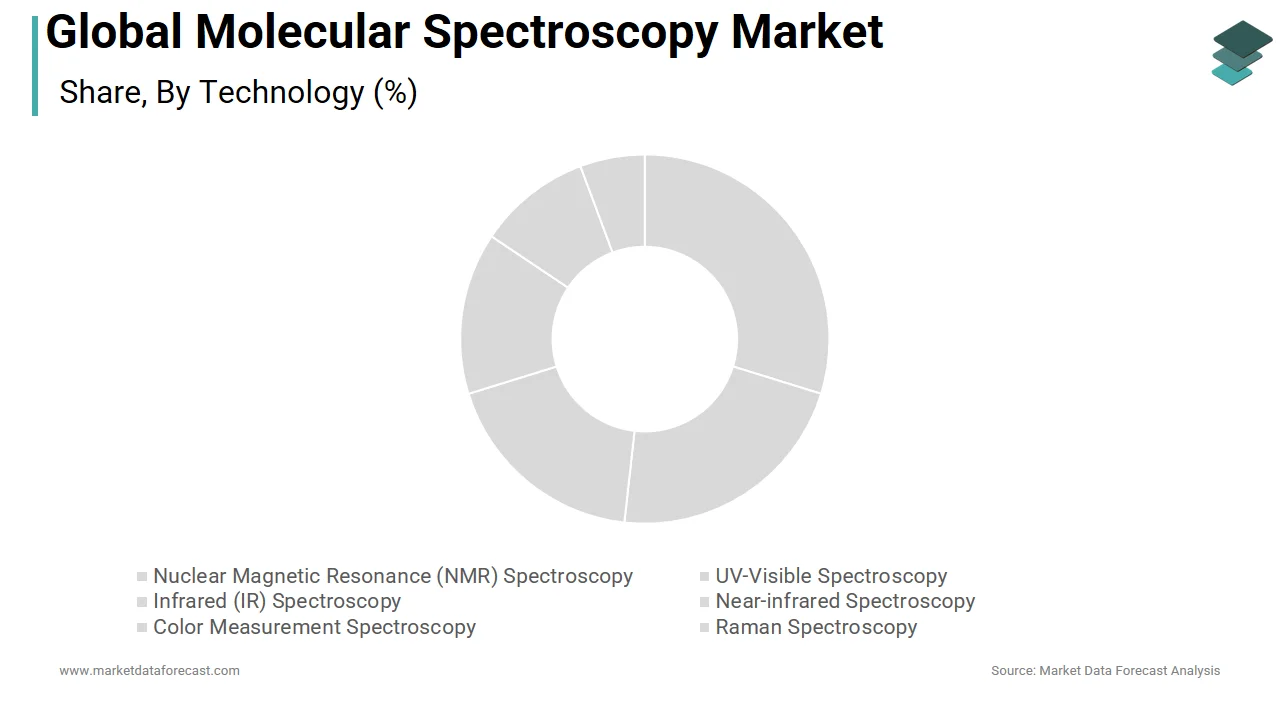
Over the forecast period, the NMR Spectroscopy segment is expected to grow at a healthy rate. In quality control and research, nuclear magnetic resonance (NMR) spectroscopy is an analytical chemistry technique for assessing the quantity and purity of a sample and its molecular structure. NMR spectroscopy has the advantage of requiring minimal sample preparation and being a non-destructive technology that preserves the molecules being studied.
By Application Insights
The pharmaceutical application is predicted to expand at the fastest CAGR throughout the forecast period. The rising importance of molecular spectroscopy in various stages of drug discovery and increased R&D in pharmaceutical firms are driving this expansion.
REGIONAL ANALYSIS
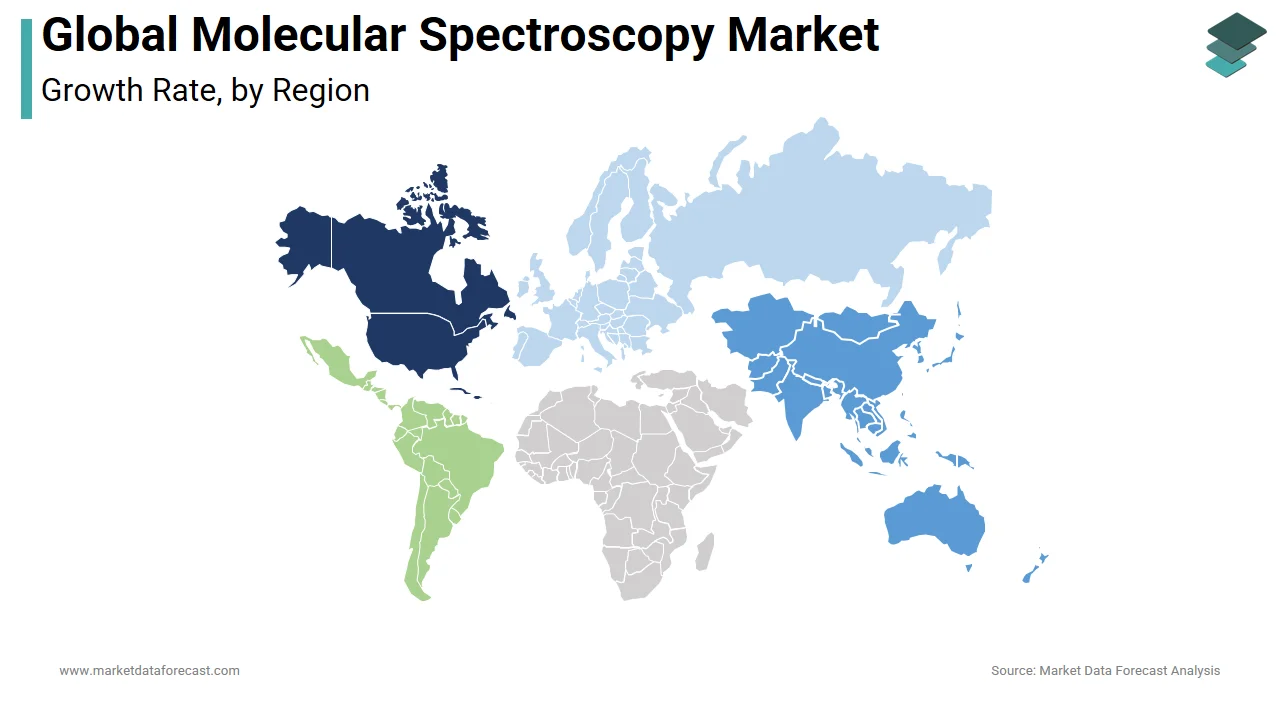
Due to the increased use of molecular spectroscopy in the pharmaceutical industry, more significant financing for environmental testing, rising worries about food safety, and favorable government efforts and legislation, North America is expected to be leading the global market. In addition, the United States boasts the world's most supportive domestic environment for pharmaceutical research, development, and commercialization, with few market restrictions. As a result, spectroscopy in drug discovery and development in the United States is projected to increase in the coming years. Many pharmaceutical companies are present in Canada, and they continue to play an important role.
The regional market for molecular spectroscopy in Europe, which includes Germany, Spain, France, and the United Kingdom, is experiencing incremental development, making Europe the second-largest market worldwide. The growing presence of global leaders and significant pharmacy companies in the region will continue to drive the expansion of the European markets.
As the market set up in growing countries such as China and India opens new windows of opportunity, Asia Pacific is also producing new opportunities for stakeholders. The region's need for a wide range of molecular spectroscopy equipment is projected to stay high. Accelerating medical-related research and development efforts in Japan could also be a strong growth driver.
KEY MARKET PLAYERS
Some of the companies that are playing a dominating role in the global silicon carbide market include
- Thermo Fisher Scientific, Inc.
- Merck KGaA
- PerkinElmer Inc.
- ABB
- Agilent Technologies, Inc.
- Bruker
- Horiba, Ltd
- Shimadzu Corporation
- JEOL Ltd
- JASCO
GLOBAL MOLECULAR SPECTROSCOPY MARKET NEWS
- The high-performance Fourier 80 system, a next-generation, 80 MHz Fourier Transform Nuclear Magnetic Resonance (FT-NMR) benchtop spectrometer with numerous new features, was launched in Europe by Bruker Corporation in 2020.
- Bruker, a numerics partner for advanced metabolomics-based diagnostic procedures, will be a partner in 2021.
- JASCO Corporation (Tokyo, Japan) is pleased to announce the launch of an entirely new line of fluorescence spectrophotometers in 2021.
MARKET SEGMENTATION
This research report on the global molecular spectroscopy market has been segmented and sub-segmented based on technology, application & region.
By Technology
- Nuclear Magnetic Resonance (NMR) Spectroscopy
- UV-Visible Spectroscopy
- Infrared (IR) Spectroscopy
- Near-infrared Spectroscopy
- Color Measurement Spectroscopy
- Raman Spectroscopy
By Application
- Pharmaceutical Applications
- Biotechnology & Biopharmaceutical Applications
- Food & Beverage Testing
- Environment Testing
- Academic Research
By Region
- North America
- Europe
- Asia-Pacific
- Latin America
- Middle East and Africa.