- Product Description Description
- Table of Contents TOC
- List of Table & Figure LOT
- Get Free Sample PDF Sample PDF
Market Size, 2025
$20.14 BnMarket Estimate, 2026
$22.52 BnMarket Forecast, 2034
$54.96 BnCAGR, 2026–2034
11.8%Executive Summary: Global Mountain and Ski Resorts Market
- Market Scope: Comprehensive global mountain and ski resorts market analysis covering service sectors, visitor demographics, regional leadership frameworks, climate resilience technologies, and experiential travel standards across major worldwide economies.
- Market Valuation: Valued at USD 20.14 billion (2025), estimated at USD 22.52 billion (2026), and projected to reach USD 54.96 billion by 2034, registering a robust CAGR of 11.80% (2026–2034).
- Primary Growth Drivers: Rising global participation in winter sports, strategic expansion of year-round mountain tourism beyond winter seasons, and increasing demand for premium experiential travel. Key technological and strategic trends include integration of advanced snowmaking and climate resilience technologies, diversification into wellness and adventure tourism, and adoption of digital tools for seamless guest experiences and operational efficiency.
Key Market Segment Metrics (2026–2034)
| Category | Leading Segment (2025 Position) | Fastest-Growing Segment |
|---|---|---|
| By Service & Offering | Skiing and snowboarding service segment (dominated with a 64.5% share) | Àprès-ski and nightlife segment (expected to grow at the fastest CAGR of 11.3%) |
| By Visitor & Demographic | Families visitor segment (held largest share at 35.2%); 26 to 35 age group (led spending with 31.5%) | Adventure seekers segment (highest CAGR of 9.6%) and above-55 demographic (CAGR of 8.7%) |
| By Technology & Season | Traditional winter alpine skiing and snowboarding lift operations | Advanced snowmaking/climate resilience tech, year-round mountain wellness, and digital pass apps |
| By Region | Europe (dominated the market with a 42.5% share in 2025, followed by North America) | Asia-Pacific (identified as a high-growth region fueled by cross-border pass integrations) |
Major Market Players & Market Structure
Market Structure: Highly competitive global mountain resort industry characterized by strategic international partnerships (such as Vail Resorts’ Niseko United alliance and Epic Promise sustainability initiatives), pass expansions (Alterra’s Ikon Pass), and multi-season adventure offerings.
Key Companies: Vail Resorts, Inc., Aspen Skiing Company, Jackson Hole Mountain Resort, Whistler Blackcomb Holdings Inc., The Alps Company, Intrawest Resorts Holdings, Inc., Boyne Resorts, The EoA Group, Alterra Mountain Company, Swiss Alpine Adventure, Les Trois Vallées, Taos Ski Valley, Inc., Sun Valley Resort, Telluride Ski & Golf, The Canyons Resort, Snowbird Ski and Summer Resort, Mammoth Mountain Ski Area, and Stowe Mountain Resort.
Global Mountain and Ski Resorts Market Size
The size of the global mountain and ski resorts market was worth USD 20.14 billion in 2025. The global market is anticipated to grow at a CAGR of 11.8% from 2026 to 2034 and be worth USD 54.96 billion by 2034 from USD 22.52 billion in 2026.
Mountain and Ski Resorts refer to the high-altitude recreational destinations designed to facilitate alpine sports, winter tourism, and year-round mountain-based leisure activities. These resorts operate within geographically constrained environments, typically above 1,200 meters, where natural or artificial snow supports skiing, snowboarding, and related winter pursuits. Beyond winter sports, modern mountain resorts have evolved into multifaceted tourism hubs offering hiking, mountain biking, wellness retreats, and luxury hospitality, transforming seasonal destinations into year-round economic engines. The operational viability of these resorts is intrinsically tied to climatic conditions, topography, and infrastructure such as cable cars, snowmaking systems, and ski lifts.
As of 2023, over 13,000 ski lifts are operational across several countries, serving an estimated 400 million skier visits annually. In the European Alps alone, ski resorts rely on elevation above 1,500 meters to ensure snow reliability during peak season. Additionally, many of the major ski destinations are located within or adjacent to protected mountain ecosystems, necessitating sustainable development practices. The integration of digital ticketing, smart lift systems, and climate-resilient infrastructure has redefined the guest experience, positioning mountain resorts at the intersection of adventure tourism, environmental stewardship, and technological innovation.
MARKET DRIVERS
Rising Global Participation in Winter Sports and Recreational Skiing
The increasing global engagement in winter sports, particularly skiing and snowboarding, is a primary catalyst for the expansion of mountain and ski resorts. Hundreds of millions of people participated in alpine skiing worldwide in 2023, with organized ski tourism contributing to more than 750 million skier days annually. In Japan, domestic ski visits rose in recent seasons, driven by improved accessibility and youth outreach programs. Similarly, in the United States, ski resort visits increased between 2021 and 2023, with Colorado alone welcoming millions of skier visits in a single season. The sport’s appeal extends beyond traditional markets; China has seen a rapid increase in alpine skiing participation since 2015, spurred by the Beijing 2022 Winter Olympics and government-backed ski school initiatives. In China, millions of citizens now engage in winter sports, prompting the development of ski facilities across Heilongjiang and Xinjiang provinces. Additionally, resorts are investing in beginner-friendly infrastructure, such as magic carpets and adaptive skiing programs, to broaden demographic reach. This growing base of enthusiasts directly fuels demand for upgraded facilities, expanded terrain, and enhanced guest services.
Expansion of Year-Round Mountain Tourism Beyond Winter Seasons
The strategic diversification into year-round tourism, reducing dependency on winter snowfall, is a pivotal factor driving the growth of mountain and ski resorts. Resorts are increasingly leveraging their natural landscapes and infrastructure to attract visitors during spring, summer, and autumn months. In the Swiss Alps, the Swiss Tourism Federation points out that much of cable car usage now occurs outside the winter season, supporting activities such as alpine hiking, mountain biking, and paragliding. Resorts are also integrating wellness tourism, with luxury spas and yoga retreats becoming standard offerings. This shift toward multi-seasonal operations enhances revenue stability and justifies investment in sustainable infrastructure, making resorts more resilient to climate variability.
MARKET RESTRAINTS
Declining Natural Snow Reliability Due to Climate Change
The diminishing reliability of natural snowfall caused by rising global temperatures is one of the most pressing constraints facing mountain and ski resorts. The Intergovernmental Panel on Climate Change indicates that the European Alps have warmed by 2°C since the late 19th century, nearly double the global average, leading to shorter snow seasons and reduced snowpack. The Swiss Federal Institute for Forest, Snow and Landscape Research reports that snow cover duration in low-altitude resorts (below 1,500 meters) has decreased by 38 days on average since 1970. In Austria, the Institute for Interdisciplinary Mountain Research confirms that 43% of ski resorts now operate with less than 100 days of natural snow cover annually, forcing increased reliance on artificial snowmaking. However, snowmaking is energy- and water-intensive; producing one hectare of ski slope coverage requires up to 4,000 cubic meters of water. In the western United States, snow water equivalent in the Sierra Nevada declined between 1955 and 2022, directly impacting resorts like Mammoth Mountain. These climatic shifts threaten the economic foundation of lower-elevation resorts, many of which lack the financial capacity to invest in extensive snowmaking or relocation.
High Capital Intensity and Infrastructure Maintenance Costs
The development and maintenance of mountain resort infrastructure entail substantial financial investment, posing a significant barrier to entry and operational sustainability. Constructing a single eight-passenger gondola lift can exceed $15 million, while high-capacity snowmaking systems cost upwards of $5 million per square kilometer, as per the International Association of Ski Area Operators. Environmental regulations further escalate costs. In North America, the U.S. Forest Service requires ski resorts on public land to pay special use fees and invest in habitat restoration, adding operational burdens. Smaller resorts, particularly in Eastern Europe and the Andes, often lack access to capital for modernization. These financial pressures limit innovation, restrict expansion, and exacerbate vulnerability to economic downturns and climate risks.
MARKET OPPORTUNITIES
Integration of Advanced Snowmaking and Climate Resilience Technologies
The adoption of next-generation snowmaking systems presents a transformative opportunity for mountain and ski resorts to mitigate climate risks and extend operational seasons. Modern snow guns, such as low-energy fan guns and nucleating systems, can produce snow at higher temperatures and with less water and energy than traditional models. The European Investment Bank has financed climate-resilient infrastructure since 2020. Additionally, resorts are deploying AI-driven snow management platforms; Whistler Blackcomb uses predictive analytics to optimize snow distribution based on weather forecasts and skier traffic patterns, improving efficiency. These technological advancements not only enhance snow reliability but also improve environmental accountability, enabling resorts to maintain operations despite warming trends.
Growth of Premium and Experiential Tourism in High-Altitude Destinations
The rising demand for immersive, high-value mountain experiences is creating new revenue streams for resorts beyond traditional lift tickets and rentals. Affluent travelers are increasingly seeking curated alpine experiences, including heli-skiing, guided backcountry tours, luxury chalet stays, and wellness-focused retreats. Resorts are responding with bespoke services. Additionally, digital nomadism has influenced resort development; Verbier launched co-working spaces with mountain views to attract remote professionals. This shift toward premiumization allows resorts to diversify income, reduce volume dependency, and build brand loyalty in an increasingly competitive global tourism landscape.
MARKET CHALLENGES
Environmental and Ecological Pressures from Resort Expansion
The expansion of mountain and ski resorts often conflicts with fragile alpine ecosystems, triggering regulatory pushback and public opposition. In North America, the U.S. Fish and Wildlife Service has challenged lift construction in the Greater Yellowstone Ecosystem due to grizzly bear migration corridors. Additionally, deforestation for ski runs and infrastructure contributes to soil erosion and reduced carbon sequestration. Water extraction for snowmaking further strains alpine aquifers. These ecological concerns have led to legal challenges and project cancellations, such as the 2022 rejection of the Kitzbühel expansion in Austria. Resorts must now balance economic growth with biodiversity conservation, requiring costly environmental impact assessments and mitigation strategies that delay development and increase compliance risks.
Seasonal Labor Shortages and Workforce Sustainability in Remote Locations
Mountain and ski resorts face persistent challenges in recruiting and retaining skilled labor due to their remote locations, seasonal operations, and demanding working conditions. In Japan, the Hokkaido Prefectural Government reports a decline in residents working at ski resorts over the past decade, replaced by temporary foreign workers under the Specified Skilled Worker visa program. However, language barriers and visa limitations constrain scalability. Additionally, younger workers are increasingly reluctant to commit to seasonal, physically intensive roles. This labor instability disrupts operations, increases training costs, and compromises guest service quality, threatening the long-term operational viability of resorts dependent on human capital.
REPORT COVERAGE
| REPORT METRIC | DETAILS |
| Market Size Available | 2025 to 2034 |
| Base Year | 2025 |
| Forecast Period | 2026 to 2034 |
| CAGR | 11.8% |
| Segments Covered | By Service, Visitor, Age Group, and Region. |
|
Various Analyses Covered | Global, Regional & Country Level Analysis, Segment-Level Analysis, DROC, PESTLE Analysis, Porter’s Five Forces Analysis, Competitive Landscape, Analyst Overview of Investment Opportunities |
| Regions Covered | North America, Europe, APAC, Latin America, Middle East & Africa |
|
Market Leaders Profiled | Vail Resorts, Inc., Aspen Skiing Company, Jackson Hole Mountain Resort, Whistler Blackcomb Holdings Inc., The Alps Company, Intrawest Resorts Holdings, Inc., Boyne Resorts, The EoA Group, Alterra Mountain Company, Swiss Alpine Adventure, Les Trois Vallées, Taos Ski Valley, Inc., Sun Valley Resort, Telluride Ski & Golf, The Canyons Resort, Snowbird Ski and Summer Resort, Mammoth Mountain Ski Area, Stowe Mountain Resort, and Others. |
SEGMENT ANALYSIS
By Service Insights
The skiing and snowboarding segment dominated the mountain and ski resorts services market by capturing 64.5% of total service-related revenue in 2025. This overwhelming share is attributed to the core identity of ski resorts as winter sports destinations. The global number of skier visits reached high hundreds of millions in the 2022–2023 season, an increase from the previous year. Infrastructure investment reinforces this dominance. Resorts like Zermatt and Park City have expanded gladed trails and terrain parks to cater to varied skill levels, boosting repeat visitation. Equipment sales reflect this trend a substantial quantity of skis and snowboards were sold globally in 202. Additionally, ski schools remain a critical revenue stream, with a notable share of visitors enrolling in lessons, generating millions annually. The cultural entrenchment of alpine sports in countries like Austria, Switzerland, and Canada ensures sustained demand, making this segment the financial and experiential backbone of the industry.
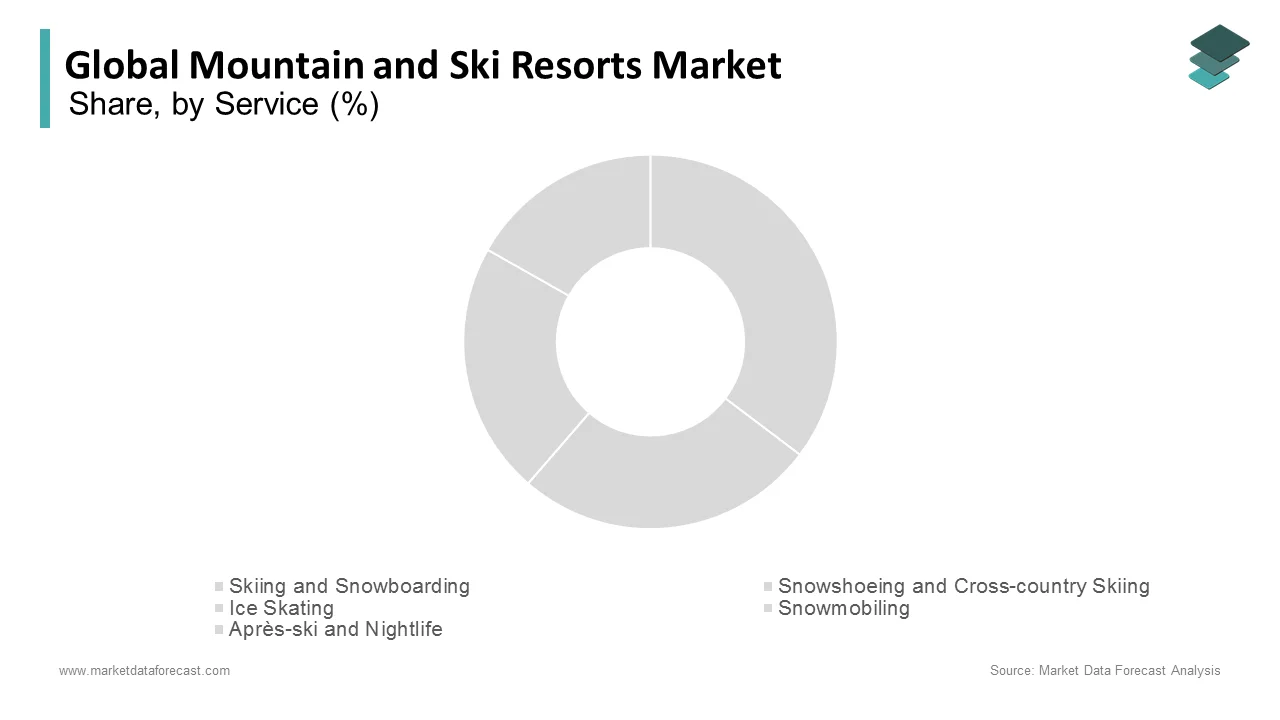
The apres-ski and nightlife segment is emerging as the fastest-growing service within the mountain and ski resorts market and is projected to grow at a CAGR of 11.3% from 2026 to 2034. This surge is driven by a shift in guest expectations; ski vacations are no longer just about slopes but holistic lifestyle experiences. Resorts like St. Anton in Austria and Aspen in Colorado have transformed into 24-hour destinations, with après-ski revenue contributing notably to total resort income. The rise of boutique mountain clubs and pop-up events, such as Whistler’s “Slope to Sound” DJ series, has attracted younger, urban demographics. Additionally, social media amplifies this trend. Luxury brands are capitalizing on this Champagne sales in Alpine bars rose. The integration of wellness-infused nightlife, such as infrared sauna parties and yoga raves, further diversifies offerings. This evolution from functional rest stops to vibrant social ecosystems is redefining mountain resort economies.
By Visitor Insights
The families segment represented the largest visitors in the global mountain and ski resorts market by accounting for 35.2% of total resort revenue in 2025. This dominance is due to multi-generational travel trends and resorts’ strategic focus on family-centric infrastructure. The average family ski trip in North America and Europe spans 6.2 days, significantly longer than individual or group stays, amplifying per-trip spending. Resorts have responded with dedicated children’s ski schools, childcare services, and terrain parks suitable for mixed-age groups. Additionally, intergenerational travel is on the rise. Airlines and rail operators have also introduced family-friendly winter travel routes, such as Swiss Federal Railways’ “Family Ski Express” to Davos, which saw a ridership increase in 2023. The economic multiplier effect of family visits, covering lodging, lift tickets, rentals, and dining, solidifies this segment’s revenue leadership.
The adventure seekers segment is the fastest-growing visitor in the mountain and ski resorts market and is projected to expand at a CAGR of 9.6% from 2026 to 2034. This surge is fueled by rising demand for backcountry skiing, heli-skiing, and off-piste experiences, particularly among millennials and Gen Z travelers. Destinations like Chamonix (France), Revelstoke (Canada), and Niseko (Japan) have seen a rise in backcountry guide bookings. The growth is further accelerated by social media influence; Instagram posts tagged with #helifishing and #offpisteskiing have collectively garnered substantial engagements since 2021. Equipment innovation also plays a critical role: avalanche airbags and GPS-enabled beacons have made extreme skiing safer, with sales of backcountry gear rising. Additionally, specialized adventure packages are part offerings at premium resorts. Operators like Aspen Snowmass and Verbier have launched certified “adventure zones” with guided extreme terrain access, contributing to an increase in high-spend visitors. This convergence of safety, technology, and digital culture is redefining winter tourism’s frontier.
By Age Group Insights
The 26 to 35 age group segment led the mountain and ski resorts market by contributing 31.5% of total visitor spending in 2025. This cohort, primarily composed of young professionals and early-career couples, combines disposable income with a strong desire for experiential travel. In 2023, the average expenditure per trip for this group was $2,150, surpassing all other age brackets, as reported by the Global Wellness Institute. This segment is also the most active in booking ski vacations independently, with a significant portion using digital platforms like Airbnb and GetYourGuide. The rise of “bleisure” travel, blending business with leisure, has further boosted their presence, with remote workers extending ski trips into workcations. Social influence is a key driver. Additionally, this group is more likely to engage in multi-activity vacations, combining skiing with snowshoeing, spa visits, and fine dining. Their financial flexibility, digital savviness, and appetite for adventure solidify their position as the market’s primary economic engine.
The above-55 age group segment is the fastest-growing demographic in the mountain and ski resorts market and is expanding at a CAGR of 8.7% from 2026 to 2034. This growth is driven by increased health consciousness, extended retirement spans, and rising disposable income among baby boomers and older adults. In 2023, retirees accounted for a notable share of all ski resort visits in Europe and North America. The average trip duration for this group is 7.4 days, the longest among all age segments, leading to higher ancillary spending. Resorts have responded with adaptive programs. Medical advancements also play a role; improved joint replacements and mobility aids have extended skiing lifespans, with a key share of orthopedic surgeons noting increased post-surgery ski activity among patients over 60. Additionally, luxury operators like Four Seasons and Ritz-Carlton have launched “active aging” packages, combining skiing with spa, nutrition, and fitness coaching. The convergence of longevity, affluence, and purpose-driven travel is reshaping the winter tourism landscape.
REGIONAL ANALYSIS
Europe Mountain and Ski Resorts Market Insights
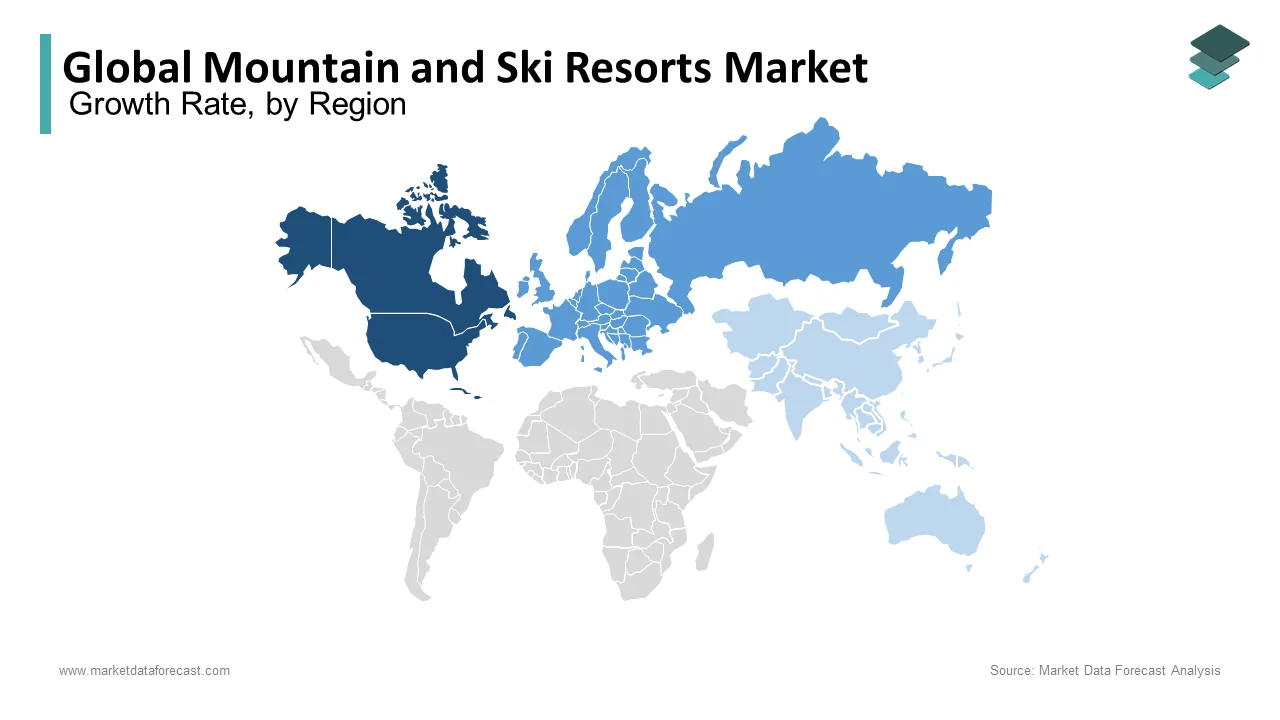
Europe led the global mountain and ski resorts market by commanding 42.5% of total market revenue in 2025. Home to the Alps the world’s most iconic ski region Europe hosts a large number of resorts across France, Switzerland, Austria, and Italy. The 2022–2023 season recorded millions of skier visits. France alone attracts a large number of skier visits annually, with Chamonix, Courchevel, and Val d’Isère serving as luxury hubs. Infrastructure is a key strength. The region benefits from strong domestic demand a significant share of European skiers are residents, reducing reliance on international travel. High-speed rail connectivity, such as France’s TGV to Bourg-Saint-Maurice, enhances accessibility, with many British skiers opting for train travel to the Alps. Additionally, Europe leads in sustainability many of the resorts now use renewable energy for snowmaking, as noted by the Mountain Riders environmental group. The region’s blend of heritage, infrastructure, and eco-innovation ensures its continued dominance.
North America Mountain and Ski Resorts Market Insights
North is a mature mountain and ski resorts market, which is driven by the U.S. and Canada’s expansive terrain and robust tourism infrastructure. Colorado, Utah, and British Columbia are top destinations. Vail Resorts, the largest operator, reported $2.3 billion in revenue for the 2023 fiscal year, reflecting strong consumer spending. The Epic Pass has revolutionized access, enabling multi-resort travel across 40+ locations. Investment in snowmaking is critical. The rise of “work-from-slope” culture has boosted midweek occupancy, particularly in destinations like Jackson Hole and Whistler. Additionally, Indigenous-led tourism initiatives, such as the Ktunaxa Nation’s involvement in Panorama Mountain Resort, are enhancing cultural authenticity. North America’s mix of scale, innovation, and evolving guest behavior keeps it a powerhouse.
Asia-Pacific Mountain and Ski Resorts Market Insights
Asia-Pacific has emerged as a high-growth region in the mountain and ski resorts market. Japan, South Korea, and China are driving expansion, with Niseko (Japan) alone welcoming a substantial volume of visitors in 2023, a notable share of whom were international. China’s winter sports push, fueled by the 2022 Beijing Olympics, has led to the development of ski resorts, with millions of domestic skiers recorded in 2023. Infrastructure investment is accelerating. Additionally, luxury demand is surging. APAC’s rising middle class and government backing position it as the next frontier.
Latin America Mountain and Ski Resorts Market Insights
Latin America holds a modest but growing share of the mountain and ski resorts market and is primarily centered in the Andes of Chile and Argentina. While seasonal and geographically limited, the region attracts a notable number of skiers annually, with Valle Nevado (Chile) and Las Leñas (Argentina) as flagship resorts. The Southern Hemisphere’s winter (June–September) complements the Northern Hemisphere off-seasons, attracting North American and European visitors seeking year-round skiing. Additionally, adventure tourism integration, such as ski-and-wine tours in Mendoza, has boosted appeal. The region also benefits from lower costs. However, climate change poses risks; glacial retreat in the Andes has reduced snow reliability, prompting investment in artificial snow systems. With targeted marketing and infrastructure growth, Latin America is carving a unique niche.
Middle East and Africa Mountain and Ski Resorts Market Insights
The Middle East and Africa collectively account for a small share of the global mountain and ski resorts market, but represent an aspirational frontier. While natural skiing is limited to Morocco’s Atlas Mountains, artificial snow facilities are redefining possibilities. The country has invested in lift upgrades and snow cannons, aiming to increase skier visits. Meanwhile, the UAE has pioneered indoor skiing. The facility offers ski lessons, snow parks, and penguin encounters, appealing to both residents and tourists. South Africa’s Tiffindell Resort, though small, serves as a training ground for African skiers. The region’s growth is fueled by luxury demand. Additionally, the African Union’s “Winter Sports for All” initiative aims to develop alpine programs across the continent. Though geographically constrained, the region’s ambition and investment signal long-term potential.
KEY MARKET PLAYERS
Companies playing a prominent role in the global mountain and ski resorts market include Vail Resorts, Inc., Aspen Skiing Company, Jackson Hole Mountain Resort, Whistler Blackcomb Holdings Inc., The Alps Company, Intrawest Resorts Holdings, Inc., Boyne Resorts, The EoA Group, Alterra Mountain Company, Swiss Alpine Adventure, Les Trois Vallées, Taos Ski Valley, Inc., Sun Valley Resort, Telluride Ski & Golf, The Canyons Resort, Snowbird Ski and Summer Resort, Mammoth Mountain Ski Area, Stowe Mountain Resort, and Others.
TOP LEADING PLAYERS IN THE MARKET
Vail Resorts
Vail Resorts has significantly expanded its footprint in the Asia-Pacific region through strategic partnerships and destination development. In 2021, the company launched Peak Resorts Japan, managing Niseko United in Hokkaido, one of the region’s most popular ski destinations. The company has invested heavily in sustainability, introducing the "Epic Promise" initiative to achieve zero net emissions by 2030 across its APAC operations. Vail Resorts has also enhanced guest experiences by integrating digital lift access, contactless payments, and multilingual mobile apps tailored for international visitors. In 2023, it partnered with Japanese real estate developers to expand luxury lodging options near Niseko, attracting high-spending travelers. The company continues to focus on improving snowmaking efficiency and trail connectivity to adapt to climate variability. By aligning with local communities and promoting eco-conscious tourism, Vail Resorts is strengthening its reputation as a premium operator in the region, positioning itself as a leader in sustainable, high-quality mountain experiences.
Alterra Mountain Company
Alterra Mountain Company has made targeted moves to strengthen its presence in the Asia-Pacific market through brand visibility and global pass expansion. While its core resorts are in North America, the company’s Ikon Pass is aggressively marketed in Australia, Japan, and South Korea to attract affluent travelers seeking multi-destination ski experiences. In 2022, Alterra formed alliances with APAC-based travel agencies and airlines to offer bundled ski vacation packages, increasing accessibility for Asian travelers. The company launched localized digital campaigns in Mandarin, Japanese, and Korean to boost pass sales and brand recognition. In 2023, it collaborated with Japanese hospitality providers to offer Ikon Pass holders exclusive lodging rates in Niseko and Hakuba. Alterra has also emphasized sustainability, implementing energy-efficient operations across partner resorts. By leveraging its pass ecosystem and focusing on customer experience, the company is building strong cross-regional loyalty and expanding its influence in the Asia-Pacific winter tourism landscape.
Niseko Venture Holdings
Niseko Venture Holdings is a leading local operator deeply embedded in Japan’s ski tourism ecosystem, playing a pivotal role in shaping the Niseko United resort area. The company manages a wide range of services, including lift operations, snow grooming, ski schools, and property management, creating an integrated guest experience. In recent years, it has invested in expanding trail networks and upgrading lifts to reduce congestion during peak seasons. In 2023, the company launched a smart reservation system for ski lessons and equipment rentals, improving operational efficiency. It has also prioritized sustainability by introducing electric snowmobiles and partnering with local farms for eco-friendly dining options. By collaborating with international investors and hospitality brands, Niseko Venture Holdings has helped transform the region into a world-class destination, attracting visitors from Australia, Southeast Asia, and beyond.
TOP STRATEGIES USED BY KEY MARKET PARTICIPANTS
Key players in the mountain and ski resorts market are deploying multifaceted strategies to enhance competitiveness and adapt to evolving consumer demands. A dominant strategy is the expansion of season passes like the Epic Pass and Ikon Pass, which foster customer loyalty and ensure predictable revenue. Resorts are increasingly investing in digital transformation, implementing mobile apps for lift access, bookings, and personalized experiences. Sustainability is another critical focus, with operators adopting renewable energy, efficient snowmaking, and carbon neutrality goals to appeal to eco-conscious travelers. Infrastructure modernization, including new lifts, expanded terrain, and upgraded lodgings aims to improve guest satisfaction and capacity. To attract younger demographics, resorts are enhancing après-ski offerings with live music, gourmet dining, and wellness experiences. Strategic partnerships with airlines, travel agencies, and real estate developers are expanding global reach, particularly in the Asia-Pacific region. Additionally, resorts are embracing work-from-slope trends by offering high-speed internet and co-working spaces. Diversification into year-round activities such as mountain biking and hiking is reducing reliance on winter tourism. These strategies collectively enable operators to differentiate their offerings, increase visitor retention, and build resilient business models in a climate- and competition-sensitive industry.
COMPETITIVE LANDSCAPE
Competition in the mountain and ski resorts market is intensifying as operators strive to differentiate through experience, technology, and sustainability. The market features a mix of large multinational corporations like Vail Resorts and Alterra Mountain Company, regional powerhouses such as Compagnie des Alpes in Europe, and local players like Niseko Venture Holdings in Asia-Pacific. These entities compete not only on terrain quality and snow reliability but also on guest experience, digital integration, and environmental stewardship. Loyalty programs, particularly multi-resort passes, have become central battlegrounds, driving customer acquisition and retention. Smaller resorts face pressure to form alliances or adopt niche positioning, such as backcountry access or luxury wellness to remain competitive. In the Asia-Pacific region, competition is fueled by rising domestic demand and growing interest from international tourists, prompting investments in infrastructure and hospitality. Climate change adds another layer of complexity, pushing resorts to innovate in snowmaking and energy efficiency. Marketing strategies increasingly target younger, experience-driven travelers through social media and influencer partnerships. Mergers, acquisitions, and joint ventures are common as companies seek scale and geographic diversification. Ultimately, the most competitive resorts are those that blend operational excellence with immersive, sustainable, and digitally seamless experiences, ensuring relevance in a rapidly evolving global tourism landscape.
RECENT MARKET DEVELOPMENTS
- In January 2022, Vail Resorts partnered with Niseko United in Japan to manage operations and expand its global footprint, enhancing guest services and sustainability initiatives in the Asia-Pacific region.
- In March 2023, Alterra Mountain Company launched localized marketing campaigns in Japan, South Korea, and Australia to boost Ikon Pass adoption and increase international visitation to its network of resorts.
- In August 2022, Niseko Venture Holdings upgraded the Grand Hirafu gondola system to reduce wait times and improve mountain access, significantly enhancing the visitor experience during peak seasons.
- In December 2023, Vail Resorts introduced a new mobile app with multilingual support and contactless lift access for guests at its Niseko United resort in Japan, streamlining operations and improving user satisfaction.
- In May 2024, Alterra Mountain Company formed a strategic alliance with Singapore-based travel platform Klook to offer bundled ski vacation packages across Asia, increasing accessibility and visibility in high-growth markets.
MARKET SEGMENTATION
This global mountain and ski resorts market research report has been segmented and sub-segmented based on service, visitor, age group, and region.
By Service
- Skiing and Snowboarding
- Snowshoeing and Cross-country Skiing
- Ice Skating
- Snowmobiling
- Après-ski and Nightlife
By Visitor
- Individual Travelers
- Families
- Groups
- Adventure Seekers
By Age Group
- Below 15 years
- 16 to 25
- 26 to 35
- 36 to 45
- 46 to 55
- above 55
By Region
- North America
- Europe
- Asia Pacific
- Latin America
- Middle East & Africa