- Product Description Description
- Table of Contents TOC
- List of Table & Figure LOT
- Get Free Sample PDF Sample PDF
Market Size, 2025
$1.86 BnMarket Estimate, 2026
$2.16 BnMarket Forecast, 2034
$7.18 BnCAGR, 2026–2034
16.2%Executive Summary: Global Multi-Touch Marketing Attribution Software Market
- Market Scope: Comprehensive global multi-touch marketing attribution software market analysis covering component categories, enterprise tiers, deployment structures, regional leadership frameworks, and privacy compliance adaptation trends.
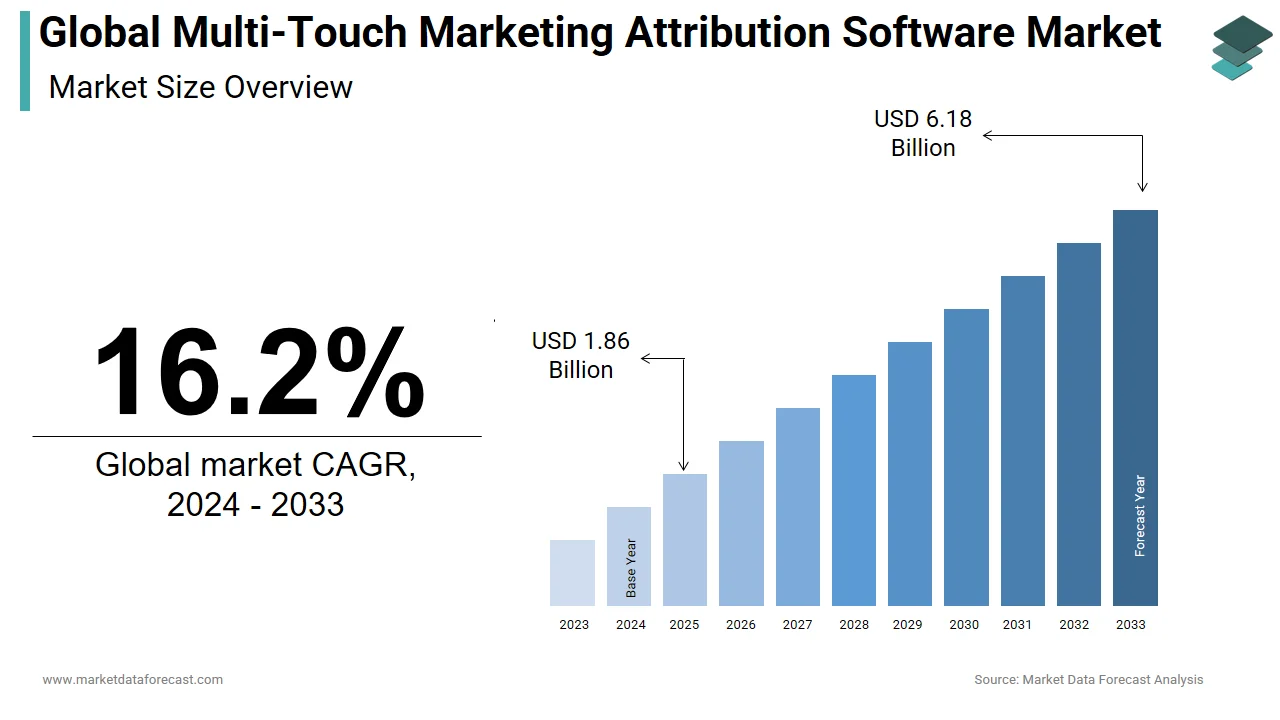
- Market Valuation: Valued at USD 1.86 billion (2025), estimated at USD 2.16 billion (2026), and projected to reach USD 7.18 billion by 2034, registering a solid CAGR of 16.2% (2026–2034).
- Primary Growth Drivers: Escalating digital channel fragmentation, budget optimization pressures, mandatory privacy compliance adaptations following cookie deprecation, unified commerce measurement, and the hybridization of predictive attribution with incrementality testing.
Key Market Segment Metrics (2026–2034)
| Category | Leading Segment (Base Position) | Fastest-Growing Segment |
|---|---|---|
| By Component | Solutions Segment (dominated the market in 2025 across attribution software platforms) | Services Segment (expanding rapidly at a robust CAGR of 24.8% due to implementation complexity) |
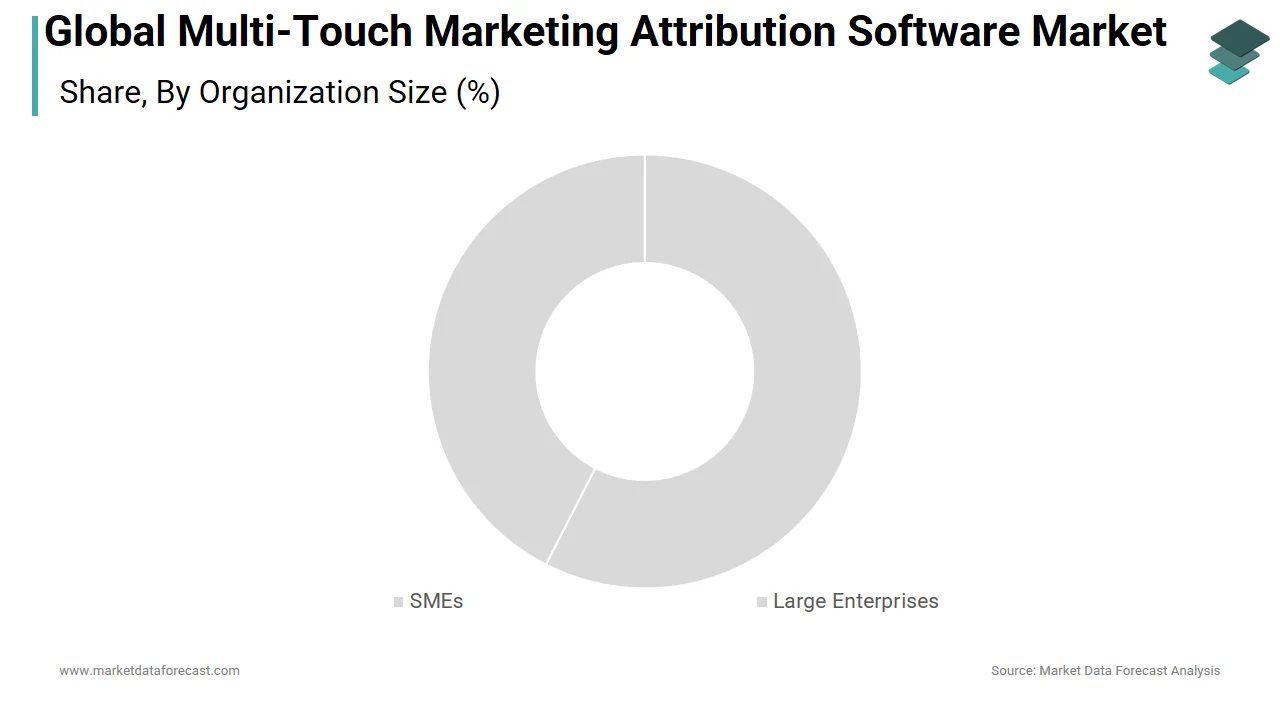
| By Enterprise Size | Large Enterprises (led the market in 2025 with extensive multi-channel budgets) | Small and Medium Enterprises (SME segment expected to exhibit a noteworthy CAGR of 28.4%) |
| By Deployment Model | Cloud Deployment (held the majority market share in 2025) | On-Premises Deployment (predicted to witness a steady CAGR of 16.2% from 2026 to 2034) |
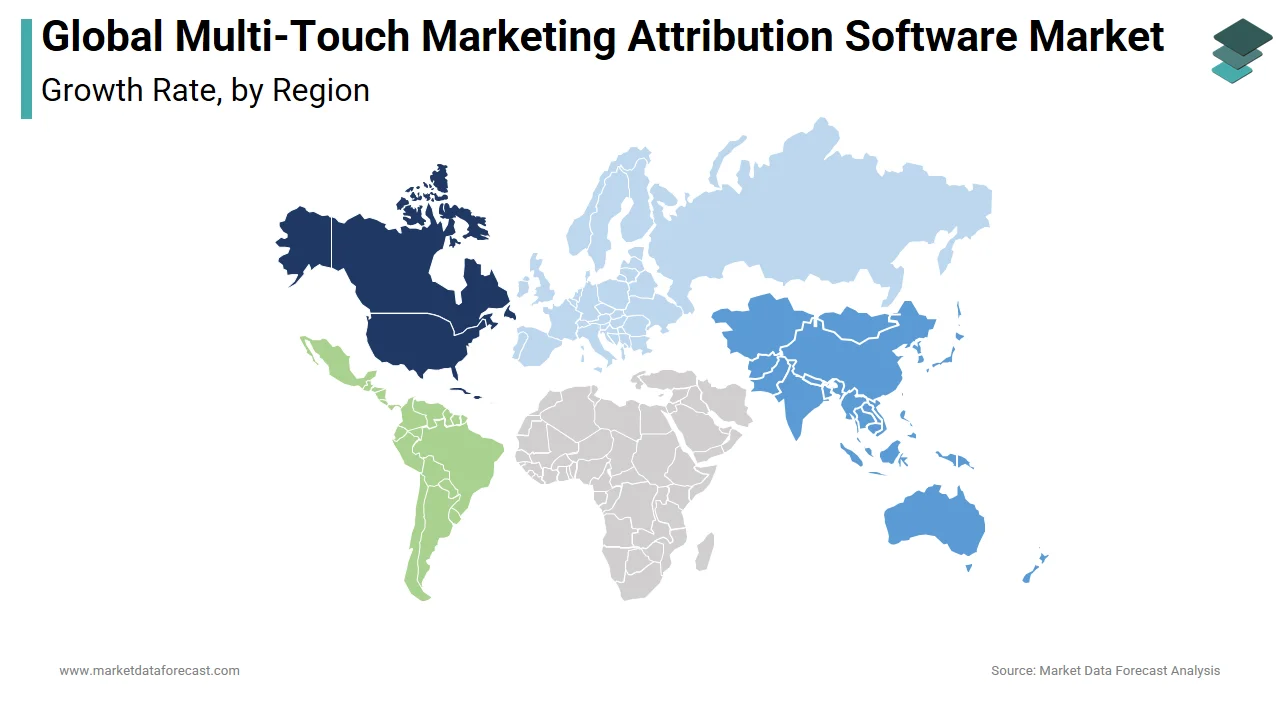
| By Region / Country | North America (top performer with a 42.8% share in 2025, followed by Europe at 27.9%) | Asia-Pacific (maintains significant share driven by mobile-first consumer behavior and super-app ecosystems) |
Major Market Players & Market Structure
Market Structure: Highly competitive global marketing technology ecosystem where marketing cloud incumbents, mobile attribution specialists, and privacy tech startups differentiate through secure multi-party computation and data clean room innovation.
Key Companies: Adobe Inc., SAP, Visual IQ, Oracle, Neustar, Salesforce Inc., LeadsRx, LeanData, Merkle, Roivenue, C3 Metrics, AppsFlyer Ltd., Equifax, Windsor.ai, Manthan, and Oribz.
 Download Free Sample Report
Global Multi-Touch Marketing Attribution Software Market Size
The global multi-touch marketing attribution software market was worth USD 1.86 billion in 2025. The global market is estimated to grow at a CAGR of 16.2% from 2026 to 2034 and be worth USD 7.18 billion by 2034 from USD 2.16 billion in 2026.
Multi Touch Marketing Attribution Software is a tool that tracks and splits credit for a sale or lead across every ad, email, or social post a customer interacts with before buying. Instead of giving all the credit to just the last click, it shows which mix of steps actually worked. These systems employ statistical modeling, including Markov chains, Shapley value regression, and algorithmic learning, to distribute conversion value beyond simplistic first- or last-click methodologies, reflecting complex nonlinear buyer journeys. According to the Association of National Advertisers, enterprise marketing leaders are shifting from arbitrary channel metrics to strict media accountability protocols to rebuild transparency across fragmented digital supply chains. As per the European Commission, regulatory enforcement under the Digital Markets Act mandates strict compliance updates for gatekeeper platforms to protect user consent tracking and restrict cross-domain data combining without explicit permission. According to Gartner, global marketing budgets flatlined at 7.7% of overall company revenue, forcing marketing organisations to manage continuous market disruption under strict resource constraints. Unlike basic web analytics, these platforms require sophisticated data integration, identity graph construction and continuous model validation, making implementation complexity as significant a barrier as licensing costs. The definition extends beyond software licensing to encompass professional services, data partnerships, and ongoing model governance required to maintain analytical validity amid evolving privacy regulations and platform ecosystem changes.
MARKET DRIVERS
Escalating Digital Channel Fragmentation and Budget Optimisation Pressure
The proliferation of digital advertising channels creates a mathematical necessity for sophisticated attribution, which drives the growth of the multi-touch marketing attribution software market. Marketers manage increasingly complex media mixes where simplistic measurement fails to capture true incremental value. According to the Interactive Advertising Bureau, US retail media network ad spending is projected to exceed 62 billion dollars in 2025 as marketers demand proof of net new sales via incremental campaign measurement. As per Unilever, corporate brand deployment strategies leverage a specialised marketing framework emphasising superior science, aesthetics, and culturally relevant shared content to drive growth. This channel complexity creates non-discretionary demand where attribution transitions from analytical luxury to operational necessity for any organisation managing a substantial amount of annual digital spend. Financial accountability pressures from CFOs demanding demonstrable ROI further accelerate adoption as marketing departments must defend budgets against competing organisational priorities using defensible quantitative evidence rather than heuristic judgment.
Privacy Regulation Compliance and Cookie Depreciation Adaptation
Evolving privacy frameworks and browser cookie restrictions are further propelling the multi-touch marketing attribution software market. This creates structural demand for attribution solutions employing privacy-compliant methodologies, including server-side tracking, aggregated measurement, and probabilistic modelling, replacing deprecated deterministic tracking. According to the International Association of Privacy Professionals data records, global tracking matrices document active data protection and comprehensive privacy laws in effect across 144 countries. As per Google browser updates, plans to systematically phase out third-party cookies inside Chrome were completely reversed to provide users with direct control options within their existing privacy settings. The regulatory and technical disruptions transform attribution from an optional optimisation tool into mandatory infrastructure investment for maintaining measurement continuity amid fundamental signal loss affecting all digital advertising ecosystems globally.
MARKET RESTRAINTS
Data Quality Degradation and Identity Resolution Limitations
Incomplete, fragmented, and noisy input data are preventing reliable cross-device and cross-channel journey reconstruction, which affects attribution accuracy and ultimately hampers the growth of the multi-touch marketing attribution software market. This trend is despite sophisticated modelling techniques. According to Forrester evaluation reports, SAS retains the clear analytical lead in the customer analytics tech category by delivering high-depth capabilities for sophisticated churn prevention and segmentation. As per studies, Adobe was recognised as a clear category leader in customer journey analytics and orchestration matrices. As per studies, Salesforce successfully consolidated over 52% of its internal customer profiles by executing unified profile streams across distinct database networks. These data quality issues create a credibility gap where attribution outputs appear precise but rest on fundamentally incomplete foundations, leading to misguided optimisation decisions and eroding stakeholder trust in analytical conclusions regardless of model sophistication.
Model Opacity and Stakeholder Trust Deficits
Complex algorithmic attribution models suffer from interpretability challenges, preventing marketing, finance, and executive stakeholders from understanding or trusting recommendations derived from black-box computations, which in turn impedes the expansion of the multi-touch marketing software market. According to Harvard Business Review research surveys, approximately 86% of global organisational leaders view the deployment of operational DevOps processes as highly critical to business success. As per CloudZero infrastructure assessments, only three out of ten modern enterprises possess the tracking capability to precisely determine where their cloud infrastructure spend goes. According to research, global marketing firms suffer from severe data silos and a structural lack of alignment between general business strategies and customer experience measurement metrics. The trust deficit creates an adoption ceiling where organisations invest in attribution capability but fail to operationalise insights at scale due to organisational resistance rooted in epistemological uncertainty about what models actually measure versus what they claim to measure.
MARKET OPPORTUNITIES
Unified Commerce Measurement Integration Across Online and Offline Channels
Integration of point-of-sale transaction data with digital attribution platforms creates an opportunity to close the measurement loop between online engagement and offline conversion, which is likely to promote the growth of the multi-touch marketing attribution software market. This captures the true omnichannel impact previously invisible to digital-centric models. According to a study, the expansion of automated cross-channel retail solutions is heavily shifting traditional brand loyalty metrics as modern digital platforms integrate direct-to-consumer inventory fulfilment pathways. As per Shopify securities filings, merchant solutions gross merchandise volume scaled globally as small businesses aggressively deploy cloud-based inventory infrastructure. According to Amazon Ads technical product releases, optimised targeting capabilities leverage automated artificial intelligence to systematically expand campaign audiences toward shoppers showing a higher probability of conversion. The convergence creates competitive differentiation for platforms offering seamless online-offline integration versus pure digital solutions increasingly inadequate for measuring modern commerce journeys spanning multiple environments and devices.
Predictive Attribution and Incrementality Testing Hybridisation
Combining predictive modelling with controlled incrementality testing creates a hybrid measurement approach, which is expected to fuel the expansion of the multi-touch marketing attribution software market. This framework simultaneously addresses correlation-based attribution limits and experimental design scalability constraints. According to MIT Sloan Management Review research reports, successful digital transformations require modern enterprise leaders to systematically dismantle internal data silos while building cross-departmental agility frameworks. As per Uber Technologies, delivery operations continue to expand cross-border margins by shifting merchant acquisition workflows to highly automated onboarding funnels. According to research, algorithmic adjustments across vertical video formats are boosting aggregate content discovery metrics for brand advertisers. The methodological convergence creates opportunity for next-generation platforms offering integrated attribution experimentation and forecasting capabilities versus siloed tools forcing manual reconciliation and subjective interpretation.
MARKET CHALLENGES
Walled Garden Ecosystem Fragmentation and Data Access Restrictions
Major advertising platforms restrict granular user-level data export, which constrains the growth of the multi-touch marketing attribution software market. This prevents independent cross-platform attribution and forces reliance on platform-provided measurement with inherent conflicts of interest. According to the U.S. Federal Trade Commission, enforcement actions against major technology ecosystems focus heavily on addressing anti-competitive digital marketplace behaviours and promoting cross-platform parity. As per the Interactive Advertising Bureau, independent cross-media verification frameworks are expanding rapidly across global marketing sectors to ensure greater accountability in automated spending. According to the European Commission, newly enforced digital platform regulations target core gatekeeper advertising services to ensure open application programming interface access for external performance verification. These restrictions create a measurement monopoly where advertisers cannot independently verify platform performance claims, forcing acceptance of potentially inflated metrics or abandonment of channels lacking transparent measurement, creating suboptimal media allocation decisions driven by data access politics rather than true effectiveness.
Talent Shortage and Organisational Capability Gaps
An acute scarcity of professionals skilled in both marketing strategy and advanced analytics holds back the expansion of the multi-touch marketing attribution market. This prevents organisations from effectively implementing, interpreting, and acting on sophisticated attribution outputs despite technology availability. According to the Bureau of Labour Statistics, employment of market research analysts is projected to grow much faster than the average for all occupations as companies increasingly leverage data-driven insights. As per the University of Pennsylvania, business analytics programs utilise rigorous quantitative modelling frameworks to train graduates for complex multi-channel market optimisation challenges. Internal upskilling programs show limited success. The human capital constraint creates an implementation gap where organisations purchase sophisticated tools but lack organisational capacity to extract value, resulting in shelfware deployments and wasted technology investments despite clear strategic intent.
REPORT COVERAGE
| REPORT METRIC | DETAILS |
| Market Size Available | 2025 to 2034 |
| Base Year | 2025 |
| Forecast Period | 2026 to 2034 |
| Segments Covered | By Component, Organization Size, Deployment Type, and Region, and Region. |
| Various Analyses Covered | Global, Regional, and Country-Level Analysis, Segment-Level Analysis, Drivers, Restraints, Opportunities, Challenges; PESTLE Analysis; Porter’s Five Forces Analysis, Competitive Landscape, Analyst Overview of Investment Opportunities |
| Countries Covered | North America, Europe, APAC, Latin America, Middle East & Africa |
| Market Leaders Profiled | Adobe Inc, SAP, Visual IQ, Oracle, Neustar, Salesforce Inc, LeadsRx, LeanData, Merkle, Roivenue, C3 Metrics, AppsFlyer Ltd, Equifax, Windsor.ai, Manthan and Oribz. |
SEGMENTAL ANALYSIS
By Component Insights
The solution segment dominated the multi-touch marketing attribution market and accounted for a substantial share in 2025. This dominance of the segment was driven by substantial recurring subscription fees that dwarf one-time service engagements, creating predictable revenue streams and higher valuation multiples for software vendors. According to Gartner, automated marketing technology ecosystems continue to scale rapidly as modern chief marketing officers prioritise generative artificial intelligence implementation over traditional resource allocations. As per Adobe securities filings, the Experience Platform surpassed a one billion dollar book of business as an incorporated enterprise real-time customer data engine. This dominance reflects fundamental SaaS business model economics where software scales with near-zero marginal cost while services require linear headcount growth constraining profitability. Buyers accept premium software pricing because continuous algorithm updates, data connector maintenance, and platform integrations deliver ongoing value impossible to replicate through discrete consulting engagements. Vendor lock-in through proprietary data models, custom configurations, and organisational learning curves further reinforces solution segment leadership as switching costs exceed potential savings from alternative providers or insourcing.
Solutions maintain segment leadership through relentless feature innovation and expanding data ecosystem integrations that continuously increase platform utility and justify ongoing subscription investment beyond initial deployment. According to Forrester, SAS remains the market leader in analytical depth, delivering sophisticated capabilities for customer segmentation, churn prevention, and lifetime value analysis. As per AppsFlyer, privacy-safe analytics suites deploy comprehensive data clean room architectures to prevent unauthorised user-level tracking. Services firms cannot replicate this innovation cadence due to project-based revenue models lacking dedicated product development funding. Buyers recognize that attribution effectiveness depends on keeping pace with evolving privacy regulations, platform API changes, and methodological advances, making continuous software updates a non-discretionary operational requirement rather than an optional enhancement. This innovation imperative creates a self-reinforcing cycle where software vendors capture the majority of value through feature differentiation while services commoditise around implementation support.
The services segment is expanding at a CAGR of 24.8% between 2026 and 2034, due to increasing implementation complexity, requiring specialised expertise for data integration, model configuration, and organisational adoption that exceeds typical buyer capabilities. According to Deloitte, the widespread implementation of genAI infrastructure is forcing modern marketing teams to completely restructure their analytical talent pipelines. The complexity-driven demand creates recurring service opportunities as organizations require ongoing model validation, performance tuning, and training programs throughout the attribution lifecycle, unlike one-time implementation engagements. Services firms benefit from knowledge accumulation across diverse implementations, creating proprietary methodologies and benchmark datasets that command premium pricing and foster long-term advisory relationships insulated from software commoditization pressures.
Services growth accelerates through mandatory compliance adaptation and methodological transition consulting as privacy regulations and cookie deprecation force organisations to fundamentally redesign measurement approaches requiring expert guidance. According to IAB Europe, the Transparency and Consent Framework is updated systematically to reflect newly enacted judicial opinions from regional data protection authorities. As per EY, data engineering practices deploy customised cloud architecture frameworks to orchestrate clean streaming pipelines across complex multi-cloud ecosystems. These regulatory and technical disruptions create non-discretionary service demand correlated with compliance deadlines rather than discretionary budget cycles, ensuring recession-resistant growth. Services firms capturing this trend gain first-mover advantage in emerging methodologies, positioning as trusted advisors during industry-wide measurement paradigm shifts where organisational uncertainty drives premium willingness to pay for expert navigation.
By Organisation Size Insights
The large enterprises segment led the multi-touch marketing attribution software market and captured a significant share in 2025. This leading position of the segment was attributed to substantial media budgets, where even marginal optimisation improvements translate to millions in recovered value, justifying significant technology and services investment. According to the Association of National Advertisers, major enterprise media investments focus on establishing comprehensive programmatic advertising transparency benchmarks across global programmatic supply chains. This scale economics creates natural segmentation where attribution becomes non-discretionary infrastructure for large spenders while remaining optional optimisation for smaller budgets. Enterprise procurement processes also favor established vendors with SOC 2 compliance, global support infrastructure, and referenceable case studies, creating barriers to entry for SMB focused solutions lacking enterprise-grade credentials. CFO accountability pressures at public companies further mandate defensible measurement frameworks, making attribution a compliance requirement rather than a discretionary tool.
Large enterprises maintain segment leadership through data volume thresholds and cross-functional integration requirements that only enterprise-grade platforms can accommodate effectively. According to Snowflake, the implementation of cloud data warehouse architectures enables enterprise organisations to streamline massive multi-source storage layers for real-time analytics. The technical requirements create sustainable competitive advantages for enterprise-focused vendors who invest in scalability, security, and integration depth that SMB solutions cannot economically justify. Large organisations also possess dedicated analytics teams capable of maximising sophisticated platform features, whereas SMBs often lack personnel to extract full value, creating a utilisation gap reinforcing enterprise segment dominance through superior ROI realisation and renewal rates.
The SME segment is expected to exhibit a noteworthy CAGR of 28.4% during the forecast period owing to self-serve attribution platforms with simplified interfaces, automated modelling and subscription pricing accessible to organisations previously excluded by cost and complexity barriers. According to BuiltWith, the overall deployment of cloud automation suites expands significantly across mid-market categories as operational software platforms lower upfront subscription requirements. The accessibility revolution transforms attribution from enterprise luxury to SMB necessity as competitive pressure forces smaller advertisers to optimise limited budgets with the same analytical rigour as larger rivals. Cloud native architectures enable vendors to serve thousands of small accounts profitably through automation, eliminating traditional high-touch sales and implementation models that previously made the SME segment economically unviable. Digital native founders increasingly expect data-driven decision-making as default operating mode, creating generational demand shift independent of traditional enterprise procurement cycles.
SME growth accelerates through deep integration with ecommerce platforms and maturation of performance marketing practices among digital native businesses requiring attribution for survival rather than optimisation. According to BigCommerce corporate reports, cross-channel commerce solutions expand multi-store storefront functionality by deploying unified application programming interfaces across global checkout pathways. The ecosystem integration reduces implementation friction and learning curves, enabling rapid value realisation critical for resource-constrained organisations. Performance marketing maturity among millennial and Gen Z entrepreneurs creates organic demand pull as the cohort expects sophisticated measurement as table stakes rather than competitive advantage. Vendor strategies targeting this segment through education content, community building, and template libraries accelerate adoption velocity beyond traditional enterprise sales cycles.
By Deployment Type Insights
In 2025, the cloud segment held the majority share in the multi-touch marketing attribution software market because of inherent scalability, elasticity, and elimination of on-premises infrastructure management burdens incompatible with variable marketing data workloads. According to the Flexera State of the Cloud Report, approximately 94% of enterprise organisations deploy at least one public or private cloud service across their broader corporate infrastructures. The infrastructure abstraction enables marketers to focus on analytical insights rather than IT operations, aligning with organisational reality where marketing teams lack dedicated infrastructure engineering resources. Cloud vendors benefit from multi-tenant economies of scale, spreading R&D, security, and compliance costs across thousands of customers, enabling continuous innovation investment impossible for on-premises vendors supporting fragmented installed bases. Buyers accept subscription premiums because total cost of ownership, including hidden infrastructure, personnel and opportunity costs, favours cloud despite higher nominal licensing fees.
Cloud maintains deployment dominance through continuous feature delivery cadence and seamless ecosystem integration capabilities that on-premises solutions cannot match due to upgrade friction and API connectivity limitations. According to Gartner market indicators, corporate cloud architectures scale rapidly as chief information officers prioritise artificial intelligence deployment models over legacy software distributions. The advantages create a self-reinforcing adoption cycle where cloud platforms attract the best talent, most innovative partners, and the largest data volumes, further accelerating differentiation. On-premises vendors face an existential challenge as skilled engineers prefer cloud native development environments and customers resist upgrade disruption, creating stranded installed bases unable to access modern capabilities. Regulatory compliance also increasingly favours cloud as vendors achieve certifications at scale that individual organisations cannot economically justify for single-tenant deployments.
The on-premises segment is predicted to witness the highest CAGR of 16.2% from 2026 to 2034. This rapid expansion of the segment is propelled by data sovereignty regulations and regulated industry mandates prohibiting sensitive customer data from leaving organisational control or national borders. According to the European Union Agency for Cybersecurity, European financial and healthcare institutions are scaling hybrid cloud architectures to protect highly sensitive personally identifiable datasets. The regulatory drivers create non-discretionary demand where compliance trumps cost efficiency or feature parity considerations. Government agencies, defence contractors, and critical infrastructure operators similarly mandate on-premises deployment for national security reasons, creating a stable niche market. Vendors offering hybrid architectures enabling on-premises data processing with cloud-based analytics UI capture this segment without sacrificing the entire product roadmap to legacy deployment models.
On-premises growth accelerates through legacy system integration requirements and air-gapped environment needs in industries where cloud connectivity is technically impossible or organizationally prohibited. According to studies, global industrial spending shifts heavily toward hybrid multi-cloud configurations as manufacturing and utility sectors integrate information technology with legacy plant operations. As per U.S. Department of Defence implementation guidelines, defence components are rapidly deploying comprehensive zero-trust network boundaries to safeguard classified data environments from internet-based intrusions. The technical constraints create durable demand segments where cloud migration is physically impossible regardless of economic incentives. Vendors specializing in secure disconnected deployments develop unique competencies in offline licensing, air-gapped update mechanisms, and hardened security configurations, creating defensible niches against mainstream cloud vendors lacking these capabilities. Long sales cycles and high customisation requirements protect margins despite a smaller addressable market versus mass market cloud offerings.
REGIONAL ANALYSIS
North America Multi Touch Marketing Attribution Software Market Analysis
North America was the top performer in the global multi-touch marketing attribution software market and occupied a 42.8% share in 2025. This dominance of the North American market was driven by the world’s largest digital advertising spend concentration of martech vendors and a mature performance marketing culture driving sophisticated measurement adoption. According to the Interactive Advertising Bureau, US retail media network ad spending is projected to exceed 62 billion dollars in 2025 as marketers demand proof of net new sales via incremental campaign measurement. As per the Gartner CMO Spend Survey, marketing budgets flatlined at 7.7% of total company revenue, with 54% of chief marketing officers prioritising quick conversions and return on investment over long-term brand building. Major attribution vendors maintain headquarters and primary R&D centres in the United States, enabling tight feedback loops between product development and domestic market needs according to company corporate filings. According to Parliament of Canada legislative records, the newly introduced Bill C-36 seeks to enact the Protecting Privacy and Consumer Data Act to replace Part 1 of the Personal Information Protection and Electronic Documents Act. However, walled garden restrictions from Meta, Google, and Amazon disproportionately impact North American advertisers due to the region’s platform dependency, creating measurement asymmetry challenges despite technological leadership. Talent concentration in San Francisco, New York, and Austin creates innovation hub effects but also salary inflation, compressing vendor margins and limiting services scalability.
Europe Multi Touch Marketing Attribution Software Market Analysis
Europe followed closely behind in the global market and held a 27.9% share in 2025. This growth of the European market was propelled by stringent privacy regulations driving privacy-compliant attribution innovation and a strong data protection culture shaping measurement methodologies distinct from North American approaches. According to European Commission directorate publications, enforcement of the Digital Markets Act targets gatekeeper compliance across core platform services to prevent anti-competitive ecosystems rather than publishing third-party attribution case summaries. As per the UK Information Commissioner's Office, direct marketing guidelines require valid consent for tracking cookies under electronic communications regulations regardless of any legitimate interest assessment for background analytics. According to sources, the United Kingdom ranks as the top digital ad market by spend volume in Europe, outpacing all other individual regional nations on aggregate investments. As per Capgemini, digital customer demand is heavily shifting toward ultra-fast delivery models, with 65% of buyers prioritising immediate item fulfilment.
Asia Pacific Multi Touch Marketing Attribution Software Market Analysis
Asia Pacific maintains a significant share of the global multi-touch marketing attribution software market due to mobile-first consumer behaviour, super-app ecosystem dominance, and rapidly maturing digital advertising infrastructure driving unique attribution requirements. According to sources, the Asia-Pacific advertising industry is projected to expand notably, driven by significant digital innovation across social, commerce, and major platforms. As per the Cyberspace Administration of China, newly implemented measures mandate a standardised system for identifying and labelling synthetic content created using artificial intelligence. As per Japan Digital Agency reports, the government is actively developing governance frameworks for verifiable credentials and decentralised identity wallets to enable secure digital attribute verification. According to Ipsos, mobile ad spending dominates India’s digital landscape by accounting for 78% of total media spends due to smartphone usage. However, data localisation requirements in China, Indonesia and Vietnam force multi-instance deployments, increasing complexity and cost versus centralised global platforms. Super app ecosystems WeChat LINE Grab integrate commerce, payments, and media, creating closed-loop attribution opportunities but also platform dependency risks analogous to Western walled gardens. Cultural preferences for relationship-based B2B selling slow enterprise adoption versus transactional Western procurement models.
Latin America Multi Touch Marketing Attribution Software Market Analysis
Latin America is moving ahead steadfastly in the global multi-touch marketing attribution software market. Adoption is concentrated in Brazil, Mexico, and Argentina, driven by e-commerce growth, digital transformation initiatives, and increasing performance marketing sophistication among regional advertisers. According to MercadoLibre securities filings, strategic investment in free shipping initiatives in Brazil accelerated unique buyer growth by 32% year on year. However, currency volatility and economic instability create budget uncertainty, delaying long-term technology commitments despite strategic intent. Limited local vendor presence forces reliance on international platforms with Spanish and Portuguese localisation gaps and LATAM-specific support deficiencies. Payment fraud and bot traffic rates exceeding notable levels in some markets degrade attribution signal quality, requiring additional validation layers not needed in cleaner ecosystems.
Middle East and Africa Multi Touch Marketing Attribution Software Market Analysis
The Middle East and Africa region is anticipated to grow notably in the global market during the forecast period owing to sovereign wealth-funded digital transformation initiatives, expatriate-heavy consumer demographics, and emerging regulatory frameworks concentrating adoption in the UAE, Saudi Arabia, and South Africa. According to the Federal Constitution of Brazil, the protection of personal data in digital media is established as a fundamental human right. As per sources, cross-border corporate violations can trigger administrative privacy fines scaling up to 100 million euros. However, limited digital infrastructure outside major urban centres restricts the addressable market to affluent expatriate and elite demographic segments. Geopolitical tensions and currency controls in some markets complicate vendor operations and payment processing. Low Arabic language content availability in global attribution platforms creates usability barriers for local marketing teams preferring native language interfaces and documentation.
COMPETITIVE LANDSCAPE
Competition in the multi-touch attribution software market intensifies as marketing cloud incumbents, mobile attribution specialists, analytics platforms and emerging privacy tech startups vie for position across fragmented measurement paradigms and regulatory environments. Platform giants Adobe, Salesforce and Google leverage integrated ecosystems, data advantages and brand trust, dominating the enterprise segment; however face disruption from nimble specialists offering superior mobile measurement, privacy compliance or methodological transparency. Mobile attribution leaders AppsFlyer, Adjust, and Branch compete through app ecosystem expertise, SKAdNetwork optimization, and data clean room innovation, capturing performance marketing spend shifting toward app and connected TV channels. Emerging privacy tech companies including InfoSum, Habu, and Bones.ai differentiate through secure multi-party computation and synthetic data generation, enabling attribution without raw data sharing, addressing fundamental signal loss challenges. Competitive dynamics vary significantly by segment, with enterprise featuring platform lock-in competition versus SMB experiencing self-serve tool proliferation and price compression. Consolidation accelerates as scale requirements for data infrastructure, privacy compliance, and R&D exceed mid-sized vendor capabilities, concentrating innovation among well-capitalized incumbents. This evolving landscape rewards ecosystem integration, privacy innovation, and methodological credibility while penalizing opaque black box approaches vulnerable to regulatory scrutiny and stakeholder skepticism amid an industry-wide measurement paradigm transition from deterministic tracking to modeled and experimental hybrid frameworks.
KEY MARKET PLAYERS
The leading companies operating in the global multi-touch marketing attribution software market include:
- Adobe Inc.
- SAP
- Visual IQ
- Oracle
- Neustar
- Salesforce Inc.
- LeadsRx
- LeanData
- Merkle
- Roivenue
- C3 Metrics
- AppsFlyer Ltd.
- Equifax
- ai
- Manthan
- Oribz
TOP PLAYERS IN THE MARKET
- Adobe Inc operates as a leading multi-touch attribution provider through the Adobe Experience Cloud Attribution AI platform, integrating seamlessly with Analytics, Target, and Campaign solutions for unified customer journey measurement. The company leverages decades of digital experience expertise and enterprise trust to serve Fortune 500 brands requiring sophisticated cross-channel attribution at scale. Adobe partnered with major retail media networks including Walmart Connect and Target Roundel to integrate offline transaction data directly into attribution models, closing the online-offline measurement loop. Manufacturing expansion of data processing capacity in Europe and Asia Pacific enhanced regional data residency compliance, supporting multinational deployments. These initiatives reinforce position as comprehensive experience platform provider bridging attribution activation and personalization while addressing privacy regulation adaptation and unified commerce measurement demands driving contemporary enterprise adoption across global digital marketing ecosystems.
- Salesforce Inc maintains a significant global presence through Marketing Cloud Attribution powered by Data Cloud, enabling identity-resolved multi-touch measurement across CRM, email advertising, and commerce touchpoints within a unified customer data platform. The company combines world-class CRM heritage with growing analytics capabilities serving enterprises seeking integrated sales and marketing attribution alignment. Its move leverages CRM data advantage, creating a defensible position against pure-play analytics vendors while capturing value through bundled platform economics and cross-cloud synergy that standalone attribution tools cannot replicate in increasingly integrated martech stacks.
- AppsFlyer Ltd serves the global multi-touch attribution market through a mobile-first measurement platform specializing in app install attribution, SKAdNetwork analytics, and privacy-preserving data collaboration technologies for performance marketers. The company pioneered the mobile attribution category and maintains leadership in app ecosystem measurement despite iOS privacy changes disrupting deterministic tracking. Partnership with major CTV platforms including Roku and Samsung Ads extended attribution beyond mobile into connected television, addressing fragmented streaming measurement challenges. These initiatives leverage mobile measurement heritage and privacy technology innovation, creating competitive advantage in the post-cookie era where traditional web-centric attribution vendors struggle with signal degradation and regulatory compliance across app and connected device ecosystems.
TOP STRATEGIES USED BY KEY MARKET PARTICIPANTS
Key players employ platform integration strategies embedding attribution within broader marketing clouds, CRM systems, or ad platforms to create sticky ecosystems generating cross-sell opportunities and reducing churn versus standalone tools. Companies invest heavily in privacy-compliant measurement technologies, including server-side tracking, aggregated modelin,g and data clean rooms, addressing cookie deprecation and regulatory pressures that threaten traditional attribution methodologies. Strategic partnerships with walled garden platforms, retail media networks, and offline data providers expand measurable touchpoint coverage, overcoming ecosystem fragmentation that limits attribution accuracy and completeness. Hybrid measurement approaches combining algorithmic attribution with incrementality testing address model opacity concerns and stakeholder trust deficits by validating correlations against causal experimental evidence. Vertical specialization in ecommerce, B2B financial services, or healthcare creates differentiated positioning versus horizontal platforms unable to address industry-specific measurement requirements and compliance constraints. Geographic expansion through local data centers, regional partnerships, and language localization addresses data sovereignty requirements and cultural preferences in high-growth markets outside North America. Talent acquisition targets marketing scientists, data engineers, and privacy lawyers through competitive compensation and remote work flexibility, addressing chronic skills shortages constraining product development and customer success capacity. Open source and freemium offerings democratize access, building developer communities and pipeline generation, while premium tiers monetize enterprise scale and advanced features.
MARKET SEGMENTATION
This research report on the global multi-touch marketing attribution software market has been segmented and sub-segmented based on component, organization size, deployment type, and region.
By Component
- Solution
- Services
By Organization Size
- SMEs
- Large Enterprises
By Deployment Type
- Cloud
- On-Premises
By Region
- North America
- Europe
- Asia Pacific
- Latin America
- Middle East & Africa