- Product Description Description
- Table of Contents TOC
- List of Table & Figure LOT
- Get Free Sample PDF Sample PDF
Market Size, 2025
$3.89 BnMarket Estimate, 2026
$4.26 BnMarket Forecast, 2034
$8.88 BnCAGR, 2026–2034
9.60%Global Multichannel Order Management Market Size
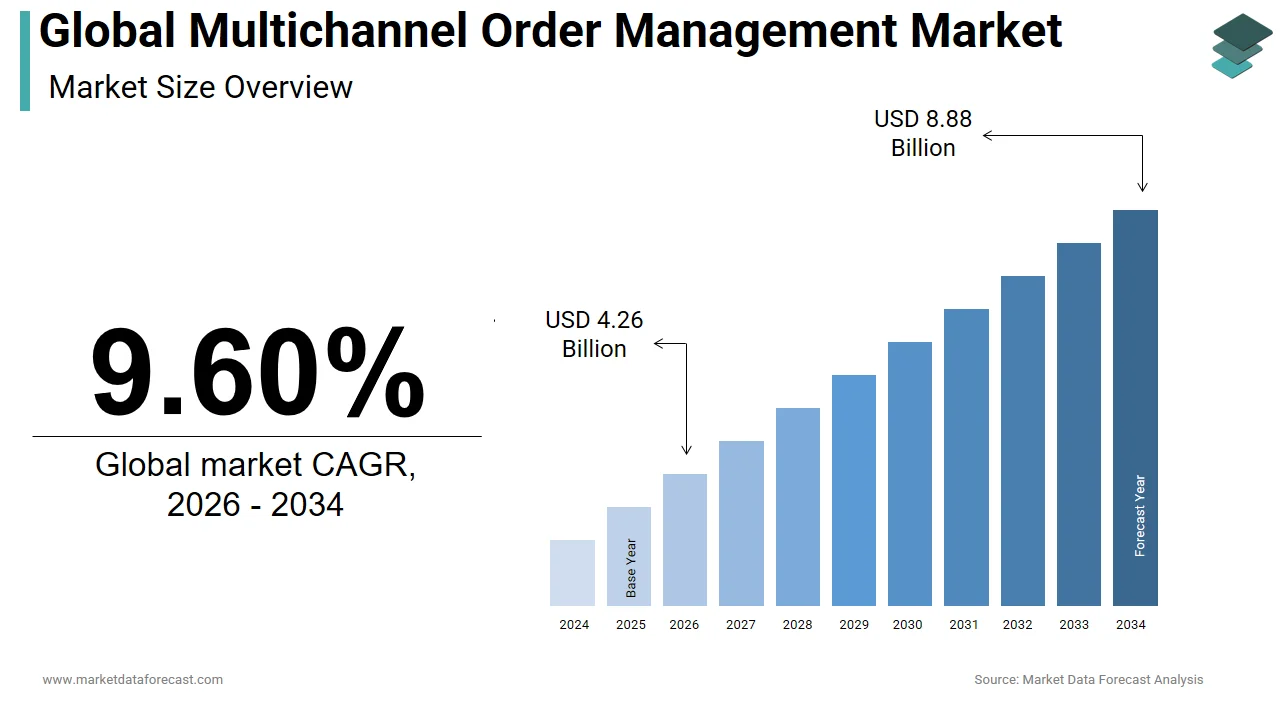
The global multichannel order management market was valued at USD 3.89 billion in 2025. This market is expected to grow at a CAGR of 9.60% from 2026 to 2034 and be worth USD 8.88 billion by 2034, up from USD 4.26 billion in 2026.
Multichannel order management is the process of using a single, centralized system to manage and fulfill customer orders from multiple sales channels like online stores, marketplaces, and physical stores. As per sources, a significant increase in touchpoints, with one study citing the average B2B decision involving over 60 interactions, sometimes exceeding 100 for complex deals. According to studies, Siloed systems are identified as a major contributor to fulfillment inaccuracies and delayed deliveries in omnichannel environments. The vast volume and complexity of transactional information necessitate advanced capabilities within modern order management systems. These systems serve as the central nervous system of commerce, synchronizing inventory allocation, payment reconciliation, shipping logistics, and returns across disparate frontends while maintaining real-time visibility for both businesses and consumers. Their evolution is no longer optional but foundational to survival in an era where customer expectations for speed, accuracy, and transparency transcend channel boundaries.
MARKET DRIVERS
Accelerating Consumer Expectations for Seamless Cross-Channel Experiences
Modern shoppers demand frictionless transitions between browsing on mobile apps, placing orders via voice assistants, and picking up purchases in store without encountering discrepancies in pricing availability or delivery timelines, which is one of the major drivers of the multichannel order management market. Seamless integration across channels is a key determinant in consumer brand loyalty decisions. E-commerce sales represent a significant portion of total retail activity. Customers expect companies to remember their past interactions regardless of the channel used. This necessitates robust order management engines capable of unifying customer profiles, cart histories, and service records in real time. Retailers failing to deliver this cohesion risk abandonment. A majority of online shopping carts are abandoned, often due to inconsistent stock visibility or checkout errors stemming from disconnected systems. Enterprises investing in intelligent order routing, dynamic inventory pooling, and contextual customer recognition are seeing measurable improvements in conversion rates and lifetime value.
Proliferation of Sales Channels and Marketplace Fragmentation
Businesses no longer operate through one or two primary channels but instead distribute products across dozens of regional and global marketplaces, each with unique API rules, settlement cycles, and return policies, which in turn propels the expansion of the multichannel order management market. According to studies, the number of active third-party sellers on major e-commerce platforms is substantial. As per research, a majority of retailers are expanding their sales strategies to include multiple distinct digital channels. Each platform introduces variability in order formats, tax calculations, shipping SLAs, and fraud detection protocols. Companies without a centralized order management backbone experience significantly higher rates of manual error and operational costs. The rise of live commerce social storefronts and conversational commerce further compounds complexity, demanding adaptive middleware that can ingest, parse, and execute orders irrespective of origin, while preserving audit trails, compliance, and customer service continuity.
MARKET RESTRAINTS
Legacy System Incompatibility and Technical Debt Accumulation
Many established retailers continue to rely on decades-old enterprise resource planning and warehouse management systems, which restrict the growth of multichannel order management. These old plans and systems were never architected for real-time multichannel synchronization. These monolithic systems often lack open APIs event driven architectures, or cloud native scalability, resulting in latency mismatches during peak traffic events such as holiday sales or flash promotions. The cost of maintaining outdated platforms is also prohibitive. Migration efforts are further complicated by data silos, customizations, and vendor lock-in. Companies attempting incremental upgrades rather than strategic replatforming frequently encounter cascading failures during channel expansion initiatives, leading to lost revenue and reputational damage. Modernization is not merely a technology refresh but a fundamental reengineering of how orders flow through the enterprise.
Data Governance and Compliance Complexity Across Jurisdictions
Brands encounter a labyrinth of regional regulations governing consumer privacy, tax reporting, product traceability, and cross-border data flows, which further impedes the expansion of the multichannel order management market. They are expanding their multichannel footprint internationally. Comprehensive data protection laws have been widely adopted across the globe. Regulatory barriers that are not tariffs represent a substantial portion of the friction costs in global trade. For order management systems, this translates into immense pressure to dynamically adjust workflows based on geolocation, customer residency, and product classification. A single order may trigger VAT calculations under EU rules, require California Consumer Privacy Act-compliant data handling, and adhere to India’s data localization mandates simultaneously. A majority of multinational retailers have incurred regulatory penalties due to the mismanagement of order data or the incorrect application of jurisdictional rules. Failure to embed compliance logic natively into the order orchestration layer exposes firms to legal liabilities, financial penalties, and loss of consumer trust, especially as regulators increase scrutiny on automated decision-making and algorithmic transparency.
MARKET OPPORTUNITIES
Emergence of AI-Driven Predictive Order Orchestration
Artificial intelligence (AI) is transforming multichannel order management from a reactive process into a proactive experience optimizer, which is generating new growth possibilities for the multichannel order management market. This optimizer is capable of anticipating demand fluctuations, predicting delivery exceptions, and personalizing fulfillment paths. These systems analyze historical sales, weather patterns, local events, traffic conditions, and even social sentiment to pre-position stock and recommend optimal fulfillment nodes, whether from a store warehouse or drop ship partner. "The advancement of natural language processing and computer vision will enable these engines to handle unstructured data, like chat transcripts or return photos, and initiate automated resolution processes autonomously. This shift positions order management not as a back office utility but as a strategic lever for competitive differentiation.
Integration of Circular Economy and Reverse Logistics Intelligence
Order management systems are increasingly being designed to manage the complexities of a circular economy (repairs, recycling, resale) with the same precision as traditional outbound logistics, which offers major opportunities for the expansion of the multichannel order management market. It is a change motivated by growing consumer environmental consciousness. Advanced order management platforms now incorporate blockchain-enabled provenance tracking, IoT sensor data for item condition assessment, and dynamic disposition rules that determine whether a return should be restocked, resold, donated, or recycled. Environmental regulations, especially the European Union's Digital Product Passport framework, are tightening; consequently, these capabilities will soon become essential requirements rather than competitive advantages, fundamentally altering the entire order management lifecycle beyond just the point of sale.
MARKET CHALLENGES
Real-Time Inventory Synchronization Across Distributed Networks
A staggering number of retailers still struggle to maintain accurate inventory visibility across channels, despite advances in technology, which leads to overselling and stockouts and frustrated customers, thereby challenging the growth of the multichannel order management market. The challenge intensifies with the rise of ship-from-store models, where local outlets act as micro fulfillment centers requiring millisecond-level updates to prevent double allocation. Even minor delays of a few seconds can cascade into fulfillment errors during high-velocity sales events. Compounding the issue is the proliferation of dark stores, ghost kitchens, and pop-up distribution nodes that operate outside traditional ERP footprints. Resolving this requires event-driven architectures, edge computing deployments, and distributed ledger technologies to ensure every unit movement is captured, reflected, and reconciled instantly across all selling interfaces without relying on batch processing or manual overrides.
Talent Shortage in Systems Integration and Commerce Operations
The complexity of modern multichannel order ecosystems demands specialized professionals who understand API orchestration, data mapping workflow automation, and real-time analytics, yet such talent remains scarce. This further holds back the expansion of the multichannel order management market. The skills gap is exacerbated by the rapid evolution of microservices cloud native platforms, and low-code configuration tools, which render traditional ERP implementation knowledge insufficient. Educational institutions have been slow to adapt curricula to reflect these emerging needs, leaving companies to invest heavily in internal academies, vendor certifications, and cross-functional upskilling programs, often with mixed success. Implementation bottlenecks and operational fragility will remain significant challenges until workforce development matches the speed of technological advancement.
REPORT COVERAGE
| REPORT METRIC | DETAILS |
| Market Size Available | 2025 to 2034 |
| Base Year | 2025 |
| Forecast Period | 2026 to 2034 |
| Segments Covered | By Component, Deployment, Enterprise Size, Application, and Region. |
| Various Analyses Covered | Global, Regional and Country-Level Analysis, Segment-Level Analysis, Drivers, Restraints, Opportunities, Challenges; PESTLE Analysis; Porter’s Five Forces Analysis, Competitive Landscape, Analyst Overview of Investment Opportunities |
| Regions Covered | North America, Europe, Asia Pacific, Latin America, Middle East & Africa |
| Market Leaders Profiled | Salesforce, IBM Corporation, SAP SE, Oracle Corporation, HCL Technologies Ltd., Square, Inc., Zoho Corporation, Aptean, Unicommerce, Cloud Commerce Pro, Browntape, Contalog, Freestyle Solutions, Vinculum, Delhivery, and Others. |
SEGMENTAL ANALYSIS
By Component Insights
The software segment dominated the multichannel order management market by capturing a substantial share in 2024. The dominance of the software is driven by the foundational role software plays as the central nervous system that coordinates inventory allocation, order routing, payment reconciliation, and customer data unification across sales channels. Enterprises cannot achieve real-time visibility or automated decision-making without deploying a robust software layer capable of ingesting and harmonizing transactional data from disparate sources. The demand is further fueled by the proliferation of API first microservices architectures, which allow modular deployment and seamless integration with existing ERP, CRM, and logistics platforms. Rising consumer expectations for instant gratification mean software is now essential for enabling speed, accuracy, and scalability.
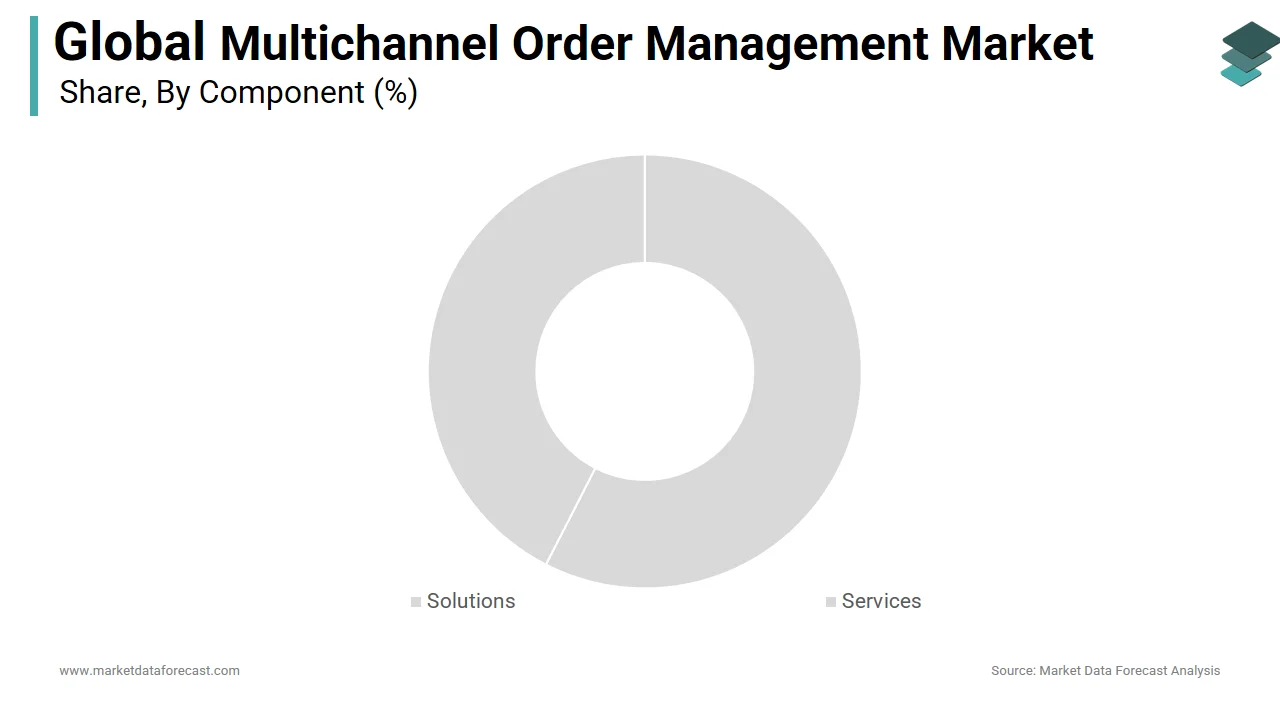
The services segment is estimated to register the fastest CAGR of 18.4% from 2025 to 2033 due to the increasing complexity of implementation customization and ongoing optimization required to align order management platforms with evolving business models. As per sources, enterprises require vendor-managed services to handle multivendor API integrations, real-time analytics configuration, and compliance updates. Organizations leveraging managed services for their order management systems reduce time to value compared to in-house deployments. The rise of headless commerce, composable architectures, and AI-driven automation demands continuous tuning and monitoring that internal IT teams often lack the bandwidth or expertise to manage. Furthermore, Retailers outsource at least one core component of their order orchestration stack, including returns management, tax calculation, or carrier selection logic, to specialized service providers who guarantee SLA adherence and system uptime during high-velocity commerce events.
By Deployment Insights
The cloud segment led the multichannel order management market and accounted for a significant share in 2024. The leading position of the cloud segment is credited to the cloud’s ability to deliver elastic scalability, rapid deployment, and automatic updates without requiring capital-intensive hardware investments. Enterprises cite the ability to handle unpredictable traffic surges during flash sales or holiday peaks as a critical advantage. Apart from these, cloud platforms offer native integrations with SaaS ecosystems such as Shopify, Salesforce, and SAP, enabling faster time to market for new channel rollouts. The operational burden of maintenance patching and disaster recovery is offloaded to vendors, allowing internal teams to focus on customer experience innovation rather than infrastructure upkeep.
By Enterprise Size Insights
The large enterprises segment was the leading share of 65% of the multichannel order management market in 2024. The prominence of the large enterprises is attributable to the sheer volume of transactions, global footprint, and channel diversity that necessitate enterprise-grade orchestration engines. Firms with large workforces require systems capable of processing millions of orders daily across continents and currencies. Large enterprises deploy numerous distinct sales channels per brand, including marketplaces, social storefronts, and B2B portals, each demanding unique workflows and compliance rules. Large retailers have dedicated order management teams overseeing system configuration, exception handling, and partner integrations. These organizations also possess the budgetary capacity to invest in AI-driven predictive routing, blockchain-enabled traceability, and real-time analytics dashboards that smaller firms cannot justify. The complexity of managing global tax regimes, carrier contracts, and return policies across jurisdictions further entrenches reliance on sophisticated multichannel order platforms that only large enterprises can fully leverage.
The small and medium enterprises segment is anticipated to witness the fastest CAGR of 21.7% during the forecast period, owing to the democratization of enterprise-grade commerce tools through subscription-based cloud platforms and embedded financial services. A large number of SMEs operate on specific e-commerce platforms, with the vast majority utilizing native order management capabilities to coordinate sales across various digital and physical channels. Most SMEs expanded to several new sales channels, necessitating automated order consolidation and inventory synchronization. SMEs using integrated order management tools significantly reduce fulfillment errors and improve customer retention rates. The rise of no-code configuration templates pre pre-built API connectors, and AI-assisted customer service bots has dramatically lowered the technical barrier, which enables even micro-merchants to operate like multinational retailers without dedicated IT staff or infrastructure investment.
By Application Insights
The retail and e-commerce segment was the largest segment of the multichannel order management market by holding a substantial share in 2024. The growth of the retail and e-commerce segment is driven by the sector’s direct exposure to consumer purchasing behavior, which has become inherently omnichannel with shoppers fluidly switching between apps, websites, physical stores, and social platforms. Consumers expect seamless integration between online shopping and physical store interactions, such as picking up items bought online or making returns in person, regardless of where the purchase was made. E-commerce transactions frequently necessitate sophisticated systems that synchronize online sales with available inventory in physical stores or coordinate with third-party logistics networks. Implementing a unified order management system across all sales channels (online, app, and in-store) significantly reduces instances of out-of-stock cancellations and improves how quickly inventory is sold and replaced. Brands utilizing intelligent order routing engines see increased customer conversion rates, driven by real-time inventory visibility and dynamic, reliable delivery promises. Intensifying consumer expectations for speed and transparency are making retail the key testing ground and engine of innovation for multichannel order orchestration technologies.
The healthcare application segment is likely to experience the fastest CAGR of 24.9% from 2025 to 2033. The rapid expansion of the healthcare application segment is fuelled by the digitization of patient engagement, pharmacy fulfillment, and medical supply distribution across hybrid care models. Hospitals offer multichannel prescription ordering and home delivery services, requiring robust backend systems to validate insurance eligibility, manage cold chain logistics, and track controlled substances. Integrating order management across apps, websites, and in-store pickup counters significantly reduces medication fulfillment errors and improves refill adherence rates. A substantial portion of outpatient prescriptions is initiated via mobile chat or voice assistant, necessitating compliant order capture and audit trail preservation. Healthcare providers are investing heavily in order orchestration platforms that can bridge digital consultations, physical dispensing, and insurance settlement in a single seamless workflow.
REGIONAL ANALYSIS
North America Multichannel Order Management Market Analysis
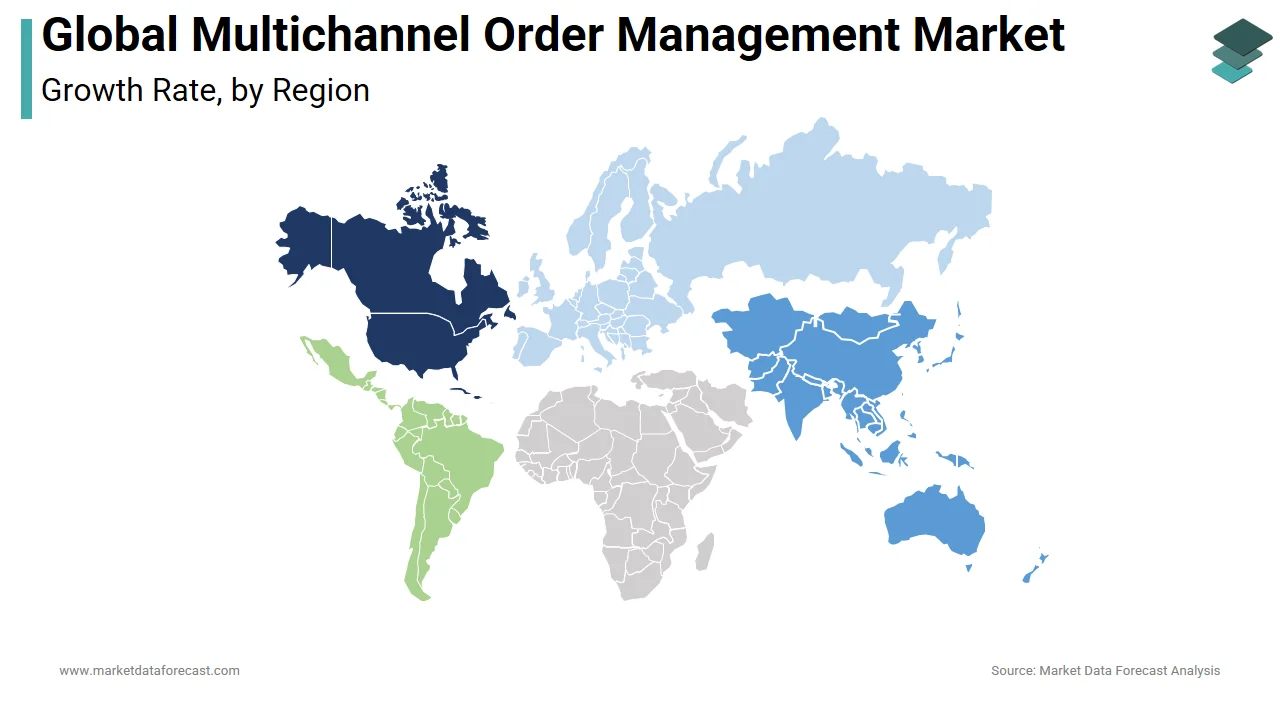
North America outperformed other regions in the global multichannel order management market by capturing a 38.5% share in 2024. The region’s dominance is attributed to the maturity of its e-commerce ecosystem, density of enterprise retailers, and aggressive adoption of AI-driven logistics automation. E-commerce sales represent a significant percentage of all retail activity. Major retailers process a vast number of customer orders, requiring complex orchestration across a large network of fulfillment nodes. Most retailers have adopted cloud-native order management platforms, incorporating real-time inventory visibility and dynamic routing features. The region also leads in regulatory clarity around data privacy and consumer rights, enabling vendors to build standardized compliance frameworks. Heavy investment in last-mile automation, warehouse robotics, and predictive analytics further cements North America’s role as the innovation hub for next-generation order orchestration technologies.
Europe Multichannel Order Management Market Analysis
Europe was the second-largest region in the multichannel order management market by occupying a share of 27.6% share in 2024. The growth of the European market is propelled by its harmonized regulatory environment cross cross-border logistics networks, and high consumer demand for sustainable and transparent fulfillment. A majority of citizens engage in online purchasing, frequently utilizing multiple channels such as mobile apps, marketplaces, and convenient click-and-collect services. Implementing a unified order management system across markets significantly decreases delivery failures and enhances the speed of return processing. A few key markets dominate the spending on retail order management software within the region. The Digital Product Passport initiative under the EU Circular Economy Action Plan is also driving demand for systems capable of tracking product provenance and facilitating repair or resale workflows. Europe’s focus on green logistics and data sovereignty continues to shape vendor roadmaps globally.
Asia Pacific Multichannel Order Management Market Analysis
Asia Pacific is the fastest expanding region in the multichannel order management market because of the explosive rise of mobile-first commerce, social commerce, and hyperlocal delivery models, particularly in China, India, and Southeast Asia. Online retail sales are substantial, with a significant majority originating from short video platforms and live streaming apps. Merchants are reducing delivery lead times by dynamically allocating inventory across regional warehouses using intelligent order management engines. Small merchants are increasingly using multiple digital channels, which is driving the need for affordable cloud-based orchestration tools. Retailers are leaders in automation, utilizing AI for real-time order prioritization and carrier selection. The region’s fragmented logistics landscape and diverse payment methods make advanced order management not a luxury but a survival necessity.
Latin America Multichannel Order Management Market Analysis
Latin America is moderately growing in the global multichannel order management market. Rapid digitization is occurring in the region, propelled by increased smartphone ownership, greater mobile payment use, and consolidation within the marketplace, all despite its modest scale. Latin American e-commerce growth is heavily concentrated in a few key markets, driven by a major platform that processes a high volume of orders. Small retailers using integrated order management solutions are observing a substantial increase in customer loyalty and repeat purchases, enabled by unified customer profiles and automated restock triggers. Logistics inefficiencies frequently cause late or damaged online orders across the sector, and implementing intelligent routing and real-time tracking is critical for differentiation and customer satisfaction. Governments are also investing in digital infrastructure, with Chile and Colombia launching national e-invoicing and inventory synchronization mandates for retailers exceeding certain transaction thresholds. These regulatory tailwinds, combined with rising middle-class consumption, are positioning Latin America for sustained double-digit growth.
Middle East and Africa Multichannel Order Management Market Analysis
The Middle East and Africa are anticipated to expand in the multichannel order management market. Government digital initiatives, a growing youth demographic, and widespread mobile money are sparking transformative growth in the region, which is still in its early stages. Saudi Arabia’s Vision twenty thirty initiative is also driving enterprise adoption with NEOM and the Red Sea Project requiring multichannel retail orchestration for tourism and hospitality ecosystems. Though infrastructure gaps remain, the region’s leapfrog potential and regulatory modernization make it the most strategically vital emerging frontier.
COMPETITIVE LANDSCAPE
The gasoline fuel additives market is characterized by intense rivalry among global chemical manufacturers and specialty formulation providers striving to differentiate through performance innovation, regulatory compliance, and supply chain reliability. Competition is driven by increasingly stringent environmental standards requiring additives that reduce emissions and enhance fuel efficiency without compromising engine integrity. Major players compete on technical expertise, formulation stability, and global distribution networks to serve oil refiners and fuel retailers. Regional suppliers focus on cost leadership and localized regulatory adaptation, particularly in emerging markets with evolving fuel quality mandates. Product differentiation hinges on proprietary chemistries that address deposit control, octane enhancement, and corrosion inhibition. Strategic alliances with automotive OEMs and fuel standards bodies are common to validate efficacy and influence specification updates. Mergers and acquisitions remain prevalent as firms seek to consolidate portfolios, expand geographic reach, and absorb R and D capabilities. Price volatility of base chemicals and feedstock availability further intensifies margin pressures and operational agility.
KEY MARKET PLAYERS
The leading companies operating in the global multichannel order management market include:
- Salesforce
- IBM Corporation
- SAP SE
- Oracle Corporation
- HCL Technologies Ltd.
- Square, Inc.
- Zoho Corporation
- Aptean
- Unicommerce
- Cloud Commerce Pro
- Browntape
- Contalog
- Freestyle Solutions
- Vinculum
- Delhivery
TOP PLAYERS IN THE MARKET
- Salesforce plays a pivotal role in the multichannel order management market through its Commerce Cloud platform, which enables global brands to unify orders, inventory, and customer data across web, mobile store, and marketplace channels. Salesforce also deepened integration with NetSuite and SAP to support complex enterprise deployments. These initiatives reinforce its position as a leader in delivering scalable cloud-based orchestration tailored for omnichannel retailers and direct-to-consumer brands seeking real-time operational agility.
- Oracle contributes significantly to the multichannel order management landscape via its Oracle Order Management Cloud Service, which supports distributed order orchestration across B2B, B2C, and D2C models. The company also expanded pre-built connectors for TikTok Shop and regional marketplaces in Southeast Asia. These enhancements allow global manufacturers and retailers to reduce delivery costs, improve sustainability metrics, and accelerate time to market while maintaining compliance with local tax and return regulations across jurisdictions.
- SAP strengthens the multichannel order management ecosystem through its SAP Commerce Cloud and SAP S/4 HANA Order Fulfillment modules, which serve large enterprises managing complex global supply chains. The company also launched industry-specific order workflows for healthcare and automotive sectors to handle serialized items and compliance documentation. These innovations enable manufacturers, distributors, and retailers to enhance order accuracy, reduce manual intervention, and deliver consistent cross-channel experiences even amid volatile demand and supply disruptions.
TOP STRATEGIES USED BY THE KEY MARKET PARTICIPANTS
Key players in the multichannel order management market prioritize embedding artificial intelligence to enable predictive routing, dynamic inventory allocation, and automated exception handling. They invest heavily in expanding pre-built native integrations with emerging sales channels such as social commerce platforms and regional marketplaces to reduce implementation time. Strategic partnerships with logistics providers, payment processors, and ERP vendors ensure seamless data flow and operational continuity. Companies also focus on industry-specific customization to address compliance, inventory traceability, and returns complexity in sectors like healthcare, automotive, and luxury goods. Continuous enhancement of no-code configuration tools empowers business users to adapt workflows without developer dependency. Cloud native architecture and API first design remain central to ensuring scalability, resilience, and real-time synchronization across global operations.
MARKET SEGMENTATION
This research report on the global multichannel order management market has been segmented and sub-segmented based on the component, deployment, enterprise size, application, and region.
By Component
- Solution
- Services
By Deployment
- On-Premise
- Cloud
By Enterprise Size
- Small and Medium Enterprise
- Large Enterprise
By Application
- Healthcare
- Wholesale
- Manufacturing
- Food & Beverages
- Automotive
- Retail & E-Commerce
- Others
By Region
- North America
- Europe
- Asia-Pacific
- Middle East & Africa
- Latin America