- Product Description Description
- Table of Contents TOC
- List of Table & Figure LOT
- Get Free Sample PDF Sample PDF
Market Size, 2025
$1.85 BnMarket Estimate, 2026
$2.04 BnMarket Forecast, 2034
$4.46 BnCAGR, 2026–2034
10.26%North America Agaricus Bisporus Market Report Summary
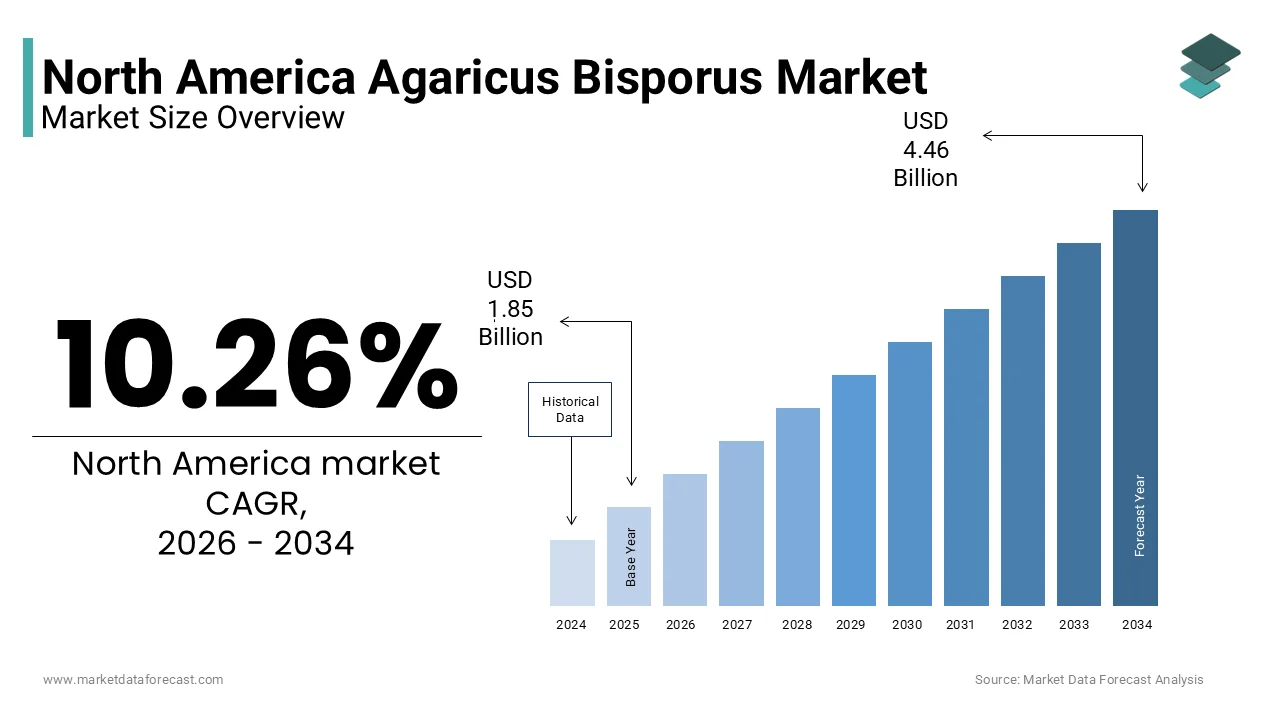
The North America Agaricus bisporus market was valued at USD 1.85 billion in 2025, is estimated to reach USD 2.04 billion in 2026, and is projected to reach USD 4.46 billion by 2034, growing at a CAGR of 10.26% during the forecast period from 2026 to 2034. The growth of the North America Agaricus bisporus market is driven by increasing consumer demand for healthy and protein-rich foods, rising adoption of plant-based diets, and expanding applications of mushrooms in retail, foodservice, and processed food industries. Growing awareness of the nutritional benefits of mushrooms, advancements in controlled-environment cultivation, and increasing demand for functional food ingredients are further supporting market growth. Additionally, the expanding retail sector and rising preference for fresh produce are accelerating market expansion across North America.
Key Market Trends
-
Rising consumer preference for healthy, low-calorie, and nutrient-rich foods is driving demand for Agaricus bisporus mushrooms.
-
Growing adoption of plant-based and flexitarian diets is increasing mushroom consumption across households and foodservice establishments.
-
Advancements in controlled-environment agriculture are improving production efficiency, quality, and year-round supply.
-
Expanding use of mushrooms in ready-to-eat meals, processed foods, and functional food products is creating new market opportunities.
-
Increasing retail availability through supermarkets and online grocery platforms is supporting market growth.
Segmental Insights
-
Based on type, the fresh mushroom segment dominated the North America Agaricus bisporus market by accounting for 68.0% of the market share in 2025. The segment's leadership is attributed to strong consumer preference for fresh mushrooms, their versatility in culinary applications, and increasing demand for minimally processed food products.
-
Based on end user, the supermarkets segment held the largest share of the North America Agaricus bisporus market by accounting for 43.5% of total demand in 2025. The segment's dominance is driven by broad product availability, organized retail expansion, competitive pricing, and consumer preference for purchasing fresh produce through modern retail outlets.
Regional Insights
-
The North America Agaricus bisporus market is witnessing strong growth due to increasing mushroom consumption, expanding commercial cultivation, and rising demand for healthy food products.
-
The United States dominated the North America Agaricus bisporus market by accounting for 84.6% of total regional production and consumption in 2025. The country's leadership is supported by its advanced mushroom cultivation industry, well-established retail infrastructure, growing consumer awareness of mushroom health benefits, and strong demand from both retail and foodservice sectors.
Competitive Landscape
The North America Agaricus bisporus market is moderately competitive, with manufacturers focusing on improving cultivation efficiency, product quality, and distribution capabilities to strengthen their market positions. Companies are investing in sustainable farming practices, controlled-environment agriculture, and strategic partnerships to meet the growing demand from retail, foodservice, and food processing industries. Key players operating in the North America Agaricus bisporus market include Mushroom Company, Bonduelle Fresh Europe, Agro Dutch Industries Ltd., Drinkwater's Button Mushrooms Limited, Banken Champignons, Lutece Holdings B.V., Drinkwater Mushrooms Ltd., Monaghan Button Mushrooms Ireland, Monterey Button Mushrooms Inc., Okechamp S.A., Shanghai Finc Bio-Tech Inc., and The Button Mushroom Company.
 Download Free Sample Report
North America Agaricus Bisporus Market Size
The Agaricus bisporus market size in North America was valued at USD 1.85 billion in 2025 and is predicted to be worth USD 4.46 billion by 2034 from USD 2.04 billion in 2026 and grow at a CAGR of 10.26% from 2026 to 2034.
Agaricus bisporus, commonly known as the button mushroom, is the most widely cultivated edible mushroom species in North America. It serves as a staple ingredient in both fresh and processed food applications across households, restaurants, and institutional catering. The North America Agaricus Bisporus Market encompasses commercial production, distribution, and consumption of this mushroom variant, primarily in the United States and Canada. Known for its mild flavor, versatility in culinary use, and nutritional benefits including high levels of B-vitamins, selenium, and antioxidants, Agaricus bisporus has become a key player in the broader mushroom market.
According to data from the Agricultural Marketing Resource Center (AgMRC), over 90% of mushrooms consumed in the U.S. are Agaricus bisporus, available in various forms such as white button, cremini, and portobello. As consumer preferences shift toward plant-based diets and functional foods, demand for nutrient-dense ingredients like mushrooms has surged. Besides, the rise of health-conscious eating habits and sustainability-driven food choices have further bolstered interest in mushroom cultivation and consumption.
Despite being a mature industry, the North American Agaricus Bisporus Market continues to evolve through innovations in farming techniques, packaging solutions, and value-added product development. These trends reflect an increasing alignment between agricultural practices and modern dietary expectations, positioning Agaricus bisporus as a central element of the region’s fresh produce sector.
MARKET DRIVERS
Rising Consumer Preference for Plant-Based Diets
Growing adoption of plant-based diets among health-conscious consumers is one of the primary drivers fueling the North America Agaricus Bisporus Market. As more individuals seek alternatives to meat and dairy products for ethical, environmental, or health-related reasons, mushrooms—particularly Agaricus bisporus—have emerged as a favored substitute due to their texture, umami flavor, and nutritional profile.
Agaricus bisporus is frequently used in vegetarian burgers, meatless sauces, and vegan dishes, offering a natural source of protein and essential micronutrients without the need for artificial additives.
Moreover, as awareness about the benefits of fiber-rich and low-calorie foods increases, consumers are incorporating mushrooms into everyday meals. As per the Mushroom Council, over 65% of American households purchased mushrooms at least once a month in 2023 , with Agaricus bisporus leading in volume. This trend shows how shifting dietary patterns are significantly contributing to the sustained growth of the mushroom market in North America.
Expansion of Functional Food and Nutraceutical Applications
Expanding role of mushrooms in functional foods and nutraceuticals is another major driver behind the growth of the North America Agaricus Bisporus Market. With rising consumer awareness about immunity-boosting and wellness-oriented diets, Agaricus bisporus is increasingly being incorporated into products designed to deliver health benefits beyond basic nutrition.
As per research conducted by the American Society for Nutrition (ASN), mushrooms like Agaricus bisporus are rich in bioactive compounds such as beta-glucans, ergothioneine, and vitamin D precursors, which support immune function and cardiovascular health. In response, food manufacturers are integrating mushroom powders, extracts, and concentrates into energy bars, plant-based milks, and fortified snacks.
Apart from these, the nutraceutical industry has recognized the potential of Agaricus bisporus in dietary supplements aimed at enhancing overall well-being.
These developments draw attention to the transition of mushrooms from traditional culinary ingredients to valued components of functional food and wellness-focused products, reinforcing their growing importance in the North American diet and health landscape.
MARKET RESTRAINTS
Seasonal Sensitivity and Environmental Vulnerability
Crop’s susceptibility to seasonal fluctuations and environmental conditions is a significant restraint affecting the North America Agaricus Bisporus Market. Unlike many other agricultural commodities that can be grown year-round with minimal intervention, mushroom cultivation requires highly controlled environments with precise temperature, humidity, and air quality parameters.
According to the Pennsylvania State University Extension, deviations in compost composition or casing soil moisture can severely impact mushroom yield and quality. For instance, prolonged heat waves or unseasonal rainfall events—increasingly common due to climate change—can disrupt mushroom cropping cycles, leading to supply shortages and price volatility.
Furthermore, mushroom farms are often located in specific regions known for favorable microclimates, such as Pennsylvania and California in the U.S., making the industry vulnerable to localized disruptions. As per the USDA noted in a 2023, extreme weather events had caused temporary closures of several mushroom houses in the Northeastern U.S., reducing regional output by nearly 12% during peak harvesting months.
This dependency on stable growing conditions introduces operational risks and cost pressures for producers, limiting the scalability and consistency of Agaricus bisporus supply across North America.
High Operational Costs and Labor Shortages
High cost of production combined with labor shortages in the mushroom farming sector is another critical constraint impacting the North America Agaricus Bisporus Market. Cultivating mushrooms is a labor-intensive process that involves manual harvesting, substrate preparation, and continuous monitoring of environmental controls. However, the availability of skilled farm labor has been declining in recent years, particularly in traditional mushroom-growing states.
Many farms rely on seasonal migrant workers, whose access has been restricted due to tightening immigration policies and border controls post-pandemic.
Further, mushroom farming facilities require significant investment in climate-controlled infrastructure, pasteurization units, and composting systems. Like, start-up costs for a medium-sized mushroom facility exceeded USD 2 million, discouraging new entrants and limiting expansion opportunities for smaller producers.
These financial and workforce challenges contribute to increased production costs, which are often passed on to consumers, potentially deterring price-sensitive buyers and constraining market growth.
MARKET OPPORTUNITIES
Growing Demand for Organic and Locally Sourced Mushrooms
The rising consumer preference for organic and locally sourced produce presents one of the most promising opportunities for the North America Agaricus Bisporus Market. As awareness about food transparency, sustainability, and health benefits grows, shoppers are increasingly seeking out certified organic mushrooms and supporting local growers who adhere to environmentally responsible farming practices.
According to the Organic Trade Association (OTA), organic mushroom sales in the U.S. increased by 22% in 2023, with Agaricus bisporus accounting for the majority of this growth. Consumers are willing to pay a premium for organically grown varieties, believing them to be free from synthetic pesticides and richer in nutrients.
Simultaneously, urban farming initiatives and vertical agriculture startups are capitalizing on the demand for locally grown food by establishing indoor mushroom farms in metropolitan areas. As per the Urban Agriculture Alliance (UAA), over 30 new indoor mushroom farms opened in major North American cities in 2023, many focusing exclusively on Agaricus bisporus due to its adaptability to controlled-environment agriculture.
This shift toward clean-label and hyper-local sourcing presents a valuable avenue for mushroom producers to differentiate their offerings and capture a niche yet rapidly expanding segment of the market.
Integration into Ready-to-Eat and Convenience Food Products
Its increasing integration into ready-to-eat (RTE) and convenience food products is another emerging opportunity for the North America Agaricus Bisporus Market. As modern lifestyles become busier and demand for quick meal solutions rises, food manufacturers are exploring ways to incorporate nutrient-dense ingredients like mushrooms into pre-prepared meals, frozen entrees, and snackable formats.
Agaricus bisporus is particularly well-suited for these applications due to its neutral taste, firm texture, and ability to absorb flavors when cooked.
In addition, food tech companies are developing mushroom-based meat analogs and blended burger patties that combine ground beef with finely chopped mushrooms to enhance moisture content and reduce calorie density. As per the Culinary Institute of America’s 2023 food trends report, over 50% of chefs surveyed planned to feature mushroom-blended proteins on their menus, reflecting a broader acceptance of mushrooms in mainstream cuisine.
MARKET CHALLENGES
Limited Shelf Life and Post-Harvest Handling Constraints
The perishable nature of mushrooms, which limits their shelf life and complicates logistics across the supply chain is one of the foremost challenges facing the North America Agaricus Bisporus Market. Fresh mushrooms typically remain viable for only five to seven days under optimal storage conditions, requiring efficient transportation and rapid retail turnover to prevent spoilage.
According to the University of California Cooperative Extension, improper handling or exposure to moisture can accelerate bacterial growth and lead to premature softening or discoloration. This sensitivity necessitates specialized packaging and cold-chain logistics, adding complexity and cost to distribution networks.
Moreover, as consumer expectations for freshness and visual appeal grow, retailers face pressure to maintain consistent stock while minimizing waste. As per the Natural Resources Defense Council (NRDC), up to 20% of harvested mushrooms are discarded before reaching consumers due to cosmetic imperfections or logistical delays.
Competition from Alternative Mushroom Varieties and Substitutes
The increasing competition from alternative mushroom species and plant-based substitutes is another pressing challenge in the North America Agaricus Bisporus Market. While Agaricus bisporus remains the most widely consumed mushroom, varieties such as shiitake, oyster, and king oyster are gaining popularity for their distinct flavors, textures, and perceived health benefits.
These exotic varieties are often marketed as premium ingredients, attracting health-conscious and culinary-savvy consumers.
Moreover, plant-based meat alternatives made from soy, pea protein, and mycoprotein are increasingly replacing mushrooms in some recipes, particularly in fast-food chains and mass-produced plant-based meals. As per the Good Food Institute (GFI), sales of plant-based meats surpassed USD 1.4 billion in 2023 , indicating a shift in consumer behavior that could affect mushroom usage in certain segments.
REPORT COVERAGE
| REPORT METRIC | DETAILS |
| Market Size Available | 2025 to 2034 |
| Base Year | 2025 |
| Forecast Period | 2026 to 2034 |
| CAGR | 10.26% |
| Segments Covered | By Type, End-User, and Region |
|
Various Analyses Covered | Regional & Country Level Analysis, Segment-Level Analysis, DROC, PESTLE Analysis, Porter’s Five Forces Analysis, Competitive Landscape, Analyst Overview on Investment Opportunities |
| Regions Covered | The United States, Canada, Mexico, and Rest of North America |
| Market Leaders Profiled | Mushroom Company, Bonduelle Fresh Europe, Agro Dutch Industries Ltd., Drinkwater’s Button Mushrooms Limited, Banken Champignons, Lutece Holdings B.V., Drinkwater Mushrooms Ltd., Monaghan Button Mushrooms Ireland, Monterey Button Mushrooms Inc., Okechamp S.A., Shanghai Finc Bio‑Tech Inc, and others |
SEGMENTAL ANALYSIS
By Type Insights
The fresh mushroom segment dominated the North America Agaricus Bisporus Market by capturing an estimated 68% market share in 2025. Increasing demand for minimally processed foods is one of the key drivers behind the lead position of fresh mushroom segment. In addition, consumer preference for fresh produce, particularly among health-conscious individuals and professional chefs who prioritize taste, texture, and nutritional value is also attributed to the overwhelming dominance of this segment. Retailers have responded by expanding fresh mushroom availability across grocery chains and farmers’ markets, reinforcing accessibility and visibility.

The widespread use of fresh Agaricus bisporus in home cooking and restaurant dishes is another contributing factor. As per the National Restaurant Association (NRA), over 60% of American restaurants regularly feature mushrooms on their menus, with white button and cremini varieties being the most commonly used. These mushrooms are favored for their versatility across cuisines, from Italian pasta sauces to Asian stir-fries and gourmet burgers.
The processed mushrooms segment is the fastest-growing segment in the North America Agaricus Bisporus Market and is projected to expand at a CAGR of 6.4% between 2026 and 2034. Increasing adoption of frozen and canned mushroom products in ready-to-eat meals and institutional catering is one of the primary reasons for this rapid expansion of processed mushrooms segment. Shifting consumer lifestyles and the rising popularity of convenience foods that incorporate ready-to-use ingredients further drives the growth of this segment.
Besides, foodservice operators and commercial kitchens are increasingly sourcing processed mushrooms to streamline preparation and reduce labor costs.
Moreover, dried mushroom powders and dehydrated slices are gaining traction in functional food and seasoning formulations. As convenience-driven consumption patterns evolve, processed mushrooms are poised for accelerated adoption across North America.
By End-User Insights
The supermarkets segment held the largest share in the North America Agaricus Bisporus Market by accounting for 43.5% of total end-user demand in 2025. The high volume of mushroom sales through national grocery retailers such as Walmart, Kroger, Albertsons, and Loblaws is One of the key drivers behind supermarket dominance. This dominance is also due to the widespread availability of fresh and packaged mushrooms in major retail chains, coupled with consistent consumer purchasing habits.
Apart from these, promotional campaigns and strategic product placements play a crucial role in boosting supermarket sales.
Furthermore, advancements in packaging—such as breathable film wraps and modified atmosphere containers—have extended shelf life and improved freshness perception, encouraging repeat purchases.
The restaurants segment is the fastest-growing end-user segment in the North America Agaricus Bisporus Market and is expected to grow at a CAGR of 7.1% through 2034. The rise of health-focused and flexitarian diets within the foodservice sector is A major driver of this trend. This growth is also fueled by the increasing integration of mushrooms into diverse menu offerings, from fine dining to fast casual and plant-based eateries. According to the NRA’s What’s Hot Culinary Survey, mushrooms were listed among the top five most-used ingredients in new restaurant dishes introduced in 2023, with Agaricus bisporus being the preferred variety due to its mild flavor and adaptability.
Further, the popularity of mushroom-blended meat dishes has surged, particularly in burger chains and pizzerias aiming to offer healthier, more sustainable options. Moreover, the post-pandemic recovery of the hospitality sector has boosted dine-in traffic, further supporting demand for premium ingredients.
REGIONAL ANALYSIS
United States
The United States led the North America Agaricus Bisporus Market by commanding a 84.6% of total regional production and consumption. As the world's largest producer and consumer of mushrooms, the U.S. maintains a well-established infrastructure for cultivation, processing, and distribution of Agaricus bisporus across both fresh and processed formats. One of the key factors driving the U.S. market is the strong presence of large-scale mushroom farms, particularly in Pennsylvania, California, and Florida. As per the Pennsylvania Department of Agriculture, the state alone accounts for more than half of all U.S. mushroom production, benefiting from favorable climate conditions and decades of expertise in controlled-environment farming.
Besides, the mushroom industry benefits from robust research initiatives aimed at improving yield, sustainability, and disease resistance. The Agricultural Research Service (ARS) highlighted several recent breakthroughs in composting techniques and pest management that have enhanced productivity and reduced environmental impact.
Consumer preferences also play a significant role, with Americans consuming an average of 3.2 pounds of mushrooms per capita annually, the majority of which consists of Agaricus bisporus.
Canada
Canada holds a significant share of the North America Agaricus Bisporus Market. Though smaller in scale compared to the U.S., Canada’s mushroom industry is highly developed, with a strong emphasis on quality, sustainability, and local sourcing. A major driver of growth in Canada is the increasing domestic demand for fresh mushrooms, particularly in urban centers such as Toronto, Montreal, and Vancouver. As per the Statistics Canada, per capita mushroom consumption rose by nearly 10% between 2020 and 2023, reflecting broader dietary shifts toward plant-based eating and nutrient-rich ingredients.
Moreover, Canada is home to several large-scale mushroom producers, particularly in Ontario and British Columbia, were advanced greenhouse technologies support year-round cultivation. Furthermore, the Canadian government has been promoting agricultural innovation through grants and research partnerships, fostering the development of organic and specialty mushroom varieties. As consumer awareness expands and export opportunities grow, Canada’s Agaricus bisporus market continues to strengthen its position within North America’s broader mushroom ecosystem.
COMPETITIVE LANDSCAPE
The North America Agaricus Bisporus Market is characterized by a competitive yet consolidated landscape, where a few dominant players coexist alongside numerous regional and local growers. While large-scale producers leverage economies of scale, advanced technology, and extensive distribution networks, smaller farms differentiate themselves through niche marketing, organic certifications, and direct-to-consumer sales channels. The competition extends beyond volume to include product freshness, packaging innovation, and branding strategies aimed at capturing consumer trust and loyalty.
Retailers and foodservice operators exert considerable influence over market dynamics, often dictating pricing structures and quality standards that shape producer behavior. Apart from these, shifting dietary trends—such as the rise of plant-based diets and flexitarian eating—have intensified competition among mushroom suppliers to position Agaricus bisporus as a staple ingredient in mainstream cuisine.
Innovation in cultivation methods, supply chain optimization, and sustainability initiatives further define competitive positioning. As demand for functional foods grows, companies are also exploring opportunities to integrate mushrooms into health-focused products, reinforcing their relevance in a rapidly evolving agri-food ecosystem.
KEY MARKET PLAYERS
Some of the key players in the North America agaricus bisporus market are
- Mushroom Company
- Bonduelle Fresh Europe
- Agro Dutch Industries Ltd.
- Drinkwater's Button Mushrooms Limited
- Banken Champignons
- Lutece Holdings B.V.
- Drinkwater Mushrooms Ltd.
- Monaghan Button Mushrooms Ireland
- Monterey Button Mushrooms Inc.
- Okechamp S.A.
- Shanghai Finc Bio-Tech Inc.
- The Button Mushroom Company
TOP PLAYERS IN THE MARKET
Several companies play a pivotal role in shaping the North America Agaricus Bisporus Market through large-scale production, innovation, and sustainable agricultural practices. Among them, Milestone Mushrooms, The Mushroom Company, and Taylor Farms stand out as key contributors to both regional and global mushroom supply chains.
- Milestone Mushrooms is one of the largest vertically integrated mushroom producers in North America. The company specializes in cultivating high-quality Agaricus bisporus varieties, including white button, cremini, and portobello mushrooms. With state-of-the-art growing facilities and a strong commitment to food safety, Milestone has become a preferred supplier for major retailers and foodservice providers across the continent.
- The Mushroom Company is a leading brand known for its premium fresh and processed mushroom offerings. Focused on Agaricus bisporus cultivation, the company has built a reputation for consistency, traceability, and environmental stewardship. Its partnerships with organic certification bodies and sustainability-focused farming initiatives have reinforced its market presence.
- Taylor Farms operates at the intersection of fresh produce and value-added food processing. As a major player in the mushroom industry, Taylor Farms integrates Agaricus bisporus into ready-to-eat meals, pre-packaged salads, and plant-based protein blends. Its ability to combine agricultural expertise with food innovation makes it a key force in expanding mushroom consumption across diverse consumer segments.
TOP STRATEGIES USED BY KEY PLAYERS
Key players in the North America Agaricus Bisporus Market employ strategic initiatives to maintain leadership and enhance competitiveness. One of the primary strategies is vertical integration , where companies control every stage from substrate preparation to harvesting and packaging, ensuring quality, efficiency, and cost management.
Another crucial approach involves product diversification and value addition , such as introducing organic, pre-sliced, or ready-to-use mushroom formats that cater to evolving consumer preferences and convenience-driven lifestyles.
Lastly, companies are increasingly investing in sustainability and controlled-environment agriculture , incorporating energy-efficient growing systems, compost recycling, and water conservation techniques to align with environmental goals and regulatory expectations while maintaining production reliability.
RECENT HAPPENINGS IN THE MARKET
- In January 2023, Milestone Mushrooms announced a partnership with a leading U.S. grocery retailer to launch a private-label line of sustainably grown Agaricus bisporus , enhancing shelf visibility and strengthening retail relationships.
- In August 2023, The Mushroom Company invested in a new climate-controlled growing facility in British Columbia, aimed at extending year-round production capabilities and improving regional supply resilience.
- In March 2025, Taylor Farms introduced a line of mushroom-blended plant-based meal kits, leveraging the nutritional profile of Agaricus bisporus to tap into the rising demand for convenient, health-conscious food options.
- In October 2025, a joint initiative between major mushroom producers and an agricultural research institute launched a compost recycling program, designed to reduce waste and improve the sustainability of mushroom substrate production.
- In May 2026, a prominent Canadian mushroom grower expanded its export operations to the U.S. Midwest, capitalizing on regional demand growth and strengthening cross-border market presence.
MARKET SEGMENTATION
This research report on the North America agaricus bisporus market has been segmented and sub-segmented based on the following categories.
By Type
- Fresh Mushroom
- Processed
By End-User
- Restaurants
- Supermarkets
- Cafeterias
- Hotels
By Country
- The United States
- Canada
- Rest of North America