- Product Description Description
- Table of Contents TOC
- List of Table & Figure LOT
- Get Free Sample PDF Sample PDF
Market Size, 2025
$54.32 BnMarket Estimate, 2026
$61.79 BnMarket Forecast, 2034
$173.19 BnCAGR, 2026–2034
13.75%Executive Summary: North America Craft Beer Market
- Market Scope: Regional craft beer market analysis covering product types, distribution channels, country-level dynamics within North America, and artisanal brewing technology adoption metrics.
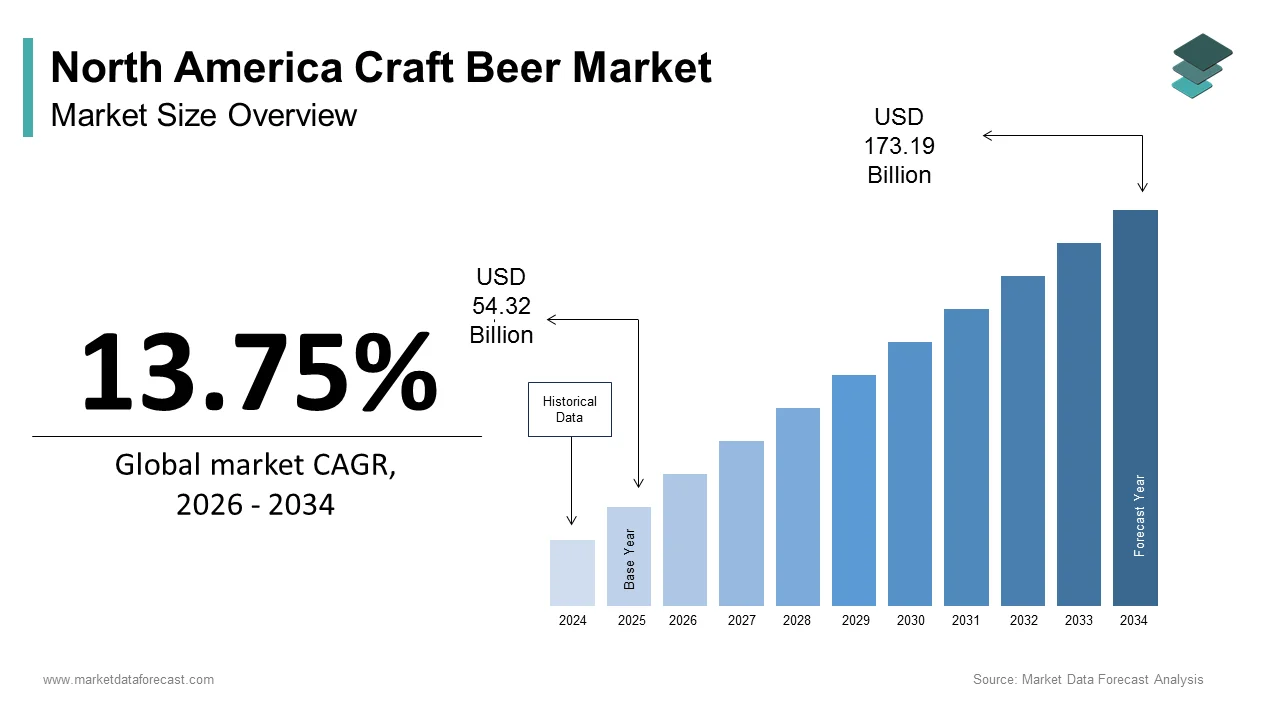
- Market Valuation: Valued at USD 54.32 billion in 2025, estimated at USD 61.79 billion in 2026, and projected to reach USD 173.19 billion by 2034, registering a CAGR of 13.75% from 2026 to 2034.
- Primary Growth Drivers: Rising consumer demand for premium beverages, increasing preference for locally brewed beer, growing interest in innovative flavors, expansion of craft breweries, and adoption of sustainable brewing practices.
Key Market Segment Metrics (2026–2034)
| Category | Leading Segment (Position) | Fastest-Growing / Key Growth Segment |
|---|---|---|
| By Product Type & Channel | Ale (dominated with a 40.5% share in 2025) & Off-Trade (held largest share at 57.3%) | Lager (fastest-growing type at 6.8% CAGR) & On-Trade (growing at 8.5% CAGR via taprooms) |
| By Technology & Innovation | Traditional craft brewing setups and standard fermentation methods | Solar power capacity expansions, organic hard seltzers, collaborative IPAs, and modern packaging designs |
| By Country / Regional Dynamics | United States (led the market with a 78.8% share in 2025) | Canada (expanding presence through robust local production and regulatory support) |
Major Market Players & Market Structure
Market Structure: Highly competitive North American artisanal and commercial brewing sector characterized by sustainable energy investments, organic product line launches, strategic retail partnerships, and collaborative limited-edition releases.
Key Companies: Carlsberg Group, Anheuser-Busch InBev, Diageo PLC, Erdinger Brewery, Heineken N.V, Lasco Brewery, Radeberger Brewery, Oettinger Brewery, and BAVARIA N.V.
North America Craft Beer Market Size
The Size of the North America Craft Beer Market was calculated to be USD 54.32 billion in 2025 and is anticipated to be worth USD 173.19 billion by 2034 from USD 61.79 billion in 2026, growing at a CAGR of 13.75% during the forecast period.
Craft beer is beer made by small, independent breweries that prioritize traditional brewing methods, high-quality ingredients, and innovative flavors. Unlike mass-produced beers, it is typically brewed in smaller batches and focuses on taste and craftsmanship rather than large-scale corporate output. The Brewers Association defines a craft brewer as one that produces fewer than 6 million barrels annually and is less than 25% owned by a non craft beverage alcohol industry member. This sector represents a significant cultural and economic shift away from mass produced lagers toward artisanal and localized beverages. In the United States and Canada consumers increasingly view beer as a culinary experience rather than a commodity driving demand for diverse styles such as India Pale Ales stouts and sour ales. According to the Brewers Association, the number of operating craft breweries in the United States reached an all-time high of 9,683 in 2023 (with a total brewery count of 9,812). The market is characterized by intense competition and a strong emphasis on community engagement through taprooms and local events. Consumer preferences are shifting toward quality over quantity with many drinkers adopting a drink less but better philosophy. This trend supports premium pricing and higher margins for craft producers. The regulatory environment varies significantly between states and provinces influencing distribution capabilities and tax structures. Sustainability initiatives are also becoming central to brand identity as breweries seek to reduce water usage and carbon footprints. The definition of craft beer continues to evolve with the inclusion of hard seltzers and ready to drink cocktails by some producers although purists argue these fall outside the traditional scope. The market remains a vital component of the broader alcoholic beverage landscape driving innovation and tourism.
MARKET DRIVERS
Consumer Preference for Premiumization and Quality Over Quantity
The shift toward premiumization and a quality-over-quantity mindset is a primary driver for the North America Craft Beer Market. This is because consumers increasingly prioritize taste and craftsmanship over volume. Modern drinkers are more educated about brewing processes and ingredients leading them to seek out unique and complex flavor profiles that mass market beers cannot offer. According to the Beverage Information Group sales of premium and super premium beer segments have consistently outpaced value segments in recent years reflecting this consumer behavior. This willingness to pay a premium allows craft breweries to maintain healthy margins despite higher production costs. The trend is particularly strong among millennials and Generation Z who view craft beer as a lifestyle choice and a form of self expression. Social media platforms amplify this trend by showcasing visually appealing packaging and unique brewing techniques which drive trial and brand loyalty. Breweries respond by experimenting with exotic hops adjuncts and aging processes to create distinctive products. The decline in overall beer consumption volume is offset by the increase in value per unit sold. Consumers are also more likely to visit taprooms where they can sample limited edition releases further enhancing the premium experience. This driver ensures that craft beer remains resilient even in economic downturns as buyers trade down from other luxury goods but maintain their spending on high quality beverages. The focus on local sourcing and artisanal production reinforces the perception of superior quality.
Strong Culture of Localism and Community Support
A strong culture of localism and community support propels the North America Craft Beer Market forward. Consumers actively seek to support local businesses and reduce their environmental footprint. The buy local movement has gained substantial momentum encouraging drinkers to choose beers brewed in their vicinity over national brands. This preference drives foot traffic to taprooms and local retail outlets creating a direct connection between brewers and their communities. Taprooms serve as social hubs fostering a sense of belonging and loyalty among patrons. Breweries often collaborate with local farmers for ingredients and local artists for label designs further embedding themselves in the community fabric. The environmental benefit of reduced transportation distances appeals to eco conscious consumers who are concerned about carbon emissions. Local governments often support craft breweries through tourism initiatives and festivals which enhance visibility and sales. The emotional connection consumers feel toward local brands provides a competitive advantage against larger corporations. This driver is reinforced by the narrative of independence and authenticity which resonates deeply with North American values. The resilience of local breweries during economic challenges demonstrates the strength of this community bond. The demand for local experiences and products remains robust as urbanization continues. Thus, this ensures sustained growth for regional craft brewers.
MARKET RESTRAINTS
Market Saturation and Intense Competition
Market saturation and intense competition are major barriers to the North American craft beer market. This occurs due to the fact that the number of breweries continues to exceed consumer demand in many regions. The rapid proliferation of craft breweries over the past two decades has led to a crowded marketplace where standing out becomes increasingly difficult. According to the Brewers Association the rate of new brewery openings has slowed while closures have increased indicating a maturing and consolidating market. This saturation leads to shelf space constraints in retail stores and bars forcing smaller players to compete aggressively for visibility. Many breweries struggle to achieve economies of scale resulting in higher per unit costs and lower profitability. The abundance of choices can also lead to consumer fatigue where buyers become overwhelmed and revert to familiar mainstream brands. Distribution channels are heavily contested with large beer conglomerates using their financial power to secure prime placements. Small breweries often lack the marketing budgets and distribution networks needed to expand beyond their local markets. The high failure rate of new breweries discourages investment and innovation in some areas. Consolidation through acquisitions by larger entities further reduces the number of independent players. This competitive pressure forces breweries to constantly innovate which can be costly and risky. The market is reaching a point of equilibrium where only the most efficient and differentiated brands will survive. This restraint limits the overall growth potential of the sector and necessitates strategic consolidation.
Rising Production Costs and Supply Chain Volatility
Rising production costs and supply chain volatility are significant hurdles for the North America Craft Beer Market. Breweries face these challenges as they navigate increasing expenses for raw materials and logistics. The cost of key ingredients such as barley hops and aluminum for cans has fluctuated wildly due to climate change geopolitical tensions and inflation. According to the Bureau of Labor Statistics the producer price index for malt beverages increased by 8 percent in 2023 driven by higher input costs. As per the Hop Growers of America hop prices have risen due to adverse weather conditions affecting yields in the Pacific Northwest a primary growing region. Aluminum tariffs and supply chain disruptions have also increased the cost of packaging which is a significant expense for craft brewers. Energy costs for brewing and refrigeration have surged adding to operational burdens. These increased costs squeeze profit margins forcing breweries to raise prices which can deter price sensitive consumers. Smaller breweries with limited cash reserves are particularly vulnerable to these fluctuations as they lack the bargaining power of larger competitors. Supply chain delays can lead to inventory shortages affecting sales and customer satisfaction. The unpredictability of costs makes long term planning and budgeting difficult for brewery owners. Some breweries are forced to reduce production volumes or discontinue less popular styles to manage expenses. This financial pressure stifles innovation and expansion efforts. The reliance on global supply chains for certain ingredients exposes breweries to international risks. Mitigating these costs requires significant investment in efficiency and alternative sourcing which is not always feasible for small operators. This restraint threatens the viability of many independent breweries in the current economic climate.
MARKET OPPORTUNITIES
Expansion into Non Traditional Beer Categories
The expansion into non traditional beer categories, such as hard seltzers, hard teas and ready to drink cocktails, offers a major opportunity for the North America Craft Beer Market. Brewers are diversifying their portfolios to meet changing consumer preferences. Many craft breweries are leveraging their fermentation expertise to produce these alternative beverages which appeal to health conscious and younger demographics. According to the Distilled Spirits Council of the United States (DISCUS), spirits-based ready-to-drink (RTD) pre-mixed cocktails grew by 26.7% in 2023 to reach $2.8 billion, and cementing its place as the fastest-growing spirits category. As per BevNet hard seltzer sales have stabilized after initial hype providing a steady revenue stream for breweries that entered the market early. This diversification allows breweries to attract consumers who may not drink traditional beer due to gluten concerns or calorie consciousness. It also helps mitigate the risk of relying solely on beer sales in a saturated market. Craft brewers can differentiate their offerings by using unique flavors and high quality ingredients that distinguish them from mass market alternatives. The production facilities for these beverages often overlap with beer brewing allowing for efficient use of resources. Marketing these products alongside beer expands brand reach and attracts new customer segments. The flexibility to experiment with new formats keeps brands relevant and exciting. This opportunity is particularly strong in urban areas where trends emerge and spread quickly. By embracing these adjacent categories craft breweries can sustain growth and remain competitive. The integration of these products into taprooms and distribution channels enhances overall revenue. This strategic pivot aligns with the broader trend of beverage alcohol convergence.
Growth of Direct to Consumer Sales and E Commerce
The growth of direct-to-consumer sales and e-commerce provides a clear path for the North America Craft Beer Market. This is heavily facilitated by recent regulatory changes and technological advancements that enable online beer sales. The pandemic accelerated the adoption of digital channels prompting many breweries to develop robust online stores and shipping capabilities. Alcohol e-commerce in North America has actually slowed down dramatically after its massive pandemic-era spikes. Consumer market data shows that instead of growing at a steady 15% clip, online alcohol sales have flattened out as buyers returned to buying their drinks in person at brick-and-mortar grocery and liquor stores. This channel allows breweries to bypass traditional distributors and retailers retaining higher margins and building direct relationships with customers. Subscription services and limited edition online releases create recurring revenue and exclusivity. Digital marketing tools enable targeted advertising and personalized recommendations enhancing customer engagement. Breweries can collect valuable data on consumer preferences which informs product development and inventory management. The ability to reach customers in remote areas expands market reach beyond local taprooms. Collaborations with third party delivery platforms further enhance accessibility. This opportunity empowers small breweries to compete with larger brands by offering unique and convenient purchasing experiences. The integration of social media and e commerce creates a seamless journey from discovery to purchase. As logistics improve and regulations continue to evolve this channel will become increasingly important. The direct connection with consumers fosters loyalty and advocacy. This digital transformation is essential for long term sustainability and growth.
MARKET CHALLENGES
Navigating Complex and Fragmented Regulatory Landscapes
Navigating complex and fragmented regulatory landscapes seriously impedes the North America Craft Beer Market. This is because breweries must comply with varying laws across different states and provinces. Each jurisdiction has its own rules regarding production limits labeling requirements distribution methods and taxation which creates administrative burdens. According to the Alcohol and Tobacco Tax and Trade Bureau federal regulations must be adhered to in addition to state and local laws which can often conflict. As per the Canadian Beverage Association provincial monopolies in Canada control the distribution and sale of alcohol limiting market access for small breweries. These regulatory hurdles increase compliance costs and delay product launches. Changes in laws such as excise tax adjustments or labeling mandates require constant monitoring and adaptation. The three tier system in the United States mandates separation between producers distributors and retailers which can limit direct sales opportunities. Navigating these systems requires legal expertise and resources that small breweries may lack. Inconsistencies in regulations across borders hinder expansion efforts for breweries looking to grow regionally or nationally. The complexity of exporting to other countries adds another layer of difficulty. Regulatory uncertainty can discourage investment and innovation. Breweries must dedicate significant time and money to ensure compliance which detracts from core business activities. The lack of harmonization across North America creates inefficiencies in the supply chain. Advocacy groups work to simplify regulations but progress is slow. This challenge remains a persistent barrier to growth and scalability for many craft brewers.
Shifting Consumer Preferences Toward Health and Wellness
Shifting consumer preferences toward health and wellness further hinders the expansion of the North America Craft Beer Market. Drinkers are increasingly reducing their alcohol intake or seeking healthier alternatives. The rise of the sober curious movement and low no alcohol trends is impacting traditional beer sales. Craft breweries traditionally focus on high alcohol content and rich flavors which may not align with these new preferences. Adapting to this trend requires reformulating products which can be technically challenging and may alter brand identity. Low alcohol beers often lack the body and taste of full strength versions leading to consumer dissatisfaction. The perception of beer as unhealthy due to calories and carbohydrates persists among health conscious buyers. Competitors in the functional beverage and kombucha sectors are capturing market share from beer. Breweries must invest in research and development to create appealing low alcohol options which increases costs. Marketing messages need to shift to emphasize moderation and quality which may conflict with traditional branding. The demographic most likely to drink craft beer is also the most health conscious creating a paradox. Failure to adapt to this trend could result in declining sales and relevance. Breweries must balance tradition with innovation to retain customers who are prioritizing wellness. This challenge requires a strategic rethinking of product portfolios and marketing strategies.
REPORT COVERAGE
| REPORT METRIC | DETAILS |
| Market Size Available | 2025 to 2034 |
| Base Year | 2025 |
| Forecast Period | 2026 to 2034 |
| CAGR | 13.75% |
| Segments Covered | By Product Type, Distribution Channel, And Region |
| Various Analyses Covered | Global, Regional & Country Level Analysis; Segment-Level Analysis; DROC, PESTLE Analysis; Porter’s Five Forces Analysis; Competitive Landscape; Analyst Overview of Investment Opportunities |
| Regions Covered | US, Canada, And Rest of North America |
| Market Leaders Profiled | Carlsberg Group, Anheuser-Busch InBev, Diageo PLC, Erdinger Brewery, Heineken N.V, Lasco Brewery, Radeberger Brewery, Oettinger Brewery, and BAVARIA N.V |
SEGMENTAL ANALYSIS
By Product Type Insights
The Ale segment held the majority share of 40.5% of the North America Craft Beer Market in 2025. This supremacy of the segment was credited to the enduring popularity of India Pale Ales IPAs and other hop forward styles that define the modern craft beer identity. Consumers in North America have developed a sophisticated palate for the bitter aromatic and complex flavor profiles offered by ales which distinguishes them from traditional lagers. According to the Brewers Association IPA sales accounted for nearly 40 percent of total craft beer volume in the United States in 2023 demonstrating the overwhelming preference for this ale subcategory. The cultural association of craft beer with experimentation and bold tastes favors ales which allow brewers to utilize diverse hop varieties and adjuncts. This segment benefits from continuous innovation such as hazy IPAs double IPAs and session IPAs which keep consumers engaged and willing to try new releases. The social media appeal of visually striking ales further drives demand among younger demographics. Breweries prioritize ale production because it offers higher margins and brand differentiation opportunities. The dominance of ales is also supported by the extensive availability of these styles in taprooms and retail stores ensuring easy access for consumers. The deep rooted culture of hop appreciation in North America ensures that ales remain the cornerstone of the craft beer industry. This preference is unlikely to diminish as brewers continue to push the boundaries of flavor and aroma in ale formulations.
The domination of the Ale segment is further reinforced by the versatility of brewing techniques and the ability to incorporate a wide range of ingredients which appeals to diverse consumer preferences. Ales are brewed at warmer temperatures using top fermenting yeast which allows for faster fermentation and greater flexibility in adding fruits spices and other adjuncts. tHE flexibility enables breweries to create seasonal limited edition and collaborative beers that generate buzz and drive foot traffic. The use of local ingredients such as regional hops fruits and herbs allows breweries to connect with their communities and offer unique terroir driven products. Ales can be adapted to various styles including stouts porters wheat beers and sour ales catering to different taste preferences and occasions. The ability to modify alcohol content from sessionable to high strength versions expands the target audience. Brewers leverage this versatility to respond quickly to emerging trends such as the demand for fruity or tart flavors. The technical ease of modifying ale recipes encourages continuous product development and keeps the segment dynamic. This adaptability ensures that ales remain relevant and exciting to consumers who seek novelty and variety in their beverage choices.
The Lager segment is on the rise and is expected to be the fastest growing segment in the market by witnessing a CAGR of 6.8% from 2026 to 2034 due to a consumer shift toward crisp refreshing and highly drinkable beers. After years of dominance by heavy and bitter ales many consumers are seeking lighter options that are suitable for extended social gatherings and warm weather consumption. Consumers appreciate the clean finish and smooth mouthfeel of lagers which make them versatile food pairing options. The rise of outdoor activities and patio culture has further amplified the demand for refreshing beverages that do not overwhelm the palate. Breweries are responding by investing in lagering tanks and mastering the precise temperature control required for high quality lager production. The perception of lager as a simple or basic beer is being challenged by craft brewers who highlight the skill and patience involved in brewing this style. Marketing campaigns emphasize the purity of ingredients and the traditional brewing methods used to create these beers. This resurgence is also fueled by the entry of new drinkers who may find ales too intense or bitter. The growing acceptance of lager as a premium craft option ensures sustained growth. The focus on quality and refreshment positions lagers as a key driver of future market expansion.
The rapid growth of the Lager segment is fueled by the expansion into premium and imported style lagers that appeal to discerning consumers seeking authenticity and quality. Craft breweries are increasingly producing Czech German and Mexican style lagers that offer distinct flavor profiles and cultural associations. Breweries are using high quality malt and noble hops to replicate the authentic taste of these imported beers. The marketing of these lagers often emphasizes heritage craftsmanship and purity which resonates with consumers valuing tradition. The availability of these styles in cans and bottles makes them accessible for home consumption and outdoor events. Collaborations with international breweries also help validate the quality and authenticity of domestic craft lagers. The trend toward globalization in food and beverage preferences supports the adoption of diverse lager styles. Consumers are educated about the differences between various lager types leading to more informed purchasing decisions. The premium positioning of these lagers allows breweries to command higher prices and improve margins. This segment benefits from the perception of lager as a sophisticated and refined choice. The continuous introduction of new lager variants ensures that the segment remains dynamic and appealing to a broad audience.
By Distribution Channel Insights
The off-Trade segment dominated the North America Craft Beer Market and accounted for a 57.3% share in 2025. This dominance of the segment was driven by the convenience and widespread availability of craft beer in retail stores supermarkets and specialty shops. Consumers prefer the ability to purchase beer for home consumption where they can enjoy it in a comfortable and cost effective environment. As per the Beverage Information Group the expansion of craft beer sections in mainstream grocery stores has significantly increased accessibility for average consumers. The variety of packaging options including cans bottles and multi packs caters to different consumption occasions and preferences. Retail promotions and discounts further drive sales in this channel attracting price sensitive buyers. The ability to browse and compare different brands and styles in store allows consumers to make informed choices. The growth of e commerce and home delivery services has further strengthened the off trade channel by providing additional convenience. Consumers appreciate the privacy and relaxation of drinking at home which has become more prevalent post pandemic. The off trade channel also benefits from the ability to stock up for parties and gatherings. Retailers invest in cold storage and display units to enhance the shopping experience. The dominance of off trade is supported by the established logistics and distribution networks that ensure consistent product availability. This channel remains the primary source of revenue for most craft breweries due to its scale and reach.
The top position of the Off-Trade segment is also supported by the cost effectiveness and value perception associated with purchasing beer for home consumption. Drinking at home is significantly cheaper than visiting bars or restaurants where markups on alcoholic beverages are high. The economic factor is particularly important in times of inflation or economic uncertainty when consumers are more budget conscious. The ability to buy in bulk through multi packs or cases offers additional savings and convenience. Retailers often offer loyalty programs and discounts that further enhance the value proposition for off trade purchases. Consumers perceive off trade purchases as a better value for money allowing them to enjoy higher quality craft beers without the premium service costs. The transparency of pricing in retail stores allows for easy comparison and decision making. The off trade channel also enables consumers to experiment with new brands at a lower financial risk. The combination of affordability and variety makes off trade the preferred choice for regular consumption. This value driven behavior ensures the continued leadership of the off trade segment in the craft beer market.
The on-trade segment is expected to exhibit a noteworthy CAGR of 8.5% during the forecast period owing to the revival of social dining and the popularity of brewery taprooms. Consumers are increasingly seeking experiential consumption where they can enjoy fresh beer in a social and engaging environment. As per the Brewers Association taproom sales now account for a substantial portion of revenue for many small breweries offering higher margins than distributed sales. The taproom experience allows consumers to interact directly with brewers learn about the brewing process and sample exclusive releases. This direct connection builds brand loyalty and community engagement. The rise of food pairings and gastropubs has elevated the status of craft beer in dining settings. Consumers are willing to pay a premium for the atmosphere service and freshness provided by on trade venues. The return of live music sports viewing and social events has further boosted foot traffic to bars and breweries. On trade venues offer a curated selection of local and regional beers that are not available elsewhere. This exclusivity drives trial and discovery among consumers. The social aspect of drinking on premise cannot be replicated by off trade channels. This experiential demand ensures the rapid growth of the on-trade segment.
The quick surge of the On-Trade segment is propelled by innovation in draft systems and the availability of limited release and experimental beers that are exclusively served on tap. Breweries use taprooms and bars as testing grounds for new recipes and seasonal offerings creating a sense of urgency and excitement among consumers. According to BeerAdvocate limited release taps drive significant foot traffic and social media engagement for breweries. As per Technomic the demand for unique and rotating tap lists is a key driver for visits to craft beer establishments. Draft beer offers superior freshness and flavor compared to packaged products which appeals to connoisseurs and enthusiasts. The use of advanced dispensing systems such as nitrogen taps and mixed gas blends enhances the presentation and texture of the beer. Bars and breweries collaborate to create exclusive collaborations and one off batches that attract dedicated fans. The visual appeal of draft pours and the ritual of serving beer add to the overall experience. On trade venues also host events such as tap takeovers and festivals that draw large crowds. These events create buzz and encourage repeat visits. The ability to provide immediate feedback to brewers fosters a sense of community and involvement. The exclusivity and novelty of on trade offerings differentiate this channel from retail. This focus on innovation and experience ensures that the on trade segment continues to grow at a faster rate than off trade.
REGIONAL ANALYSIS
United States Craft Beer Market Analysis
The United States led the North America Craft Beer Market and captured a 78.8% share in 2025. This leading position of the US market was supported by its large population and mature craft beer culture. The country is characterized by a high number of independent breweries and a strong consumer base that values diversity and quality in beer. According to the Brewers Association there were over 9,000 operating breweries in the United States in 2023 reflecting the depth and breadth of the industry. The regulatory environment varies by state but generally supports the growth of small breweries through favorable tax laws and direct sales permissions. Consumer trends in the US are driven by a desire for localization and sustainability with many buyers preferring beers from nearby breweries. The presence of major craft beer festivals and competitions fosters innovation and recognition. The US market is also a leader in adopting new trends such as hard seltzers and non alcoholic craft beers. Distribution networks are well developed allowing breweries to reach national and international markets. The competitive landscape is intense but drives continuous improvement and creativity. The US serves as a trendsetter for the global craft beer industry influencing styles and practices worldwide. The strong entrepreneurial spirit and supportive community ensure sustained growth and resilience.
Canada Craft Beer Market Analysis
Canada holds a significant position in the North America Craft Beer Market due to a vibrant brewing scene and strong provincial support for local products. The country has seen a steady increase in the number of craft breweries particularly in provinces like British Columbia Ontario and Quebec. According to data tracked by Beer Canada and analysts, the number of operating breweries in Canada was approximately 1,165 to 1,200 in 2022. In fact, the industry saw a contraction in subsequent years with closures increasing. Recent reports from the Canadian Craft Brewers Association and Statistics Canada indicate that beer sales volumes have been declining or flattening (down ~2.9% in 2023), with the sector facing a "year of correction" rather than continued robust expansion. The regulatory framework in Canada is complex due to provincial control over alcohol distribution but recent reforms have allowed for more direct sales and interprovincial trade. Canadian consumers are increasingly interested in local and sustainable products which benefits small independent breweries. The climate and geography influence the types of beers produced with a focus on lagers and ales that suit seasonal changes. The tourism sector plays a crucial role in promoting craft beer through brewery tours and festivals. Collaboration among breweries and with local food producers enhances the market appeal. The Canadian market is less saturated than the US offering opportunities for new entrants. The focus on community and heritage drives brand loyalty. Canada continues to innovate and expand its presence in the global craft beer landscape.
COMPETITION OVERVIEW
The competition in the North America Craft Beer Market is intense and characterized by a high number of independent breweries vying for consumer attention and shelf space. Large craft brewers compete with small local breweries through brand recognition distribution networks and marketing budgets. Product differentiation is crucial as breweries innovate with unique flavors ingredients and brewing styles to stand out. Price competition is moderate with premium positioning common among craft brands. The rise of alternative beverages such as hard seltzers and spirits adds pressure on beer sales. Consolidation through acquisitions by large beverage corporations impacts market dynamics and independence perceptions. Regulatory variations across states influence distribution strategies and market access. Consumer loyalty is driven by quality authenticity and community engagement rather than price alone. Digital platforms enable direct to consumer sales bypassing traditional distribution channels. Sustainability practices and corporate social responsibility are increasingly important competitive factors. The market requires continuous innovation and adaptability to survive. Breweries must balance growth with maintaining craft credibility. The fragmented nature of the market allows niche players to thrive alongside larger entities. Success depends on strategic positioning and operational efficiency.
KEY MARKET PLAYERS
A few major players of the north america craft beer market include
- Carlsberg Group
- Anheuser-Busch InBev
- Diageo PLC
- Erdinger Brewery
- Heineken N.V
- Lasco Brewery
- Radeberger Brewery
- Oettinger Brewery
- BAVARIA N.V
Top Strategies Used by Key Market Participants
Key players in the North America Craft Beer Market primarily focus on product diversification and experiential marketing to maintain competitive advantage. Companies expand their portfolios to include hard seltzers ready to drink cocktails and non alcoholic beers to capture broader consumer segments. Strategic investments in taprooms and brewery tours create direct consumer engagement and higher margin sales. Brands emphasize sustainability and local sourcing to appeal to environmentally conscious buyers. Digital marketing and social media campaigns drive brand awareness and loyalty among younger demographics. Collaborations with local businesses and artists enhance community ties and brand visibility. Mergers and acquisitions allow larger craft brewers to consolidate market presence and access new distribution channels. Innovation in flavor profiles and brewing techniques keeps product offerings fresh and exciting. These strategies collectively enable companies to navigate market saturation and shifting consumer preferences effectively.
Leading Players in the North America Craft Beer Market
- Boston Beer Company is a pioneering force in the North America Craft Beer Market known for its Samuel Adams brand and innovative product portfolio. The company has significantly influenced the industry by popularizing seasonal beers and introducing diverse styles to mainstream consumers. Recent actions to strengthen its market position include the expansion of its Truly Hard Seltzer line and the acquisition of Funky Buddha Brewery to enhance its craft credibility. Boston Beer Company invests heavily in marketing campaigns that emphasize brewing heritage and quality ingredients. The company also focuses on sustainability initiatives such as water conservation and renewable energy usage in its breweries. By diversifying into adjacent categories like hard tea and kombucha the company mitigates risks associated with beer market saturation. Their strategic partnerships with retail chains ensure broad distribution and visibility. Boston Beer Company continues to lead through innovation and brand loyalty maintaining a strong presence across the United States.
- Sierra Nevada Brewing Co is a cornerstone of the North America Craft Beer Market renowned for its commitment to quality and environmental stewardship. The company played a pivotal role in defining the American IPA style and continues to set standards for brewing excellence. Recent actions to strengthen its market position include the expansion of its brewery in Mills River North Carolina which increases production capacity and regional reach. Sierra Nevada emphasizes sustainable practices such as solar power generation and waste reduction appealing to eco conscious consumers. The company regularly releases limited edition and collaborative beers that drive consumer excitement and engagement. Their focus on employee welfare and community involvement enhances brand reputation and loyalty. Sierra Nevada also invests in educational programs about beer appreciation and brewing processes. By maintaining independence and prioritizing quality over volume the company retains its authentic craft identity. These efforts ensure Sierra Nevada remains a respected and influential player in the competitive landscape.
- D.G. Yuengling and Son Inc is the oldest operating brewery in the United States and holds a significant position in the North America Craft Beer Market due to its rich heritage and regional dominance. The company has successfully expanded its distribution beyond the East Coast to national markets leveraging its historical brand appeal. Recent actions to strengthen its market position include modernizing brewing facilities and introducing new packaging formats to attract younger demographics. Yuengling focuses on consistency and affordability making its products accessible to a broad audience. The brewery engages in local community events and sponsorships to reinforce its connection with consumers. By balancing tradition with modern marketing strategies Yuengling maintains relevance in a changing market. The company also explores partnerships with other craft brewers to expand its portfolio. Their emphasis on family owned values resonates with consumers seeking authentic experiences. Yuengling continues to grow by capitalizing on its legacy while adapting to contemporary trends in the craft beer industry.
RECENT HAPPENING NEWS IN THE MARKET
- In March 2024 Boston Beer Company launched a new line of organic hard seltzers. This launch is anticipated to allow Boston Beer Company to capture health conscious consumers and strengthen the North America Craft Beer Markett presence
- In May 2024 Sierra Nevada Brewing Co expanded its solar power capacity at its Chico facility. This expansion is anticipated to allow Sierra Nevada to reduce operational costs and strengthen the North America Craft Beer Markett presence
- In January 2025 D.G. Yuengling and Son Inc introduced a new packaging design for its flagship lager. This introduction is anticipated to allow Yuengling to attract younger buyers and strengthen the North America Craft Beer Markett presence
- In September 2024 Bell's Brewery partnered with a national retail chain for exclusive distribution. This partnership is anticipated to allow Bell's to increase market reach and strengthen the North America Craft Beer Markett presence
- In November 2024 New Belgium Brewing Company released a limited edition collaborative IPA. This release is anticipated to allow New Belgium to drive consumer excitement and strengthen the North America Craft Beer Markett presence
MARKET SEGMENTATION
This research report on the north america craft beer market has been segmented and sub-segmented based on product type, distribution channel, and region.
By Product Type
- Amber Ale
- Amber Lager
- Indian Pale Ale
- Others
By Distribution Channel
- On-site
- Off-site networks
By Region
- US
- Canada
- Rest of North America