- Product Description Description
- Table of Contents TOC
- List of Table & Figure LOT
- Get Free Sample PDF Sample PDF
Market Size, 2025
$14.31 BnMarket Estimate, 2026
$15.51 BnMarket Forecast, 2034
$29.57 BnCAGR, 2026–2034
8.4%North America Greenhouse Horticulture Market Size, Share, Trends & Forecast (2026–2034)
- Market Scope: Comprehensive regional market analysis covering covering materials, applications, products, and country-level breakdowns across the United States, Canada, and Mexico.
- Market Valuation: Valued at USD 14.31 billion in 2025, anticipated to reach USD 15.51 billion in 2026, and projected to scale up to USD 29.57 billion by 2034, registering a strong CAGR of 8.4% (with report metrics citing up to 11.3%) from 2026 to 2034.
- Primary Growth Drivers: Surging demand for locally sourced and organic produce, severe water scarcity driving resource-efficient protected agriculture, and technological adoption of AI, IoT, and automated climate control.
North America Greenhouse Horticulture Market Segment Metrics (2026–2034)
| Category | Leading Segment (2025 Position) | Fastest-Growing Segment |
|---|---|---|
| By Covering Material | Plastic (held majority share of 57.7% due to cost-effectiveness and film durability) | Glass (predicted highest CAGR of 9.3% due to light transmission and premium crops) |
| By Application | Greenhouse Films (dominated with a 44.3% share for microclimate control) | Grow Bags (estimated fastest CAGR of 12.2% from soilless/substrate adoption) |
| By Product | Edibles (largest segment at 62.3% share, driven by year-round vegetable demand) | Ornamentals (fastest CAGR of 10.8% driven by indoor gardening and biophilic design) |
| By Country | United States (led with a 71.8% share backed by massive agricultural hubs) | Canada (significant export-oriented clusters in Ontario, BC, and Quebec) |
Major Market Players & Competitive Landscape
Market Structure: Moderate consolidation characterized by turnkey solutions providers, structural engineers, and technology firms competing on digital automation, energy efficiency, and climate control innovations.
Key Market Players: Richel Group, Hoogendoorn Growth Management B.V., Certhon Inc., Dalsem Horticulture Projects B.V., HortiMaX B.V., Harnois Greenhouses, Priva B.V., Ceres Greenhouse Solutions, Van Der Hoeven, Oritech Solutions, Netafim Ltd., Ridder Holding Harderwijk B.V., Rough Brothers Inc., and Top Greenhouses Ltd.
 Download Free Sample Report
North America Greenhouse Horticulture Market Size
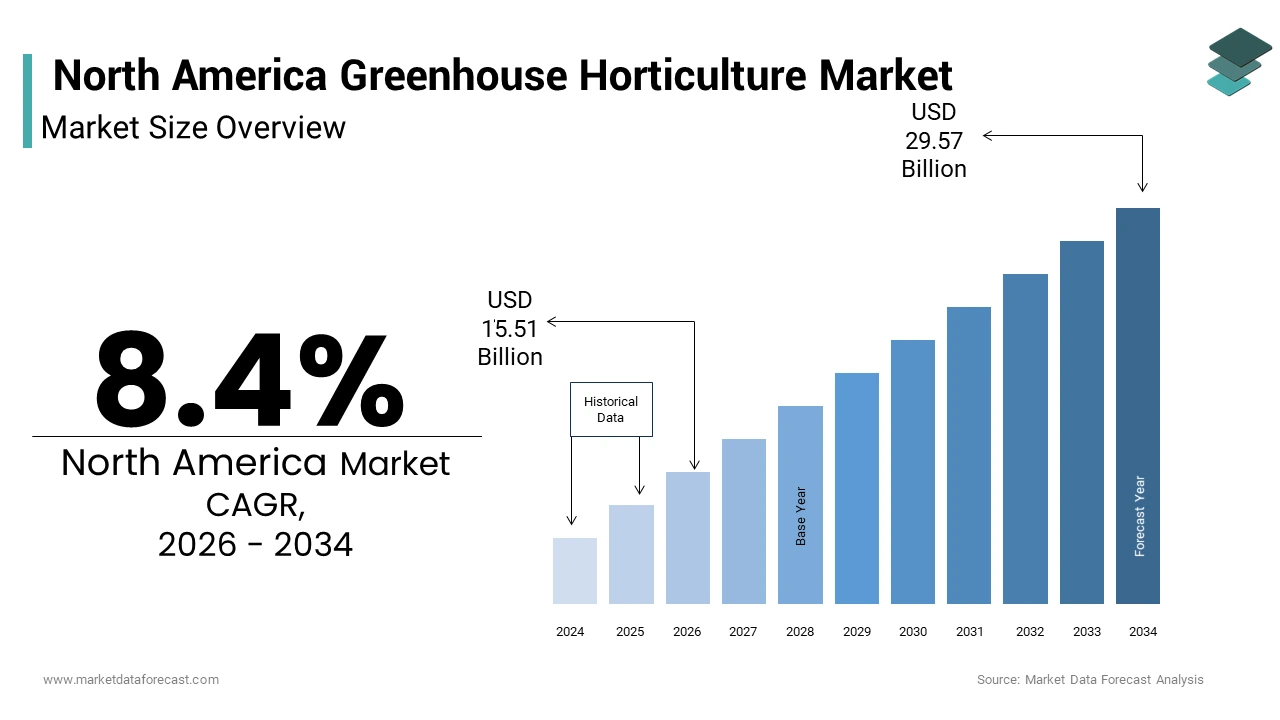
The North American greenhouse horticulture market was valued at USD 14.31 billion in 2025 and is anticipated to reach USD 15.51 billion in 2026 from USD 29.57 billion by 2034, growing at a CAGR of 8.4% during the forecast period from 2026 to 2034.
Greenhouse horticulture, also often called protected cropping, is a sophisticated agricultural sector dedicated to the cultivation of crops within controlled environments that regulate temperature, humidity, and light. This method allows for year round production independent of external weather conditions ensuring a consistent supply of fresh produce. The region is witnessing a paradigm shift from traditional open field farming to protected agriculture driven by the need for food security and resource efficiency. According to the United States Department of Agriculture the value of greenhouse and nursery products in the United States has consistently exceeded 15 billion dollars annually reflecting the economic significance of this sector. In Canada Statistics Canada data indicates that greenhouse vegetable area has expanded significantly with tomatoes peppers and cucumbers being the primary crops. The adoption of advanced technologies such as hydroponics aeroponics and automated climate control systems is transforming operational efficiency. Consumer demand for locally grown pesticide free produce is accelerating as urban populations seek fresher alternatives to imported goods. Furthermore the impact of climate change including unpredictable frost patterns and droughts is compelling growers to invest in resilient infrastructure. Government initiatives in both the United States and Canada are supporting sustainable agricultural practices through grants and research funding. The integration of Internet of Things devices enables real time monitoring and precision farming reducing waste and optimizing yields. This technological convergence positions greenhouse horticulture as a critical component of the future food supply chain in North America addressing both environmental and economic challenges.
MARKET DRIVERS
Increasing Demand for Locally Sourced and Organic Produce
The surging consumer preference for locally sourced and organic produce fuels the expansion of the North America greenhouse horticulture market. Modern consumers are increasingly conscious of the environmental footprint associated with long distance food transportation and the potential health risks of pesticide residues. According to the Organic Trade Association sales of organic food in the United States have grown steadily with fresh produce representing a significant portion of this growth. Greenhouses provide an ideal environment for organic cultivation by minimizing the need for chemical pesticides through biological control methods and physical barriers. In Canada the Local Food Plus certification and similar initiatives have boosted consumer confidence in regional produce. Retailers and restaurants are prioritizing local suppliers to reduce carbon emissions and support community economies. The ability of greenhouses to produce high quality leafy greens herbs and vegetables year round ensures a stable supply that meets the expectations of discerning customers. In urban centers like New York Toronto and Vancouver vertical farms and rooftop greenhouses are emerging to meet the demand for hyper local food. This trend is further supported by the Clean Label Project which highlights consumer desire for transparency in food sourcing. As health awareness rises particularly post pandemic individuals are willing to pay a premium for fresh nutrient dense foods. This shift in purchasing behavior incentivizes growers to adopt greenhouse technologies that guarantee product safety and freshness thereby driving market growth.
Water Scarcity and Need for Resource Efficient Agriculture
Water scarcity and the urgent need for resource efficient agricultural practices are compelling the region’s growers to adopt greenhouse horticulture, and thereby contribute to the growth of the North America greenhouse horticulture market. Traditional farming methods consume vast amounts of water which is becoming increasingly scarce in many parts of the continent due to climate change and overuse. According to the United States Geological Survey agriculture accounts for approximately 80 percent of the consumptive water use in the United States. Greenhouse systems particularly those utilizing hydroponic or aeroponic techniques can reduce water usage by up to 90 percent compared to conventional soil based farming. This efficiency is achieved through recirculating irrigation systems that capture and reuse nutrient rich water. In states like California and Arizona where drought conditions are frequent greenhouse operators are leading the transition to sustainable water management. The Canadian government also promotes water conservation technologies through various agricultural programs. Additionally greenhouses protect crops from extreme weather events such as heavy rains or hail which can damage open field crops and lead to significant losses. The controlled environment allows for precise application of nutrients reducing runoff and environmental pollution. As regulatory pressures mount regarding water usage and environmental protection greenhouse horticulture offers a viable solution that aligns with sustainability goals. Investors and policymakers are increasingly recognizing the long term benefits of these systems in preserving natural resources while maintaining high productivity levels. This strategic alignment with environmental stewardship drives substantial investment in greenhouse infrastructure across the region.
MARKET RESTRAINTS
High Initial Capital Investment and Operational Costs
High initial capital investment required for construction and equipment is one of the major factors obstructing the growth of the North America greenhouse horticulture market. Establishing a commercial grade greenhouse involves substantial expenditure on structures glazing materials heating ventilation and air conditioning systems as well as automated controls. Cornell University and modern CEA estimators indicate that while entry-level commercial greenhouses cost around $20 to $50 per square foot, a fully automated, high-tech greenhouse facility ranges from $50 to over $100 per square foot depending on the integration of advanced climate and lighting technologies. This financial barrier is particularly challenging for small and medium sized farmers who lack access to sufficient credit or capital. Additionally operational costs including energy for heating and lighting can be prohibitive especially in colder regions of Canada and the northern United States. Fluctuating energy prices further exacerbate these costs impacting profit margins. In regions with harsh winters heating expenses can account for a significant portion of the overall budget making it difficult to compete with imports from warmer climates. The complexity of managing advanced systems also requires skilled labor which commands higher wages. Without adequate financial support or subsidies many potential entrants are deterred from entering the market. The long payback period for greenhouse investments adds to the financial risk discouraging conservative investors. The high cost structure will remain a critical constraint on market expansion. This barrier will persist until financing options become more accessible and energy-efficient technologies become more affordable.
Labor Shortages and Skilled Workforce Availability
The availability of skilled labor is also a major restraint to the expansion of the North America greenhouse horticulture market. Operating modern greenhouses requires specialized knowledge in plant physiology pest management and technical system maintenance which is often lacking in the current workforce. According to the American Farm Bureau Federation labor shortages have been a persistent issue in the agricultural sector with many farms struggling to find qualified workers. The complexity of automated systems means that traditional farming skills are insufficient requiring additional training in technology operation. In Canada the seasonal nature of some greenhouse operations complicates workforce retention leading to high turnover rates. The aging demographic of existing farmers further exacerbates the problem as fewer young people are entering the agricultural profession. Immigration policies affecting the availability of seasonal workers also impact labor supply particularly in the United States where reliance on foreign labor is significant. Training programs are not always readily available or accessible leaving a gap between industry needs and worker capabilities. This shortage leads to increased operational inefficiencies and higher labor costs as companies compete for limited talent. Furthermore the physical demands of greenhouse work can deter potential employees seeking less strenuous jobs. Addressing this human resource challenge requires comprehensive educational initiatives and improved working conditions to attract and retain skilled personnel. Until the labor gap is bridged the scalability of greenhouse operations will remain constrained.
MARKET OPPORTUNITIES
Integration of Artificial Intelligence and Robotics
The integration of artificial intelligence and robotics opens the door for the growth of the North America greenhouse horticulture market. This enhances efficiency and reduces dependency on manual labor. AI powered systems can analyze data from sensors to optimize climate conditions nutrient delivery and irrigation schedules in real time. According to research, the adoption of automation in agriculture could increase productivity by 10 to 15 percent while reducing input costs. Robotics are being deployed for tasks such as seeding transplanting harvesting and packaging which are labor intensive and prone to human error. In the United States several startups are developing autonomous robots capable of identifying ripe fruits and harvesting them with precision. This technology not only addresses labor shortages but also improves consistency and quality control. In Canada research institutions are collaborating with tech firms to create smart greenhouse solutions that leverage machine learning for predictive analytics. These systems can forecast yield outcomes and detect early signs of disease allowing for proactive interventions. The scalability of AI solutions makes them attractive for large scale commercial operations seeking to maximize output. As the cost of sensors and computing power declines these technologies become more accessible to mid sized growers. The potential for data driven decision making empowers farmers to optimize resource usage and minimize waste. This technological evolution positions greenhouse horticulture at the forefront of the smart agriculture revolution offering significant competitive advantages.
Expansion into Urban and Vertical Farming Models
The expansion of protected cropping into urban and vertical farming models offers a significant opportunity to meet the growing demand for fresh produce in densely populated areas, which is expected to propel the North America greenhouse horticulture market. Urban greenhouses utilize unused spaces such as rooftops warehouses and abandoned buildings to cultivate crops closer to consumers. According to the United Nations Department of Economic and Social Affairs urbanization rates in North America continue to rise with over 80 percent of the population living in cities. This demographic trend creates a lucrative market for locally grown produce that reduces transportation costs and spoilage. Vertical farming techniques allow for high density cultivation by stacking layers of crops thereby maximizing space utilization. In cities like Chicago and Montreal vertical farms are supplying restaurants and grocery stores with fresh greens year round. The proximity to consumers enhances product freshness and allows for faster response to market demands. Additionally urban farming initiatives often receive support from local governments aiming to improve food security and reduce urban heat islands. Community engagement is another benefit as urban farms provide educational opportunities and green spaces. The modular nature of vertical systems allows for scalable deployment adapting to various urban environments. As real estate values fluctuate repurposing underutilized buildings for agriculture becomes economically viable. This model aligns with sustainability goals by reducing carbon footprints associated with food transport. The convergence of urban development and agricultural innovation creates a robust pathway for market growth and diversification.
MARKET CHALLENGES
Energy Volatility and Sustainability Pressures
Managing energy volatility and meeting sustainability pressures are major hurdles for greenhouse operators within the North America greenhouse horticulture market. Experts note that escalating geopolitical and market instability make treating energy as a strategic asset critical. Greenhouses require substantial energy for heating cooling and lighting particularly in regions with extreme temperatures. According to the Energy Information Administration natural gas and electricity prices have experienced significant fluctuations impacting operational budgets for agricultural facilities. In colder climates such as Canada and the northern United States heating costs can constitute up to 30 percent of total production expenses. Sudden spikes in energy prices can erode profit margins making it difficult for growers to maintain competitiveness against imports from regions with lower energy costs. Additionally there is increasing pressure from consumers and regulators to adopt renewable energy sources and reduce carbon emissions. Transitioning to solar or geothermal energy requires significant upfront investment which may not be feasible for all operators. The intermittency of renewable sources also poses reliability issues requiring backup systems. Compliance with evolving environmental regulations adds complexity to operations necessitating continuous monitoring and reporting. Growers must balance the need for cost effective energy solutions with sustainability goals to maintain market relevance. Failure to adapt to these pressures can result in reputational damage and loss of market share. Developing resilient energy strategies is crucial for long term viability but remains a complex and costly endeavor for many businesses in the sector.
Regulatory Complexity and Compliance Burdens
Navigating the complex regulatory landscape and compliance burdens associated with protected cropping is a considerable hurdle for operators in the region, which holds back the expansion of the North America greenhouse horticulture market. Regulations regarding water usage pesticide application waste management and food safety vary significantly between states provinces and federal jurisdictions. According to the Environmental Protection Agency stringent guidelines govern the discharge of nutrient rich wastewater from greenhouses to prevent environmental contamination. Compliance with these regulations requires investment in treatment systems and regular monitoring which increases operational costs. In Canada the Canadian Food Inspection Agency enforces strict standards for produce safety requiring detailed record keeping and traceability systems. Obtaining certifications such as GlobalGAP or Organic status involves rigorous audits and documentation adding to the administrative burden. Changes in labor laws and immigration policies also impact workforce management creating uncertainty for growers relying on seasonal workers. Zoning laws in urban areas may restrict the establishment of commercial greenhouses limiting expansion opportunities. The lack of harmonization across different regions complicates operations for companies seeking to scale across borders. Keeping abreast of evolving regulations requires dedicated legal and compliance resources which smaller operators may lack. Non compliance can result in hefty fines and operational shutdowns posing a significant risk to business continuity. Streamlining regulatory processes and providing clear guidance is essential to support the growth of the industry but remains an ongoing challenge for stakeholders.
REPORT COVERAGE
| REPORT METRIC | DETAILS |
| Market Size Available | 2025 to 2034 |
| Base Year | 2025 |
| Forecast Period | 2026 to 2034 |
| CAGR | 11.3% |
| Segments Covered | By Covering Material, Application, Product And Country |
| Various Analyses Covered | Global, Regional & Country Level Analysis, Segment-Level Analysis, DROC, PESTLE Analysis, Porter’s Five Forces Analysis, Competitive Landscape, Analyst Overview of Investment Opportunities |
| Regions Covered | The United States, Canada, Mexico, and the Rest of North America |
| Market Leaders Profiled | Richel Group, Hoogendoorn Growth Management B V, Certhon Inc, Dalsem Horticulture Projects B V, HortiMaX B V, Harnois Greenhouses, Priva B V, Ceres Greenhouse Solutions, Certhon, Van Der Hoeven, Oritech Solutions, Netafim Ltd, Ridder Holding Harderwijk B V, Rough Brothers Inc, Top Greenhouses Lt,d and others. |
SEGMENTAL ANALYSIS
By Covering Material Insights
In 2025, the plastic greenhouse segment held the majority share of 57.7% of the North America greenhouse horticulture market because of the cost effectiveness and widespread adoption of plastic structures among commercial growers across the region. The lower initial investment required for plastic structures compared to glass alternatives makes them highly accessible for small scale and medium scale agricultural operations. Technological advancements in polyethylene films have significantly improved the durability and light transmission properties of plastic coverings. These modern plastic materials offer excellent thermal insulation which helps maintain optimal growing temperatures while reducing energy consumption costs. The flexibility of plastic allows for easier construction and maintenance which further contributes to its popularity among farmers. Additionally plastic greenhouses can be customized with various additives to control ultraviolet radiation and enhance crop protection. Also, the USDA Census of Horticultural Specialties indicates that film plastic structures account for the largest share of protected agricultural area. The lightweight nature of plastic materials also reduces structural support requirements which lowers overall construction expenses. Studies note that the plastic segment benefits from continuous innovation in multilayer film technologies that extend lifespan and improve performance metrics. These factors collectively ensure that plastic greenhouses remain the preferred choice for a vast majority of horticultural producers in North America seeking economical and efficient cultivation solutions.
On the other hand, the glass greenhouse segment is predicted to witness the highest CAGR of 9.3% between 2026 and 2034 due to increasing demand for premium quality produce and controlled environment agriculture systems. Glass greenhouses offer superior light transmission characteristics which are essential for high value crops such as tomatoes peppers and ornamental plants. The longevity of glass structures provides long term value despite higher upfront costs as they can last for several decades with minimal degradation. Advanced glass technologies including double glazing and low emissivity coatings have improved energy efficiency making glass greenhouses more economically viable. Commercial growers are increasingly investing in glass structures to meet stringent quality standards required by retail chains and export markets. The aesthetic appeal of glass greenhouses also drives adoption in urban farming projects and agritourism ventures. Government incentives promoting sustainable agriculture practices further support the transition toward durable glass infrastructure. Sources confirm that glass greenhouses are uniquely suited for the integration of smart climate control and automation systems, significantly enhancing resource efficiency and crop productivity in high-tech operations. These technological synergies position glass greenhouses as the preferred solution for sophisticated horticultural operations aiming for maximum yield consistency and product quality.
By Application Insights
The greenhouse films segment dominated the North America greenhouse horticulture market and accounted for a 44.3% share in 2025. This dominance of the segment was driven by its critical role in creating optimal microclimates for crop cultivation across diverse geographical regions. These films provide essential protection against harsh weather conditions including extreme temperatures heavy rainfall and strong winds. Modern greenhouse films incorporate advanced additives that enhance ultraviolet stability thermal retention and light diffusion properties. The affordability of film based solutions makes them accessible to both large commercial operations and small scale family farms. Regular replacement cycles for greenhouse films generate consistent recurring revenue streams for manufacturers and distributors. Technological innovations have produced multilayer films that offer superior durability lasting up to five years or more under normal operating conditions. The versatility of greenhouse films allows customization for specific crop requirements such as increased infrared blocking for heat sensitive plants. A study indicates that the widespread adoption of protected agriculture techniques has significantly boosted demand for high performance greenhouse films. Agricultural extension services frequently recommend film covered structures as an entry point for farmers transitioning from open field cultivation. The ease of installation and maintenance further reinforces the preference for greenhouse films among horticultural practitioners. These factors collectively establish greenhouse films as the foundational component of contemporary greenhouse infrastructure throughout North America.
However, the grow bags segment is estimated to register the fastest CAGR of 12.2% over the forecast period owing to the increasing shift toward soilless cultivation methods and substrate based growing systems. Industry reports highlight that grow bags are expected to experience the highest growth rate among all application segments during the forecast period. North America holds approximately 28 percent of the global agricultural grow bags industry share driven by advanced greenhouse infrastructure and high adoption rates. Grow bags offer precise control over nutrient delivery and root zone management which enhances plant health and yield consistency. The convenience of pre filled grow bags reduces labor requirements and minimizes contamination risks associated with traditional soil preparation. Modern grow bags are manufactured from breathable materials that promote optimal aeration and drainage preventing root rot and disease incidence. The portability of grow bags facilitates efficient space utilization and enables flexible cropping arrangements within greenhouse facilities. Environmental sustainability concerns are driving adoption of biodegradable and recyclable grow bag options among eco conscious producers. Commercial vegetable growers particularly favor grow bags for cultivating tomatoes cucumbers and peppers due to improved harvest quality and extended production cycles. The integration of automated irrigation systems with grow bag setups further enhances operational efficiency and resource conservation. A study projects continued strong growth for grow bags as greenhouse operators prioritize precision agriculture techniques and standardized production protocols. These advantages position grow bags as an indispensable tool for modern horticultural enterprises seeking scalable and sustainable cultivation solutions.
By Product Insights
In 2025, the edibles segment was the largest in the North America greenhouse horticulture market and occupied a 62.3% share. The supremacy of this segment was supported by increasing consumer preference for fresh, locally grown produce with extended shelf life. This segment includes vegetables, fruits, and herbs cultivated under protected environments to meet year-round consumer demand. Greenhouse grown vegetables such as tomatoes lettuce and cucumbers command premium prices in retail markets due to their consistent quality and appearance. The United States Department of Agriculture reports that greenhouse vegetable production has expanded significantly to address seasonal supply gaps in traditional open field agriculture. Controlled environment cultivation enables producers to maintain strict quality standards and minimize pesticide usage which appeals to health conscious consumers. The rise of organic certification programs for greenhouse products has further strengthened market positioning for edible crops. Retail chains and food service providers increasingly source from greenhouse operations to ensure reliable supply contracts throughout the year. Technological advancements in hydroponic and aeroponic systems have dramatically increased yield per square foot for edible crops compared to conventional methods. Labor shortages in agriculture are partially mitigated by automation technologies specifically designed for harvesting and packaging greenhouse edibles. Consumer awareness campaigns promoting the nutritional benefits and environmental advantages of greenhouse grown foods continue to drive demand. The edibles segment benefits from strong government support through agricultural subsidies and research funding aimed at enhancing food security. These combined factors establish edibles as the cornerstone of North America greenhouse horticulture operations generating substantial revenue and employment opportunities.
On the other hand, the ornamentals segment is anticipated to witness the fastest CAGR of 10.8% from 2026 to 2034. This quick surge of the segment is fuelled by rising disposable incomes and growing interest in home gardening and landscaping. Also, this segment includes cut flowers potted plants foliage and decorative species cultivated for aesthetic and recreational purposes. The increasing trend toward indoor gardening and biophilic design in residential and commercial spaces fuels demand for ornamental plants. Social media platforms have amplified interest in plant care and interior decoration using live greenery creating new market opportunities. Specialty nurseries and online retailers have expanded distribution channels making ornamental plants more accessible to urban consumers. The wedding event and hospitality industries contribute significantly to demand for premium cut flowers and decorative arrangements. Advances in breeding techniques have produced novel varieties with unique colors shapes and fragrances that command higher profit margins. Greenhouse operators leverage climate control capabilities to force flowering and synchronize production with peak demand periods such as holidays and special occasions. The ornamentals segment also benefits from lower perishability concerns compared to edible crops allowing for longer marketing windows. Educational programs promoting the mental health benefits of interacting with plants further stimulate consumer engagement. These dynamics position ornamentals as a high value growth segment within the North America greenhouse horticulture landscape.
COUNTRY ANALYSIS
United States Greenhouse Horticulture Market Analysis
The United States led the North America greenhouse horticulture market and captured a 71.8% share in 2025. Moreover, the massive scale of American greenhouse operations is supported by extensive agricultural infrastructure advanced technology adoption and strong domestic consumption patterns. California Florida and the Northeast corridor serve as primary production hubs benefiting from favorable climatic conditions and proximity to major population centers. Rising consumer demand for locally sourced organic produce drives investment in controlled environment agriculture facilities across multiple states. Federal and state level initiatives promoting sustainable farming practices provide financial incentives for greenhouse development and modernization. The integration of renewable energy sources such as solar panels with greenhouse structures reduces operational costs and enhances environmental credentials. Large scale commercial operators utilize sophisticated automation systems for seeding transplanting harvesting and packaging to maximize efficiency. The presence of leading agricultural technology companies fosters innovation in greenhouse design climate control and crop management solutions. Export opportunities to Canada and Mexico further expand market reach for American greenhouse producers. The robust regulatory framework ensuring food safety and quality standards strengthens consumer confidence in domestically grown greenhouse products. These factors collectively reinforce the United States position as the undisputed leader in North America greenhouse horticulture.
Canada Greenhouse Horticulture Market Analysis
Canada holds a significant share of the North America greenhouse horticulture market due to concentrated production clusters primarily located in Ontario, British Columbia, and Quebec provinces. According to the RBC Climate Action Institute (citing Statistics Canada), greenhouse vegetables account for 39% of Canada's fresh produce exports, with 99.5% of these exports destined for the United States. Recent reports from Agriculture and Agri-Food Canada (2024) indicate the sector's contribution by value may now be as high as 47%. Harsh winter conditions necessitate substantial investment in heating and insulation technologies making energy efficiency a critical operational priority. Canadian producers specialize in high value crops including tomatoes peppers cucumbers and ornamental plants that thrive in controlled environments. Government programs supporting agricultural innovation and climate adaptation encourage adoption of advanced greenhouse technologies. The Canadian Greenhouse Conference serves as a key platform for knowledge exchange and technology demonstration attracting international participants. Collaboration between research institutions and industry stakeholders drives continuous improvement in crop varieties and cultivation techniques. Environmental regulations promoting reduced carbon emissions incentivize implementation of geothermal heating and cogeneration systems. The proximity to major American markets provides Canadian exporters with logistical advantages and established distribution networks. Growing domestic interest in local food systems supports expansion of community supported agriculture models utilizing greenhouse production. These elements position Canada as a technologically advanced and export oriented participant in the North America greenhouse horticulture ecosystem.
COMPETITIVE LANDSCAPE
The competition in the North America Greenhouse Horticulture Market is characterized by a mix of established international players and emerging regional specialists vying for dominance through technological innovation and service excellence. Major competitors differentiate themselves by offering comprehensive turnkey solutions that combine structural engineering with advanced automation and climate control systems. The market exhibits moderate consolidation as larger firms acquire smaller technology startups to enhance their digital capabilities and expand product offerings. Intense rivalry exists in providing cost effective yet high performance greenhouse structures that meet diverse climatic conditions across different regions. Companies compete on factors such as energy efficiency customization options after sales support and integration of smart farming technologies. Price competition remains significant particularly among suppliers of basic plastic greenhouse kits while premium segments focus on value added services and proprietary technologies. The entry of new players specializing in vertical farming and urban agriculture solutions adds further complexity to the competitive landscape. Established manufacturers respond by diversifying into niche applications such as pharmaceutical crop cultivation and ornamental plant production. Continuous investment in research and development drives innovation cycles requiring competitors to rapidly adapt to changing consumer preferences and regulatory requirements. Strategic alliances with agricultural universities and research institutions help companies stay ahead in developing next generation cultivation techniques and sustainable practices.
KEY MARKET PLAYERS
These are the market players in the North American greenhouse horticulture market.
- Richel Group
- Hoogendoorn Growth Management B V
- Certhon Inc
- Logiqs B.V.
- Dalsem Horticulture Projects B V
- HortiMaX B V
- Harnois Greenhouses
- Priva B V
- Ceres Greenhouse Solutions
- Certhon
- Van Der Hoeven
- Oritech Solutions
- Netafim Ltd
- Ridder Holding Harderwijk B V
- Rough Brothers Inc.
- Top Greenhouses Ltd
Top Players In The Market
- Richel Group stands as a prominent player in the North America greenhouse horticulture sector by offering comprehensive turnkey solutions for commercial growers. The company specializes in designing and constructing advanced glass and plastic greenhouses equipped with state of the art climate control systems. Their involvement extends to providing integrated irrigation lighting and automation technologies that enhance crop yield and operational efficiency. Recent actions include expanding their service network across key agricultural regions in the United States and Canada to support growing demand for protected cultivation. Richel Group has invested heavily in research and development to introduce energy efficient greenhouse designs that reduce carbon footprints while maintaining optimal growing conditions. They actively collaborate with local agricultural institutions to demonstrate innovative cultivation techniques and promote sustainable farming practices. This strategic approach strengthens their reputation as a reliable partner for large scale commercial operations seeking high performance greenhouse infrastructure.
- Certhon is a leading provider of high tech greenhouse solutions with a strong presence in the North America market through its specialized engineering and construction services. The company focuses on delivering customized greenhouse projects that integrate advanced hydroponic systems automated harvesting equipment and precision climate management tools. Their contribution involves helping commercial growers transition from traditional farming methods to modern controlled environment agriculture. Recent initiatives include launching new modular greenhouse designs that allow for scalable expansion and reduced installation time. Certhon has strengthened its position by forming strategic partnerships with technology providers to incorporate artificial intelligence and machine learning into greenhouse operations. These innovations enable real time monitoring and predictive analytics for improved decision making. The company also emphasizes sustainability by promoting water recycling systems and renewable energy integration in their projects which appeals to environmentally conscious producers.
- Logiqs B.V. contributes significantly to the North America greenhouse horticulture market by supplying sophisticated internal logistics and automation systems for greenhouse facilities. The company specializes in developing automated transport systems pot handling equipment and sorting machinery that streamline workflow within large scale production units. Their involvement helps growers maximize space utilization and reduce labor costs through efficient material handling solutions. Recent actions include introducing robotic systems for transplanting and harvesting operations which address labor shortage challenges faced by many agricultural enterprises. Logiqs B.V. has expanded its customer support infrastructure in North America to provide timely maintenance and technical assistance. They continuously innovate by integrating smart sensors and data analytics into their logistics platforms enabling growers to track inventory and optimize resource allocation. This focus on automation and digitalization positions Logiqs B.V. as a critical enabler of productivity enhancements in modern greenhouse operations.
Top Strategies Used By Key Market Participants
Key players in the North America Greenhouse Horticulture Market employ several strategic approaches to maintain competitive advantage and drive growth. Product innovation remains a primary strategy where companies invest heavily in research and development to create advanced greenhouse structures with improved energy efficiency and durability. Strategic partnerships and collaborations with technology firms enable integration of smart farming solutions such as Internet of Things sensors and artificial intelligence for precise climate control. Expansion of service networks across rural and urban agricultural hubs ensures broader market reach and enhanced customer support capabilities. Companies also focus on sustainability initiatives by promoting eco friendly materials and renewable energy integration to appeal to environmentally conscious consumers and comply with regulatory standards. Mergers and acquisitions facilitate access to new technologies and geographic markets while strengthening overall product portfolios. Training programs and educational workshops help build long term relationships with growers by demonstrating best practices and maximizing return on investment for greenhouse investments.
MARKET SEGMENTATION
This research report on the North American greenhouse horticulture market has been segmented and sub-segmented into the following categories.
By Covering Material
- Plastic Greenhouse
- Glass Greenhouse
By Application
- Films
- Grow Bags
- Windbreak
- Shelter Nets
- Horticulture Twines
- Other Applications
By Product
- Ornamentals
- Edibles
By Country
- The U.S.
- Canada
- Mexico
- Rest of North America