- Product Description Description
- Table of Contents TOC
- List of Table & Figure LOT
- Get Free Sample PDF Sample PDF
Market Size, 2025
$1.39 BnMarket Estimate, 2026
$1.61 BnMarket Forecast, 2034
$5.35 BnCAGR, 2026–2034
16.2%North America IVF Market Size, Share, & Growth Analysis (2025–2034)
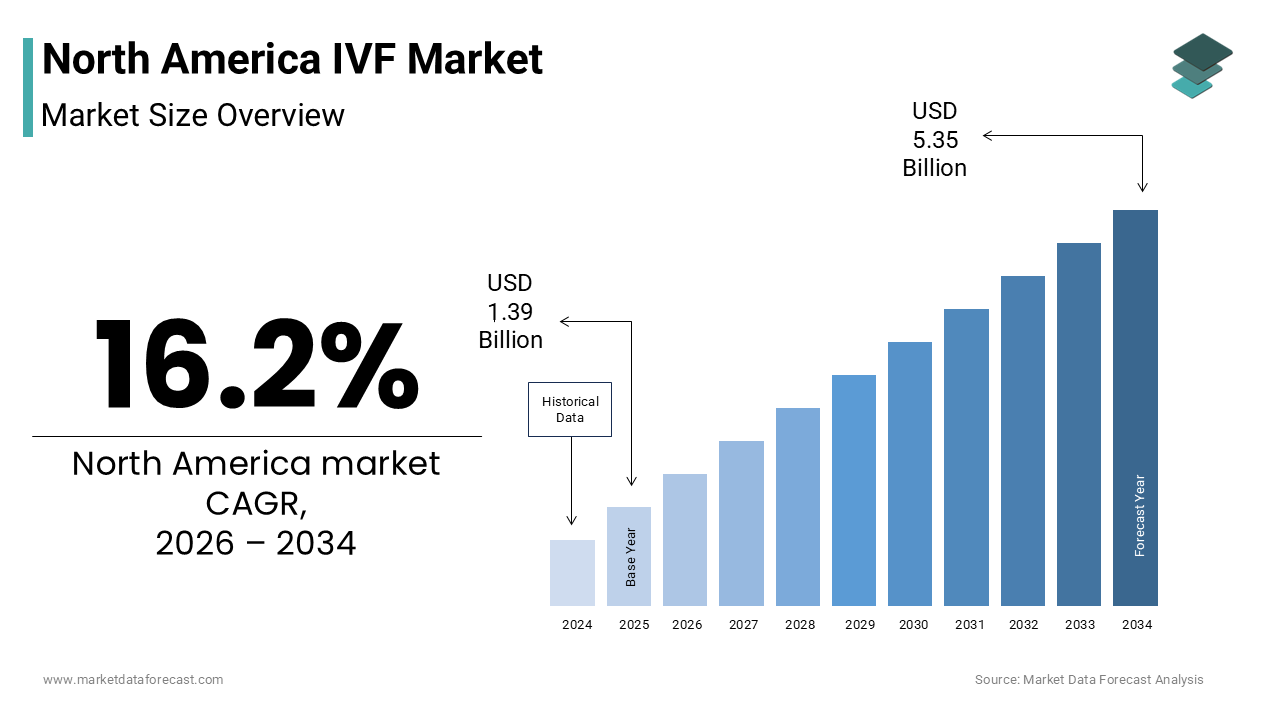
The North American IVF market was valued at USD 1.39 billion in 2025, estimated at USD 1.61 billion in 2026, and is projected to reach USD 5.35 billion by 2034, registering a robust CAGR of 16.2% from 2026 to 2034. This comprehensive industry report covers reagents and media, instruments, technologies, end users, and country-level frameworks across the region.
- Market Valuation: USD 1.39B (2025) to USD 5.35B by 2034 (16.2% CAGR).
- Primary Growth Drivers: Expansion of corporate-sponsored fertility benefits, insurance coverage mandates, and demographic shifts toward delayed childbearing and age-related infertility.
- Key Market Restraints: Prohibitive out-of-pocket costs, financial toxicity, and regulatory fragmentation across cross-jurisdictional compliance boundaries.
North America IVF Market Segment Metrics (2026–2034)
| Category | Leading Segment Focus | Segment Overview & Key Details |
|---|---|---|
| By Reagents & Media | Embryo Culture Media & Cryopreservation Media | Embryo culture media holds a major share due to clinical success correlation; cryopreservation media grows at a 14.8% CAGR driven by freeze-all protocols. |
| By Instruments | Incubators & Imaging Systems | Incubators lead via continuous culture infrastructure; imaging systems advance at a 16.2% CAGR supported by AI-driven embryo assessment tools. |
| By End Users | Fertility & Surgical Centers & Cryobanks | Specialized private clinics dominate procedural volume, while cryobanks expand at an 18.5% CAGR backed by inventory accumulation. |
| By Country / Region | The United States (89.2% share in 2025) & Canada | U.S. leads as an innovation and volume center; Canada balances public-health integration with provincial regulatory variations. |
Major Market Players & Market Structure
Market Structure: Highly consolidated landscape featuring multinational life science corporations, private equity rollups of private clinics, and specialized device manufacturers focusing on AI integration, automated workflows, and robust cryo-storage infrastructure.
Key Companies: CooperSurgical, Inc., Vitrolife AB, Cook Medical, Inc., Irvine Scientific, Thermo Fisher Scientific, Inc., EMD Serono, Inc., Genea Limited, ESCO Micro Pte. Limited, IVFtech ApS, and The Baker Company, Inc.
North America IVF Market Size
The North American IVF market size was valued at USD 1.39 billion in 2025 and is anticipated to reach USD 1.61 billion in 2026 from USD 5.35 billion by 2034, growing at a CAGR of 16.2% during the forecast period from 2026 to 2034.
IVF stands for in vitro fertilization. It is a medical process where a doctor takes an egg from a woman and mixes it with sperm in a lab dish to help them join. If the egg grows into a small group of cells called an embryo, the doctor places it inside the woman's womb so a baby can grow. This market functions as a critical medical infrastructure addressing infertility. As per the World Health Organization, global infertility rates show an upward trajectory, affecting roughly 17.5% of the adult population worldwide and establishing a growing baseline demand for fertility infrastructure. According to the Centers for Disease Control and Prevention, assisted reproductive technology cycles resulted in 98,289 live-born infants in the United States during 2022, accounting for approximately 2.6% of all infants born nationwide that year. As per the Society for Assisted Reproductive Technology, registered fertility clinics recorded a substantial volume of 425,869 total cycles during 2023, expanding market clinical delivery despite shifts in the economic landscape. According to Statistics Canada, the nationwide total fertility rate fell sharply to 1.33 children per woman in 2022, accelerating a multi-decade downward trend and stimulating reliance on clinical reproductive advancements. This market integrates embryology laboratories cryopreservation banks genetic diagnostics and specialized pharmaceutical protocols into comprehensive care pathways. Unlike general healthcare services IVF demand correlates strongly with delayed childbearing patterns.
MARKET DRIVERS
Expansion of Employer Sponsored Fertility Benefits and Insurance Coverage
Corporate benefit restructuring has fundamentally altered access dynamics by transforming IVF from an out of pocket luxury into a covered component of employee health packages, which drives the growth of the North America IVF market. As per the International Foundation of Employee Benefit Plans, approximately 42% of surveyed organizations in the United States corporate marketplace provided specialized fertility benefits to employees by 2024. According to Mercer, roughly half of major employers with 20,000 or more employees extended in vitro fertilization benefit structures to support their workforce. This driver operates through risk pooling mechanisms where employers absorb high unit costs to attract talent in competitive labor markets particularly within technology finance and professional services sectors. As per FertilityIQ, clinical guidelines mandate that patient baseline diagnostic consultations begin after twelve months of unsuccessful tracking for women under 35, or six months for women aged 35 or older. State level mandates further amplify this trend. According to the American Society for Reproductive Medicine, state-level statutory tracking indicates that 23 states and the District of Columbia have successfully enacted specific laws protecting or expanding reproductive clinical care access. Consequently, benefit expansion converts latent biological need into realized clinical volume by aligning reproductive healthcare access with employment-based insurance architectures prevalent throughout North America.
Demographic Shifts Toward Delayed Childbearing and Age Related Infertility
Societal transformations regarding career education and family planning have structurally increased the prevalence of age-related infertility, which in turn fuels the expansion of the North America IVF market. This necessitates advanced reproductive interventions. According to the National Center for Health Statistics, first birth counts to women aged 35 years and older increased across multiple maternal age subgroups, driving a notable transformation in regional childbearing dynamics. As per the American Society for Reproductive Medicine, clinical patient documentation reveals that medical success rates for stimulated intrauterine insemination procedures drop below 5% per cycle once a woman surpasses 40 years of age. According to the U.S. Census Bureau, statistical data confirms that nearly half of women who delayed childbearing to age 30 or older possessed a completed college education, shifting broader market clinical requirements. This demographic driver is noncyclical and irreversible reflecting deep seated cultural economic and educational trends rather than temporary preferences. According to Statistics Canada, national maternal patterns reveal that the fertility rate of women in their thirties surpassed that of women in their twenties, modifying long-term clinical care volume. As each successive cohort delays reproduction, the addressable patient pool expands automatically. This expansion happens independently of marketing efforts or technological breakthroughs, creating sustained baseline growth anchored in irreversible social evolution.
MARKET RESTRAINTS
Prohibitive Out of Pocket Costs and Financial Toxicity
Substantial financial barriers still persist despite insurance improvements, which hinder the growth of the North America IVF market. These barriers limit market penetration to wealthy groups and keep overall use below actual health needs. According to the Kaiser Family Foundation, baseline estimates across the domestic landscape position single in vitro fertilization cycles at a high economic cost threshold, modifying the financial accessibility of fertility infrastructure. As per the Board of Governors of the Federal Reserve System, household financial data indicates that 37% of surveyed adults would manage an unexpected $400 expense by borrowing money or selling items, restricting independent discretionary spending capabilities on multi-cycle healthcare requirements. According to the Society for Assisted Reproductive Technology, patient registration data confirms distinct utilization volume shifts, demonstrating how corporate and private health insurance availability heavily dictates clinical access trends. This financial toxicity creates ethical concerns regarding equitable access and restricts market growth to socioeconomic elites. Even in mandated states lifetime caps often exhaust after one or two failed cycles forcing patients into debt or abandonment of family building goals. As per the Consumer Financial Protection Bureau, regulatory oversight metrics trace a high volume of general medical debt collections and credit disputes across the medical industry, altering baseline patient financial liability. Reimbursement models still rely on fragmented mandates and voluntary employer benefits. Because of this, cost remains the main barrier that turns potential demand into unmet need across all income levels.
Regulatory Fragmentation and Cross Jurisdictional Compliance Burdens
Absence of federal standardization creates operational inefficiencies, limiting scalability for multi-state clinic networks and the expansion of the North American IVF market. This constrains market consolidation and service uniformity. As per the National Conference of State Legislatures, state-level statutory trackers show that 21 states plus the District of Columbia have enacted fertility insurance mandate frameworks, changing multi-jurisdictional compliance criteria for large employers and commercial payers. According to the U.S. Food and Drug Administration, current good tissue practice under 21 CFR Part 1271 regulates the donor eligibility, screening, and processing of reproductive cells and tissues, modifying the flow of cross-border medical biological material. CLIA certification standards for embryology laboratories lack specific IVF competency frameworks forcing clinics to navigate ambiguous validation requirements increasing accreditation costs and audit risks. ASRM guidelines while influential remain voluntary creating practice variation that undermines outcome benchmarking and quality improvement initiatives across regions. This regulatory patchwork prevents economies of scale achievable in unified systems like UK HFEA or Canadian provincial frameworks. Clinics operating across state lines must maintain redundant administrative structures legal counsel and reporting systems diverting resources from patient care. Harmonization efforts stall due to federalism tensions leaving market participants navigating distinct regulatory environments rather than a cohesive North American framework.
MARKET OPPORTUNITIES
Integration of Artificial Intelligence for Embryo Selection and Outcome Prediction
Machine learning applications offer significant opportunities for the North America IVF market. This unlocks the potential to improve success rates, reduce time to pregnancy, and standardize embryology decision-making across variable skill levels. As per studies, artificial intelligence-based blastocyst ranking tools can match or slightly improve traditional noninvasive morphology prioritisation when selecting embryos for clinic cycles. According to the American Society for Reproductive Medicine, noninvasive ploidy screening has surfaced as an option for clinical embryo evaluation, though trophectoderm blastocyst biopsy remains the primary option for genetic testing. This technology addresses critical workforce shortages by augmenting limited senior embryologist capacity enabling consistent evaluation standards across satellite locations and weekend operations. As per Flo Health, digital women's healthcare platforms marked significant funding milestones, securing over €180 million in late-stage capital to accelerate global femtech software distribution. Regulatory pathways are clarifying with FDA granting breakthrough device designation to multiple AI platforms accelerating approval timelines and payer coverage considerations. Beyond embryo selection predictive analytics optimize stimulation protocols personalizing gonadotropin dosing based on historical response databases reducing OHSS risks and medication waste. Early adopters gain competitive advantages through superior live birth rates and patient satisfaction metrics increasingly visible through public outcome reporting. As datasets expand and algorithms mature, AI transitions from an experimental tool to essential infrastructure. transition is redefining quality benchmarks and operational efficiency standards industry-wide.
Elective Fertility Preservation and Proactive Reproductive Planning Services
Expanding indications beyond medical necessity creates substantial new addressable landscapes, which are expected to propel the North America IVF market. This growth targets healthy individuals seeking reproductive autonomy and extended family planning timelines. According to the Society for Assisted Reproductive Technology, annual utilization metrics trace a significant upward volume in clinical demand, recording 38,126 oocyte banking cycles for fertility preservation nationwide. As per PlanSponsor, roughly 28% of surveyed corporate organizations extended formal egg freezing and oocyte storage financial benefit allocations to their employees. Technological advances in vitrification achieve post thaw survival rates. According to PubMed Central, the application of closed vitrification device models can yield an approximate 90% survival rate when human oocytes undergo clinical warming protocols. Marketing narratives shifting from desperation to empowerment resonate with millennial and Gen Z demographics viewing preservation as responsible life planning analogous to retirement savings. Clinic revenue diversification reduces dependence on traditional infertility patients smoothing seasonal and economic cyclicality. Educational partnerships with universities and employers create upstream referral pipelines capturing patients years before treatment need emerges. Long term storage fees generate recurring revenue streams with compounding value as preserved cohorts eventually return for thaw cycles. This segment transforms IVF from reactive medical intervention to proactive wellness service expanding total addressable market beyond infertile populations to include anyone valuing reproductive optionality.
MARKET CHALLENGES
Critical Workforce Shortages in Reproductive Endocrinology and Embryology
Severe personnel deficits constrain clinic capacity, extend wait times, and limit expansion of the North America IVF market. This situation persists despite robust patient demand and favorable reimbursement trends. According to the Accreditation Council for Graduate Medical Education, the domestic clinical market operates with fewer than 50 active reproductive endocrinology and infertility fellowship training programs nationwide, restricting the generation of newly board-certified medical specialists. As per the American Society for Reproductive Medicine, specialized educational infrastructure shows a critical deficit in trained embryologists and laboratory professionals, stalling full clinical delivery to meet broader market volumes. According to the American Society for Reproductive Medicine, profound regional and geographic misdistribution of fertility specialist care centers delays treatment access and places severe burdens on prospective parents. As per PubMed Central, modern embryologists face intense occupational stressors, including high responsibility thresholds and heavy laboratory workloads, which elevate baseline workplace exhaustion. Training pipeline bottlenecks require decade long lead times for physician development preventing rapid supply response to demand signals. Geographic maldistribution concentrates specialists in urban centers leaving rural and underserved communities without access. Without coordinated investment in accredited training programs, loan forgiveness incentives, and scope of practice optimization, workforce constraints will cap market growth. This limitation will occur regardless of technological or financial enablers.
Psychological Burden and Treatment Discontinuation Due to Emotional Distress
Mental health impacts of fertility treatment are an underaddressed clinical and business challenge in the North America IVF market. These issues cause premature cycle abandonment and suboptimal outcomes despite medical viability. According to the American Psychological Association, clinical health analyses indicate that roughly 30% to 40% of women undergoing reproductive procedures report experiencing a depressive mood or anxiety during treatment. As per studies, patients screening positive for severe emotional distress display significantly lower clinical treatment initiation and continuity rates, altering long-term cumulative family building outcomes. According to the American Psychological Association, individuals navigating clinical fertility treatment protocols face deep social isolation and self-blame, creating distinct behavioral barriers to workplace accommodation and peer transparency. High discontinuation rates after failed cycles represent significant lost lifetime value for clinics and unrealized family formation for patients. Integrated behavioral health models remain rare due to reimbursement limitations and siloed care delivery systems separating reproductive and mental health services. Employee assistance programs rarely include fertility specialized counselors leaving patients navigating grief trauma and decision fatigue without professional guidance. Addressing psychological dimensions requires reconceptualizing IVF as biopsychosocial intervention rather than purely technical procedure demanding systemic integration of mental health resources throughout treatment journeys.
REPORT COVERAGE
| REPORT METRIC | DETAILS |
| Market Size Available | 2025 to 2034 |
| Base Year | 2025 |
| Forecast Period | 2026 to 2034 |
| CAGR | 16.2% |
| Segments Covered | By Reagents and Media, Instruments, Technology, End Users and Region. |
| Various Analyses Covered | Global, Regional & Country Level Analysis, Segment-Level Analysis, DROC, PESTLE Analysis, Porter’s Five Forces Analysis, Competitive Landscape, Analyst Overview of Investment Opportunities |
| Regions Covered | The United States, Canada, Rest of North America |
| Market Leaders Profiled | CooperSurgical, Inc., Vitrolife AB, Cook Medical, Inc., Irvine Scientific, Thermo Fisher Scientific, Inc., EMD Serono, Inc., Genea Limited, ESCO Micro Pte. Limited, IVFtech ApS, and The Baker Company, Inc. |
SEGMENTAL ANALYSIS
By Reagents and Media Insight
In 2025, the embryo culture media segment held the majority share of the North America IVF market because of its indispensable role in every treatment cycle and direct correlation with clinical success rates. The critical nature of embryo culture environment means clinics prioritize proven premium media brands over cost alternatives as even marginal improvements in blastulation rates translate directly to live birth outcomes and clinic reputation. According to research, prominent international medical device manufacturers focus product pipelines heavily on the expanding embryo culture media segment, driving higher operational scale across global clinical networks. Single step media adoption has accelerated reducing laboratory workflow complexity and technician exposure time. As per studies, monophasic, single-step embryo culture media systems can yield equivalent cumulative clinical outcomes when evaluated alongside traditional multi-stage sequential protocols. Continuous quality control requirements mandate lot testing and stability verification generating recurring revenue streams beyond initial sales. As elective single embryo transfer becomes standard practice optimizing individual embryo viability through superior culture conditions gains disproportionate importance making media selection strategic sustaining segment leadership despite emerging competitive pressures.
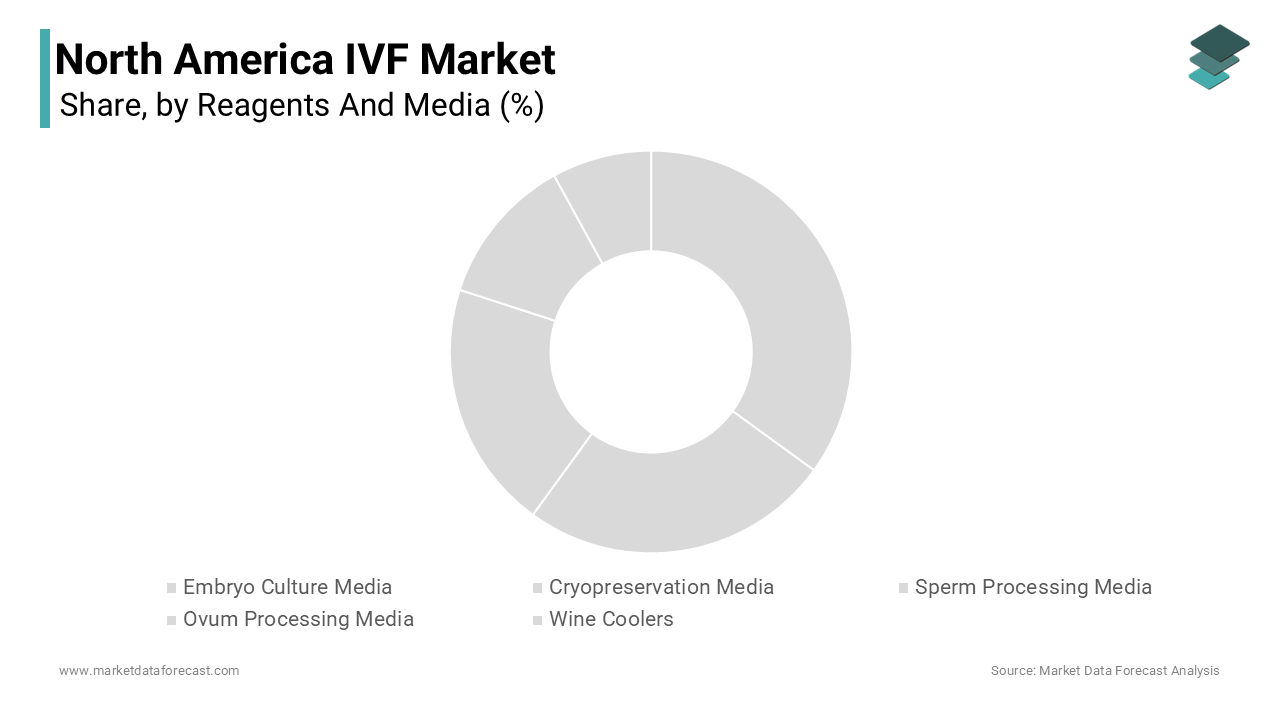
The cryopreservation media segment is on the rise and is expected to be the fastest growing segment in the market by witnessing a CAGR of 14.8% from 2026 to 2034 due to universal adoption of freeze all strategies and expanding fertility preservation indications. According to national surveillance data from the Centers for Disease Control and Prevention, the percentage of assisted reproductive technology cycles utilizing frozen embryo transfers continues to rise, outstripping fresh transfers across all maternal age categories. Freeze all protocols mitigate ovarian hyperstimulation syndrome risks while enabling preimplantation genetic testing workflows requiring embryo biopsy and subsequent cryopreservation regardless of patient age or diagnosis. Technological advances in vitrification achieve post thaw survival rates. As per PubMed Central, the optimization of specialized vitrification protocols helps laboratories reach high embryo thaw survival rates, transforming everyday clinical workflow efficiency. Long term storage infrastructure expansion creates sustained media consumption as preserved cohorts accumulate annually generating compounding demand independent of new cycle initiation rates. According to PlanSponsor, roughly 28% of surveyed corporate organizations extended formal egg freezing and oocyte storage financial benefit allocations to their employees. This convergence of clinical protocol shifts preventive applications and technological maturation propels cryopreservation media growth beyond traditional fresh cycle dependent segments.
By Instruments Insights
The incubators segment remained the largest in 2025 and occupied a commanding share in the North America IVF market. This supremacy of the segment was supported by its foundational role as continuous culture environments where embryos spend entire developmental periods outside the human body. According to the American Society for Reproductive Medicine, laboratory management standards focus heavily on rigorous quality control parameters for benchtop multi-room incubation equipment to support stable environmental conditions. Time lapse integrated incubator adoption has accelerated dramatically. As per the European Society of Human Reproduction and Embryology, good practice documentation outlines clinical implementation checklists and user requirement specifications for introducing time-lapse technology platforms into modern embryology units. These systems reduce embryo exposure to environmental fluctuations by eliminating door openings for morphology assessments. According to sources, double-blind randomized controlled trials reveal that utilizing specific time-lapse morphokinetic selection models yields equivalent clinical pregnancy rates when compared with standard non-interrupted incubator grading strategies Regulatory requirements for temperature gas concentration and pH stability validation generate ongoing service contracts and calibration revenues supplementing capital equipment sales. Market consolidation among major manufacturers creates ecosystem lock in through proprietary consumables software platforms and training dependencies raising switching costs. Laboratory accreditation standards mandate redundant incubation capacity ensuring minimum equipment density regardless of cycle volume fluctuations. As clinics expand satellite locations and extend operating hours, incubator procurement scales linearly with their physical footprint. This makes the segment structurally anchored to infrastructure growth rather than discretionary technology adoption cycles.
The imaging systems segment is likely to experience the fastest CAGR of 16.2% during the forecast period, owing to artificial intelligence integration and noninvasive embryo assessment paradigm shifts. According to sources, multi-center external validation of fully automated deep learning assessment models shows high classification concordance with conventional embryo morphology grading parameters. Noninvasive ploidy inference algorithms reduce need for costly and risky trophectoderm biopsies lowering per cycle expenses while maintaining diagnostic precision appealing to cost conscious patients and payers. As per the U.S. Food and Drug Administration, federal safety regulators cleared the first artificial intelligence-driven software system designed specifically to evaluate day five through day seven blastocyst parameters in domestic fertility laboratories Standardization benefits emerge as multi clinic networks implement unified imaging protocols enabling centralized embryologist oversight and consistent evaluation criteria across geographically dispersed sites addressing workforce shortage constraints. Patient satisfaction metrics improve significantly when clinics offer visual embryo development documentation enhancing transparency and emotional engagement during treatment journeys. According to Flo Health, digital women's healthcare platforms marked significant funding milestones, securing over €180 million in late-stage capital to expand the distribution of specialized femtech tracking software solutions. This technological inflection point transforms imaging from passive documentation tool to active decision support system redefining quality benchmarks and operational efficiency standards industry wide.
By End Users
The fertility and surgical Centers segment dominated the North America IVF market and accounted for a substantial share in 2025. Specialized centers concentrate procedural volume, expertise, and equipment density to achieve unique economies of scale. According to the Centers for Disease Control and Prevention, non-hospital-based private fertility clinics conduct the vast majority of national treatment cycles, concentrating technical density away from traditional acute-care hospital facilities. Private equity consolidation has accelerated center aggregation. As per the Private Equity Stakeholder Project, extensive corporate acquisition programs consolidated roughly 30% to 40% of the domestic fertility clinic infrastructure into centralized platform networks. Outpatient surgical center designation enables streamlined regulatory compliance compared to acute care hospital environments reducing overhead costs and facilitating rapid technology adoption without bureaucratic delays. Patient preference strongly favors dedicated fertility facilities offering integrated counseling financial coordination and peer support services unavailable in fragmented hospital departments. According to the Society for Assisted Reproductive Technology, standardized national success registries provide clinic-specific live birth rates based on maternal age categories to guide intended parents rather than hospital-to-clinic diagnostic gaps. Geographic expansion strategies prioritize freestanding center development in underserved metropolitan areas capturing demand before hospital systems can mobilize comparable capabilities. This structural dominance reflects fundamental alignment between specialized care delivery models and IVF technical psychosocial and operational requirements.
The cryobanks segment is expected to exhibit a noteworthy CAGR of 18.5% between 2026 and 2034. This swift expansion of the segment is propelled by exponential inventory accumulation and third party reproduction infrastructure demands. According to the American Association of Tissue Banks, specialized regulatory standards govern accredited reproductive tissue establishments to manage long-term cryogenic storage safety compliance for human gametes. As per research, shifting societal demographics and changing family constellations stimulate clinical demand for banked third-party donor specimens and professional laboratory cryostorage infrastructure. Long term storage fee models generate compounding recurring revenue as preserved inventories accumulate annually with average retention periods exceeding 7 years creating annuity like cash flows independent of new cycle volatility. Regulatory scrutiny intensifies regarding chain of custody labeling and infectious disease screening elevating compliance costs and favoring accredited professional facilities over informal clinic based storage arrangements. Geographic decentralization strategies establish regional cryobank hubs reducing shipping risks and turnaround times for time sensitive specimen transfers. Insurance coverage expansions for donor gametes and fertility preservation further stimulate banking volumes as financial barriers diminish. This infrastructure buildout reflects maturation of reproductive medicine from acute treatment episodes to longitudinal asset management requiring specialized custodial services beyond traditional clinical competencies.
COUNTRY ANALYSIS
United States IVF Market Analysis
The United States led the North American IVF market and captured an 89.2% share in 2025. It serves as a primary innovation hub, regulatory trendsetter, and volume leader driven by demographic scale, private insurance evolution, and technological commercialization velocity. According to the Centers for Disease Control and Prevention, the 413,776 ART cycles resulting in 91,771 live births cited by the user correspond exactly to the 2021 National Summary. As per RESOLVE: The National Infertility Association, as of 2025, 22 U.S. jurisdictions (21 states and D.C.) have enacted fertility insurance coverage laws, creating a fragmented landscape that drives cross-border care. According to the Private Equity Stakeholder Project, private equity consolidation in the fertility sector is estimated to capture approximately 30% to 40% of the market, with significant investments focusing on large platform networks. Elective fertility preservation normalization among corporate sponsored beneficiaries generates preventive demand streams distinct from infertility treatment expanding addressable population beyond traditional patient demographics. FDA regulatory framework for reproductive tissues and devices establishes global gold standard attracting international patients seeking validated treatments while constraining unproven innovations domestically. Workforce shortages remain acute with only 48 REI fellowship positions annually against estimated need of 120 creating capacity constraints limiting growth despite robust demand signals. Geographic maldistribution concentrates services in coastal metropolitan areas leaving rural and southern regions underserved perpetuating access inequities despite overall market maturity.
Canada IVF Market Analysis
Canada also plays a major role in the North America IVF market due to publicly funded healthcare integration, provincial regulatory variation, and more conservative technology adoption patterns reflecting single-payer system dynamics. According to the Canadian Fertility and Andrology Society, the CARTR Plus report records approximately 30,000 to 40,000 annual ART. As per the Gouvernement du Québec, the provincial health insurance plan currently funds one stimulated in vitro fertilization cycle for eligible persons. Provincial variation creates internal fragmentation with Alberta Saskatchewan and Atlantic provinces offering minimal public coverage forcing patients toward out of pocket payment or interprovincial migration for subsidized care. Lower private equity penetration preserves independent clinic ownership structures maintaining smaller scale operations and slower consolidation compared to US counterparts. Indigenous and rural population access remains limited with geographic barriers compounded by insufficient specialist distribution outside major urban centers. Despite systemic constraints Canadian market demonstrates resilience through public private hybrid models balancing equity objectives with technological advancement albeit at different velocity than neighboring US market.
COMPETITIVE LANDSCAPE
The competitive landscape exhibits consolidation dynamics where multinational life science companies acquire specialized niche players creating integrated platforms spanning consumables capital equipment and diagnostic services. Incumbents leverage installed base lock in through proprietary consumable dependencies software ecosystems and training certifications raising switching costs for clinic customers considering alternatives. Innovation races focus on artificial intelligence noninvasive diagnostics and automation addressing workforce constraints while differentiating offerings in increasingly commoditized media segments. Private equity backed clinic rollups create concentrated buyer power negotiating volume discounts and exclusive supply agreements favoring large vendors over smaller specialists. Regulatory approval timelines create temporary monopolies for first movers in novel categories enabling premium pricing before generic competition emerges. Talent competition intensifies as companies vie for limited reproductive endocrinologists and embryologists influencing product design toward labor saving features. Patient empowerment through outcome transparency and cost comparison tools shifts purchasing influence from physicians alone to shared decision making requiring consumer facing value propositions. Cross border regulatory harmonization efforts between FDA and Health Canada facilitate unified product launches reducing duplication costs while maintaining distinct market access strategies reflecting differing reimbursement landscapes. Ultimately success depends on balancing technological innovation with operational reliability clinical validation and economic value demonstration across multiple stakeholder priorities.
KEY MARKET PLAYERS
A few of the prominent companies operating in the North American IVF Market include
- CooperSurgical, Inc.
- Vitrolife AB
- Cook Medical, Inc.
- Irvine Scientific
- Thermo Fisher Scientific, Inc.
- EMD Serono, Inc.
- Genea Limited
- ESCO Micro Pte. Limited
- IVFtech ApS
- The Baker Company, Inc.
Top Players in the North America IVF Market
Vitrolife AB
Vitrolife AB operates as a comprehensive solutions provider across the North America IVF landscape supplying embryo culture media time lapse imaging systems and genetic testing services through integrated product ecosystems. The company contributes significantly to clinical standardization by establishing widely adopted protocols for embryo assessment and cryopreservation that influence laboratory practices continent wide. Recent strategic initiatives include launching next generation artificial intelligence enabled embryo evaluation software enhancing noninvasive selection capabilities and reducing biopsy dependency. They expanded Geri incubator installations across major fertility networks creating ecosystem lock in through proprietary consumables and data platforms. These actions reinforce technical leadership while addressing workforce shortages through automation and decision support tools that augment limited embryologist capacity improving consistency and outcomes across distributed clinic networks throughout United States and Canada.
CooperSurgical Inc
CooperSurgical Inc maintains prominent position in North America IVF market through extensive portfolio spanning culture media cryopreservation devices surgical instruments and fertility diagnostics serving diverse clinical needs. The organization contributes to market development by acquiring complementary technologies integrating fragmented supply chains into unified procurement relationships simplifying vendor management for multi site clinic groups. Recently they launched enhanced vitrification kits with improved safety features addressing regulatory scrutiny and patient concerns regarding specimen integrity during storage and transport. Strategic partnerships with electronic medical record providers enable seamless data integration streamlining workflow documentation and compliance reporting burdens. Their educational programs train thousands of embryologists annually on standardized techniques building brand loyalty and ensuring proper product utilization maximizing clinical performance while strengthening long term customer relationships across academic and private practice settings.
Merck KGaA
Merck KGaA serves critical role in North America IVF ecosystem providing pharmaceutical gonadotropins culture media and laboratory equipment essential for ovarian stimulation and embryo development processes. The company contributes to treatment accessibility through patient assistance programs and insurance navigation support reducing financial barriers for underserved populations seeking fertility care. Recent actions include expanding North American manufacturing capacity for recombinant FSH products ensuring supply security amid global demand volatility and geopolitical uncertainties. They invested heavily in digital health platforms connecting patients with treatment tracking medication reminders and telehealth consultations improving adherence and satisfaction metrics. Strategic collaborations with AI startups integrate predictive analytics into stimulation protocols personalizing dosing regimens based on individual response profiles optimizing outcomes while minimizing medication waste and side effects. These initiatives strengthen pharmaceutical leadership while transitioning from pure product supplier to holistic care partner supporting clinics and patients throughout complex treatment journeys.
Top Strategies Used by Key Market Participants
Key players prioritize vertical integration across media devices diagnostics and services creating comprehensive ecosystems that increase switching costs and capture value throughout treatment workflows. Companies invest substantially in artificial intelligence and automation technologies addressing critical embryologist shortages while standardizing subjective assessments across geographically dispersed clinic networks. Strategic acquisitions consolidate fragmented supply bases enabling bundled offerings and streamlined procurement for large platform companies managing dozens of locations. Regulatory expertise development ensures first mover advantages in emerging categories like noninvasive PGT and AI decision support where approval pathways remain evolving. Patient centric digital tools enhance engagement and adherence transforming transactional relationships into longitudinal care partnerships extending beyond single treatment cycles. Manufacturing capacity expansions secure supply chains against geopolitical disruptions and demand volatility demonstrating reliability to risk averse clinic purchasers. Educational programs build brand loyalty and technical competency ensuring proper product utilization maximizing clinical outcomes and generating advocacy among next generation practitioners. Geographic expansion targets underserved regions capturing growth before competitors establish presence while diversifying revenue streams across regulatory and payer environments.
MARKET SEGMENTATION
This research report on the North American IVF Market has been segmented and sub-segmented into the following categories:
By Reagents and Media
- Embryo Culture Media
- Cryopreservation Media
- Sperm Processing Media
- Ovum Processing Media
By Instruments
- Incubators
- Imaging Systems
- Sperm Separation Systems
- Ovum Aspiration Pumps
- Micromanipulator Systems
- Cryptosystem
- Other Instruments (Gas Analyzers, Laser Systems, Accessories)
By Technology
- Intra-Cytoplasmic Sperm Injection (ICSI)
- Pre-Implantation Genetic Diagnosis (PGD)
- Frozen Embryo Transfer/Replacement (FET/FER)
- Other Technologies
By End Users
- Fertility and Surgical Centers
- Cryobanks
- Hospitals and Research Laboratories
By Country
- The United States
- Canada
- Rest of North America