- Product Description Description
- Table of Contents TOC
- List of Table & Figure LOT
- Get Free Sample PDF Sample PDF
Market Size, 2025
$551.64 MnMarket Estimate, 2026
$584.85 MnMarket Forecast, 2034
$933.57 MnCAGR, 2026–2034
6.02%North America Shea Butter Market Size, Growth, Trends & Forecast (2026–2034)
The North America shea butter market size was valued at USD 551.64 million in 2025, reached USD 584.85 million in 2026, and is projected to scale up to USD 933.57 million by 2034, registering a compound annual growth rate (CAGR) of 6.02% during the forecast period from 2026 to 2034. Driven by the rising preference for clean-label, plant-based personal care products and expanding therapeutic applications, the market continues to expand across the region.
Key Executive Metrics (At-a-Glance)
- 2025 Base Valuation: USD 551.64 Million
- 2026 Current Valuation: USD 584.85 Million
- 2034 Forecast Valuation: USD 933.57 Million
- Compound Annual Growth Rate (CAGR): 6.02% (2026–2034)
- Leading Country Market: United States (Accounted for 88.3% of the regional market share in 2025, driven by a massive consumer base and prominent beauty brands)
- Prominent Country Market: Canada (Accounted for 10.4% share in 2025, propelled by strong demand for natural ingredients tailored to colder climates)
- Leading Type Segment: Unrefined Shea Butter (Captured 62.5% of regional market share in 2025, favored for clean-label authenticity and bioactive retention)
- Fastest-Growing Type Segment: Refined Shea Butter (Projected CAGR of 8.7% due to consistency and odor neutrality for mass-market formulations)
- Leading Application Segment: Personal Care (Led the market with 54.5% share in 2025)
- Fastest-Growing Application Segment: Medicinal / Therapeutic (Estimated CAGR of 9.3% due to clinical recognition in wound care and dermatological protocols)
Core Market Drivers
- Clean-Label & Sensitive Skin Care: High consumer demand for fragrance-free, hypoallergenic moisturizers and botanical alternatives to synthetic ingredients.
- Clinical & Therapeutic Integration: Growing use of shea-enriched formulations in post-procedure recovery, dermatology guidelines, and specialized healthcare protocols.
Primary Market Restraints & Challenges
- Supply Chain Vulnerabilities: Climate change-induced desertification in West Africa's Sahel region and reliance on manual labor, which impact raw material availability.
- Adulteration & Regulatory Gaps: Prevalence of lower-grade fillers, inconsistent quality benchmarks, and the absence of standardized definitions for terms like "raw" or "refined."
North America Shea Butter Market Segmentation Highlights
| Segment Category | Leading / Dominant Segment | Fastest-Growing / Prominent Segment |
|---|---|---|
| By Type | Unrefined Shea Butter (62.5% share in 2025) | Refined Shea Butter (CAGR of 8.7%) |
| By Application | Personal Care (54.5% share in 2025) | Medicinal / Therapeutic (CAGR of 9.3%) |
| By Country | United States (88.3% share in 2025) | Canada (Expanding natural ingredient and cold-climate skin lines) |
Major Industry Players Profiled
Key suppliers, non-profit institutions, and brand leaders shaping the market include Star Shea Ltd., Bread For Life, All Pure Nature Ltd., Shea Radiance, VINK CHEMICALS GMBH & CO. KG, Jedwards International, Inc., Lovinah Naturals, Maison Karite, Sociedad Limitada, Shebu Industries, GloryMount Limited, The Global Shea Alliance, and Anusha International.
North America Shea Butter Market Size
The shea butter market in North America was valued at USD 551.64 million in 2025, and the North America market size is estimated to grow at a CAGR of 6.02% from 2026 to 2034, and the North American market size is anticipated to be worth USD 933.57 million by 2034 from USD 584.85 million in 2026.

Shea Butter is a natural fat extracted from the nut of the Vitellaria paradoxa tree. It is primarily used for cosmetic, personal care, and niche food applications. While not indigenous to North America, shea butter has become a cornerstone ingredient in dermatological and haircare formulations due to its emollient, anti-inflammatory, and UV-protective properties. According to the World Agroforestry Centre, over 80% of global shea production originates from the Sahel region of Africa, where it supports the livelihoods of more than 16 million women involved in its collection and processing. In the United States, shea butter-based products for managing atopic dermatitis due to its non-irritating and barrier-repairing qualities. Furthermore, the U.S. Food and Drug Administration (FDA) classifies shea butter as a Generally Recognized as Safe (GRAS) substance which permits its use in both topical and edible products, strengthening its dual applicability and consumer trust.
MARKET DRIVERS
The rising consumer preference for clean-label and plant-based personal care products, particularly among individuals with sensitive skin and chronic dermatological conditions, drives the growth of North America shea butter market. According to the research, number of adults in the U.S. are diagnosed with eczema annually, with many seeking fragrance-free, hypoallergenic moisturizers containing natural emollients like shea butter. As per a study, a portion of American consumers actively avoid synthetic ingredients such as parabens and mineral oils by favoring botanical alternatives. Brands have capitalized on this trend by formulating dermatologist-tested, ethically sourced shea butter products that cater to diverse skin types. Apart from these, the growing popularity of skinification in haircare, where scalp and hair treatments mimic skincare routines. This has expanded shea butter’s application in conditioners and scalp serums which further entrenching its role in daily wellness regimens.
The increasing integration of shea butter into clinical and therapeutic skincare protocols, particularly in post-procedure and wound care applications, is propelling the growth of North America shea butter market. Furthermore, shea butter-containing formulations in its national dermatology guidelines for managing dry skin and pruritus in elderly patients. This clinical validation has prompted medical spas, dermatology clinics, and aesthetic centers across North America to incorporate shea-enriched products into recovery kits. Shea butter has transitioned from a cosmetic additive to a functional therapeutic agent because healthcare providers are increasingly endorsing natural ingredients with proven biocompatibility. This accelerates demand in both professional and over-the-counter channels.
MARKET RESTRAINTS
Vulnerability of the global supply chain to climate variability and deforestation in West Africa, impedes the growth of North America shea butter market. According to the stusy, the Sahel region has lost hectares of woodland since 2010 due to agricultural expansion and desertification which threatenes the long-term sustainability of shea trees. It takes years to mature. These environmental burdens reduce raw material availability and increase price volatility by complicating procurement for North American manufacturers. Apart from these, the lack of mechanized harvesting and reliance on manual labor, performed predominantly by women, limits scalability. Supply instability will continue to constrain market growth and elevate production costs due to the lack of large-scale reforestation and agroforestry initiatives.
The prevalence of adulteration and inconsistent quality restricts the growth of North America shea butter market. This weakens consumer confidence and regulatory compliance. According to an analysis, a portion of shea butter samples tested in U.S. retail products contained fillers such as palm oil, paraffin, or stearic acid, diluting efficacy and potentially causing adverse reactions. This lack of standardization complicates formulation consistency for manufacturers and exposes brands to reputational risk. Furthermore, the absence of mandatory origin tracing allows unethical sourcing practices to persist. Asper the study, only a portion of shea butter imported into North America is certified under ethical trade programs which limits transparency. The market remains susceptible to substandard products that erode trust and hinder premiumization because of the absence of enforceable quality benchmarks and third-party verification.
MARKET OPPORTUNITIES
The expansion of shea butter into functional food and dietary supplement applications, driven by growing awareness of its bioactive compounds, is setting up new opportunities for the North America shea butter market. According to the study, shea butter contains high levels of stearic acid and cinnamic acid, which exhibit anti-inflammatory and mild cholesterol-lowering properties. Companies have already introduced vegan chocolate bars using shea butter as a cocoa butter substitute by appealing to clean-label consumers. Apart from these, the rise of nutraceuticals has opened avenues for encapsulated shea extracts targeting joint and skin health. North American innovators are well-positioned to pioneer shea-enriched functional foods that bridge nutrition and wellness owing to the FDA’s GRAS designation enabling food use. There is also an increasing demand for plant-based as well as non-allergenic fats.
The formalization of ethical and women-led sourcing partnerships, which enhance brand credibility and meet consumer demand for social responsibility, is setting up new opportunities for the growth of North America shea butter market. North American brands have established direct trade agreements with women’s cooperatives in Ghana and Mali by ensuring fair wages and community reinvestment. Furthermore, certification programs like Fair for Life and Rainforest Alliance are gaining traction, allowing brands to differentiate through verified impact. Companies can provide transparent sourcing narratives by investing in traceability technologies such as blockchain and satellite monitoring. This transforms shea butter from a commodity into a vehicle for sustainable development and consumer engagement.
MARKET CHALLENGES
The lack of standardized regulatory definitions and labeling requirements for grades and processing methods challenges the growth of North America Shea butter market. According to the Cosmetic Ingredient Review (CIR) Expert Panel, there is no uniform classification for terms such as “raw,” “refined,” “unrefined,” or “ultra-refined,” leading to inconsistent product quality and consumer confusion. The U.S. Food and Drug Administration (FDA) does not mandate disclosure of processing techniques, which can involve chemical solvents or deodorization that alter the phytochemical profile. This absence of harmonized standards complicates clinical research, formulation stability, and marketing claims which impedes scientific validation and limits the ingredient’s potential in medical and pharmaceutical applications.
The competitive force from alternative natural emollients such as cocoa butter, mango butter, and jojoba oil, which are increasingly formulated into similar product categories, degrades the growth of North America market. Jojoba oil, though more expensive, is favored in high-end serums due to its similarity to human sebum. Apart from these, emerging bioengineered alternatives, such as lab-grown squalane and fermentation-derived lipids, are gaining traction for their consistency and sustainability. As per a study, a portion of formulators are exploring substitutes to reduce dependency on agricultural raw materials. Shea butter risks being commoditized or displaced in formulations where performance, cost, and novelty are key decision drivers, particularly in the rapidly evolving clean beauty sector.
REPORT COVERAGE
| REPORT METRIC | DETAILS |
| Market Size Available | 2025 to 2034 |
| Base Year | 2025 |
| Forecast Period | 2026 to 2034 |
| CAGR | 6.02% |
| Segments Covered | By Type, Application, and Region |
| Various Analyses Covered | Global, Regional, and Country Level Analysis, Segment-Level Analysis, DROC, PESTLE Analysis, Porter’s Five Forces Analysis, Competitive Landscape, Analyst Overview of Investment Opportunities |
| Countries Covered | United States, Canada & Mexico |
| Market Leaders Profiled | hea Ltd., Bread For Life, All Pure Nature Ltd., Shea Radiance, VINK CHEMICALS GMBH & CO. KG., Jedwards International, Inc., Lovinah Naturals, Maison Karite, Sociedad Limitada, Shebu Industries, and others |
SEGMENTAL ANALYSIS
By Type Insights
The unrefined shea butter segment dominated the North America Shea Butter Market by capturing 62.5% of the regional market share in 2025. The growth of the unrefined shea butter segment is driven by its strong consumer appeal as a "raw," minimally processed ingredient aligned with clean-label and natural product preferences. According to a study, a portion of U.S. consumers consider unrefined shea butter more effective for skin healing and moisture retention than its refined counterpart. Unrefined shea retains higher concentrations of bioactive compounds such as triterpenes and vitamin E. Brands emphasize the artisanal and fair-trade origins of their unrefined shea by strengthening authenticity and ethical sourcing narratives. Apart from these, the growing popularity of DIY skincare and wellness communities has amplified demand for unrefined forms, which are perceived as purer and more potent despite their shorter shelf life and stronger odor.
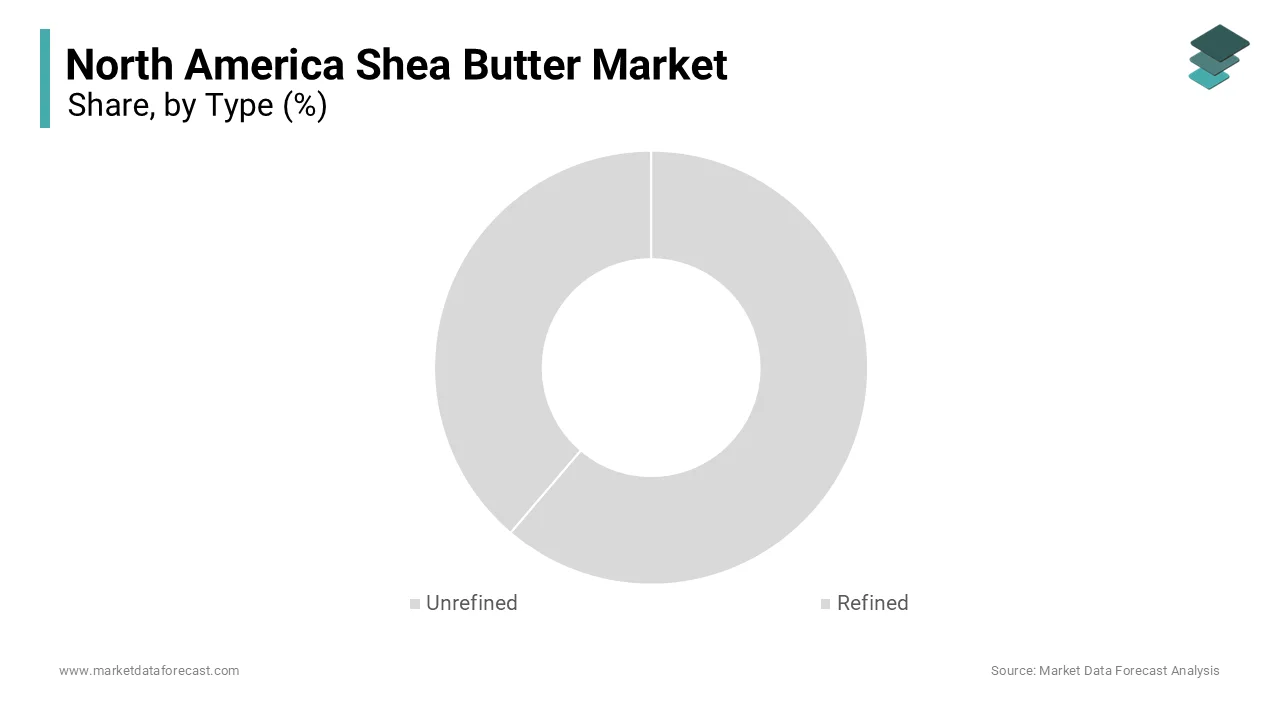
The refined shea butter segment is estimated to register the fastest CAGR of 8.7% from over the forecast period due to its superior consistency, odor neutrality, and suitability for mass-market formulations. According to the research, a portion of commercial lotions, lip balms, and hair conditioners require odorless, color-stable ingredients to maintain product uniformity and consumer appeal, qualities inherent in refined shea. Its compatibility with high-speed manufacturing processes and longer shelf life also makes it favorable for large-scale production. Refined shea butter is becoming the preferred choice for scalable and consumer-friendly formulations as mainstream brands are increasingly incorporating natural ingredients without compromising sensory experience.
By Application Insights
The personal care segment led the North America Shea Butter Market by capturing 54.5% of the regional market share in 2025. The growth of the personal care segment is driven by the widespread use of shea butter in daily skincare and haircare routines, particularly among consumers with dry, sensitive, or ethnically diverse skin types. Its occlusive and anti-inflammatory properties make it a staple in body lotions, hand creams, and baby care products. Apart from these, the rise of curl care and textured hair routines has driven demand in leave-in conditioners and scalp treatments. Retail giants like Target and Walmart have expanded dedicated clean beauty and inclusive care aisles which features shea-enriched brands. This further institutionalizes its role in everyday personal wellness.
The medicinal application segment is estimated to register the fastest CAGR of 9.3% between 2026 and 2034 due to increasing clinical recognition of shea butter’s therapeutic properties in dermatological and wound care settings. According to a study, patients using shea-enriched emollients after surgical procedures experienced a reduction in transepidermal water loss and faster re-epithelialization. The Mayo Clinic includes shea-based formulations in its recommended protocols for managing radiation dermatitis and diabetic xerosis. The U.S. Pharmacopeia (USP) is currently evaluating standardized monographs for topical shea preparations, which could pave the way for over-the-counter drug claims. Shea butter is transitioning from cosmetic adjunct to clinically supported therapeutic agent as healthcare providers are shifting toward integrative and non-pharmacological interventions.
REGIONAL ANALYSIS
United States Shea Butter Market Insights
The United States was the top performer in the North America Shea Butter Market in 2025 and accounted for 88.3% of the regional market share in 2025. The domination of the United States in the regional market is primarily driven by its massive consumer base, high per capita spending on personal care, and strong cultural emphasis on natural and ethically sourced ingredients. The presence of major beauty brands such as SheaMoisture, Carol’s Daughter, and Burt’s Bees, many of which originated from African American haircare traditions, has institutionalized shea butter in mainstream retail. Apart from these, brands source shea directly from women’s cooperatives in West Africa which strengthens ethical narratives. The U.S. remains the primary innovation and distribution hub for shea-based products across the continent due to the robust e-commerce penetration and influencer-driven marketing.
Canada Shea Butter Market Insights
Canada is the second-largest in the North America shea butter market and accounted for 10.4% of the regional market share in 2025. The growth of the Canada in the regional market is propelled by growing consumer awareness of natural ingredients and sustainability. Canadian consumers show a strong preference for ethically certified products. Brands have introduced shea-based eczema and baby care lines tailored to the country’s cold climate, where dry skin is prevalent. Apart from these, Health Canada’s updated cosmetic ingredient labelling regulations have increased transparency, boosting consumer confidence in product claims. Canada is emerging as a strategic growth market for premium and therapeutic shea formulations because of the rising demand in both urban and Indigenous communities.
COMPETITIVE LANDSCAPE
The competition in the North America Shea Butter Market is intensifying as demand for natural and organic personal care ingredients rises. Numerous suppliers, ranging from small ethical brands to large ingredient distributors, compete on quality, sustainability, and pricing. Differentiation through certifications such as USDA Organic, Fair Trade, and cruelty-free labeling plays a crucial role in brand positioning. Companies are increasingly investing in transparent supply chains and eco-friendly practices to appeal to environmentally conscious consumers. Innovation in product forms, like whipped shea butter or infused variants, enhances market appeal. Direct partnerships with African shea producers help ensure ethical sourcing and supply stability. The presence of both established ingredient suppliers and emerging niche brands fosters a dynamic competitive landscape. Apart from these, expansion into adjacent markets such as baby care and medicinal skincare provides growth opportunities. As consumer awareness grows, companies that combine quality, traceability, and social responsibility are gaining a competitive edge.
KEY MARKET PLAYERS
Some of the notable key players in the North American shea butter market are
-
Star Shea Ltd.
-
Bread For Life
-
All Pure Nature Ltd.
-
Shea Radiance
-
VINK CHEMICALS GMBH & CO. KG
-
Jedwards International, Inc.
-
Lovinah Naturals
-
Maison Karite
-
Sociedad Limitada
-
Shebu Industries
-
Shea Therapy Ltd. (formerly trading as AGC Ltd)
-
The Pure Company
TOP PLAYERS IN THE MARKET
- GloryMount Limited is a leading producer and exporter of high-quality shea butter, primarily sourced from West Africa. The company has established a strong presence in the North America Shea Butter Market by supplying unrefined, organic shea butter to cosmetic and personal care manufacturers. GloryMount emphasizes sustainable sourcing and ethical trade practices, partnering with women’s cooperatives in Ghana and Burkina Faso. GloryMount’s commitment to traceability and eco-friendly packaging has strengthened its reputation. Its participation in international trade fairs and certifications like USDA Organic and Fair Trade has further enhanced its global visibility and credibility.
- The Global Shea Alliance is a prominent non-profit organization that plays a pivotal role in shaping the North America Shea Butter Market by uniting stakeholders across the shea value chain. While not a direct manufacturer, GSA supports producers, buyers, and formulators through advocacy, research, and standardization initiatives. GSA strengthens market confidence and drives demand through educational campaigns and industry conferences. Its efforts in setting quality benchmarks and supporting gender-inclusive economic development have made it a key influencer in both North America and emerging Asian markets.
- Anusha International is a major supplier of natural and organic ingredients, including premium-grade shea butter, serving the North America Shea Butter Market with a focus on cosmetics and wellness sectors. The company sources raw shea butter from West African cooperatives and processes it in ISO-certified facilities to meet international quality standards. Its investment in R&D and sustainability certifications has positioned it as a trusted supplier in both regions, supporting the growing demand for ethically sourced natural ingredients.
TOP STRATEGIES USED BY THE KEY MARKET PLAYERS
Key players in the North America Shea Butter Market employ several strategic initiatives to enhance their competitiveness. Vertical integration is widely adopted, with companies securing direct sourcing from African shea-producing regions to ensure quality and sustainability. Many firms invest in organic and fair-trade certifications to appeal to eco-conscious consumers. Strategic partnerships with women’s cooperatives not only support ethical sourcing but also ensure a stable supply chain. Product differentiation through specialized formulations, such as ultra-refined, scented, or blended shea butter, helps brands cater to niche markets. Companies also focus on digital marketing and e-commerce expansion to reach direct-to-consumer audiences. Collaborations with skincare and haircare brands enable private-label manufacturing, increasing brand visibility. Apart from these, participants engage in educational campaigns to emphasize shea butter’s benefits, boosting consumer awareness. Expansion into high-growth regions like Asia Pacific through export networks and local distributors strengthens global presence. Continuous innovation in packaging and sustainability further differentiates market leaders.
MARKET SEGMENTATION
This research report on the North American shea butter market has been segmented and sub-segmented into the following categories.
By Type
- Unrefined
- Refined
By Application
- Cosmetics
- Personal Care
- Food
- Medicinal
By Country
- The U.S.
- Canada
- Mexico
- Rest of North America