- Product Description Description
- Table of Contents TOC
- List of Table & Figure LOT
- Get Free Sample PDF Sample PDF
Market Size, 2025
$1.65 BnMarket Estimate, 2026
$1.76 BnMarket Forecast, 2034
$2.93 BnCAGR, 2026–2034
6.60%Global Shea Butter Market Size
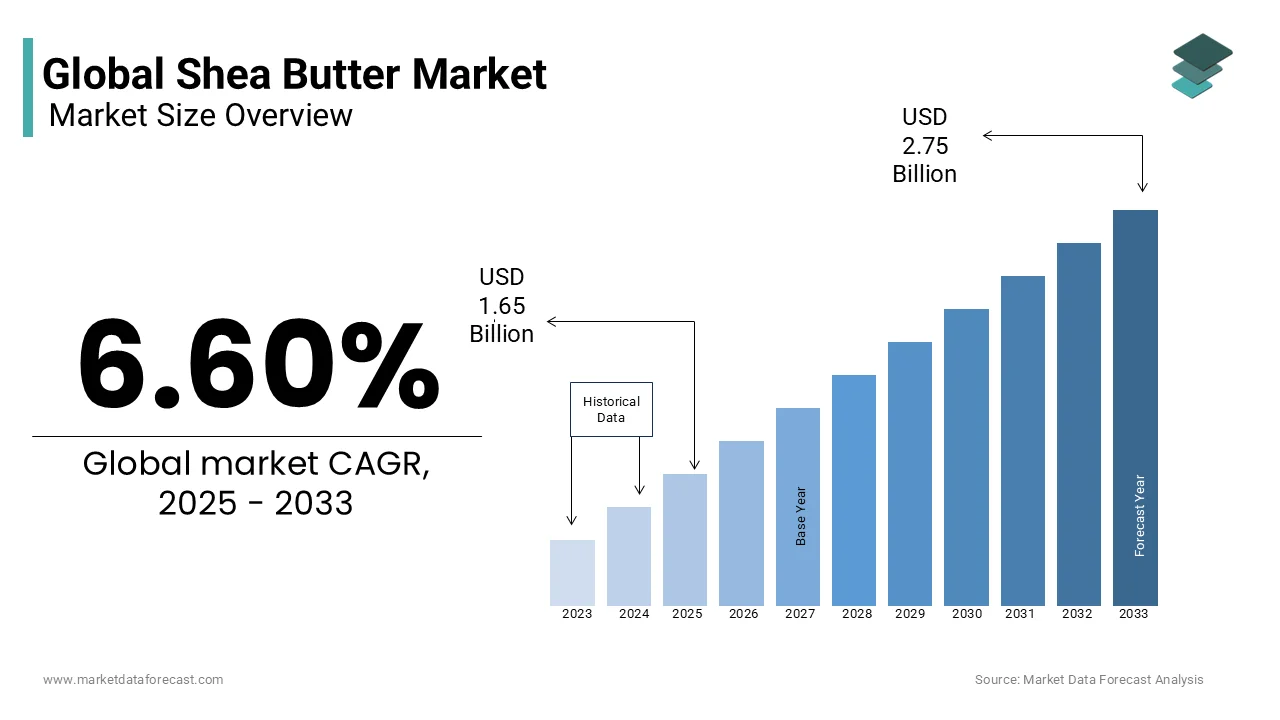
The global shea butter market size was valued at USD 1.65 billion in 2025, and it is estimated to reach at USD 2.93 billion by 2034 from USD 1.76 billion in 2026, expanding at a CAGR of about 6.60% during the forecast period from 2026 to 2034.
Shea butter is a triglyceride-rich fat extracted from the nuts of Vitellaria paradoxa trees indigenous to Africa’s Sudano-Sahelian belt. It functions as both a cultural heritage product and a globally traded emollient. It is valued for its non-greasy texture, thermal stability, and high concentration of unsaponifiables like cinnamic acid and tocopherols. Unlike commodity fats, its value derives from artisanal extraction methods, seasonal harvest cycles, and phytochemical variability tied to terroir.
MARKET DRIVERS
Ethical and Bio-Based Trends Drive Shea Butter Demand
The accelerating pivot in personal care formulations toward bio-based, fair-trade-certified ingredients in premium skincare and haircare segments where ethical sourcing and skin-barrier efficacy are non-negotiable is a key driver of the shea butter market growth. According to the study, imports of certified organic shea butter into the EU surged, driven by reformulation mandates. In South Korea, where K-beauty brands expanded exports a portion in 2023, as per the study, shea-based barrier creams constitute a share of new product registrations, prized for their compatibility with fermented actives and ceramide complexes.
Ban on Synthetic Emollients Boosts Shea Butter Adoption
The global regulatory shift toward banning synthetic emollients and silicones in leave-on cosmetics, particularly in regions enforcing strict biodegradability and aquatic toxicity thresholds, contributes significantly to the expansion of the shea butter market. Many cosmetic SKUs reformulated replaced dimethicone with shea butter to meet aquatic biodegradation benchmarks, a transition accelerating in rinse-off products. the ASEAN Cosmetic Directive (ACD) requires ingredient information and manufacturing process data to be documented and available for regulatory review. Here, shea butter is not an alternative.
MARKET RESTRAINTS
Climate Variability and Low Yields Disrupt Shea Supply
The acute volatility in raw nut yields driven by erratic rainfall, desertification, and aging tree stocks disrupts supply consistency and inflates spot pricing restricting the growth of the shea butter market. According to the research, the Sudano-Sahelian zone experienced a decline in annual precipitation, directly correlating with a drop in shea nut harvests per hectare. As per research, a portion of shea-producing households in northern Ghana and Mali lacked irrigation or soil moisture retention techniques, which forces processors to import nuts from non-traditional zones with inferior fatty acid profiles. This climatic instability forces brands into reactive reformulation, which erodes consumer trust and complicating long-term sourcing contracts.
Informal Processing Methods Limit Product Quality
Primary processing remains persistently informal, relying on sun-drying, hand-cracking, and open-fire roasting impedes the expansion of the shea butter market. These methods introduce microbial contamination and oxidative degradation. As a result, shelf life and regulatory compliance are compromised. As per the study, fewer share of shea collection centers in West Africa meet ISO food safety prerequisites, a gap triggering rejection rates in EU border inspections.
MARKET OPPORTUNITIES
Enzymatic Fractionation Expands Shea Product Potential
The rapid commercialization of enzymatically fractionated shea stearin and olein is substantially to enhance the growth of the shea butter market. The global demand for shea stearin in confectionery grew, with Barry Callebaut and Cargill sourcing certified shea fractions to replace palm oil in vegan chocolate formulations. According to study, enzymatically separated shea olein reduces comedogenicity versus crude butter, which triggers adoption in acne-prone skincare lines. These innovations not only meet clean-label mandates but unlock premium pricing in functional food and derma-cosmetic supply chains, which transforms shea from a bulk emollient into a precision bioactive.
Blockchain and Gender Equity Create Market Opportunities
The digital integration of blockchain-tracked and gender-equity verified shea supply chains, where brands pay premiums for real-time harvest data, women’s income disbursement records, and carbon sequestration metrics, is setting up new opportunities for the shea butter market. Manufacturers deploying traceable shea platforms reduced supplier audit costs and accelerated certification by several months. L'Occitane's transparency ledger, which correlates GPS-tagged harvest zones with fatty acid profiles and women's cooperative payout ratios, enables marketing claims about ethical sourcing and product origin verification.
MARKET CHALLENGES
Lack of Cold-Press Infrastructure Hinders Value Addition
There is a shortage of cold-press and solvent-free refining infrastructure, especially in producing countries where some output still uses rudimentary boiling or clay filtration methods that degrade bioactive unsaponifiables and challenges the growth of the shea butter market. As per the study, fewer industrial-scale cold-press facilities operate across the entire shea belt, while over 3,200 women’s cooperatives produce unrefined butter. According to research, thermally processed shea loses a portion of its cinnamate esters, the very compounds responsible for UV absorption and anti-inflammatory activity. Producers lacking localized low-temperature refining cannot access clinical skincare or pharmaceutical markets, which caps value addition despite global premiumization trends.
Land Tenure Conflicts Restrict Shea Supply Chain Growth
The incompatibility between traditional land tenure systems and export-driven plantation models, where communal tree ownership clashes with corporate traceability and yield optimization demands further hampers the expansion of the shea butter market. A portion of shea parklands in Burkina Faso and Niger remain under customary governance, which prohibits individual tree tagging or GPS mapping required by EU deforestation regulations. According to study, a portion of proposed shea intensification projects stalled due to unresolved benefit-sharing agreements with village elders. In response, global buyers increasingly demand Community Consent Certificates, yet fewer share of cooperatives possess legal capacity to issue them.
REPORT COVERAGE
| REPORT METRIC | DETAILS |
| Market Size Available | 2025 to 2034 |
| Base Year | 2025 |
| Forecast Period | 2026 to 2034 |
| CAGR | 6.60% |
| Segments Covered | By Type, Application, & region |
| Various Analyses Covered | Global, Regional and Country Level Analysis; Segment-Level Analysis; DROC; PESTLE Analysis; Porter’s Five Forces Analysis; Competitive Landscape; Analyst Overview of Investment Opportunities |
| Regions Covered | North America, Europe, APAC, Latin America, Middle East & Africa |
| Market Leaders Profiled | Star Shea Ltd, Bread For Life, All Pure Nature Ltd, Shea Radiance, VINK CHEMICALS GMBH & CO. KG, Jedwards International, Inc, Lovinah Naturals, Maison Karite Sociedad Limitada, Shebu Industries, Shea Therapy Ltd (formerly trading as AGC Ltd), The Pure Company. |
SEGMENTAL ANALYSIS
By Type Insights
The refined shea butter segment dominated the shea butter market by capturing 62.9% of share in 2025. The growth of the refined shea butter segment is driven by its odorless, colorless profile and oxidative stability, prerequisites for mass-market cosmetics, confectionery, and pharmaceutical formulations where sensory neutrality and shelf life are non-negotiable. According to the study, a portion of shea-based cosmetic launches utilized deodorized, bleached butter to ensure compatibility with fragrance systems and active ingredients like retinol and niacinamide. In the EU, refined shea met a share of brand specifications for peroxide value and free fatty acid content, benchmarks unattainable with artisanal unrefined variants.
The unrefined shea butter segment is likely to experience the fastest CAGR of 11.3% from 2026 to 2034. The rapid expansion is propelled by the global “skinimalism” movement and clinical validation of bioactive retention where consumers and dermatologists prioritize phytochemical integrity over aesthetic uniformity. The unrefined shea demonstrated higher cinnamic acid concentration than refined variants, which directly correlates with greater UV-B absorption in SPF booster formulations. There has been a year-over-year increase in unrefined shea sales, driven by Gen Z demand for raw ingredient transparency and FairWild certification. In South Korea, where the Korea Consumer Agency documented a rise in searches for non-deodorized plant butters, indie brands emphasize cold-pressed, village-sourced shea as a marker of authenticity, which transforms rusticity into premium differentiation.
By Application Insights
The cosmetics segment held 48.3% of global shea butter market share in 2025. The prominence of the cosmetics segment is fuelled by the ingredient’s unparalleled emolliency, non-comedogenicity, and compatibility with high-performance actives, which makes it indispensable in moisturizers, lipsticks, and anti-aging serums. As per study, a portion of its new barrier-repair formulations incorporated shea butter due to its proven reduction in transepidermal water loss over days. Even in price-sensitive India, where premium skincare exports grew, demand for RSPO-certified shea surged to meet EU and ASEAN clean-label thresholds.
The food segment segment is estimated to register a CAGR of 13.7% during the forecast period. The growth of the food segment segment is fuelled by the global pivot toward vegan, palm-oil-free structuring fats, particularly in premium chocolate, plant-based cheese, and bakery glazes where melting profile and mouthfeel are vital. According to study, vegan chocolate line, which uses enzymatically fractionated shea stearin, grew, driven by Whole Foods and Waitrose shelf placements. The U.S. saw an increase in shea-based bakery release agents, which replaces hydrogenated oils to meet FDA trans-fat labeling mandates.
REGIONAL ANALYSIS
Europe Market Analysis
Europe led global shea butter market by capturing 38.8% share in 2025. The prominecne of the Europe in the global market is primarily driven by regulatory dominance and premium formulation culture and not merely volume. As per the research, a portion of shea imports carried Fair for Life or Ecocert certifications, driven by the EU Deforestation Regulation’s due diligence mandates. In Germany, a portion of organic cosmetic brands source unrefined shea directly from women’s cooperatives in Ghana, formulations clinically.
North America Market Analysis
North America is another key region in the shea butter market with 29.5% share in 2025. The growth of the North America is due to clinical validation and clean-label enforcement, particularly in derma-cosmetics and functional food. According to the study, new cosmetic SKUs listed shea butter as primary emollient, a portion of which carried non-deodorized, and cold-pressed. Canada saw growth in shea-based bakery release agents by replacing palm fractions to meet retailer clean-label scorecards.
Asia Pacific Market Analysis
Asia Pacific is expected to be the most lucrative region in the shea butter market is due to K-beauty innovation and halal-certified personal care, sectors where texture elegance and religious compliance converge. As per the study, shea-based cushion compacts and sleeping masks grew, prized for their compatibility with fermented essences and ceramide delivery systems. Japan cleared new quasi-drug lotions containing shea butter for eczema relief.
Latin America Market Analysis
Latin America grew gradually in the shea butter market and is driven by premium natural cosmetics and vegan food innovation, particularly in Brazil and Mexico where ethical sourcing resonates with urban millennials. Brazil’s pointed out a growth in shea-based hair masks and formulations targeting curly hair porosity with Fair Trade-certified butter. Mexico saw a rise in shea-structured vegan chocolates, which replaces cocoa butter in premium confectionery to meet clean-label thresholds. Here, shea is not imported commodity.
Middle East & Africa Market Analysis
Middle East and Africa is likely to expand in the shea butter market from 2026 to 2034 owing to the cultural and genetic epicenter of shea, with local consumption and export-grade processing growing in parallel. As per study, large number of women in Nigeria, Ghana, and Burkina Faso participate in certified collection networks, surging household incomes while conserving hectares of parkland. South Africa saw growth in locally refined shea exports, which targets EU halal and vegan cosmetics markets. Here, shea is not raw material. It is intergenerational stewardship, economic empowerment, and ecological resilience woven into every gram.
COMPETITIVE LANDSCAPE
KEY MARKET PLAYERS
Some of the key players dominating the global shea butter market are
- Star Shea Ltd
- Bread For Life
- All Pure Nature Ltd
- Shea Radiance
- VINK CHEMICALS GMBH & CO. KG
- Jedwards International, Inc
- Lovinah Naturals
- Maison Karite Sociedad Limitada
- Shebu Industries
- Shea Therapy Ltd (formerly trading as AGC Ltd)
- The Pure Company
TOP STRATEGIES USED BY KEY MARKET PLAYERS
Vertical integration with women-led cooperatives to ensure ethical traceability and phytochemical consistency, enzymatic fractionation to isolate high-value stearin and olein for food and clinical skincare, deployment of blockchain and AI-driven quality modeling to validate bioactive retention and oxidative stability, investment in solar-powered cold-press infrastructure to preserve unsaponifiables without thermal degradation, and co-engineering with global brands to embed shea into clean-label, vegan, and halal-certified formulations, these constitute the core strategic levers deployed by key players to secure technical indispensability, regulatory alignment, and premium differentiation in a market defined by authenticity.
COMPETITION OVERVIEW
The shea butter market is defined by phytochemical sovereignty and ethical traceability, not commodity pricing. Players compete on verified bioactive concentration, cold-process integrity, and women’s empowerment metrics, which transforms rustic village butter into clinically validated, blockchain-tracked luxury. Incumbents dominate via direct cooperative partnerships, eliminating middlemen and ensuring fatty acid consistency. Regulatory fragmentation, from EU deforestation rules to U.S. clean-label mandates, demands hyper-localized compliance. Competition centers on innovation velocity: who can isolate, stabilize, and certify next-gen fractions fastest. Digital traceability, enzymatic refinement, and clinical substantiation are now table stakes, with winners determined by phytochemical fidelity and social impact transparency, not production scale.
TOP PLAYERS IN THE MARKET
- L’Occitane anchors its global shea dominance through vertically integrated sourcing from women’s cooperatives in Burkina Faso, ensuring traceability and phytochemical consistency. Its platform offers consumers real-time harvest zone mapping and fatty acid chromatograms. The company also funded solar-powered cold-press units across Ghana, which reduces oxidative degradation and unlocking clinical-grade export potential while strengthening ethical indispensability.
- Bunge Loders Croklaan drives global shea innovation through enzymatic fractionation and food-grade structuring fats for vegan confectionery and bakery. It co-engineered RSPO-certified shea fractions for vegan white chocolate with free fatty acids. Its ensures cold-refining preserves unsaponifiables for derma-cosmetic applications. Bunge also deployed AI-driven oxidative stability modeling across West African refineries, which optimizes shelf life without bleaching. These actions position shea not as bulk oil but as precision bio-lipid for clean-label food and pharma.
- Ghana Nuts supports its global footprint through FairWild-certified, village-sourced unrefined shea butter targeting premium derma-cosmetic and halal markets. It now supplies enzymatically stabilized butter to Japanese quasi-drug manufacturers, which transforms rusticity into regulatory-compliant bioactive.
MARKET SEGMENTATION
This research report on the global shea butter market has been segmented and sub-segmented based on type, application, & region.
By Type
- Unrefined shea butter
- Refined shea butter
By Application
- Cosmetics
- Personal care
- Food
- Medical
- Others
By Region
- North America
- Europe
- Asia Pacific
- Latin America
- Middle East and Africa