- Product Description Description
- Table of Contents TOC
- List of Table & Figure LOT
- Get Free Sample PDF Sample PDF
Market Size, 2025
$412 MnMarket Estimate, 2026
$678.4 MnMarket Forecast, 2034
$36,660 MnCAGR, 2026–2034
64.66%Executive Summary: Global Narrowband IoT (NB-IoT) Chipset Market
- Market Scope: Comprehensive global analysis covering offerings, devices, deployment types, end-use applications, regional breakdowns, growth drivers, restraints, and competitive landscapes.
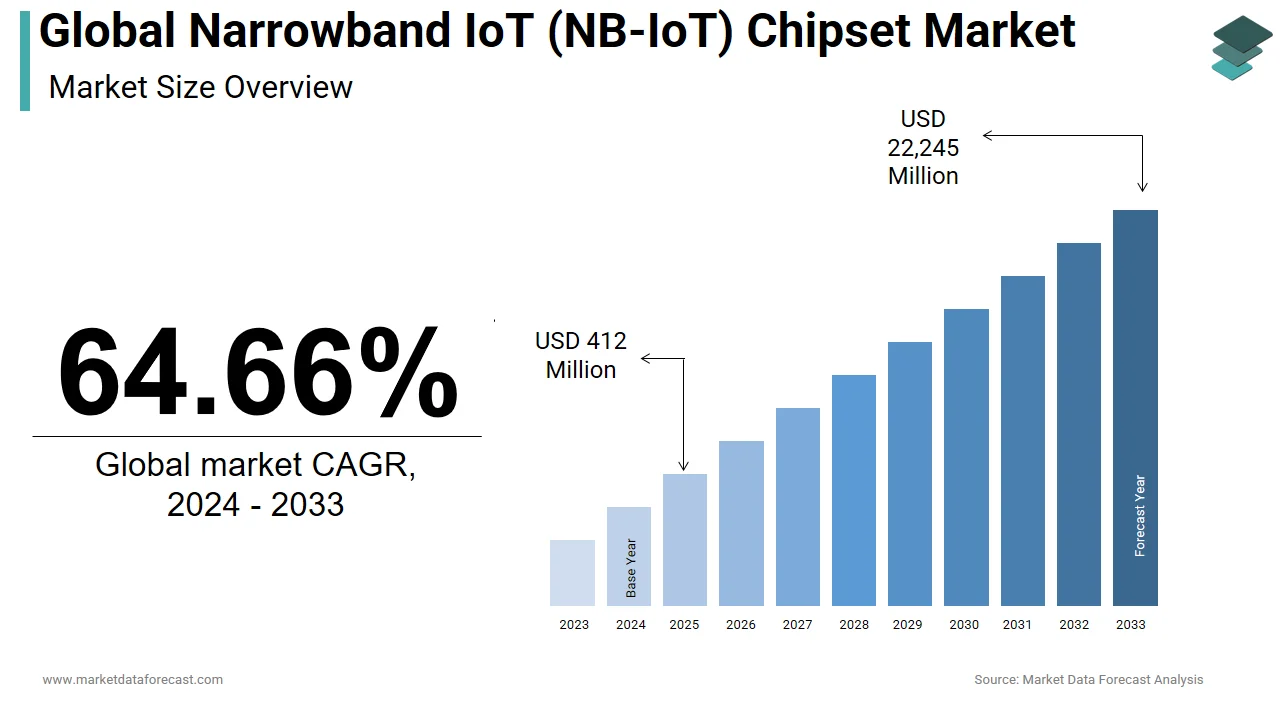
- Market Valuation: Valued at USD 412 million in 2025, estimated at USD 678.40 million in 2026, and projected to reach USD 36,660 million by 2034, registering an explosive compound annual growth rate (CAGR) of 64.66% during the forecast period (2026–2034).
- Primary Growth Drivers: Escalating adoption rates of IoT and network-enabled devices, rising demand for long-range connectivity, high reliability, low operational costs, and exceptional power efficiency of NB-IoT chipsets.
Key Market Segment Metrics (2026–2034)
| Category | Leading / Key Segments | Segment Overview |
|---|---|---|
| By Offering | Hardware & Software | Hardware serves as the foundation for physical IoT device integration, supported by specialized management software. |
| By Deployment Type | In-band, Guard band, & Standalone | Flexible deployment options allow carriers to utilize existing LTE spectrum or dedicated frequency bands. |
| By Application | Smart Meters, Trackers, & Smart Appliances | Driven by smart utility deployments, asset tracking, and smart city infrastructure projects. |
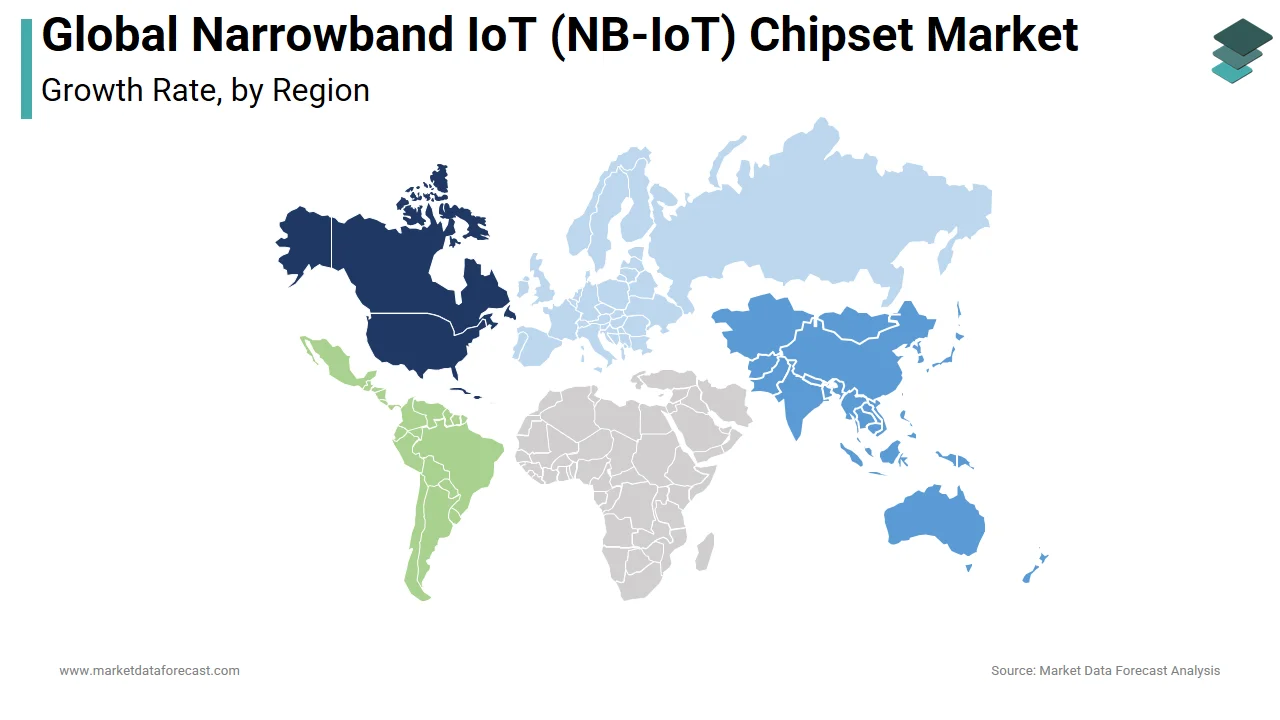
| By Region | North America (Dominant) & Asia-Pacific (Fastest-Growing) | North America leads via government smart initiatives, while APAC grows rapidly due to smart city rollouts in China, Japan, and India. |
Major Market Players & Market Structure
Market Structure: Highly competitive landscape featuring global telecommunications leaders, semiconductor giants, and wireless innovators competing on chip integration, power saving, and 3GPP standards compliance.
Key Companies: Huawei Technologies Co. Ltd., Ericsson, Vodafone Group PLC, Qualcomm Incorporated, Intel Corporation, Samsung Group, Nokia Networks, Verizon Communications, CommSolid GmbH, U-Blox Holding AG, and MistBase AB.
 Download Free Sample Report
Global Narrowband IoT (NB-IoT) Chipset Market Size
The global Narrowband IoT (NB-IoT) chipset market was worth USD 412 million in 2025. The global market is predicted to reach USD 678.40 million in 2026 and USD 36,660 million by 2034, growing at a robust growth rate CAGR of 64.66% from 2026 to 2034.
MARKET SCENARIO
The major factors favoring the N.B. IoT Chipset market are the increasing rates in the adoption of IoT, the sudden growth and need for the installations of network-enabled devices, and the growing demand for long-range connectivity among the networks etc. Apart from these, factors such as the high reliability of N.B. IoT chipsets, the low operational costs involved, and the lower power consumption factor of these chipsets are also aiding the growth of this market globally. However, non-standardized issues and unstable updates are hurting this market.
REPORT COVERAGE
| REPORT METRIC | DETAILS |
| Market Size Available | 2025 to 2034 |
| Base Year | 2025 |
| Forecast Period | 2026 to 2034 |
| CAGR | 64.66% |
| Segments Covered | By Offering, Device, Deployment Type, End-Use Application, Geography |
|
Various Analyses Covered | Global, Regional & Country Level Analysis, Segment-Level Analysis, DROC, PESTLE Analysis, Porter’s Five Forces Analysis, Competitive Landscape, Analyst Overview on Investment Opportunities |
| Regions Covered | North America, Europe, APAC, Latin America, Middle East & Africa |
|
Market Leaders Profiled | Huawei Technologies Co. Ltd., Ericsson, Vodafone Group PLC, Qualcomm Incorporated, Intel Corporation, Samsung Group, Nokia Networks, Verizon Communication, CommSolid GmBH, U-Blox Holding AG, MistBase AB, and others. |
REGIONAL ANALYSIS
The North American region has dominated the global market by accounting for most of the market share and revenue. The U.S. government's investment in launching the IoT in various sectors, such as infrastructure and public services, under programs such as "Smart America," drove the N.B. chip market in North America's IoT and helped it place its position so strong. Deploying intelligent cities and infrastructures in countries such as China, Japan, and India will contribute to the fastest progress in the Asia-Pacific region over the planned period.
KEY MARKET PARTICIPANTS
The significant players in the narrowband IoT market are Huawei Technologies Co. Ltd., Ericsson, Vodafone Group PLC, Qualcomm Incorporated, Intel Corporation, Samsung Group, Nokia Networks, Verizon Communications, CommSolid GmbH, U-Blox Holding AG, and MistBase AB.
RECENT MARKET HAPPENINGS
-
In March 2019, CEVA Inc., a semiconductor company, collaborated with an I.C. design company, our link Technology, to launch Nurlink's NK6010 3GPP Rel.. 14 eNB-IoT system-on-chip (SoC).
-
In February 2019, a semiconductor industrial company, STMicroelectronics, unveiled a Linux-driven STM32MP1 SoC, its first Cortex-A chip optimized for small cells, portable base stations, and specialized handsets.
-
In January 2019, Qualcomm Technologies Inc., an American semiconductor company and a subsidiary of Nasdaq-listed Qualcomm, has recently declared the integration of the Qualcomm Snapdragon mobile platform with 5G integrated chip (SoC). The company said adding the 5G multimode modem and application processing technologies in one system-on-a-chip was essential in making 5G more widely available in all regions and levels.
MARKET SEGMENTATION
This global narrowband IoT (NB-IoT) chipset market research report has been segmented and sub-segmented based on the offering, device, deployment type, end-user application, and region.
By Offering
- Hardware
- Software
By Device
- Alarms & Detector
- Trackers
- Smart Appliance
- Smart Meters
- Wearable Devices
- Others
By Deployment Type
- In-band
- Guard band
- Standalone
By End-Use Application
- Agriculture
- Automotive & Transportation
- Energy
- Healthcare
- Manufacturing
- Retail
- Safety & Security
- Infrastructure
- Building Automation
- Others
By Region
-
North America
-
The United States
-
Canada
-
Rest of North America
-
-
Europe
-
The United Kingdom
-
Spain
-
Germany
-
Italy
-
France
-
Rest of Europe
-
-
The Asia Pacific
-
India
-
Japan
-
China
-
Australia
-
Singapore
-
Malaysia
-
South Korea
-
New Zealand
-
Southeast Asia
-
-
Latin America
-
Brazil
-
Argentina
-
Mexico
-
Rest of LATAM
-
-
The Middle East and Africa
-
Saudi Arabia
-
UAE
-
Lebanon
-
Jordan
-
Cyprus
-