- Product Description Description
- Table of Contents TOC
- List of Table & Figure LOT
- Get Free Sample PDF Sample PDF
Market Size, 2025
$5.87 BnMarket Estimate, 2026
$6.15 BnMarket Forecast, 2034
$8.95 BnCAGR, 2026–2034
4.8%Global Naval Radar System Market Size, Growth, Trends & Forecast (2026–2034)
The global naval radar system market size was valued at USD 5.87 billion in 2025, is estimated to reach USD 6.15 billion in 2026, and is projected to scale up to USD 8.95 billion by 2034, registering a compound annual growth rate (CAGR) of 4.80% during the forecast period from 2026 to 2034. Driven by surging maritime security threats, aggressive fleet modernization initiatives, and the integration of active electronically scanned arrays (AESA) and AI-driven signal processing, the market continues to expand steadily worldwide.
Key Executive Metrics (At-a-Glance)
- 2025 Base Valuation: USD 5.87 Billion
- 2026 Current Valuation: USD 6.15 Billion
- 2034 Forecast Valuation: USD 8.95 Billion
- Compound Annual Growth Rate (CAGR): 4.80% (2026–2034)
- Dominant Component Segment: Antenna Unit & Transceiver Unit (critical for active electronic scanning and high-resolution target acquisition)
- Dominant Frequency Segment: X-Band & S-Band (vital for high-resolution surface tracking and long-range surveillance)
- Dominant Application Segment: Surveillance & Missile Guidance (essential for multi-function defense architecture)
- Dominant Region: North America (commanding a leading share backed by U.S. Navy procurement programs and advanced defense tech developers)
Core Market Drivers
- Rising Maritime Security Threats: Escalating incidents of piracy, territorial incursions, asymmetric drone warfare, and smuggling requiring persistent monitoring.
- Advanced Radar Innovations: Integration of AESA technology, solid-state transmitters, and AI-driven machine learning algorithms for autonomous threat classification.
- Naval Fleet Expansion: Broad defense modernization programs across the globe, particularly in the Asia-Pacific and North American regions.
Primary Market Restraints & Challenges
- High Capital Expenditure: Substantial development, integration, and lifecycle maintenance expenses associated with modern naval radar suites.
- Cyber Vulnerabilities: Susceptibility of legacy systems to advanced electronic warfare jamming and sophisticated cyber-attacks.
Global Naval Radar System Market Segmentation Breakdown
| Segment Category | Leading Sub-Segment (2025 Base) | Fastest-Growing Sub-Segment (2026–2034) |
|---|---|---|
| By Component | Antenna & Transceiver Units | Processing & Control Units (AI-Enabled) |
| By Frequency | X-Band Systems | S-Band Multi-Function Systems |
| By Application | Surveillance | Missile Guided & Fire Control |
| By Region | North America (35.3%) | Asia-Pacific (28.5%) |
Major Industry Players Profiled
Key enterprises shaping the competitive global naval radar system market include Raytheon Technologies Corporation, Lockheed Martin Corporation, Thales Group, Leonardo S.p.A., Israel Aerospace Industries Limited, Saab AB, Kelvin Hughes Limited, BAE Systems, Airbus Group, Furuno Electric Co., Ltd., and Northrop Grumman Corporation.
Global Naval Radar System Market Size
The global naval radar system market size was valued at USD 5.87 billion in 2025 and is anticipated to reach a valuation of USD 6.15 billion in 2026 and USD 8.95 billion by 2034, growing at a CAGR of 4.8% during the forecast period from 2026 to 2034.
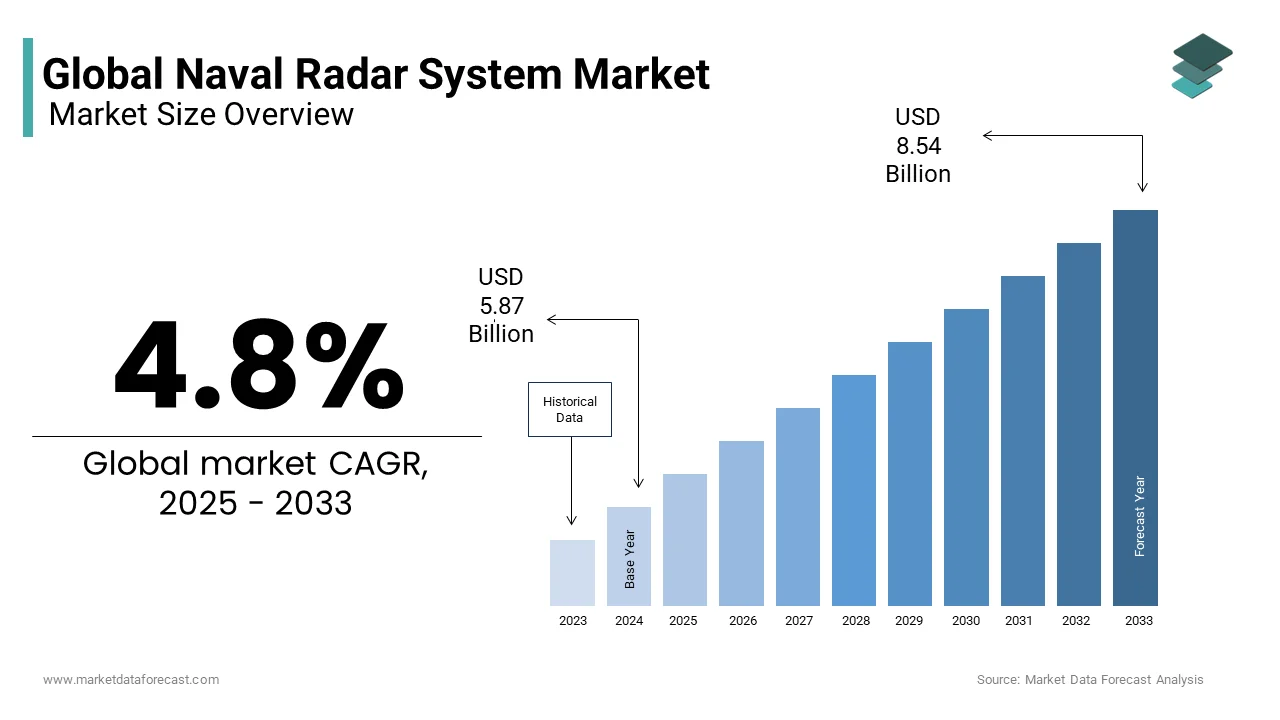
A naval radar system is a vital component of modern maritime defense infrastructure, designed to detect, track, and identify vessels, aircraft, missiles, and other potential threats across vast oceanic expanses. These systems operate across multiple frequency bands and incorporate advanced signal processing technologies to ensure high-resolution imaging and long-range surveillance capabilities. As per multiple sources, the vast majority of international trade continues to be transported via sea routes, solidifying maritime domain awareness as a crucial component of national security strategies. According to research, global military expenditure continues to increase significantly, with a notable emphasis on modernizing naval capabilities. The integration of artificial intelligence, active electronically scanned arrays (AESA), and multi-function radar systems has further enhanced the operational efficiency of naval radars. Apart from these, rising geopolitical tensions in strategic waterways such as the South China Sea and the Strait of Hormuz have prompted nations to invest heavily in next-generation radar solutions. The deployment of unmanned surface vehicles and stealth technology by adversaries has necessitated the development of more sophisticated detection mechanisms. As per research, radar upgrades now constitute a portion of total shipboard modernization budgets.
MARKET DRIVERS
Rising Maritime Security Threats
The escalating frequency of maritime security threats such as piracy, smuggling, and unauthorized territorial incursions is a key accelerator of the naval radar system market. According to the International Maritime Bureau, the total number of global piracy and armed robbery incidents increased slightly in 2023 compared to the previous year, with a notable rise in crew-related violence and a resurgence of activity in the Gulf of Guinea and off the coast of Somalia. These threats necessitate persistent monitoring and early detection capabilities, which traditional radar systems are increasingly unable to fulfill due to advancements in stealth technology and electronic countermeasures. Modern naval radar systems offer improved target discrimination, reduced false alarm rates, and enhanced resistance to jamming, making them essential for safeguarding Exclusive Economic Zones (EEZs) and strategic chokepoints. Furthermore, the proliferation of asymmetric warfare tactics, including drone swarms and fast-moving small boats, has intensified the need for real-time situational awareness. The U.S. Navy's Fiscal Year 2024 budget request proposed substantial funding for shipbuilding and sought to increase the total number of battle force ships over the long term, with a focus on acquiring modern vessels to address evolving maritime requirements. Global naval forces are widely engaged in extensive modernization efforts, driven by the need to counter a diverse and changing range of maritime security challenges.
Technological Advancements in Radar Systems
Technological innovations such as Active Electronically Scanned Arrays (AESA), solid-state transmitters, and artificial intelligence-driven signal processing are among the major drivers of the naval radar system market. AESA radars offer superior reliability, extended detection range, and simultaneous multi-target tracking, which are critical for modern naval operations. The AN/SPY-6 radar system used by the U.S. Navy offers significant improvements in sensitivity over older radar systems. These advancements allow for better detection of smaller and less visible targets. There is a growing global investment in naval radar systems based on active electronically scanned array technology. The integration of machine learning algorithms allows for autonomous threat classification and predictive analytics, significantly reducing response times. Moreover, the miniaturization of radar components has enabled the deployment of high-performance systems on smaller platforms such as corvettes and patrol vessels. Besides, the development of multi-function radars capable of performing air surveillance, surface search, and fire control simultaneously has streamlined naval operations. Countries like Japan, South Korea, and India are investing in indigenous radar development programs to reduce reliance on foreign suppliers and enhance self-sufficiency in defense technology.
MARKET RESTRAINTS
High Development and Maintenance Costs
The development and deployment of cutting-edge naval radar systems involve substantial capital investments, which pose a significant barrier for many nations, particularly those with constrained defense budgets, and thereby restrict the growth of the naval radar system market. Acquiring individual advanced radar systems can involve substantial costs, not including associated expenses like setup, personnel instruction, and extended operational upkeep. A naval radar system upgrade program for existing ships is projected to require a significant financial commitment spanning a period of several years. In addition to upfront costs, the ongoing maintenance of these systems demands specialized personnel, periodic hardware upgrades, and continuous software updates to counter emerging threats. Developing nations, despite recognizing the strategic importance of maritime surveillance, often struggle to allocate adequate financial resources. For example, several Southeast Asian countries have delayed radar modernization projects due to budget reallocations towards humanitarian and infrastructure initiatives. Furthermore, the complexity of integrating new radar systems with legacy platforms increases retrofitting costs, which discourages mid-life upgrades.
Vulnerability to Electronic Warfare and Cyber Threats
Modern naval radar systems are increasingly susceptible to sophisticated electronic warfare (EW) and cyber-attacks, whichaffects their operational effectiveness and poses a significant restraint to the naval radar system market. Adversaries are deploying advanced jamming techniques, deceptive signals, and cyber intrusions to degrade radar performance and compromise situational awareness. Simulated cyber attacks have been incorporated into naval exercises in the recent past, uncovering significant weaknesses in current systems. Legacy radar architectures, which rely on predictable signal patterns and centralized data processing, are particularly vulnerable to spoofing and denial-of-service attacks. The integration of networked radar systems across multiple platforms has expanded the attack surface, creating additional entry points for malicious actors. Many naval radar systems currently in operation across NATO countries lack sufficient cybersecurity protections. The growing reliance on commercial off-the-shelf (COTS) components in radar design has further introduced potential backdoors and vulnerabilities. Additionally, the absence of standardized cybersecurity frameworks for naval radars complicates interoperability and increases the risk of cross-platform contamination. Potential adversaries possess the ability to interfere with radar functions over great distances, which emphasizes the need for stronger and more secure radar designs.
MARKET OPPORTUNITY
Expansion of Naval Modernization Programs in the Asia-Pacific
The Asia-Pacific region is witnessing a surge in naval modernization initiatives, which offer potential opportunities for the growth of the naval radar system market. This is driven by increasing territorial disputes, rising defense budgets, and the strategic importance of maritime trade routes. Countries such as India, Japan, South Korea, and Australia are prioritizing investments in advanced radar systems to enhance their maritime domain awareness and strengthen regional deterrence capabilities. Japan intends to procure new Aegis-equipped destroyers featuring advanced radar systems. Similarly, India's Navy plans surface fleet upgrades, including internally developed radar technology. The region’s growing emphasis on blue-water naval capabilities necessitates the deployment of long-range, multi-function radar systems capable of supporting carrier strike groups and amphibious operations. The establishment of joint radar development programs, such as the India-France collaborative effort on the SMART-L MM/N radar, underscores the strategic importance of regional partnerships. Furthermore, the increasing participation of Asia-Pacific nations in multilateral naval exercises enhances interoperability and creates demand for standardized radar solutions. The growing presence of unmanned naval platforms also presents opportunities for compact and high-performance radar systems tailored for autonomous operations.
Integration of AI and Machine Learning in Radar Systems
The convergence of artificial intelligence (AI) and machine learning (ML) with these systems provides a major opportunity for enhancing detection accuracy, reducing false alarms, and enabling autonomous threat response. This is expected to fuel the expansion of the naval radar system market. AI-driven radar systems can process vast volumes of sensor data in real-time, identify anomalous patterns, and classify targets with minimal human intervention. Machine learning algorithms enable adaptive signal processing, allowing radars to dynamically adjust parameters based on environmental conditions and threat profiles. This capability is particularly valuable in cluttered maritime environments where traditional radar systems struggle to distinguish between legitimate threats and benign objects. Besides, the integration of AI facilitates predictive maintenance, reducing downtime and extending the operational lifespan of radar systems. The adoption of AI also supports the development of cognitive radar systems capable of learning from past engagements and improving performance over time. Emerging applications such as swarm detection and electronic support measures are further expanding the utility of AI-powered radar technologies in modern naval warfare.
MARKET CHALLENGES
Regulatory and Export Control Constraints
The export and deployment of advanced naval radar systems are subject to stringent regulatory frameworks and export control regimes, which can impede market expansion and technology transfer, thereby challenging the growth of the naval radar system market. The Wassenaar Arrangement, Missile Technology Control Regime (MTCR), and International Traffic in Arms Regulations (ITAR) impose restrictions on the sale of dual-use radar technologies and limit access to sensitive components. The United States government denies a significant number of export license applications for radar-related technologies when such transfers are determined to pose risks to national security. These regulations often result in delayed deliveries, increased compliance costs, and restricted collaboration opportunities between international defense contractors. Developing nations seeking to procure advanced radar systems frequently encounter bureaucratic hurdles and prolonged approval processes, which can delay critical modernization projects. Besides, the lack of harmonization among national export control policies creates inconsistencies in global trade flows and complicates supply chain management. Furthermore, the classification of emerging technologies such as AI-enabled radar systems under export control regimes introduces additional layers of complexity. The growing emphasis on cybersecurity compliance further restricts the export of radar systems to non-aligned nations, which limits market penetration in key growth regions.
Interoperability Issues Among Allied Forces
Ensuring seamless interoperability among radar systems deployed by allied naval forces remains a persistent impediment to the naval radar system market. This challenge is particularly acute in multinational operations and coalition warfare scenarios. Differences in communication protocols, data formats, and radar architectures hinder real-time information sharing and joint situational awareness. Legacy radar platforms, which constitute a significant portion of global naval fleets, cannot often integrate with modern command and control systems. This disparity creates operational gaps and reduces the effectiveness of coordinated maritime missions. The complexity of retrofitting older systems with new interoperability standards further increases costs and extends project timelines. The absence of universal standards for radar data exchange also complicates joint exercises and training programs. Besides, the proliferation of proprietary radar technologies by defense contractors has created vendor lock-in scenarios, which limit flexibility in system upgrades. The development of open-architecture radar systems and standardized interfaces is critical to addressing these challenges and enabling seamless coalition operations in future maritime conflicts.
REPORT COVERAGE
| REPORT METRIC | DETAILS |
| Market Size Available | 2025 to 2034 |
| Base Year | 2025 |
| Forecast Period | 2026 to 2034 |
| CAGR | 4.8% |
| Segments Covered | By Component, Frequency, Application, and Region |
| Various Analyses Covered | Global, Regional & Country Level Analysis, Segment-Level Analysis, DROC, PESTLE Analysis, Porter’s Five Forces Analysis, Competitive Landscape, Analyst Overview on Investment Opportunities |
| Regions Covered | North America, Europe, APAC, Latin America, Middle East & Africa |
| Market Leaders Profiled | Leonardo S.p.A, Israel Aerospace Industries Limited, Lockheed Martin Corporation, Saab AB, Kelvin Hughes Limited, BAE Systems, Raytheon Technologies Corporation, Airbus Group, Furuno Electric Co., Ltd., West Marine, Northrop Grumman Corporation. |
REGIONAL ANALYSIS
North America Market Analysis
North America outperformedother regionsn in the global naval radar system market and accounted for a 35.3% share in 2025. The dominance of the North American market is driven by the region’s advanced naval capabilities and substantial defense investments. A different growth factor behind this market dominance is the extensive modernization programs undertaken by the U.S. Navy. The U.S. Navy continuously invests billions annually in new ship construction and modernization, focusing heavily on integrating advanced radar systems like the new SPY-6 and SPY-7 into its fleet, reflecting an ongoing commitment to superior situational awareness and defense capabilities. These initiatives highlight the region’s commitment to maintaining naval superiority through advanced radar technology. Besides, the presence of leading radar system manufacturers in North America contributes to the region’s market dominance. Companies like Raytheon Technologies and Lockheed Martin are at the forefront of radar innovation, supplying advanced systems to navies worldwide. Raytheon’s AN/SPY-6 radar, for instance, has been adopted by the U.S. Navy and several allied nations, reinforcing North America’s position as a global leader in naval radar systems. The concentration of these industry leaders in the region ensures continued market growth and technological advancement.
Asia-Pacific Market Analysis
Asia-Pacific was the second-largest region in the global naval radar system market by holding a 28.5% share in 2025. The expansion of the APAC market is propelled by the region’s increasing naval modernization efforts and rising defense expenditures. A different driver is the aggressive naval expansion programs undertaken by countries like China and India. The People's Liberation Army Navy has consistently expanded its fleet, which is now the world's largest by ship count, incorporating increasingly sophisticated destroyers, submarines, and other major combatants. China's overall military expenditure has seen continuous, substantial growth over several years to support a comprehensive military modernization, and external expert analyses suggest the actual spending is significantly higher than officially reported figures. Similarly, India’s Navy is investing in Project 17A frigates and aircraft carriers, requiring advanced radar installations to enhance operational capabilities. Furthermore, the growing emphasis on maritime security in the region has led to increased radar system procurements. The strategic importance of the South China Sea and the Indian Ocean has prompted countries like Japan, South Korea, and Australia to enhance their naval surveillance capabilities. These initiatives reflect the region’s commitment to maintaining maritime security through advanced radar technology, driving market growth.
Europe Market Analysis
Europe is another key player in the global naval radar system market, with the region’s advanced defense industry and collaborative naval programs. A further factor is the collaborative defense initiatives among European nations aimed at enhancing naval capabilities. These initiatives promote the adoption of advanced radar technologies across European navies, driving market growth. Additionally, the presence of leading defense contractors in Europe contributes to the region’s market share. Companies like Thales Group and Leonardo S.p.A. are prominent suppliers of naval radar systems, offering advanced solutions to global markets. Thales’ SMART-L radar system, for example, is widely used in European naval platforms, including the Dutch and Belgian navies. The expertise of these companies in radar technology ensures Europe’s continued prominence in the global naval radar system market.
Middle East and Africa Market Analysis
The Middle East and Africa region experienced a consistent growth of the global naval radar system market owing to the increasing focus on maritime security and defense modernization in the region. An additional accelerator of this growth is the rising defense expenditures in Gulf Cooperation Council (GCC) countries, particularly Saudi Arabia and the UAE. Moreover, the UAE’s Navy is investing in radar-equipped corvettes to strengthen coastal defense operations. Moreover, the strategic importance of maritime trade routes in the region has led to increased radar system installations. The Strait of Hormuz and the Red Sea are critical shipping lanes, prompting countries to enhance naval surveillance to protect maritime assets. Egypt’s Navy, for instance, has procured advanced radar systems for its Gowind-class corvettes, reflecting the growing emphasis on maritime security. These initiatives underscore the region’s commitment to safeguarding maritime interests through advanced radar technology.
Latin America Market Analysis
Latin America is anticipated to expand notably in the global naval radar system market from 2025 to 2033 due to increasing defense investments and modernization efforts. A different key factor is the growing focus on maritime border security in countries like Brazil and Chile. Brazil’s Navy has initiated the Tamandare-class frigate program, which includes the installation of advanced radar systems. In addition, Chile’s Navy is investing in radar-equipped patrol vessels to monitor its maritime borders, driving demand for naval radar systems. Additionally, the modernization of aging naval fleets in the region is contributing to market growth. Many Latin American countries are replacing outdated radar systems with modern alternatives to improve operational efficiency. Argentina’s Navy, for example, has procured new radar systems for its corvettes as part of a broader fleet modernization initiative. These efforts to upgrade naval capabilities reflect the region’s commitment to enhancing maritime security through advanced radar technology.
COMPETITIVE LANDSCAPE
The naval radar system market exhibits intense competition characterized by technological innovation and strategic positioning among established players. Major defense contractors compete fiercely to provide advanced radar solutions that offer superior performance, reliability, and integration capabilities. The competitive landscape is shaped by continuous research and development investments, with companies striving to develop next-generation radar technologies that address evolving maritime threats. Strategic acquisitions and partnerships play a crucial role in market consolidation, enabling companies to expand their technological portfolios and geographic reach. Regional players are increasingly challenging established manufacturers by offering cost-effective solutions tailored to specific naval requirements. The market dynamics are influenced by government defense budgets, geopolitical tensions, and emerging security concerns that drive demand for advanced naval radar systems. Competition is further intensified by the need for continuous product upgrades and after-sales support services that ensure long-term customer relationships and market retention.
KEY MARKET PLAYERS
Some of the leading companies operating in the Global Naval Radar System Market are:
- Leonardo S.p.A
- Israel Aerospace Industries Limited
- Lockheed Martin Corporation
- Saab AB
- Kelvin Hughes Limited
- BAE Systems
- Raytheon Technologies Corporation
- Airbus Group
- Furuno Electric Co. Ltd.
- West, Marine
- Northrop Grumman Corporation
Top Players In The Market
- Raytheon Technologies Corporation stands as a dominant force in the naval radar system market, renowned for its advanced Aegis Combat System and SPY series radars. The company's expertise spans decades of naval defense innovation, providing cutting-edge radar solutions to navies worldwide. Their integrated sensor systems offer superior target detection, tracking, and engagement capabilities, making them a preferred choice for major naval powers. Raytheon's commitment to research and development ensures continuous technological advancement in naval radar systems, maintaining its competitive edge in the global market.
- Lockheed Martin Corporation Lockheed Martin represents a cornerstone in naval radar technology, delivering sophisticated radar systems that form the backbone of modern naval defense. The company's extensive portfolio includes advanced surveillance and fire control radars that equip various naval platforms globally. Their innovative approach to radar system design emphasizes reliability, performance, and integration capabilities. Lockheed Martin's strong partnerships with government agencies and international allies have solidified their position as a leading provider of naval radar solutions, consistently meeting evolving maritime security requirements.
- Thales Group emerges as a prominent European player in the naval radar system market, offering comprehensive radar solutions through its advanced sensor technologies. The company's expertise encompasses air and surface surveillance radars, navigation systems, and combat management solutions. Thales has established strong relationships with European and international navies, providing tailored radar systems that meet specific operational requirements. Their focus on innovation and technological excellence has positioned them as a key supplier of naval radar systems, contributing significantly to maritime defense capabilities worldwide.
Top Strategies Used by Key Market Participants
- Strategic Partnerships and Collaborations Leading players in the naval radar system market actively pursue strategic partnerships with government agencies, research institutions, and international defense organizations. These collaborations enable companies to leverage complementary expertise, share development costs, and access new market opportunities. Through joint ventures and technology sharing agreements, manufacturers can accelerate innovation cycles and develop advanced radar solutions that meet evolving naval requirements. Such partnerships also facilitate knowledge transfer and enhance competitive positioning in the global market.
- Research and Development Investments Key market participants consistently allocate substantial resources toward research and development initiatives to maintain technological superiority. These investments focus on developing next-generation radar technologies, including advanced signal processing, artificial intelligence integration, and multi-functional capabilities. Companies prioritize innovation in areas such as electronic scanning, improved detection ranges, and enhanced target discrimination. Continuous R&D efforts enable manufacturers to stay ahead of emerging threats and provide navies with cutting-edge solutions that address contemporary maritime challenges.
- Geographic Expansion and Market Penetration Major players employ aggressive geographic expansion strategies to capture emerging market opportunities and strengthen their global presence. This approach involves establishing regional manufacturing facilities, forming local partnerships, and adapting products to meet specific regional requirements. Companies focus on penetrating high-growth markets in Asia-Pacific, the Middle East, and Latin America, where naval modernization programs are gaining momentum. Geographic expansion also includes participation in international defense exhibitions and direct engagement with regional defense authorities to build long-term relationships.
MARKET SEGMENTATION
This research report on the global naval radar system market has been segmented and sub-segmented based on the component, frequency, application, and region.
By Component
- Antenna Unit
- Transceiver Unit
- Processing Unit
- Display Unit
- Control Unit
By Frequency
- X- Band
- S-Band
By Application
- Surveillance
- Missile Guided
By Region
- North America
- Europe
- Asia-Pacific
- Latin America
- Middle East and Africa