- Product Description Description
- Table of Contents TOC
- List of Table & Figure LOT
- Get Free Sample PDF Sample PDF
Market Size, 2025
$34.18 BnMarket Estimate, 2026
$39.03 BnMarket Forecast, 2034
$112.92 BnCAGR, 2026–2034
14.2%Global Near Field Communication Market Size, Growth, Trends & Forecast (2026–2034)
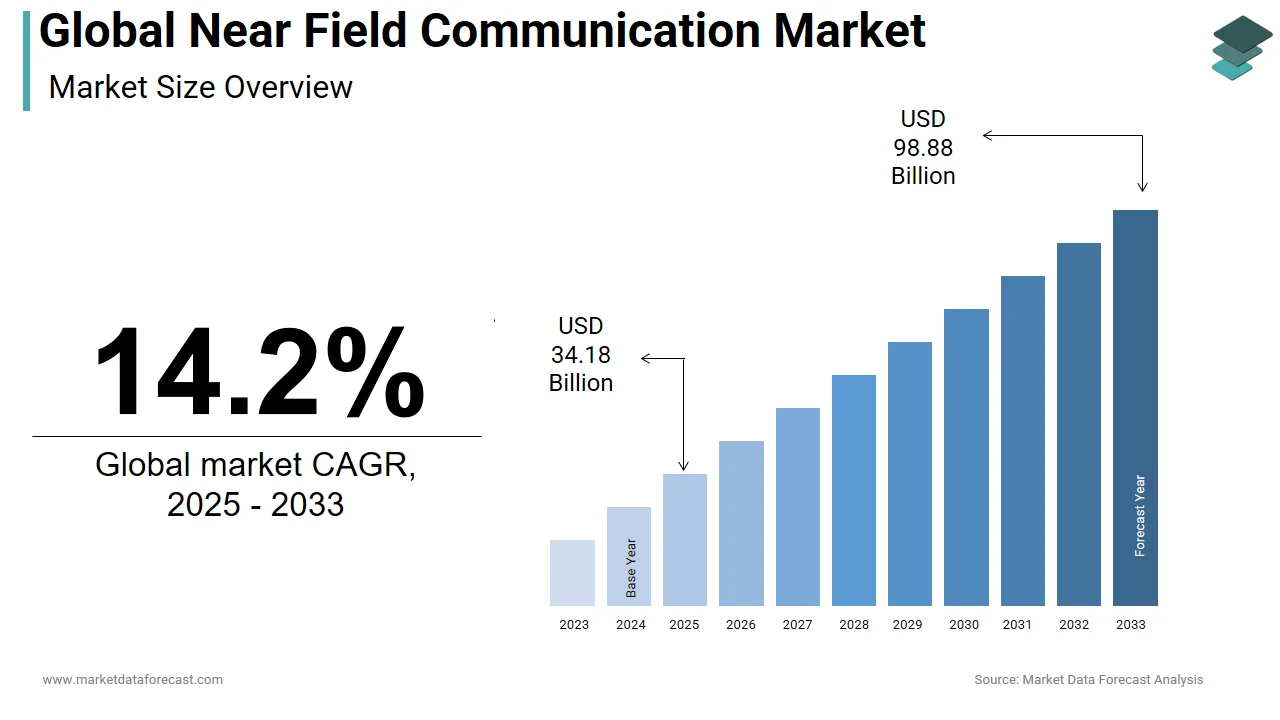
The global near field communication (NFC) market was valued at USD 34.18 billion in 2025, is predicted to reach USD 39.03 billion in 2026, and is projected to scale up to USD 112.92 billion by 2034, registering a compound annual growth rate (CAGR) of 14.2% during the forecast period from 2026 to 2034. Driven by the explosion of cashless mobile transactions, expanding IoT ecosystems, and advanced medical patient monitoring solutions, the market continues to experience steady global expansion.
Key Executive Metrics (At-a-Glance)
- 2025 Base Valuation: USD 34.18 Billion
- 2026 Current Valuation: USD 39.03 Billion
- 2034 Forecast Valuation: USD 112.92 Billion
- Compound Annual Growth Rate (CAGR): 14.2% (2026–2034)
- Dominant Device Segment: Smartphones & Mobile Wearables (anchoring high-frequency tap-and-go transactions)
- Fastest-Growing End User / Application: Healthcare & BFSI (driven by secure patient monitoring and contactless banking compliance)
- Dominant Region: North America (supported by advanced tech infrastructure and early contactless adoption)
Core Market Drivers
- Cashless & Contactless Transactions: Surging utilization of smartphones and wearable devices for seamless, secure retail payments and transit ticketing.
- Healthcare Innovations: Integration of NFC smart sensors for real-time remote patient monitoring, biometric tracking, and secure medical records management.
Primary Market Restraints & Challenges
- Adoption Barriers: Limited user awareness in emerging sectors, short-range communication boundaries, expensive development costs, and rising cybersecurity vulnerability concerns.
Global Near Field Communication Market Segmentation Breakdown
| Segment Category | Leading Sub-Segment (2025 Base) | Fastest-Growing Sub-Segment (2026–2034) |
|---|---|---|
| By Type | Non-Auxiliary Products (standard ICs and embedded tags) | Auxiliary Products (micro-SD/SIM covers and add-ons) |
| By Device | Smartphones (primary consumer interaction hub) | Tablets & Connected Wearables (IoT integration) |
| By Application | NFC Payments & Ticketing (high-volume deployment) | Healthcare & Access Control (secure data exchanges) |
| By Region | North America (leading market valuation and mature tech) | Asia-Pacific (fastest-growing due to rising per capita income and mobile tech adoption in China/India) |
Major Industry Players Profiled
Key market leaders steering the global near field communication ecosystem include [NXP Semiconductors](https://www.nxp.com) (Netherlands), [Broadcom](https://www.broadcom.com) (United States), [Samsung](https://www.samsung.com) (South Korea), [Intel Corporation](https://www.intel.com) (United States), [Qualcomm Inc.](https://www.qualcomm.com) (United States), [AMS AG](https://ams.com) (Austria), [STMicroelectronics](https://www.st.com) (Switzerland), [Texas Instruments](https://www.ti.com) (United States), MStar Semiconductor (Taiwan), and [Flomio, Inc.](https://www.flomio.com) (United States).
 Download Free Sample Report
Global Near Field Communication Market Size
The global near field communications (NFC) market was valued at USD 34.18 billion in 2025. The global market is predicted to reach USD 39.03 billion in 2026 and USD 112.92 billion by 2034, growing at a CAGR of 14.2% during the forecast period.
Near-field communication is a low-power, short-range communication protocol between two devices. One device, the initiator, uses magnetic induction to create a radio wave field that the target can sense and access, allowing small amounts of data to be transferred wirelessly over a relatively short distance.
The healthcare sector is expected to be the biggest adopter of near-field communication technologies. This technology can help medical institutes provide medical records directly by bringing devices into contact with each other. It uses current mobile technologies in conjunction with the cloud and is considered a revolutionary method for improving healthcare infrastructure around the world.
NFC end users can use the technology with little knowledge of the underlying technology. Communication starts automatically simply by physically joining two devices or a device and a tag respectively. Hence, NFC is very suitable for mobile payment and ticketing scenarios.
The Peer-to-Peer mode offered by NFC can be used for transparent money transfers between people and to exchange other forms of data. The Android operating system provides a feature called Android Beam. Android developers can use this option to transfer videos, pictures, websites, or other data by holding two suitable phones together.
MARKET DRIVERS
The main factors driving the global near-field communications market are the increasing adoption of NFC technology by various smartphone and similar device manufacturers, the convenient transfer and security of data, and the increasing use of smartphones for cashless transactions.
However, a lack of awareness of the advantages of NFC, expensive development costs, competition from alternative payment methods, the problem of short-distance communications, and growing security concerns may hamper the growth of the worldwide NFC market.
NFC also offers multiple advantages in the field of medical applications. One promising approach offers various methods of monitoring health and recording the health status of patients using NFC. Patient monitoring via NFC, including the ideal technology for patient monitoring, such as smart sensors, which measure patients' fitness and transmit data to nearby monitoring devices, mobile networks, and healthcare professionals for monitoring and evaluation. In addition, the rise of wearable technology further drives the market's growth, as NFC also finds substantial applications in modern wearable devices. Patient monitoring solutions can be standard or customized to obtain personalized treatment and secure medical data. Therefore, many companies design personalized NFC tags for patients. NFC tags provide secure physical access to track patient data. Home monitoring using NFC-enabled devices is increasingly used, and medical data can, therefore, be transmitted to the doctor.
NFC innovations in patient monitoring include "MiniME," which is a biometric device developed by Ergonomic Design monitors, with parameters such as ECG, blood pressure, heart rate, body temperature, and many other functions that transmit data through the NFC cloud. In addition, Impak Health has developed home heart, lung, and sleep monitoring devices and has integrated NFC into “Rhythm Track,” which tracks the ECG and sleep cycle. Furthermore, the increasing number of innovations in NFC has led to the development of the technology.
REPORT COVERAGE
| REPORT METRIC | DETAILS |
| Market Size Available | 2025 to 2034 |
| Base Year | 2025 |
| Forecast Period | 2026 to 2034 |
| CAGR | 14.2% |
| Segments Covered | By Type, End User, Device, Application, and Region. |
|
Various Analyses Covered | Global, Regional & Country Level Analysis, Segment-Level Analysis, DROC, PESTLE Analysis, Porter’s Five Forces Analysis, Competitive Landscape, Analyst Overview on Investment Opportunities |
| Regions Covered | North America, Europe, APAC, Latin America, Middle East & Africa |
|
Market Leaders Profiled | NXP Semiconductors (Netherlands), Broadcom Corporation (United States), SAMSUNG (South Korea), Intel Corporation (United States), Qualcomm Inc. (United States), AMS AG (Austria), STMicroelectronics (Switzerland), Texas Instruments Incorporated (United States), MStar Semiconductor, Inc. (Taiwan), Flomio, Inc. (United States) and Others. |
REGIONAL ANALYSIS
North America is expected to dominate the market, followed by Europe, due to the presence of advanced technologies and the presence of global players. Asia-Pacific is expected to become the fastest growing market for near-field communications due to strong demand for NFC-enabled smartphones, growth in the consumer electronics industry, and growing security concerns in the sectors like BFSI. Furthermore, rising revenue, high adoption of smart devices, and rising per capita income in countries such as India and China are expected to drive strong growth for the near-field communications market in the Asia Pacific region.
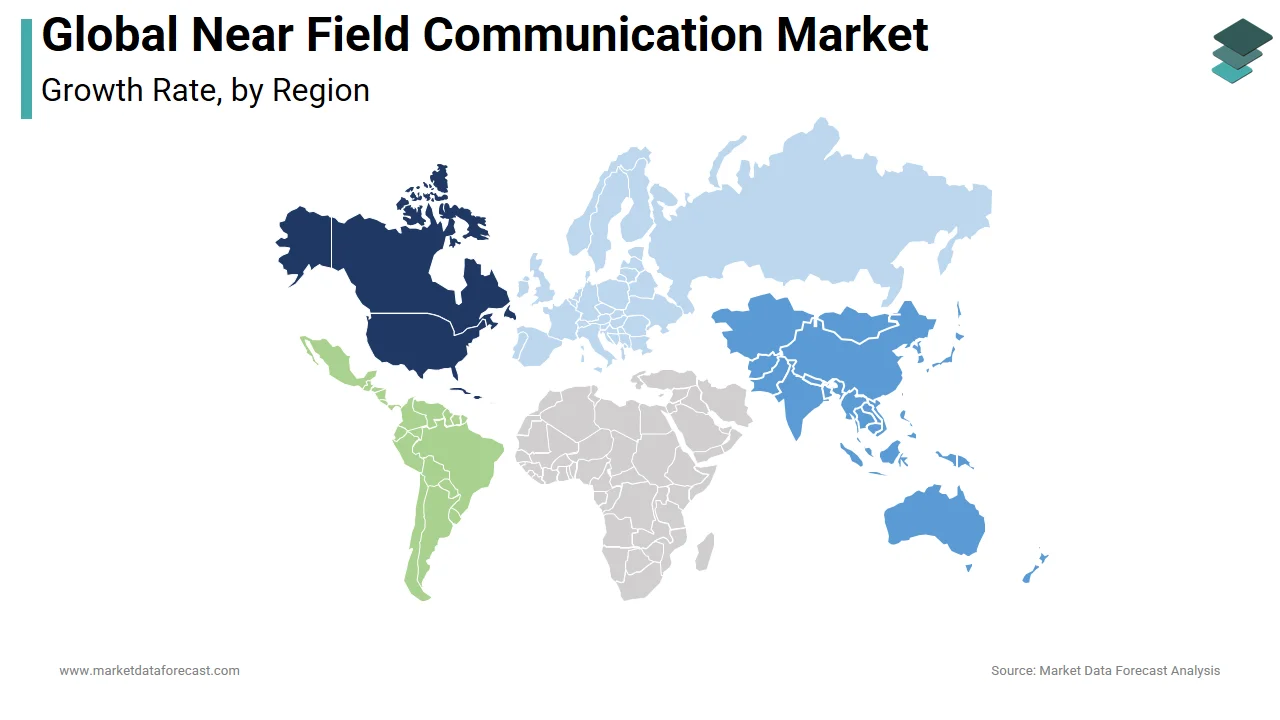
Europe and North America are the top two contributors to the NFC chip industry. These two regions collectively represent more than 50% of the global markets due to the higher rate of adoption of NFC applications. Germany and the UK are expected to be the most lucrative NFC markets in the near future. Also, each country has its own contactless payment limit.
KEY MARKET PLAYERS
The main players in the global near-field communications market include NXP Semiconductors (Netherlands), Broadcom Corporation (United States), SAMSUNG (South Korea), Intel Corporation (United States), Qualcomm Inc. (United States), AMS AG (Austria), STMicroelectronics (Switzerland), Texas Instruments Incorporated (United States), MStar Semiconductor, Inc. (Taiwan), Flomio, Inc. (United States), among others.
RECENT MARKET HAPPENINGS
-
In June 2020, NXP Semiconductors, Mastercard, and Xiaomi Inc. announced that they will bring more convenient and secure contactless experiences to Russia as part of the first phase of a Europe-wide deployment with NXP's mobile wallet solution. NXP's mWallet 2GO, which powers mobile payments for Xiaomi's Mi Smart Band 4 NFC wearable devices, supports accelerated deployment in Europe by meeting OEM needs for easy yet secure and scalable wallet deployments.
-
In April 2020, Infineon Technologies AG completed the acquisition of Cypress Semiconductor Corporation. With this, the company can offer its customers the most comprehensive portfolio in the industry to connect the real to the digital world and shape digitization, one of the most important global trends.
MARKET SEGMENTATION
This research report on the global near field communication market has been segmented and sub-segmented based on the type, end user, device, application, and region.
By Type
-
Auxiliary
-
Non-Auxiliary
By End User
-
Cloud Service
-
Telecom Service
-
Enterprises
By Device
-
Smartphone
-
Laptop
-
Tablet
-
Computer
By Application
-
NFC Payments
-
Ticketing
-
Reservation
-
Data Exchange
-
Authentication and Access Control
-
Healthcare
-
Games and Toys
By Region
-
North America
-
The United States
-
Canada
-
Rest of North America
-
-
Europe
-
The United Kingdom
-
Spain
-
Germany
-
Italy
-
France
-
Rest of Europe
-
-
The Asia Pacific
-
India
-
Japan
-
China
-
Australia
-
Singapore
-
Malaysia
-
South Korea
-
New Zealand
-
Southeast Asia
-
-
Latin America
-
Brazil
-
Argentina
-
Mexico
-
Rest of LATAM
-
-
The Middle East and Africa
-
Saudi Arabia
-
UAE
-
Lebanon
-
Jordan
-
Cyprus
-