- Product Description Description
- Table of Contents TOC
- List of Table & Figure LOT
- Get Free Sample PDF Sample PDF
Global Nerve Repair and Regeneration Market Size
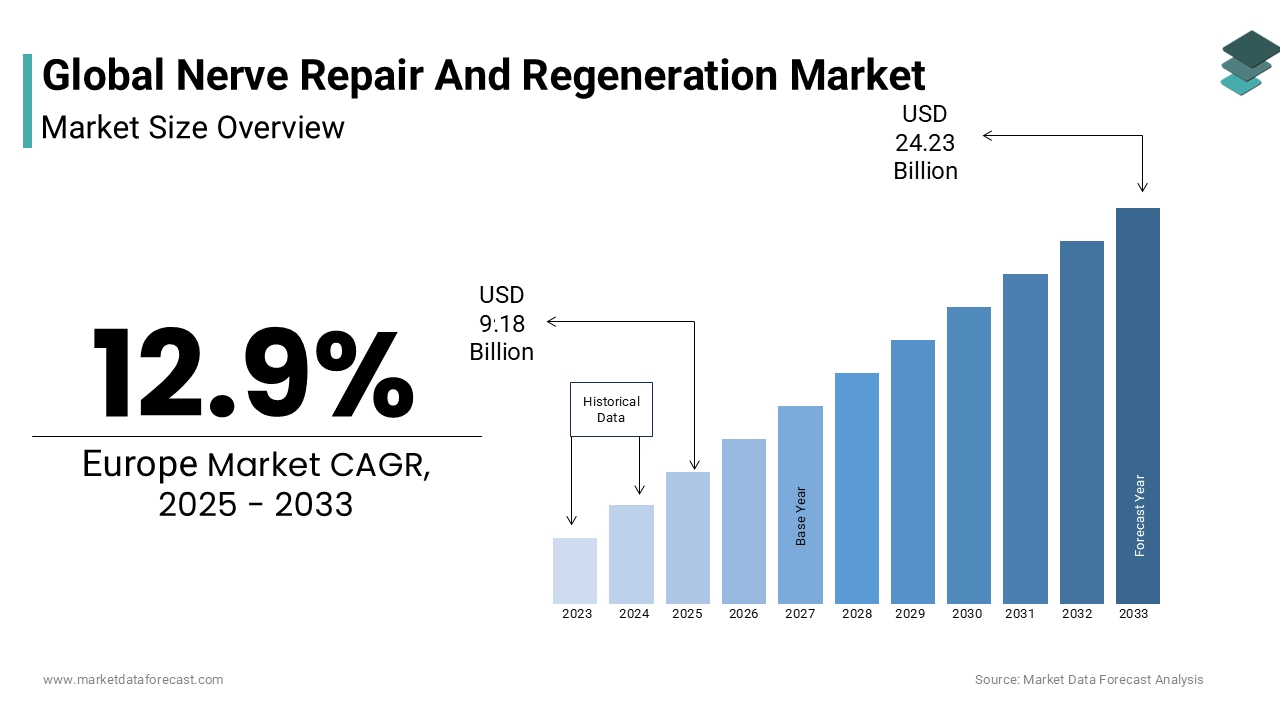
The global nerve repair and regeneration market size was valued at USD 8.13 billion in 2024 and is estimated to reach USD 24.23 billion by 2033 from USD 9.18 billion in 2025, registering a CAGR of 12.9% from 2025 to 2033.
Nerve repair and regeneration refer to the therapeutic interventions surgical devices biologics and neuroengineering platforms designed to restore structural continuity and functional signaling in damaged peripheral or central nervous systems. As per sources, traumatic nerve injuries affect millions of individuals worldwide each year. An even larger population suffers from chronic neuropathies resulting from conditions like diabetes, autoimmune disorders, or chemotherapy-induced toxicity. The burden is particularly acute among military veterans where Among specific populations, such as military personnel returning from active combat zones, peripheral nerve trauma is a frequent issue, often necessitating reconstructive intervention. According to research, a significant challenge in treatment is that using conventional autograft techniques results in a minority of patients achieving meaningful motor recovery within two years when dealing with major nerve gaps. Emerging modalities such as bioengineered nerve conduits stem cell seeded matrices electrical stimulation scaffolds and gene activated matrices aim not merely to bridge anatomical discontinuities but to actively orchestrate axonal regrowth myelination and synaptic reintegration. This field represents the convergence of neurobiology materials science and precision medicine striving to transform irreversible neurological deficits into treatable biological processes.
MARKET DRIVERS
Rising Global Incidence of Traumatic and Iatrogenic Nerve Injuries
The escalating volume of nerve damage cases stemming from accidents surgical complications and combat injuries is among the key driving factors of the nerve repair and regeneration market. According to research, peripheral nerve trauma is a significant and widespread health concern in the United States, frequently resulting from motor vehicle collisions, industrial machinery incidents, and sports-related lacerations. An additional substantial number of nerve injuries occur annually due to medical procedures, particularly those related to orthopedics and cancer treatment, with the brachial plexus and sciatic nerves being most commonly affected, as per sources. In conflict zones, a notable percentage of extremity injuries sustained in conflict zones involve major nerve disruption, as per studies. Furthermore, the capacity to perform essential primary nerve repair is limited in many major trauma centers located in low-income countries. These epidemiological trends are compelling health systems to invest in scalable off the shelf nerve guidance conduits and cellularized implants that reduce dependency on donor tissue availability and specialized surgical expertise.
Advancements in Biomaterial Science and Neurotrophic Delivery Systems
Breakthroughs in scaffold design-controlled release kinetics and bioactive surface functionalization are enabling engineered constructs to mimic the native extracellular matrix and deliver precise molecular cues that accelerate axonal elongation and target reinnervation This advancement further contributes to the expansion of the nerve repair and regeneration market. According to research, Hydrogel-based conduits that use aligned nanofibers and specific growth factors have been shown to accelerate motor neuron regeneration. Advanced 3D-printed scaffolds infused with stem cells are effective in restoring significant functional strength following nerve damage, as per sources. Meanwhile, conductive conduits capable of delivering pulsed electrical stimulation synchronized with the body's natural repair cycles can enhance sensory fiber density. These innovations shift the paradigm from passive bridging to active neuromodulation creating microenvironments that recruit endogenous Schwann cells suppress scar formation and guide directional growth. Regulatory agencies including the FDA and EMA are establishing expedited pathways for combination products that integrate biomaterials biologics and physical stimulation acknowledging their potential to redefine standards of care in reconstructive neurology.
MARKET RESTRAINTS
Limited Reimbursement Pathways and High Procedure Costs
Inadequate insurance coverage and prohibitive out of pocket expenses for patients remain a barrier for the nerve repair and regeneration market. Private insurers frequently classify bioengineered nerve conduits and cellular therapies as experimental denying preauthorization even when supported by peer reviewed efficacy data. In Europe, the National Institute for Health and Care Excellence in the UK has yet to issue formal guidance on reimbursement for acellular nerve allografts leaving local commissioning groups to make fragmented funding decisions. This financial uncertainty discourages hospitals from stocking next generation products and dissuades clinicians from recommending them even when clinically superior. Widespread adoption of these technologies hinges on the implementation of value based payment models, which currently fail to account for long term functional improvements and the reduction of disability burden.
Biological Complexity of Central Nervous System Regeneration
The minimal recovery of CNS neurons after injury, in contrast to the PNS's regenerative ability, is attributed to inhibitory factors like glial scarring, lack of growth-promoting substrates, and limited neurotrophic support, and thereby hinders the expansion of the nerve repair and regeneration market. According to sources, traumatic spinal cord injuries typically lead to lasting sensorimotor deficits because damaged nerve fibers struggle to regrow and bridge the injury site, even when supportive structures are in place. A key difference noted between species is that human central nervous system neurons show significantly lower expression of genes linked to nerve regeneration compared to those in rodent models, as per research. Clinical trials of chondroitinase ABC an enzyme that degrades inhibitory proteoglycans showed only marginal improvements in hand function in cervical spinal cord injury patients as per results from the Christopher and Dana Reeve Foundation. Furthermore, the blood brain barrier restricts systemic delivery of neuroregenerative biologics necessitating invasive intrathecal administration or viral vector mediated gene therapy which introduces safety and scalability challenges. Overcoming these biological constraints requires combinatorial strategies that simultaneously neutralize inhibitors enhance intrinsic growth programs and rebuild synaptic circuitry a feat that remains beyond current technological reach despite decades of investment.
MARKET OPPORTUNITIES
Expansion into Chemotherapy Induced Peripheral Neuropathy Management
A mounting demand exists for neuroprotective and regenerative interventions that preserve quality of life without compromising oncologic outcomes, which offers new opportunities for the growth of the nerve repair and regeneration market. This is driven by the millions of cancer patients who annually develop dose-limiting nerve damage from platinum, taxane, and vinca alkaloid therapies. Many patients receiving oxaliplatin develop chronic sensory neuropathy, often with persistent pain and functional impairment long after treatment has ended, according to sources. In addition, Neuropathy is the primary reason for reducing or stopping chemotherapy doses, which affects the effectiveness of treatment in various cancers, including breast, ovarian, and colorectal cancers, as per studies. Startups are developing small molecule TrkA agonists and HDAC six inhibitors that prevent mitochondrial dysfunction and microtubule destabilization in dorsal root ganglia. Localized drug delivery via biodegradable microparticles shows promise in reducing pain sensitivity while maintaining the treatment's effect against tumors. Integrating these agents with nerve guidance scaffolds could enable structural repair in established neuropathies opening a multibillion-dollar adjunctive care market currently dominated by symptomatic analgesics with limited efficacy.
Integration with Neural Interface and Neuroprosthetic Technologies
The convergence of nerve regeneration platforms with bidirectional neural interfaces is opening the way for restoring not only anatomy but also real time sensorimotor control in amputees and paralyzed individuals, which is likely to create fresh prospects for the nerve repair and regeneration market. Companies are developing implantable bioelectronic scaffolds that record efferent motor commands while delivering patterned electrical stimulation to guide axonal pathfinding. This synergy transforms passive conduits into intelligent neuro cybernetic systems capable of adapting stimulation parameters based on neural activity biomarkers. The maturation of brain-machine interface technologies will lead to the evolution of regulatory frameworks for integrated medical devices, thereby accelerating the commercial pathways for solutions that address both biological reconstruction and functional embodiment.
MARKET CHALLENGES
Lack of Predictive Biomarkers and Standardized Outcome Measures
The absence of objective quantifiable indicators to track nerve regeneration progress in real time severely impedes clinical trial design, patient stratification, and therapeutic optimization, and this is one of the challenges to the nerve repair and regeneration market. Magnetic resonance neurography while promising lacks widespread protocol harmonization. Serum biomarkers such as neurofilament light chain show correlation with axonal degeneration but do not reliably predict regenerative capacity or functional recovery timelines. The Food and Drug Administration acknowledges this gap in its guidance on regenerative medicine therapies noting that surrogate endpoints for nerve regeneration remain investigational. The absence of validated biomarkers hinders sponsors' ability to efficiently demonstrate dose-response relationships or identify non-responders early in trials, leading to increased development costs and extended timelines. Investment in multimodal monitoring combining wearable EMG sensors AI driven gait analysis and molecular imaging is critical to establish dynamic biological signatures that reflect true regenerative progress rather than static anatomical bridging.
Regulatory Ambiguity Surrounding Combination Neuro Regenerative Products
Devices integrating biomaterials cells genes and electronic components face complex and often conflicting regulatory classifications that delay market entry and increase compliance risk to ultimately affect the growth of the nerve repair and regeneration market. In the United States the FDA’s Office of Combination Products frequently reclassifies borderline submissions between device biologic and drug categories requiring sponsors to restart preclinical testing under new regulatory pathways. The classification process itself has created significant holdups, as seen in instances where a collagen scaffold seeded with autologous Schwann cells was reclassified, which substantially extended its approval timeline due to changes in how its primary mechanism of action was determined. This ambiguity discourages venture investment and forces startups to allocate a share of R and D budgets to regulatory strategy rather than biological innovation. Harmonized global frameworks that recognize the multifactorial nature of nerve regeneration technologies are urgently needed to streamline evaluation and accelerate patient access.
REPORT COVERAGE
| REPORT METRIC | DETAILS |
| Market Size Available | 2024 to 2033 |
| Base Year | 2024 |
| Forecast Period | 2025 to 2033 |
| Segments Covered | By Surgery, Product, and Region |
| Various Analyses Covered | Global, Regional & Country Level Analysis Segment-Level Analysis, DROC, PESTLE Analysis, Porter’s Five Forces Analysis, Competitive Landscape, Analyst Overview on Investment Opportunities |
| Regions Covered | North America, Europe, APAC, Latin America, Middle East & Africa |
| Market Leaders Profiled | AxoGen, Baxter International, Boston Scientific Incorporation, Cyberonics, Integra Lifesciences, Medtronic, Orthomed S.A.S., Polyganics B.V., St. Jude Medical, and Stryker Corporation. |
SEGMENTAL ANALYSIS
By Surgery Type Insights
The autografts segment dominated the nerve repair and regeneration market by accounting for a 34.7% share in 2024. The dominance of the autografts segment is driven by its longstanding status as the clinical gold standard for bridging nerve gaps exceeding three centimeters where direct suture repair is anatomically impossible. Despite donor site morbidity and limited tissue availability autografts remain the benchmark against which all synthetic and cellular alternatives are measured. Their entrenched position in surgical training curricula and insurance reimbursement codes further entrenches adoption even as newer modalities emerge. Autografts will continue to be the leading clinical and economic solution for large gap repairs as long as engineered conduits fail to consistently equal or exceed their efficacy.
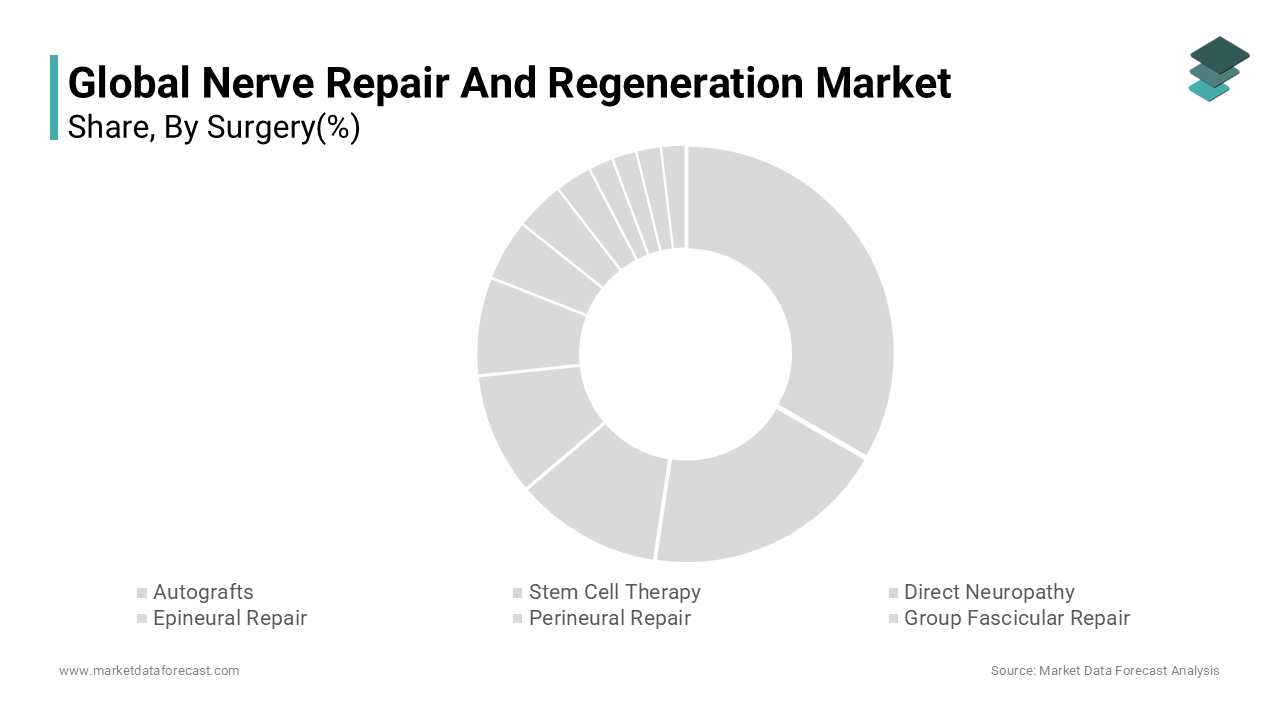
The stem cell therapy segment is predicted to witness the highest CAGR of 27.8% from 2025 to 2033 due to breakthroughs in induced pluripotent stem cell differentiation protocols and scaffold mediated delivery systems that enable precise spatial and temporal control over neuroregenerative signaling. Researchers have developed methods to differentiate induced pluripotent stem cells (iPSCs) into functional Schwann-like cells, which have demonstrated a capacity to support nerve regeneration in laboratory models, as per sources. Regulatory agencies in various countries have established frameworks allowing for conditional approval and use of specific autologous stem cell therapies for peripheral nerve trauma. Global clinical research is increasingly focused on stem cell-enhanced nerve repair, integrating cellular potency, advanced biomaterials, and immunomodulation to restore functional nerve circuits rather than just providing a structural bridge.
REGIONAL ANALYSIS
North America Nerve Repair and Regeneration Market Analysis
North America led the global nerve repair and regeneration market by capturing a 41.2% share in 2024. Early adoption of novel biologics and neurotechnologies robust venture funding for neural engineering startups and a high concentration of Level one trauma centers performing complex microsurgical reconstructions contributes to the dominance of North America in the global market. Institutions like Johns Hopkins and the Mayo Clinic serve as global referral hubs for brachial plexus and facial nerve reconstruction drawing international patients and fostering cross institutional protocol harmonization. Heavy investment in neural interface technologies by DARPA and private entities such as Neuralink further cements North America’s role as the innovation nucleus for next generation neuroregenerative solutions.
Europe Nerve Repair and Regeneration Market Analysis
Europe was the second-largest region in nerve repair and regeneration market and occupied a 29.4% share in 2024. The expansion of the European market is supported by its centralized regulatory frameworks strong public funding for translational neuroscience and high density of academic medical centers specializing in peripheral nerve surgery. According to sources, Acellular nerve allografts for nerve gaps over two centimeters are increasingly eligible for reimbursement across European Union member states after positive health technology assessments in individual nations. As per studies, Enrollment is complete for the initial randomized controlled trial comparing stem cell-enhanced conduits to autografts specifically for median nerve injuries within a European clinical trial network. The United Kingdom’s National Institute for Health and Care Excellence is developing formal guidance on neuromodulation assisted nerve repair expected to standardize coverage across NHS trusts. Outcome tracking is well-established in Nordic countries, particularly in Sweden, where a national registry of nerve repair cases enables significant real-world evidence generation. Europe’s emphasis on multidisciplinary care pathways and longitudinal functional assessment continues to set global benchmarks for postoperative rehabilitation and quality of life measurement.
Asia Pacific Nerve Repair and Regeneration Market Analysis
The Asia-Pacific is expected to be the most lucrative region in the nerve repair and regeneration market and is fueled by rising trauma incidence expanding neurosurgical capacity and government backed initiatives to localize advanced biomaterial manufacturing. China is witnessing an increasing number of nerve repair procedures in public hospitals, with a shift toward synthetic conduits alongside traditional autografts, the former benefiting from expanded insurance coverage. India's government has established a dedicated mission to accelerate the clinical validation of advanced nerve regeneration technologies, including stem cell applications and electroconductive materials. Japan has expedited the approval process for innovative regenerative medicine treatments, recently granting conditional approvals to several nerve regeneration therapies. South Korean research institutions are developing breakthroughs in advanced nerve graft technology, utilizing 3D bioprinting to create structures that promote faster nerve regrowth. Despite disparities in rural access urban medical hubs in Shanghai Seoul and Mumbai are rapidly closing the innovation gap through public private partnerships and international trial collaborations.
Latin America Nerve Repair and Regeneration Market Analysis
Latin America grew notably in the nerve repair and regeneration market. The region is undergoing accelerated adoption driven by rising motor vehicle trauma burden expansion of private hospital networks and increasing participation in global clinical trials. Brazil has seen significant activity in nerve reconstruction surgeries, with collagen-based conduits gaining traction in cosmetic and hand surgery, though autografts remain standard. Meanwhile, Argentina has funded a multicenter trial that compared xenograft-derived matrices with autografts for ulnar nerve injuries, demonstrating that the newer approach is equally effective for sensory recovery. both Chile and Colombia have updated their medical device regulations, which facilitates the importation of approved nerve repair products. Though public system constraints persist private pay and medical tourism are driving investment in microsurgical training and advanced biomaterial access particularly in São Paulo Bogotá and Monterrey.
Middle East and Africa Nerve Repair and Regeneration Market Analysis
The Middle East and Africa is likely to expand in the nerve repair and regeneration market. Though nascent the region presents high strategic potential due to conflict related nerve trauma burden medical tourism initiatives and government investments in neurosurgical infrastructure. Kenya and Nigeria are piloting mobile tele neurosurgery platforms to extend specialist consultation to rural trauma centers. Despite infrastructure and specialist shortages the convergence of public investment diaspora expertise and global trial inclusion is laying the foundation for scalable adoption of advanced nerve regeneration therapies across diverse clinical environments.
COMPETITVE LANDSCAPE
The gasoline fuel additives market is characterized by intense rivalry among global chemical manufacturers and specialty formulators competing on performance differentiation regulatory compliance and supply chain reliability. Competition centers on developing multifunctional chemistries that simultaneously enhance octane rating reduce intake valve deposits inhibit corrosion and lower evaporative emissions without compromising fuel stability or engine compatibility. Major players invest heavily in proprietary catalyst technologies and collaborate with automotive OEMs to validate performance under real world driving cycles. Regional suppliers focus on cost leadership and localized formulation adaptation particularly in markets with evolving fuel quality mandates. Strategic acquisitions remain prevalent as firms seek to consolidate intellectual property expand geographic reach and absorb application expertise. Price volatility of base chemicals and feedstock availability intensify margin pressures forcing continuous innovation in efficiency and multifunctionality. Compliance with tightening environmental regulations particularly in Europe and North America further raises barriers to entry and drives consolidation among smaller players lacking R and D scale.
KEY MARKET PLAYERS
Some notable companies leading the Global Nerve Repair and Regeneration Market include
- AxoGen
- Baxter International
- Boston Scientific Inc
- Cyberonics
- Integra Lifesciences
- Medtronic
- Orthomed S.A.S.
- Polyganics B.V.
- St. Jude Medical
- Stryker Corporation.
Top Players in the Nerve Repair and Regeneration Market
Axogen Inc
Axogen Inc is a pioneer in developing off the shelf regenerative nerve repair solutions including its flagship Avance Nerve Graft an acellular allograft processed to preserve the native extracellular matrix architecture. The company also expanded its clinical evidence program. These initiatives reinforce Axogen’s leadership in providing standardized biologically active alternatives to autografts while reducing donor site morbidity and surgical time for reconstructive surgeons globally.
Collagen Matrix Inc
Collagen Matrix Inc contributes to the nerve repair and regeneration market through its portfolio of collagen based nerve wraps conduits and dural substitutes engineered to support axonal regrowth and reduce scar adhesion. It also initiated a European post market registry to correlate conduit design parameters with sensory recovery rates in ulnar nerve transections. These efforts position Collagen Matrix as a key enabler of customizable off the shelf solutions that bridge anatomical gaps while modulating the local regenerative microenvironment.
Integra LifeSciences
Integra LifeSciences strengthens the nerve repair ecosystem via its NeuraGen and NeuraWrap product lines which combine semi permeable collagen tubes with laminin coatings to guide axonal elongation and protect coaptation sites. The company also partnered with academic centers in Germany and Canada to validate combination therapies pairing its conduits with adipose derived stem cells. These innovations enable Integra to address complex nerve injuries requiring both structural support and bioactive signaling to restore sensorimotor function in trauma and oncologic resection cases.
Top Strategies Used by the Key Market Participants
Key players in the nerve repair and regeneration market prioritize expanding clinical evidence generation through multicenter longitudinal outcome studies to validate functional recovery beyond anatomical bridging. They invest in biomaterial innovation focusing on microarchitectural guidance topographical cues and controlled release of neurotrophic factors to enhance axonal navigation. Strategic collaborations with academic medical centers and trauma networks accelerate real world validation and surgeon adoption. Companies also pursue regulatory designations such as FDA breakthrough or EMA PRIority MEdicines to expedite review timelines. Portfolio diversification across autograft alternatives neuromodulation integration and stem cell compatible scaffolds mitigates technology risk. Emphasis on intraoperative ease of use sterilization compatibility and reimbursement coding ensures seamless integration into existing surgical workflows.
RECENT MARKET HAPPENINGS
- In 2017, The U.S. Food and Drugs Administration approved the Avance nerve graft launched by Axogen.
- In June 2017, Medtronic received SureTune3 got, the CE approval mark designed with the latest technologies.
MARKET SEGMENTATION
This research report on the global nerve repair and regeneration market has been segmented and sub-segmented into the following categories and calculated market size and forecast for each segment until 2033.
By Surgery
- Autografts
- Stem Cell Therapy
- Direct Neuropathy
- Epineural Repair
- Perineural Repair
- Group Fascicular Repair
- Nerve Grafting
- Allografts
- Xenografts
- Neuromodulation Surgery
- External Neuromodulation Surgery
- Internal Neuromodulation Surgery
By Product
-
Biomaterials
-
Nerve Conduits
-
Nerve Protectors
-
Nerve Wraps
-
Nerve Connectors
-
-
Neuromodulation Surgery Devices
-
External Neuromodulation Surgery
-
Transcutaneous Electrical Nerve Stimulation
-
Transcranial Magnetic Stimulation
-
Internal Neuromodulation Surgery
-
-
Spinal Cord Stimulation
-
Deep Brain Stimulation
-
Sacral Nerve Stimulation
-
Vagus Nerve Stimulation
-
Others
-
-
By Region
- North America
- Europe
- Asia-Pacific
- Latin America
- The Middle East and Africa