- Product Description Description
- Table of Contents TOC
- List of Table & Figure LOT
- Get Free Sample PDF Sample PDF
Market Size, 2025
$1139 MnMarket Estimate, 2026
$1201 MnMarket Forecast, 2034
$1844 MnCAGR, 2026–2034
5.5%Global Non-Vascular Stents Market Size, Growth, Trends & Forecast (2026–2034)
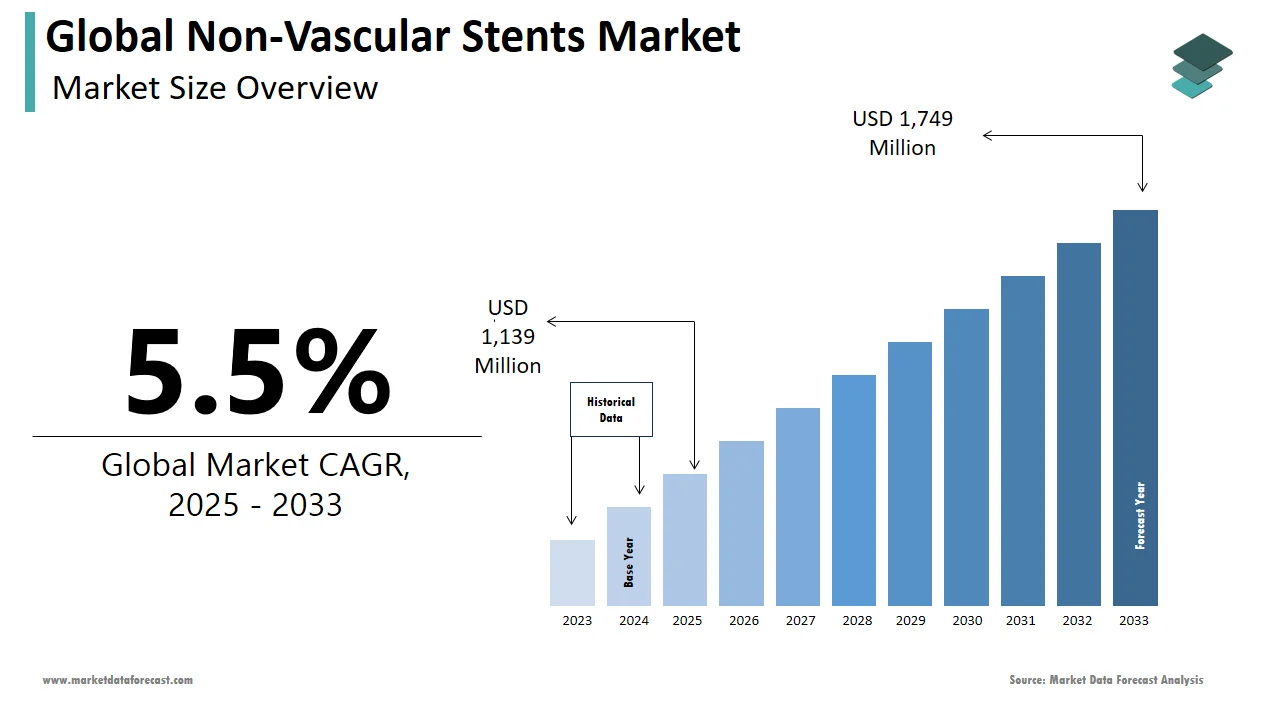
The global non-vascular stents market was valued at US$ 1,139 million in 2025, reached US$ 1,201.65 million in 2026, and is projected to scale up to US$ 1,844 million by 2034, registering a compound annual growth rate (CAGR) of 5.5% during the forecast period from 2026 to 2034. Driven by the increasing prevalence of cancer, urological and gastrointestinal conditions, and rising shifts toward minimally invasive procedures, the market maintains a robust expansion track globally.
Key Executive Metrics (At-a-Glance)
- 2025 Base Valuation: US$ 1,139 Million
- 2026 Current Valuation: US$ 1,201.65 Million
- 2034 Forecast Valuation: US$ 1,844 Million
- Compound Annual Growth Rate (CAGR): 5.5% (2026–2034)
- Dominant Regional Market: North America (retaining a leading market share due to advanced healthcare infrastructure, high chronic disease prevalence, and local presence of major industry players)
- Key Growth Segments: Gastrointestinal and ureteral stents, metallic material types, and hospital end-user channels
Core Market Drivers & Growth Triggers
- Rising Disease Prevalence: Growing incidence of cancers (gastrointestinal, prostate, lung), urolithiasis, and chronic pulmonary conditions worldwide.
- Minimally Invasive Interventions: Increasing preference for procedures that lower hospital stays, diminish infection risks, and accelerate patient recovery times.
Primary Market Restraints & Challenges
- Regulatory & Cost Hurdles: Stringent approval pathways and high device costs limiting wider market adoption in resource-constrained environments.
- Available Alternatives: Existence of substitute treatments for managing luminal structures impacting steady volume growth.
Global Non-Vascular Stents Market Segmentation Breakdown
| Segment Category | Largest Segment / Leader | Fastest-Growing Segment |
|---|---|---|
| By Type | Gastrointestinal Stents (Leads volume demand due to high incidences of stomach, bowel, and liver cancers) | Ureteral Stents (Expands rapidly with rising urinary tract infections, stone diseases, and prostate disorders) |
| By End User | Hospitals (Captures the dominant market share backed by advanced surgical facilities and chronic disease caseloads) | Ambulatory Surgical Centers (Growing steadily as outpatient procedures gain patient preference) |
| By Material | Metallic Stents (Holds the largest market share owing to superior structural integrity and broad clinical application) | Non-Metallic Stents (Fastest-growing variant preferred for treating benign structures due to shorter treatment time and cost efficiency) |
| By Region | North America (Commands the premier revenue position globally) | Asia-Pacific (Fastest-growing regional market driven by rising healthcare spending, aging demographics, and government initiatives) |
Major Industry Players Profiled
Key corporations shaping the global non-vascular stents market include CONMED Corporation, Taewoong Medical Co., Medtronic, C. R. Bard, Inc., Boston Scientific Corporation, Hobbs Medical, Inc., Cook Medical, Ella – CS, s.r.o., Synchron Med Inc., and Glaukos Corporation.
Global Non-Vascular Stents Market Size
The global non-vascular stents market was worth US$ 1,139 million in 2025 and is anticipated to reach US$ 1,844 million by 2034 from US$ 1,201.65 million in 2026, growing at a CAGR of 5.5% during the forecast period 2026 to 2034.
MARKET DRIVERS
The increasing disease prevalence of cancer and urolithiasis is primarily driving the growth of the non-vascular stents market.
As per the American Cancer Society, 1.9 million new cancer cases and 609360 cancer deaths are expected in the United States in 2022. The growing number of people suffering from urological and gastrointestinal diseases and the increasing application of non-vascular stents in various emerging fields, such as ophthalmic and neural sciences, are further expected to promote the growth of non-vascular stents. The rising demand for less invasive techniques decreases hospital stays, and diminishing the threat of contracting hospital-acquired infections propels the market growth. In the United States, kidney disorders kill more people than prostate or breast cancer each year. An estimated 34500 people die from prostate cancer yearly in the United States, whereas approximately 43780 die from breast cancer. The growing adoption of the latest technologies to develop stents and retrieval, growing demand for minimally invasive surgeries, and patients due to less cost and less procedural time amid the ambulatory surgical centers are projected to boost the growing demand for non-vascular stents market growth. More than 1 million abdominal wall hernia repairs are implemented annually in the U.S., with inguinal hernias representing around 77,000 cases. About 90% of inguinal hernia repairs are executed in males. As per WHO, 3 million people and above die yearly from chronic obstructive pulmonary diseases (COPD) worldwide, and 90% of the deaths are from low and middle-income countries.
In addition, the growing adoption of technological advancements in the healthcare sector, YOY growth in the geriatric population, and increased life expectancy are anticipated to boost the market’s growth rate during the forecast period. According to the World Health Organization (WHO), one in every six people is expected to be older than 60 or more by 2030. As a result, the aging population is likely to get diagnosed with various diseases, which is anticipated to result in a greater need for non-vascular stents.
MARKET RESTRAINTS
However, stringent regulatory systems and high costs associated with non-vascular stents are expected to limit the adoption and negatively impact market growth. In addition, the availability of alternative options for relieving luminal structures further limits the market’s growth rate.
REPORT COVERAGE
| REPORT METRIC | DETAILS |
| Market Size Available | 2025 to 2034 |
| Base Year | 2025 |
| Forecast Period | 2026 to 2034 |
| Segments Covered | By Type, End User, Material, and Region. |
| Various Analyses Covered | Global, Regional, and Country-Level Analysis, Segment-Level Analysis, Drivers, Restraints, Opportunities, Challenges; PESTLE Analysis; Porter’s Five Forces Analysis, Competitive Landscape, Analyst Overview of Investment Opportunities |
| Regions Covered | North America, Europe, Asia Pacific, Latin America, Middle East & Africa |
| Market Leaders Profiled | CONMED Corporation, Taewoong Medical Co., Medtronic; C. R. Bard, Inc.; Boston Scientific Corporation; HOBBS MEDICAL, INC; Cook Medical; ELLA - CS, s.r.o.; Ltd.; Synchron Med Inc.; and Glaukos Corporation., and Others. |
SEGMENTAL ANALYSIS
By Type Insights
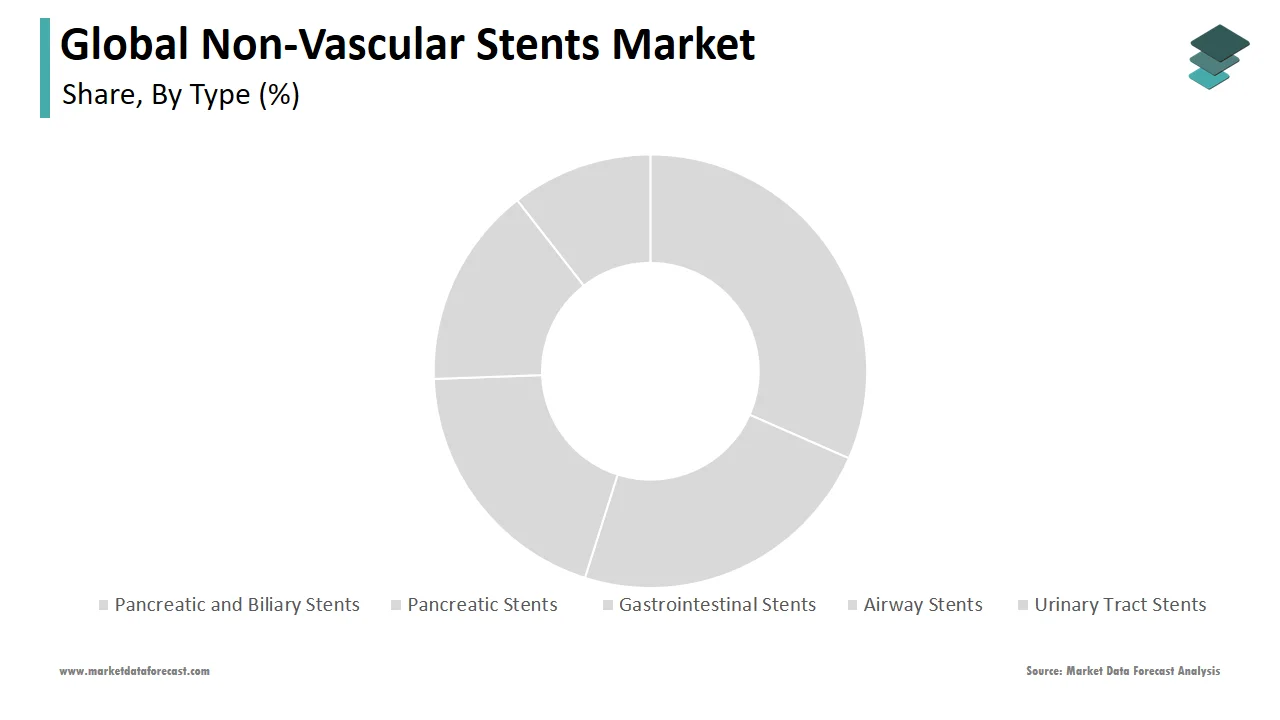
The gastrointestinal stents segment is expected to dominate the non-vascular stents market with the largest share during the forecast period. The segment's growth is driven by the growing incidence of gastrointestinal cancer, such as stomach cancer, small intestine, bowels, and liver, integrated with patients' climbing significance for minimally invasive surgeries.
The ureteral stents segment is expected to grow rapidly owing to the rising incidence of ureteral diseases, urinary tract infections, and prostate cancers worldwide. In addition, thee. The increasing number of ureteroscopy, lithotripsy, and other techniques worldwide augment the growth of the ureteral stents segment.
By End-User Insights
The hospital end-user segment is predicted to dominate the global non-vascular stents market during the forecast period. The increasing number of patients suffering from ureteral, gastrointestinal, and other chronic diseases is climbing the market growth. Moreover, the well-developed healthcare infrastructure, expanding sound knowledge among the patients regarding the patients' early diagnosis and treatment, bolsters the market growth.
By Material Insights
The metallic stents segment holds the largest share in the non-vascular stents market during the forecast period. The escalating technology advancements are significantly driving factors in usage and wide applications of metallic stents coupled with advanced technologies surge the market growth expansion during the analysis period.
The non-metallic stents segment is the quickest-growing segment and is scheduled to record the highest CAGR growth rate during the period. The non-metallic stents, used for treating benign structures as they require less treatment time, less cost, and easy movement, make the market move forward.
REGIONAL ANALYSIS
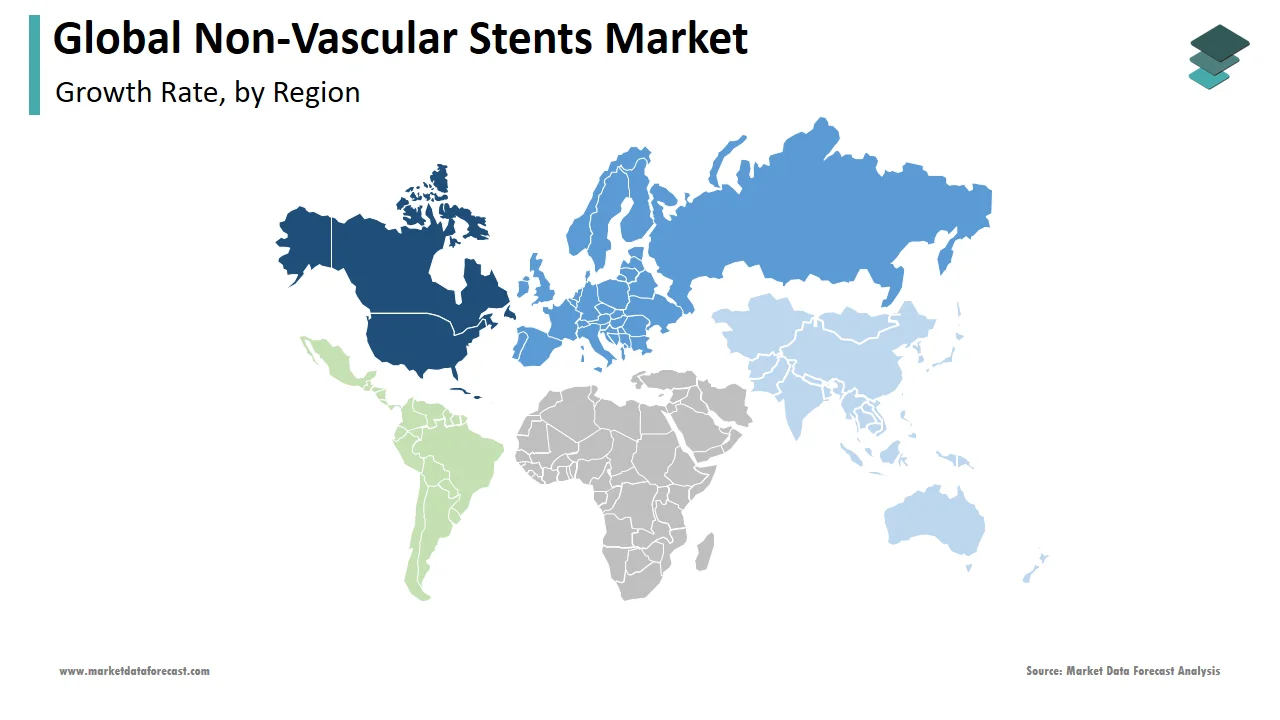
North America held a significant share in the global market in 2024 and the domination of the North American region in the global market is likely to be see during the forecast period owing to the increasing prevalence of lung cancer, glaucoma, central airway obstruction, COPD, asthma, and other chronic diseases in the U.S. and Canada. In addition, the local presence of major market players, the target population, and the robust healthcare infrastructure in the region further supported this region's dominance.
Europe is also expected to hold a substantial market share during the forecast period due to the flourishing medical technology sector and the increasing prevalence of gastric cancer in the EU5 countries.
On the other hand, the Asia-Pacific is expected to register a higher CAGR over the forecast period compared to other regions due to favorable government initiatives for using such medical devices, the rising geriatric population, and increasing healthcare expenditure.
Regions such as Latin America and MEA are expected to witness a steady CAGR during the forecast period.
KEY MARKET PLAYERS
Companies playing a leading role in the global non-vascular stents market profiled in this report are
- CONMED Corporation
- Taewoong Medical Co.
- Medtronic
- C. R. Bard, Inc.
- Boston Scientific Corporation
- HOBBS MEDICAL, INC.
- Cook Medical
- ELLA – CS, s.r.o.
- Synchron Med Inc.
- Glaukos Corporation
GLOBAL NON-VASCULAR STENTS MARKET NEWS
- In October 2020, Medtronic received FDA approval for its Abre venous self-expanding stent device to treat venous outflow obstruction.
- In January 2021, the Synergy Megatron Drug-Eluting system of Boston Scientific received U.S. Food and Drug Administration approval. The Synergy Megatron offers best-in-class radial and axial strength in maintaining strength integrity.
MARKET SEGMENTATION
This research report on global non-vascular stents has been segmented and sub-segmented based on the type, end user, material, and Region.
By Type
- Pancreatic and Biliary Stents
- Biliary Stents
- Plastic Biliary Stents
- Metal Biliary Stents
- Metal Non-Covered Biliary Stents
- Metal Partially Covered Biliary Stents
- Metal Fully Covered Biliary Stents
- Pancreatic Stents
- Plastic Pancreatic Stents
- Metal Pancreatic Stents
- Metal Non-Covered Pancreatic Stents
- Metal Fully Covered Pancreatic Stents
- Biliary Stents
- Gastrointestinal Stents
- Fully Covered Gastrointestinal Stents
- Partially Covered Gastrointestinal Stents
- Non-Covered Gastrointestinal Stents
- Airway Stents
- Silicone Airway Stents
- Metallic Airway Stents
- Fully Covered Metallic Airway Stents
- Uncovered Metallic Airway Stents
- Urinary Tract Stents
- Ureteral Stents
- Metal Ureteral Stents
- Polymer Ureteral Stents
- Bioabsorbable Ureteral Stents.
- Prostate Stents
- Metal Prostrate Stents
- Polymer Prostrate Stents
- Bioabsorbable Prostate Stents.
- Urethral Stents
- Metal Urethral Stents
- Polymer Urethral Stents
- Bioabsorbable Urethral Stents
By End User
- Hospitals
- Ambulatory Surgical Centers
- Others
By Material
- Metallic Stents
- Non-Metallic Stents
By Region
- North America
- Europe
- Asia Pacific
- Latin America
- Middle East and Africa