- Product Description Description
- Table of Contents TOC
- List of Table & Figure LOT
- Get Free Sample PDF Sample PDF
Market Size, 2025
$10.17 BnMarket Estimate, 2026
$12.35 BnMarket Forecast, 2034
$58.57 BnCAGR, 2026–2034
21.48%North America 3D Printing Market Size
The 3D printing market size in North America was valued at USD 10.17 billion in 2025 and is predicted to be worth USD 58.57 billion by 2034 from USD 12.35 billion in 2026 and grow at a CAGR of 21.48% from 2026 to 2034.
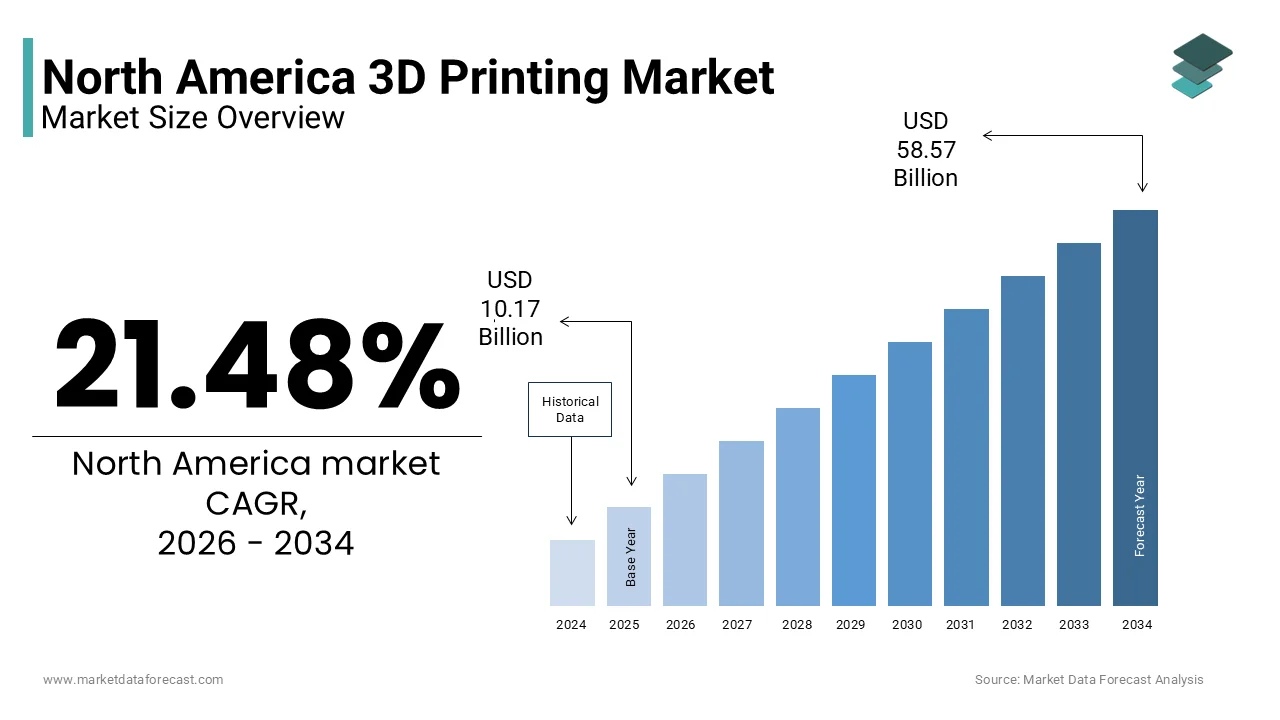
3D printing, also known as additive manufacturing, is a transformative production method that constructs three-dimensional objects layer by layer from digital models. In North America, the technology has evolved from prototyping to full-scale industrial production across aerospace, healthcare, automotive, and consumer goods sectors. As of 2025, the region remains a global leader in 3D printing innovation, with the U.S. hosting the majority of patents and R&D centers in the field. The market has also benefited from increasing government support, including grants and partnerships through agencies like the National Institute of Standards and Technology (NIST). The region's advanced digital infrastructure, skilled workforce, and presence of leading technology firms have further solidified its position as a hub for additive manufacturing innovation.
MARKET DRIVERS
Expansion of Industrial Applications in Aerospace and Defense
The increasing adoption of additive manufacturing in the aerospace and defense sectors is one of the primary drivers of the North American 3D printing market. Aerospace giants like Boeing, Lockheed Martin, and GE Aviation have integrated additive manufacturing into their production lines to fabricate complex, lightweight parts that reduce fuel consumption and improve performance. For example, GE Aviation’s LEAP engine, which powers several commercial aircraft, includes 3D-printed fuel nozzles that consolidate 20 separate components into a single, durable unit. As per the Society of Manufacturing Engineers (SME), the use of 3D printing in aerospace has led to a 35% reduction in material waste and up to a 60% decrease in production lead times. Additionally, the U.S. Department of Defense (DoD) has invested over $150 million in additive manufacturing initiatives since 2022 to enable on-demand spare parts production for military aircraft and vehicles. The ability of 3D printing to produce high-strength, low-weight components with minimal tooling requirements makes it particularly attractive in these high-performance industries.
Growth of Medical and Healthcare Applications
The rapid expansion of medical and healthcare applications is another major driver of the North American 3D printing market. The technology enables the creation of patient-specific implants, prosthetics, dental devices, and surgical tools, offering unprecedented customization and precision. The orthopedic and dental sectors have particularly benefited, with companies like Stryker, Zimmer Biomet, and Align Technology leveraging additive manufacturing to produce customized implants and clear aligners. As per the Mayo Clinic, 3D-printed surgical guides have reduced operation times by up to 30% and improved patient outcomes in complex procedures. The Veterans Health Administration (VHA) has also adopted 3D printing for prosthetic limb development, significantly lowering costs and production time for veterans. Additionally, the rise of bioprinting—where living tissues and organs are printed—has garnered significant research funding, with the National Institutes of Health (NIH) allocating over $75 million to bioprinting research between 2022 and 2025. The increasing demand for personalized medicine and the aging population are expected to further propel the adoption of 3D printing in medical applications.
MARKET RESTRAINTS
High Equipment and Material Costs
The high cost associated with industrial-grade equipment and specialized materials is a major restraint in the North American 3D printing market. Additionally, the cost of raw materials such as titanium, cobalt-chrome alloys, and high-performance polymers remains elevated compared to traditional manufacturing inputs. The high capital expenditure required for entry into additive manufacturing limits adoption in cost-sensitive industries and restricts scalability for startups. Furthermore, maintenance, software licensing, and operator training add to the overall cost burden. While material costs are expected to decline with increased production and supply chain development, the current pricing structure remains a major barrier to widespread adoption.
Limited Awareness and Skilled Workforce Shortage
The limited awareness and shortage of skilled professionals capable of operating and optimizing advanced additive manufacturing systems is another major restraint in the North American 3D printing market. Despite growing adoption in high-tech sectors, many traditional manufacturers remain unfamiliar with the full capabilities and cost-benefit potential of 3D printing. Besides, the complexity of 3D printing technologies requires specialized training in design for additive manufacturing (DfAM), material science, and post-processing techniques. As per the Society of Manufacturing Engineers (SME), there is a shortage of over 50,000 qualified additive manufacturing professionals in North America. Educational institutions have been slow to incorporate additive manufacturing into engineering and vocational curricula, further exacerbating the skills gap. This lack of trained personnel limits the ability of companies to fully leverage 3D printing for mass production and innovation. As per McKinsey & Company, workforce development challenges have delayed the implementation of 3D printing projects in over 40% of North American manufacturing firms.
MARKET OPPORTUNITIES
Integration of 3D Printing with Digital Twin and AI Technologies
The integration of additive manufacturing with digital twin and artificial intelligence (AI) technologies is a potential opportunity for the North American 3D printing market. Digital twins, virtual replicas of physical products, allow for real-time monitoring, simulation, and optimization of 3D printing processes, enhancing efficiency and reducing errors. According to the U.S. National Institute of Standards and Technology (NIST), the adoption of digital twin technology in additive manufacturing could reduce production defects by up to 35% and shorten design cycles by 40%. Companies like Siemens, Autodesk, and GE Additive are actively developing AI-driven software solutions that optimize print parameters, predict failures, and improve material utilization. Additionally, the U.S. Department of Energy has funded over $100 million in AI-driven additive manufacturing research since 2022 to improve energy efficiency and sustainability. The convergence of 3D printing with AI and digital twins is enabling more precise, data-driven production, particularly in aerospace, automotive, and medical applications.
Expansion of 3D Printing in Automotive and Spare Parts Production
The growing adoption of additive manufacturing in the automotive industry, particularly for spare parts and customized vehicle components, is another significant opportunity for the North American 3D printing market. Automakers such as Ford, General Motors, and Tesla are increasingly leveraging 3D printing to produce lightweight, durable parts that improve fuel efficiency and support electric vehicle (EV) development. Many automotive companies in North America have established in-house 3D printing labs to accelerate prototyping and reduce time-to-market. The ability to produce on-demand spare parts without maintaining large inventories is also gaining traction. As per the U.S. International Trade Commission (ITC), 3D-printed automotive spare parts could reduce logistics costs by up to 40% and warehouse space requirements by 50%. Also, the shift toward electric vehicles has increased demand for complex, heat-dissipating components that are more efficiently manufactured using additive techniques. The National Renewable Energy Laboratory (NREL) estimates that 3D printing could reduce material waste in automotive manufacturing by up to 60%.
MARKET CHALLENGES
Intellectual Property and Regulatory Uncertainties
The uncertainty surrounding intellectual property (IP) rights and regulatory frameworks is one of the foremost challenges facing the North American 3D printing market. Unlike traditional manufacturing, where IP protection is well-established, 3D printing introduces complexities in tracking and enforcing design ownership, particularly in digital file sharing and decentralized production. Moreover, the Food and Drug Administration (FDA) has issued evolving guidelines for medical device manufacturers using 3D printing, requiring rigorous validation and traceability of printed components. In the aerospace sector, the Federal Aviation Administration (FAA) mandates extensive certification for 3D-printed parts, adding to production complexity. As per the Brookings Institution, unclear IP laws and inconsistent regulatory standards have discouraged investment in 3D printing startups, with over 30% of surveyed firms citing legal risks as a major barrier to expansion.
Material Limitations and Standardization Gaps
Material limitations and the lack of standardized specifications pose a significant challenge to the growth of the North American 3D printing market. Although additive manufacturing supports a wide range of polymers, metals, and composites, the availability of high-performance materials with consistent properties remains limited. According to the American Society for Testing and Materials (ASTM), fewer than 200 standardized materials are currently approved for industrial 3D printing, compared to thousands used in conventional manufacturing. This restricts the ability of manufacturers to achieve consistent mechanical, thermal, and chemical properties in printed components. Additionally, material suppliers often develop proprietary formulations, leading to compatibility issues across different 3D printing platforms. As per the National Institute of Standards and Technology (NIST), the lack of standardized testing protocols for 3D-printed materials has resulted in a 20–30% variance in part performance, even when using the same feedstock. The U.S. Department of Defense (DoD) has identified material inconsistency as a key barrier to scaling additive manufacturing for critical defense applications. Efforts are underway to establish industry-wide standards. However, until material uniformity and certification processes improve, the widespread adoption of 3D printing in high-stakes industries will remain constrained.
REPORT COVERAGE
| REPORT METRIC | DETAILS |
| Market Size Available | 2025 to 2034 |
| Base Year | 2025 |
| Forecast Period | 2026 to 2034 |
| CAGR | 21.48% |
| Segments Covered | By Offering, Technology, Process, Application, Vertical, and Region |
|
Various Analyses Covered | Regional & Country Level Analysis, Segment-Level Analysis, DROC, PESTLE Analysis, Porter’s Five Forces Analysis, Competitive Landscape, Analyst Overview on Investment Opportunities |
| Regions Covered | The United States, Canada, Mexico, and Rest of North America |
| Market Leaders Profiled | 3D Systems Corp, Autodesk Inc, Canon Inc, Dassault Systemes SE, EnvisionTEC, ExOne, GE Additive, HP Inc, Redwire Corp, Materialise NV ADR, Optomec, Organovo Holdings Inc, Proto Labs Inc, Shapeways Holdings Inc, Stratasys Ltd, Voxeljet AG ADR, and others |
SEGMENTAL ANALYSIS
By Offering Insights
The printers segment led the North America 3D printing market by accounting for a 39.7% in 2025. Continuous technological advancements and rising adoption across industrial sectors is driving the growth of this segment. Companies are investing heavily in next-generation printers capable of handling complex geometries and high-performance materials. According to the U.S. Department of Commerce, over 12,000 industrial 3D printers were deployed across North America in 2025, with the aerospace, automotive, and healthcare sectors accounting for more than 60% of installations. The demand for high-speed, multi-material printers has surged, particularly in R&D and production environments. Additionally, the Inflation Reduction Act (IRA) has incentivized localized production of 3D printing equipment, further boosting this segment. The expansion of 3D printer manufacturing facilities by companies such as Stratasys, 3D Systems, and HP in the U.S. has strengthened supply chain resilience and supported market growth.
The software segment is projected to grow at the fastest CAGR of 16.8% from 2026 to 2034. Increasing complexity of 3D printing workflows and the need for advanced design, simulation, and process optimization tools is fuelling the rapid expansion of this segment. The integration of digital twin technology has further accelerated software adoption, allowing manufacturers to simulate print outcomes before production. Apart from these, cloud-based platforms for design collaboration and distributed manufacturing are gaining traction, particularly among automotive and aerospace firms. Autodesk and Siemens have launched specialized additive manufacturing software suites that are being adopted by over 40% of large-scale 3D printing operations in North America. As per McKinsey & Company, the demand for design-for-additive-manufacturing (DfAM) tools is expected to double by 2027, reinforcing the software segment’s position as the fastest-growing in the market.
By Technology Insights
Fused Deposition Modeling (FDM) remained the largest technology categoryin the North America 3D printing market by holding a 43.4% of total share in 2025. Its affordability, ease of use, and widespread adoption in both industrial and educational settings is attributed to the dominance of this segment. FDM printers are extensively used in prototyping, automotive parts development, and consumer goods manufacturing due to their ability to work with a variety of thermoplastic materials. As per the National Institute of Standards and Technology (NIST), FDM accounted for more than 50% of all 3D printer sales in the U.S. in 2023, driven by small-to-medium enterprises (SMEs) seeking cost-effective manufacturing solutions. Also, the rise of open-source FDM platforms like RepRap and Ultimaker has expanded accessibility and fostered innovation. FDM is increasingly used in the production of customized jigs, fixtures, and tooling in automotive assembly lines, further reinforcing its market leadership.
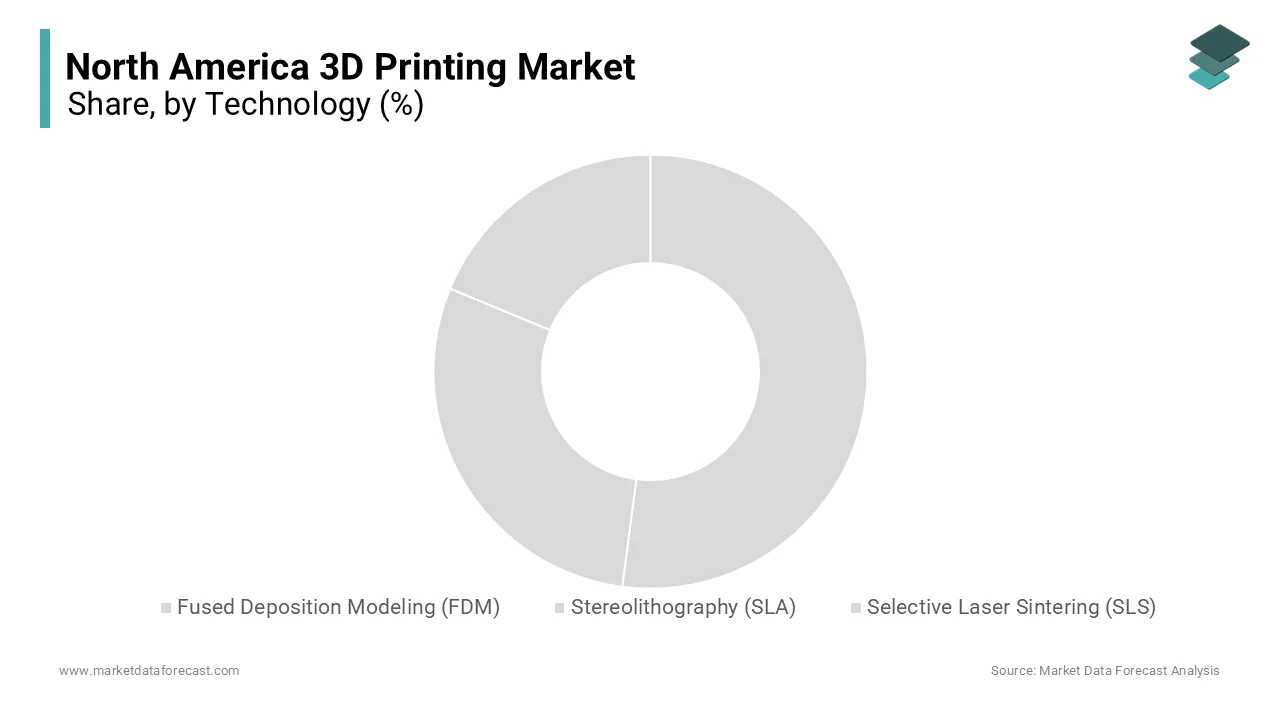
The Selective Laser Sintering (SLS) segment is projected to grow at the highest CAGR of approximately 19.2% from 2026 to 2034. This rapid growth is fueled by its ability to produce complex, functional parts without the need for support structures, making it ideal for industrial and medical applications. Additionally, the aerospace and defense sectors are leveraging SLS for lightweight, high-strength components, including turbine blades and structural brackets. The National Aeronautics and Space Administration (NASA) has incorporated SLS-printed parts in several spacecraft and satellite projects. The availability of high-performance polymers such as nylon 11 and carbon-filled thermoplastics has further enhanced the appeal of SLS. Also, material innovation and process automation are expected to drive continued double-digit growth in the SLS segment over the next decade.
REGIONAL ANALYSIS
United States
The United States is the dominant player in the North American 3D printing market by holding 88.5% of the regional share in 2025. The country leads in both technological innovation and commercial adoption, with a strong presence of major 3D printing firms such as Stratasys, 3D Systems, and GE Additive. Government initiatives, including the America COMPETES Act and the Inflation Reduction Act (IRA), have provided significant funding for additive manufacturing research and infrastructure development. The National Institute of Standards and Technology (NIST) has funded several additive manufacturing projects since 2022, supporting advancements in materials science and process optimization. Additionally, the aerospace, automotive, and healthcare sectors are the primary drivers of 3D printing adoption.
Canada
Canada holds a growing but smaller share of the North American 3D printing market. The country has been actively promoting additive manufacturing through research initiatives and government funding programs. The aerospace and healthcare sectors are leading adoption, with companies such as CAE and Bombardier incorporating 3D-printed components into aircraft and medical devices. Additionally, the Montreal-based Consortium for Additive Manufacturing and 3D Printing (CAMPI) has facilitated collaboration between academia, industry, and government to accelerate technology transfer. Despite slower adoption compared to the U.S., Canada’s focus on innovation and skilled workforce development is positioning it as a key player in the regional 3D printing ecosystem.
Rest of North America
The remaining North American 3D printing market holds a modest share. While 3D printing adoption remains limited in this region, certain industrial sectors, particularly automotive and aerospace, are showing increasing interest. Mexico, in particular, has emerged as a potential growth hub due to its proximity to U.S. manufacturing clusters and established industrial base. As per the Mexican Ministry of Economy (SE), over 15 Mexican automotive suppliers have begun exploring 3D printing for prototyping and tooling applications. The country’s National Council of Science and Technology (CONACYT) has also funded several additive manufacturing research initiatives. However, the lack of dedicated infrastructure, skilled labor, and standardized regulations has slowed broader adoption.
COMPETITIVE LANDSCAPE
The North America 3D printing market is characterized by a highly competitive landscape driven by rapid technological advancements and increasing industrial adoption. A mix of established global leaders and emerging startups is shaping the market, each striving to capture a significant share through innovation, strategic collaborations, and expanded service offerings. Major players are continuously refining their product portfolios and investing in research to stay ahead in a rapidly evolving industry. The competition extends beyond hardware to include materials development, software integration, and end-to-end digital manufacturing solutions. As companies seek to differentiate themselves, partnerships with academic institutions, government-backed research initiatives, and industry-specific customization have become key battlegrounds. Additionally, the rise of open-source platforms and decentralized manufacturing models is fostering a more inclusive and competitive ecosystem. The market is also witnessing increased consolidation through mergers and acquisitions as larger firms aim to enhance their technological capabilities and geographic reach. With the growing convergence of 3D printing with AI, IoT, and digital twin technologies, the competitive landscape is expected to become even more dynamic, with firms focusing on scalability, sustainability, and integrated digital manufacturing solutions to maintain leadership positions.
KEY MARKET PLAYERS
3D Systems Corp, Autodesk Inc, Canon Inc, Dassault Systemes SE, EnvisionTEC, ExOne, GE Additive, HP Inc, Redwire Corp, Materialise NV ADR, Optomec, Organovo Holdings Inc, Proto Labs Inc, Shapeways Holdings Inc, Stratasys Ltd, Voxeljet AG ADR are playing dominating role in the North America 3D printing market
TOP PLAYERS IN THE MARKET
- Stratasys is a leading innovator in the North American 3D printing market, known for its broad portfolio of industrial and desktop 3D printing solutions. The company has played a pivotal role in advancing additive manufacturing across aerospace, healthcare, and automotive sectors. Stratasys has consistently introduced cutting-edge technologies, such as high-performance polymer printing and multi-material capabilities, that have influenced global industry standards. Its strong R&D focus and strategic partnerships with major manufacturers have enabled the integration of 3D printing into mainstream production workflows. With headquarters in the U.S., Stratasys continues to drive technological advancements and expand its global footprint through acquisitions and international collaborations.
- 3D Systems has been a foundational player in the development and commercialization of 3D printing technologies. Based in the U.S., the company offers a comprehensive range of printers, materials, and software tailored for industrial applications. 3D Systems has been instrumental in advancing direct metal printing and precision plastic fabrication, which are now widely adopted across global manufacturing sectors. The company's deep engagement with aerospace and medical device manufacturers has set benchmarks for quality and performance in additive manufacturing. Through continuous innovation and customer-centric solutions, 3D Systems remains a key influencer in shaping the evolution of 3D printing technologies worldwide.
- HP has rapidly emerged as a major player in the North American 3D printing market through its Multi Jet Fusion technology, which enables high-speed, high-quality industrial printing. The company has leveraged its global technology infrastructure and enterprise relationships to drive adoption across automotive, consumer goods, and healthcare sectors. HP’s commitment to open collaboration has fostered ecosystem development, encouraging material innovation and software integration. By focusing on scalable and sustainable additive manufacturing solutions, HP has positioned itself as a transformative force in the global shift toward digital manufacturing, with a strong presence in North America and expanding influence internationally.
TOP STRATEGIES USED BY KEY PLAYERS
One of the primary strategies employed by key players in the North America 3D printing market is strategic partnerships and collaborations with industry leaders, research institutions, and government agencies. These alliances help accelerate technology development, expand market reach, and align with regulatory and standardization efforts. Another key approach is continuous innovation through dedicated R&D initiatives aimed at enhancing printer capabilities, developing new materials, and improving software integration for better workflow efficiency. Companies are also investing heavily in localized manufacturing and service centers to strengthen their supply chains, reduce lead times, and provide tailored support to industrial clients. These strategies collectively enhance competitiveness and support the long-term growth of the 3D printing industry in North America.
RECENT HAPPENINGS IN THE MARKET
- In February 2025, Stratasys announced a strategic collaboration with a leading aerospace manufacturer to develop next-generation 3D-printed aircraft components, reinforcing its position in high-performance industrial applications.
- In May 2025, 3D Systems launched a new innovation center in Colorado focused on accelerating the adoption of metal additive manufacturing in the defense and energy sectors, enhancing its technical support and R&D capabilities.
- In September 2025, HP expanded its Multi Jet Fusion facility in California to increase production capacity and provide faster turnaround for industrial clients across the West Coast.
- In November 2025, Desktop Metal entered into a partnership with a major automotive supplier to integrate 3D printing into mass production lines, signaling a shift toward scalable additive manufacturing in the sector.
- In January 2026, Xometry introduced a new AI-driven platform for optimizing 3D printing workflows, enhancing design capabilities and production efficiency for enterprise customers across North America.
MARKET SEGMENTATION
This research report on the North America 3D printing market has been segmented and sub-segmented based on the following categories.
By Offering
- Printers
- Materials
- Software
- Services
By Technology
- Fused Deposition Modeling (FDM)
- Stereolithography (SLA)
- Selective Laser Sintering (SLS)
By Process
- Powder Bed Fusion (PBF)
- Vat Photopolymerization
- Binder Jetting
- Material Extrusion
- Material Jetting
- Other Processes
By Application
- Prototyping
- Tooling
- Functional Part Manufacturing
By Vertical
- Automotive
- Aerospace & Defense
- Healthcare
- Architecture & Construction
- Consumer Goods
By Country
- The United States
- Canada
- Rest of North America