- Product Description Description
- Table of Contents TOC
- List of Table & Figure LOT
- Get Free Sample PDF Sample PDF
Market Size, 2025
$3.64 MnMarket Estimate, 2026
$3.85 MnMarket Forecast, 2034
$5.96 MnCAGR, 2026–2034
5.62%Executive Summary: North America Advanced Infusion Systems Market Analysis & Growth Forecast (2026-2034)
- Market Scope: Comprehensive regional industry analysis covering product categories, application domains, end-user settings, country-level frameworks, and core market demand drivers.
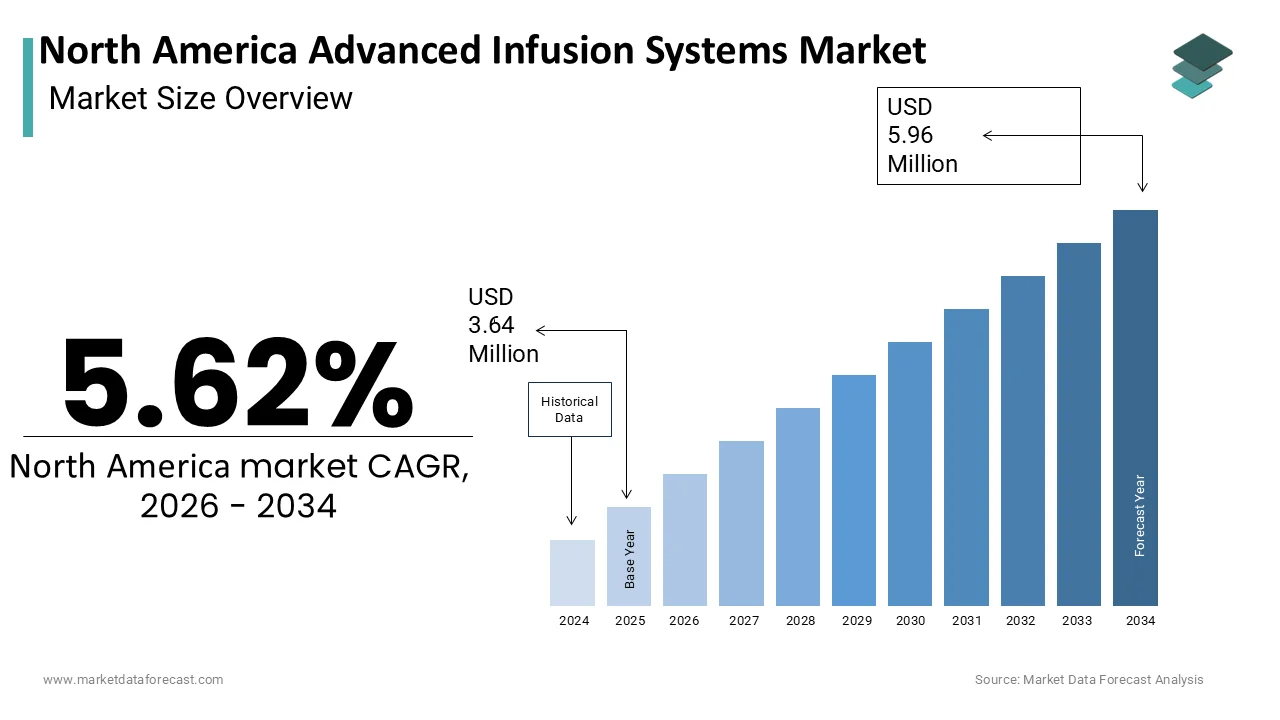
- Market Valuation: Valued at USD 3.64 million in 2025, estimated at USD 3.85 million in 2026, and projected to reach USD 5.96 million by 2034, registering a steady CAGR of 5.62% from 2026 to 2034.
- Primary Growth Drivers: Rising prevalence of chronic diseases (cancer, diabetes, etc.) requiring complex precision therapies, integration of IoT/wireless connectivity enhancing clinical workflows, and the expansion of home healthcare services.
Key North America Advanced Infusion Systems Market Segment Metrics (2026-2034)
| Category | Leading Segment (2025 Position) | Fastest-Growing / High-Impact Segment |
|---|---|---|
| By Product Type | Infusion Pumps (captured 55.4% market share due to precise medication dosage requirements in acute care) | IV Disposables (growing at a 12.3% CAGR driven by stringent infection control and single-use mandates) |
| By Application | Chemotherapy (held 34.2% share driven by rising cancer incidence and need for complex multi-drug protocols) | Diabetes (lucrative growth at a 10.5% CAGR backed by escalating prevalence and automated insulin delivery tech) |
| By End User | Hospitals (dominated the market due to high patient volume and stringent safety/EHR integration requirements) | Homecare (exhibiting the fastest CAGR of 8.2% propelled by cost containment and portable smart pump advances) |
| By Country | United States (top performer capturing 84.3% share due to high healthcare expenditure and rapid AI/IoT adoption) | Canada (held 13.2% share driven by universal healthcare, aging demographics, and home care service shifts) |
Major North America Advanced Infusion Systems Market Players & Industry Structure
Market Structure: Intensely competitive landscape characterized by a mix of dominant multinational corporations and specialized niche players focusing heavily on dose error reduction software, EHR interoperability, and AI-enabled predictive analytics.
Key Companies: Baxter International Inc., Becton, Dickinson and Company (CareFusion), ICU Medical Inc., Hospira, Inc. (Pfizer Inc.), AngioDynamics, Inc., Medtronic plc, Terumo Corporation, Johnson & Johnson, Animas Corporation, B. Braun Melsungen AG, I-Flow Corporation, and F. Hoffmann-La Roche Ltd.
North America Advanced Infusion Systems Market Size
The North America Advanced Infusion Systems Market is projected to grow from USD 3.64 million in 2025 to USD 3.85 million in 2026 and reach USD 5.96 million by 2034, registering a CAGR of 5.62% during the forecast period from 2026 to 2034.
The advanced infusion systems are medical devices designed to deliver fluids medications, and nutrients directly into thepatient'st bloodstream with enhanced precision, safety, and automation. These systems include smart infusion pumps, closed-loop delivery mechanisms,s and wireless connectivity modules that integrate with hospital information systems to minimize human error and optimize therapeutic outcomes. The aging population further amplifies demand as chronic conditions such as cancer, diabetes,s and heart failure require long-term intravenous therapy. Regulatory bodies, such as the Food and Drug Administration, enforce stringent standards for device safety and interoperability,y ensuring high-quality benchmarks. The shift towards value-based care models encourages healthcare providers to invest in technologies that reduce length of stay and prevent adverse drug events. This technological evolution is supported by robust infrastructure and a skilled workforce capable of managing complex infusion protocols in acute and home care settings.
MARKET DRIVERS
Rising Prevalence of Chronic Diseases Drives Demand for Precision Therapy
The rising prevalence of chronic diseases necessitates precise and consistent delivery of potent medications for long-term management, which is a major factor promoting the growth of the North American advanced infusion systems market. Conditions, such as cancer, autoimmune disorders,s and cardiovascular diseases, es often require complex intravenous therapies, including chemotherapy, biologics, and parenteral nutrition, which demand high accuracy to ensure efficacy and patient safety. As per the American Cancer Society, approximately 1.9 million new cancer cases are diagnosed annually in the United States alone,e creating a substantial patient pool requiring regular infusion treatments. Advanced infusion systems equipped with dose error reduction software and real-time monitoring capabilities help clinicians manage these high-risk medications effectively. Smart pumps allow for personalized dosing regimens that adapt to patient weight, age,e and renal function,n reducing the risk of toxicity or underdosing. Healthcare providers prioritize advanced systems to mitigate the burden of manual calculations and enhance workflow efficiency.
Integration of Internet of Things and Wireless Connectivity Enhances Clinical Workflow
The integration of Internet of Things and wireless connectivity enhances clinical workflow and drives the adoption of advanced systems by enabling real-time data exchange and remote monitoring, which is also bolstering the growth of the North America advanced infusion systems market. Modern infusion pumps are increasingly equipped with Wi Fi and Bluetooth capabilities that connect to hospital networks, allowing nurses and physicians to monitor infusion status, adjust rates, and receive alerts from central stations or mobile devices. This interoperability supports the broader digital transformation of healthcare facilities by integrating data from infusion systems into electronic health records for comprehensive patient profiling. The Food and Drug Administration has issued guidelines encouraging the use of standardized communication protocols to ensure seamless device integration. Hospitals leveraging these connected systems report significant reductions in documentation errors and improved compliance with safety protocols. The ability to track inventory usage and maintenance needs remotely also optimizes operational costs. As healthcare systems strive for greater transparency and accountability, the demand for smart connected infusion solutions continues to grow rapidly.
MARKET RESTRAINTS
High Initial Capital Investment and Maintenance Costs Restrain Adoption in Smaller Facilities
The high initial capital investment and ongoing maintenance costs, particularly affecting smaller community hospitals and rural healthcare facilities, are hampering the growth of the North American advanced infusion systems market. Advanced smart infusion pumps and their associated software infrastructure require substantial upfront expenditure, which can strain limited budgets. The total cost of ownership includes not only the hardware but also licensing fees for dose error reduction software, regular calibration services, and IT support for network integration. These recurring expenses create a barrier to entry for facilities with tighter fiscal constraints. Additionally, the rapid pace of technological obsolescence means that devices may need replacement or significant upgrades within five to seven years, further adding to financial pressure. Many small providers delay technology investments due to uncertainty about return on investment. The complexity of training staff on new systems also incurs additional costs and temporary productivity losses. While larger health systems can absorb these costs through economies of scale, smaller entities struggle to compete,e leading to disparities in care quality.
Complexity of Interoperability and Cybersecurity Risks Hinder Seamless Integration
The complexity of interoperability and cybersecurity risks hinders the seamless integration by exposing healthcare networks to potential vulnerabilities and operational disruptions, which is additionally declining the growth of the North America advanced infusion systems market. As infusion devices become more connected, they become attractive targets for cyberattacks, which can compromise patient safety and data integrity. Ensuring that infusion pumps from different manufacturers communicate effectively with various electronic health record systems requires adherence to strict standards, which are not always uniformly implemented. The Food and Drug Administration has highlighted concerns regarding outdated software in legacy devices that lack security patches. Hospitals must invest heavily in cybersecurity infrastructure and continuous monitoring to protect these critical care devices. Managing the security of interconnected medical devices remains a top challenge for IT departments. Compatibility issues can lead to data silos preventing the full realization of smart hospital benefits. Furthermore, regulatory requirements for software validation add layers of complexity to system updates and integrations. These technical and security challenges require specialized expertise and resources, which many healthcare providers find difficult to sustain.
MARKET OPPORTUNITIES
Expansion of Home Healthcare Services Presents Significant Growth Potential
The expansion of home healthcare services by shifting complex infusion therapies from hospital settings to patient homes is likely to set up new opportunities for the growth of the North American advanced infusion systems market. Advances in miniaturization and battery technology have enabled the development of portable and wearable infusion pumps that allow patients to receive treatments, such as antibiotics, chemotherapy, and pain management, ent in comfort. Medicare and private insurers are increasingly reimbursing for home infusion services, recognizing the lower cost compared to inpatient stays. This trend creates a demand foruser-friendlyy devices with intuitive interfaces and remote monitoring capabilities that empower patients and caregivers. Manufacturers are developing smart home infusion systems that transmit data to healthcare providers for real-time oversight, ensuring safety outside clinical environments. The proper training and technology support are key to successful home infusion programs. The aging population and rise in chronic diseases are further fuelling the growth of the market.
Adoption of Artificial Intelligence for Predictive Analytics and Error Prevention
The adoption of artificial intelligence for predictive analytics and error prevention by enhancing decision support and operational efficiency is also bolstering the growth of the North America advanced infusion systems market. AI algorithms can analyze historical infusion data, patient vital signs, and medication profiles to predict potential adverse events such as occlusions, infiltration,n or dosage errors before they occur. Advanced infusion systems equipped with machine learning capabilities can learn from individual patient responses to optimize flow rates and alert clinicians to anomalies. This proactive approach aligns with the value-based care model, which rewards providers for preventing complications rather than just treating them. The Food and Drug Administration is actively exploring regulatory frameworks forAI-enabledd medical devices, fostering innovation in this space. The integration of AI into clinical workflows is becoming a priority for health systems seeking to improve safety metrics. Companies that incorporate AI into their infusion platforms can differentiate themselves by offering superior safety features and data insights.
MARKET CHALLENGES
Shortage of Skilled Healthcare Professionals Impacts Device Utilization and Safety
The shortage of skilled healthcare professionals impacts the utilization and safety of systems by limiting the availability of trained personnel to operate and monitor these complex devices, posing a major challenge for the growth of the North American advanced infusion systems market. Nursing shortages have reached critical levels, with many hospitals struggling to maintain adequate staffing ratios. Advanced infusion systems require thorough training to ensure proper programming,g troubleshooting, and response to alarms. Without sufficient staffing, there is a higher risk of alarm fatigue, where clinicians become desensitized to frequent alerts,s potentially missing critical warnings. The turnover rates in healthcare remain high,gh leading to a constant influx of new staff who require extensive onboarding. This continuity gap can compromise the effective use of smart features such as dose error reduction software. The inadequate staffing is a leading root cause of sentinel events involving medication errors. Healthcare facilities may hesitate to deploy advanced technologies if they lack the human resources to manage them effectively.
Regulatory Hurdles and Lengthy Approval Processes Delay Product Launches
The regulatory hurdles and lengthy approval processes delay product launches by extending time to market and increasing development costs, which is another factor limiting the growth of the North American advanced infusion systems market. The Food and Drug Administration requires rigorous premarket submission and review for new infusion devices, especially those with novel software algorithms or connectivity features. The average review times for Class II medical devices can range from several months to over a year,r depending on the complexity of the submission. Manufacturers must provide extensive clinical data and validation studies to demonstrate safety and efficacy, which requires significant investment and time. Changes in regulatory guidelines or requests for additional information can further prolong the approval timeline. Navigating the regulatory landscape is one of the biggest challenges for medtech companies. Delays in approval mean that innovative technologies reach patients later than anticipated, ed allowing competitors to gain a foothold or rendering the technology less relevant upon launch. Small and mid-sized innovators often lack the regulatory affairs expertise to navigate these processes efficiently, leading to consolidation or abandonment of promising projects.
REPORT COVERAGE
| REPORT METRIC | DETAILS |
| Market Size Available | 2025 to 2034 |
| Base Year | 2025 |
| Forecast Period | 2026 to 2034 |
| Segments Covered | By Application Type, Product Type, End-Users, and Region |
| Various Analyses Covered | Global, Regional and Country-Level Analysis, Segment-Level Analysis, Drivers, Restraints, Opportunities, Challenges; PESTLE Analysis; Porter’s Five Forces Analysis, Competitive Landscape, Analyst Overview of Investment Opportunities |
| Countries Covered | United States Canada Rest of North America |
| Market Leaders Profiled | Hospira, Inc. (Pfizer Inc.), AngioDynamics, Inc., Medtronic plc, Terumo Corporation, Johnson & Johnson, CareFusion Corporation (BD), Animas Corporation, Baxter International Inc., B. Braun Melsungen AG, I-Flow Corporation, F. Hoffmann-La Roche Ltd. |
SEGMENTAL ANALYSIS
By Product Type Insights
The infusion pumps segment was the largest, holding 55.4% of the North America advanced infusion systems market share in 2025 due to their role in delivering precise medication dosages and ensuring patient safety in acute care settings. These devices are indispensable in hospitals and intensive care units, where accurate delivery of high-alert medications such as insulin, heparin,n and chemotherapy agents is vital. As per the research, medication errors involving intravenous drugs are a significant cause of adverse events, thus driving the mandatory adoption of smart pumps with dose error reduction software. Many US hospitals utilize electronic infusion pumps to minimize human calculation errors and streamline nursing workflows. The integration of these pumps with hospital information systems allows for real-time monitoring and data logging, which is essential for regulatory compliance and quality assurance. The aging population requiring complex polypharmacy regimens further necessitates the use of automated delivery systems to manage multiple infusions simultaneously. Technological advancements such as wireless connectivity and touchscreen interfaces have enhanced usability, ty making them the preferred choice over manual gravity methods.

The IV disposables segment is swiftly emerging, with the fastest CAGR of 12.3% during the forecast period, with the stringent infection control protocols and the widespread adoption of single-use medical supplies. The importance of using sterile disposable components, such as tubing connectors and bags, to preventhealthcare-associatedd infections, which affect approximately 1.7 million patients annually in the United States. The shift towards single-use items has accelerated post-pandemic to minimize cross-contamination risks in healthcare facilities. The convenience and cost-effectiveness of disposable sets compared to reusable alternatives drive their rapid adoption in both hospital and home care settings. The volume of intravenous therapies administered in outpatient settings has increased significantly, requiring a steady supply of disposable infusion accessories. Manufacturers are innovating withsafety-engineeredd disposables that reduce needle stick injuries and improve handling efficiency. The rise in home infusion therapy also contributes to growth as patients prefer easy-to-use disposable kits for self-administration. Regulatory guidelines from the Occupational Safety and Health Administration further mandate the use of safe disposal mechanisms, encouraging the uptake of advanced disposable products.
By Application Insights
The chemotherapy segment was the largest, holding 34.2% of the North America advanced infusion systems market share in 2025 due to the rising incidence of cancer and the complexity of modern treatment regimens requiring precise drug delivery. Oncology treatments often involve potent cytotoxic agents that must be administered at exact rates to maximize efficacy while minimizing severe side effects such as tissue damage and systemic toxicity. As per the American Cancer Society, approximately 1.9 million new cancer cases are diagnosed annually in the United States, creating a substantial demand for reliable infusion technologies. Advanced infusion systems equipped with specialized oncology libraries and safety features are essential for managing thesehigh-riskk medications. The National Comprehensive Cancer Network guidelines recommend the use of smart pumps to ensure adherence to standardized protocols and reduce variability in care. Nurses rely heavily on automated systems to manage complex multi-drug protocols and monitor patient responses in real time. The shift towards outpatient chemotherapy centers has further increased the need for portable and user-friendly infusion devices that allow patients to receive treatment outside hospital walls. Insurance coverage for cancer treatments ensures consistent funding for necessary medical equipment.
The diabetes application segment is lucratively growing at the fastest CAGR of 10.5% from 2026 to 2034, with the escalating prevalence of diabetes and the adoption of automated insulin delivery systems. Type 1 and increasingly Type 2 diabetes require continuous or frequent insulin administration, which is optimally managed through advanced infusion pumps andclosed-loopp systems. As per the Centers for Disease Control and Prevention, more than 37 million Americans have diabetes, and approximately 1.4 million new cases are diagnosed each year. The development of artificial pancreas technologies that integrate continuous glucose monitors with insulin pumps has revolutionized disease management, offering improved glycemic control and quality of life. The use of insulin pumps has grown significantly as patients seek greater flexibility and precision compared to multiple daily injections. Medicare and private insurers have expanded coverage for these devices, recognizing their long-term benefits in preventing complications. Technological advancements such as smartphone connectivity and predictive algorithms enhance user experience and adherence. The pediatric and adult populations are increasingly adopting these systems due to ease of use and remote monitoring capabilities.
By End User Insights
Hospitals hold the leading position in the North American advanced infusion systems market by end user due to their high patient volume concentration of critical care units and stringent safety requirements. Acute care facilities manage a wide range of conditions requiring intravenous therapy,y including surgery,ry trauma, and severe infections,s necessitating a large inventory of advanced infusion devices. The complexity of hospital workflows demands integrated smart pumps that communicate with electronic health records to prevent medication errors and ensure documentation accuracy. The Joint Commission accreditation standards emphasize the use of technology to improve patient safety, ty driving hospitals to invest in state-of-the-art infusion systems. The hospitals employ the largest number of healthcare professionals who require efficient tools to manage heavy workloads and reduce administrative burden. Budget allocations for capital equipment in large health systems support the regular upgrading of infusion infrastructure. The presence of specialized units, such as intensive care and neonatal intensive care, further drives demand for highly precise and versatile infusion technologies.
The homecare segment is likely to exhibit the fastest CAGR of 8.2% during the forecast period, with the cost containment strategies and strong patient preference for receiving treatment in comfortable home environments. Healthcare payers,s including Medicare and private insurers, rs are actively promoting home infusion therapy as a cost-effective alternative to prolonged hospital stays, which can cost thousands of dollars per day. The home healthcare industry is expanding rapidly, with millions of patients receiving skilled nursing and infusion services at home. Advances in portable and wearable infusion pumps have made it feasible to administer complex therapies, such as antibiotics, nutrition,ition and pain management outside clinical settings. The Centers for Medicare and Medicaid Services has simplified reimbursement rules for home infusion, encouraging providers to expand these services. Technology providers are developing user-friendly devices with remote monitoring capabilities to ensure safety and support for caregivers. The aging population and rise in chronic diseases further fuel this shift.
COUNTRY LEVEL ANALYSIS
United States Advanced Infusion Systems Market Analysis
The United States was the top performer in the North America advanced infusion systems market by holding 84.3% of the share in 2025, with the highest healthcare expenditure globally and a robust ecosystem for medical innovation. The country accounts for the majority of regional demand driven by a large patient population with chronic conditions and widespread adoption of advanced medical technologies. The presence of leading medical device manufacturers and research institutions fosters continuous development ofnext-generationn infusion systems with AI and connectivity features. The Food and Drug Administration provides a clear regulatory pathway for new devices, encouraging competition and innovation. The majority of US hospitals have achieved meaningful use of electronic health records,s facilitating the integration of smart infusion pumps. High prevalence of cancer and diabetes drives consistent demand for specialized infusion therapies. Private insurance coverage and government programs ensure financial accessibility for advanced treatments. The strong focus on patient safety and quality metrics further accelerates the replacement of legacy systems with smart technologies.
Canada Advanced Infusion Systems Market Analysis
Canada's advanced infusion systems market was attributed to holding 13.2% of the share in 2025, with its universal healthcare system and rapidly aging demographics, which increase the demand for chronic disease management. The Canadian healthcare framework ensures broad access to medical treatments,s including infusion therapies for cancer and other serious conditions. Provincial health authorities prioritize patient safety and efficiency, leading to the gradual adoption of smart infusion technologies in hospitals and community care settings. Health Canada regulates medical devices rigorously, ensuring high standards for safety and performance. The healthcare spending continues to rise with a focus on reducing wait times and improving outcomes through technology. The shift towards home care services is gaining momentum as provinces seek to reduce hospital congestion. Collaboration between government agencies and medical device suppliers facilitates the introduction of innovative solutions.
COMPETITIVE LANDSCAPE
The competition in the North American advanced infusion systems market is intense,se characterized by a few dominant multinational corporations and several specialized niche players vying for hospital contracts. Technological superiority,ity particularly in connectivity and dose error reduction,tion serves as the primary differentiator among competitors. Companies compete on the ability of their devices to integrate seamlessly with existing hospital infrastructure and electronic health records. Price sensitivity is moderate as healthcare providers prioritize patient safety and regulatory compliance over initial cost savings. However, the total cost of ownership, including maintenance and software licensing, influences purchasing decisions significantly. Innovation cycles are rapid, with frequent updates to software and hardware features driving replacement demand. Customer loyalty is strong due to high switching costs associated with training and system integration. Strategic alliances with group purchasing organizations provide competitive advantages in securing large-scale deployments. Cybersecurity capabilities are increasingly becoming a critical factor in vendor selection, as hospitals face rising threats.
KEY MARKET PLAYERS
Some of the companies that are playing a dominating role in the North American Advanced Infusion Systems Market include
- Hospira, Inc. (Pfizer Inc.)
- AngioDynamics, Inc.
- Medtronic plc
- Terumo Corporation
- Johnson & Johnson
- CareFusion Corporation (BD)
- Animas Corporation
- Baxter International Inc.
- B. Braun Melsungen AG
- I-Flow Corporation
- F. Hoffmann-La Roche Ltd.
TOP LEADING PLAYERS IN THE MARKET
- Baxter International is a global leader in the North American advanced infusion systems market,rket providing a comprehensive portfolio of smart pumps and connectivity solutions. The company focuses on integrating its infusion devices with electronic health records to enhance medication safety and workflow efficiency. Baxte recently launched next-generation volumetric infusion pumps featuring advanced dose error reduction software and wireless capabilities. The firm has expanded its manufacturing capacity in the United States to ensure a consistent supply and reduce lead times for healthcare providers. Strategic partnerships with hospital networks facilitate the adoption of closed-loop medication administration systems. Baxter also invests heavily in clinical education programs to train nurses on proper device usage. These initiatives reinforce its reputation for reliability and innovation while addressing critical patient safety needs across acute care settings.
- Becton Dickinson and Company plays a pivotal role in the North AAmerican advancedinfusion systems market through its Alaris platform, which is widely recognized for its robust safety features. The company emphasizes interoperability by ensuring its infusion pumps seamlessly connect with various hospital information systems. BD recently introduced enhanced software updates that improve alarm management and reduce alert fatigue among nursing staff. The firm has strengthened its market position by acquiring complementary technology companies specializing in data analytics and remote monitoring. BD actively collaborates with regulatory bodies to shape standards for connected medical devices. Its focus on user-centered design ensures intuitive interfaces that minimize programming errors.
- ICU Medical Inc is a specialized player in the North American advanced infusion systems market known for its innovative Plum 360 pump and cloud-based analytics platform. The company differentiates itself through superior connectivity features that enable real-time visibility into infusion data across entire health systems. ICU Medical recently expanded its service offerings to include comprehensive fleet management and predictive maintenance tools. The firm focuses on reducing the total cost of ownership for hospitals by optimizing device utilization and minimizing downtime. Strategic alliances with major group purchasing organizations have improved access and adoption rates. ICU Medical also engages in extensive research collaborations to validate clinical outcomes associated with its technology.
TOP STRATEGIES USED BY KEY MARKET PARTICIPANTS
Key players in the North American advanced infusion systems market primarily focus on technological innovation to enhance device safety and interoperability. Companies invest heavily in research and development to integrate artificial intelligence and machine learning for predictive analytics. Strategic partnerships with electronic health record vendors ensure seamless data exchange and workflow integration. Expansion of service portfolios to include remote monitoring and fleet management adds value for healthcare providers. Regulatory compliance and cybersecurity measures are prioritized to build trust and mitigate risks. Educational initiatives and clinical training programs support proper device utilization and reduce user error. Mergers and acquisitions facilitate access to new technologies and broaden product offerings.
MARKET SEGMENTATION
This research report on the North America Advanced Infusion Systems Market is segmented & sub-segmented into the following categories.
By Application Type
- Clinical Nutrition
- Chemotherapy
- Pain Management
- Diabetes
- Asthma Treatment
By Product Type
- Disposable Infusion System
- Elastomeric Infusion System
- Ambulatory Infusion System
- Volumetric Infusion System
- Patient Controlled Analgesia Pump
- Syringe Infusion System
- Implantable Infusion System
By End-Users
- Diagnostic Centers
- Hospitals
- Ambulatory Surgical Centers
By Country
- United States
- Canada
- Rest of North America