- Product Description Description
- Table of Contents TOC
- List of Table & Figure LOT
- Get Free Sample PDF Sample PDF
Market Size, 2025
$1.75 BnMarket Estimate, 2026
$2.06 BnMarket Forecast, 2034
$7.58 BnCAGR, 2026–2034
17.68%North America Air-to-Water Heat Pump Market Size
The North America air-to-water heat pump market size was valued at USD 1.75 billion in 2025 and is anticipated to reach USD 2.06 billion in 2026 from USD 7.58 billion by 2034, growing at a CAGR of 17.68% during the forecast period from 2026 to 2034.
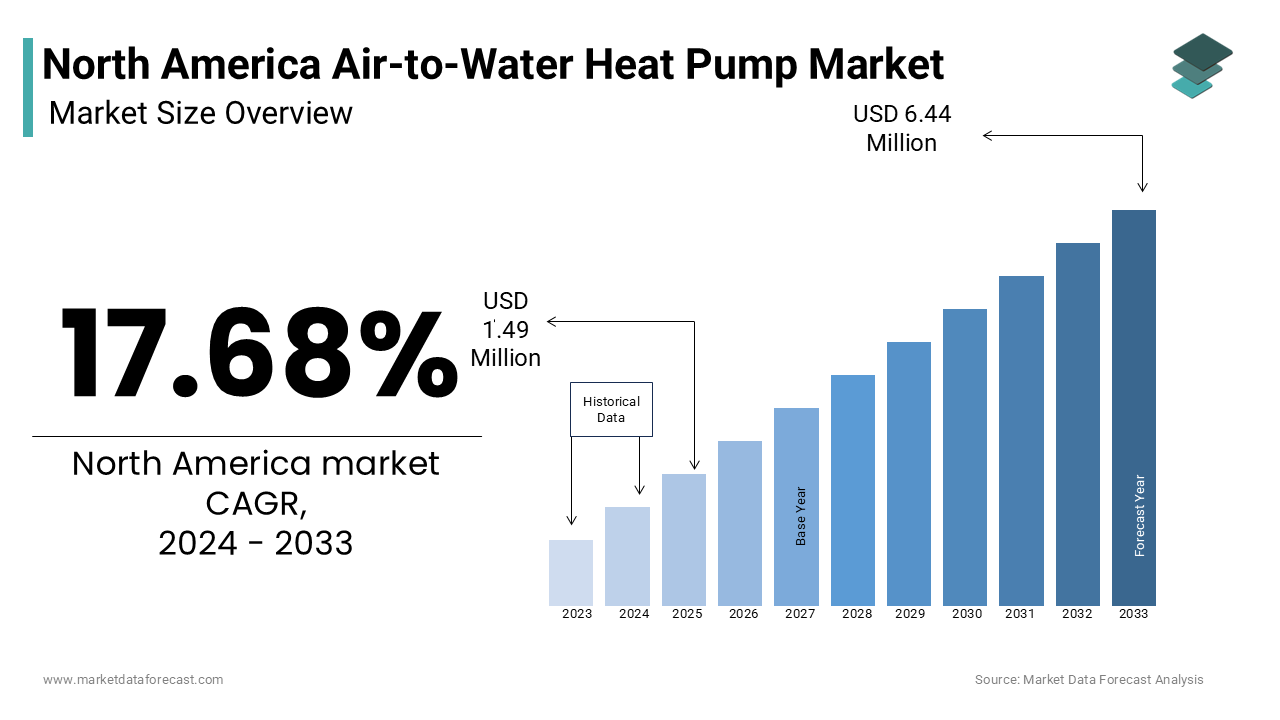
The air to water heat pump systems function by extracting ambient heat from outdoor air and transferring it to water for space heating, domestic hot water, or radiant floor systems. As per the U.S. Department of Energy, air-source heat pumps, including air-to-water variants, can achieve efficiencies of up to 300% under optimal conditions, making them significantly more efficient than traditional fossil fuel-based heating systems. In Canada, Natural Resources Canada reports that over 1.7 million heat pumps have been installed across residential and commercial sectors as of 2023, with a growing emphasis on cold-climate technologies. The integration of these systems with renewable energy sources and smart grid infrastructure is gaining traction, particularly in regions with progressive building codes and decarbonization targets.
MARKET DRIVERS
Stringent Energy Efficiency Regulations and Building Codes
The tightening of energy efficiency standards and updated building codes aimed at reducing carbon emissions are accelerating the growth of the North America air-to-water heat pump market. California’s Title 24 Energy Code mandates that new residential constructions must be equipped with high-efficiency heating and cooling systems, favoring electric heat pumps over gas alternatives. Similarly, in Canada, the National Energy Code for Buildings (NECB) 2020 emphasizes low-carbon heating options, with provinces like British Columbia offering rebates for heat pump installations. The Canadian Green Building Council notes that over 60% of new commercial buildings in major metropolitan areas now incorporate heat pump technologies. These regulatory frameworks not only stimulate demand but also influence consumer behavior by incentivizing retrofits and new installations. Additionally, utility companies across both nations offer time-of-use pricing and demand response programs that align with heat pump operations, enhancing their economic appeal.
Rising Consumer Awareness and Demand for Electrified Heating Solutions
The growing environmental consciousness and increased awareness regarding the long-term cost benefits of electrified heating are attributed in leveraging the growth of the North America air-to-water heat pump market. According to a 2023 survey conducted by the Consumer Reports National Research Center, nearly 65% of homeowners expressed interest in switching to energy-efficient heating systems, with air-source heat pumps ranking among the top choices. This shift is particularly evident in colder regions such as New England and the Pacific Northwest, where manufacturers have developed cold-climate heat pumps capable of operating efficiently at temperatures as low as -13°F. The U.S. Department of Energy's Better Buildings Initiative reports that cold-climate heat pumps can reduce heating costs by up to 50% compared to electric resistance heating. Furthermore, the availability of federal tax credits, such as the Inflation Reduction Act’s 30C rebate program, provides up to $8,000 for qualifying heat pump installations, which significantly lowers upfront investment barriers.
MARKET RESTRAINTS
High Initial Capital Investment and Payback Period Concerns
The substantial upfront costs associated with air-to-water heat pump systems is limiting the growth of the North America air-to-water heat pump market. According to the Canadian Federation of Independent Business (CFIB), the average installation cost for a residential air-to-water heat pump ranges between $8,000 and $15,000, depending on system complexity and regional labor rates. A 2023 report by the American Council for an Energy-Efficient Economy indicates that the payback period for these systems typically spans 7 to 12 years, which may deter budget-conscious consumers despite potential energy savings. Additionally, financing options remain limited or inaccessible for low-to-moderate-income households, constraining broader market penetration. In rural areas, where access to qualified technicians and specialized equipment is sparse, installation delays and higher service fees further exacerbate cost concerns. While government incentives help offset some expenses, they often require upfront payments followed by reimbursement, creating cash flow challenges for consumers.
Technical Limitations in Extreme Cold Climates
The technical limitations persist, particularly in extremely cold regions are also degrading the growth of the North America air-to-water heat pump market. As per the Cold Climate Heat Pump Research Consortium, air-to-water heat pumps experience a notable drop in coefficient of performance (COP) when ambient temperatures fall below 5°F, which is leading to reduced efficiency and increased reliance on backup heating systems. In provinces like Manitoba and territories such as Yukon, where winter temperatures frequently dip below -22°F, this inefficiency translates into higher operational costs and diminished user satisfaction. Furthermore, defrost cycles, necessary to maintain coil performance, consume additional energy and temporarily interrupt heat output, affecting indoor comfort levels. Manufacturers continue to innovate with variable refrigerant flow (VRF) systems and enhanced compressor technologies, yet these solutions often come at a premium.
MARKET OPPORTUNITIES
Expansion of Smart Grid Integration and Demand Response Programs
The convergence of smart grid infrastructure and intelligent HVAC controls is greatly influencing the growth of the North America air-to-water heat pump market. According to the Electric Power Research Institute (EPRI), residential heat pumps can reduce peak electricity demand by up to 20% when integrated with smart thermostats and grid-responsive controls. In regions like Ontario and New York, utility companies offer time-of-use tariffs and dynamic pricing models that reward consumers for shifting heat pump operation to off-peak hours. The U.S. Department of Energy’s Grid Modernization Initiative emphasizes the role of electrified heating systems in enhancing grid stability and integrating renewable energy sources such as wind and solar. Pilot projects in Quebec have demonstrated that aggregated heat pump loads can provide ancillary services by including frequency regulation and load balancing, generating additional revenue streams for users. Moreover, the proliferation of IoT-enabled devices and home energy management systems allows for real-time optimization of heat pump performance, improving both efficiency and user convenience. As per a 2023 analysis by ICF International, over 3 million North American households are expected to adopt smart-grid compatible heat pumps by 2030.
Emerging Focus on Hybrid Heating Systems
The hybrid heating configurations, which combine air-to-water heat pumps with conventional boilers or furnaces are prompting the growth of the North America air-to-water heat pump market. As per the Canadian Institute for Climate Choices, hybrid systems can reduce natural gas consumption by up to 60% without compromising heating reliability by making them attractive to both residential and commercial end-users. In colder climates such as Alberta and Maine, where all-electric solutions may not be feasible year-round, hybrid setups provide a pragmatic transition pathway toward decarbonization. The U.S. Department of Energy’s Building Technologies Office has funded multiple research initiatives focused on optimizing hybrid control algorithms to minimize fuel switching losses and maximize efficiency.
MARKET CHALLENGES
Lack of Skilled Workforce and Installation Expertise
The shortage of trained technicians and qualified installers capable of handling complex hydronic systems is likely to slow down the growth of the North America air-to-water heat pump market. As per the National Association of Home Builders (NAHB), only 35% of HVAC contractors in the U.S. possess the specialized knowledge required for heat pump installations, particularly those involving water-based distribution systems. This skill gap is even more pronounced in rural and remote areas, where access to continuing education and certification programs is limited. Misconfigurations, such as improper sizing, inadequate insulation of piping, and incorrect refrigerant charge levels, can lead to premature system failures and voided warranties. Training institutions and industry associations are beginning to address this issue through targeted apprenticeship programs and online certification courses. However, the pace of workforce development lags behind market demand, particularly as the Inflation Reduction Act and provincial green recovery initiatives drive unprecedented deployment targets.
Limited Standardization and Interoperability Across Systems
The absence of unified technical standards and interoperability protocols limits the seamless integration and scalability, which inhibits the growth of the North America air-to-water heat pump market. Unlike Europe, where EN standards govern product specifications and performance metrics, the North American market lacks harmonized guidelines for hydronic compatibility, communication interfaces, and component interoperability. As per the American Society of Heating, Refrigerating and Air-Conditioning Engineers (ASHRAE), inconsistencies in control logic, sensor calibration, and data exchange formats hinder system optimization and increase commissioning complexity. This fragmentation is particularly problematic in mixed-brand installations, where components from different manufacturers fail to communicate effectively, limiting automation capabilities and diagnostic functionalities. A 2023 white paper by the Building Performance Institute (BPI) revealed that nearly 45% of installed systems experienced integration issues within the first two years, primarily due to mismatched control platforms and proprietary software architectures. Furthermore, the lack of standardized testing procedures for extreme cold performance and seasonal efficiency metrics complicates product comparison and consumer decision-making.
SEGMENTAL ANALYSIS
By Application Insights
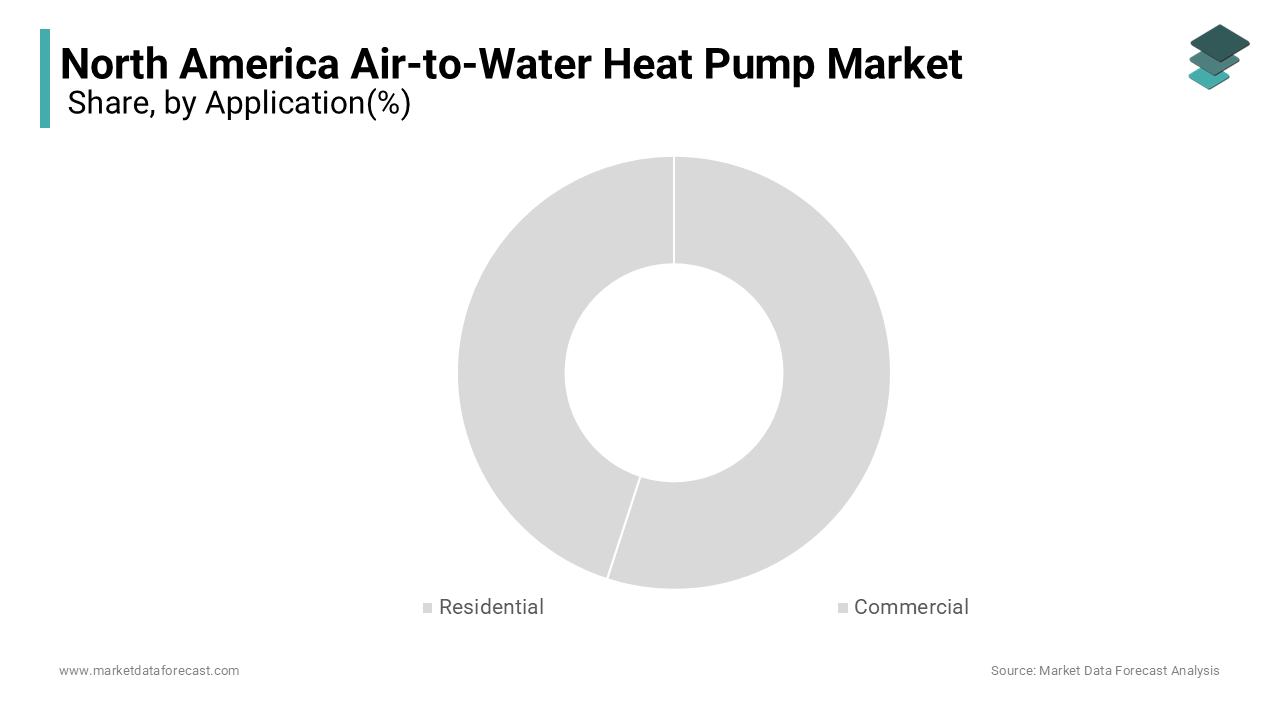
The residential segment dominated the North America air-to-water heat pump market share in 2024. Federal and state-level incentive programs have emerged as the primary catalyst propelling residential air-to-water heat pump adoption across North America. The Inflation Reduction Act of 2022 introduced substantial financial support mechanisms, including direct rebates of up to $8,000 for qualifying heat pump installations through the High-Efficiency Electric Home Rebate Program. According to the American Council for an Energy-Efficient Economy, these incentives have reduced the effective cost of residential heat pump systems by an average of 40% for eligible households. Additionally, state-level initiatives such as New York's Clean Heat Program and California's HVAC Replacement Program have collectively allocated over $2.3 billion for residential electrification projects since 2021.
The healthcare segment is likely to register a CAGR of 12.8% throughout the forecast period with the healthcare industry's need for reliable, efficient, and precise climate control systems that maintain optimal environmental conditions for patient care and medical equipment operation. Healthcare facilities require consistent temperature and humidity control to ensure patient comfort, prevent infection transmission, and support sensitive medical technologies, making air-to-water heat pumps an ideal solution for these demanding applications. The rapid expansion of healthcare infrastructure with the rising aging populations and increased healthcare accessibility is surging the demand of the advanced HVAC systems in medical facilities. The American Hospital Association reports that U.S. hospitals invested over $18.6 billion in capital improvements during 2022, with HVAC system upgrades accounting for approximately 15% of total expenditures. This construction boom includes the development of specialized medical centers, outpatient facilities, and long-term care institutions that require sophisticated climate control solutions.
REGIONAL ANALYSIS
United States Air-to-Water Heat Pump Market Insights
The United States was the top performer in the North America air-to-water heat pump market by capturing 82.3% of the share in 2024 with the country's vast residential and commercial building stock, progressive energy policies, and robust manufacturing ecosystem that supports both domestic production and international trade. The U.S. market benefits from extensive research and development investments, comprehensive incentive programs, and strong consumer demand for energy-efficient heating solutions across diverse climatic zones. The Inflation Reduction Act has allocated unprecedented funding for residential and commercial electrification, while states like California, New York, and Massachusetts have implemented aggressive building codes that favor heat pump adoption. Additionally, the presence of major manufacturers and a well-established distribution network ensures widespread product availability and competitive pricing. The U.S. Department of Energy's Building Technologies Office continues to fund research initiatives focused on improving heat pump performance in cold climates, further enhancing market prospects.
Canada Air-to-Water Heat Pump Market Insights
Canada was positioned next by holding 18.2% of the North America for air-to-water heat pumps market share in 2024. The Canadian market's expansion is accelerated by federal initiatives such as the Canada Greener Homes Grant, which has provided over 170,000 homeowners with grants averaging $5,600 for energy-efficient retrofits since its inception. Natural Resources Canada reports that residential heat pump adoption increased by 45% annually between 2020 and 2023, with air-to-water systems gaining popularity in new construction projects. Provincial programs, particularly in British Columbia and Quebec, offer additional rebates and incentives that make heat pump installations economically attractive for both residential and commercial customers. The Canadian Green Building Council indicates that over 70% of new commercial buildings in major metropolitan areas now incorporate heat pump technologies as part of their HVAC infrastructure. Canada's commitment to achieving net-zero emissions by 2050, combined with the country's extensive hydropower resources that provide clean electricity for heat pump operation, creates favorable conditions for sustained market growth.
COMPETITIVE LANDSCAPE
The North America air-to-water heat pump market exhibits intense competition characterized by the presence of established global manufacturers alongside emerging regional players. Market dynamics are shaped by technological innovation, regulatory compliance, and the ability to address specific regional climate challenges. Competition is particularly fierce in the residential segment, where brand recognition, pricing strategies, and dealer networks play crucial roles in market positioning. Commercial applications present opportunities for differentiation through specialized solutions and integrated system capabilities. The competitive landscape is further complicated by the need for extensive technical support, training programs, and after-sales service networks. Companies must balance product performance with cost-effectiveness while navigating evolving regulatory requirements and consumer preferences. Market participants compete not only on product features and pricing but also on installation support, warranty offerings, and long-term reliability. The increasing focus on sustainability and energy efficiency has created new competitive dimensions where environmental performance and integration with renewable energy sources become key differentiators.
KEY MARKET PLAYERS
Some of the promising companies that are playing a dominating role in the North America air-to-water heat pump market include
- Carrier
- Trane Technologies
- Bosch Thermotechnology
- Rheem Manufacturing Company
- Daikin North America
- Lochinvar LLC
- GREE Electric Appliances
- Fujitsu General America
- Aermec North America
- Arctic Heat Pumps (Chiltrix Inc.)
- Nordic Heat Pumps
- ClimateMaster Inc.
- NIBE Industrier AB
- Glen Dimplex Group
Top Players in the North America Air to Water Heat Pump Market
Daikin Industries Ltd.
Daikin Industries was positioned as a prominent player in the North America air-to-water heat pump market with its extensive global expertise in HVAC technology. The company's Altherma series has gained significant recognition for its advanced inverter technology and exceptional performance in cold climate conditions. Daikin's commitment to research and development has resulted in innovative solutions that address the unique challenges of North American heating requirements. The company's strategic partnerships with local distributors and contractors have established a robust network that ensures widespread product availability and technical support. Their focus on energy efficiency and environmental sustainability aligns with North American regulatory requirements and consumer preferences. Daikin's continuous investment in manufacturing capabilities and technological advancement has positioned them as a preferred choice for both residential and commercial applications. The company's comprehensive product portfolio caters to diverse market segments, from single-family homes to large commercial installations.
Mitsubishi Electric Corporation
Mitsubishi Electric has established itself as a major player in the North America air-to-water heat pump market through its innovative ZUBADEN series and commitment to cold climate performance. The company's advanced hyper-heating technology enables efficient operation in extreme temperature conditions, addressing one of the primary concerns in northern regions. Mitsubishi's extensive dealer network and strong relationships with HVAC professionals have facilitated widespread market penetration. Their focus on smart building integration and IoT connectivity has positioned them at the forefront of the digital transformation in heating systems. The company's emphasis on quality manufacturing and long-term reliability has earned consumer trust and repeat business. Mitsubishi Electric's proactive approach to regulatory compliance and energy efficiency standards has ensured their products meet evolving market requirements. Their commitment to sustainability and environmental responsibility resonates with North American consumers increasingly focused on reducing their carbon footprint.
Vaillant Group
Vaillant Group represents a significant force in the North America air-to-water heat pump market, which is bringing European engineering excellence and decades of experience in hydronic heating systems. The company's AroTHERM series has gained recognition for its compact design and exceptional integration capabilities with existing heating infrastructure. Vaillant's deep understanding of hydronic systems and renewable energy technologies has enabled them to develop solutions specifically tailored to North American market needs. Their commitment to training and education has helped build a network of qualified installers capable of properly configuring and maintaining complex air-to-water systems. The company's focus on modularity and system compatibility has made its products attractive to contractors seeking flexible installation options. Vaillant's dedication to customer service and technical support has established strong brand loyalty in key market segments.
Top Strategies Used by Key Market Participants
Strategic Partnerships and Distribution Network Expansion
Leading manufacturers in the North America air-to-water heat pump market have focused heavily on establishing strategic partnerships with local distributors, contractors, and system integrators. These collaborations enable companies to leverage existing market knowledge, customer relationships, and installation expertise. By partnering with established HVAC professionals and expanding their dealer networks, manufacturers can ensure proper product positioning, technical support, and after-sales service. These strategic alliances also facilitate market entry into new geographic regions and help companies navigate complex regulatory requirements. The emphasis on building strong distribution partnerships has become essential for market penetration, particularly in regions where local market knowledge and established customer relationships are for success.
Product Innovation and Cold Climate Technology Development
Key players have invested significantly in research and development to address the unique challenges posed by North American climate conditions, particularly in northern regions. Companies have focused on developing advanced cold-climate technologies that maintain efficiency and reliability in sub-zero temperatures. This includes innovations in compressor technology, defrost cycle optimization, and system integration capabilities. Manufacturers have also emphasized the development of smart controls and IoT connectivity features that enhance user experience and system performance. The continuous improvement of product performance, energy efficiency, and environmental sustainability has become a cornerstone strategy for maintaining competitive advantage. Companies that successfully develop and commercialize cold-climate optimized solutions gain significant market differentiation and customer preference.
Comprehensive Training and Certification Programs
Leading manufacturers have implemented extensive training and certification programs to address the shortage of skilled technicians capable of properly installing and maintaining air-to-water heat pump systems. These programs focus on educating contractors, installers, and service technicians about system design, installation best practices, troubleshooting, and maintenance procedures. By investing in workforce development, companies ensure proper product application and customer satisfaction, which ultimately strengthens brand reputation and market position. These training initiatives also help standardize installation practices and improve overall market confidence in air-to-water heat pump technology. Companies that provide comprehensive educational resources and certification programs create loyal networks of qualified professionals who prefer their products and recommend them to customers.
RECENT MARKET DEVELOPMENTS
- In January 2024, Mitsubishi Electric Corporation established a new manufacturing facility in Georgia dedicated to producing air-to-water heat pumps for the North American market. This strategic investment aimed to reduce supply chain dependencies and improve delivery times while creating local employment opportunities.
- In November 2023, Vaillant Group partnered with the National Association of Plumbing-Heating-Cooling Contractors to develop a comprehensive training curriculum for air-to-water heat pump installation and maintenance. This initiative addressed the shortage of skilled technicians in the growing market segment.
- In August 2023, Carrier Corporation acquired a leading controls and automation company to enhance its smart building integration capabilities for air-to-water heat pump systems. This acquisition strengthened their position in commercial applications and IoT-enabled heating solutions.
- In June 2023, Lennox International Inc. launched a nationwide dealer certification program focused specifically on air-to-water heat pump technologies. This program included hands-on training sessions, digital learning modules, and ongoing technical support to ensure proper installation and customer satisfaction.
MARKET SEGMENTATION
This research report on the North America Air-to-Water Heat Pump Market is segmented and sub-segmented based on categories.
By Application
- Residential
- Single family
- Multi family
- By product
- Domestic hot water heat pump
- Room heat pump
- Commercial
- Education
- Healthcare
- Retail
- Logistics & transportation
- Offices
- Hospitality
By Country
- U.S.
- Canada
- Rest of North America