- Product Description Description
- Table of Contents TOC
- List of Table & Figure LOT
- Get Free Sample PDF Sample PDF
Market Size, 2025
$0.35 BnMarket Estimate, 2026
$0.37 BnMarket Forecast, 2034
$0.53 BnCAGR, 2026–2034
4.53%North America Algae Protein Market Size, Growth, Trends & Forecast (2026–2034)
The North America Algae Protein Market size was calculated to be USD 0.35 billion in 2025, is anticipated to be worth USD 0.37 billion in 2026, and is expected to reach USD 0.53 billion by 2034, growing at a compound annual growth rate (CAGR) of 4.53% during the forecast period from 2026 to 2034. Growth is primarily driven by rising environmental sustainability concerns, climate change mitigation requirements, and increasing consumer health consciousness regarding plant-based nutrition.
Key Executive Metrics (At-a-Glance)
- 2025 Base Valuation: USD 0.35 billion
- 2026 Current Valuation: USD 0.37 billion
- 2034 Forecast Valuation: USD 0.53 billion
- Compound Annual Growth Rate (CAGR): 4.53% (2026–2034)
- Dominant Type Segment: Spirulina segment (holding the dominant share in 2025)
- Fastest-Growing Type Segment: Chlorella segment (expanding at a CAGR of 12.8% from 2026 to 2034)
- Dominant Source Segment: Freshwater algae segment (largest share in 2025)
- Fastest-Growing Source Segment: Marine algae segment (expanding at a CAGR of 11.4% from 2026 to 2034)
- Dominant Application Segment: Dietary supplements segment (holding 55.2% share in 2025)
- Fastest-Growing Application Segment: Food products segment (expanding at a CAGR of 14.2% from 2026 to 2034)
- Dominant Region: United States (commanding 82.3% of the share in 2025)
Core Market Drivers
- Environmental Sustainability: Adoption of alternative protein sources to minimize greenhouse gas emissions from livestock agriculture and conserve water resources.
- Health Consciousness: Rising consumer demand for plant-based proteins that improve cardiovascular health and provide complete amino acid profiles.
Primary Market Restraints & Challenges
- High Production Costs: Cultivation and processing expenses ranging from $8–15 per kilogram, exceeding conventional soy protein.
- Consumer Acceptance Barriers: Limited familiarity, taste profile concerns, and sensory characteristics (earthy/fishy flavors).
North America Algae Protein Market Segmentation Breakdown
| Segment Category | Leading Sub-Segment | Fastest-Growing Sub-Segment |
|---|---|---|
| By Type | Spirulina Segment | Chlorella Segment (CAGR of 12.8%) |
| By Source | Freshwater Algae Segment | Marine Algae Segment (CAGR of 11.4%) |
| By Application | Dietary Supplements (55.2% share in 2025) | Food Products Segment (CAGR of 14.2%) |
Major Industry Players Profiled
Key market leaders shaping the North American algae protein market include Corbion, Cargill Incorporated, Cyanotech Corporation, Earthrise Nutritionals LLC, TerraVia Holdings Inc., Far East Microalgae Industries Co. Ltd., E.I.D. - Parry (India) Limited, Pond Technologies Inc., Cellana Inc., Nutrex Hawaii Inc., and Roquette Frères.
North America Algae Protein Market Size
The North America Algae Protein Market Size was calculated to be USD 0.35 billion in 2025 and is anticipated to be worth USD 0.53 billion by 2034, from USD 0.37 billion in 2026, growing at a CAGR of 4.53% during the forecast period.
The algae protein is a rapidly evolving sector focused on the cultivation, processing, and commercialization of protein-rich biomass derived from various microalgae and macroalgae species for applications in food, feed, pharmaceuticals, and nutritional supplements. This emerging industry leverages sophisticated biotechnology processes, including photobioreactors, open pond systems, and advanced extraction techniques to produce high-quality protein isolates that offer superior amino acid profiles, enhanced digestibility, and sustainable production characteristics compared to traditional protein sources. Modern algae protein production integrates renewable energy systems, closed-loop water management, and precision cultivation technologies that optimize growth conditions while minimizing environmental impact and resource consumption.
MARKET DRIVERS
Environmental Sustainability and Climate Change Mitigation
The environmental sustainability concerns and climate change mitigation requirements are propelling the growth of the North America algae protein market. The Intergovernmental Panel on Climate Change reports that livestock agriculture accounts for 14.5% of global greenhouse gas emissions, which is creating pressure on food producers and consumers to adopt alternative protein sources that minimize environmental impact while maintaining nutritional quality and consumer acceptance. Water resource conservation requirements create additional demand for algae protein solutions that utilize minimal freshwater resources while providing high-yield protein production capabilities that address growing water scarcity concerns throughout North American agricultural regions. Furthermore, land use efficiency advantages make algae protein production particularly attractive for North American markets experiencing land scarcity and urban development pressures that limit agricultural expansion opportunities.
Health Consciousness and Nutritional Superiority Recognition
The increasing consumer health consciousness and recognition of algae protein nutritional superiority drive substantial demand for premium protein products that is accelerating the growth of the North America algae protein market. The American Heart Association reports that 65% of American adults actively seek plant-based protein sources to reduce saturated fat intake and improve cardiovascular health outcomes, creating sustained demand for algae protein products that provide complete amino acid profiles without animal-derived cholesterol or saturated fats. Allergen-free characteristics and dietary restriction compatibility make algae protein solutions particularly valuable for consumers with food allergies, intolerances, or specialized dietary requirements that limit traditional protein source options. Additionally, functional health benefits and bioactive compound content create premium market opportunities for algae protein products that offer additional nutritional advantages beyond basic protein provision. The National Institutes of Health reports that algae-derived proteins contain elevated levels of omega-3 fatty acids, antioxidants, and immune-supporting compounds that provide measurable health benefits beyond traditional protein sources.
MARKET RESTRAINTS
Production Cost and Economic Viability Challenges
The high production costs and economic viability challenges are impeding the growth of the North America algae protein market. The Department of Energy reports that current algae protein production costs range from $8-15 per kilogram, substantially exceeding conventional soy protein costs of $2-4 per kilogram and limiting market penetration to premium applications where price sensitivity is minimal. These cost disadvantages particularly affect food applications where consumer price sensitivity and competitive pricing pressure prevent premium algae protein products from achieving mass market adoption and volume sales necessary for economic sustainability. Energy consumption requirements for intensive cultivation systems and processing operations create additional economic barriers that increase production costs and reduce overall profitability throughout the algae protein value chain. Furthermore, limited processing infrastructure and specialized equipment requirements create supply chain bottlenecks that increase production costs and reduce operational efficiency throughout the algae protein industry.
Consumer Acceptance and Market Education Barriers
The limited consumer awareness and acceptance of algae protein products is also inhibiting the growth of the North America algae protein market. The International Food Information Council reports that only 25% of American consumers are familiar with algae protein products, while 60% express concerns about taste, safety, and naturalness that prevent trial and adoption of algae-based protein solutions. Taste profile and sensory characteristics create additional consumer acceptance challenges that limit algae protein product adoption in food applications where flavor, texture, and mouthfeel significantly influence consumer satisfaction and repeat purchase behavior. The Institute of Food Technologists indicates that 45% of consumers who try algae protein products report dissatisfaction with taste characteristics, citing earthy, fishy, or metallic flavors that conflict with expectations for neutral-tasting protein ingredients in food formulations. These sensory challenges require substantial investment in product development, flavor masking technologies, and formulation optimization that increase production costs while creating technical barriers that limit product versatility and application range in competitive food markets.
MARKET OPPORTUNITIES
Functional Food and Beverage Innovation Applications
The functional food and beverage innovation through development of specialized products that combine nutritional benefits with health-enhancing bioactive compounds and targeted wellness applications is greatly influencing the growth of the North America algae protein market. The Functional Food Association reports that the North American functional food market has grown by 85% over the past five years, creating significant demand for ingredient solutions that provide measurable health benefits beyond basic nutrition while supporting consumer wellness objectives and lifestyle preferences. Sports nutrition and athletic performance applications create particularly promising opportunity segments for algae protein products that offer superior amino acid profiles, enhanced digestibility, and rapid absorption characteristics that support training recovery and performance optimization. The Sports Nutrition Society indicates that 70% of fitness enthusiasts seek plant-based protein sources that provide complete amino acid profiles without digestive discomfort or allergen concerns, creating demand for algae protein solutions that address these specific requirements while supporting athletic performance and recovery objectives. Furthermore, medical nutrition and therapeutic applications create opportunities for algae protein solutions that address specific health conditions, dietary restrictions, and medical requirements that established protein sources may not adequately support.
Animal Feed and Aquaculture Market Expansion
Animal feed and aquaculture applications seeking to diversify beyond human nutrition and capitalize on increasing demand for sustainable feed ingredients that support animal health and performance while reducing environmental impact is additionally to create new opportunities for the growth of the North America algae protein market. The Food and Agriculture Organization reports that global aquaculture production has increased by 527% over the past two decades, creating sustained demand for high-quality protein ingredients that support fish and shellfish growth while reducing reliance on wild fish stocks for feed production. Algae protein's amino acid profiles closely match requirements for aquatic species while providing sustainable alternatives to fish meal that support industry growth and environmental sustainability objectives. Livestock and poultry feed applications create additional opportunities for algae protein utilization that address growing demand for antibiotic-free, sustainable feed ingredients that support animal health and performance while meeting consumer expectations for ethically produced animal products. The National Pork Board indicates that 65% of pork producers are actively seeking alternative protein sources for feed formulations that reduce antibiotic dependency and support animal welfare objectives, creating demand for algae protein solutions that provide nutritional completeness and health benefits without antibiotic growth promoters or controversial feed ingredients.
MARKET CHALLENGES
Scalability and Production Technology Limitations
The scalability challenges and production technology limitations are acting as a great barriers for the growth of the North America algae protein market. The National Academy of Sciences reports that current algae cultivation systems achieve only 20-40% of theoretical maximum productivity rates, creating substantial efficiency gaps that increase production costs and limit commercial viability compared to established protein production systems. These scalability limitations particularly affect photobioreactor systems that require substantial capital investment and energy inputs while achieving limited volumetric productivity that constrains economic returns and operational sustainability. Furthermore, harvesting and processing technology limitations create efficiency bottlenecks that increase production costs and reduce overall economic viability throughout the algae protein value chain. The Pacific Northwest National Laboratory reports that dewatering and harvesting operations account for 25-35% of total algae production costs, with current technologies requiring substantial energy inputs and specialized equipment that limit operational efficiency and economic returns.
Regulatory Compliance and Quality Assurance Requirements
The complex regulatory frameworks and quality assurance requirements are also to pose a challenge for the growth of the North America algae protein market. The Food and Drug Administration maintains stringent requirements for novel food ingredients, requiring extensive safety testing, documentation, and regulatory review processes that can extend product development cycles by 24-36 months while requiring substantial financial investment in compliance activities and scientific validation studies. These regulatory requirements are particularly complex for algae protein products that may contain novel compounds or processing residues that require specific safety evaluations and regulatory approvals. Additionally, quality assurance and contamination prevention requirements create ongoing compliance pressures that necessitate continuous monitoring and potential product modifications throughout the production lifecycle.
REPORT COVERAGE
| REPORT METRIC | DETAILS |
| Market Size Available | 2025 to 2034 |
| Base Year | 2025 |
| Forecast Period | 2026 to 2034 |
| CAGR | 4.53% |
| Segments Covered | By Type, Source, Application, And Region |
| Various Analyses Covered | Global, Regional & Country Level Analysis; Segment-Level Analysis; DROC, PESTLE Analysis; Porter’s Five Forces Analysis; Competitive Landscape; Analyst Overview of Investment Opportunities |
| Regions Covered | Us, Canada, and the Rest of North America |
| Market Leaders Profiled | Corbion, Cargill Incorporated, Cyanotech Corporation, Earthrise Nutritionals LLC, TerraVia Holdings Inc., Far East Microalgae Industries Co. Ltd., E.I.D. - Parry (India) Limited, Pond Technologies Inc., Cellana Inc., Nutrex Hawaii Inc., Roquette Frères |
SEGMENTAL ANALYSIS
By Type Insights
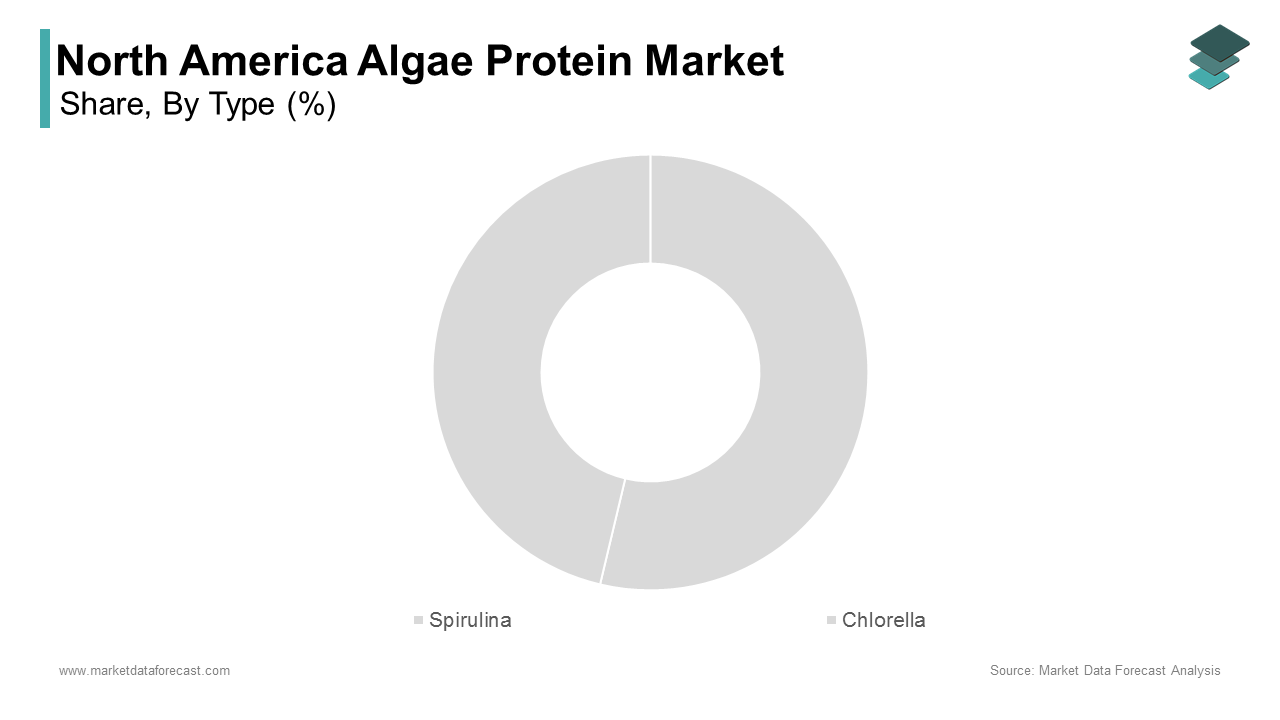
The spirulina segment held the dominant share of the North American algae protein market in 2025 with the established commercial cultivation infrastructure and production capabilities that have been developed over decades of spirulina production, creating extensive supply chains, processing facilities, and distribution networks that ensure consistent quality and reliable supply to meet growing market demand. The National Algae Association reports that over 70% of North American algae protein production facilities are optimized for spirulina cultivation , representing billions of dollars in infrastructure investments that create economic incentives for continued production and market expansion. The consumer familiarity and market acceptance that spirulina enjoys compared to newer algae protein alternatives, which is creating lower marketing costs, reduced consumer education requirements, and higher adoption rates that support sustained market growth and premium pricing opportunities. The Council for Responsible Nutrition indicates that spirulina represents 80% of algae-based dietary supplement sales in North American health food markets, reflecting consumer recognition and trust in spirulina's nutritional benefits and safety profile that have been established through decades of commercial availability and scientific research validation. Additionally, diverse application versatility and formulation compatibility make spirulina particularly suitable for multiple market segments including dietary supplements, food products, cosmetics, and specialty applications that require specific nutritional profiles, color characteristics, or functional properties that support broad market demand and revenue diversification.
The chlorella segment is likely to register a CAGR of 12.8% from 2026 to 2034 with the increasing recognition of chlorella's unique nutritional characteristics, enhanced bioavailability properties, and specialized health benefits that differentiate it from established spirulina products and create premium market opportunities for innovative applications. Another significant driver is the emerging scientific validation and clinical research support that demonstrates chlorella's unique health benefits including immune system support, detoxification properties, and metabolic enhancement capabilities that create opportunities for evidence-based marketing and premium product positioning. The National Institutes of Health indicates that over 200 peer-reviewed studies have documented chlorella's health benefits including cholesterol reduction, blood sugar regulation, and antioxidant protection that provide scientific credibility and consumer confidence that support market expansion and premium pricing strategies.
By Source Insights
The freshwater algae segment was the largest and held a significant share of the North American algae protein market share in 2025 with the abundant freshwater resources and established water management infrastructure throughout North American regions that provide reliable water supply, reduced contamination risks, and simplified regulatory compliance for freshwater algae cultivation operations. As per the United States Geological Survey, North America possesses over 20% of global freshwater resources, providing extensive water availability for algae cultivation while reducing dependency on expensive seawater transportation or desalination systems that increase marine algae production costs. These water resources are particularly valuable in agricultural regions where existing irrigation infrastructure and water rights facilitate large-scale algae cultivation operations that support commercial production and economic viability.
The marine algae segment is projected to expand with a CAGR of 11.4% from 2026 to 2034 with the superior omega-3 fatty acid content and enhanced nutritional diversity that marine algae provide compared to freshwater alternatives. The Marine Biotechnology Association reports that marine algae contain 5-10 times higher omega-3 fatty acid concentrations compared to freshwater species, providing valuable nutritional advantages for cardiovascular health, brain function, and anti-inflammatory benefits that support premium product development and specialized market applications. These nutritional advantages are particularly valuable for health-conscious consumers, athletes, and medical nutrition markets that require specific fatty acid profiles and nutritional completeness.
By Application Insights
The dietary supplements held 55.2% of the North America algae protein market share in 2025 with the established health and wellness market infrastructure that has developed around algae-based dietary supplements over decades of commercial availability, creating extensive distribution networks, consumer awareness, and retail partnerships that ensure consistent market access and consumer adoption. The Council for Responsible Nutrition reports that algae-based supplements represent 15% of the total natural products supplement market in North America, with spirulina and chlorella being among the top-selling natural supplements that benefit from established consumer trust and retailer support. Additionally, scientific validation and evidence-based marketing opportunities support dietary supplement market positioning through clinical research, peer-reviewed publications, and healthcare professional endorsements that create consumer confidence and market credibility that drive sustained demand and premium pricing.
The food products segment is likely to grow with a CAGR of 14.2% from 2026 to 2034 with the technological advances in food formulation and processing capabilities that have overcome traditional taste, texture, and color barriers that previously limited algae protein inclusion in mainstream food products, creating opportunities for widespread market adoption and volume growth. The algae protein ingredients qualify for natural and organic labeling claims that appeal to health-conscious consumers and support premium positioning in mainstream food markets. These regulatory advantages create opportunities for food manufacturers to develop algae protein products that meet growing consumer demand for clean label, sustainable, and health-promoting food ingredients that command premium pricing and volume growth.
REGIONAL ANALYSIS
United States Algae Protein Market Insights
The United States was the top performer of the North American algae protein market with 82.3% of the share in 2025 with the extensive health and wellness industry infrastructure that has developed around natural and functional foods throughout the United States, creating substantial demand for innovative protein sources that align with consumer health consciousness and sustainability preferences. The Institute of Food Technologists indicates that over 300 food manufacturers have incorporated algae protein into product formulations including protein bars, beverages, and meat alternatives. These processing capabilities create opportunities for algae protein producers to develop specialized ingredients and co-manufacturing partnerships that support volume growth and market expansion. Additionally, strong research and development investment and scientific validation support U.S. algae protein market development through university research programs, government funding initiatives, and industry collaboration.
Canada Algae Protein Market Insights
Canada algae protein market held 15.3% of the share in 2025 with the growing demand for sustainable protein sources that align with Canadian values and regulatory frameworks. This environmental focus is particularly pronounced in western provinces where sustainability values strongly influence purchasing decisions and support premium pricing for environmentally responsible products. The comprehensive health food retail infrastructure that has developed throughout Canada by creating extensive distribution networks, specialized retail partnerships, and informed consumer bases that support algae protein market expansion and premium positioning.
Furthermore, government support and research funding initiatives create favorable conditions for algae protein industry development through research grants, tax incentives, and regulatory support that enhance commercial viability and technological advancement throughout the Canadian market.
LEADING PLAYERS IN THE MIDDLE EAST AND AFRICA TRAGACANTH MARKET
Royal Barksdale Company
Royal Barksdale Company has established itself as a leading supplier in the Middle East and Africa tragacanth market through decades of specialized trading experience and extensive regional distribution networks. The company's commitment to quality assurance and sustainable sourcing practices has enabled them to serve diverse industries including pharmaceuticals, food processing, and cosmetics across multiple countries. Their strategic partnerships with Iranian suppliers ensure consistent supply chain reliability while maintaining competitive pricing structures. The company's investment in processing facilities and quality control systems has enhanced product purity and customization capabilities by allowing them to meet specific customer requirements across different industrial applications and geographic markets.
Golnar Tragacanth Company
Golnar Tragacanth Company has gained significant market presence in the African tragacanth sector through innovative processing techniques and comprehensive regional coverage. The company specializes in producing pharmaceutical-grade tragacanth with enhanced solubility properties that cater to the growing healthcare manufacturing demand across the continent. Their integrated approach from raw material procurement to final product development ensures consistent quality control throughout the supply chain. Golnar's research and development initiatives have led to the creation of specialized formulations for specific industrial applications, which is positioning them as a preferred supplier among cosmetic and food processing companies seeking reliable and high-quality tragacanth solutions.
Persian Tragacanth Industries
Persian Tragacanth Industries represents a significant force in the regional market through their comprehensive product portfolio and strategic market expansion initiatives. The company has successfully penetrated both traditional and emerging markets by offering customized tragacanth solutions tailored to specific customer requirements and regional preferences. Their vertically integrated operations from raw material harvesting to finished product manufacturing ensure quality standards while maintaining competitive pricing. The company's focus on sustainable harvesting practices and community engagement programs has strengthened their reputation among environmentally conscious buyers by enabling them to capture substantial market share across diverse geographical territories and industrial sectors.
TOP STRATEGIES USED BY KEY PLAYERS IN NORTH AMERICA ALGAE PROTEIN MARKET
Vertical Integration and Supply Chain Control
Leading companies in the North American algae protein market are pursuing vertical integration strategies to gain greater control over their supply chains, ensure consistent quality standards, and reduce dependency on external suppliers for raw materials and processing capabilities. This approach involves acquiring or developing cultivation facilities, which is processing plants, and distribution networks that enable comprehensive control over production processes from algae cultivation to final product delivery. Companies are also investing in proprietary cultivation technologies, specialized processing equipment, and quality control systems that differentiate their products and protect intellectual property while ensuring consistent supply and quality standards that support customer satisfaction and market expansion.
Product Innovation and Application Diversification
Market participants are investing heavily in research and development initiatives to create innovative algae protein products and expand application opportunities across diverse market segments including food products, dietary supplements, animal feed, and specialty applications. These innovation efforts focus on improving taste profiles, enhancing nutritional characteristics, developing specialized formulations, and creating new product formats that address specific consumer needs and market requirements. Companies are also exploring novel processing technologies, encapsulation techniques, and formulation approaches that overcome traditional barriers to algae protein adoption while creating premium product offerings that command higher pricing and support market differentiation.
Strategic Partnerships and Collaborative Development
Major players are forming strategic partnerships with food manufacturers, supplement companies, research institutions, and technology providers to accelerate product development, expand market reach, and leverage complementary capabilities and resources. These collaboration efforts enable companies to access new customer bases, gain insights into specific market requirements, develop co-branded products, and share development costs while reducing time-to-market for innovative algae protein solutions. Companies are also partnering with academic institutions and government research programs to advance cultivation technologies, processing innovations, and nutritional validation that enhance product credibility and commercial viability while supporting long-term market growth and technological advancement.
KEY MARKET PLAYERS AND COMPETITION OVERVIEW
Major Players of the North America Algae Protein Market include Corbion, Cargill Incorporated, Cyanotech Corporation, Earthrise Nutritionals LLC, TerraVia Holdings Inc., Far East Microalgae Industries Co. Ltd., E.I.D. - Parry (India) Limited, Pond Technologies Inc., Cellana Inc., Nutrex Hawaii Inc., Roquette Frères
The North American algae protein market presents an emerging competitive landscape characterized by the presence of several innovative startups, established biotechnology companies, and traditional protein producers entering the algae-based protein space. Major players compete primarily on product quality, technological innovation, and application versatility rather than price alone, as the market is still developing and consumers are willing to pay premium prices for innovative, sustainable protein sources with superior nutritional profiles. The market dynamics are influenced by factors such as technological advancement, regulatory compliance requirements, and evolving consumer preferences for environmentally responsible and health-promoting protein alternatives.
Competition intensifies across different application segments, with dietary supplements and specialty foods commanding premium pricing while food products and animal feed applications represent high-volume opportunities that require different competitive strategies and market approaches. The industry also experiences ongoing consolidation as larger players acquire smaller competitors to expand product portfolios and geographic reach. Market participants continuously adapt their business strategies to address changing regulatory environments, emerging technological trends, and shifting consumer demands while maintaining competitive positioning in an evolving marketplace that increasingly values innovation, sustainability, and nutritional excellence.
RECENT HAPPENINGS IN THE MARKET
- In January 2025, AlgaVia acquired Pure Harvest Technologies to expand their cultivation capacity and enhance their spirulina production capabilities for food ingredient applications.
- In April 2025, TerraVia partnered with Nestlé to develop algae protein ingredients for plant-based food products and expand their presence in the mainstream food market.
- In June 2025, Corbion acquired AlgaeHealth to strengthen their position in the algae-based nutritional ingredients market and expand their product portfolio.
- In September 2025, Algenuity launched their new chlorella-based protein powder line specifically targeting the sports nutrition market and health-conscious consumers.
- In November 2025, Cyanotech expanded their Hawaiian cultivation facilities and introduced new organic-certified algae protein products for premium supplement markets.
MARKET SEGMENTATION
This research report on the North America algae protein market has been segmented and sub-segmented based on type, source, application, and region.
By Type
- Spirulina
- Chlorella
By Source
- Freshwater Algae
- Marine Algae
By Application
- Dietary Supplements
- Food Products
- Animal Feed
- Others
By Region
- US
- Canada
- Rest of North America