- Product Description Description
- Table of Contents TOC
- List of Table & Figure LOT
- Get Free Sample PDF Sample PDF
Market Size, 2025
$1.58 BnMarket Estimate, 2026
$1.62 BnMarket Forecast, 2034
$1.96 BnCAGR, 2026–2034
2.44%North America Automotive Chromium Finishing Market Size
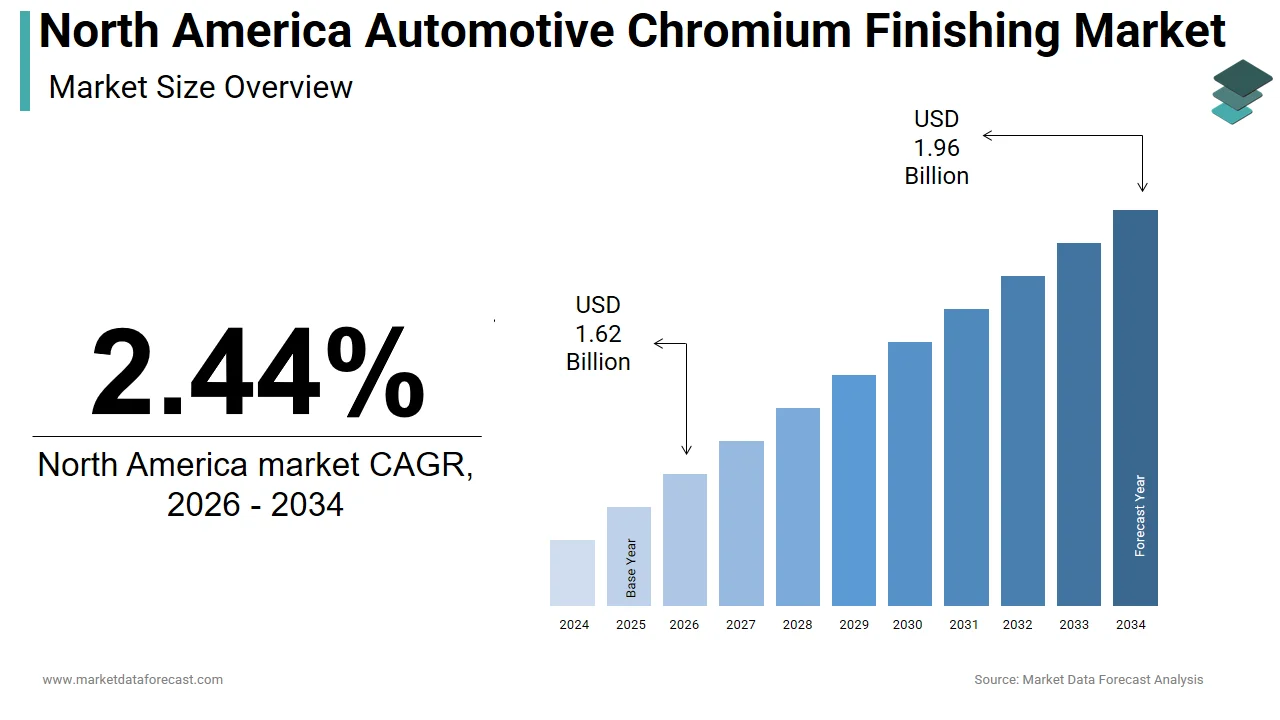
The size of the North America automotive chromium finishing market was worth USD 1.58 billion in 2025. The regional market is anticipated to grow at a CAGR of 2.44% from 2026 to 2034 and be worth USD 1.96 billion by 2034 from USD 1.62 billion in 2026.
Automotive chromium finishing is chrome plating technologies on vehicle components to enhance aesthetic appeal, corrosion resistance, and durability. This process is widely used across passenger vehicles, commercial vehicles, and specialty automotive segments such as luxury and vintage cars. The primary applications include plating of wheels, grilles, exhaust systems, trim parts, and various under-the-hood components.
In recent years, the demand for high-performance surface treatments in the automotive industry has grown significantly due to increasing consumer preference for visually striking and long-lasting finishes. Additionally, the resurgence of classic car restoration projects, particularly in states like California and Texas, has further fueled demand for premium chrome finishes.
The market is also being shaped by technological advancements in trivalent chromium plating, which offers reduced environmental impact compared to traditional hexavalent processes.
MARKET DRIVERS
Resurgence in Classic and Custom Vehicle Restoration
The growing trend of restoring and customizing vintage and classic vehicles is one of the key drivers of the North America automotive chromium finishing market. Enthusiasts and collectors are increasingly investing in restoring older models to their original luster, with chrome plating playing a central role in achieving authentic aesthetics.
Moreover, the rise of auto shows, concours events, and online marketplaces for vintage automobiles has created a thriving ecosystem for restoration services. In 2022, as per the Specialty Equipment Market Association (SEMA), the U.S. aftermarket customization industry generated over $50 billion in revenue, with chrome finishing accounting for approximately 6% of that value. Chrome's ability to provide a mirror-like finish with superior corrosion resistance makes it the preferred choice for exterior and interior trim components in restorations. Given that many classic models were originally manufactured with chrome accents, there is a strong emphasis on preserving or replicating those features using modern plating techniques.
Growth in Premium Automotive Segment Demand
The rising production and sales of premium and luxury vehicles, which extensively utilize chrome finishes for branding and differentiation, is another major driver of the North America automotive chromium finishing market. Automakers such as Cadillac, Lincoln, BMW, Mercedes-Benz, and Lexus incorporate chrome into grille designs, exhaust tips, window surrounds, and wheel rims to convey sophistication and performance.
These higher-end models often feature more chrome-intensive designs to elevate visual appeal and perceived value. For instance, brands like Rolls-Royce and Bentley use hand-polished chrome elements that require specialized plating and finishing expertise.
Apart from these, electric vehicle (EV) manufacturers such as Tesla and Lucid have begun integrating chrome-like finishes into their exteriors to compete with traditional luxury automakers. Although some EVs opt for alternative materials like polished aluminum or composite chrome, the overall trend toward premiumization supports increased demand for high-quality chromium finishing solutions across OEM and Tier-1 supplier networks in North America.
MARKET RESTRAINTS
Stringent Environmental Regulations on Hexavalent Chromium Use
The tightening of environmental regulations governing the use of hexavalent chromium, a toxic compound traditionally used in chrome plating, is a significant restraint impacting the North America automotive chromium finishing market. Hexavalent chromium emissions pose serious health risks and environmental hazards, prompting regulatory bodies such as the U.S. Environmental Protection Agency (EPA) and Environment and Climate Change Canada to impose strict limits on its industrial use. Under the EPA’s National Emission Standards for Hazardous Air Pollutants (NESHAP), chrome electroplating facilities must comply with stringent emission controls, including the installation of advanced filtration systems and regular worker exposure monitoring.
Many small and mid-sized plating shops have struggled to absorb these expenses, leading to consolidation within the industry. Furthermore, as per the Occupational Safety and Health Administration (OSHA), hexavalent chromium exposure remains one of the top workplace safety concerns in metal finishing sectors, reinforcing the push toward safer alternatives like trivalent chromium plating.
High Cost of Advanced Plating Technologies and Infrastructure
The high capital expenditure required to implement advanced plating technologies and maintain compliant infrastructure is another major constraint in the North America automotive chromium finishing market. Modern chrome finishing facilities need substantial investments in electroplating equipment, chemical management systems, ventilation units, and wastewater treatment plants to meet environmental and safety standards.
These costs are compounded by ongoing operational expenditures, including energy consumption, chemical replenishment, and waste disposal. Energy costs alone account for approximately 30% of total operating expenses in chrome finishing plants, as per the U.S. Department of Energy. Additionally, the scarcity of skilled labor trained in precision plating techniques adds another layer of complexity. As per a 2023 survey by the Precision Metalforming Association, nearly 45% of metal finishing firms faced challenges in hiring qualified technicians, resulting in production delays and increased training budgets.
For smaller players, these financial and logistical barriers limit scalability and competitiveness.
MARKET OPPORTUNITIES
Expansion of Electric Vehicle Manufacturing and Design Innovation
The rapid expansion of electric vehicle (EV) manufacturing and the evolving design preferences within the segment an emerging opportunities for the North America automotive chromium finishing market. While early EV models largely avoided chrome finishes in favor of minimalist, aerodynamic styling, recent trends indicate a shift toward incorporating chrome-like surfaces to enhance visual appeal and brand identity. Major automakers such as Ford (with Mustang Mach-E), General Motors (with Cadillac Lyriq), and Rivian have integrated chrome-accented elements into their EV lineups to attract consumers accustomed to premium aesthetics.
According to data from the U.S. Department of Energy, EV sales in North America surged to over 1.2 million units in 2023, representing a 50% increase compared to the previous year. As competition intensifies in the EV space, manufacturers are exploring ways to differentiate their products through design, including the use of reflective and durable finishes. While some companies are experimenting with polymer-based chrome alternatives, others are returning to real chrome plating—especially for luxury EV models where authenticity and craftsmanship are emphasized.
Moreover, Tier-1 suppliers such as Magna International and Plastic Omnium are investing in hybrid finishing technologies that combine chrome plating with lightweight substrates to reduce weight without compromising aesthetics.
Growth in Aftermarket Accessories and Personalization Trends
The rising popularity of vehicle personalization and accessory upgrades presents a compelling growth avenue for the North America automotive chromium finishing market. Consumers are increasingly seeking distinctive looks for their vehicles, driving demand for customized chrome-finished components such as grilles, badges, door handles, and lighting bezels.
This trend is particularly pronounced among younger demographics, including millennials and Gen Z, who prioritize individuality and aesthetic appeal in their vehicles. Online platforms such as YouTube, Instagram, and TikTok have amplified the visibility of custom builds and chrome detailing, influencing purchasing behavior and encouraging DIY modifications. Auto dealerships and independent body shops have responded by offering chrome upgrade packages at point-of-sale, further embedding these finishes into mainstream consumer awareness.
Besides, the proliferation of e-commerce marketplaces like Amazon, eBay, and RockAuto has made chrome accessories more accessible to a broader audience. This digital accessibility enables even rural and suburban consumers to access high-quality chrome components, expanding the reach of the finishing market beyond traditional urban hubs.
MARKET CHALLENGES
Supply Chain Disruptions Impacting Raw Material Availability
The volatility in the supply chain for critical raw materials, particularly metallic chromium and plating chemicals, is a pressing challenge facing the North America automotive chromium finishing market. The global supply chain disruptions caused by geopolitical tensions, trade restrictions, and pandemic-related shutdowns have had lingering effects on material availability and pricing.
Fluctuations in export policies and freight logistics have led to extended lead times and cost instability. These increases place pressure on plating service providers, many of whom operate on thin margins and cannot easily pass on cost hikes to customers. Moreover, the semiconductor shortage affecting automotive production has indirectly impacted chrome finishing demand, as automakers scale back output or delay model launches.
Technological Complexity and Skilled Labor Shortage in Trivalent Chromium Adoption
As the automotive industry transitions toward trivalent chromium plating to comply with environmental regulations, the North America automotive chromium finishing market faces significant challenges related to the technological complexity and workforce readiness required for this shift. Unlike traditional hexavalent chromium plating, trivalent systems demand precise control over bath composition, temperature, and current density to achieve consistent finishes.
Furthermore, the industry is grappling with a shortage of skilled technicians capable of managing these advanced systems. Educational institutions and vocational programs have been slow to update curricula to reflect these changes, exacerbating the talent gap.
Besides, the variability in trivalent chromium performance across different substrates and part geometries necessitates extensive R&D and process optimization. Many Tier-2 suppliers and independent platers lack the resources to conduct in-house testing, delaying their ability to offer competitive chrome finishing services.
REPORT COVERAGE
| REPORT METRIC | DETAILS |
| Market Size Available | 2025 to 2034 |
| Base Year | 2025 |
| Forecast Period | 2026 to 2034 |
| Segments Covered | By Base Material, Process, End-user, Vehicle, and Region. |
| Various Analyses Covered | Global, Regional and Country-Level Analysis, Segment-Level Analysis, Drivers, Restraints, Opportunities, Challenges; PESTLE Analysis; Porter’s Five Forces Analysis, Competitive Landscape, Analyst Overview of Investment Opportunities |
| Countries Covered | United States, Canada, Mexico, Rest of North America |
| Market Leaders Profiled | Atotech, MacDermid, Borogh, Synergies Casting, U.S. Chrome, and Others. |
SEGMENTAL ANALYSIS
By Base Material Insights
The steel and aluminum segment dominated the regional market by accounting for a substantial portion of total demand in 2025. Its extensive application in heavy commercial vehicles (HCVs) and off-road equipment, where wear resistance and longevity are critical, is one of the primary drivers behind the continued dominance of metal. These materials retain plating integrity even under extreme thermal stress and exposure to road contaminants, making them indispensable in industrial vehicle manufacturing. This dominance stems from the widespread use of metallic substrates in structural and load-bearing components such as exhaust systems, wheels, suspension parts, and engine components, where chrome plating enhances corrosion resistance and mechanical durability. Also, aluminum’s growing adoption in lightweighting strategies within the automotive industry further supports this segment’s expansion. As per data from the Aluminum Association, North American automakers increased their usage of aluminum content per vehicle to an average of 418 pounds in 2023, up from 390 pounds in 2021. Since aluminum can be effectively chrome-plated to offer both aesthetic and functional benefits, it has become a favored base material for luxury and performance-oriented models. The synergy between advanced metallurgy and chrome finishing technologies ensures that the metal-based chromium finishing segment remains dominant across OEM and Tier-1 supplier operations in North America.
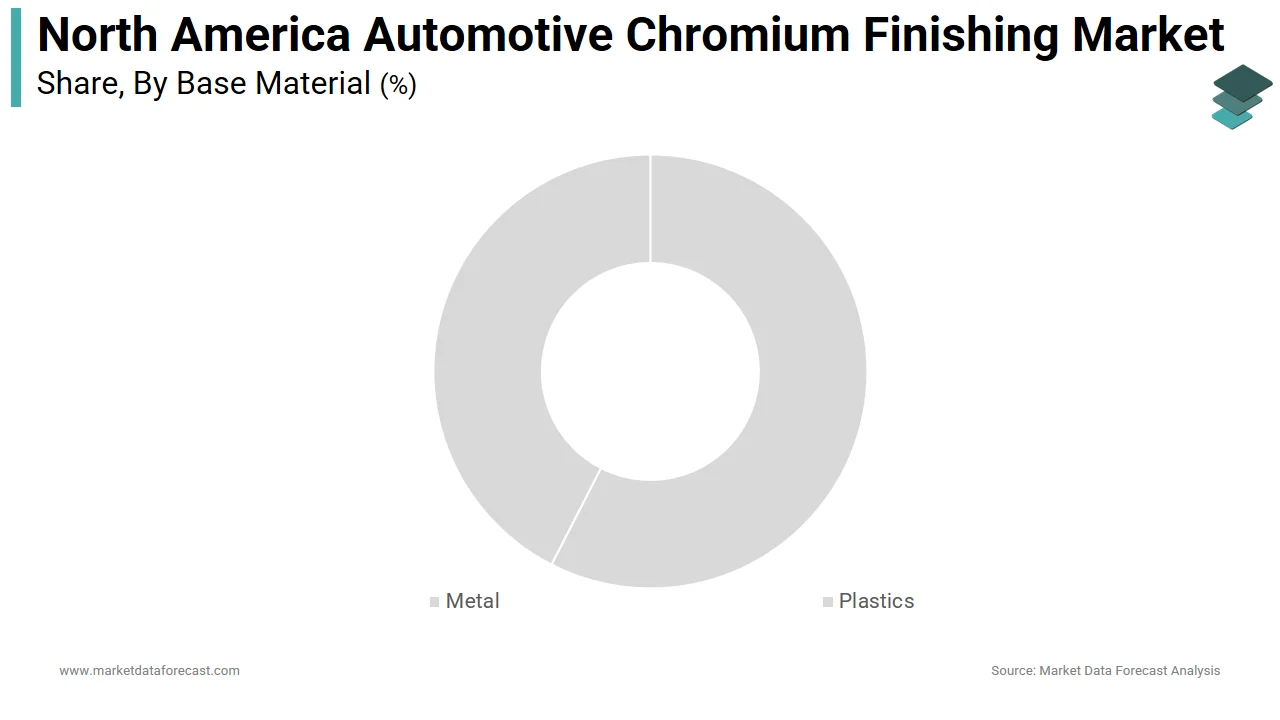
The plastics segment saw a notable trend in the North America automotive chromium finishing market and is rapidly growing. It is projected to expand at the highest CAGR of 6.2% during the forecast period. The increasing demand for lightweight and aerodynamic vehicle designs, especially in electric and hybrid models, is one key factor driving this growth. While currently smaller than the metal-based segment, plastic substrates are gaining traction due to advancements in plastic-to-metal conversion technologies, enabling chrome finishes on polymer surfaces without compromising design flexibility or weight efficiency. Automakers are shifting toward high-performance polymers like ABS, PC/ABS, and polypropylene to reduce overall vehicle mass and improve fuel economy. As per data from the International Council on Clean Transportation (ICCT), every 10% reduction in vehicle weight translates to a 6–8% improvement in fuel efficiency, a compelling incentive for using chrome-finished plastic components in grilles, trim pieces, and interior accents. The rising popularity of design personalization and customization among consumers is another major catalyst. Plastic chrome parts are easier to mold into complex shapes and can be applied more cost-effectively in low-volume production runs. Platforms like SEMA Show and aftermarket retailers have reported a surge in demand for chrome-accented plastic accessories.
By Process Insights
The Decorative Chrome segment led the market by contributing 65.3% of total revenue in 2024. The growing consumer preference for premium aesthetics, particularly in the luxury and SUV segments, is a significant driver of this segment. This dominance is also attributed to the widespread application of decorative chrome plating in enhancing the visual appeal of exterior and interior automotive components such as grilles, bumpers, trim strips, and wheel rims. Chrome detailing plays a crucial role in brand identity, with manufacturers like Cadillac, BMW, and Lincoln incorporating chrome elements to elevate the visual impact of their vehicles. Moreover, the aftermarket customization sector continues to fuel demand for decorative chrome finishes. Enthusiasts and collectors are increasingly opting for chrome upgrades to enhance the look of both modern and classic vehicles, reinforcing the segment’s stronghold in the regional market. With styling remaining a key differentiator in competitive automotive markets, decorative chrome plating is expected to maintain its leading position in the years ahead.
The Hard Chrome segment is emerging as the fastest-growing category and is most likely recording a projected CAGR of 6.7% between 2025 and 2033. Its widespread application in heavy-duty and commercial vehicles, including trucks, construction machinery, and agricultural equipment, is one of the primary factors propelling this segment’s rapid expansion. The ability of hard chrome to withstand extreme temperatures and abrasive conditions makes it indispensable in industrial vehicle manufacturing. Unlike decorative chrome, which focuses on aesthetics, hard chrome plating is primarily used for its exceptional wear resistance, hardness, and corrosion protection, making it ideal for functional components exposed to high-stress environments. The increasing demand for remanufacturing and component refurbishment, especially in the aerospace and defense sectors, is another key growth driver. Also, in the automotive repair industry, hard chrome plating is being adopted to restore worn-out parts rather than replacing them entirely, aligning with sustainability goals.
By End-user Insights
The Automotive OEM segment dominated the market by holding a 62.3% of total share in 2024. The dominance of Automotive OEM segment is driven by the integration of chrome finishing processes directly into vehicle manufacturing lines, ensuring consistency in quality, compliance with regulatory standards, and scalability in production. Among the key reasons for the OEM segment’s leading position is the high volume of chrome-finished components used in original equipment manufacturing, particularly in luxury, premium, and commercial vehicle segments. Major automakers such as Ford, General Motors, and Stellantis incorporate chrome plating into grilles, exhaust tips, window surrounds, and wheel trims to enhance brand identity and perceived value. Besides, Tier-1 suppliers and contract manufacturers are investing heavily in advanced plating facilities to meet OEM specifications for environmental compliance and finish precision.
The Automotive Aftermarket segment is projected to grow at the fastest rate, likely registering a CAGR of 7.1% between 2025 and 2033. The rising interest in vehicle customization and appearance upgrades, especially among younger demographics, is one of the main drivers behind this growth. Enthusiasts are increasingly opting for chrome grilles, badges, door handles, and lighting bezels to enhance the visual appeal of both modern and classic vehicles. While traditionally smaller than the OEM segment, the aftermarket is experiencing rapid expansion due to changing consumer preferences, increased vehicle ownership durations, and a growing culture of personalization and restoration. Additionally, the expansion of e-commerce platforms such as Amazon, eBay, and RockAuto has made chrome accessories more accessible to a broader consumer bas. This digital accessibility enables even rural and suburban customers to access high-quality chrome components without relying solely on dealership services or local body shops. Furthermore, the classic car restoration movement is gaining momentum. Many of these vintage models originally featured chrome accents, prompting owners to invest in replating and restoration services. As consumer interest in self-expression through vehicle styling continues to rise, the Automotive Aftermarket segment is positioned for robust and sustained growth.
By Vehicle Type Insights
The Passenger Cars segment represented the largest vehicle type by accounting for 56.4% of total market demand in 2024. One of the key drivers behind this segment’s leading position is the integration of chrome plating in luxury and mid-tier passenger cars to enhance visual appeal and brand differentiation. Major automakers such as Cadillac, BMW, and Mercedes-Benz utilize chrome extensively in grilles, exhaust tips, and trim elements to create a premium aesthetic. This dominance is primarily driven by the high production volumes of passenger vehicles and the widespread incorporation of chrome finishes in both exterior and interior components. Additionally, the aftermarket customization industry significantly contributes to chrome finishing demand in the passenger car segment. Consumers are increasingly opting for personalized chrome upgrades to enhance the look of their vehicles, further reinforcing this segment’s market leadership. Moreover, electric vehicle (EV) manufacturers are adopting chrome-like finishes to maintain visual appeal despite minimalistic design trends. As styling remains a key differentiator in competitive automotive markets, the passenger car segment continues to dominate the North American automotive chromium finishing industry.
The Heavy Commercial Vehicles (HCVs) are witnessing the fastest growth and is projected to expand at a CAGR of 7.4% between 2024 and 2033. Rising demand for durable and wear-resistant components in freight and logistics fleets is one of the primary growth drivers. According to the American Trucking Associations (ATA), the U.S. freight industry transported over 11 billion tons of goods in 2023, requiring vehicles capable of withstanding harsh operating conditions. Chrome plating is extensively used on piston rods, brake calipers, suspension parts, and exhaust manifolds, providing superior hardness and thermal stability. The expanding remanufacturing and refurbishment industry, particularly in the commercial vehicle sector, is another key factor contributing to this segment’s rapid growth. By extending the lifecycle of expensive mechanical parts, chrome finishing offers a cost-effective and sustainable alternative to full replacements. Furthermore, government initiatives promoting infrastructure development and freight efficiency are boosting commercial vehicle production. As a result, the Heavy Commercial Vehicles segment is emerging as the fastest-growing category in the North American automotive chromium finishing market.
COUNTRY-LEVEL ANALYSIS
U.S. Automotive Chromium Finishing Market Insights
The U.S. automotive industry remained one of the most influential globally. Major automakers such as Ford, General Motors, and Tesla integrate chrome plating into various exterior and interior components to enhance aesthetics and differentiate product offerings. Another key driver is the resurgence of classic car restoration projects, particularly in states like California, Texas, and Florida. Furthermore, the transition to trivalent chromium technology has been widely adopted by U.S.-based plating companies, helping them comply with stringent environmental regulations enforced by the Environmental Protection Agency (EPA). With continuous innovation in chrome finishing methods and a strong presence of Tier-1 suppliers and OEMs, the United States remains the cornerstone of the North American automotive chromium finishing industry.
Canada Automotive Chromium Finishing Market Insights
Canada holds a notable position in the North America automotive chromium finishing market. Although smaller in scale compared to the U.S., Canada's market is characterized by a strong presence of automotive manufacturing hubs, particularly in Ontario, Quebec, and British Columbia, which drive consistent demand for chrome finishing solutions. One of the key drivers supporting Canada’s market position is its integrated automotive supply chain, with several Tier-1 suppliers operating within proximity to major assembly plants. According to Natural Resources Canada, the country produced over 1.1 million vehicles in 2023, with brands like Fiat Chrysler Automobiles (Stellantis), Ford, and Toyota maintaining substantial production footprints. These manufacturers utilize chrome plating for both functional and decorative components, including exhaust systems, trim parts, and wheel rims, contributing to ongoing demand for surface finishing services. In addition to OEM activity, Canada's aftermarket sector is also expanding, supported by a growing interest in vehicle customization and restoration. Moreover, cities like Toronto, Montreal, and Vancouver have seen a rise in boutique auto detailing studios offering premium chrome finishes, catering to a niche but affluent clientele. Environmental regulations in Canada, aligned with those in the U.S., are also influencing the adoption of trivalent chromium plating technologies. Environment and Climate Change Canada has mandated stricter emissions controls for electroplating facilities, prompting industry players to invest in cleaner alternatives. As a result, Canada's automotive chromium finishing market is evolving with a balance of regulatory compliance, OEM integration, and aftermarket growth shaping its trajectory.
Rest of North America Automotive Chromium Finishing Market Insights
The Rest of North America (RONA), which includes Mexico and other smaller territories, contributes a notable share of total regional demand in the North America automotive chromium finishing market. While not as dominant as the U.S. or Canada, Mexico, in particular, is emerging as a strategic player in the automotive supply chain, driving growth in chrome finishing applications. One of the primary factors fueling RONA’s market expansion is the booming automotive manufacturing sector in Mexico. A significant portion of these vehicles are exported to the U.S. and Canada, necessitating the use of chrome finishes for branding and aesthetic appeal. Companies such as Nissan, Honda, and Volkswagen operate large-scale production facilities in the country, integrating chrome-plated components into grilles, wheels, and trim parts. Additionally, Mexico’s low-cost labor environment and proximity to the U.S. market make it an attractive destination for Tier-1 suppliers setting up plating and finishing operations. As per the National Institute of Statistics and Geography (INEGI), the Mexican metal finishing industry grew by 5.8% in 2023, driven largely by automotive-related demand. Moreover, the United States-Mexico-Canada Agreement (USMCA) has facilitated cross-border investment, allowing integrated supply chains to develop further. Beyond OEM manufacturing, the aftermarket segment in Mexico is also gaining traction, with increasing investments in chrome detailing and restoration services.
COMPETITIVE LANDSCAPE
The competition in the North America automotive chromium finishing market is shaped by a mix of established players, niche service providers, and emerging innovators striving to maintain relevance amid evolving industry dynamics. As environmental regulations tighten and technological advancements redefine finishing techniques, companies are under pressure to adapt quickly while ensuring quality and compliance. The market features a blend of large-scale finishers with extensive client networks and smaller, specialized firms catering to niche segments such as classic car restoration or custom detailing. While larger players leverage economies of scale, process standardization, and R&D capabilities to dominate OEM contracts, mid-sized firms focus on agility, customization, and localized service offerings to capture aftermarket opportunities. Competitive differentiation is increasingly driven by sustainability practices, process innovation, and the ability to deliver consistent, high-performance chrome finishes across diverse substrates. Additionally, vertical integration efforts, strategic acquisitions, and partnerships with material suppliers are reshaping the competitive landscape. With shifting consumer preferences toward aesthetics and durability, coupled with the push for greener alternatives, the market remains dynamic, requiring continuous investment and operational flexibility from all participants.
KEY MARKET PLAYERS
Noteworthy Companies dominating the North America automotive chromium finishing market profiled in the report are
- Atotech
- MacDermid
- Borogh
- Synergies Casting
TOP LEADING PLAYERS IN THE MARKET
One of the leading players in the North America automotive chromium finishing market is Shamrock Industries. The company has built a strong reputation for delivering high-quality chrome plating solutions across OEM and aftermarket segments. With decades of expertise, Shamrock focuses on precision finishing for luxury vehicles, commercial trucks, and specialty automotive components. Its commitment to innovation and sustainable plating techniques has positioned it as a trusted partner among major automakers and Tier-1 suppliers.
Another key player is Levitt-Safety, a diversified surface finishing provider that plays a crucial role in the automotive sector. Known for its advanced plating technologies and compliance with environmental standards, Levitt-Safety serves a wide range of clients including automotive manufacturers and restoration specialists. The company emphasizes process efficiency and worker safety while maintaining high-performance chrome finishes tailored to evolving industry demands.
Atotech is also a dominant force in the North American market, offering cutting-edge electroplating solutions for automotive applications. As a global leader in metal finishing, Atotech provides innovative trivalent chromium technologies that align with regulatory requirements and sustainability goals. Its technical expertise and collaborative approach with OEMs have reinforced its position as a preferred supplier in the automotive chromium finishing space.
TOP STRATEGIES USED BY KEY MARKET PARTICIPANTS
A primary strategy adopted by leading players in the North America automotive chromium finishing market is technology innovation and adoption of eco-friendly plating methods. Companies are investing heavily in research and development to transition from traditional hexavalent chromium processes to safer, more sustainable trivalent alternatives. This shift not only helps them comply with stringent environmental regulations but also enhances their brand image as responsible manufacturers.
Another key strategy is strategic partnerships and collaborations with automotive OEMs and Tier-1 suppliers. By aligning closely with vehicle manufacturers, finishing service providers ensure early integration of chrome components into production lines. These partnerships allow companies to customize solutions, improve process efficiency, and secure long-term contracts, reinforcing their competitive edge in the market.
Lastly, expansion of service capabilities through facility upgrades and regional footprint growth is widely pursued. Major players are modernizing their plating facilities, enhancing automation, and setting up new centers in proximity to automotive manufacturing hubs. This enables faster turnaround times, better customer support, and improved scalability to meet growing demand across both OEM and aftermarket channels.
RECENT MARKET DEVELOPMENTS
- In January 2024, Shamrock Industries launched a new line of proprietary trivalent chromium plating solutions designed specifically for lightweight aluminum components used in premium SUVs and electric vehicles. This initiative was aimed at addressing increasing OEM demand for sustainable yet durable finishes without compromising visual appeal.
- In March 2024, Levitt-Safety announced a collaboration with a major U.S.-based automotive manufacturer to integrate real-time plating quality monitoring systems within its finishing lines. The partnership focused on improving consistency, reducing rework, and enhancing overall process control in high-volume production environments.
- In May 2024, Atotech introduced an advanced chrome finishing training program for technicians across North America in partnership with several vocational institutions. The initiative was designed to address the growing skills gap in the industry and ensure a steady supply of trained professionals capable of managing next-generation plating technologies.
- In July 2024, a leading independent chrome plating firm acquired a regional competitor based in Ohio, expanding its footprint and reinforcing its presence in the Midwest automotive manufacturing corridor. The move allowed for greater capacity utilization and improved logistics for serving OEM and Tier-1 clients.
- In September 2024, a consortium of North American surface finishers formed a joint sustainability task force to develop best practices for reducing water consumption and chemical waste in chrome plating operations. This collective effort was intended to preempt future regulatory pressures and enhance industry-wide environmental performance.
MARKET SEGMENTATION
This North America automotive chromium finishing market research report is segmented and sub-segmented into the following categories.
By Base Material
- Metal
- Steel
- Aluminum
- Others (zinc, copper, non-ferrous metals, etc.)
- Plastics
By Process
- Decorative chrome
- Automotive OEM
- Automotive Aftermarket
- Hard chrome
- Automotive OEM
- Automotive Aftermarket
By End-user
- Automotive OEM
- Automotive Aftermarket
By Vehicle
- Passenger car
- LCV
- HCV
- Two-wheelers
By Country
- United States
- Canada
- Mexico
- Rest of North America