- Product Description Description
- Table of Contents TOC
- List of Table & Figure LOT
- Get Free Sample PDF Sample PDF
Market Size, 2025
$127.36 BnMarket Estimate, 2026
$132.63 BnMarket Forecast, 2034
$183.48 BnCAGR, 2026–2034
4.14%Executive Summary: North America Aviation Infrastructure Market
- Market Scope: Comprehensive analysis of the North America aviation infrastructure market covering infrastructure types, applications, country-level breakdowns, and strategic expansion frameworks.
- Market Valuation: Valued at USD 127.36 billion in 2025, anticipated to reach USD 132.63 billion in 2026, and projected to scale up to USD 183.48 billion by the end of 2034, expanding at a steady CAGR of 4.14% from 2026 to 2034.
- Primary Growth Drivers: Federal Aviation Administration (FAA) funding and financing initiatives, rising volumes of air passengers and commercial aircraft movements, and widespread demands for modernizing or expanding existing airport terminals, hangars, and air traffic control systems.
Key Market Segment Metrics (2026–2034)
| Category | Leading Segment / Position | Growth Dynamics & Outlook |
|---|---|---|
| By Type | Brownfield vs. Greenfield | Dominated by brownfield expansion projects focused on updating and modernizing legacy infrastructure. |
| By Application | Airport Terminals (New Airports / Terminals) | Maintains market dominance owing to surging international travel demand and passenger handling pressures. |
| By Country | The United States | Acts as the primary revenue engine backed by major hub expansions (e.g., DFW's multi-billion dollar terminal projects). |
Major Market Players & Market Structure
Market Structure: Highly competitive landscape characterized by major heavy construction corporations and engineering contractors partnering with aviation authorities to execute large-scale terminal modernizations and capacity enhancements.
Key Companies: Turner Construction Company, Hensel Phelps Construction Co, Austin Industries (Austin Commercial), Skanska AB, AECOM, Crisdel Group, Manhattan Construction Group Inc., Vecellio and Grogan, Inc., Clark Construction Group, and VRH Deployment.
North America Aviation Infrastructure Market Size
The North America aviation infrastructure market size was valued USD 127.36 billion in 2025 and is anticipated to reach USD 132.63 billion in 2026 to reach USD 183.48 billion by the end of 2034, expanding at a healthy CAGR of 4.14% during the foreseen period 2026 to 2034.
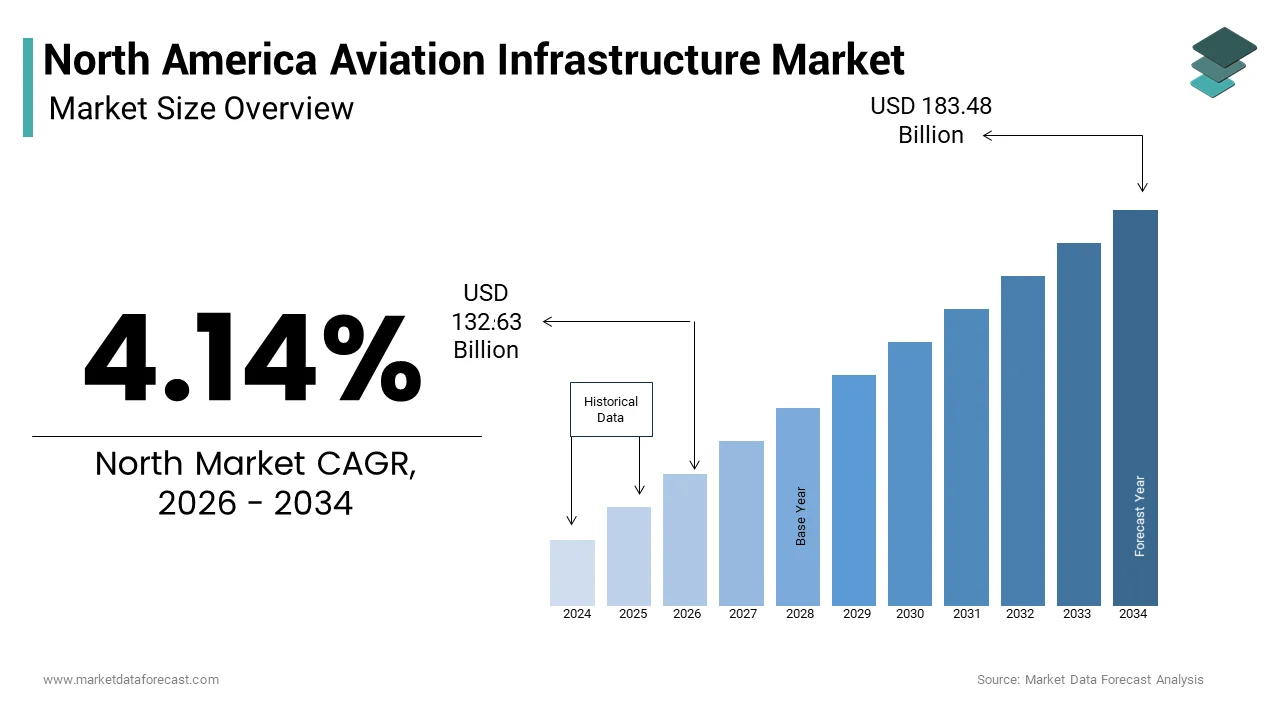
The airport infrastructure is an indicator of the country's economic prosperity. The airport connects people and the world economy. Adequate airport and land infrastructure are critical for financial development. It is necessary to develop aviation infrastructure so as not to impede the growth of the overall aviation market in any area, especially the busiest regions like North America.
MARKET DRIVERS
The North America Aviation Infrastructure plays a vital role in supporting economic development and long-term economic growth in all countries. Federal Aviation Administration (FAA) financing to improve airport infrastructure is also supporting the market growth.
This sector offers economic benefits by providing direct benefits to users and positively affecting the economy and productivity. Therefore, taking advantage of the flight infrastructure is essential to maintain the role of the aviation sector in the marketplace. In addition, the increase in existing airport expansion plans and the growing demand for smart airport construction are some of the key factors that support the growth of the North American Aviation Infrastructure market during the forecast period. As the number of air travellers, as well as airplanes, has increased dramatically, aircraft operators are under tremendous pressure when it comes to establishing control and handling of passengers. This primary factor led to the selection of a new plan that would help build the appropriate North America Aviation Infrastructure at present and in future.
A good aviation infrastructure will help to achieve the perfect balance between the airport, the plane and air traffic control. This is another reason to require most aircraft operators to build a modern and technically advanced aviation infrastructure. However, with the participation of the national government, the negative factors can be avoided very comfortably. Therefore, taking into account all the positive and negative aspects, the North America Aviation Infrastructure market is expected to grow slowly during the forecast period.
MARKET RESTRAINTS
Nevertheless, some factors can hinder the growth of the North America Aviation Infrastructure market. A few of those are the costs of technological changes and advances, the existing infrastructure and the new infrastructure. The rapid growth in terms of the number of passengers has caused some airports to face extreme problems with passenger handling.
REPORT COVERAGE
| REPORT METRIC | DETAILS |
| Market Size Available | 2025 to 2034 |
| Base Year | 2025 |
| Forecast Period | 2026 to 2034 |
| CAGR | 4.14% |
| Segments Covered | By Type, Application, and Country |
| Various Analyses Covered | Regional & Country Level Analysis, Segment-Level Analysis, DROC, PESTLE Analysis, Porter’s Five Forces Analysis, Competitive Landscape, Analyst Overview on Investment Opportunities |
| Countries Covered | The United States, Canada, Mexico, and Rest of North America |
| Market Leaders Profiled | Turner Construction Company, Hensel Phelps Construction Co, Austin Industries (Austin Commercial), Skanska AB, Aecom, Crisdel Group, Manhattan Construction Group Inc, Vecellio and Grogan, Inc., Clark Construction Group and VRH deployment |
SEGMENTAL ANALYSIS
By Application Insights
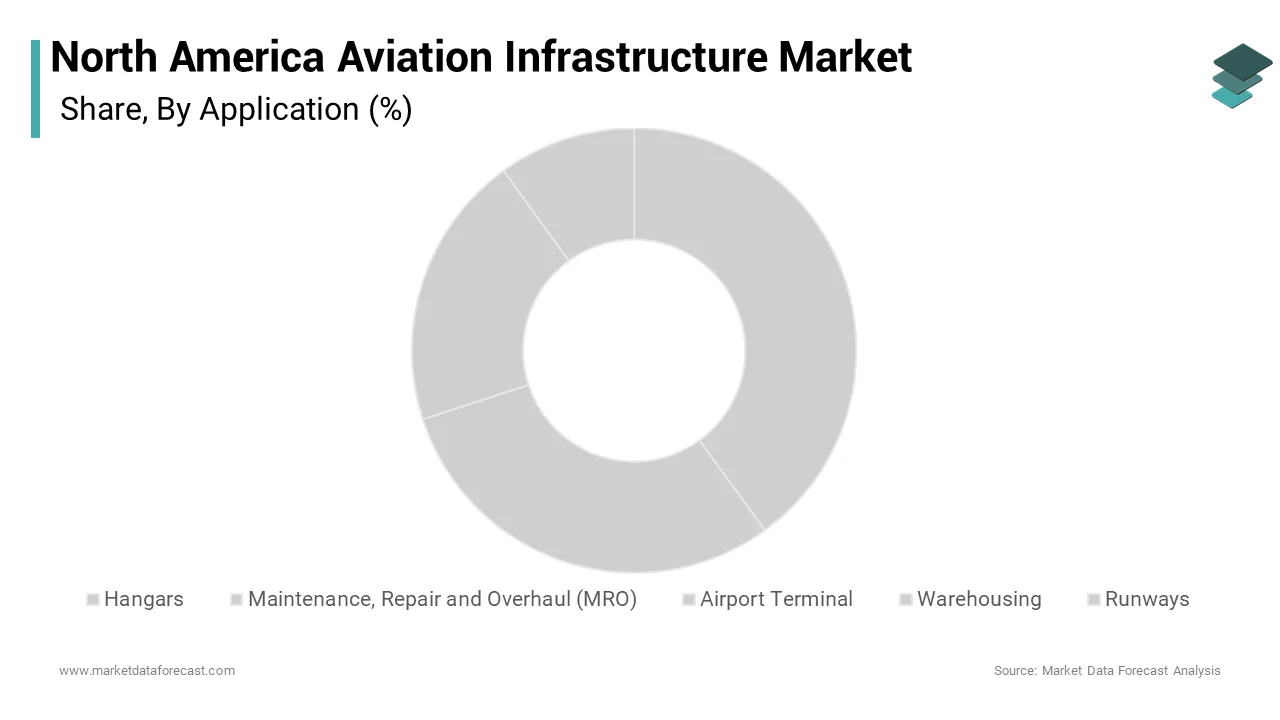
The North America aviation infrastructure market is divided into hangars, maintenance, repair and overhaul facilities (MRO), airport terminals, warehouses and airstrips. New airports are expected to be the most dominant part of the regional aviation infrastructure market and maintain this preference for the anticipated period as demand for international airports increases.
REGIONAL ANALYSIS
North America aviation infrastructure market dominated the global business in 2019, recording the highest CAGR during the forecast period. It is also foreseen to expand with a considerable growth rate in the anticipated period. The United States had a dominant share in the North American aviation infrastructure market in 2019. In particular, with respect to airports, the US aviation infrastructure will see significant growth in the coming years due to the growing demand of passengers. This situation is pressing officials to build new airports or modernize them. With the rise of air travel in the US, the construction of several airports, hangars, terminals and airstrips has increased, but North America is expected to lose some share in terms of market portion due to increasing growth of the aviation sector in the Asia Pacific region.
LEADING COMPANY
The DFW airport operator announced plans to build a new terminal that will be the sixth airport terminal. The construction of the new terminal is expected to be completed by 2026, with a cost of more than $ 3 billion.
KEY MARKET PLAYERS
The main players operating in the North America Aviation Infrastructure include
- Turner Construction Company
- Hensel Phelps Construction Co
- Austin Industries (Austin Commercial)
- Skanska AB
- Aecom
- Crisdel Group
- Manhattan Construction Group Inc
- Vecellio and Grogan, Inc.
- Clark Construction Group
- VRH deployment
RECENT MARKET NEWS
- In January 2016, construction of a new terminal will begin at the Louis Armstrong International Airport in New Orleans, which will be open to the public before the end of 2019.
- June 2018: The British government approved a plan to build a third runway at Heathrow International Airport. The new third runway will help improve Heathrow's ability to perform airport operations.
- April 2018: Sharjah airport officials finalized plans to build a new terminal at the airport. Also, the construction of a new airport terminal will help Sharjah International Airport increase its capacity to 25 million passengers in the near future.
MARKET SEGMENTATION
This research report on the North America aviation infrastructure market is segmented and sub-segmented into the following categories.
By Type
- Brownfield
- Greenfield
By Application
- Hangars
- Maintenance, Repair and Overhaul (MRO)
- Airport Terminal
- Warehousing
- Runways
By Country
- The United States
- Canada
- Rest of North America