- Product Description Description
- Table of Contents TOC
- List of Table & Figure LOT
- Get Free Sample PDF Sample PDF
Market Size, 2025
$441.91 BnMarket Estimate, 2026
$457.55 BnMarket Forecast, 2034
$604.38 BnCAGR, 2026–2034
3.54%Executive Summary: Global Aircraft Market
- Market Scope: Global analysis of the aircraft industry, covering commercial, military, and general aviation sectors, aircraft types, size classes, regional demand, and technological advancements.
- Market Valuation: Valued at USD 441.91 billion in 2025, reaching USD 457.55 billion in 2026, and projected to expand to USD 604.38 billion by 2034, growing at a steady CAGR of 3.54% during the forecast period from 2026 to 2034.
- Primary Growth Drivers: Post-pandemic recovery of passenger traffic, soaring defense expenditures driven by geopolitical tensions, and rising demand for fuel-efficient narrow-body fleets by low-cost carriers in emerging markets.
Key Market Segment Metrics
| Category | Leading Segment (Base Position) | Fastest-Growing / High-Growth Segment |
|---|---|---|
| By Type | Passenger Aircraft (held a dominant 55.7% share of the market in 2025, supported by recovering global air travel and growing middle-class populations) | Combat Aircraft (fastest-growing segment with a CAGR of 4.8%, propelled by rising national defense budgets and modern military fleet upgrades) |
| By Size | Narrow-Body Aircraft (captured 60.2% of the market in 2025, serving as the foundational backbone for low-cost carriers and domestic flights) | Wide-Body Aircraft (fastest-growing size segment with a CAGR of 5.1%, driven by expanding international long-haul travel networks) |
| By Region | North America (held 40.2% of the global share in 2025, anchored by major aerospace giants like Boeing and Lockheed Martin) | Asia-Pacific (fastest-growing regional market with a CAGR of 5.2%, fueled by rapid urbanization and massive airline fleet expansions) |
Major Market Players & Industry Landscape
Market Structure: Highly consolidated commercial manufacturing duopoly transitioning into a competitive ecosystem driven by emerging eVTOL innovators, defense contractors, and sustainable aviation technology developers.
Key Companies: Airbus SE, The Boeing Company, Lockheed Martin Corporation, Textron Inc., and Embraer S.A.
Global Aircraft Market Size
The global aircraft market size was valued at USD 441.91 billion in 2025 and is anticipated to reach USD 457.55 billion in 2026 to reach USD 604.38 billion by 2034, growing at a CAGR of 3.54% from 2026 to 2034.

The aircraft market is a fast-changing and complex industry that involves creating, building, selling, and using airplanes for different purposes like commercial flights, military use, and personal aviation. In 2023, this market is going through big changes because of new technologies, concerns about the environment, and what customers want. Despite problems like broken supply chains, changing fuel costs, and conflicts between countries, the aircraft market has stayed strong. The International Air Transport Association (IATA) says that air travel is bouncing back well in 2023, with passenger numbers reaching 85% of what they were before the pandemic, showing that the industry is growing again.
Commercial aviation is the biggest part of the market, as more people are flying, especially in growing countries like India and China. Airbus predicts in its Global Market Forecast 2023-2042 that over 39,000 new airplanes will be needed in the next 20 years to keep up with demand. At the same time, the military aircraft and business are also growing because countries are spending more on defense, according to a report by the Stockholm International Peace Research Institute (SIPRI). Another important change is the focus on making aviation greener. Companies like Rolls-Royce are working hard to develop cleaner technologies, such as electric and hybrid planes, with the goal of cutting carbon emissions to zero by 2050. All these trends show how important the aircraft market is for connecting the world, boosting economies, and protecting the environment.
MARKET DRIVERS
Urban Air Mobility and Advanced Air Transport Systems
Urban air mobility (UAM) is becoming a game-changer for the aircraft market. UAM uses special electric aircraft called eVTOLs, which can take off and land vertically, to carry people short distances in cities. These aircraft aim to solve problems like traffic jams and pollution. Companies like Joby Aviation and Lilium are leading the way, with over 200 eVTOL projects being developed worldwide, according to the Vertical Flight Society. The FAA is working on rules to safely add these aircraft to city skies. This new technology creates exciting opportunities for manufacturers while reducing the need for cars and buses. With more people moving to cities, expected to be 68% of the world’s population by 2050, as per the United Nations,s UAM offers a big chance for the aircraft industry to grow into new markets.
Rising Defense Expenditure and Geopolitical Tensions
Higher defense spending due to tensions between countries is driving growth in the aircraft market. Many nations are upgrading their military planes to improve security. According to SIPRI, global military spending hit $2.2 trillion in 2022, with a lot of money going toward buying advanced aircraft. In the U.S., the 2023 defense budget includes $47 billion just for aircraft, including advanced jets like the F-35. India also plans to spend $12 billion on fighter jets and helicopters over the next five years, as stated by its Ministry of Defence. These investments are increasing demand for military planes, benefiting companies like Lockheed Martin and Dassault Aviation.
MARKET RESTRAINTS
Environmental Concerns and Public Resistance to Air Travel
Concerns about the environment and people avoiding flights because of their carbon footprint are holding back the aircraft market. Air travel produces about 2.4% of the world’s CO2 emissions, according to the International Energy Agency (IEA). Campaigns like "flight shaming" encourage people to skip flying to reduce their environmental impact. A survey by Ipsos in 2023 found that 28% of Europeans are thinking about flying less due to these concerns. This trend is hurting demand for flights, especially in places where people care deeply about the environment. Airlines are under pressure to go green, but adopting cleaner technologies costs a lot of money.
Stringent Regulatory Frameworks and Certification Delays
Strict rules and delays in approving new aircraft are major obstacles for the aircraft market. Groups like the FAA and EASA set tough safety and environmental standards, which often slow down the launch of new planes. A report by KPMG shows it can take up to seven years to get approval for a new commercial aircraft, causing long delays before they reach the market. For example, Boeing faced big delays certifying its 777X plane, pushing deliveries past their planned dates, as reported by Reuters. These delays make development more expensive and make it harder for companies to meet customer demands quickly. New rules, such as those cutting noise or emissions, require constant design changes, adding complexity and costs. These challenges affect both big companies and new players trying to enter the aircraft market.
MARKET OPPORTUNITIES
Growth of Low-Cost Carriers in Emerging Markets
The rise of low-cost carriers (LCCs) in emerging markets is creating a big opportunity for the aircraft market. These airlines are becoming more popular because they offer cheap tickets, making it easier for more people to fly. According to the Centre for Aviation (CAPA), LCCs made up 35% of all airline capacity worldwide in 2023, with the Asia-Pacific region leading the way. Countries like India and Indonesia have seen huge growth in LCCs, with airlines like IndiGo and Lion Air becoming major players. The International Air Transport Association (IATA) predicts that passenger numbers in these regions will grow by 4.8% every year over the next 20 years. This trend is increasing demand for smaller, single-aisle planes like the Airbus A320 and Boeing 737, which are cheaper to operate and perfect for LCCs. As more people in these areas choose affordable flights, aircraft manufacturers can take advantage of this growing market.
Development of Autonomous Aircraft Technology
The development of autonomous aircraft technology is opening up exciting new opportunities for the aircraft market. Autonomous systems, such as drones and self-flying planes, are becoming more popular thanks to advancements in artificial intelligence and sensors. This growth is driven by uses in delivering goods, monitoring areas, and even transporting passengers. Companies like Amazon and DHL are already testing drones to deliver packages, while Airbus is working on self-flying features for commercial planes. The Federal Aviation Administration (FAA) is creating rules to safely add these systems into the skies. These innovations help reduce costs and make operations more efficient, which airlines and delivery companies love.
MARKET CHALLENGES
Rising Fuel Costs and Economic Uncertainty
Rising fuel costs and economic instability are major challenges for the aircraft market. Jet fuel makes up 20-30% of an airline’s expenses, according to the International Civil Aviation Organization (ICAO). In 2023, problems like conflicts between countries and supply chain issues caused fuel prices to go up sharply, squeezing airlines’ profits. At the same time, economic uncertainty caused by inflation and changing currency values has made people spend less on air travel. A report by Deloitte shows that 40% of airlines are struggling to stay profitable in this tough environment. These challenges are forcing airlines to delay buying new planes or retire old ones early, which hurts manufacturers’ sales. High fuel costs also push airlines to want more fuel-efficient planes, but switching to newer models costs a lot of money, adding to their financial stress.
Workforce Shortages and Skill Gaps
A lack of skilled workers is a big challenge for the aircraft market. The aviation industry needs many trained professionals, including pilots, engineers, and technicians, to keep growing. Boeing’s 2023 Pilot and Technician Outlook predicts that the world will need over 600,000 new pilots and 610,000 maintenance technicians in the next 20 years to handle the growing number of planes. However, training programs aren’t keeping up with this demand, especially in places like Africa and Southeast Asia. The International Labour Organization (ILO) points out that the problem is made worse by an aging workforce, as many experienced workers are close to retirement. This shortage delays plane deliveries and increases risks for airlines. Fixing this issue requires big investments in education and training, but progress is slow, threatening the industry’s long-term growth and stability.
REPORT COVERAGE
| REPORT METRIC | DETAILS |
| Market Size Available | 2025 to 2034 |
| Base Year | 2025 |
| Forecast Period | 2026 to 2034 |
| CAGR | 3.54% |
| Segments Covered | By Type, Size, and Region |
|
Various Analyses Covered | Global, Regional & Country Level Analysis, Segment-Level Analysis, DROC, PESTLE Analysis, Porter’s Five Forces Analysis, Competitive Landscape, Analyst Overview of Investment Opportunities |
| Regions Covered | North America, Europe, APAC, Latin America, Middle East & Africa |
| Market Leaders Profiled | The Boeing Company, Airbus SE, Lockheed Martin Corporation, Textron Inc., andEmbraer S.A. |
SEGMENT ANALYSIS
By Type Insights
The Passenger aircraft segment is the biggest part of the aircraft market by holding a 55.7% share in 2025. This segment is leading because more people around the world are flying. IATA predicts that the number of passengers will grow by 4% every year for the next 20 years. The growth is happening because more people are moving to cities, es and the middle class is growing in places like Asia-Pacific. Boeing says airlines will need 39,000 new commercial planes by 2042, and most of these will be passenger aircraft. These planes are very important because they connect people across the world, help tourism grow, and support economies. They can fly both short and long distances, making them very useful.
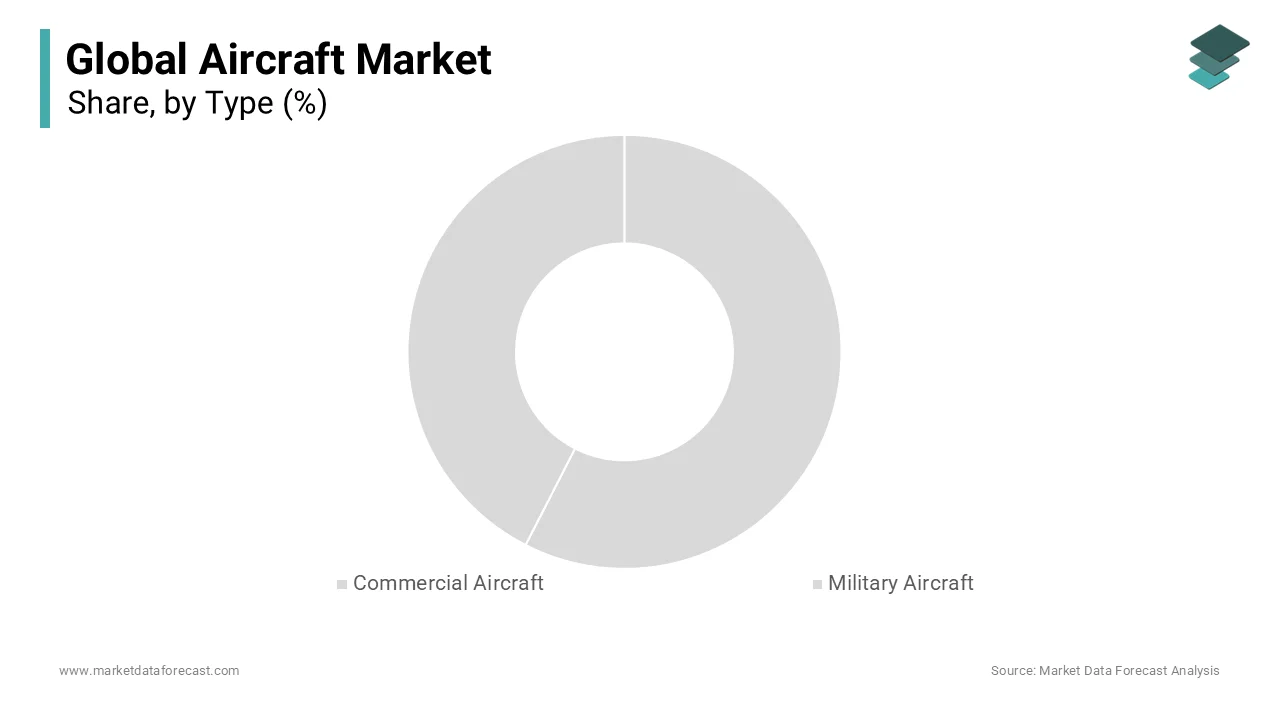
The combat aircraft segment is growing faster than any other, with a CAGR of 4.8% during the forecast period. This rise is happening because countries like the U.S., China, and India are spending more money on defense. The U.S. Department of Defense’s 2023 budget includes $47 billion just for buying new aircraft, including advanced fighter jets like the F-35. Combat aircraft are very important for keeping countries safe and fighting modern wars. They use advanced technologies like stealth and precision weapons. SIPRI reports that global military spending reached $2.2 trillion in 2022, which means there will be steady demand for combat aircraft. Their fast growth shows how important they are for national security and global politics.
By Size Insights
The narrow-body aircraft segment was the most popular type of plane, capturing a 60.2% share of the market in 2025. These planes are used for short and medium flights, making them perfect for low-cost airlines and domestic travel. The FAA says that narrow-body aircraft will make up 75% of all new planes delivered by 2042 because they are fuel-efficient and cheaper to operate. Airbus and Boeing lead this segment with models like the A320 and 737. Narrow-body aircraft are very important because they meet the rising demand for air travel, especially in growing markets like India and China. Their affordability and flexibility make them the foundation of global aviation, supporting both local and international travel.
The wide-body aircraft segment is the fastest-growing type of plane, with a CAGR of 5.1% because more people are traveling internationally, and airlines are adding more long-haul routes. Boeing predicts that airlines will need 7,200 new wide-body planes by 2042, worth $2.3 trillion. As people earn more money and the world becomes more connected, more travelers are flying long distances, creating demand for bigger planes. The International Civil Aviation Organization (ICAO) notes that international passenger traffic grew by 18% in 2023 compared to the previous year. Wide-body aircraft are essential for connecting continents and helping global trade grow, making them a key focus for airlines that want to expand their networks.
REGIONAL ANALYSIS
North America Market Analysis
North America was the biggest player in the aircraft market by holding 40.2% of the global share in 2025. The region is home to major companies like Boeing and Lockheed Martin, which are leaders in creating new and advanced aircraft. The FAA says that the number of commercial planes in the U.S. will grow by 32% by 2042, meaning airlines will need around 8,600 new planes. North America is also leading the way in making aviation greener by investing in sustainable aviation fuels (SAF). Its success comes from cutting-edge technology, strong rules for safety, and high demand from travelers. Because of this, North America plays a key role in shaping the future of aviation and remains the largest regional market.

Europe Market Analysis
Europe is a major player in the aircraft market and contributed 25.6% of the global share in 2025. Airbus, based in Europe, is a big competitor to Boeing and focuses on making aviation more sustainable, with a goal to cut emissions to zero by 2050. EASA reports that air traffic in Europe will return to pre-pandemic levels by 2024. Countries like France and Germany are important because they have advanced factories and invest heavily in research. Europe’s success comes from its skilled workers, modern technology, and focus on protecting the environment. With steady growth in both commercial flights and military aviation, Europe continues to be a key part of the global aircraft industry.
Asia Pacific Market Analysis
The Asia-Pacific region is growing faster than any other in the aircraft market, with an expected CAGR of 5.2% over the forecast period. This region will account for 45% of all new passengers globally during this time. Countries like China and India are leading the way, with airlines ordering thousands of new planes. Boeing predicts that the Asia-Pacific will need 17,000 new aircraft by 2042, worth $3.1 trillion. Governments are spending a lot on building better airports and using green technologies. The region’s rapid growth is due to more people moving to cities, a growing middle class, and supportive government policies. This makes Asia-Pacific a key hub for both commercial and military aviation.
Middle East And Africa Market Analysis
The Middle East is a strategic leader in the aircraft market because of its location as a global travel hub. While it has a smaller market share compared to North America and Asia-Pacific, its growth potential is huge. Boeing’s 2023 Market Outlook says the region will need 3,300 new planes by 2042, thanks to expanding international routes. Airlines like Emirates and Qatar Airways operate some of the largest fleets in the world, focusing on luxury flights and cargo services. Big investments in airports, like Dubai’s Al Maktoum International, show the region’s commitment to aviation growth. The Middle East’s leadership comes from its central location, booming tourism, and heavy investment in aviation infrastructure.
Latin America Market Analysis
Latin America is becoming an important player in the aircraft market. More people are flying because of economic growth and rising demand for air travel. Brazil is leading the region, with Embraer being one of the top aircraft manufacturers globally. Boeing estimates that Latin America will need 2,900 new planes by 2042, worth $350 billion. Low-cost airlines are adding more domestic and regional flights, making air travel affordable for more people. The region’s potential lies in its growing economy, urbanization, and efforts to improve regional connectivity. Latin America’s role in connecting North and South America makes it strategically important in the global aviation network.
COMPETITIVE LANDSCAPE
- The aircraft market is highly competitive, with companies constantly finding new ways to stand out. While we’ve discussed traditional competition like Boeing vs. Airbus, other fascinating angles are shaping the industry today. One emerging trend is the rise of smaller, niche players focusing on specific segments like electric aircraft or urban air mobility (UAM). For example, startups like Joby Aviation and Volocopter are challenging big companies by creating eVTOLs (electric vertical takeoff and landing vehicles) for short-distance travel. This shift is forcing giants like Boeing and Airbus to invest in similar technologies to avoid falling behind.
- Another unique aspect is the role of government policies and subsidies in influencing competition. Countries like China are heavily backing their domestic manufacturers, such as COMAC, by providing financial support and favorable regulations. This gives them an edge in pricing and regional dominance, especially in Asia-Pacific markets. Similarly, Europe’s focus on green aviation has pushed Airbus to lead in sustainable aircraft development, while U.S. companies benefit from strong defense contracts.
- Competition is also intensifying in the aftermarket services sector, which includes maintenance, repairs, and spare parts. Companies like GE Aviation and Rolls-Royce are expanding their service offerings to lock in long-term customer relationships. Data-driven tools, like predictive maintenance powered by AI, are becoming key differentiators here.
- Lastly, collaborations with tech firms are reshaping competition. Aircraft manufacturers are partnering with software companies to integrate advanced systems like autonomous flight controls and blockchain for supply chain transparency. These innovative strategies highlight how competition in the aircraft market goes beyond just building planes—it’s about adapting to new trends, technologies, and global dynamics.
KEY MARKET PLAYERS
The major players in the global aircraft market include the
- Boeing Company
- Airbus SE
- Lockheed Martin Corporation
- Textron Inc.
- Embraer S.A.
TOP PLAYERS IN THE MARKET
- Boeing is one of the largest and most influential players in the global aircraft market, contributing significantly to both commercial and military aviation. As of 2023, Boeing holds approximately 45% of the global commercial aircraft market share, according to its annual report. The company is renowned for its popular models like the 737 (narrow-body) and 787 Dreamliner (wide-body), which are widely used by airlines worldwide. Boeing also dominates the military aircraft segment with advanced fighter jets like the F-15EX and transport planes like the C-17 Globemaster III. In 2022, Boeing delivered over 480 commercial aircraft, highlighting its strong presence in the industry. The company’s focus on innovation, fuel efficiency, and sustainability ensures its leadership in shaping the future of aviation.
- Airbus is Boeing’s biggest competitor and a dominant force in the aircraft market, holding around 50% of the global commercial aircraft market share, as per its 2023 financial report. Headquartered in Europe, Airbus leads with its best-selling models like the A320 family (narrow-body) and the A350 (wide-body), which are favored for their fuel efficiency and passenger comfort. In 2022, Airbus delivered 661 commercial aircraft, surpassing Boeing’s numbers and solidifying its position as the top manufacturer globally. Airbus is also making strides in sustainable aviation, investing heavily in hydrogen-powered aircraft and eco-friendly technologies. Its contributions extend to the defense sector with military aircraft like the A400M Atlas and helicopters, further diversifying its portfolio.
- Lockheed Martin is a key player in the military aircraft segment, specializing in advanced combat and surveillance systems. While it doesn’t compete directly in the commercial aircraft market, its dominance in defense aviation is unmatched. Lockheed Martin’s F-35 Lightning II, a fifth-generation stealth fighter jet, is one of the most advanced and widely purchased military aircraft globally, with orders exceeding 3,000 units from multiple countries. According to the U.S. Department of Defense, Lockheed Martin received contracts worth over $70 billion in 2022, primarily for aircraft and aerospace systems. The company’s innovations in stealth technology, unmanned aerial vehicles (UAVs), and missile defense systems make it a critical contributor to global military aviation and national security.
TOP STRATEGIES USED BY THE KEY MARKET PARTICIPANTS
Emphasis on Urban Air Mobility (UAM) and eVTOL Development
Companies like Airbus and Boeing are investing heavily in urban air mobility (UAM) and electric vertical takeoff and landing (eVTOL) aircraft to tap into emerging markets. Airbus has launched its CityAirbus NextGen, a zero-emission eVTOL designed for urban passenger transport, while Boeing is collaborating with startups like Wisk Aero to develop autonomous air taxis. These initiatives align with the growing demand for sustainable urban transportation solutions. According to a report by Morgan Stanley, the UAM market could reach $1 trillion by 2040, making it a lucrative opportunity for manufacturers to diversify their portfolios and establish leadership in this nascent segment.
Partnerships with Space and Defense Innovators
Key players are expanding beyond traditional aviation by forming strategic partnerships in space exploration and advanced defense systems. For example, Lockheed Martin has partnered with NASA to develop the Orion spacecraft, which plays a critical role in deep-space missions. Similarly, Boeing is working on the Space Launch System (SLS) for lunar missions. By leveraging their aerospace expertise, these companies are positioning themselves at the forefront of the space economy, which is projected to grow to $1.4 trillion by 2030, according to Bank of America. This strategy not only strengthens their brand but also diversifies revenue streams beyond conventional aircraft manufacturing.
Adoption of Digital Twin Technology and Predictive Maintenance
Aircraft manufacturers are increasingly using digital twin technology to enhance aircraft design, production, and maintenance processes. Airbus has implemented digital twins to simulate aircraft performance and optimize fuel efficiency, reducing operational costs for airlines. Similarly, Boeing uses predictive maintenance tools powered by artificial intelligence (AI) to monitor aircraft health in real-time, minimizing downtime and improving safety. A study estimates that the predictive maintenance market will grow to $23 billion by 2028, highlighting the importance of this strategy in enhancing customer satisfaction and operational efficiency.
RECENT MARKET NEWS
- In September 2024, Chinese aircraft manufacturer COMAC was reported to be in discussions with Brazilian airline Total Linhas Aéreas for the sale of up to four C919 jets. This potential deal could mark COMAC's first entry into the Western airline market, positioning the C919 as a competitor to the Airbus A320 and Boeing 737 MAX.
- In June 2024, the European Space Agency (ESA) signed contracts with European companies to develop a commercial space cargo return service. This initiative is a first step towards a cargo service to and from space stations in low Earth orbit, such as the International Space Station.
MARKET SEGMENTATION
This research report on the global aircraft market is segmented and sub-segmented into the following categories.
By Type
- Commercial Aircraft
- Passenger Aircraft
- Freighter
- Military Aircraft
- Combat Aircraft
- Non-Combat Aircraft
By Size
- Narrow Body Aircraft
- Wide Body Aircraft
By Region
- North America
- Europe
- Asia-Pacific
- Latin America
- Middle East and Africa