- Product Description Description
- Table of Contents TOC
- List of Table & Figure LOT
- Get Free Sample PDF Sample PDF
Market Size, 2025
$12.02 BnMarket Estimate, 2026
$12.48 BnMarket Forecast, 2034
$16.88 BnCAGR, 2026–2034
3.85%North America Beverage Refrigeration Market Size
The Beverage refrigeration market size in North America was valued at USD 12.02 billion in 2025 and is predicted to be worth USD 16.88 billion by 2034 from USD 12.48 billion in 2026 and grow at a CAGR of 3.85% from 2026 to 2034.
Beverage refrigeration refers to the systems designed to preserve and display beverages at optimal temperatures across commercial and residential environments. This includes walk-in coolers, reach-in units, merchandisers, and undercounter refrigerators used by restaurants, convenience stores, supermarkets, and bars. The market is shaped by evolving consumer preferences for ready-to-drink beverages, craft sodas, and functional drinks, as well as rising standards for food safety and energy efficiency. In parallel, rapid urbanization and an increase in retail footprints have driven the need for high-performance, scalable refrigeration infrastructure. The integration of smart technologies and IoT-enabled monitoring systems has further transformed the operational landscape of beverage cooling solutions in North America, enabling remote diagnostics, predictive maintenance, and real-time temperature control.
 MARKET DRIVERS
Rising Consumption of Ready-to-Drink (RTD) Beverages
The growing consumer preference for ready-to-drink beverages such as iced teas, energy drinks, flavored waters, and cold brew coffee has significantly fueled the demand for advanced beverage refrigeration systems. These products require consistent cold chain storage and display capabilities to maintain freshness and appeal. Additionally, the expansion of premium beverage segments, including organic and functional drinks, necessitates precise temperature regulation, which enhances the reliance on technologically advanced refrigeration units. The proliferation of grab-and-go retail formats and micro-fulfillment centers has also amplified the deployment of compact yet efficient beverage chillers. This sustained consumer-driven demand underscores the critical role of refrigeration in preserving product integrity and supporting evolving retail dynamics in North America.
Stringent Food Safety and Energy Efficiency Regulations
Regulatory mandates aimed at ensuring food safety and promoting energy conservation have become pivotal in shaping the North American beverage refrigeration landscape. The U.S. Food and Drug Administration's Food Code emphasizes that potentially hazardous foods and beverages must be stored at or below 41°F to prevent microbial growth. This regulatory framework necessitates the adoption of reliable and certified refrigeration systems that maintain consistent temperatures. The regulations not only ensure compliance but also drive manufacturers to innovate in insulation materials, compressor efficiency, and intelligent defrost cycles. Retailers and foodservice providers are increasingly investing in eco-friendly refrigeration systems to align with sustainability goals and reduce operational costs, thereby accelerating market growth.
MARKET RESTRAINTS
High Initial Capital Investment and Maintenance Costs
The substantial upfront cost associated with commercial beverage refrigeration systems presents a significant barrier to market penetration, particularly for small and medium-sized enterprises. Additionally, ongoing maintenance costs, including compressor replacements, refrigerant leaks, and door seal repairs, contribute to the total cost of ownership. Labor shortages in the HVAC and refrigeration technician sector have further escalated repair costs, with hourly rates high in many metropolitan areas. For franchise chains and convenience store operators managing thin profit margins, these financial burdens often delay system upgrades or lead to the continued use of outdated, inefficient units, thereby constraining overall market expansion.
Environmental Concerns and Refrigerant Regulations
Environmental regulations targeting hydrofluorocarbon (HFC) refrigerants have imposed significant compliance challenges on manufacturers and end-users within the North American beverage refrigeration market. Furthermore, the flammability and toxicity risks associated with some alternative refrigerants raise safety concerns among operators, particularly in densely populated urban areas. The complexity of transitioning to compliant systems, coupled with the lack of standardized retrofitting protocols, has created hesitancy among smaller stakeholders, thereby slowing down market-wide adoption and innovation.
MARKET OPPORTUNITIES
Integration of IoT and Smart Technologies
The integration of Internet of Things (IoT) and smart technologies in beverage refrigeration systems presents a transformative growth opportunity for the North American market. Smart refrigeration units equipped with sensors, cloud connectivity, and AI-driven analytics enable real-time temperature monitoring, predictive maintenance, and energy optimization. Retailers are increasingly leveraging these systems to reduce food waste, enhance operational efficiency, and improve customer experience. Similarly, convenience store chains like 7-Eleven have deployed smart merchandisers that adjust lighting and cooling based on foot traffic patterns, resulting in energy savings. This digital transformation not only aligns with sustainability goals but also opens avenues for value-added services such as remote diagnostics and automated inventory tracking, thereby enhancing vendor-customer relationships.
Expansion of Cold Chain Infrastructure for E-Commerce
The exponential growth of e-commerce and direct-to-consumer beverage delivery services has created a surge in demand for robust cold chain infrastructure, presenting a lucrative opportunity for the North American beverage refrigeration market. This shift has necessitated investments in temperature-controlled warehouses, last-mile delivery vehicles, and portable refrigeration solutions to ensure product integrity during transit. Companies like Drizly and Instacart have expanded their cold storage fleets, incorporating modular refrigeration units that maintain beverage quality across varying delivery zones. Moreover, the rise of subscription-based beverage services, such as monthly craft soda or kombucha deliveries, has intensified the need for scalable refrigeration assets that support both bulk storage and individual packaging. This evolving logistics ecosystem not only drives demand for industrial-grade refrigeration systems but also spurs innovation in lightweight, energy-efficient units tailored for mobile and decentralized distribution networks.
MARKET CHALLENGES
Supply Chain Disruptions and Component Shortages
The North American beverage refrigeration market continues to grapple with persistent supply chain disruptions and component shortages, particularly in the wake of global geopolitical tensions and semiconductor shortages. Key components such as compressors, electronic controls, and insulation materials have experienced extended lead times and price volatility. The reliance on global suppliers, particularly in Asia, has exacerbated vulnerabilities, as shipping delays and port congestion have disrupted inventory replenishment cycles. Furthermore, the lingering effects of the pandemic, including labor shortages at manufacturing hubs and freight constraints, have hindered the timely delivery of custom-engineered units. These challenges have not only inflated project costs but also delayed facility expansions and equipment upgrades, particularly in high-demand sectors such as convenience retail and foodservice, thereby constraining short-term market momentum.
Workforce Shortage in Skilled Refrigeration Technicians
The acute shortage of skilled technicians capable of installing, maintaining, and repairing advanced refrigeration systems is a critical bottleneck facing the North American beverage refrigeration market. The deficit is particularly pronounced in the refrigeration segment, where specialized knowledge of refrigerant handling, electrical systems, and digital diagnostics is essential. The demographic imbalance has led to increased labor costs and longer service turnaround times. The complexity of modern systems, which often integrate IoT sensors and variable-speed compressors, further necessitates ongoing training and certification, which many smaller firms cannot afford. Without strategic workforce development initiatives, including apprenticeships and vocational training programs, the market risks operational inefficiencies and service quality degradation.
REPORT COVERAGE
| REPORT METRIC | DETAILS |
| Market Size Available | 2025 to 2034 |
| Base Year | 2025 |
| Forecast Period | 2026 to 2034 |
| CAGR | 3.85% |
| Segments Covered | By Product Type, Capacity, Temperature Range, Installation Type, Application, and Region |
|
Various Analyses Covered | Regional & Country Level Analysis, Segment-Level Analysis, DROC, PESTLE Analysis, Porter’s Five Forces Analysis, Competitive Landscape, Analyst Overview on Investment Opportunities |
| Regions Covered | The United States, Canada, Mexico, and Rest of North America |
| Market Leaders Profiled | Carrier, Danfoss, Haier Inc., Hoshizaki Corporation, Whirlpool Corporation, Electrolux, Illinois Tool Works, True Manufacturing Co., Inc., Turbo Air Inc., and Lennox International Inc, and others |
SEGMENTAL ANALYSIS
By Product Type Insights
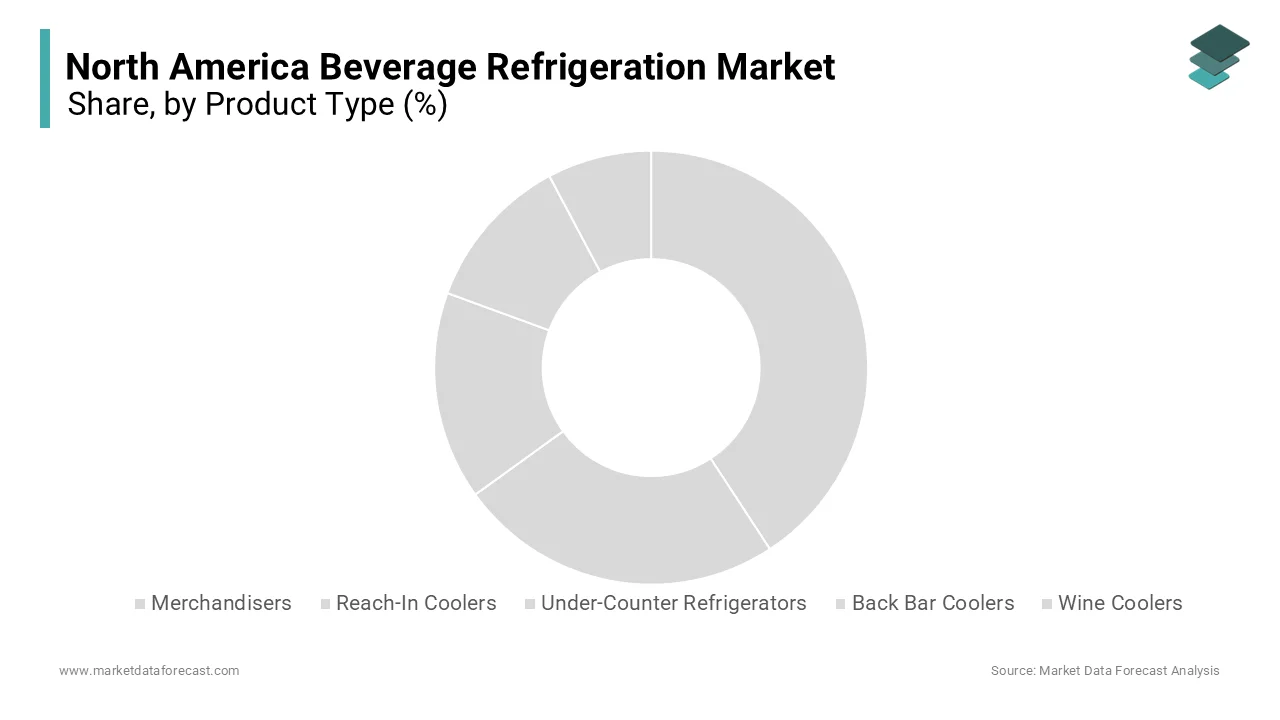
The merchandisers segment was the prominent force in the North American beverage refrigeration market by commanding approximately 35% of the total market share as of 2023. This segment's supremacy is due to its critical role in retail environments where visual appeal and product accessibility drive consumer purchasing decisions. The extensive deployment of merchandisers in convenience stores, supermarkets, and gas stations has been fueled by the exponential growth in beverage variety and the need for prominent product display.
The transformation of retail environments toward experiential shopping has made merchandisers indispensable for beverage retailers seeking to maximize sales through strategic product presentation. Modern merchandisers incorporate LED lighting, digital displays, and adjustable shelving systems that enhance product visibility and consumer engagement. The integration of smart glass technology and interactive displays has increased average unit values compared to traditional models. Beverage manufacturers are increasingly partnering with retailers to customize merchandising solutions that showcase their products effectively, driving demand for sophisticated units. Coca-Cola's investment in self-service fountain merchandisers with customizable flavor options has resulted in higher sales conversion rates in pilot locations. The emphasis on brand storytelling through refrigeration equipment has transformed merchandisers from mere storage units to marketing tools, compelling retailers to upgrade their fleets regularly.
The unprecedented expansion of convenience store chains and the growing preference for immediate consumption have significantly propelled the merchandiser segment's dominance in North America. The emergence of micro-fulfillment centers and dark stores for e-commerce operations has created additional demand for compact merchandising solutions. Companies like 7-Eleven and Circle K have standardized on high-capacity merchandisers that can accommodate diverse beverage categories while maintaining optimal temperatures. The shift toward healthier beverage options, including cold-pressed juices and functional drinks, has increased the need for specialized merchandising units that preserve product integrity. Urbanization trends have accelerated convenience store proliferation, with new locations opening at a rate of 1,200 annually across North America, each requiring multiple merchandisers to meet consumer expectations for immediate availability.
The wine cooler segment is experiencing the most rapid growth in the North American beverage refrigeration market and is projected to expand at a CAGR of 8.9% through 2034. This accelerated growth trajectory reflects changing consumer preferences toward premium wine consumption and the increasing sophistication of home entertaining practices. The escalating preference for premium wine varieties and the transformation of home spaces into entertainment hubs have catalyzed unprecedented demand for specialized wine cooling solutions across North America. The proliferation of direct-to-consumer wine shipping services has increased household wine inventories, necessitating proper storage conditions to preserve quality. Luxury real estate developers are increasingly incorporating built-in wine coolers as standard features in high-end residential properties. The rise of virtual wine tasting events during and post-pandemic periods has normalized home wine consumption, encouraging investments in temperature-controlled storage solutions. Celebrity chefs and lifestyle influencers have further popularized wine coolers through social media endorsements, creating aspirational value that transcends functional utility.
Advanced technological developments in wine cooler design, particularly dual-zone temperature control and vibration-dampening systems, have revolutionized consumer perceptions and accelerated market adoption rates. Modern wine coolers now feature independent temperature zones that can maintain red wines at 55-65°F while preserving white wines at 45-50°F simultaneously, addressing previously unmet consumer needs. The integration of IoT connectivity allows remote monitoring and smartphone control. Energy efficiency improvements have made wine coolers more attractive to environmentally conscious consumers. Premium manufacturers like Sub-Zero and Viking have introduced customizable wine storage solutions that integrate seamlessly with kitchen cabinetry. The development of thermoelectric cooling technology has eliminated vibration concerns associated with traditional compressor systems, ensuring optimal wine aging conditions and justifying higher price points in the luxury segment.
By Capacity Insights
The 5 to 10 cubic feet capacity segment dominated the North American beverage refrigeration market by accounting for a 42.5% of total share in 2025. This segment's preeminence is due to its optimal balance between storage capacity and spatial efficiency, making it the preferred choice for small to medium-sized commercial establishments and residential applications. Units within this capacity range typically serve restaurants, bars, cafes, and home entertainment spaces where moderate beverage storage needs must be met without excessive space consumption. The versatility of 5-10 cubic feet units allows them to accommodate diverse beverage categories while fitting seamlessly into standard commercial kitchen layouts and residential settings.
The dramatic expansion of small-scale foodservice operations, including food trucks, pop-up restaurants, and artisanal cafes, has created substantial demand for mid-capacity beverage refrigeration units that optimize space utilization while meeting operational requirements. Food truck operators, who constitute a rapidly growing segment across the United States, predominantly utilize 5-10 cubic feet beverage coolers due to vehicle space constraints and mobility requirements. The rise of ghost kitchens and virtual restaurant concepts has further amplified demand for space-efficient refrigeration systems that can accommodate multiple beverage SKUs within limited square footage. Craft brewery taprooms and specialty coffee shops often operate in converted retail spaces where traditional large-capacity units are impractical, making mid-range coolers essential for maintaining diverse beverage inventories.
The transformation of residential kitchens into multifunctional entertainment and lifestyle spaces has driven significant demand for 5-10 cubic feet beverage refrigeration units that complement modern home design while providing adequate storage capacity. The integration of beverage refrigeration into kitchen islands and entertainment areas has created demand for units that blend aesthetic appeal with practical storage capabilities. The popularity of home brewing and craft beverage consumption has increased the need for specialized storage that maintains optimal conditions for various beverage types. Luxury appliance manufacturers have responded by developing designer series coolers that match high-end kitchen cabinetry, commanding premium prices that have contributed to the segment's revenue dominance. The trend toward multi-generational living and home entertaining has made beverage accessibility a priority for homeowners, further supporting adoption of this capacity range.
The above 20 cubic feet capacity segment represents the fastest-growing category in the North American beverage refrigeration market and is projected to expand at a CAGR of 9.2% through 2034. This remarkable growth trajectory reflects the increasing scale of commercial beverage operations and the evolving needs of large-format retail and hospitality establishments. Units exceeding 20 cubic feet serve institutional settings, large restaurants, hotel chains, and wholesale beverage distributors that require substantial storage capacity to support high-volume operations. The segment's acceleration is driven by the expansion of craft brewery taprooms, sports venues, and corporate catering facilities that demand extensive beverage inventories while maintaining precise temperature control.
The explosive growth of the craft brewing industry across North America has created unprecedented demand for large-capacity beverage refrigeration systems that can accommodate extensive beer inventories and support direct-to-consumer sales operations. Taproom operations typically require 25-40 cubic feet beverage coolers to maintain diverse beer selections while ensuring optimal serving temperatures, driving significant equipment investments. Large-scale craft breweries expanding their production capabilities often install walk-in coolers supplemented by oversized reach-in units to manage raw materials, finished products, and seasonal inventory variations. The trend toward year-round beer gardens and outdoor beer festivals has created additional demand for portable large-capacity units that can support high-volume events. Regional brewery collaborations and beer distribution networks increasingly rely on centralized storage facilities equipped with industrial-grade refrigeration systems exceeding 20 cubic feet.
The construction and renovation of large-scale sports venues, entertainment complexes, and hospitality facilities across North America has generated substantial demand for oversized beverage refrigeration systems that can support massive crowd-serving operations. Modern stadiums and arenas typically install 40-80 cubic feet beverage coolers in concession areas to maintain diverse beverage selections while supporting peak demand periods during events. The trend toward premium seating experiences and all-inclusive hospitality packages has increased the need for specialized refrigeration systems that can store premium beverages and maintain brand presentation standards. Corporate catering facilities serving large conferences and events invest heavily in oversized units to pre-stock beverages for multi-day functions, with average installations ranging from 30-50 cubic feet per venue. Theme parks and entertainment destinations require redundant large-capacity systems to ensure continuous beverage availability during extended operating hours. The integration of mobile beverage carts and kiosks in large venues has created demand for centralized storage hubs that can supply multiple dispensing points simultaneously, necessitating industrial-scale refrigeration solutions.
By Temperature Range Insights
The 0 to 5 degrees Celsius temperature range segment dominates the North American beverage refrigeration market BY capturing 45.3% of the total share in 2025. This temperature zone represents the optimal storage conditions for the majority of commercially available beverages, including carbonated soft drinks, bottled water, energy drinks, and most alcoholic beverages. The prevalence of this segment stems from the universal requirement for chilled beverage preservation across diverse retail and foodservice environments. Units operating within this temperature range serve as the backbone of beverage storage infrastructure in convenience stores, restaurants, supermarkets, and institutional settings where maintaining product freshness and consumer appeal is paramount.
The 0 to 5 degrees Celsius temperature range represents the gold standard for preserving the quality, taste, and safety of diverse beverage categories consumed across North American markets, making it the default choice for manufacturers and retailers. The proliferation of functional beverages, including probiotic drinks and vitamin-enhanced waters, has increased the importance of precise temperature control to maintain active ingredient stability. The standardization of beverage distribution networks around this temperature range has created economies of scale that benefit manufacturers, distributors, and retailers through simplified logistics and reduced operational complexity.
Consumer expectations for consistently chilled beverages at the point of purchase and consumption have established the 0 to 5 degrees Celsius range as the industry standard for commercial beverage refrigeration across North American markets. The convenience store sector, relies entirely on this temperature range to meet consumer expectations for immediate consumption. The rise of grab-and-go retail formats has intensified the need for reliable temperature maintenance throughout the supply chain, from distribution centers to point-of-sale displays.
The 5 to 10 degrees Celsius temperature range segment is experiencing the most rapid growth in the North American beverage refrigeration market and is projected to expand at a CAGR of 10.1% through 2034. This accelerated growth reflects the increasing popularity of craft beverages, including certain wines, ciders, and specialty cocktails that require slightly elevated storage temperatures to preserve their nuanced characteristics. The segment's expansion is driven by the sophistication of North American beverage consumption patterns and the growing appreciation for artisanal products that demand precise temperature management.
The meteoric rise of craft cider production and consumption across North America has created substantial demand for specialized refrigeration systems that maintain optimal storage conditions between 5-10°C, supporting the delicate flavor profiles of these artisanal beverages. Traditional European cider varieties, which constitute a growing segment of imports, require storage temperatures between 7-10°C to maintain their authentic flavor profiles, driving demand for specialized refrigeration equipment. The emergence of hybrid beverage categories, including wine-cider blends and fruit-infused craft beers, has expanded the need for flexible temperature management solutions that can accommodate diverse product requirements. The proliferation of cider houses and tasting rooms across North America has created additional demand for commercial-grade units that can showcase multiple varieties while maintaining proper storage conditions. Craft beverage producers investing in direct-to-consumer sales channels require reliable refrigeration systems that can preserve product quality during extended storage periods, supporting the segment's growth trajectory.
The growing sophistication of North American wine consumption and the increasing demand for premium wine storage solutions have accelerated adoption of 5-10°C refrigeration systems that provide optimal conditions for specific wine varieties and aging processes. The trend toward home wine collecting and cellar development has increased demand for residential wine coolers that operate within this temperature range. Restaurant wine programs have evolved to include extensive selections of temperature-sensitive varietals, requiring specialized storage that maintains proper conditions without over-chilling delicate wines. The rise of natural and biodynamic wines, which are particularly sensitive to temperature fluctuations, has created demand for precise refrigeration systems that can maintain consistent conditions throughout storage periods. The expansion of wine subscription services and direct-to-consumer wine clubs has increased household wine inventories, necessitating proper storage solutions that maintain optimal conditions for extended periods.
REGIONAL ANALYSIS
United States
The United States represented the dominant force in the North American beverage refrigeration market by commanding a 87.5% of the total regional share in 2025. This overwhelming market position stems from the country's vast commercial infrastructure, diverse beverage consumption patterns, and sophisticated retail landscape that demands extensive refrigeration capabilities. The United States' beverage refrigeration market is characterized by high technological adoption rates, stringent regulatory compliance requirements, and significant investment in energy-efficient solutions that reflect broader sustainability trends. The market's maturity is evident in its comprehensive distribution networks, established manufacturing base, and robust service infrastructure that supports both large-scale commercial operations and residential applications.
The United States' position as the largest market participant is fundamentally supported by its extensive network of quick-service restaurants and convenience stores that require sophisticated beverage refrigeration infrastructure to support daily operations and consumer demand. Each quick-service location typically operates 6-10 beverage coolers to maintain diverse drink selections while ensuring optimal serving temperatures, creating substantial equipment demand. Franchise expansion continues at an accelerated pace, with major chains opening several new locations annually, each requiring complete beverage refrigeration setup investments. The integration of self-service beverage stations and customizable drink options has increased the complexity and quantity of refrigeration equipment required per location. Regional variations in climate and consumer preferences have created demand for specialized units that can maintain consistent temperatures in diverse environmental conditions, supporting the market's technological sophistication and revenue generation capacity.
The United States' leadership position in the beverage refrigeration market is reinforced by its early adoption of smart technologies and IoT-enabled refrigeration solutions that enhance operational efficiency and support sustainability initiatives. The integration of artificial intelligence and machine learning algorithms has improved temperature consistency while reducing energy consumption. Smart refrigeration systems equipped with occupancy sensors and adaptive cooling technologies have become standard in new commercial developments, driving premium pricing and supporting market revenue growth. The emphasis on food safety compliance has accelerated adoption of temperature logging and remote monitoring capabilities that provide continuous verification of storage conditions. Technology partnerships between major equipment manufacturers and software providers have created comprehensive ecosystem solutions that integrate with broader facility management platforms, establishing the United States as a technology leader in commercial refrigeration applications.
Canada
Canada holds a key position in the North American beverage refrigeration market. The Canadian market's distinctive characteristics include rigorous energy efficiency standards, cold climate adaptations, and unique regulatory requirements that shape equipment specifications and performance expectations. Canada's beverage refrigeration sector demonstrates strong growth potential driven by expanding retail networks, increasing craft beverage production, and heightened consumer awareness of food safety standards. The market benefits from proximity to major U.S. manufacturers while maintaining distinct regional preferences that influence product development and distribution strategies.
Canada's significant market position is largely attributed to its comprehensive regulatory framework that mandates high energy efficiency standards and environmental compliance for commercial refrigeration equipment, driving demand for advanced beverage cooling solutions. The Pan-Canadian Framework on Clean Growth and Climate Change has established ambitious carbon reduction targets that necessitate the adoption of low-global warming potential refrigerants and energy-efficient technologies in commercial applications. Provincial initiatives, particularly in British Columbia and Ontario, offer substantial rebates and incentives for businesses upgrading to ENERGY STAR certified beverage refrigeration systems. The integration of smart controls and variable-speed compressors has become standard practice in Canadian installations, supporting the country's leadership in sustainable refrigeration technology adoption.
Canada's robust market position is significantly strengthened by the rapid expansion of domestic craft beverage production and the growth of tourism-related hospitality sectors that require specialized beverage refrigeration infrastructure. The legalization and expansion of cannabis beverage production has created entirely new market segments requiring specialized refrigeration systems that maintain product integrity and comply with regulatory storage requirements. Provincial tourism initiatives have emphasized local beverage experiences. The integration of craft distilleries and cidery operations has created demand for multi-temperature refrigeration systems that can accommodate various beverage types while maintaining optimal storage conditions. Regional preferences for locally produced beverages have accelerated the development of micro-distribution networks that require compact yet efficient refrigeration solutions for last-mile delivery and retail support operations.
KEY MARKET PLAYERS AND COMPETITIVE LANDSCAPE
Key players in the North America beverage refrigeration market are Carrier, Danfoss, Haier Inc., Hoshizaki Corporation, Whirlpool Corporation, Electrolux, Illinois Tool Works, True Manufacturing Co., Inc., Turbo Air Inc., and Lennox International Inc.
The North American beverage refrigeration market exhibits intense competitive dynamics characterized by the presence of established multinational corporations alongside specialized regional manufacturers and emerging technology-focused startups. Market leaders leverage their extensive distribution networks, brand recognition, and financial resources to maintain dominant positions while continuously innovating to address evolving customer requirements. The competitive landscape is marked by strategic acquisitions and partnerships that enable companies to expand their product portfolios and geographic reach. Pricing pressures persist as customers increasingly demand value-added features and services while maintaining cost-effectiveness. Differentiation strategies focus on energy efficiency, smart technology integration, and customized solutions that address specific industry segments. The market's maturity has led to consolidation trends where larger players acquire smaller competitors to strengthen their market positions and eliminate competition. Innovation cycles are accelerating as participants invest in research and development to incorporate advanced materials, digital technologies, and sustainable practices. Customer relationships are becoming increasingly important as switching costs rise and equipment complexity increases. Service capabilities and technical support have emerged as critical competitive factors alongside product performance and reliability.
TOP PLAYERS IN THE MARKET
True Manufacturing Company
True Manufacturing stands as a leading innovator in commercial refrigeration solutions, specializing in high-performance beverage cooling equipment for foodservice and retail applications. The company's commitment to energy efficiency and sustainable manufacturing practices has positioned it as a preferred supplier for major restaurant chains and institutional buyers. True's extensive product portfolio includes walk-in coolers, reach-in units, and specialized beverage dispensing systems that meet stringent food safety standards. Their engineering expertise in temperature control technology and compressor optimization has enabled them to develop solutions that reduce operational costs while maintaining superior product preservation. The company's strong distribution network and customer service infrastructure have facilitated widespread adoption across North American markets, establishing long-term partnerships with key industry players.
Hussmann Corporation
Hussmann Corporation represents a cornerstone of commercial refrigeration excellence, delivering comprehensive beverage cooling solutions tailored for retail environments and foodservice operations. The company's engineering capabilities encompass custom-designed merchandising systems that combine aesthetic appeal with functional efficiency. Hussmann's focus on smart refrigeration technology integration has enabled retailers to optimize energy consumption while enhancing customer experience through advanced display capabilities. Their commitment to research and development has resulted in innovative solutions addressing evolving retail formats and consumer preferences. The corporation's extensive service network and technical support capabilities have strengthened customer relationships and ensured consistent equipment performance. Hussmann's collaborative approach with major retail chains has facilitated the development of customized solutions that drive sales while maintaining operational efficiency.
Veridicus Refrigeration
Veridicus Refrigeration has emerged as a technology-driven leader in intelligent beverage refrigeration systems, specializing in IoT-enabled solutions that transform traditional cooling equipment into smart, connected assets. The company's expertise in remote monitoring and predictive maintenance technologies has revolutionized how commercial operators manage their refrigeration infrastructure. Their focus on data analytics and machine learning algorithms enables proactive system optimization and energy management. Veridicus has pioneered cloud-based platform integration that provides real-time insights into equipment performance and environmental conditions. The company's commitment to sustainability is evident through their development of eco-friendly refrigerants and energy-efficient designs that support corporate sustainability initiatives. Their innovative approach to user interface design and mobile application development has enhanced operational accessibility for facility managers and maintenance personnel.
TOP STRATEGIES USED BY KEY PLAYERS
Technology Integration and Smart Connectivity Leading manufacturers in the North American beverage refrigeration market are aggressively pursuing technology integration strategies that transform traditional cooling equipment into intelligent, connected systems. This approach involves incorporating IoT sensors, cloud connectivity, and advanced analytics capabilities that enable real-time monitoring and predictive maintenance. Companies are developing proprietary software platforms that provide comprehensive equipment management solutions, allowing operators to optimize performance and reduce downtime. The integration of artificial intelligence and machine learning algorithms enhances temperature control precision while adapting to environmental conditions and usage patterns. This strategic focus on digital transformation not only improves operational efficiency but also creates new revenue streams through subscription-based service models and data analytics offerings.
Sustainability and Energy Efficiency Focus Market participants are implementing comprehensive sustainability strategies that emphasize energy efficiency improvements and environmental compliance. This involves developing equipment with advanced insulation materials, variable-speed compressors, and optimized heat exchange systems that significantly reduce energy consumption. Companies are investing heavily in research and development to transition to low-global warming potential refrigerants while maintaining performance standards. The focus extends to manufacturing processes, where participants are implementing circular economy principles through recycling programs and sustainable material sourcing. Strategic partnerships with utility companies and government agencies facilitate the development of incentive programs that accelerate adoption of energy-efficient solutions. This sustainability focus not only addresses regulatory compliance requirements but also appeals to environmentally conscious customers seeking to reduce their carbon footprint.
Customization and Modular Design Innovation Key players are pursuing customization strategies that address diverse customer requirements through modular design approaches and flexible configuration options. This involves developing standardized platforms that can be easily adapted to specific application requirements, reducing lead times and manufacturing costs. Companies are investing in design engineering capabilities that enable rapid prototyping and customer-specific modifications without compromising quality or performance. The modular approach facilitates scalable solutions that can accommodate business growth and changing operational needs. Strategic partnerships with end-users during the design phase ensure that equipment specifications align with actual usage requirements and environmental conditions. This customization strategy enhances customer satisfaction while creating competitive differentiation through tailored solutions that optimize space utilization and operational efficiency.
RECENT HAPPENINGS IN THE MARKET
- In March 2025, True Manufacturing announced the launch of their new EcoSmart series beverage coolers featuring advanced variable-speed compressor technology and IoT connectivity for remote monitoring capabilities.
- In January 2025, Hussmann Corporation completed the acquisition of TempTech Solutions, a specialized provider of custom refrigeration systems for craft beverage producers, expanding their portfolio in the premium segment.
- In February 2025, Veridicus Refrigeration partnered with Microsoft Azure to integrate cloud-based analytics platform capabilities into their entire beverage refrigeration product line for enhanced predictive maintenance services.
- In May 2025, True Manufacturing established a new manufacturing facility in Mexico to serve Latin American markets while reducing production costs for North American operations through optimized supply chain logistics.
- In April 2025, Hussmann Corporation launched their GreenCool initiative, offering trade-in programs for older equipment and providing rebates to customers upgrading to energy-efficient beverage refrigeration systems that meet new environmental standards.
MARKET SEGMENTATION
This research report on the North America beverage refrigeration market has been segmented and sub-segmented based on the following categories.
By Product Type
- Merchandisers
- Reach-In Coolers
- Under-Counter Refrigerators
- Back Bar Coolers
- Wine Coolers
By Capacity
- Below 5 Cubic Feet
- 5 to 10 Cubic Feet
- 10 to 15 Cubic Feet
- 15 to 20 Cubic Feet
- Above 20 Cubic Feet
By Temperature Range
- -20 to -10 Degrees Celsius
- -10 to -5 Degrees Celsius
- -5 to 0 Degrees Celsius
- 0 to 5 Degrees Celsius
- 5 to 10 Degrees Celsius
By Installation Type
- Freestanding
- Built-In
By Application
- Commercial
- Residential
By Country
- The United States
- Canada
- Rest of North America