- Product Description Description
- Table of Contents TOC
- List of Table & Figure LOT
- Get Free Sample PDF Sample PDF
North America BioSurgery Market Size
The North America bioSurgery market size was valued at USD 9.10 billion in 2025 and is anticipated to reach USD 9.85 billion in 2026 from USD 18.56 billion by 2034, growing at a CAGR of 8.24% during the forecast period from 2026 to 2034.

BioSurgery includes fibrin sealants, hemostats, adhesion barriers, and tissue sealants that are increasingly used in complex surgical procedures across hospitals and ambulatory surgical centers. The market has evolved significantly due to technological advancements and rising demand for minimally invasive surgeries.
Canada is also witnessing steady growth, with increasing investments in regenerative medicine and surgical innovation. As per Statistics Canada, healthcare expenditure rose to over CAD 300 billion in 2023, supporting the integration of novel surgical technologies. The aging population, rising prevalence of chronic diseases, and increased number of orthopedic and cardiovascular surgeries further contribute to market expansion. The regulatory environment, particularly under the FDA and Health Canada, plays a pivotal role in ensuring product safety and efficacy while fostering innovation in bio-surgical applications.
MARKET DRIVERS
Rising Prevalence of Chronic Diseases and Surgical Procedures
The increasing incidence of chronic diseases such as diabetes, cardiovascular disorders, and osteoarthritis, which necessitate surgical interventions, is one of the primary drivers of the North America BioSurgery Market. According to the Centers for Disease Control and Prevention (CDC), more than 60% of adults in the U.S. suffer from at least one chronic condition, many of which require surgical treatment. This has led to a surge in procedures where bio-surgical products like hemostats and sealants are essential for effective wound management and reduced postoperative complications.
Many of these procedures involved complex surgeries—such as cardiac, orthopedic, and oncologic surgeries—where biosurgical agents are crucial for minimizing blood loss and accelerating recovery. Moreover, the aging population in North America is contributing to this trend. As per the U.S. Census Bureau, approximately 21% of the U.S. population was aged 65 years or older in 2024, a demographic segment that typically undergoes more surgical interventions. This growing patient pool creates sustained demand for bio-surgical products, reinforcing their importance in modern surgical practices.
Apart from these, the shift toward outpatient and ambulatory surgical settings is enhancing the adoption of easy-to-use and fast-acting bio-surgical products. According to the American Society of Anesthesiologists, nearly 65% of all surgeries in the U.S. are now performed in outpatient centers. These environments prioritize efficiency and faster recovery times, making biosurgical agents an integral part of procedural workflows.
Technological Advancements and Product Innovations
Technological advancements in biomaterials and surgical techniques have played a transformative role in expanding the North America BioSurgery Market. Companies are increasingly investing in research and development to introduce next-generation bio-surgical products that offer enhanced efficacy, safety, and ease of application. For instance, innovations in fibrin sealants and synthetic hemostats have significantly improved surgical outcomes by reducing operative time and lowering the risk of post-operative bleeding.
Major players such as Baxter International, Ethicon (a Johnson & Johnson company), and B. Braun Melsungen AG are actively launching new products tailored for specific surgical applications.
Moreover, the integration of bio-surgical products with robotic-assisted surgery platforms has opened new avenues for market growth. These procedures often involve delicate tissue handling and minimal invasiveness, making bio-surgical agents indispensable for achieving optimal sealing and hemostasis.
MARKET RESTRAINTS
High Cost of BioSurgery Products and Limited Reimbursement Coverage
The relatively high cost of bio-surgical products compared to traditional alternatives is a significant restraint affecting the North America BioSurgery Market. Fibrin sealants, hemostats, and adhesion barriers often come with premium pricing due to the complexity of manufacturing processes and the use of biological components such as human or animal-derived proteins. This cost burden is especially pronounced in community hospitals and smaller surgical centers, which operate under tighter budget constraints.
As per a 2023 survey by the American Hospital Association, nearly 45% of rural and independent hospitals cited financial limitations as a key barrier to adopting newer surgical technologies, including bio-surgical agents.
Besides, reimbursement policies for these products remain inconsistent across payers. While some private insurers provide partial coverage, Medicare and Medicaid reimbursements do not always account for the full cost of biosurgical materials, limiting their widespread use. Hospitals often absorb the remaining costs, discouraging procurement and utilization.
Stringent Regulatory Requirements and Lengthy Approval Processes
The rigorous regulatory framework governing the approval and commercialization of bio-surgical products is another major challenge impeding the North American BioSurgery Market. The U.S. Food and Drug Administration (FDA) enforces stringent evaluation protocols for biological products, requiring extensive preclinical and clinical testing before market entry. This process can take anywhere from three to seven years, delaying the availability of innovative products and increasing development costs for manufacturers.
Furthermore, post-market surveillance and quality control requirements add additional layers of complexity. Any adverse event reports or deviations in manufacturing standards can lead to recalls or production halts, as seen in several cases involving leading biosurgical product manufacturers in recent years.
Canada’s regulatory landscape through Health Canada also imposes similar hurdles. These regulatory challenges not only slow down product launches but also deter smaller companies from entering the market, thereby limiting competition and innovation.
MARKET OPPORTUNITIES
Expansion of Regenerative Medicine and Tissue Engineering Applications
The growing integration of regenerative medicine and tissue engineering into surgical practices presents a promising opportunity within the North America BioSurgery Market. Advances in stem cell therapy, scaffold development, and bioengineered tissues are creating synergies with existing bio-surgical products, enabling more comprehensive healing and tissue restoration. According to the Alliance for Regenerative Medicine, the global regenerative medicine sector attracted over USD 12 billion in investment in 2023, with North America accounting for nearly half of this funding.
In particular, the use of bio-surgical matrices and sealants in combination with cellular therapies is gaining traction in orthopedic, wound care, and reconstructive surgery. For example, amniotic membrane-derived products are being increasingly used alongside platelet-rich plasma (PRP) treatments to enhance soft tissue repair. In addition, the combined use of PRP and bio-surgical scaffolds resulted in a reduction in postoperative recovery time among patients undergoing knee arthroscopy.
Moreover, academic and industry collaborations are accelerating the development of hybrid bio-surgical solutions. The Mayo Clinic and Stanford University, in partnership with biotech firms, have launched multiple clinical trials exploring the use of bioengineered skin substitutes in conjunction with surgical sealants for burn and trauma patients. These developments indicate a strong pipeline of integrated therapeutic approaches that will drive future market expansion.
Increasing Adoption in Ambulatory Surgical Centers (ASCs)
The rising preference for outpatient surgical procedures is opening new growth avenues for the North America BioSurgery Market. Ambulatory Surgical Centers (ASCs) have become a preferred setting for various elective and minimally invasive surgeries, offering cost-effective and efficient care. According to the Ambulatory Surgery Center Association (ASCA), more than 65% of all surgeries in the U.S. were performed in ASCs in 2023, up from 58% in 2020.
Bio-surgical products are particularly well-suited for ASCs due to their ability to reduce intraoperative bleeding, shorten procedure times, and facilitate faster patient recovery—all critical factors in high-throughput outpatient settings. For instance, topical hemostats and fibrin sealants have demonstrated effectiveness in reducing surgical site complications, which is essential for maintaining low readmission rates in ASCs. Also, the use of advanced hemostatic agents in ASCs led to a decrease in average procedure time and a reduction in postoperative bleeding incidents.
Furthermore, regulatory support and favorable payer policies are encouraging ASCs to adopt biosurgical products. As per the Centers for Medicare & Medicaid Services (CMS), reimbursement for certain biosurgical agents was expanded in 2023 for use in outpatient surgical settings, providing financial incentives for ASCs to integrate these tools into routine practice.
MARKET CHALLENGES
Supply Chain Disruptions and Raw Material Shortages
The vulnerability of supply chains, particularly concerning raw material sourcing, is a pressing challenge confronting the North America BioSurgery Market. Many bio-surgical products rely on human or animal-derived components such as fibrinogen, thrombin, collagen, and gelatin, which are subject to fluctuating availability and regulatory scrutiny. According to the U.S. Department of Health and Human Services, disruptions in the supply of source plasma contributed to shortages of fibrin sealants in early 2024, affecting several major hospitals and surgical centers.
These supply issues are exacerbated by geopolitical tensions, pandemic-related logistics bottlenecks, and seasonal variations in donor availability.
Moreover, the reliance on a limited number of suppliers for specialized biomaterials increases market concentration risks. A single contamination incident or regulatory non-compliance at a supplier facility can cascade into widespread product unavailability. These disruptions not only affect patient access to critical surgical tools but also pose operational and financial challenges for healthcare providers and manufacturers alike.
Lack of Standardization and Variability in Clinical Outcomes
The lack of standardization across bio-surgical products, leading to variability in clinical performance and physician acceptance, is a persistent challenge in the North America BioSurgery Market. Unlike pharmaceuticals, which follow strict dosage and formulation guidelines, bio-surgical agents often differ in composition, viscosity, activation time, and application method, making comparative assessments difficult.
This variability affects decision-making in clinical settings and hampers the adoption of biosurgical products, especially in institutions that prioritize evidence-based procurement. For instance, as per a multi-center clinical trial published in the Journal of Surgical Research in 2023, different brands of oxidized regenerated cellulose (ORC)-based hemostats exhibited up to a 25% variance in clotting time when tested under identical conditions. Such discrepancies create uncertainty regarding product performance and may discourage broader usage.
Further, the absence of universally accepted clinical benchmarks for evaluating biosurgical agents complicates reimbursement and formulary inclusion decisions.
SEGMENTAL ANALYSIS
By Type Insights
The hemostatic agents segment led the North America BioSurgery Market by accounting for 34.4% of total revenue in 2025. One key driver behind this segment’s leadership is the Growing number of minimally invasive surgeries (MIS) is one key driver behind the growth of the hemostatic agents segment. These agents play a crucial role in MIS due to their ability to provide rapid and localized bleeding control without the need for extensive mechanical compression or suturing. Apart from these, product innovation has further strengthened the position of hemostatic agents. Companies like B. Braun and Ethicon have introduced advanced formulations such as microfibrillar collagen and oxidized regenerated cellulose-based hemostats, which offer faster clotting times and reduced risk of thromboembolic events. These clinical benefits are reinforcing their preference among surgeons, thereby sustaining the segment's market-leading position.
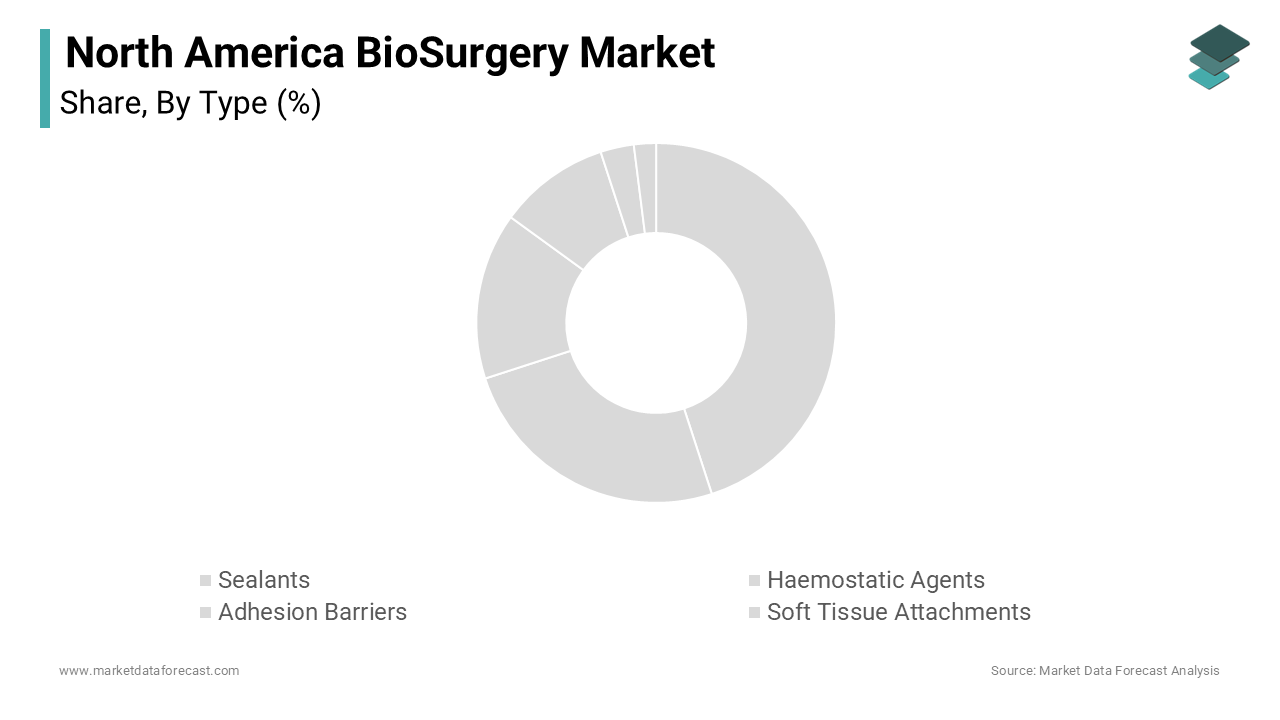
The adhesion barriers segment is projected to be the fastest-growing within the North America BioSurgery Market, with a CAGR of 11.7% between 2026 and 2034. The rising incidence of postoperative complications related to adhesions is a primary factor driving the rapid expansion of the adhesion barriers segment. These barriers are used to prevent the formation of post-surgical adhesions, particularly after abdominal, gynecological, and cardiac surgeries. Their increasing application in laparoscopic and open surgical procedures is fueling robust growth. As per the National Institutes of Health (NIH), over 90% of patients undergoing abdominal surgery develop adhesions, and nearly 20% of them experience significant complications such as bowel obstruction or chronic pain. The economic burden associated with treating these complications is prompting healthcare providers to adopt preventive solutions like adhesion barriers.
Moreover, regulatory approvals and product launches have enhanced accessibility and awareness. According to a survey conducted by the American Association of Gynecologic Laparoscopists, 68% of surveyed physicians reported an increase in the use of adhesion barriers over the past two years. This shift reflects growing confidence in their efficacy and cost-effectiveness, positioning adhesion barriers as one of the most dynamic segments in the biosurgery landscape.
REGIONAL ANALYSIS
The United States maintained a dominant position in the North America BioSurgery Market by holding a market share of substantial market share in 2025. This leadership stems from a combination of high healthcare expenditure, advanced surgical infrastructure, and a large patient pool requiring complex interventions. A key growth driver is the country’s strong focus on innovation and technology integration in surgical care. Major players such as Baxter International, Johnson & Johnson, and Medtronic continue to invest heavily in R&D, launching novel products tailored for specific surgical applications. For example, in 2023, Baxter introduced a next-generation fibrin sealant optimized for vascular and thoracic procedures, which quickly gained traction in hospital settings.
In addition, the presence of favorable reimbursement policies through private insurers and expanding coverage under Medicare Advantage plans has improved access to biosurgical products. According to the Centers for Medicare & Medicaid Services (CMS), over USD 1.2 trillion was spent on healthcare in 2023, with surgical services accounting for a substantial portion. These financial dynamics, coupled with a rapidly aging population, are expected to sustain robust demand for biosurgical solutions in the coming years.
Canada holds a moderate but steadily growing share in the North America BioSurgery Market. While its overall market size is smaller compared to the U.S., Canada’s healthcare system supports consistent adoption of biosurgical products, particularly in urban hospitals and academic medical centers. A major driver of growth is the increasing investment in regenerative medicine and biotechnology research. Canadian institutions such as the University of Toronto and McGill University are actively involved in clinical trials assessing novel biosurgical matrices, enhancing domestic innovation capacity.
A further contributing factor is the rising prevalence of chronic diseases and age-related conditions. According to the Public Health Agency of Canada, nearly 40% of adults aged 65 and above suffer from osteoarthritis, leading to a surge in orthopedic procedures where bone graft substitutes and hemostatic agents are frequently used. Moreover, the Canadian healthcare system’s emphasis on reducing hospital readmissions has encouraged the use of adhesion barriers and sealants to minimize post-operative complications.
Mexico accounts for a minor yet emerging share in the North America BioSurgery Market. Although still in the early stages of development, the Mexican market is witnessing gradual expansion driven by improving healthcare infrastructure and rising surgical volumes. A key factor influencing growth is the ongoing modernization of Mexico’s public and private healthcare systems. This increase has enabled greater access to specialized surgical care, particularly in metropolitan areas such as Mexico City and Monterrey, where several new ambulatory surgical centers have opened in recent years.
Besides, government initiatives aimed at strengthening medical device regulation and encouraging foreign investment are supporting market development. The Federal Commission for the Protection against Sanitary Risk (COFEPRIS) has streamlined approval processes for biosurgical products, facilitating quicker market entry for international manufacturers. According to a 2024 report by the Mexican Association of Medical Device Industries (AMID), imports of surgical sealants and hemostats grew by 9% year-over-year, indicating rising demand. Although challenges such as limited insurance coverage and uneven distribution of surgical facilities persist, Mexico’s evolving healthcare ecosystem presents long-term potential for biosurgery product adoption.
COMPETITIVE LANDSCAPE
The competitive landscape of the North America BioSurgery Market is characterized by the presence of well-established multinational corporations alongside emerging regional players. Market leaders maintain dominance through robust product portfolios, continuous innovation, and strong brand recognition. However, increasing demand for cost-effective biosurgical solutions and growing pressure from private-label alternatives are compelling large firms to refine their pricing and distribution strategies. Smaller companies are leveraging niche technologies and specialized applications to carve out market space, particularly in regenerative medicine and hybrid surgical therapies. Moreover, differentiation through product performance, ease of application, and compatibility with minimally invasive procedures is becoming critical. As the market evolves, competition is intensifying not only on product features but also on clinician education, customer support, and post-market surveillance to ensure sustained adoption and loyalty.
KEY MARKET PLAYERS
Companies leading the North American BioSurgery Market include
- Baxter International Inc.
- C.R. Bard, Inc.
- Johnson & Johnson
- Covidien plc
- Getinge AB
- B. Braun Melsungen AG
- CryoLife, Inc.
- Stryker Corporation
- Hemostasis, LLC
- Sanofi Group
Top Players in the North America BioSurgery Market
One of the leading players in the North America BioSurgery Market is Ethicon, a subsidiary of Johnson & Johnson. The company has a strong global footprint and offers a diverse portfolio of biosurgical products, including sealants, hemostats, and tissue adhesion barriers. Ethicon is known for its continuous innovation in surgical solutions and for maintaining high product standards through rigorous clinical research. Its focus on developing advanced wound closure systems and integration with minimally invasive surgical techniques positions it as a key contributor to the global biosurgery landscape.
Another major player is Baxter International Inc., which plays a pivotal role in the biosurgery market through its extensive range of hemostatic agents and fibrin sealants. Baxter's commitment to patient safety and product efficacy has earned it a trusted position among healthcare providers. The company leverages its global distribution network and strong R&D capabilities to introduce next-generation bio-surgical solutions. Its emphasis on biologically derived materials and sustainable manufacturing practices further strengthens its influence in both domestic and international markets.
B. Braun Melsungen AG is another prominent participant, recognized for its innovative biosurgical products tailored for complex surgical environments. With a focus on patient-centric outcomes, B. Braun continues to enhance its product offerings through strategic partnerships and continuous improvement in formulation technologies. The company's dedication to education and training for surgeons ensures broader adoption of its biosurgical solutions across North America.
Top Strategies Used by Key Market Participants
A primary strategy employed by leading players in the North American BioSurgery Market is continuous product innovation. Companies invest heavily in research and development to create more effective, safe, and easy-to-use biosurgical products that cater to evolving surgical needs. This includes advancements in biomaterials, delivery mechanisms, and integration with robotic-assisted procedures.
Another crucial approach is strategic collaborations and partnerships. Market leaders frequently engage in joint ventures, licensing agreements, and academic alliances to accelerate product development and expand their clinical applications. These collaborations also help in gaining regulatory approvals faster and entering new therapeutic areas within biosurgery.
Lastly, expanding market reach through targeted commercial strategies is vital. Companies are strengthening their sales and distribution networks, especially in underserved regions, while also focusing on direct engagement with surgeons and hospitals through educational programs, clinical trials, and hands-on training sessions to build brand trust and preference.
RECENT MARKET DEVELOPMENTS
- In February 2024, Ethicon launched a new line of absorbable hemostatic agents specifically designed for laparoscopic use, enhancing its surgical product portfolio and reinforcing its leadership in minimally invasive surgery solutions.
- In May 2024, Baxter International expanded its manufacturing facility in Colorado to increase production capacity for fibrin sealants, aiming to meet rising demand and reduce supply chain bottlenecks in the U.S. market.
- In July 2024, B. Braun introduced an advanced surgical sealant with improved viscosity control, developed in collaboration with leading surgical centers to optimize performance during complex cardiovascular procedures.
- In September 2024, Medtronic announced a strategic partnership with a biotech startup to co-develop next-generation adhesion barrier technologies using synthetic polymers for enhanced postoperative recovery.
- In November 2024, Cryolife (now part of LivaNova) received FDA clearance for a new formulation of its biologic tissue adhesive, expanding its application into thoracic and vascular surgeries, thereby strengthening its foothold in the biosurgery sector.
MARKET SEGMENTATION
This research report on the North America BioSurgery Market has been segmented and sub-segmented into the following categories.
By Type
- Sealants
- Haemostatic Agents
- Adhesion Barriers
- Soft Tissue Attachments
- Bone Graft Substitutes
- Staple Line Reinforcement Agents
By Application
- Orthopaedic Surgeries
- General Surgeries
- Neurological Surgeries
- Cardiovascular Surgeries
- Reconstructive Surgeries
- Gynaecological Surgeries
- Urological Surgeries
- Thoracic Surgeries
By Country
- The United States
- Canada
- Rest of North America