- Product Description Description
- Table of Contents TOC
- List of Table & Figure LOT
- Get Free Sample PDF Sample PDF
Market Size, 2025
$0.61 BnMarket Estimate, 2026
$0.66 BnMarket Forecast, 2034
$1.23 BnCAGR, 2026–2034
8.11%North America Blast Chillers Market Size, Growth, Trends & Forecast (2026–2034)
The North America Blast Chillers Market size was calculated to be USD 0.61 billion in 2025, is anticipated to be worth USD 0.66 billion in 2026, and is expected to reach USD 1.23 billion by 2034, growing at a compound annual growth rate (CAGR) of 8.11% during the forecast period from 2026 to 2034. Market expansion is propelled by the rising consumption of ready-to-eat and pre-cooked meals, alongside strict health department regulations mandating rapid cooling for food safety compliance.
Key Executive Metrics (At-a-Glance)
- 2025 Base Valuation: USD 0.61 billion
- 2026 Current Valuation: USD 0.66 billion
- 2034 Forecast Valuation: USD 1.23 billion
- Compound Annual Growth Rate (CAGR): 8.11% (2026–2034)
- Dominant Type Segment: Scroll compressor segment (holding 42.3% of the market share in 2025)
- Fastest-Growing Type Segment: Screw compressor segment (projected to grow at a CAGR of 8.3% from 2026 to 2034)
- Dominant Application Segment: Food & beverage segment (dominating market share in 2025 across commercial kitchens and institutional catering)
- Fastest-Growing Application Segment: Medical application segment (expected to grow at a CAGR of 9.1% from 2026 to 2034)
- Dominant Country Hub: United States (accounting for 80.3% of regional market share in 2025)
- Key Growth Region: Canada (contributing 17.3% share in 2025, supported by expanding food manufacturing sectors and health infrastructure)
Core Market Drivers
- Ready-to-Eat Demand: Surging consumption of RTE and pre-cooked meal solutions driven by urban, fast-paced lifestyles.
- Food Safety Mandates: Stricter government and FDA food safety regulations requiring rapid cooling to prevent bacterial contamination.
Primary Market Restraints & Challenges
- High Capital Expenditure: Expensive initial purchasing and installation costs coupled with significant energy consumption.
- Technical Gaps: Limited awareness, technical expertise, and complex maintenance requirements among independent foodservice operators.
North America Blast Chillers Market Segmentation Breakdown
| Segment Category | Leading Sub-Segment | Fastest-Growing Sub-Segment |
|---|---|---|
| By Type | Scroll Compressor (42.3% share in 2025) | Screw Compressor (CAGR of 8.3%) |
| By Application | Food & Beverage Segment | Medical Application (CAGR of 9.1%) |
| By Region | United States (80.3% share in 2025) | Canada (17.3% share in 2025, robust food processing growth) |
Major Industry Players Profiled
Key manufacturing leaders and refrigeration specialists driving the North American market include Electrolux Professional Inc., Hoshizaki Corporation of America, Panasonic Corporation (Panasonic Eco Solutions North America), Delfield Company LLC, IRINOX North America, Master-Bilt Products LLC, Traulsen & Co. Inc., Turbo Air Inc., Victory Refrigeration, American Panel Corporation, Hobart Corporation, Precision Refrigeration, Coldline Commercial Refrigeration, True Manufacturing Co. Inc., Williams Refrigeration, Nor-Lake Inc., and Fagor Commercial.
 Download Free Sample Report
North America Blast Chillers Market Size
The North America Blast Chillers Market Size was calculated to be USD 0.61 billion in 2025 and is anticipated to be worth USD 1.23 billion by 2034, from USD 0.66 billion in 2026, growing at a CAGR of 8.11% during the forecast period.
The blast chillers are essential in commercial kitchens, food processing facilities, and catering operations to maintain food safety, preserve texture and flavor, and extend shelf life. Blast chillers are widely used across the foodservice industry, including hotels, restaurants, and institutional catering, where large volumes of food are prepared in advance. According to the U.S. Food and Drug Administration (FDA), rapid cooling of food within two hours post-cooking is to prevent bacterial growth and ensure compliance with food safety regulations. As per the National Restaurant Association, over 70% of full-service restaurants in the U.S. have adopted blast chilling technology to improve food handling efficiency and meet health code standards.
MARKET DRIVERS
Increasing Demand for Ready-to-Eat and Pre-Cooked Meals
The rising consumption of ready-to-eat (RTE) and pre-cooked meals in urban areas with fast-paced lifestyles is escalating the growth of the North American blast chillers market. According to the U.S. Department of Agriculture (USDA), the RTE food market in the U.S. has grown by over 15% annually in recent years, driven by consumer demand for convenience and time-saving meal solutions. Blast chillers play a crucial role in this supply chain by ensuring that pre-prepared meals are cooled rapidly to maintain food safety and quality before packaging and distribution. As per the Food Marketing Institute, more than 60% of U.S. consumers purchase pre-prepared meals from grocery stores or meal kit services at least once a week, reinforcing the need for efficient blast chilling systems in food manufacturing and catering.
Regulatory Emphasis on Food Safety and Hygiene Standards
The second major driver of the North American blast chillers market is the strengthening of food safety regulations by government and health authorities, which mandate rapid cooling of cooked food to prevent bacterial contamination. According to the U.S. Food and Drug Administration (FDA), the Food Code recommends that food be cooled from 135°F to 70°F within two hours and further to 41°F or below within six hours to minimize the risk of pathogen growth. This has led to stricter enforcement of food handling protocols in restaurants, institutional kitchens, and food processing plants, which is enhancing the use of blast chillers.
MARKET RESTRAINTS
High Initial Investment and Operating Costs
The high upfront cost of purchasing and installing industrial-grade blast chilling systems, which can be a barrier for small and mid-sized foodservice operators, is limiting the growth of the North American blast chillers market. According to the National Restaurant Association, the average cost of a commercial blast chiller ranges between $10,000 and $50,000, depending on capacity and features, making it a significant capital expenditure for independent restaurants and catering businesses. In addition to acquisition costs, energy consumption and maintenance expenses further increase the total cost of ownership. As per the U.S. Department of Energy (DOE), blast chillers consume significantly more energy than conventional refrigeration units due to their high-speed cooling cycles.
Limited Awareness and Technical Expertise in Smaller Food Operations
The lack of awareness and technical expertise among smaller foodservice operators regarding the benefits and proper usage of blast chilling technology is also limiting the growth of the North American blast chillers market. According to the Cornell University School of Hotel Administration, many independent restaurants and small catering businesses are unfamiliar with the operational advantages of blast chillers beyond basic refrigeration. As per the National Restaurant Association, only 40% of independent foodservice providers in the U.S. have adopted blast chillers, citing a lack of training and operational complexity as key barriers. In Canada, the Ontario Culinary Tourism Alliance reports that many small-scale food producers and community catering services continue to rely on traditional cooling methods, such as ice baths and ambient cooling, due to limited knowledge of blast chilling systems. The American Society for Healthcare Foodservice Management (ASHFM) notes that even in institutional settings like schools and assisted living facilities, staff training on blast chiller operation is often insufficient.
MARKET OPPORTUNITIES
Expansion of Centralized Food Production and Meal Prep Facilities
The growing trend of centralized food production and meal prep services, which require rapid cooling solutions to maintain product quality and safety, is setting up new opportunities for the growth of the North American blast chillers market. According to the U.S. Department of Agriculture (USDA), the number of centralized kitchen facilities in the U.S. has increased by over 20% since 2020, driven by the rise of ghost kitchens, cloud restaurants, and large-scale meal delivery services. Blast chillers are essential in these operations to cool freshly prepared meals quickly before packaging and distribution. As per the Food Marketing Institute, over 50% of meal kit companies and cloud kitchen operators now use blast chillers to ensure food safety and extend shelf life.
Integration of Smart and Energy-Efficient Technologies
The integration of smart and energy-efficient technologies into blast chiller systems is also emerging as a key growth opportunity in the North American market. According to the U.S. Department of Energy (DOE), advancements in smart refrigeration technology have enabled blast chillers to optimize cooling cycles, monitor internal temperatures in real time, and adjust energy consumption based on load conditions. As per the American Society of Heating, Refrigerating and Air-Conditioning Engineers (ASHRAE), next-generation blast chillers equipped with IoT-enabled controls can reduce energy consumption by up to 30% compared to conventional models. Additionally, the integration of cloud-based monitoring and predictive maintenance features is improving operational efficiency and reducing downtime for foodservice operators. Leading manufacturers such as Electrolux, Panasonic, and Hoshizaki are incorporating AI-driven diagnostics and remote monitoring capabilities into their blast chiller models.
MARKET CHALLENGES
Complexity in Maintenance and Technical Support
The complexity associated with maintenance and technical support is likely to degrade the growth of the North American blast chillers market. According to the U.S. Department of Commerce, blast chillers require specialized servicing due to their high-performance cooling systems, advanced controls, and refrigerant management. As per the National Restaurant Association, nearly 30% of foodservice operators report difficulties in sourcing qualified technicians for blast chiller repairs, leading to prolonged downtime and increased operational costs. In Canada, the Canadian Institute of Refrigeration and HVAC notes that the shortage of trained service professionals for commercial blast chillers is a growing concern, especially in rural and remote areas.
Variability in Operational Requirements Across Foodservice Segments
The variability in operational requirements across different foodservice segments presents a significant challenge in the North American blast chillers market. According to the Cornell University School of Hotel Administration, blast chiller needs differ widely based on kitchen size, menu complexity, and volume of food production. Full-service restaurants, hotels, and institutional kitchens often require large, industrial-grade units, while smaller catering businesses and ghost kitchens may prefer compact or modular models. As per the Food Marketing Institute, this diversity in demand complicates product standardization and limits economies of scale for manufacturers. Additionally, differences in regulatory requirements between U.S. states and Canadian provinces further complicate product design and compliance.
REPORT COVERAGE
| REPORT METRIC | DETAILS |
| Market Size Available | 2025 to 2034 |
| Base Year | 2025 |
| Forecast Period | 2026 to 2034 |
| CAGR | 8.11% |
| Segments Covered | By Type, Application, And Region |
| Various Analyses Covered | Global, Regional & Country Level Analysis; Segment-Level Analysis; DROC, PESTLE Analysis; Porter’s Five Forces Analysis; Competitive Landscape; Analyst Overview of Investment Opportunities |
| Regions Covered | Us, Canada, and the Rest of North America |
| Market Leaders Profiled | Delfield Company LLC, IRINOX North America, Master-Bilt Products LLC, Traulsen & Co. Inc., Electrolux Professional Inc., Turbo Air Inc., Victory Refrigeration, American Panel Corporation, Hobart Corporation, Precision Refrigeration, Coldline Commercial Refrigeration, True Manufacturing Co. Inc., Williams Refrigeration, Nor-Lake Inc., Fagor Commercial |
SEGMENTAL ANALYSIS
By Type Insights
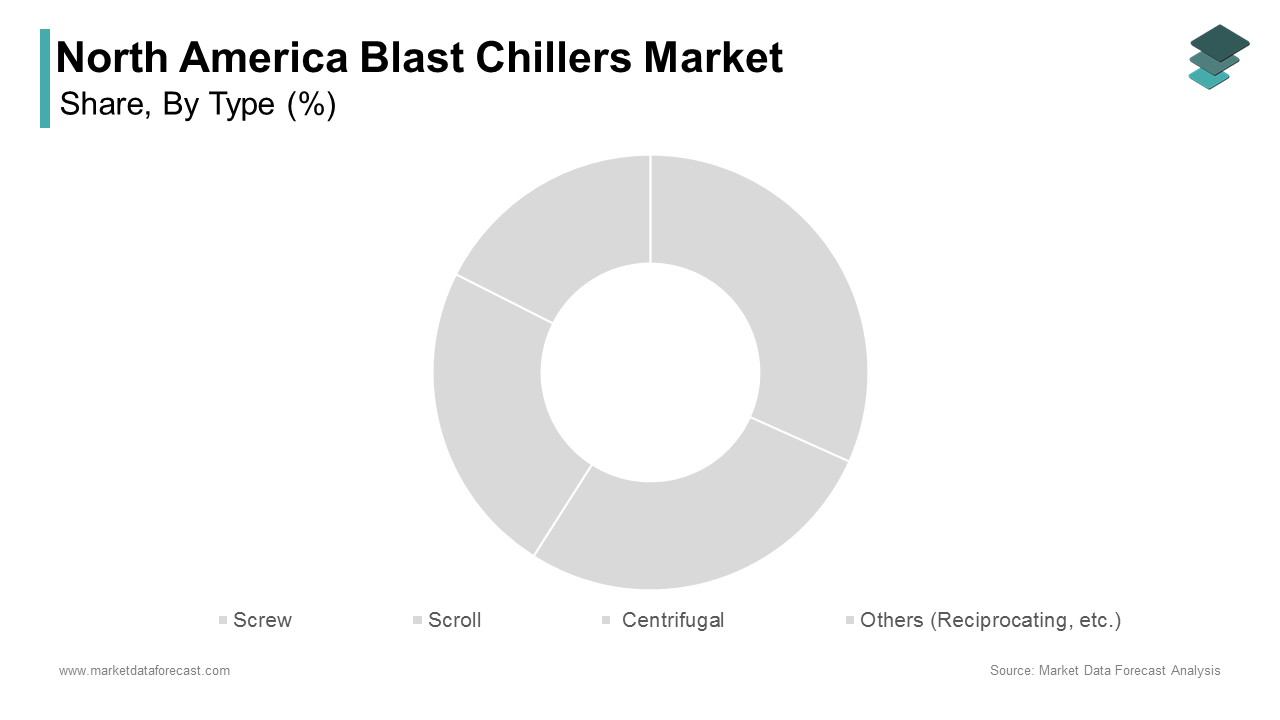
The scroll compressor segment was the largest and held 42.3% of the North America blast chillers market share in 2025, with the widespread use of scroll compressors in commercial and industrial blast chilling systems due to their high efficiency, compact design, and reliable performance. According to the U.S. Department of Energy (DOE), scroll compressors offer superior energy efficiency compared to traditional reciprocating models, which is making them ideal for foodservice and industrial cooling applications.
The screw compressor segment is projected to grow with a CAGR of 8.3% from 2026 to 203,3, owing to the increasing demand for high-capacity blast chillers in large-scale food processing, pharmaceutical, and chemical manufacturing facilities. Screw compressors are known for their ability to handle large cooling loads with high efficiency, making them ideal for industrial applications where continuous and rapid cooling is essential. As per the Food and Agriculture Organization (FAO), the U.S. food processing industry has expanded significantly, with over 25,000 processing plants operating nationwide, many of which rely on screw compressor-based blast chillers for batch cooling of perishable goods. Additionally, advancements in variable-speed screw compressors that enhance energy efficiency and reduce operational costs are making this segment a key growth driver in the North American blast chillers market.
By Application Insights
The food & beverage segment dominated the North America blast chillers market share in 2025. According to the National Restaurant Association, over 70% of full-service restaurants and institutional catering facilities in the U.S. use blast chillers to comply with health department regulations that require rapid cooling of cooked food within two hours. The U.S. Department of Agriculture (USDA) emphasizes that blast chillers are essential in preventing bacterial growth in perishable foods, particularly in batch cooking operations. In Canada, the Canadian Food Inspection Agency (CFIA) mandates rapid cooling of pre-prepared meals in school and hospital kitchens, further reinforcing market demand.
The medical application segment is expected to grow with a CAGR of 9.1% from 2026 to 2034, with the increasing use of blast chillers in healthcare settings for temperature-sensitive pharmaceutical storage, vaccine preservation, and laboratory specimen cooling. According to the Centers for Disease Control and Prevention (CDC), the demand for ultra-low temperature storage solutions has surged due to the expansion of vaccine distribution programs and biopharmaceutical research. The U.S. Food and Drug Administration (FDA) mandates strict temperature controls for biological samples and medications, making blast chillers a crucial component in hospital pharmacies and research labs.
REGIONAL ANALYSIS
United States Blast Chillers Market Insights
The United States was the largest contributor in the North American blast chillers market by accounting for 80.3% of the share in 2025. The country’s vast foodservice industry, which includes over one million restaurants, thousands of food manufacturing plants, and an expanding network of centralized meal preparation facilities, is accelerating the growth of the North American blast chillers market. According to the National Restaurant Association, more than 70% of full-service restaurants in the U.S. utilize blast chillers to meet FDA food safety regulations that require rapid cooling of cooked food. The food processing plants across the country rely heavily on blast chillers to maintain product quality and extend shelf life. In addition, the expansion of ghost kitchens, cloud restaurants, and ready-to-eat meal services has further boosted demand for efficient cooling solutions.
Canada Blast Chillers Market Insights
Canada was next with 17.3% of the North American blast chillers market share in 2025. According to the Ontario Ministry of Agriculture, Food and Rural Affairs (OMAFRA), the Canadian food manufacturing sector has expanded by 5% annually over the past five years, with many processors investing in blast chillers to enhance product safety and consistency. The Canadian Culinary Tourism Alliance reports that meal prep services and centralized catering centers are on the rise, particularly in urban centers like Toronto and Vancouver, contributing to increased demand for blast chilling technology. In healthcare, Health Canada has reinforced the need for controlled cooling environments in hospitals and research labs, particularly for vaccine and pharmaceutical storage. The Canadian Institute for Health Information (CIHI) notes that investments in hospital infrastructure and food safety initiatives are supporting market expansion.
LEADING PLAYERS IN THE NORTH AMERICA BLAST CHILLERS MARKET
Electrolux Professional
Electrolux Professional is a leading global manufacturer of commercial refrigeration and blast chilling solutions, with a strong presence in North America. The company offers a wide range of high-performance blast chillers designed for use in professional kitchens, catering operations, and food processing facilities. Electrolux is known for its innovative product design, energy-efficient systems, and integration of smart technology that enhances food safety and operational efficiency. Its commitment to sustainability and compliance with global food safety standards has positioned it as a preferred brand among commercial foodservice providers. The company also supports its customers with comprehensive after-sales service and technical support, further reinforcing its leadership in the market.
Hoshizaki Corporation of America
Hoshizaki is a key player in the North American blast chillers market, recognized for its durable, high-efficiency cooling systems tailored for commercial kitchens and foodservice applications. The company is known for its reliability, precision engineering, and long-lasting equipment that meets the demands of high-volume operations. Hoshizaki’s blast chillers are widely used in restaurants, hotels, and institutional kitchens due to their rapid cooling capabilities and compliance with stringent hygiene standards.
Panasonic Corporation (Panasonic Eco Solutions North America)
Panasonic has established a strong foothold in the North American blast chillers market through its advanced refrigeration technologies and energy-efficient product offerings. The company’s blast chillers are designed with smart controls, optimized airflow systems, and superior insulation to ensure rapid and uniform cooling. Panasonic’s focus on integrating IoT-enabled monitoring and predictive maintenance features has enhanced the appeal of its products in commercial and industrial settings. The company’s commitment to reducing environmental impact through energy-saving technologies has also contributed to its growing market presence in North America.
TOP STRATEGIES USED BY KEY MARKET PARTICIPANTS
Product Innovation and Technological Integration
Leading companies are continuously investing in research and development to introduce advanced blast chiller models with enhanced cooling efficiency, smart controls, and real-time monitoring capabilities. These innovations are aimed at improving food safety, which is reducing energy consumption, and providing user-friendly interfaces for commercial operators.
Expansion of Distribution and After-Sales Service Networks
Market participants are strengthening their presence in North America by expanding their dealer networks, service centers, and logistics infrastructure. This ensures timely delivery, installation, and maintenance support, which is crucial for maintaining customer satisfaction and long-term brand loyalty.
Customization and Application-Specific Solutions
Manufacturers are offering tailored blast chiller solutions to meet the diverse needs of different foodservice segments, including restaurants, catering, healthcare, and industrial food processing. By designing models that align with specific workflow requirements and regulatory standards, companies are enhancing their competitive edge in the market.
KEY MARKET PLAYERS AND COMPETITIVE OVERVIEW
Major Players of the North America Blast Chillers Market include Delfield Company LLC, IRINOX North America, Master-Bilt Products LLC, Traulsen & Co. Inc., Electrolux Professional Inc., Turbo Air Inc., Victory Refrigeration, American Panel Corporation, Hobart Corporation, Precision Refrigeration, Coldline Commercial Refrigeration, True Manufacturing Co. Inc., Williams Refrigeration, Nor-Lake Inc., and Fagor Commercial.
The North American blast chillers market is highly competitive, with a mix of global leaders and regional manufacturers striving to capture market share through product differentiation, technological innovation, and strategic market expansion. Established players dominate due to their brand reputation, extensive product portfolios, and well-developed distribution networks. However, the market is also witnessing increasing competition from emerging brands that offer cost-effective and energy-efficient alternatives tailored to niche applications. Competitive differentiation is largely based on performance efficiency, energy consumption, ease of maintenance, and integration with smart kitchen technologies. Companies are also focusing on sustainability by developing models that comply with environmental regulations and reduce carbon footprints. In addition, customer service and technical support play a crucial role in maintaining brand loyalty, as complex equipment requires regular maintenance and prompt repair services.
RECENT HAPPENINGS IN THE MARKET
- In February 2025, Electrolux Professional launched a new line of smart blast chillers equipped with cloud connectivity and AI-driven temperature optimization by enhancing food safety and energy efficiency for commercial kitchens across North America.
- In April 2025, Hoshizaki introduced an updated range of compact blast chillers designed for small to mid-sized restaurants and catering businesses by expanding its market reach among independent foodservice operators.
- In June 2025, Panasonic partnered with a major North American food safety certification body to integrate its blast chillers into industry training programs, which promotes best practices in food handling and cooling protocols.
- In August 2025, Hussmann Corporation expanded its blast chiller distribution network across the Midwest and Southern U.S., which is strengthening its presence in institutional and food processing markets.
- In October 2025, True Manufacturing launched a new line of ENERGY STAR® certified blast chillers by targeting eco-conscious commercial kitchens and aligning with federal sustainability initiatives in the foodservice industry.
MARKET SEGMENTATION
This research report on the North American blast chillers market has been segmented and sub-segmented based on type, application, and region.
By Type
- Screw
- Scroll
- Centrifugal
- Others (Reciprocating, etc.)
By Application
- Chemicals & Petrochemicals
- Food & Beverage
- Medical
- Plastic
- Rubber
By Region
- US
- Canada
- Rest of North America