- Product Description Description
- Table of Contents TOC
- List of Table & Figure LOT
- Get Free Sample PDF Sample PDF
Market Size, 2025
$2.73 BnMarket Estimate, 2026
$2.81 BnMarket Forecast, 2034
$3.59 BnCAGR, 2026–2034
3.10%North America Canned Fruits Market Size
The North America canned fruits market size was valued at USD 2.73 billion in 2025, and is expected to reach USD 3.59 billion by 2034 from USD 2.81 billion in 2026. With a growing CAGR of 3.10%.
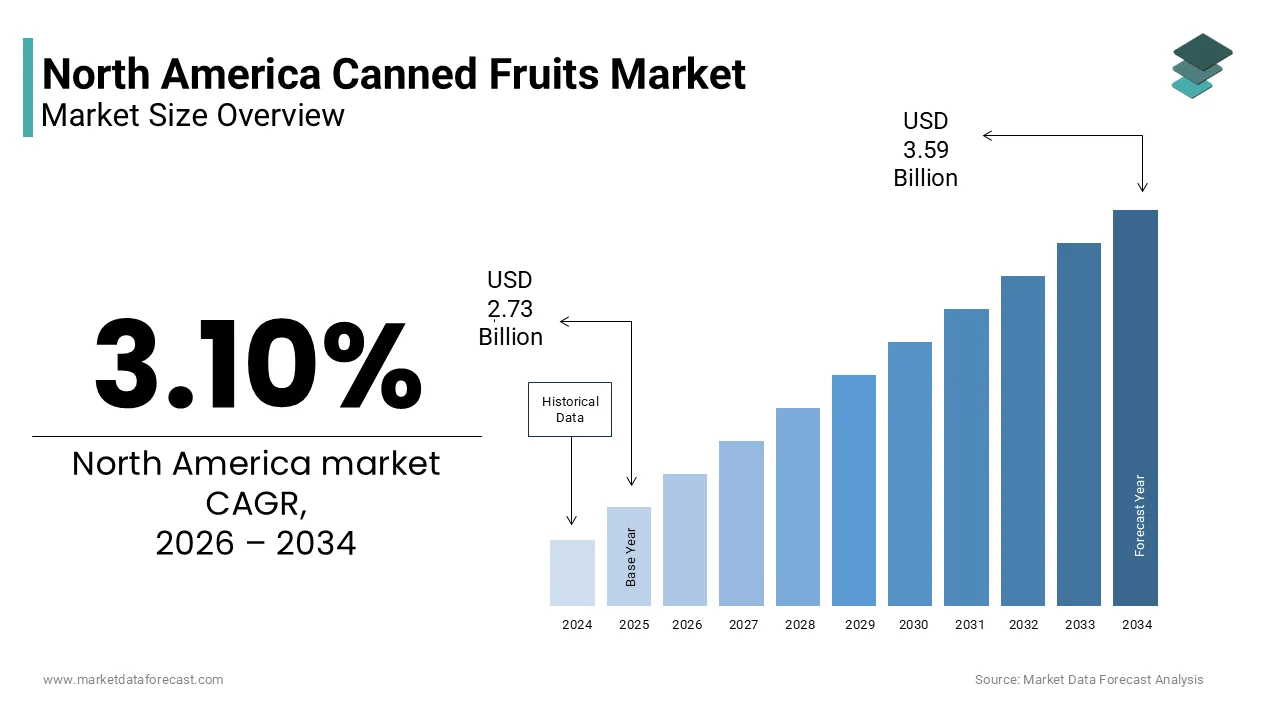
Canned Fruits have a longer shelf life compared to normal ones. The North America canned fruit market is expected to be driven by raising awareness of the health advantages of fruit-eating, a growing vegetarian population, and increased demand for convenient products. In addition, the increased customer preference for healthy and organic foods and the increasing demand for clean-label products are expected to provide market participants with an opportunity. Buyers are willing to pay a premium for high-quality food, which is predicted to drive niche enterprises to manufacture clean-label items with high-profit margins
Canning is a food preservation method that involves the use of heating and storing procedures in airtight containers, which increases the shelf life of food products by eliminating microorganisms that cause food spoilage. The addition of preservatives further prolongs the shelf life and keeps food fresh for a longer time.
Factors fuelling the growth of market are rapid rate of urbanization, increasing number of nuclear households, busy lifestyles and increasing demand for portable storage methods for food products as well as growing popularity for convenience foods. However, factors like the presence of alternative economic packaging methods and high prices of canned fruits are the factors hindering the growth of the market.
Fruits are one of the most varied and widely consumed foods on the planet, and they constitute an essential part of people's diets that promote health. They can improve the diet quality and health of those who eat fruits daily. However, due to their seasonality, they are frequently consumed processed, fuelling the North American canned fruit market. The growing desire for nutritious and convenient or ready-to-eat food options in developed and busy lifestyles and rising family income is expected to boost the industry in the future years. Consumers avoid high-calorie food products to protect themselves from health concerns as consumer awareness of health issues grows. Because a significant section of the American population is at risk of diabetes, it is critical to remove excess sugar from fruits used in bread items. With the development of natural juice-dipped fruit pieces, the sugar level in baked products can be lowered significantly without affecting the sweetness of the fruits, as opposed to those loaded with syrup. As a result, juice-dipped canned fruits have better options for use in low-sugar baked products.
Strict limitations on the use of canned fruit ingredients and additives and high canned product packaging costs may hamper the growth of the canned fruits market over the projection period.
REPORT COVERAGE
| REPORT METRIC | DETAILS |
| Market Size Available | 2025 to 2034 |
| Base Year | 2025 |
| Forecast Period | 2026 to 2034 |
| CAGR | 3.10% |
| Segments Covered | By Type, Form, Distribution Channel, and Region. |
| Various Analyses Covered | Global, Regional and Country Level Analysis; Segment-Level Analysis; DROC; PESTLE Analysis; Porter’s Five Forces Analysis; Competitive Landscape; Analyst Overview of Investment Opportunities |
| Regions Covered | UAE, Israel, KSA, Saudi Arabia, Egypt, Ethiopia, kenya And Rest Of Middle East |
| Market Leaders Profiled | ConAgra Foods, Dole Food Company, H.J. Heinz, Seneca Foods, Rhodes Food Group, Ardo, Conserve, Del Monte, CHB Group, Tropical Food Industries and Reese. |
REGIONAL ANALYSIS
The North American canned fruit market is divided into three regions: the United States, Canada, and Mexico. North America is expected to expand significantly in the worldwide market. The region's growing vegetarian population and the region's escalating health and wellness trend are projected to fuel the regional market. The canned fruit business in the United States is expected to be worth $2.8 billion by 2021. The country presently controls 27.05 percent of the global market. Bananas, mangos, avocados, pineapples, apples, honeydew melons, lemons, lychees, durian, rambutan, guavas, passion fruit, sapodilla, and jackfruit are among the fruits imported by the United States. The ordinary American's broad palate, combined with the population's diverse ethnic groups, increases the demand for distinctive and native dishes. North America has a sophisticated economy with a considerable customer base and a significant population of working professionals. The regional market has been driven by improvements in supply chain infrastructure and the growing popularity of canned fruit. Investments from multinational corporations from large markets such as the United States, Canada, and Mexico will generate chances for various local players. Consumption of canned fruits has increased due to an increase in the working population and a busy lifestyle.
KEY MARKET PLAYERS
Key Players In The North America Canned Fruits Market Are ConAgra Foods, Dole Food Company, H.J. Heinz, Seneca Foods, Rhodes Food Group, Ardo, Conserve, Del Monte, CHB Group, Tropical Food Industries and Reese.
RECENT HAPPENINGS IN THE MARKET
- Del Monte, one of the major producers, distributors, and marketers of premium quality and branded food goods, announced plans in March 2017 to convert to non-BPA packaging and increase their non-GMO offerings.
MARKET SEGMENTATION
This research report on the North America canned fruits market is segmented, and sub segmented into following categories
By Type
- Organic
- Inorganic
By Form
- Whole Fruits
- Cut Fruits
By Distribution Channel
- Supermarkets
- Online Retail
- Convenience Stores
- Others
By Region
- United States
- Canada
- Mexico