- Product Description Description
- Table of Contents TOC
- List of Table & Figure LOT
- Get Free Sample PDF Sample PDF
Market Size, 2025
$2.35 BnMarket Estimate, 2026
$2.46 BnMarket Forecast, 2034
$3.59 BnCAGR, 2026–2034
4.82%North America Cast-in-Place Concrete Flooring Market Summary
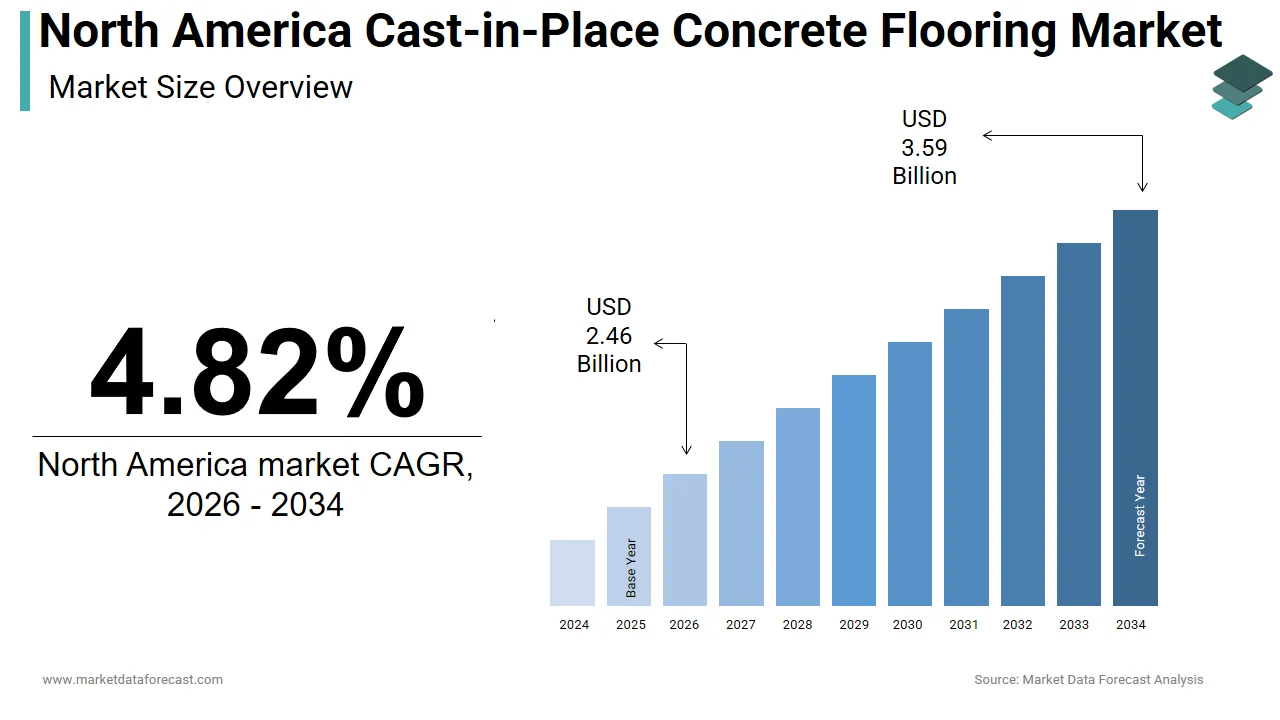
The North America cast-in-place concrete flooring market is witnessing steady expansion, projected to grow from $2.46 billion in 2026 to $3.59 billion by 2034, at a CAGR of 4.82%. This growth is primarily fueled by the industrial boom and the critical need for durable flooring in the logistics sector.
Market Snapshot (2026 to 2034)
- Logistics & Distribution Leadership: This segment leads the market with a 28.5% share, driven by the massive expansion of e-commerce warehouses and fulfillment centers requiring high-load-bearing floors.
- Non-Residential Dominance: Commercial and industrial applications account for 45.8% of the market, outperforming residential projects due to the scale of infrastructure modernization.
- Regional Hubs:
- United States: The undisputed market leader, holding a massive 85.3% share as of 2024.
- Canada: Ranked second, supported by robust resource extraction industries and a strong commitment to infrastructure development.
- Technique Preference: Traditional floor techniques remain the standard, maintaining a 52.1% share, though technological advancements in specialized mixtures are gaining traction.
Strategic Industry Trends
- Industrial Surge: The continued rise in warehouse construction across North America is the primary driver for high-volume concrete pouring contracts.
- Sustainability Focus: Environmental regulations and concerns over the carbon footprint of cement are pushing the industry toward "Green Concrete" and innovative material solutions.
- Technical Customization: Competition is shifting beyond price to include technical expertise and customized solutions, such as high-performance mixtures that resist cracking and chemical wear.
- Digital Integration: Companies are increasingly adopting digital transformation initiatives to enhance supply chain reliability and operational efficiency during the casting process.
Critical Industry Challenges
- Material Volatility: Fluctuating raw material prices (aggregates, cement, and chemical additives) continue to challenge profit margins for contractors.
- Carbon Constraints: Intensified competition now revolves around environmental performance as regulatory bodies demand lower-emission construction practices.
Key Industry Leaders: Market Categorization
The North American landscape is dominated by a mix of aggregate giants, chemical innovators, and specialized flooring solution providers:
- Global Material Giants: LafargeHolcim and Cemex lead in providing the foundational high-volume concrete required for massive industrial pours.
- Chemical & Performance Additives: Sika AG and The Euclid Chemical Company are the primary innovators in curing compounds, sealers, and performance-enhancing mixtures.
- Construction Infrastructure: Vulcan Materials Company and Boral maintain a strong foothold through their extensive supply chains for raw aggregates and specialized concrete materials.
- Finishing & Specialized Solutions: Saint-Gobain, ARDEX Group, and Laticrete International focus on high-durability surface finishes and technical flooring systems.
- Industrial & Commercial Powerhouses: Shaw Industries Group and Mohawk Industries provide integrated solutions for large-scale non-residential projects.
North America Cast-in-Place Concrete Flooring Market Size
The North America cast-in-place concrete flooring market was valued at USD 2.35 billion in 2025. The regional market is projected to grow from USD 2.46 billion in 2026 to reach USD 3.59 billion by 2034, exhibiting a compound annual growth rate (CAGR) of 4.82% from 2026 to 2034.
Cast-in-place concrete flooring refers to a construction methodology where concrete is poured directly on-site into formwork, allowing it to cure and harden as a monolithic slab. This technique is widely adopted in North America for industrial, commercial, and institutional buildings due to its durability, load-bearing capacity, and adaptability to various structural requirements. As per sources, cast-in-place concrete flooring systems are widely utilized as a prevalent and foundational construction method for a substantial portion of large-scale commercial buildings in the U.S. The region’s robust infrastructure development, particularly in urban centers like New York, Los Angeles, and Toronto, continues to drive demand. According to research, A significant volume of new residential units authorized for construction in the U.S. annually incorporate concrete for essential foundational elements and basement flooring. Besides, Concrete is a leading and extensively used flooring material in new industrial facilities throughout Canada, particularly in major industrial provinces like Ontario and Quebec, due to its durability and performance characteristics. These systems are favored for their seamless finish, resistance to wear, and compatibility with radiant heating systems. The growing emphasis on sustainable construction practices has further enhanced the relevance of cast-in-place concrete, given its recyclability and thermal mass properties. Concrete is a prominent and widely adopted material for non-residential floor construction across North America, contributing substantially to the total annual floor area built.
MARKET DRIVERS
Surge in Industrial and Warehouse Construction
The rapid expansion of logistics and warehousing infrastructure across the region is a primary driver for the North America cast-in-place concrete flooring market. Continued substantial growth in e-commerce sales has intensified the demand for durable and expansive flooring solutions in industrial fulfillment centers. Cast-in-place concrete is particularly suited to these environments due to its high load-bearing capacity and resistance to mechanical stress. As per a study, in line with substantial growth in the industrial real estate sector, a significant amount of warehouse and fulfillment center space continues to be developed, with durable concrete remaining the standard and dominant flooring material. The flooring system’s compatibility with automated guided vehicles (AGVs) and robotic systems further enhances its appeal in modern warehouses. Additionally, the long-term cost-effectiveness of concrete flooring, with lifecycle costs lower than epoxy or vinyl alternatives, makes it a preferred option for large-scale industrial projects. This trend is particularly prominent in Texas, California, and Florida, where logistics hubs are expanding rapidly. The integration of concrete flooring with smart sensors for monitoring structural integrity is also gaining traction, aligning with Industry 4.0 trends. These factors collectively underscore the growing reliance on cast-in-place concrete flooring in industrial applications.
Infrastructure Modernization and Government Investment
The region’s aging infrastructure has prompted substantial public and private investment in modernization projects, which boosts the expansion of the North America cast-in-place concrete flooring market. The Infrastructure Investment and Jobs Act in the U.S. includes general provisions for upgrading transportation hubs, public buildings, and utilities that require durable flooring solutions. Public roadways across the U.S. often necessitate reconstruction efforts that involve concrete flooring in transit stations, airports, and municipal facilities. In Canada, a national investment plan prioritizes resilient infrastructure, with concrete flooring being integral to subways, hospitals, and educational institutions. Apart from these, numerous bridges have been rehabilitated or replaced across the U.S., many utilizing cast-in-place concrete slabs. Furthermore, concrete’s fire resistance and low maintenance requirements make it ideal for critical infrastructure. These investments are expected to sustain long-term demand for cast-in-place concrete flooring across North America.
MARKET RESTRAINTS
Environmental Regulations and Carbon Footprint Concerns
Environmental regulations and sustainability concerns pose major restraints to the North American cast-in-place concrete flooring market. Concrete production is a major contributor to CO₂ emissions, accounting for a portion of global emissions, as per research. In response, regulatory bodies across North America are imposing stricter carbon reduction mandates. For instance, the California Air Resources Board has introduced guidelines limiting embodied carbon in construction materials, which could impact concrete usage. Similarly, Canada’s Green Building Strategy emphasizes low-carbon alternatives, encouraging the adoption of recycled materials and alternative flooring systems. Besides, the rising popularity of cross-laminated timber and other eco-friendly alternatives is diverting demand. According to sources, timber-based flooring systems have seen growth in adoption. These shifts are compelling concrete manufacturers to innovate with carbon-neutral or low-emission formulations, which are still in nascent stages. The growing demand for green buildings is putting significant pressure on conventional concrete to improve its environmental performance.
Skilled Labor Shortage and Construction Delays
A persistent shortage of skilled labor in the regional construction sector is inhibiting the expansion of the North American cast-in-place concrete flooring market. As per sources, many companies in the construction sector are finding it challenging to hire workers with the necessary qualifications. Cast-in-place concrete flooring requires specialized expertise in formwork installation, pouring techniques, and curing processes, which are increasingly difficult to source. The output efficiency of labor within the construction industry has shown a noticeable decrease over recent years. The Canadian construction market is experiencing a significant lack of skilled workers across various specialized roles. These shortages not only extend project timelines but also compromise the quality of concrete flooring installations. Delayed curing and improper jointing due to inadequate labor have led to increased maintenance costs and structural concerns. Issues related to workforce availability are a contributing factor to the rising expenses associated with construction projects. As a result, many contractors are shifting toward precast or modular flooring systems, which require less on-site labor. This trend is particularly evident in metropolitan areas like Chicago and Vancouver, where labor costs are disproportionately high.
MARKET OPPORTUNITIES
Technological Advancements in Concrete Mixtures
Technological innovations in concrete formulations offer a significant opportunity for the North American cast-in-place concrete flooring market. The development of self-leveling, ultra-high-performance, and fiber-reinforced concrete mixtures is enhancing the versatility and efficiency of flooring applications. Self-leveling concrete, for instance, reduces the need for extensive finishing work, thereby cutting labor costs and project timelines. As per research, the concrete industry is observing a growing interest in the application of enhanced concrete formulations within various projects. Ultra-high-performance concrete (UHPC), known for its superior strength and durability, is gaining traction in high-traffic industrial environments. There is a noticeable upward trajectory in how specialized high-performance concrete is being used for different structural components. Additionally, the integration of smart additives such as shrinkage-reducing admixtures and corrosion inhibitors is improving the longevity of concrete floors. Current practices in industrial flooring frequently involve integrating materials that improve overall performance characteristics. These advancements are particularly beneficial in cold-weather regions like Alaska and northern Canada, where freeze-thaw resistance is crucial. The rising demand for customizable concrete solutions that offer aesthetic appeal, such as polished or stained finishes, is also opening new market segments. These innovations are enabling contractors to meet diverse project specifications while maintaining cost efficiency.
Growth in Green Building and LEED Certification Projects
The increasing emphasis on green building practices and LEED certification provides a lucrative opportunity for the North America cast-in-place concrete flooring market. LEED-certified projects often prioritize materials with high recycled content and low environmental impact, both of which align with modern concrete formulations. Many commercial building projects are certified as LEED or are in the process of pursuing certification. Concrete’s thermal mass properties contribute to energy efficiency, a key criterion for LEED credits. According to research, Concrete flooring is a feature found in numerous LEED-certified buildings. Incorporating concrete flooring in a building can contribute to a reduction in energy consumption related to heating, ventilation, and air conditioning systems. Fly ash and slag-based concrete mixtures, which utilize industrial byproducts, are increasingly used to meet sustainability benchmarks. There has been a notable increase in the number of certified industrial and commercial projects in Canada. Additionally, concrete’s recyclability at the end of its lifecycle supports circular economy principles. The inclusion of concrete flooring in green building rating systems further expands its market potential. "Sustainability is now a competitive edge, pushing manufacturers to invest in greener concrete, which makes cast-in-place flooring ideal for future builds.
MARKET CHALLENGES
Fluctuating Raw Material Prices
The volatility in raw material prices, particularly cement and aggregates, poses a significant challenge to the North America cast-in-place concrete flooring market. Cement prices in one country saw a substantial increase, influenced by energy costs and issues within the supply chain. Similarly, the cost of aggregates has fluctuated due to regional shortages and transportation bottlenecks. In Canada, aggregate material prices rose, which may be connected to production capacity limits in certain areas. These price swings directly impact project budgets and timelines, making cost estimation difficult for contractors. A number of construction businesses experienced material cost overruns, with some concrete components being notably affected. Additionally, the reliance on imported materials, such as specialty admixtures from Asia, has introduced currency exchange risks. A portion of the materials used in high-performance concrete production are obtained from international markets, which introduces potential market vulnerabilities related to global logistics. These challenges are particularly acute in regions with limited local production capacity, such as the Canadian Prairies and the U.S. Mountain West. As a result, many contractors are exploring alternative materials or renegotiating contracts to mitigate cost risks, which could slow the adoption of cast-in-place concrete flooring in price-sensitive markets.
Stringent Building Codes and Compliance Requirements
The complexity and variation of building codes across the regional jurisdictions act as a major impediment to the North America cast-in-place concrete flooring market. Each state and province has specific standards for fire resistance, seismic performance, and accessibility, necessitating customized flooring solutions. Building codes related to concrete are frequently updated across different states. Changes to construction requirements are a regular occurrence within the building industry. The national building code in Canada undergoes periodic revisions. Provinces often incorporate modifications specific to their regional needs within the national code framework. Specific regional requirements, such as those related to seismic activity, can influence the types of construction techniques employed. These specialized construction techniques have an effect on project installation costs. Additionally, accessibility standards under the Americans with Disabilities Act mandate specific surface textures and joint configurations, complicating flooring design. The National Fire Protection Association’s guidelines for fire-rated floors further restrict material choices and installation methods. Non-compliance can result in costly rework or project delays. Smaller contractors often lack the expertise to navigate these regulations, leading to increased reliance on consultants and specialized firms. These regulatory complexities are particularly burdensome in multi-jurisdictional projects, such as cross-border infrastructure developments, where compliance with both U.S. and Canadian standards is required.
REPORT COVERAGE
| REPORT METRIC | DETAILS |
| Market Size Available | 2025 to 2034 |
| Base Year | 2025 |
| Forecast Period | 2026 to 2033 |
| Segments Covered | By Application, Technique, End User Industry, and Country. |
| Various Analyses Covered | Global, Regional, and Country-Level Analysis, Segment-Level Analysis, Drivers, Restraints, Opportunities, Challenges; PESTLE Analysis; Porter’s Five Forces Analysis, Competitive Landscape, Analyst Overview of Investment Opportunities |
| Countries Covered | United States, Canada, Mexico, Rest of North America |
| Market Leaders Profiled | Boral, Cemex, CSR Limited, Sika AG, Saint-Gobain, 3M, Johns Manville, Milliken, Interface, Inc., Shaw Industries Group, Inc., Kajaria Ceramics Limited, Mohawk Industries, Inc., Tarkett, Owens Corning, Fletcher Building, TAMKO Building Products LLC, SCG (Siam Cement Group), The Euclid Chemical Company, Liberty Industries, LafargeHolcim Ltd, Synetik, ARDEX Group, Q.E.P. Co., Inc., Vulcan Materials Company, and Others. |
SEGMENTAL ANALYSIS
By Application Insights
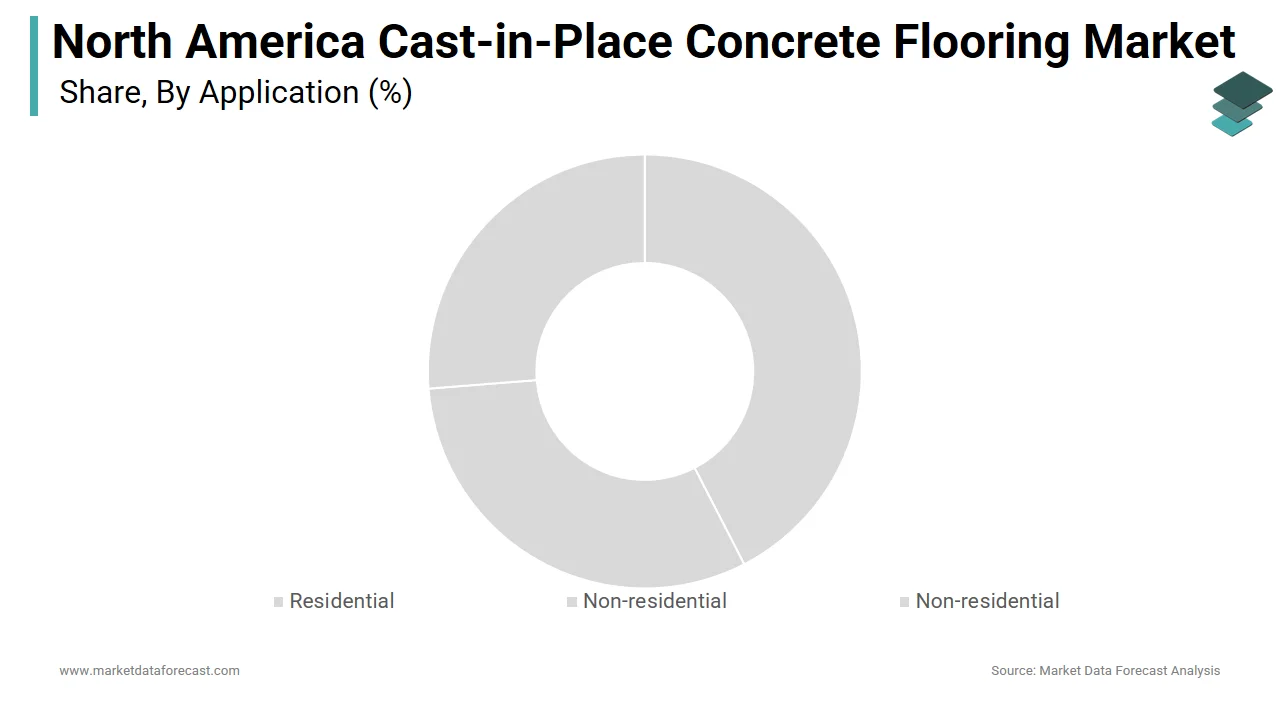
The non-residential segment dominated the North America cast-in-place concrete flooring market by accounting for a 45.8% share in 2024. The dominance of the non-residential segment is primarily attributed to the extensive use of concrete flooring in commercial buildings, educational institutions, healthcare facilities, and retail spaces. Non-residential construction spending has experienced a notable upward trajectory within the United States. The volume of commercial office building development has led to an extensive utilization of concrete flooring across substantial square footage. The durability and low maintenance requirements of cast-in-place concrete make it the preferred choice for high-traffic commercial environments. Educational institutions represent a significant portion of this demand. Healthcare facilities, which demand sterile and durable flooring solutions, contributed to a portion of non-residential concrete flooring installations, as per sources. The segment's growth is further supported by the increasing trend toward mixed-use developments, which combine retail, office, and residential spaces within single structures. These projects typically require specialized concrete flooring solutions that can accommodate varying load requirements and aesthetic preferences. The versatility of cast-in-place concrete in creating seamless, joint-free surfaces makes it ideal for environments where hygiene and safety are paramount, particularly in food service and pharmaceutical applications.
The infrastructure segment is likely to experience the fastest CAGR of 7.8% from 2026 to 2034. The accelerated growth of the infrastructure segment is propelled by substantial government investments in transportation networks, utility systems, and public facilities. The implementation of recent significant legislation has provided substantial funding for infrastructure enhancement across the country, according to research. Airport modernization programs are driving significant demand. Numerous initiatives aimed at improving various aspects of air travel facilities are actively being pursued as part of ongoing nationwide development efforts. Bridge construction and rehabilitation projects have surged. A considerable number of projects dedicated to the vital maintenance, restoration, and replacement of key transit overpasses are currently in progress. Public transit expansion is another key driver. Significant capital investments are being directed toward modernizing and expanding public transportation systems nationwide. Utility infrastructure modernization, including water treatment plants and electrical substations, is contributing to growth. A notable amount of financial support has been designated specifically for essential upgrades and improvements to water infrastructure systems. These projects require specialized concrete formulations that can withstand harsh environmental conditions and chemical exposure. The segment's growth is further amplified by smart city initiatives that demand durable, long-lasting flooring solutions for municipal buildings, emergency services facilities, and public spaces. Climate resilience considerations are driving the adoption of high-performance concrete flooring that can withstand extreme weather events and temperature fluctuations.
By Technique Insights
The traditional floor segment maintained the prominent share of 52.1% of the North America cast-in-place concrete flooring market in 2024. The prominence of the traditional floor segment is because of the widespread familiarity and established supply chains for conventional reinforced concrete methods. The simplicity and cost-effectiveness of traditional floor systems make them the preferred choice for standard construction projects across various applications. According to research, a notable share of residential and commercial projects continue to utilize traditional reinforced concrete flooring due to its proven performance and ease of installation. Cost advantages are particularly significant, with traditional methods typically less expensive than specialized techniques. The availability of skilled labor for traditional concrete work remains abundant. Regional building codes and specifications often favor traditional approaches, with many U.S. states maintaining building standards that primarily reference conventional concrete practices. The versatility of traditional flooring allows for easy integration with various finishing techniques, including staining, polishing, and texturing, making it suitable for both functional and aesthetic requirements. Standardization in material procurement and quality control processes has established traditional concrete as the baseline for performance expectations. The technique's compatibility with existing construction equipment and formwork systems reduces capital investment requirements for contractors. Besides, the extensive documentation and technical support available for traditional methods provide contractors with confidence in achieving consistent results. The segment benefits from well-established supply chains for conventional reinforcement materials, including steel rebar and wire mesh, ensuring consistent availability and competitive pricing across North America.
The steel fiber reinforced concrete segment is on the rise and is expected to be the fastest growing segment in the market by witnessing a CAGR of 9.2% over the forecast period due to the superior performance characteristics and efficiency gains offered by steel fiber reinforcement technology. The elimination of conventional rebar placement significantly reduces installation time. Labor cost savings are substantial. The enhanced crack resistance and improved load distribution properties of steel fiber reinforced concrete make it particularly attractive for industrial applications where floor integrity is critical. The technique's ability to create joint-free or reduced-joint flooring systems appeals to warehouse and distribution center operators seeking to minimize maintenance and operational disruptions. Performance improvements include increased impact resistance and reduced spalling. The growing adoption in seismic zones is notable, as steel fiber reinforcement provides superior energy absorption capabilities during earthquake events. Specification trends show increasing inclusion of steel fiber requirements in municipal and institutional projects.
By End User Industry Insights
The logistics and distribution segment led the North America cast-in-place concrete flooring market by holding a 28.5% share in 2024. The leading position of the logistics and distribution segment is credited to the important role of durable, low-maintenance flooring in modern warehouse and distribution center operations. The rapid expansion of online shopping has significantly altered the need for warehouse space and design. The substantial volume of goods bought through digital platforms requires large facilities for both storage and order fulfillment. Consequently, many expansive fulfillment centers are now in operation, each needing durable, specialized flooring to support heavy use. This demand has led to a major increase in the construction of new industrial warehouse space across the country. Temperature-controlled storage facilities, essential for food and pharmaceutical distribution, require specialized concrete formulations that can withstand thermal cycling without cracking. Automated guided vehicle systems, increasingly common in modern warehouses, demand smooth, joint-free concrete surfaces to ensure optimal navigation and operational efficiency. As per studies, a portion of distribution centers now incorporate automation technologies requiring specialized concrete flooring specifications. Floor flatness and levelness requirements have intensified, with many facilities demanding FF/FL ratings, necessitating advanced concrete placement and finishing techniques. The integration of renewable energy systems, including solar panels and battery storage, requires concrete flooring that can support additional structural loads while maintaining durability. Cross-docking operations that require rapid goods movement benefit from the seamless surfaces and enhanced durability provided by cast-in-place concrete flooring systems.
The data center segment is expected to exhibit a noteworthy CAGR of 11.4% from 2025 to 2033, owing to the exponential expansion of digital infrastructure requirements and the critical need for stable, reliable flooring systems in mission-critical facilities. The data center market across North America continues to experience expansion, driven partly by the construction of very large computing facilities. Major technology companies are making significant capital investments to expand their data center presence across various regions, resulting in large-scale infrastructure developments that require substantial amounts of specialized construction materials. Smaller, distributed data centers are becoming more prevalent as a growing amount of enterprise-generated data is processed in proximity to its origin, a trend that necessitates specific infrastructure and design considerations. Raised floor systems, essential for cable management and cooling distribution, require concrete slab foundations that meet stringent flatness specifications. The integration of artificial intelligence and machine learning workloads demands enhanced power density capabilities, requiring concrete flooring systems designed to support 20-30 kW per rack compared to traditional 5-10 kW configurations. Sustainability requirements are driving innovation. The emergence of liquid cooling systems for high-performance computing applications requires concrete flooring with enhanced chemical resistance and thermal stability properties.
COUNTRY-LEVEL ANALYSIS
United States Cast-in-Place Concrete Flooring Market Analysis
The United States outperformed other countries in the North America cast-in-place concrete flooring market by accounting for a 85.3% share in 2024. The supremacy of the US market is driven by the country's extensive construction activity, advanced infrastructure development, and sophisticated industrial base. The United States construction landscape exhibits considerable financial volume, with commercial and industrial construction accounting for a notable portion of this expenditure. Regional variations in market activity are significant, with specific regions demonstrating substantial activity in industrial construction spending compared to other areas. The concentration of major metropolitan areas creates substantial demand for high-rise commercial buildings and mixed-use developments that extensively utilize cast-in-place concrete flooring systems. A major regional corridor in the Northeast accounts for a significant share of the national commercial construction spending. State-level building codes and environmental regulations influence specification trends. The prevalence of union labor in major urban markets affects installation practices and quality standards. A substantial number of registered workers are employed in concrete-related occupations throughout the country. Government infrastructure investments are anticipated to provide ongoing financial contributions in the coming years. The maturity of the U.S. concrete industry, with Numerous facilities dedicated to producing ready-mixed concrete are operational across the United States. Regional climate variations influence concrete mixture specifications, with northern states requiring enhanced freeze-thaw resistance and southern states prioritizing heat resistance and durability.
Canada Cast-in-Place Concrete Flooring Market Analysis
Canada was the second-largest country in the North America cast-in-place concrete flooring market because of the country's robust construction sector, extensive resource extraction industries, and commitment to infrastructure modernization. Overall, Canadian construction spending is a significant economic activity. Industrial construction contributes a portion of the total Canadian construction expenditure. Ontario, British Columbia, and Alberta are among the provinces with substantial annual construction spending volumes. The concentration of manufacturing and logistics facilities in the Toronto-Windsor corridor creates significant demand for industrial concrete flooring systems. Western Canada's oil and gas sector drives specialized flooring requirements for processing facilities and equipment foundations. The Canadian Association of Petroleum Producers is reporting CAD 32 billion in capital expenditures for 2023. Provincial building codes exhibit variations that influence concrete specifications. Capital expenditures for petroleum-related activities involve considerable investment. The integration of sustainable building practices is accelerating. Cold-weather construction challenges require specialized concrete formulations and installation techniques. The presence of major urban centers, including Toronto, Vancouver, and Calgary, creates demand for high-density residential and commercial developments requiring advanced concrete flooring solutions. Trade relationships with the United States facilitate technology transfer and specification alignment,
COMPETITIVE LANDSCAPE
The North American cast-in-place concrete flooring market exhibits intense competition characterized by the presence of established global players alongside regional specialists and emerging innovators. Market dynamics are influenced by technological advancement, sustainability requirements, and evolving customer preferences that drive continuous innovation and strategic positioning. Competition extends beyond price considerations to encompass service quality, technical expertise, and solution customization capabilities that differentiate market participants. The fragmented nature of the construction industry creates opportunities for specialized providers to capture niche market segments while large integrated players leverage scale advantages and comprehensive service portfolios. Regional market characteristics influence competitive strategies, with local knowledge and relationships playing crucial roles in market success. The increasing emphasis on sustainable construction practices has intensified competition around environmental performance and innovative material solutions. Technology integration and digital transformation initiatives are reshaping competitive landscapes as companies seek to enhance operational efficiency and customer value propositions. Supply chain reliability and material quality consistency remain fundamental competitive factors that influence customer selection and retention. The evolving regulatory environment creates both challenges and opportunities for market participants to demonstrate compliance expertise and innovation capabilities.
KEY MARKET PLAYERS
The leading companies operating in the North America cast-in-place concrete flooring market include:
- Boral
- Cemex
- CSR Limited
- Sika AG
- Saint-Gobain
- 3M
- Johns Manville
- Milliken
- Interface, Inc.
- Shaw Industries Group, Inc.
- Kajaria Ceramics Limited
- Mohawk Industries, Inc.
- Tarkett
- Owens Corning
- Fletcher Building
- TAMKO Building Products LLC
- SCG (Siam Cement Group)
- The Euclid Chemical Company
- Liberty Industries
- LafargeHolcim Ltd
- Synetik
- ARDEX Group
- E.P. Co., Inc.
- Vulcan Materials Company
TOP PLAYERS IN THE MARKET
- Cemex stands as one of the leading global building materials companies with a significant presence in the North American cast-in-place concrete flooring market. The company's extensive network of ready-mix concrete plants and technical expertise positions it as a preferred supplier for large-scale commercial and industrial projects. Their commitment to innovation is evident through their specialized concrete formulations designed for enhanced durability and performance. Cemex's integrated approach combines material supply with technical support services, ensuring optimal installation and long-term performance of concrete flooring systems. The company's sustainability initiatives and carbon-neutral concrete solutions have gained recognition in the green building sector. Their regional distribution network enables rapid response to project requirements while maintaining consistent quality standards. Cemex's collaborative approach with contractors and engineers has established strong relationships throughout the construction industry. The company's investment in research and development continues to drive advancement in concrete technology and application methods.
- LafargeHolcim maintains a prominent position in the North American cast-in-place concrete flooring market through its comprehensive portfolio of construction materials and innovative solutions. The company's focus on sustainable construction practices aligns with evolving market demands for environmentally responsible building materials. Their advanced concrete formulations incorporate recycled materials and low-carbon cement alternatives, supporting green building initiatives. LafargeHolcim's technical expertise extends beyond material supply to include comprehensive project support services, including mix design optimization and installation guidance. The company's commitment to digital transformation has enhanced project management capabilities and quality control processes. Their regional manufacturing facilities ensure a consistent supply and competitive pricing across major construction markets. Strategic partnerships with leading contractors and engineering firms have strengthened their market position and expanded their customer base. LafargeHolcim's emphasis on research and development has resulted in breakthrough innovations in concrete performance and sustainability. The company's global experience provides valuable insights for addressing complex North American market requirements.
- Vulcan Materials Company represents a major force in the North American cast-in-place concrete flooring market through its extensive aggregates and concrete operations. The company's vertically integrated business model provides competitive advantages in material quality and supply chain reliability. Their comprehensive understanding of regional market requirements enables tailored solutions for diverse construction applications. Vulcan's commitment to operational excellence is reflected in its consistent delivery of high-quality materials and technical support services. The company's investment in modern production facilities ensures compliance with evolving industry standards and environmental regulations. Their strategic geographic positioning facilitates efficient distribution and timely project completion. Vulcan Materials' collaborative relationships with contractors and developers have established a strong market presence across key construction markets. The company's focus on innovation drives continuous improvement in concrete performance and sustainability. Their experienced technical team provides valuable guidance throughout project lifecycles, ensuring optimal results and customer satisfaction.
TOP STRATEGIES USED BY KEY MARKET PARTICIPANTS
Strategic Partnerships and Collaborations Leading companies in the North American cast-in-place concrete flooring market actively pursue strategic partnerships with contractors, engineering firms, and technology providers to enhance their market reach and service capabilities. These collaborations enable comprehensive project delivery solutions that combine material expertise with installation excellence. Partnerships with equipment manufacturers facilitate the adoption of advanced placement and finishing technologies, improving project efficiency and quality outcomes. Joint ventures with regional contractors expand market penetration while leveraging local expertise and relationships. Technology partnerships with software providers enhance project management capabilities and quality control processes. Collaborative research initiatives with academic institutions drive innovation in concrete formulations and application methods. Strategic alliances with sustainability organizations support the development of environmentally responsible solutions that meet evolving market demands. These partnerships create synergies that benefit all stakeholders while strengthening competitive positions in the marketplace.
Product Innovation and Technology Development Market leaders continuously invest in research and development to create advanced concrete formulations and application technologies that address evolving customer requirements. Innovation focuses on enhancing performance characteristics, including durability, strength, and sustainability, while reducing environmental impact. Development of self-leveling and rapid-setting concrete solutions addresses time-sensitive project requirements and improves installation efficiency. Advanced admixture technologies enable customized solutions for specific application requirements, including chemical resistance and thermal performance. Digital integration initiatives enhance quality control and project management capabilities through real-time monitoring and data analytics. Research into sustainable materials incorporates recycled content and alternative cementitious materials that reduce carbon footprints. Development of specialized finishing techniques creates enhanced aesthetic and functional properties for diverse applications. Innovation in equipment and tooling improves installation precision and reduces labor requirements while maintaining quality standards.
Geographic Expansion and Market Penetration: Key players strategically expand their geographic presence to capture emerging market opportunities and strengthen customer proximity. Regional expansion initiatives establish local production facilities and distribution networks that ensure reliable supply and responsive service. Market penetration strategies target underserved geographic areas and emerging construction markets with growing demand for concrete flooring solutions. Strategic acquisitions of regional concrete producers and contractors enhance market presence while providing access to established customer relationships. Expansion into adjacent markets, including infrastructure and industrial sectors, diversifies revenue streams and reduces market concentration risks. International expansion initiatives leverage North American expertise and technology to address global market opportunities. Development of mobile production capabilities enables rapid response to remote project locations and temporary market demands. Market development programs focus on educating potential customers about concrete flooring benefits and best practices.
MARKET SEGMENTATION
This research report on the North America cast-in-place concrete flooring market has been segmented and sub-segmented into the following categories.
By Application
- Residential
- Non-residential
- Infrastructure
By Technique
- Prestressed Concrete
- Steel Fiber Reinforced Concrete
- Traditional Floor
By End User Industry
- Logistics and Distribution / Warehousing
- Automotive Industry
- Aviation Industry
- Pharmaceutical / Chemical Industry
- Data Centers
- Recycling Facilities
- Textile
- Food and Beverage
- Heavy Equipment / Construction Equipment Manufacturing and Distribution
- Others
By Country
- United States
- Canada
- Mexico
- Rest of North America