- Product Description Description
- Table of Contents TOC
- List of Table & Figure LOT
- Get Free Sample PDF Sample PDF
Market Size, 2025
$4.06 BnMarket Estimate, 2026
$4.22 BnMarket Forecast, 2034
$5.77 BnCAGR, 2026–2034
4%North America Ceiling Fan Market Size, Growth, Trends & Forecast (2026–2034)
The North America ceiling fan market size was valued at USD 4.06 billion in 2025, is estimated to reach USD 4.22 billion in 2026, and is projected to reach USD 5.77 billion by 2034, registering a compound annual growth rate (CAGR) of 4% during the forecast period from 2026 to 2034. Driven by growing consumer awareness regarding energy conservation, rising construction activities, and the widespread integration of smart home technologies, the regional market continues to expand as a sustainable alternative to conventional air conditioning systems.
Key Executive Metrics (At-a-Glance)
- 2025 Base Valuation: USD 4.06 Billion
- 2026 Current Valuation: USD 4.22 Billion
- 2034 Forecast Valuation: USD 5.77 Billion
- Compound Annual Growth Rate (CAGR): 4% (2026–2034)
- Leading Country Market: United States (82.4% share in 2025)
- Core Product Attributes: Energy-efficient ventilation devices designed to improve indoor thermal comfort, reduce HVAC reliance, and support sustainable climate control.
Core Market Drivers
- Energy Conservation & Cost Savings: Increasing demand for energy-efficient cooling solutions to offset high residential electricity usage and reduce greenhouse gas emissions.
- Smart Technology Integration: Surging consumer preference for IoT-enabled devices, voice command compatibility, and automated climate sensing models.
Primary Market Restraints & Challenges
- Seasonal Demand Fluctuations: Weather-dependent purchasing patterns, leading to sales peaks in warmer months and slowdowns during winter seasons.
- Installation Complexity & Costs: Specialized electrical wiring requirements and safety standards necessitating professional installation, which adds to overall consumer expenses.
North America Ceiling Fan Market Segmentation Breakdown
| Segment Category | Largest Segment | Fastest-Growing Segment |
|---|---|---|
| By Type | Standard Fan | Energy Saving Fan (CAGR 8.6%) |
| By Application | Residential | Commercial (CAGR 9.1%) |
| By Distribution Channel | Offline | Online (CAGR 11.4%) |
| By Country | United States | Canada |
Major Industry Players Profiled
Key market participants shaping the North American ceiling fan landscape include Hunter Fan Company, Haiku (Big Ass Fans), Minka Group (Minka-Aire / Minka-Lavery), Crompton Greaves Consumer Electricals Limited, Orient Electric, Havells, The Henley Fan Company Ltd, Emerson Electric Co., and NuTone Inc.
North America Ceiling Fan Market Size
The North America ceiling fan market was valued at USD 4.06 billion in 2025, is estimated to reach USD 4.22 billion in 2026, and is projected to reach USD 5.77 billion by 2034, growing at a CAGR of 4 % from 2026 to 2034.

A ceiling fan is an electrically powered ventilation device installed on ceilings to circulate air and improve indoor thermal comfort. These fans are widely used in residential, commercial, and industrial buildings as an energy-efficient alternative or complement to air conditioning systems. Ceiling fans operate by redistributing warm air during winter and enhancing airflow during summer, thereby contributing to reduced HVAC usage and lower electricity bills.
Market growth is influenced by rising consumer awareness regarding energy conservation, increasing construction activities, and the growing preference for smart home technologies. According to the U.S. Department of Energy, ceiling fans can reduce cooling costs by up to 40%, making them a preferred choice for homeowners seeking sustainable and cost-effective climate control solutions. Apart from these, as per the National Association of Home Builders, over 80% of new single-family homes built in 2023 included ceiling fans as standard features, particularly in southern states where temperatures are higher.
Moreover, advancements in design and functionality, such as integration with smart home systems, variable speed controls, and LED lighting,g have enhanced the appeal of ceiling fans among modern consumers. As per the American Lighting Association, aesthetic considerations have become a key purchasing factor, with decorative and designer models gaining traction in urban housing and commercial interiors.
These evolving consumer preferences and regulatory emphasis on energy efficiency continue to shape the dynamics of the North America ceiling fan market.
MARKET DRIVERS
Rising Demand for Energy-Efficient Cooling Solutions
The increasing demand for energy-efficient cooling solutions, driven by both environmental concerns and economic incentives, is one of the primary drivers of the North American ceiling fan market. With growing awareness about climate change and energy consumption, homeowners and businesses are actively seeking alternatives to traditional air conditioning systems, which account for a significant portion of electricity usage.
According to the U.S. Environmental Protection Agency (EPA), air conditioning accounts for nearly 6% of total residential energy use in the United States, costing homeowners billions annually and contributing to greenhouse gas emissions. Ceiling fans, in contrast, consume significantly less power while enhancing perceived cooling through air movement, allowing occupants to raise thermostat settings without sacrificing comfort.
Furthermore, utility companies across the U.S. and Canada offer rebates and incentives for installing energy-efficient appliances, including ENERGY STAR-certified ceiling fans. Like, several states such as California, Texas, and New York have implemented rebate programs that encourage consumers to replace older, inefficient units with newer models equipped with DC motors and smart controls.
This shift toward energy-conscious behavior, combined with financial incentives and regulatory support, has significantly boosted ceiling fan adoption across residential and commercial sectors in North America.
Integration of Smart Technology and IoT Features
The integration of smart technology and Internet of Things (IoT) capabilities into ceiling fan designs is another major driver of the North America ceiling fan market. Consumers increasingly prefer connected home devices that offer convenience, remote control, and automation, leading manufacturers to incorporate Wi-Fi connectivity, voice command compatibility, and adaptive sensors into their products.
Ceiling fans have become a part of this trend, with brands like Hunter Fan Company, Minka-Aire, and Haiku introducing models that integrate seamlessly with platforms such as Amazon Alexa, Google Assistant, and Apple HomeKit.
Smart ceiling fans also feature occupancy sensors, ambient temperature detection, and programmable timers, optimizing energy use based on real-time conditions. As per the American Lighting Association, in 2023, nearly 35% of ceiling fans sold in North America were smart-enabled models, a sharp increase from just 10% in 2020.
MARKET RESTRAINTS
Seasonal Demand Fluctuations and Climate Dependency
The seasonal nature of demand, which is heavily influenced by regional climate patterns, remains one of the most notable restraints affecting the North America ceiling fan market. Unlike essential household appliances, ceiling fans experience fluctuating demand throughout the year, primarily peaking during warmer months and declining in colder seasons.
According to the National Oceanic and Atmospheric Administration (NOAA), average annual temperatures in the U.S. vary significantly by region, with southern states experiencing longer periods of heat compared to northern areas. This disparity affects consumer purchasing behavior, with residents in states like Florida, Texas, and Arizona being more likely to install ceiling fans than those in cooler regions such as Minnesota or Maine.
Besides, the U.S. Census Bureau’s Housing Vacancy Survey revealed that in 2023, new home construction activity was concentrated in the Sun Belt region, reinforcing regional disparities in ceiling fan adoption. In contrast, northern states often rely more heavily on central heating systems, reducing the perceived necessity of ceiling fans. This geographic and climatic dependency limits the uniformity of market growth across North America, making it challenging for manufacturers to maintain consistent sales volumes year-round.
Availability of Alternative Air Circulation Products
The availability of alternative air circulation and cooling products that compete for consumer spending is another key restraint on the NoAmericanrica ceiling fan market. Portable fans, floor-standing fans, and evaporative coolers serve as direct substitutes in certain applications, especially in rental properties and small living spaces where permanent installations may not be feasible.
These products are often easier to install, more affordable, and suitable for temporary use, making them attractive to budget-conscious buyers.
In addition, the rise of advanced HVAC systems with built-in air circulation modes has further diluted the need for ceiling fans in newly constructed high-end residences. As per the American Society of Heating, Refrigerating,ating and Air-Conditioning Engineers (ASHRAE), many luxury homes now prioritize zoned climate control systems, reducing reliance on supplementary cooling devices.
MARKET OPPORTUNITIES
Expansion of Smart and Connected Ceiling Fan Offerings
The continued expansion of smart and connected ceiling fan offerings is a significant opportunity for the American ceiling fan market. As home automation becomes increasingly mainstream, consumers are showing greater interest in integrated systems that allow centralized control of lighting, climate, and ventilation.
Companies are responding by incorporating Wi-Fi modules, Bluetooth connectivity, and voice assistant compatibility into their products, enabling users to adjust fan speeds, set schedules, and monitor energy usage via mobile apps.
Furthermore, manufacturers are exploring innovations such as AI-driven climate sensing, which allows ceiling fans to automatically adjust airflow based on room occupancy and temperature changes.
Growing Residential Renovation and Remodeling Activities
The surge in residential renovation and remodeling activities, particularly in older housing stock, is another promising opportunity for the North American ceiling fan market. As homeowners seek to enhance energy efficiency, aesthetics, and indoor comfort, ceiling fans have become a popular upgrade in kitchens, living rooms, and outdoor patios.
Ceiling fans are frequently incorporated into these renovations as part of broader efforts to modernize home interiors and improve ventilation.
Moreover, as per the National Association of Realtors, homes featuring updated lighting and ceiling fans had higher resale values and faster selling times, reinforcing the appeal of such improvements in the real estate market.
MARKET CHALLENGES
High Initial Cost of Premium Smart Ceiling Fans
The relatively high initial cost of premium smart ceiling fans, which can deter price-sensitive consumers, is a major challenge facing the North American ceiling fan market. While basic models remain affordable, advanced variants with integrated smart technology, energy-efficient motors, and designer aesthetics often come with significantly higher price tags.
This pricing gap makes it difficult for some consumers, particularly first-time homeowners and renters, to justify the investment despite long-term energy savings.
Installation Complexity and Maintenance Requirements
The complexity associated with installation and ongoing maintenance is another critical challenge confronting the North American ceiling fan market. Unlike plug-and-play cooling solutions such as portable fans, ceiling fans require professional installation due to electrical wiring, ceiling structure compatibility, and safety regulations.
According to the Electrical Safety Foundation International (ESFI), improper installation accounts for nearly 12% of all ceiling fan-related accidents, highlighting the importance of certified electrician involvement. This requirement increases overall ownership costs and discourages DIY buyers, particularly in rental properties where tenants may not have permission to make permanent modifications.
Furthermore, regular cleaning and blade balancing are necessary to ensure optimal performance and longevity, yet many consumers find these tasks inconvenient. The National Association of Home Builders (NAHB) reported that over 30% of homeowners cited maintenance concerns as a reason for avoiding ceiling fan purchases.
REPORT COVERAGE
| REPORT METRIC | DETAILS |
| Market Size Available | 2025 to 2034 |
| Base Year | 2025 |
| Forecast Period | 2026 to 2034 |
| Segments Covered | By Type, Application, Distribution Channel, and Region. |
| Various Analyses Covered | Global, Regional,l and Country-Level Analysis, Segment-Level Analysis, Drivers, Restraints, Opportunities, Challenges; PESTLE Analysis; Porter’s Five Forces Analysis, Competitive Landscape, Analyst Overview of Investment Opportunities |
| Countries Covered | United States, Canada, Mexico, Rest of North America |
| Market Leaders Profiled | Crompton Greaves Consumer Electricals Limited (India), Orient Electric (India), Havells (India), Hunter Fan Company (U.S.), The Henley Fan Company Ltd (U.K.), Mega Home Appliances (U.S.), Emerson Electric Co. (India), NuTone Inc. (U.S.), Shell Electric Holdings Limited (Hong Kong), Fantasia Ceiling Fans (U.K.), and others. |
SEGMENTAL ANALYSIS
By Type Insights
The standard fan segment held the largest share of the North America ceiling fan market, with 42.6% of total sales in 2025. Its affordability, widespread availability, and suitability for a broad range of residential applications are driving the dominance of the standard fan segment. The high demand from budget-conscious consumers, particularly in rental housing and mid-tier housing developments, is also one of the key drivers behind this segment’s growth. As per the Joint Center for Housing Studies at Harvard University, nearly 65% of new multifamily units constructed in 2023 included standard ceiling fans as part of developer-installed amenities, emphasizing cost-effectiveness over premium design or smart features. Moreover, the continued replacement cycle in older homes contributes significantly to the sustained demand for standard fans. As per the U.S. Census Bureau, over 7 million existing homes underwent minor renovations in 2023, with ceiling fan replacements being a common upgrade due to their ease of installation and functional benefits.
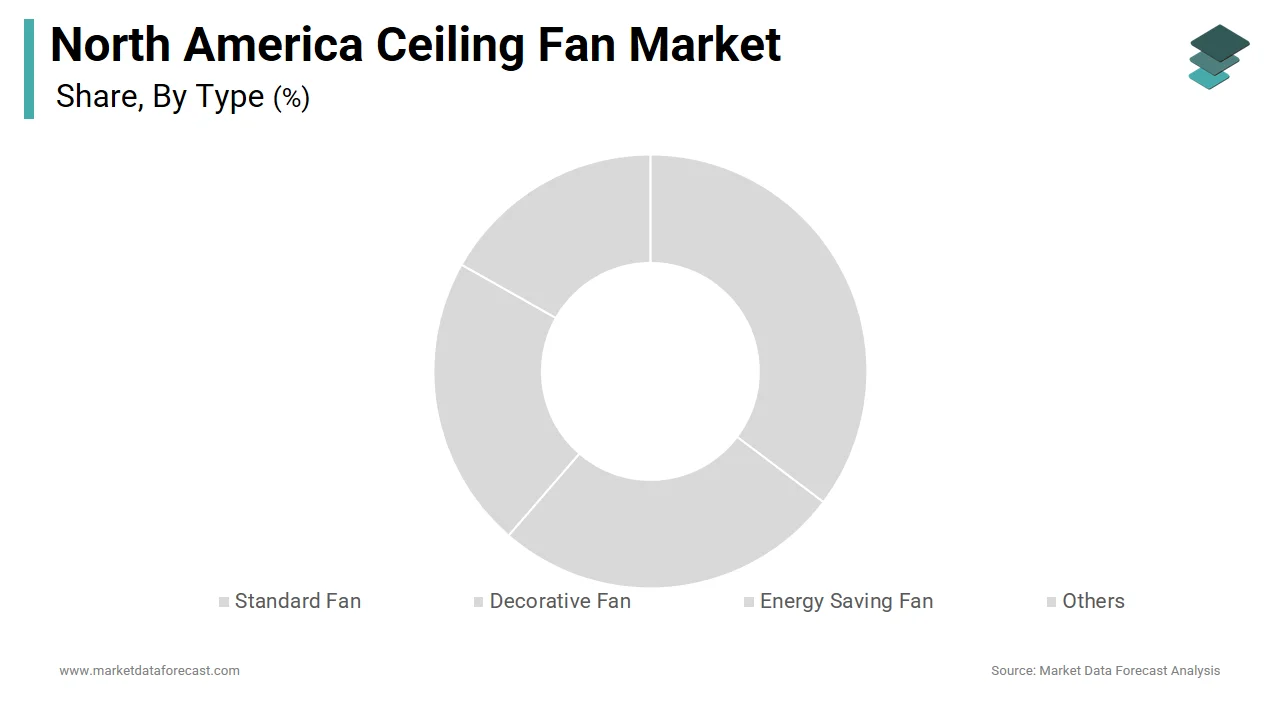
The energy-saving fan segment is emerging as the fastest-growing type in the North America ceiling fan market and is projected to expand at a CAGR of 8.6%. This growth is driven by rising energy conservation awareness and increasing adoption of ENERGY STAR-certified appliances across both residential and commercial sectors, which is propelling the rise of the energy-saving fan segment. The growing preference for DC motor-powered ceiling fans is also a factor contributing to this rapid expansion. Moreover, utility companies and government agencies are offering rebates and tax incentives for purchasing energy-efficient ceiling fans. With climate policies tightening and consumer interest in eco-friendly products rising, the energy-saving fan segment is poised for strong future growth.
By Application Insights
The residential application segment dominated the North America ceiling fan market by holding an estimated share of 85% in 2025. This leading position is primarily driven by the widespread use of ceiling fans in single-family homes, apartments, and condominiums to enhance indoor comfort while reducing reliance on air conditioning, which is primarily driving the leading position of the residential application segment. The rising construction of new residential properties, especially in warm-weather regions such as Florida, Texas, and Arizona, is another key driver of this segment's growth. Further, the home renovation boom has further fueled demand. As urbanization continues and sustainability trends gain momentum, the residential sector remains the cornerstone of the North America ceiling fan market.
The commercial application segment is experiencing the fastest growth in the North America ceiling fan market, projected to grow at a CAGR of 9.1% between 2025 and 2033. This surge is attributed to the increasing adoption of high-volume, industrial-grade ceiling fans in retail spaces, restaurants, office buildings, and hospitality venues, which is surging the commercial application segment. The expansion of commercial real estate, particularly in the food service and entertainment industries, is also one of the primary growth drivers. Furthermore, green building certifications such as LEED and WELL are encouraging commercial developers to integrate energy-efficient ceiling fans into their designs.
By Distribution Channel Insights
The offline distribution channel held the largest share of the North America ceiling fan market by accounting for 68.6% of total sales in 2025. The continued preference for in-store purchases, where consumers can assess product quality, size, and design before making a buying decision, is largely driving the dominance of the offline distribution channel. A major driver behind this segment’s leadership is the strong presence of home improvement retailers and electrical wholesalers, such as Home Depot, Lowe’s, and Menards, which offer a wide selection of ceiling fans alongside professional installation services. Apart from these, the availability of in-store promotions and bundled offers with lighting kits or remote controls enhances the appeal of offline channels.
The online distribution channel is the fastest-growing segment in the North America ceiling fan market and is projected to expand at a CAGR of 11.4% between 2025 and 2033. The rising popularity of online marketplaces such as Amazon, Wayfair, and Houzz, which offer extensive product selections, competitive pricing, and customer reviews that help buyers make informed decisions, is one of the key factors fueling this expansion. This rapid growth is driven by shifting consumer behavior, increased digital engagement, and the expanding reach of e-commerce platforms. Moreover, the integration of augmented reality (AR) tools by online retailers allows customers to visualize how ceiling fans will look in their homes before purchasing. With younger generations favoring digital shopping and logistics networks improving delivery times, the online ceiling fan market is set to accelerate even further in the coming years.
COUNTRY-LEVEL ANALYSIS
United States Ceiling Fan Market Insights
The United States maintained the largest market share in North America with 82.4% of regional ceiling fan consumption in 2025. This lead position is underpinned by the country’s robust residential construction activity, favorable climate conditions in southern states, and a mature home appliance retail ecosystem. A major driver behind the U.S. dominance is the high penetration of ceiling fans in new home construction, particularly in warm-weather regions like Florida, Texas, and California. According to the National Association of Home Builders (NAHB), over 80% of new single-family homes built in 2023 included ceiling fans as standard fixtures, reflecting both builder preferences and homeowner expectations. In addition, the booming home renovation sector has further boosted ceiling fan demand. According to the Joint Center for Housing Studies at Harvard University, reported that remodeling expenditures exceeded $450 billion in 2023, with ceiling fan replacements and upgrades being a common feature in kitchen and living room renovations.
Canada Ceiling Fan Market Insights
Canada is positioning itself as a steady-growth region supported by urban development and rising smart home adoption, according to Natural Resources Canada. While not as large as the U.S. market, Canada’s ceiling fan industry benefits from increasing residential investments and a growing focus on energy efficiency. One of the key growth drivers in Canada is the expansion of multi-unit residential construction, particularly in cities like Toronto, Vancouver, and Montreal. Besides, Canadian consumers are increasingly embracing smart ceiling fans with Wi-Fi connectivity and voice control features, aligning with broader smart home trends. Also, sales of smart ceiling fans grew, outpacing the growth of conventional models.
Rest of North America Ceiling Fan Market Insights
The Rest of North America, including Mexico and smaller Caribbean economies, collectively hold a smaller share of the regional ceiling fan market. While currently minor contributors, these markets are showing signs of development, particularly in Mexico, where rising disposable incomes and urbanization are driving demand for household cooling solutions. Mexico’s proximity to U.S. supply chains and participation in trade agreements facilitate access to affordable ceiling fan imports. Moreover, local retailers are expanding their offerings to include both basic and decorative models, catering to diverse buyer preferences. Despite challenges related to raw material availability and limited domestic manufacturing capacity, the Rest of North America presents long-term opportunities for ceiling fan suppliers aiming to expand beyond traditional markets.
KEY MARKET PLAYERS
Noteworthy Companies dominating the North America ceiling fan market profiled in the report are
Crompton Greaves Consumer Electricals Limited (India), Orient Electric (India), Havells (India), Hunter Fan Company (U.S.), The Henley Fan Company Ltd (U.K.), Mega Home Appliances (U.S.), Emerson Electric Co. (India), NuTone Inc. (U.S.), Shell Electric Holdings Limited (Hong Kong), Fantasia Ceiling Fans (U.K.), and others.
TOP LEADING PLAYERS IN THE MARKET
Hunter Fan Company
Hunter Fan Company is a pioneering brand with over a century of experience in ceiling fan design and manufacturing. As one of the most recognized names in the industry, Hunter has set benchmarks for performance, durability, and style. The company offers a broad range of ceiling fans tailored for both residential and commercial applications. Its commitment to innovation, including energy-efficient motors and smart-enabled models, has positioned it as a market leader not only in North America but also in international markets where quality and reliability are highly valued.
Haiku (Big Ass Fans)
Haiku, a premium brand under Big Ass Fans, specializes in high-performance ceiling fans that combine minimalist design with cutting-edge technology. Known for its focus on air movement efficiency and smart home integration, Haiku appeals to architects, designers, and environmentally conscious consumers. The brand’s emphasis on sustainability, precision engineering, and aesthetic appeal has made it a preferred choice in luxury homes and upscale commercial spaces across North America and beyond.
Minka Group (Minka-Aire and Minka-Lavery)
The Minka Group is a major player in the ceiling fan industry, offering two distinct brands, Minka-Aire and Minka-Laver,y that cater to diverse consumer preferences. With a strong presence in both mainstream and designer segments, Minka focuses on product variety, innovative lighting integrations, and affordability. Through strategic retail partnerships and continuous product development, the company has built a solid reputation in North America and contributes significantly to global ceiling fan trends through its stylistic influence and wide distribution reach.
TOP STRATEGIES USED BY KEY MARKET PARTICIPANTS
- Innovation through Smart Technology Integration. Key players are investing heavily in integrating smart technologies into ceiling fans, enabling voice control, mobile app connectivity, and adaptive automation. These features align with the growing trend of smart homes and enhance user convenience, making ceiling fans more appealing to tech-savvy consumers.
- Diversification across Product Categories and Price Ranges to capture a broader customer base, manufacturers are expanding their portfolios to include a wide range of products from budget-friendly standard models to premium designer and energy-saving variants. This approach allows them to serve multiple market segments, from rental housing to luxury residences.
- Strategic Retail and E-commerce Partnerships Leading companies are strengthening their market presence by forming alliances with major home improvement retailers and online platforms. By improving accessibility and visibility through these channels, they ensure greater consumer engagement and drive consistent sales growth across urban and suburban markets.
COMPETITION LANDSCAPE
- The NorAmericanica ceiling fan market is marked by intense competition among well-established brands and emerging players striving to capture market share through differentiation and innovation. Industry leaders such as Hunter Fan Company, Haiku, and the Minka Group maintain dominance due to their strong brand recognition, extensive product lines, and robust distribution networks. However, new entrants are leveraging digital marketing, direct-to-consumer models, and niche design offerings to carve out space in the market.
- Technological advancement remains a key battleground, with companies racing to integrate smart controls, improve motor efficiency, and offer superior airflow performance. Further, the rising emphasis on aesthetics and interior décor compatibility has led to an increase in designer models that cater to evolving consumer tastes. Sustainability is also becoming a differentiator, with manufacturers introducing eco-conscious materials and energy-efficient components.
- Retail strategies play a crucial role in competitive positioning, as partnerships with big-box stores and e-commerce platforms determine product availability and consumer access. Pricing strategies, promotional campaigns, and after-sales service further influence purchasing decisions. As demand evolves across residential and commercial sectors, the market continues to be dynamic, requiring agility and innovation from all participants.
RECENT MARKET DEVELOPMENTS
- In February 2025, Hunter Fan Company launched a new line of ultra-quiet ceiling fans featuring WhisperWind™ motor technology, targeting homeowners who prioritize noise reduction without compromising airflow performance.
- In May 2025, Haiku introduced an AI-integrated ceiling fan model capable of learning user behavior patterns and adjusting speed and operation automatically based on occupancy and ambient conditions, reinforcing its leadership in smart home ventilation.
- In August 2025, Minka Group expanded its partnership with Lo, introducing exclusive ceiling fan collections designed to enhance visual appeal while maintaining affordability, catering to mid-tier residential buyers.
- In October 2025, Westinghouse Electric Company unveiled a series of industrial-grade ceiling fans specifically engineered for commercial use in warehouses, restaurants, and retail spaces, aiming to tap into the fast-growing non-residential segment.
- In December 2025, Wayfair partnered with multiple ceiling fan manufacturers to launch an augmented reality-based visualization tool, allowing customers to preview fan installations virtually before making a purchase decision.
MARKET SEGMENTATION
This North America ceiling fan market research report is segmented and sub-segmented into the following categories.
By Type
- Standard Fan
- Decorative Fan
- Energy Saving Fan
- Others
By Application
- Residential
- Commercial
By Distribution Channel
- Online
- Offline
By Country
- United States
- Canada
- Mexico
- Rest of North America