- Product Description Description
- Table of Contents TOC
- List of Table & Figure LOT
- Get Free Sample PDF Sample PDF
Market Size, 2025
$7.53 BnMarket Estimate, 2026
$9.95 BnMarket Forecast, 2034
$92.24 BnCAGR, 2026–2034
32.10%Executive Summary: North America Cloud-Based Contact Center Market
- Market Scope: Comprehensive regional market analysis covering solution components, professional/managed services, deployment models (public, private, hybrid), organization sizes, industry verticals, and country-level adoption frameworks across North America.
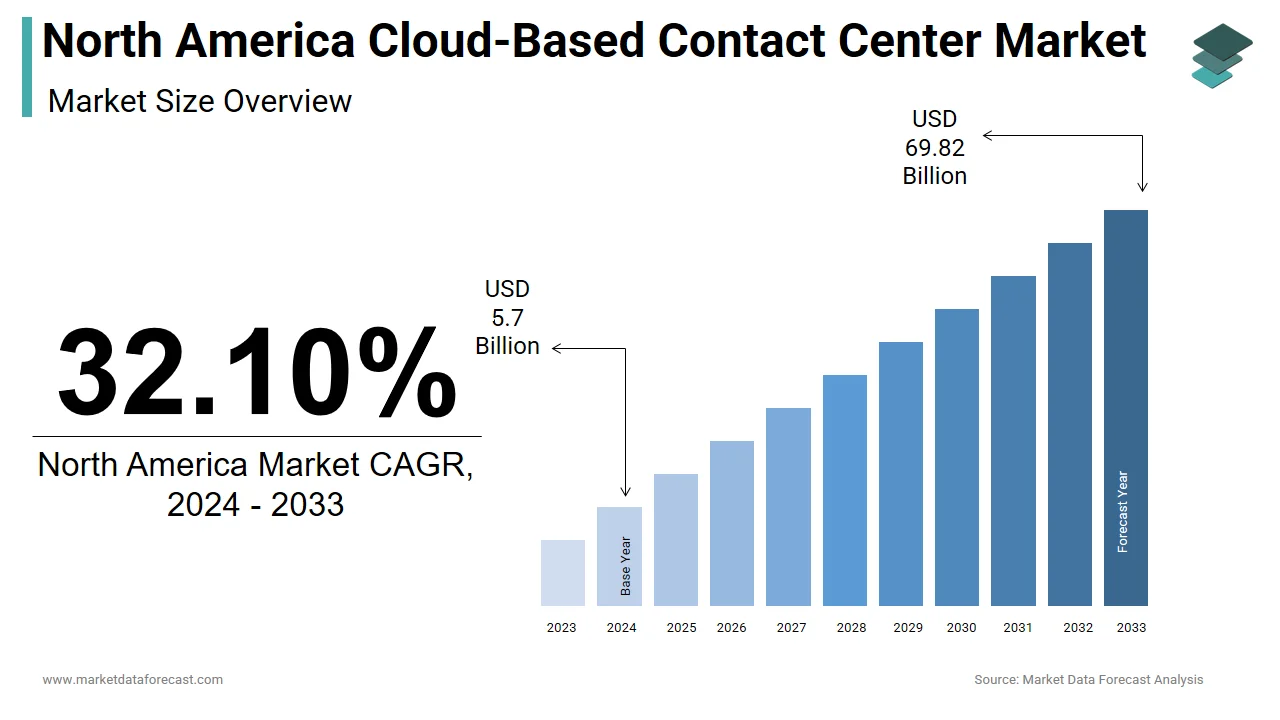
- Market Valuation: Valued at USD 7.53 billion (2025), estimated at USD 9.95 billion (2026), and projected to reach USD 92.24 billion by 2034, registering an exceptional CAGR of 32.10% (2026–2034).
- Primary Growth Drivers: Acceleration of remote work and distributed customer service models, expanding omnichannel customer engagement strategies, and deepening integration of artificial intelligence (AI) and advanced analytics like conversational bots and sentiment analysis.
Key Market Segment Metrics (2026–2034)
| Category | Leading Segment (2025 Position) | Fastest-Growing Segment |
|---|---|---|
| By Component | Solutions (commanded 55.1% of total revenue via unified communication and omnichannel capabilities) | Services (projected to grow at a CAGR of 14.6% driven by migration consulting, system integration, and managed support) |
| By Deployment | Public Cloud (captured 52.6% of total revenue due to cost-effectiveness and pay-as-you-go flexibility) | Hybrid Cloud (expected to register the highest CAGR of 15.2% driven by data sovereignty and regulatory compliance needs) |
| By Organization Size | Large Enterprises (held 57.4% of total revenue owing to complex operational volumes and robust enterprise security needs) | Small and Medium-Sized Enterprises (SMEs) (fastest-growing category with a CAGR of 16.1% due to low entry barriers) |
| By Country | United States (estimated at 76.6% market share in 2025, driven by a mature digital ecosystem and early tech adoption) | Canada (witnessing robust growth backed by progressive digital transformation policies and secure cloud adoption) |
Major Market Players & Market Structure
Market Structure: Dynamic and highly competitive regional cloud engagement landscape featuring global tech giants, specialized cloud contact center providers, and emerging innovators competing intensely on AI automation, omnichannel depth, security compliance, and CRM integrations.
Key Companies: Genesys Telecommunications Laboratories, RingCentral, Amazon Web Services, Cisco Systems, Five9, Avaya, NICE, 8x8, Talkdesk, and Oracle Corporation.
North America Cloud-Based Contact Center Market Size
The North America cloud-based contact center market was valued at USD 7.53 billion in 2025. The market is estimated at USD 9.95 billion in 2026 and is projected to reach USD 92.24 billion by 2034, growing at a CAGR of 32.10% from 2026 to 2034.
Cloud-based contact center refers to the customer engagement platforms through cloud computing infrastructure, enabling businesses to manage customer interactions across multiple channels such as voice, email, chat, and social media. These systems eliminate the need for on-premise hardware by offering scalable, subscription-based solutions that can be accessed remotely. As organizations increasingly prioritize agility and cost efficiency, cloud-based contact centers have become a strategic choice for managing customer service operations.
In North America, this market is being driven by the digital transformation of customer service functions, particularly in sectors like banking, healthcare, retail, and telecommunications. The adoption has been further accelerated by the rise of remote work models post-pandemic, which require seamless access to customer data from any location.
Moreover, advancements in AI-powered tools such as chatbots, sentiment analysis, and speech recognition are enhancing customer experience and operational efficiency.
MARKET DRIVERS
Rise of Remote Workforce and Distributed Customer Service Models
The increasing shift toward remote and distributed workforce models is one of the primary drivers fueling the growth of the North America cloud-based contact center market. The global pandemic acted as a catalyst, compelling companies to adopt work-from-home setups and virtual collaboration tools, including cloud-based communication platforms.
This shift has significantly increased the demand for cloud contact centers that offer anywhere, anytime access to customer data, interaction history, and CRM integration. Unlike traditional on-premise systems, cloud-based platforms allow seamless scalability and rapid deployment, making them ideal for fluctuating call volumes and evolving business needs.
Apart from these, cloud platforms provide robust disaster recovery capabilities, ensuring business continuity even during unexpected disruptions. This reliability, along with lower capital expenditure and faster implementation timelines, makes cloud-based contact centers an attractive option for organizations transitioning to flexible work arrangements.
Integration of Artificial Intelligence and Advanced Analytics
The deepening integration of artificial intelligence (AI) and advanced analytics into customer engagement platforms is another major driver behind the expansion of the North America cloud-based contact center market. Businesses are leveraging AI-powered tools such as chatbots, voice recognition, natural language processing (NLP), and sentiment analysis to enhance customer interactions and streamline operations.
These intelligent systems enable real-time routing of customer inquiries, personalized responses, and predictive insights that help agents deliver more effective service. AI also facilitates omnichannel experiences by synchronizing interactions across voice, email, SMS, and social media platforms. According to Capgemini, organizations using AI-enhanced contact centers see up to a 30% reduction in average handling time, directly contributing to higher customer satisfaction scores.
Furthermore, cloud-based platforms allow for continuous updates and improvements without requiring extensive hardware upgrades. This agility enables companies to stay ahead of evolving consumer expectations and competitive pressures.
MARKET RESTRAINTS
Data Privacy and Regulatory Compliance Challenges
The complex landscape of data privacy regulations and compliance requirements is a significant restraint affecting the North America cloud-based contact center market. As customer interactions generate vast amounts of sensitive information, companies must adhere to stringent laws such as the California Consumer Privacy Act (CCPA), the Health Insurance Portability and Accountability Act (HIPAA), and industry-specific mandates like PCI DSS for payment card security.
Many businesses remain cautious about migrating mission-critical customer service operations to the cloud due to concerns over data sovereignty and unauthorized access. In particular, financial institutions, healthcare providers, and government agencies face heightened scrutiny regarding where data is stored and how it is processed. As per the U.S. Department of Commerce, data localization laws are becoming more prevalent, requiring companies to ensure that customer records are hosted within specific jurisdictions.
Reluctance to Replace Legacy Systems in Large Enterprises
Many large enterprises in North America remain hesitant to transition away from legacy, on-premise systems. These organizations often operate complex, deeply entrenched infrastructures that have been customized over decades to align with internal workflows and customer engagement strategies.
A primary concern is the perceived disruption associated with migration, including potential downtime, employee retraining, and compatibility issues with existing enterprise software. Besides, some organizations fear losing control over infrastructure and data management when moving to a third-party cloud provider. As per Gartner, integration complexity and change management resistance were cited as top barriers by 60% of IT executives surveyed in 2023.
Moreover, long-term contracts with legacy vendors and sunk costs in existing infrastructure create additional inertia. While newer cloud platforms offer superior scalability, analytics, and automation, the transition process is viewed as costly and risky, especially for firms operating in highly regulated industries.
MARKET OPPORTUNITIES
Expansion of Omnichannel Customer Engagement Strategies
The growing emphasis on omnichannel customer engagement strategies is one of the most promising opportunities driving the North America cloud-based contact center market. Consumers today expect seamless interactions across multiple touchpoints, including phone, email, live chat, messaging apps, and social media, and businesses are responding by adopting unified cloud platforms that integrate all these channels into a single interface. According to Salesforce, over 75% of customers expect consistent service across channels, making omnichannel capabilities a key differentiator for brands.
Cloud-based contact centers are uniquely positioned to support this shift, offering centralized dashboards, real-time analytics, and AI-driven routing to ensure smooth transitions between communication modes. These platforms enable customer service agents to access complete interaction histories regardless of the channel used, improving resolution times and personalization. According to McKinsey, companies with strong omnichannel strategies retain an average of 89% of their customers, compared to just 33% for those with weak implementations.
Moreover, the ability to scale quickly and add new channels without significant infrastructure investment makes cloud-based solutions particularly appealing to fast-growing businesses. E-commerce companies, digital banks, and health tech startups are leading the charge in adopting omnichannel contact centers, setting a precedent for broader adoption across industries.
Growth of AI-Powered Customer Self-Service Solutions
The rising adoption of AI-powered self-service solutions that reduce dependency on human agents while improving customer satisfaction is another emerging opportunity in the North America cloud-based contact center market. Companies are increasingly deploying intelligent virtual assistants, chatbots, and interactive voice response (IVR) systems capable of resolving common queries without human intervention.
Cloud-based contact centers serve as the foundation for these AI-driven tools, providing the necessary infrastructure for real-time data processing, machine learning model training, and seamless integration with CRM systems. These self-service options not only enhance efficiency but also cater to younger, digitally savvy consumers who prefer instant, 24/7 support through mobile apps or messaging platforms.
Moreover, AI-powered self-service tools reduce wait times and free up human agents to focus on more complex cases, improving overall service quality.
MARKET CHALLENGES
Ensuring High Availability and Reliability of Cloud Services
Ensuring the high availability and reliability of cloud services, especially during peak traffic periods or outages is one of the foremost challenges facing the North America cloud-based contact center market. Unlike on-premise systems, where businesses have direct control over uptime, cloud-based contact centers depend on the performance and stability of third-party infrastructure providers.
Contact centers are mission-critical for customer retention and brand reputation, making unplanned downtime unacceptable. A single hour of service disruption can lead to lost revenue, dissatisfied customers, and reputational damage. This concern is particularly acute for companies in finance, healthcare, and emergency services that cannot afford interruptions.
Complexity of Integrating with Existing Enterprise Systems
The complexity of integrating these platforms with existing enterprise systems such as CRM, ERP, workforce management, and analytics tools is another significant challenge impeding the growth of the North America cloud-based contact center market. Many organizations operate heterogeneous IT environments with legacy applications that do not easily interface with cloud-native solutions.
Successful integration requires seamless data flow between the contact center platform and back-end systems to enable features like screen popping, historical customer data retrieval, and real-time analytics. However, disparate APIs, inconsistent data formats, and security constraints often complicate this process. As per Gartner, integration efforts account for nearly 40% of total deployment costs in cloud contact center projects, discouraging smaller firms from making the switch.
Moreover, maintaining synchronization across multiple platforms while ensuring data integrity and compliance adds another layer of complexity. Organizations must invest in middleware, custom connectors, and professional services to bridge gaps, which can offset some of the cost savings associated with cloud migration.
REPORT COVERAGE
| REPORT METRIC | DETAILS |
| Market Size Available | 2025 to 2034 |
| Base Year | 2025 |
| Forecast Period | 2026 to 2034 |
| Segments Covered | By Component, Deployment, Organization Size, Vertical, and Region. |
| Various Analyses Covered | Global, Regional and Country-Level Analysis, Segment-Level Analysis, Drivers, Restraints, Opportunities, Challenges; PESTLE Analysis; Porter’s Five Forces Analysis, Competitive Landscape, Analyst Overview of Investment Opportunities |
| Countries Covered | United States, Canada, Mexico, Rest of North America |
| Market Leaders Profiled | Genesys Telecommunications Laboratories, Inc., Ameyo, Aircall SAS, RingCentral, Inc., Amazon Web Services, Inc., Metaswitch Networks Ltd., Vocalcom Group, Cisco Systems, Inc., Five9, Inc., Oracle Corporation, Exotel Techcom Pvt. Ltd., TCN, Inc., Avaya Inc., NICE Ltd., Tata Consultancy Services Limited, 3CLogic Software, Inc., Aspect Software, Inc., Talkdesk, Inc., Worldline, 8x8, Inc., and others. |
SEGMENTAL ANALYSIS
By Component Insights
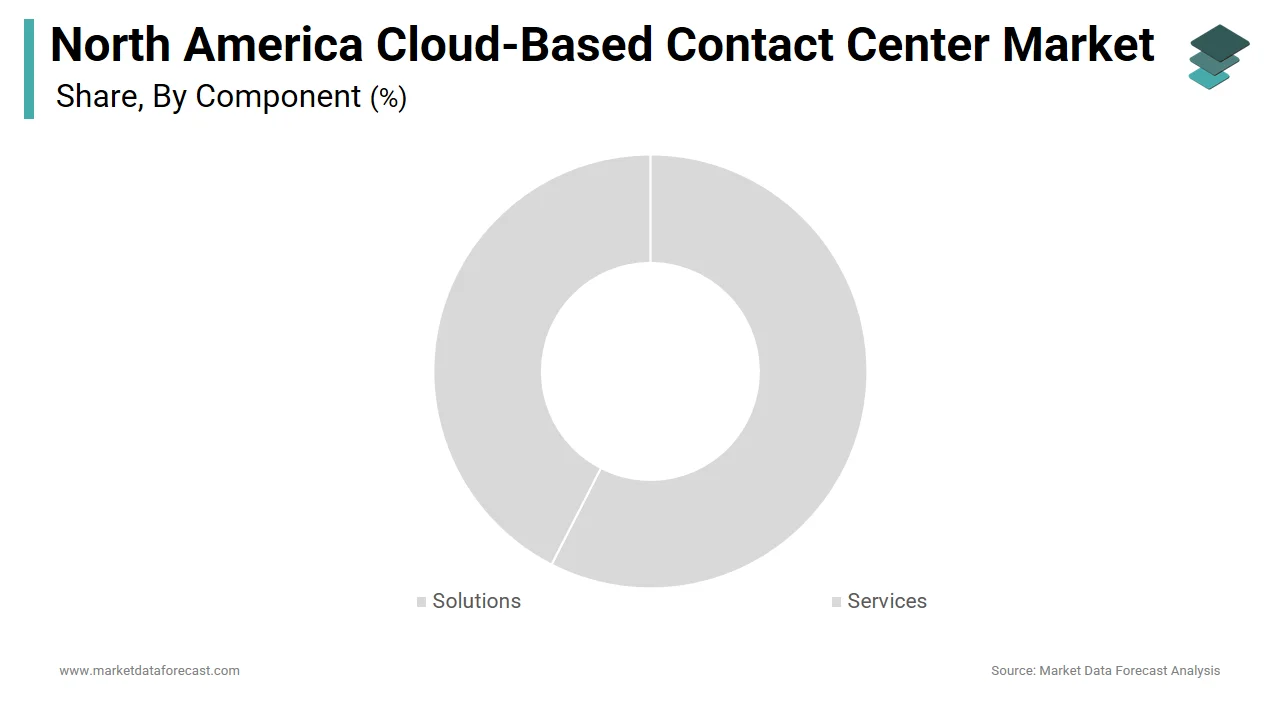
The solutions segment commanded the North America cloud-based contact center market by accounting for 55.1% of total revenue in 2025. The growing demand for unified communication platforms that streamline customer interactions across voice, chat, email, and social media channels is one key driver of the rise of the solutions segment. These platforms enable businesses to deliver personalized experiences while improving agent productivity through centralized dashboards and intelligent call routing. This dominance of the segment is also attributed to the increasing adoption of cloud-native customer engagement platforms that offer omnichannel support, real-time analytics, AI-driven automation, and seamless CRM integration.
In addition, the integration of artificial intelligence and machine learning capabilities into contact center solutions is another major factor. Vendors like Amazon Connect, Genesys, and Five9 have embedded NLP, sentiment analysis, and predictive routing into their offerings, further enhancing adoption.
Further, scalability and cost-efficiency are driving preference for cloud-based solutions over traditional on-premise systems. This economic advantage is particularly attractive to mid-sized companies looking to modernize their customer service operations without long deployment cycles.
The services segment is projected to grow at the fastest rate, with a CAGR of 14.6% from 2026 to 2034. The complexity involved in migrating legacy systems to cloud environments, especially for large enterprises with established IT infrastructures, is a primary driver of the services segment. This has led to increased reliance on third-party consultants and managed service providers. The growth of this segment is also fueled by the rising need for professional services such as system integration, consulting, training, and managed services to ensure successful implementation and ongoing optimization of cloud-based contact centers.
Moreover, the growing emphasis on continuous improvement and performance monitoring is boosting demand for managed services.
Lastly, the rise of AI and automation in customer engagement requires ongoing tuning and customization, which many companies outsource to specialized vendors.
By Deployment Insights
The public cloud deployment model segment led the North America cloud-based contact center market by capturing 52.6% of total revenue in 2025. Cost-effectiveness and pay-as-you-go pricing model associated with public cloud services is one key driver of the public cloud deployment model segment. Unlike private cloud or on-premise deployments, public cloud eliminates the need for dedicated hardware, software licenses, and internal IT management.
The availability of fully managed, AI-enhanced contact center platforms offered by leading providers is another contributing factor. Companies like AWS, Microsoft, and Google provide scalable, secure, and feature-rich environments that integrate seamlessly with other enterprise applications. Deloitte highlights that public cloud platforms now offer advanced capabilities such as conversational AI, sentiment analysis, and omnichannel routing, making them suitable even for complex customer service needs.
The leading position of this segment is also driven by its affordability, scalability, and ease of deployment, making it an ideal choice for businesses seeking rapid digital transformation without heavy upfront investment.
Furthermore, the shift toward remote work and distributed teams has accelerated public cloud adoption, as employees can access contact center tools from any location with internet connectivity.
The hybrid cloud deployment segment is expected to register the highest CAGR of 15.2% between 2026 to 2034.
One major factor behind this trend is the need to comply with data sovereignty and regulatory requirements. Many financial institutions and healthcare providers must store sensitive customer data within specific geographic boundaries, prompting them to adopt hybrid models that allow selective use of private clouds for critical data while leveraging public clouds for non-sensitive operations.
Enterprises' desire to balance the flexibility of public cloud with the security and control of private cloud infrastructure, particularly in highly regulated industries such as finance, healthcare, and government, is also driving the growth of this segment.
The increasing complexity of customer engagement workflows, which often require integration with both internal legacy systems and external SaaS applications, is another key driver. The hybrid model enables organizations to maintain control over core data while benefiting from the agility and innovation of public cloud-based contact center tools. As per Capgemini, hybrid cloud environments support seamless integration with CRM, ERP, and analytics platforms, ensuring a cohesive customer experience.
Lastly, business continuity and disaster recovery capabilities are strengthening the appeal of hybrid deployments. With redundant data storage and failover mechanisms spread across multiple environments, enterprises can ensure uninterrupted service even during outages.
By Organization Insights
The large organizations segment spearheaded the North America cloud-based contact center market by holding a 57.4% of total revenue in 2025. The need for scalable and reliable customer engagement platforms that can handle thousands of concurrent interactions across multiple channels is one key driver of the large organizations segment. These platforms allow large firms to automate routine inquiries, personalize interactions, and route calls intelligently based on customer history and agent availability.
In addition, the adoption of omnichannel strategies to enhance customer experience is another important factor. Large enterprises are integrating voice, email, chat, SMS, and social media into a single interface, enabling seamless transitions between touchpoints. According to Salesforce, customers engaging across three or more channels report 90% higher satisfaction levels, encouraging major brands to invest heavily in cloud-based solutions that support this approach.
The prowess of this segment is also driven by the extensive customer bases, complex service requirements, and high volume of interactions handled by enterprises in sectors such as banking, telecommunications, and retail.
Apart from these, regulatory compliance and data security concerns are pushing large firms to partner with enterprise-grade cloud providers offering robust encryption, access controls, and audit trails. As per IBM’s Cost of a Data Breach Report, data breaches in large enterprises cost an average of $4.45 million in 2023, highlighting the importance of secure cloud contact center environments.
Small and Medium-Sized Organizations (SMEs)
The small and medium-sized organization (SME) segment is emerging as the fastest-growing category, with a projected CAGR of 16.1% during the forecast period. The rapid expansion of this segment is driven by the increasing accessibility of affordable cloud-based contact center solutions tailored for budget-conscious businesses.
An additional key driver is the decline in entry barriers due to subscription-based pricing models and plug-and-play deployment options. Unlike traditional on-premise systems that require significant capital expenditure, cloud-based solutions offer low-cost, scalable alternatives with minimal setup time.
The rising need for competitive differentiation through superior customer service is another factor. SMBs are recognizing that delivering fast, personalized support can significantly impact brand loyalty and sales conversion.
Moreover, the proliferation of e-commerce and digital customer engagement channels is fueling demand among smaller retailers, startups, and service providers.
COUNTRY LEVEL ANALYSIS
United States Cloud-Based Contact Center Market Insights
The United States commanded the North America cloud-based contact center market by estimated at 76.6% in 2025. As the most developed economy in the region, the U.S. benefits from a mature digital ecosystem, widespread adoption of AI-driven customer engagement tools, and a strong presence of global cloud technology providers. A key growth driver is the rapid digital transformation across major industries such as finance, healthcare, retail, and telecom, all of which rely heavily on cloud-based customer interaction platforms.
Besides, strong venture capital and corporate investment in customer experience technologies is fostering innovation. Companies like Twilio, Zendesk, and Dialpad are continuously expanding their cloud offerings to meet evolving business demands.
Urbanization and the rise of e-commerce and digital banking are also shaping market dynamics. As consumer expectations for instant, personalized support grow, so does the demand for sophisticated cloud-based contact center solutions.
Lastly, regulatory frameworks supporting data privacy and cybersecurity are influencing vendor strategies. The California Consumer Privacy Act (CCPA) and federal guidelines encourage the development of compliant cloud platforms, ensuring trust and adoption across industries.
Canada Cloud-Based Contact Center Market Insights
Canada maintains a robust market supported by progressive digital transformation policies and growing investments in AI-enabled customer engagement solutions. A major growth factor is the expansion of cloud adoption in the public sector and regulated industries, including healthcare, banking, and government services. Provincial governments have also embraced digital initiatives aimed at streamlining public inquiries and support services. Another key driver is the presence of a well-developed IT services industry, which supports rapid deployment and integration of cloud-based contact centers. Toronto, Montreal, and Vancouver serve as major tech hubs where local and international vendors offer customized cloud solutions tailored to Canadian regulatory and linguistic requirements.
Moreover, Canadian businesses are increasingly prioritizing customer experience metrics, leading to greater investment in omnichannel platforms. Salesforce pointed out that Canadian consumers expect seamless support across voice, chat, and social media, aligning with broader trends seen in the U.S. This has prompted banks, telecom providers, and retailers to upgrade their contact center infrastructure accordingly.
Lastly, data residency and compliance considerations are shaping cloud deployment strategies, particularly in sectors like finance and healthcare. Canadian privacy laws, such as PIPEDA, encourage the use of hybrid cloud models that allow businesses to maintain control over sensitive information while still benefiting from cloud agility and scalability.
Rest of North America Cloud-Based Contact Center Market Insights
The Rest of North America (RoNA), which includes Mexico and Central American territories, represents a smaller but rapidly evolving segment, holding a notable portion of the regional market share. Though currently less developed compared to the U.S. and Canada, RoNA presents significant future growth potential. One key driver is the expansion of foreign direct investment (FDI) in manufacturing and logistics hubs. Countries like Mexico have become attractive destinations for multinational corporations setting up production facilities. As per the Mexican Ministry of Economy, FDI inflows reached $38 billion in 2023, much of it directed toward automotive and electronics manufacturing, which require advanced fire protection systems.
Moreover, urbanization and infrastructure modernization efforts are gaining traction. However, limited regulatory enforcement and lower public awareness remain challenges. Unlike the U.S. and Canada, fire safety standards in parts of RoNA are not uniformly applied or rigorously enforced.
Despite these challenges, international collaborations and technology transfers are helping bridge the gap. Companies like Tyco Fire Protection and Halma have expanded operations into Mexico, offering localized fire safety solutions and training programs to enhance market readiness.
KEY MARKET PARTICIPANTS
The key market players in the North America cloud-based contact center market include Genesys Telecommunications Laboratories, Inc., Ameyo, Aircall SAS, RingCentral, Inc., Amazon Web Services, Inc., Metaswitch Networks Ltd., Vocalcom Group, Cisco Systems, Inc., Five9, Inc., Oracle Corporation, Exotel Techcom Pvt. Ltd., TCN, Inc., Avaya Inc., NICE Ltd., Tata Consultancy Services Limited, 3CLogic Software, Inc., Aspect Software, Inc., Talkdesk, Inc., Worldline, 8x8, Inc., and others.
TOP LEADING PLAYERS IN THE MARKET
- Amazon Web Services plays a pivotal role in the North America cloud-based contact center market through its Amazon Connect platform, a scalable and AI-integrated customer service solution. AWS enables businesses to deploy contact centers quickly without the burden of managing complex infrastructure. Its global presence and integration with other AWS services, such as machine learning and analytic,s make it a leader in enabling intelligent, data-driven customer engagement strategies across industries.
- Genesys is a leading provider of cloud-based contact center solutions, offering a comprehensive suite of tools designed to enhance customer experience through omnichannel engagement, automation, and AI-powered insights. The company’s PureCloud and PureEngage platforms are widely adopted by enterprises seeking flexible, secure, and high-performance communication systems. Genesys contributes globally by setting benchmarks for innovation, particularly in AI-driven routing, workforce engagement management, and real-time analytics tailored for modern customer service demands.
- Five9 is a dominant player in the North American cloud contact center space, known for delivering a fully integrated, cloud-native platform that supports voice, chat, email, and social media interactions. The company has been instrumental in driving the shift from legacy on-premise systems to cloud-based models, especially among mid-sized enterprises. Five9’s focus on scalability, ease of deployment, and deep CRM integrations has made it a preferred choice for organizations aiming to deliver seamless customer experiences while reducing operational complexity.
TOP STRATEGIES USED BY KEY MARKET PARTICIPANTS
A primary strategy employed by key players in the North America cloud-based contact center market is deepening AI and automation capabilities, where companies are embedding natural language processing, sentiment analysis, and predictive routing into their platforms to enhance customer interactions and reduce agent workload.
Another key approach is expanding strategic partnerships and ecosystem integrations, allowing vendors to offer seamless compatibility with major CRM, analytics, and enterprise software platforms, thereby increasing their value proposition and adoption rates across industries.
Lastly, investing in vertical-specific solutions has become a dominant trend, with vendors tailoring their offerings for healthcare, finance, retail, and government sectors to meet unique compliance, workflow, and customer engagement needs, ensuring long-term client retention and differentiation in a competitive landscape.
COMPETITION OVERVIEW
The competition in the North America cloud-based contact center market is highly dynamic, shaped by rapid technological advancements, evolving customer expectations, and the increasing convergence of artificial intelligence with customer engagement platforms. The market features a mix of global tech giants, specialized cloud contact center providers, and emerging startups, all vying for dominance through innovation, strategic alliances, and enhanced service portfolios. Incumbent players are leveraging their brand strength and existing customer relationships to integrate next-generation capabilities like conversational AI, omnichannel routing, and real-time analytics, while newer entrants are focusing on niche offerings and agile deployment models to capture market share.
Customer-centricity remains at the heart of competitive differentiation, with businesses demanding solutions that not only streamline operations but also personalize interactions across multiple touchpoints. This has led to intensified investment in AI-driven automation, workforce optimization tools, and cloud-native architectures that support scalability and resilience. Further, the growing emphasis on regulatory compliance, data security, and hybrid cloud deployments is influencing vendor strategies, compelling companies to tailor their offerings for specific industry verticals.
As digital transformation accelerates across sectors, the battle for leadership is increasingly being defined by the ability to deliver intelligent, flexible, and secure customer engagement ecosystems. This evolving landscape fosters both collaboration and rivalry, ensuring that innovation remains the cornerstone of market progression.
RECENT MARKET DEVELOPMENTS
- In January 2024, Genesys announced the launch of a new AI-powered virtual agent solution, designed to enhance self-service capabilities and improve customer interaction efficiency across voice and digital channels, reinforcing its position in the intelligent contact center space.
- In March 2024, Amazon Web Services expanded the integration capabilities of Amazon Connect, introducing native connectors for leading CRM platforms to streamline data flow and improve agent productivity, strengthening its appeal for enterprise clients seeking seamless workflows.
- In May 2024, Five9 partnered with a leading cybersecurity firm to embed advanced threat detection and data encryption features into its cloud contact center platform, addressing rising concerns over customer data protection and compliance in regulated industries.
- In August 2024, Cisco acquired a conversational AI startup specializing in multilingual chatbots, enhancing its Webex Contact Center offering and expanding its reach in North America’s growing omnichannel customer engagement market.
- In November 2024, Twilio introduced a modular contact center solution tailored for mid-market businesses, offering customizable components and pre-built integrations aimed at accelerating deployment and lowering total cost of ownership for smaller enterprises.
MARKET SEGMENTATION
This research report on the North American cloud-based contact center market has been segmented and sub-segmented based on the following categories.
By Component
- Solutions
- Interactive Voice Response (IVR)
- Automatic Call Distribution
- Computer Telephony Integration (CTI)
- Call Recording
- Reporting and Analytics
- Dialer
- Workforce Optimization
- Customer Collaboration
- Others
- Services
- Professional Services
- Managed Services
By Deployment
- Public
- Private
- Hybrid
By Organization Size
- Large Enterprises
- Small and Medium-Sized Enterprises
By Vertical
- Banking, Financial Services, and Insurance
- ITES
- IT and Telecom
- Government
- Healthcare
- Consumer Goods and Retail
- Travel and Hospitality
- Media and Entertainment
- Others
By Country
- United States
- Canada
- Mexico
- Rest of North America