- Product Description Description
- Table of Contents TOC
- List of Table & Figure LOT
- Get Free Sample PDF Sample PDF
Market Size, 2025
$120.76 MnMarket Estimate, 2026
$125.60 MnMarket Forecast, 2034
$172.02 MnCAGR, 2026–2034
4.01%Executive Summary: North America Coffee Roaster Market
- Market Scope: Regional analysis of North America's coffee roaster sector, detailing energy sources, volume capacities, product types, applications, and country-level profiles across the US, Canada, and Mexico.
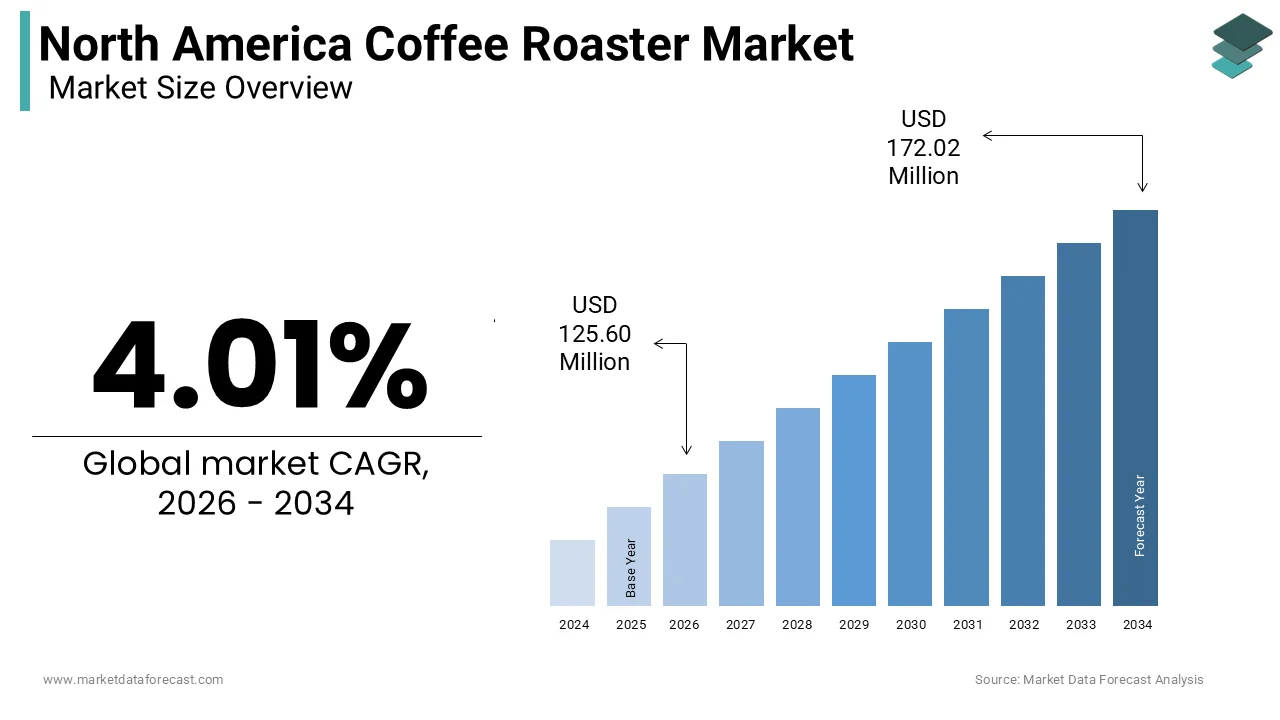
- Market Valuation: Valued at USD 120.76 million in 2025, reaching USD 125.60 million in 2026, and projected to expand to USD 172.02 million by 2034, growing at a robust CAGR of 4.01% from 2026 to 2034.
- Primary Growth Drivers: Rising demand for fresh and aromatic coffee beans, expansion of small-scale commercial roasting shops, and a shift toward home roasting for ultimate flavor control and freshness.
Key Market Segment Metrics
| Category | Leading Segment (Base Position) | Fastest-Growing / High-Growth Segment |
|---|---|---|
| By Energy Source | Electric (dominated base market share due to ease of use in home and small-scale settings) | Gas (high-growth segment driven by high-capacity commercial and industrial factory roasters) |
| By Volume Capacity | Large Scale (held primary share through extensive commercial and factory roasting operations) | Home Use & Small Scale (fastest-growing segment propelled by consumer interest in fresh-batch roasting) |
| By Product Type | Drum Roasters (dominated market adoption due to even heat distribution and consistent batch processing) | Hot Air / Fluid Bed Roasters (high-growth segment favored for quick, clean, and uniform roasting profiles) |
| By Application | Coffee Shop & Factory (captured major market share supported by widespread commercial café culture) | Household (fastest-growing application driven by artisanal coffee enthusiasts roasting at home) |
| By Region | United States (market leader backed by a massive consumer base, mature café networks, and high demand for specialty brews) | Canada & Mexico (key high-growth regional markets driven by growing urban specialty coffee trends) |
Major Market Players & Industry Landscape
Market Structure: Competitive manufacturing landscape featuring precision engineering firms, industrial equipment suppliers, and niche brands catering to home roasters and artisanal cafes.
Key Companies: Giesen, Toper, Genio, Probat, Nesco, Sonofresco, Ambex, Behmor, Discaf, and Hottop.
 Download Free Sample Report
North America Coffee Roaster Market Size
The size of the North American coffee roaster market was expected to be worth USD 120.76 million in 2025 and is anticipated to be worth USD 172.02 million by 2034, from USD 125.60 million in 2026, growing at a CAGR of 4.01% during the forecast period.
Roasting coffee beans changes the chemical and physical properties of green coffee beans. Roasting helps bring out the flavor of the beans by causing them to expand and change color, taste, and smell. As green coffee is more stable than roasted, the roasting process tends to take place close to where it will be consumed. This reduces the time that roasted coffee spends in distribution, giving it a longer shelf life. The vast majority of coffee is roasted commercially on a large scale, but some coffee drinkers who roast coffee at home have more control over the freshness and flavor profile of the beans.
Many consumers are now switching to home roasting the beans as they want to experience the complete freshness of the coffee bean. Home roasting has the advantage of being able to roast smaller volumes of coffee to match consumption so that the roasted coffee can be used before it goes stale.
The major driver for the coffee roaster market is the increasing consumer base demanding fresh and aromatic coffee using the roasting process. Mostly the coffee roasting is performed at large scale, but in the past few years small scale coffee roasting shops have grown significantly. A major restraint is the limited and short shelf life of these beans as they start loosing flavor after a certain period of time. Moreover, wide usage of instant coffee powders barricades the market growth, as they reduce the time of roasting and grinding.
This research report on the North American coffee roaster market is segmented and sub-segmented into the following categories.
North American Coffee Roaster Market By Energy Source
- Electric
- Gas
NorthAmericana Coffee Roaster Market By Volume Capacity
- Large
- Medium
- Small Scale
- Home Use
NortAmericanca Coffee Roaster Market By Product Type
- Drum
- Hot Air
- Stove Top
- Others
NorAmericanica Coffee Roaster Market By Application
- Factory
- Coffee Shop
- Household
NoAmericanrica Coffee Roaster Market By Region
- US
- Canada
- Mexico
- Rest of North America
North America holds a major market share in the global market. In North America people generally prefer instant coffee which is prepared at home.
KEY MARKET PLAYERS
Major Key Players in the North America Coffee Roaster Market are Giesen, Toper, Genio, Probat, Nesco, Sonofresco, Ambex, Behmor, Discaf, and Hottop