- Product Description Description
- Table of Contents TOC
- List of Table & Figure LOT
- Get Free Sample PDF Sample PDF
Market Size, 2025
$2.85 BnMarket Estimate, 2026
$3.03 BnMarket Forecast, 2034
$4.99 BnCAGR, 2026–2034
6.43%North America Commercial Boiler Market Size
The North America commercial boiler market size was valued at USD 2.85 billion in 2025 and is anticipated to reach USD 3.03 billion in 2026 from USD 4.99 billion by 2034, growing at a CAGR of 6.43% during the forecast period from 2026 to 2034.
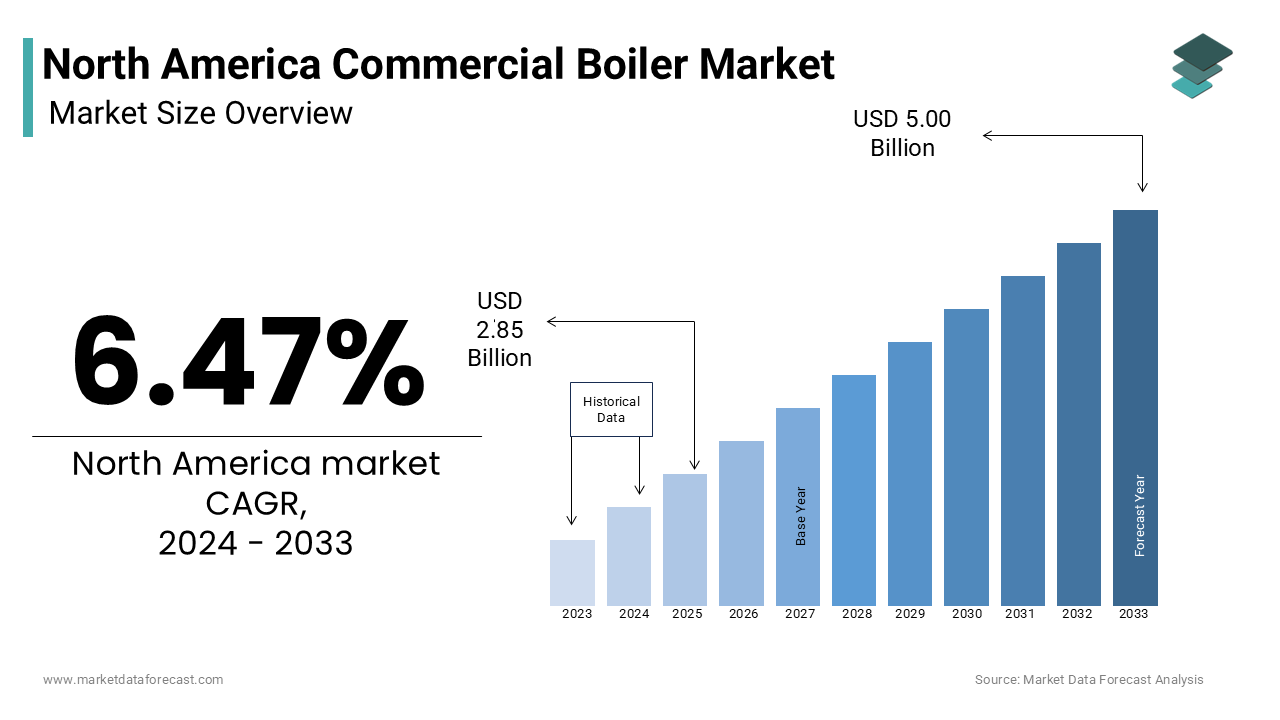
The commercial boiler is designed to generate steam or hot water for heating, power generation, and industrial processes in non-residential buildings such as hospitals, schools, hotels, office complexes, and retail centers. These boilers are essential for maintaining thermal comfort, supporting HVAC operations, and facilitating energy-efficient building management across the region.
MARKET DRIVERS
Rising Demand for Energy Efficiency in Commercial Buildings
The growing demand for energy-efficient heating systems in commercial facilities is promoting the growth of the North America commercial boiler market. According to the American Council for an Energy-Efficient Economy (ACEEE), upgrading to high-efficiency boilers can reduce natural gas consumption in commercial buildings by up to 30% annually, making them a financially attractive investment over time. In addition, green building certifications such as LEED (Leadership in Energy and Environmental Design) have incentivized the adoption of energy-efficient boilers in new constructions and retrofits. The U.S. Green Building Council reported that over 4.5 billion square feet of commercial space was LEED-certified by mid-2023.
Aging Infrastructure and Increasing Retrofitting Activities
The aging infrastructure in both the U.S. and Canada, which has spurred extensive retrofitting and replacement activities is propelling the growth of the North America commercial boiler market. Many commercial buildings constructed before the 1990s still operate with outdated boiler systems that are inefficient, costly to maintain, and often non-compliant with current environmental regulations. As per the National Institute of Building Sciences (NIBS), approximately 60% of commercial buildings in the U.S. were constructed before 198, meaning their heating systems are nearing or have surpassed their typical lifespan of 25–30 years. Furthermore, municipal initiatives such as New York City’s Local Law 97, which imposes carbon emission limits on large buildings, have accelerated the pace of boiler replacements. Similar legislation in California and Ontario has also encouraged property owners to upgrade to cleaner and more efficient heating technologies.
MARKET RESTRAINTS
High Initial Investment and Installation Costs
The high initial investment required for purchasing and installing modern, high-efficiency boiler systems is hampering the growth of the North America commercial boiler market. According to the U.S. Department of Energy (DOE), replacing a commercial boiler can cost anywhere between $25,000 and $250,000, depending on the system size, type, and integration requirements. AMoreover, economic uncertainty and fluctuating interest rates have made financing options less accessible for some business owners. As per survey conducted by the National Association of Home Builders (NAHB) in 2023, over 40% of commercial property managers delayed boiler replacements due to budget constraints.
Regulatory and Environmental Compliance Pressures
The tightening of environmental regulations aimed at reducing greenhouse gas emissions and air pollutants is also restricting the growth of the North America commercial boiler market. Federal and state-level agencies such as the U.S. Environmental Protection Agency (EPA) and Environment and Climate Change Canada (ECCC) have introduced stringent emissions standards that impact boiler selection and operation.
For instance, the EPA’s Clean Air Act mandates strict limits on nitrogen oxide (NOx) emissions, compelling commercial entities to invest in low-emission boiler technologies. Similarly, states like California and Massachusetts have enacted laws requiring ultra-low NOx emissions for new boiler installations, increasing equipment complexity and cost.
MARKET OPPORTUNITIES
Adoption of Smart and Connected Boiler Systems
The increasing adoption of smart and connected boiler systems that integrate with building automation and energy management platforms is likely to setup new opportunities for the North America commercial boiler market. These intelligent systems leverage IoT-enabled sensors, cloud analytics, and remote monitoring capabilities to enhance operational efficiency, predictive maintenance, and real-time diagnostics. Smart boilers allow facility managers to adjust settings dynamically based on occupancy patterns, weather conditions, and energy pricing fluctuations, thereby optimizing performance and reducing utility bills. Additionally, the rise of digital twin technology where virtual replicas of physical boiler systems enable simulation-based optimization is gaining traction in the industry. Companies such as Siemens and Johnson Controls have launched AI-powered energy management solutions that interface directly with commercial boilers.
Expansion of District Energy and Cogeneration Systems
The growing deployment of district energy and combined heat and power (CHP) systems are to escalate the growth of the North America commercial boiler market. District heating networks supply thermal energy from centralized plants to multiple buildings, improving efficiency and reducing individual boiler requirements in dense urban areas. CHP systems, which simultaneously generate electricity and useful heat, are increasingly adopted in commercial and institutional campuses for their energy-saving potential. According to the International District Energy Association (IDEA), over 200 district energy systems were operational across North America in 2023, serving universities, hospitals, and downtown business districts. Moreover, government incentives for CHP installations, such as those offered by the U.S. Department of Energy’s CHP Technical Assistance Partnerships (TAPs), have encouraged greater adoption. The DOE estimates that CHP systems can achieve efficiencies exceeding 80%, compared to conventional separate production methods.
MARKET CHALLENGES
Supply Chain Disruptions and Component Shortages
The ongoing disruption in global supply chains concerning raw materials, electronic components, and specialized manufacturing inputs is to impede the growth of the North America commercial boiler market. The aftermath of the pandemic, coupled with geopolitical tensions and trade restrictions, has led to extended lead times and increased costs for boiler manufacturers. Additionally, semiconductor shortages have affected the availability of programmable logic controllers (PLCs) and digital thermostats used in modern commercial boilers. The U.S. Chamber of Commerce reported that in 2023, over 35% of HVAC equipment suppliers faced delivery delays exceeding six weeks, causing project postponements and procurement bottlenecks.
Skilled Labor Shortage in Installation and Maintenance Services
The shortage of skilled technicians and engineers trained in the installation, servicing, and troubleshooting of modern boiler systems is also to limit the growth of the North America commercial boiler market. According to the U.S. Bureau of Labor Statistics (BLS), employment of HVAC and boiler technicians grew by 8% in 2023. Furthermore, apprenticeship programs and vocational training initiatives have not kept pace with industry demands, resulting in a skills gap that hampers market growth.
SEGMENTAL ANALYSIS
By Fuel Insights
The natural gas segment dominated the North America commercial boiler market share in 2025 with the extensive pipeline infrastructure across the U.S. and Canada, ensuring reliable supply and stable pricing. According to the U.S. Energy Information Administration (EIA), over 85% of commercial buildings using fossil fuels for heating relied on natural gas in 2023 due to its efficiency and ease of access. Additionally, federal and state-level incentives promoting cleaner energy sources have further reinforced its adoption. The growing shift away from oil and coal-based boilers due to environmental concerns and stricter emissions regulations is additionally to fuel the growth of the segment.
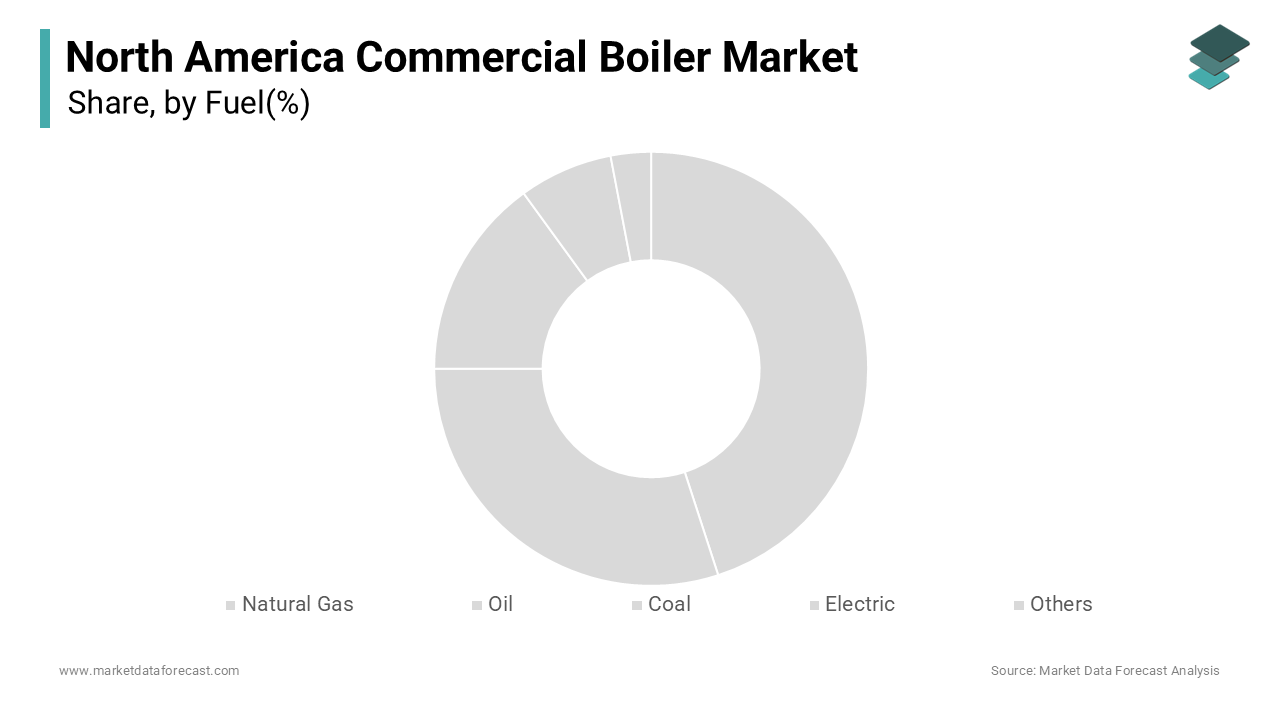
The electric segment is projected to grow with a CAGR of 6.8% during the forecast period due to the rise in renewable energy generation, particularly wind and solar power, which has made electric heating more sustainable and economically viable. According to the International Renewable Energy Agency (IRENA), renewable electricity accounted for nearly 30% of total U.S. power generation in 2023. Additionally, stringent emissions regulations in states like California and provinces like British Columbia have encouraged building owners to adopt zero-emission heating solutions.
By Technology Insights
The non-condensing segment was accounted in holding 58.4% of the North America commercial boiler market share in 2025 with the large number of legacy installations in older commercial buildings. As per the National Institute of Building Sciences (NIBS), over 60% of commercial structures in the U.S. were built before 1990, many of which still operate with conventional non-condensing boiler systems that are either too costly or logistically complex to replace. Additionally, certain industrial and institutional applications require higher steam temperatures that traditional non-condensing boilers can deliver more effectively than newer condensing models.
The Condensing segment is anticipated to register a CAGR of 7.4% from 2026 to 2034 with the tightening of federal and state-level efficiency standards. The U.S. Department of Energy (DOE) revised its minimum efficiency requirements for commercial boilers in 2023, mandating higher Annual Fuel Utilization Efficiency (AFUE) ratings that favor condensing technology. Moreover, the push for green building certifications like LEED and BREEAM has led developers to prioritize condensing boilers for their superior energy performance. The U.S. Green Building Council reported that in 2023, over 40% of newly constructed commercial buildings incorporated condensing boiler systems to meet sustainability benchmarks.
By Product Insights
The hot water segment held a significant share of the North America commercial boiler market in 2025 with the preference for low-pressure hot water systems in commercial heating applications due to their safety, efficiency, and ease of integration with radiant floor heating and fan coil units. According to the American Society of Heating, Refrigerating and Air-Conditioning Engineers (ASHRAE), over 70% of commercial HVAC retrofits in 2023 involved hot water boiler installations. Additionally, hot water boilers offer greater flexibility in terms of fuel options, including natural gas, propane, and electricity, making them suitable for diverse commercial environments.
The steam segment is expected to witness a CAGR of 6.2% during the forecast period. A key contributing factor is the resurgence of combined heat and power (CHP) systems in manufacturing, healthcare, and district energy networks. Steam boilers serve as the backbone of these systems by generating both electricity and usable heat, thereby improving overall energy efficiency. Furthermore, the pharmaceutical, chemical, and food processing industries rely heavily on steam for sterilization, pasteurization, and direct-contact heating processes.
REGIONAL ANALYSIS
The United States was the top performer in the North America commercial boiler market with 84.3% of share in 2025 with aging infrastructure and proactive government initiatives aimed at improving building energy efficiency. The U.S. Department of Energy (DOE) updated its efficiency standards for commercial boilers in 2023, pushing manufacturers and facility operators toward high-performance systems. Additionally, the Inflation Reduction Act (IRA) provided tax incentives for businesses investing in energy-efficient heating equipment, accelerating replacement cycles.
Canada commercial boiler market held 14.3% of share in 2024 due to reducing greenhouse gas emissions under the Pan-Canadian Framework on Clean Growth and Climate Change. Natural Resources Canada (NRCan) launched several incentive programs in 2023 to encourage commercial property owners to upgrade to high-efficiency condensing boilers and electrified heating solutions. Additionally, provinces like Ontario and British Columbia mandated stricter emissions standards for new boiler installations, aligning with broader net-zero targets. Moreover, Canada’s cold climate necessitates robust and efficient heating infrastructure, especially in densely populated urban centers such as Toronto, Montreal, and Vancouver.
KEY MARKET PLAYERS
The key players in the North America Commercial Boiler Market include
- Cleaver-Brooks
- A. O. Smith Corporation
- Fulton Boiler Works Inc.
- Parker Boiler Company
- Miura America Co.
- Weil-McLain
- Burnham Commercial
- Hurst Boiler & Welding Co., Inc.
COMPETITIVE LANDSCAPE
The competition in the North America commercial boiler market is characterized by a blend of global leaders, regional specialists, and emerging players focused on capturing market share through differentiation in efficiency, technology, and service offerings. While established brands like Bosch, Weil-McLain, and Viessmann dominate due to their extensive distribution networks and brand recognition, smaller manufacturers are leveraging niche innovations and localized support to gain traction.
Market participants are increasingly emphasizing energy-efficient solutions in response to tightening emissions regulations and growing demand for sustainable infrastructure. This has led to a shift toward condensing boiler technologies and smart system integrations that optimize energy use and improve user experience. At the same time, original equipment manufacturers (OEMs) are expanding their service portfolios to include predictive maintenance, remote diagnostics, and lifecycle support, further differentiating themselves in a competitive landscape.
Moreover, rising material costs, supply chain disruptions, and labor shortages have intensified pressure on pricing and delivery timelines. As a result, companies are focusing on vertical integration, automation, and strategic sourcing to maintain profitability while meeting the evolving needs of commercial clients across diverse sectors such as healthcare, education, hospitality, and institutional buildings.
Top Players in the North America Commercial Boiler Market
Bosch Thermotechnology is a division of Robert Bosch GmbH, is a leading player in the commercial boiler market, known for its high-efficiency condensing boilers and innovative heating solutions. The company offers a broad portfolio tailored for residential, commercial, and industrial applications. In North America, Bosch has built a strong reputation for reliability, energy efficiency, and smart integration capabilities that align with evolving building standards.
Weil-McLain is a subsidiary of Burnham Holdings, specializes in hydronic heating systems and is a key provider of commercial boilers across the United States and Canada. Weil-McLain is recognized for its durable cast iron boilers and commitment to sustainable heating technologies, including gas-fired and oil-fired models designed for both retrofitting and new construction projects.
Viessmann Manufacturing Company is a major global player with a significant presence in North America. Known for its engineering excellence and comprehensive product range, Viessmann delivers high-performance commercial boilers that integrate seamlessly into modern HVAC systems. The company emphasizes digitalization, energy efficiency, and environmental responsibility, positioning itself at the forefront of sustainable heating technology development and deployment in the region.
Top Strategies Used by Key Market Participants
The product innovation and technological advancement is a key strategy by the North America commercial boiler market players. Companies are continuously investing in R&D to develop high-efficiency condensing boilers, smart controls, and low-emission combustion technologies that meet evolving regulatory standards and customer expectations for sustainability.
The expanding service networks and after-sales support is also a strategy that can expand the portfolio of the companies. Recognizing the importance of long-term customer relationships, leading manufacturers are enhancing their technical support, maintenance programs, and parts availability to ensure optimal system performance and customer satisfaction across diverse commercial applications.
The strategic partnerships and acquisitions play a crucial role in strengthening market position. The companies can expand their reach, enhance local expertise, and offer integrated solutions that combine hardware, software, and energy management services tailored for commercial end-users by acquiring regional distributors or forming alliances with HVAC contractors and energy consultants.
RECENT MARKET DEVELOPMENTS
- In January 2024, Bosch Thermotechnology launched a new line of ultra-low NOx condensing boilers designed specifically for mid-sized commercial buildings. This initiative was aimed at helping facility managers comply with stricter air quality regulations while improving energy efficiency and reducing operational costs.
- In March 2024, Weil-McLain announced a partnership with a leading U.S. HVAC distributor to enhance its regional service network. The collaboration was intended to improve access to technical support, spare parts, and installation training for commercial boiler customers across multiple states.
- In June 2024, Viessmann introduced a cloud-based boiler monitoring platform that allows facility managers to remotely track system performance, schedule maintenance, and receive real-time alerts. This digital solution was developed to enhance customer engagement and extend product lifecycle value.
- In September 2024, Burnham Holdings acquired a specialty boiler manufacturer focused on custom-engineered steam systems. This acquisition was designed to strengthen Burnham’s presence in industrial and institutional markets where high-capacity boilers are essential for process heating and power generation.
- In November 2024, A.O. Smith expanded its commercial boiler production capacity in its Wisconsin facility to meet increasing demand for high-efficiency hot water systems. The investment was part of the company’s broader strategy to capitalize on the growing trend of electrification and decarbonization in commercial heating.
MARKET SEGMENTATION
This research report on the North American dietary supplements market is segmented and sub-segmented based on categories.
By Fuel
- Natural Gas
- Oil
- Coal
- Electric
- Others
By Capacity
- ≤ 0.3 - 2.5 MMBtu/hr
- 2.5 - 10 MMBtu/hr
- 10 - 50 MMBtu/hr
- 50 - 100 MMBtu/hr
- 100 - 250 MMBtu/hr
By Technology
- Condensing
- Non-Condensing
By Product
- Hot Water
- Steam
By Application
- Offices
- Healthcare Facilities
- Educational Institutions
- Lodgings
- Retail Stores
- Others
By Country
- The United States
- Canada
- Rest of North America