- Product Description Description
- Table of Contents TOC
- List of Table & Figure LOT
- Get Free Sample PDF Sample PDF
Market Size, 2025
$3.15 BnMarket Estimate, 2026
$3.40 BnMarket Forecast, 2034
$6.23 BnCAGR, 2026–2034
7.86%Executive Summary: North America Confectionery Ingredients Market
- Market Scope: North American confectionery ingredients market analysis covering ingredient types, ingredient forms, sourcing origins, application sectors, national leadership shares, and consumer-driven clean-label trends.
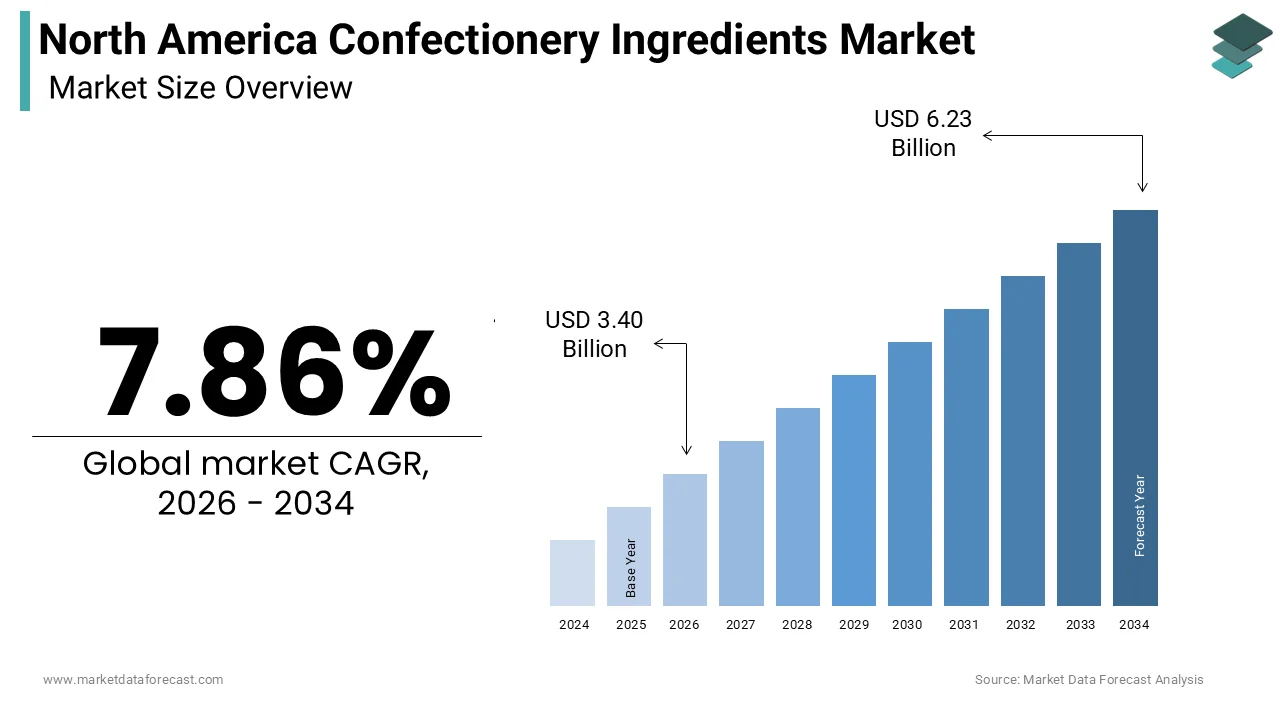
- Market Valuation: Valued at USD 3.15 billion (2025), estimated at USD 3.40 billion (2026), and forecast to attain USD 6.23 billion by 2034, registering a solid CAGR of 7.86% (2026–2034).
- Primary Growth Drivers: Escalating consumer demand for health-conscious, functional, premium, artisanal, and clean-label confectionery products. Key market and sourcing benchmarks include over 70% of premium chocolate brands in North America emphasizing traceable and eco-friendly sourcing, and functional foods containing botanical extracts and bioactive compounds achieving 18% sales growth.
Key Market Segment Metrics (2026–2034)
| Category | Leading Segment (2025 Position) | Fastest-Growing Segment |
|---|---|---|
| By Ingredient Type | Cocoa and chocolate ingredients (dominated with a 27.3% share in 2025) | Sweeteners and alternative functional sweetening agents (projected to grow at a 6.9% CAGR) |
| By Form | Dry-form ingredients (held the dominant market share) | Liquid-form ingredients (anticipated to grow at a 5.8% CAGR) |
| By Source Origin | Synthetic ingredients (accounted for 54.3% of the market in 2025) | Natural ingredients (forecast to expand at a 7.4% CAGR driven by clean-label preferences) |
| By Application Sector | Chocolate confectionery (led with a 41.2% share in 2025) | Chewing gum and specialized confectionery items (projected to grow at a 6.1% CAGR) |
| By Country / Region | United States (dominated with 82.1% of the market in 2025, followed by Canada with 14.2%) | North American regional markets shifting toward specialty artisan confectionery |
Major Market Players & Market Structure
Market Structure: Highly competitive North American confectionery ingredients marketplace featuring major global agricultural processors, food science corporations, and specialized ingredient manufacturers competing intensely on low-sugar and vegan formulations, product customization, strategic B2B partnerships, sustainable raw material sourcing, and clean-label innovation.
Key Companies: ADM Company, Cargill, Koninklijke DSM, Kerry Group, E. I. du Pont de Nemours and Company, Tate & Lyle, Arla Foods, Ingredion, Olam International, and Barry Callebaut.
North America Confectionery Ingredients Market Size
The North America Confectionery Ingredients Market size is assessed to be USD 3.15 billion in 2025, and is anticipated to be worth USD 6.23 billion by 2034, from USD 3.40 billion in 2026, growing at a CAGR of 7.86% during the forecast period.
The North American confectionery ingredients market encompasses a diverse range of components used in the production of chocolates, candies, gums, and other sweet treats. These ingredients include sugar, cocoa derivatives, starches, flavors, colors, preservatives, and functional additives such as emulsifiers and texturizers. As per NielsenIQ, more than half of American consumers now prioritize transparency in food labeling, pushing confectionery brands to adopt natural and recognizable ingredients. In response, suppliers are reformulating products using stevia, monk fruit extracts, beet-derived colors, and non-GMO stabilizers. Additionally, the rise of private label brands and artisanal confectionery producers is reshaping sourcing dynamics across the supply chain.
MARKET DRIVERS
Rising Demand for Health-Conscious and Functional Confectionery Products
A primary driver of the North America confectionery ingredients market is the increasing consumer preference for health-conscious and functional confectionery items. Traditional confectionery products have long been associated with high sugar content and artificial additives, but shifting attitudes toward wellness have led to a surge in demand for low-sugar, plant-based, and nutrient-enhanced alternatives. Moreover, the integration of adaptogens, vitamins, and probiotics into confectionery items is gaining traction among younger demographics seeking both indulgence and wellness benefits. For example, companies like SmartSweets and Zollipops have successfully launched gummies and candies fortified with fiber and collagen, contributing to the broader adoption of functional ingredients. This evolution in consumer behavior has directly influenced the confectionery ingredients supply chain, prompting suppliers to develop cleaner, safer, and more sustainable formulations tailored to contemporary tastes and health priorities.
Expansion of Premium and Artisanal Confectionery Brands
Another key driver fueling the North America confectionery ingredients market is the rapid expansion of premium and artisanal confectionery brands. Consumers are increasingly gravitating toward high-quality, small-batch, and ethically sourced confections, which require specialized and often more expensive ingredients compared to mass-produced alternatives. Artisan chocolate makers, bean-to-bar producers, and independent candy boutiques have flourished in urban centers across the U.S. and Canada, creating new demand for niche ingredients such as organic cocoa butter, fair-trade sugar, and natural flavor extracts.
In addition, sustainability and ethical sourcing have become critical differentiators for these brands. As reported by the Fine Chocolate Industry Association (FCIA), more than 70% of premium chocolate brands operating in North America now emphasize traceable and eco-friendly sourcing practices. This has increased the demand for certified organic and regeneratively grown raw materials, further stimulating the market for specialty confectionery ingredients. Furthermore, collaborations between artisan producers and ingredient suppliers have led to the development of unique textures, enhanced melt profiles, and improved shelf stability, supporting the growth of this premium segment and reinforcing its influence on the broader confectionery ingredients landscape.
MARKET RESTRAINTS
Regulatory Scrutiny and Ingredient Labeling Requirements
A significant restraint affecting the North America confectionery ingredients market is the tightening regulatory environment surrounding food labeling and ingredient transparency. Both the U.S. Food and Drug Administration (FDA) and Health Canada have implemented stricter guidelines regarding the use of synthetic additives, artificial colors, and misleading nutritional claims, which is forcing manufacturers to reformulate products or face compliance risks. According to the FDA’s 2023 Food Safety Modernization Act (FSMA) update, there has been an increase in enforcement actions against companies using unapproved color additives or making unsubstantiated health claims. This has particularly impacted smaller confectionery firms that lack the resources to navigate complex regulatory frameworks or invest in alternative ingredient sourcing. Additionally, the FDA’s updated Nutrition Facts labeling rule, effective from January 2021, mandates the disclosure of added sugars, compelling confectionery manufacturers to reassess their formulations.
Volatility in Raw Material Prices and Supply Chain Disruptions
Raw material price volatility and supply chain disruptions present another major challenge for the North America confectionery ingredients market. Key inputs such as cocoa, sugar, dairy fats, and natural flavorings are subject to fluctuating global prices due to climate conditions, geopolitical tensions, and trade restrictions. According to the International Cocoa Organization (ICCO), global cocoa prices surged by over 80% in 2023 due to poor harvests in West Africa, which supplies more than 70% of the world’s cocoa beans. Similarly, sugar prices in the U.S. have experienced upward pressure due to domestic policy interventions and import quotas under the U.S. Sugar Program. These fluctuations, coupled with ongoing logistical bottlenecks and labor shortages in freight and packaging sectors, have made it difficult for small and mid-sized confectionery businesses to maintain stable pricing and consistent product availability, thereby limiting market expansion potential.
MARKET OPPORTUNITIES
Growth of Plant-Based and Vegan Confectionery Products
A promising opportunity emerging in the North America confectionery ingredients market is the rising popularity of plant-based and vegan confectionery products. With increasing awareness around animal welfare, environmental sustainability, and personal health, consumers are actively seeking out confections free from dairy, gelatin, and other animal-derived ingredients. Ingredient suppliers are responding by developing dairy-free chocolate bases, vegan marshmallows, and gumdrops using alternatives such as oat milk, coconut oil, and agar-agar. Companies like Dandies and YumEarth have successfully leveraged these innovations to capture market share and attract investment. Furthermore, partnerships between confectionery ingredient providers and plant-based certification bodies such as Vegan Action and the European Vegetarian Union are helping to standardize product claims and build consumer trust.
Integration of Functional Ingredients in Confectionery for Wellness Benefits
Another significant opportunity in the North America confectionery ingredients market lies in the integration of functional ingredients designed to deliver wellness benefits beyond mere indulgence. Consumers are increasingly seeking confections that support mental clarity, immune function, sleep quality, and digestive health, which is driving demand for ingredients such as CBD, ashwagandha, L-theanine, and prebiotic fibers. According to the Council for Responsible Nutrition (CRN), sales of functional foods containing botanical extracts and bioactive compounds grew by 18% in 2023, with confectionery items representing a rapidly expanding category within this space.
Leading confectionery brands such as ChocXO and HigherDOSE have introduced dark chocolate bars infused with adaptogens and nootropics, catering to consumers looking for stress relief and cognitive enhancement through edible formats. Similarly, gummy candies fortified with collagen, magnesium, and vitamin D are gaining traction among health-conscious buyers.
This convergence of wellness and indulgence has prompted ingredient suppliers to collaborate with nutraceutical firms and research institutions to develop scientifically backed formulations that maintain sensory appeal while delivering measurable health benefits. As a result, the incorporation of functional ingredients into confectionery is expected to drive sustained innovation and market expansion in North America.
MARKET CHALLENGES
Balancing Clean-Label Demands with Product Stability and Shelf Life
One of the most pressing challenges facing the North America confectionery ingredients market is the need to balance clean-label demands with maintaining product stability and extended shelf life. Consumers increasingly expect confectionery products to be free from artificial preservatives, colors, and flavors, yet removing these ingredients can compromise texture, appearance, and longevity.
According to the Institute of Food Technologists (IFT), natural alternatives such as rosemary extract, vitamin E, and fermented sugar solutions are being explored to replace synthetic preservatives. However, these substitutes often come at a higher cost and may not provide the same level of microbial inhibition or oxidation resistance. These complexities create formulation hurdles for manufacturers striving to meet consumer expectations without sacrificing product integrity. Consequently, ingredient developers must invest heavily in R&D to optimize clean-label confectionery formulations that perform effectively throughout the supply chain.
Meeting the Rising Cost Expectations of Smaller Confectionery Producers
Another critical challenge confronting the North America confectionery ingredients market is the widening gap between the affordability of premium ingredients and the financial capacity of smaller confectionery producers. According to the Small Business Administration (SBA), nearly 40% of small-scale confectionery businesses in the U.S. cited ingredient cost inflation as a primary barrier to growth in 2023. Many of these businesses operate on thin margins and rely on cost-effective bulk purchasing, which is increasingly difficult as demand for ethically sourced and specialty ingredients rises. Furthermore, as larger players secure exclusive supply contracts with ingredient suppliers, small producers find themselves locked out of preferred pricing tiers and limited access to high-performance additives.
REPORT COVERAGE
| REPORT METRIC | DETAILS |
| Market Size Available | 2025 to 2034 |
| Base Year | 2025 |
| Forecast Period | 2026 to 2034 |
| CAGR | 7.86% |
| Segments Covered | By Type, Form, Source, Application, And Region |
| Various Analyses Covered | Global, Regional & Country Level Analysis; Segment-Level Analysis; DROC, PESTLE Analysis; Porter’s Five Forces Analysis; Competitive Landscape; Analyst Overview of Investment Opportunities |
| Regions Covered | Us, Canada, and the Rest of North America |
| Market Leaders Profiled | ADM Company, Cargill Inc, Koninklijke DSM N.V, Kerry Group, E. I. du Pont de Nemours and Company, Tate & Lyle PLC, Arla Foods, Ingredion Incorporated, Olam International, and Barry Callebaut |
SEGMENTAL ANALYSIS
By Type Insights
The cocoa and chocolate ingredients segment dominated the North America confectionery ingredients market by accounting for 27.3% of share in 2025. According to the National Confectioners Association (NCA), chocolate confectionery products accounted for nearly 48% of all candy sales in the U.S. in 2023. The high consumption rate of chocolate bars, truffles, filled chocolates, and premium dark chocolate variants has sustained strong demand for cocoa mass, cocoa butter, and chocolate liquor among manufacturers. Additionally, the rise of bean-to-bar chocolate producers and gourmet chocolate boutiques has further boosted the need for high-quality cocoa ingredients. Moreover, major chocolate companies like Mars, Hershey’s, and Lindt have continuously introduced new product lines incorporating unique textures and flavor infusions, necessitating advanced cocoa processing techniques.
The sweeteners segment is posing a lucrative CAGR of 6.9% in the next coming years. This growth is largely driven by the rising consumer preference for reduced-sugar and sugar-free confectionery options, spurred by health consciousness and regulatory pressure on added sugars. According to the Centers for Disease Control and Prevention (CDC), more than 40% of American adults are classified as obese, prompting a shift toward alternative sweeteners such as stevia, erythritol, monk fruit extract, and allulose. Furthermore, the U.S. Food and Drug Administration’s updated labeling requirements mandating the disclosure of “added sugars” have led many confectionery brands to reformulate their products using natural and non-nutritive sweeteners. Companies like SmartSweets and YumEarth have capitalized on this trend, introducing gummies and candies with zero or reduced sugar content while maintaining taste appeal.
By Form Insights
The dry-form confectionery ingredients segment held a dominant share of the North America confectionery ingredients market in 2025. The increasing adoption of dry-mix formulations in private-label and artisanal confectionery production has further reinforced this segment’s stronghold. Moreover, dry ingredients offer advantages in storage and transportation, making them a preferred choice for large-scale manufacturers and small-batch producers alike.
The liquid-form confectionery ingredients segment is likely to grow with an anticipated are CAGR of 5.8% in the next coming years. According to Mintel, there has been a notable rise in the introduction of chewy, gummy, and jelly confections enriched with CBD, collagen, and nootropic compounds all of which require liquid bases for optimal dispersion and consistency. In 2023 alone, over 120 new gummy confectionery products were launched in the U.S., many of which featured liquid-infused formulations. Another key factor is the growing use of liquid caramel, chocolate sauces, and invert sugar syrups in premium and artisanal confectionery applications. Furthermore, advancements in clean-label preservation and stabilization techniques have improved the shelf life and microbial safety of liquid ingredients, making them more viable for commercial use.
By Source Insights
The synthetic-source segment was the largest and held 54.3% of the North America confectionery ingredients market share in 2025. Additionally, artificial preservatives such as sodium benzoate and potassium sorbate play a crucial role in extending the shelf life of gummies, jellies, and soft candies, particularly in large-scale production environments. These additives help prevent microbial spoilage and maintain texture consistency over time. Moreover, synthetic sweeteners like aspartame, sucralose, and acesulfame-K are extensively used in sugar-free and diet confectionery products, catering to diabetic and weight-conscious consumers.
The natural-source segment in the North America market is likely to grow with a CAGR of 7.4% during the forecast period. This rapid growth is primarily fueled by shifting consumer preferences toward transparency, wellness, and sustainability, compelling manufacturers to replace synthetic additives with plant-based, organic, and minimally processed alternatives. According to a 2023 survey conducted by NielsenIQ, nearly 62% of U.S. consumers stated they actively seek out confectionery products labeled as “natural” or “clean label.” Furthermore, regulatory initiatives such as the FDA’s voluntary removal of certain synthetic dyes from children’s products have accelerated the transition toward natural-source ingredients. In addition, the rise of plant-based and vegan confectionery has further boosted demand for natural emulsifiers, stabilizers, and fats derived from sunflower, coconut, and algae sources.
By Application Insights
The chocolate segment was the largest and held 41.2% of the North America confectionery ingredients market share in 2025. The integration of premium, dark, and functional chocolate variants into wellness-focused and artisanal offerings has further expanded market reach. Moreover, the growing influence of direct-to-consumer (DTC) chocolate brands and subscription-based models has created new avenues for ingredient utilization. Additionally, chocolate is a core component of gifting, holiday promotions, and impulse buying, ensuring steady demand throughout the year.
The chewing gum segment is likely to grow with an anticipated CAGR of 6.1% in the next coming years. Nicotine pouches and CBD-infused gums have emerged as popular alternatives to smoking and vaping, driving demand for specialized gum base materials, encapsulated actives, and controlled-release ingredients. Furthermore, the shift toward sugar-free gum formulations has contributed to ingredient innovation.
REGIONAL ANALYSIS
United States Confectionery Ingredients Market Insights
The United States was the largest contributor with 82.1% of the North America confectionery ingredients market share in 2025. According to the National Confectioners Association (NCA), the U.S. confectionery industry generated over USD 36 billion in retail sales in 2023, with chocolate, gum, and sugar confections forming the bulk of this revenue. Additionally, the U.S. market is characterized by a growing emphasis on clean-label, functional, and plant-based confections, influencing ingredient supplier strategies.
Canada Confectionery Ingredients Market Insights
Canada confectionery ingredients market held 14.2% of the share in 2025. According to Statistics Canada, the country’s confectionery and chocolate manufacturing industry generated CAD 3.1 billion in revenue in 2023, with Quebec and Ontario serving as major production hubs. Canadian consumers exhibit a strong preference for locally made, sustainable, and ethically sourced confections, influencing ingredient choices and supplier partnerships. Furthermore, the rise of plant-based and sugar-free confectionery options has contributed to the demand for alternative sweeteners, dairy substitutes, and natural flavorings.
LEADING PLAYERS IN THE NORTH AMERICAN CONFECTIONERY INGREDIENTS MARKET
Cargill Incorporated
Cargill is a leading global supplier of confectionery ingredients with a strong presence in North America. The company offers a wide range of products including cocoa derivatives, chocolate coatings, sugar alternatives, and texturizing solutions. Cargill supports both large-scale manufacturers and artisan producers by providing customized formulations that align with evolving consumer preferences for clean-label and functional confections.
ADM (Archer Daniels Midland Company)
ADM is a major player in the North American confectionery ingredients market, offering a comprehensive portfolio that includes sweeteners, flavors, emulsifiers, and specialty fats. The company leverages its vast agricultural supply chain to deliver high-quality, traceable raw materials used in confectionery manufacturing. ADM focuses on developing plant-based and reduced-sugar ingredients to meet growing demand for healthier confectionery options. Its strategic partnerships and investment in food science help drive product differentiation and support clients in launching next-generation confections tailored to modern dietary trends.
Tate & Lyle PLC (North America Division)
Tate & Lyle is a key contributor to the North America confectionery ingredients sector, particularly in the development of alternative sweeteners and functional carbohydrates. The company provides sucralose, allulose blends, and starch-based texturizers that enhance taste and mouthfeel in low-sugar confections. With a focus on sustainability and nutrition, Tate & Lyle collaborates with confectionery brands to reformulate products while maintaining indulgence. Its expertise in sweetness modulation and formulation science makes it a preferred partner for companies aiming to innovate in the health-conscious confectionery space.
TOP STRATEGIES USED BY KEY MARKET PARTICIPANTS
One of the primary strategies employed by key players in the North America confectionery ingredients market is product innovation and customization, where companies continuously develop new formulations tailored to specific dietary preferences such as low-sugar, vegan, and functional confections. This approach allows them to cater to niche markets and stay ahead of shifting consumer expectations.
Another crucial strategy is strategic acquisitions and partnerships, wherein leading firms acquire or collaborate with smaller ingredient developers and research institutions to expand their capabilities and gain access to emerging technologies. These alliances help accelerate time-to-market for novel ingredients and strengthen supply chain resilience.
Sustainability and ethical sourcing initiatives have become central to brand positioning. Companies are investing in regenerative agriculture, carbon-neutral production processes, and transparent sourcing practices to align with consumer values and regulatory expectations, reinforcing long-term competitiveness in the evolving confectionery landscape.
KEY MARKET PLAYERS AND COMPETITIVE OVERVIEW
Major Players of the North America confectionery ingredients market include ADM Company, Cargill Inc, Koninklijke DSM N.V, Kerry Group, E. I. du Pont de Nemours and Company, Tate & Lyle PLC, Arla Foods, Ingredion Incorporated, Olam International, and Barry Callebaut
The competitive landscape of the North America confectionery ingredients market is highly dynamic, shaped by a mix of global giants, regional specialists, and emerging ingredient innovators. Market participants face increasing pressure to align with evolving consumer preferences, including the demand for transparency, health benefits, and environmental responsibility. Large multinational corporations dominate due to their extensive R&D capabilities, established supply chains, and ability to invest in advanced processing technologies. However, niche suppliers and boutique ingredient developers are gaining traction by catering to specialized needs such as plant-based formulations, functional enhancements, and clean-label compliance. The market is also witnessing heightened competition from private-label ingredient providers who offer cost-effective solutions without compromising quality. As confectionery manufacturers seek differentiation through unique textures, flavors, and wellness attributes, ingredient suppliers must continuously innovate and adapt. Regulatory scrutiny, fluctuating raw material costs, and the need for scalable production further intensify the competitive environment, pushing companies to explore strategic collaborations, vertical integration, and digital engagement strategies to maintain a strong foothold in this rapidly evolving sector.
RECENT HAPPENINGS IN THE MARKET
- In March 2025, Cargill announced the launch of a new line of sustainably sourced cocoa powders designed specifically for premium chocolate confections by enhancing flavor profiles while supporting farmer livelihoods through direct trade partnerships.
- In June 2025, ADM collaborated with a biotech startup to develop a proprietary fermentation-based sweetener aimed at replacing traditional sugar in gummy candies and chewy confections without altering texture or taste.
- In September 2025, Tate & Lyle introduced a co-branded suite of reduced-sugar confectionery kits targeted at small and mid-sized candy makers by enabling them to easily transition to healthier formulations with minimal process changes.
- In November 2025, a leading natural flavor supplier based in California expanded its production capacity to meet rising demand for plant-based flavoring solutions used in vegan chocolates and fruit candies.
- In January 2026, a U.S.-based ingredient manufacturer invested in a state-of-the-art pilot facility focused on encapsulation technology, which is allowing for better delivery of active ingredients in functional gum and lozenge applications.
DETAILED SEGMENTATION OF THE NORTH AMERICA CONFECTIONERY INGREDIENTS MARKET INCLUDED IN THIS REPORT
This research report on the North America Confectionery Ingredients Market has been segmented and sub-segmented based on type, form, source, application & region.
By Type
- Cocoa & Chocolate
- Dairy Ingredients
- Oils & Shortenings
- Others (Starch & Derivatives, Hydrocolloids, Emulsifiers, Malts, Sweeteners, Flavors)
By Source
- Synthetic
- Natural
By Form
- Dry
- Liquid
By Application
- Chocolate
- Sugar Confectionery
- Gum
- Others (Coating, Fillings, caramel, aerated confectionery)
By Region
- US
- Canada
- Mexico
- Rest of North America