- Product Description Description
- Table of Contents TOC
- List of Table & Figure LOT
- Get Free Sample PDF Sample PDF
Market Size, 2025
$6.17 BnMarket Estimate, 2026
$6.86 BnMarket Forecast, 2034
$16.04 BnCAGR, 2026–2034
11.20%Executive Summary: North America Crane Rental Market
- Market Scope: Comprehensive regional market analysis covering crane types, application sectors, country-level leadership frameworks, and infrastructure modernization/renewable energy metrics for the North American crane rental sector.
- Market Valuation: Valued at USD 6.17 billion (2025), estimated at USD 6.86 billion (2026), and projected to reach USD 16.04 billion by 2034, registering a robust CAGR of 11.20% (2026–2034).
- Primary Growth Drivers: Government investment in infrastructure modernization, renewable energy project expansions, transportation network rehabilitation, advanced crane tech adoption with real-time monitoring, and fleet optimization digital integrations. Market challenges include operator shortages and regulatory compliance costs, while opportunities lie in straddle crane container expansions, industrial manufacturing reshoring, and wind/solar energy installations.
Key Market Segment Metrics (2026–2034)
| Category | Leading Segment Position | Fastest-Growing Segment |
|---|---|---|
| By Crane Type / Application | Wheel-mounted mobile crane segment (dominated with 45.4% share in 2025) & Construction sector (held largest share with 64.6% demand in 2025) | Straddle crane segment (projected CAGR of 8.7% from 2025–2033) & Industrial applications segment (expected CAGR of 9.3%) |
| By Region / Country | United States (dominant force accounting for majority regional share in 2025 supported by industrial base and infrastructure needs) | Canada (maintains significant position driven by resource extraction and public infrastructure initiatives) |
Major Market Players & Market Structure
Market Structure: Highly competitive North American crane rental landscape centering on strategic heavy equipment rental acquisitions, authorized dealer partnerships, digital reservation platform rollouts, and advanced safety monitoring systems.
Key Companies: United Rentals, Inc., Maxim Crane Works, L.P., Caterpillar Inc., All Erection & Crane Rental Corp., Lampson International LLC, Buckner HeavyLift Cranes, Ahern Rentals Inc., American Equipment Company, Inc., Sunbelt Rentals, and HERC Rentals.
North America Crane Rental Market Size
The North America crane rental market was valued at USD 6.17 billion in 2025 and is anticipated to reach a valuation of USD 6.86 billion in 2026 and USD 16.04 billion by 2034, growing at a CAGR of 11.20%, from 2026 to 2034.
Crane rental is the commercial provision of various types of mobile, tower, and crawler cranes to construction, industrial, and infrastructure development projects temporarily. This specialized rental segment serves diverse end-users, including general contractors, utility companies, manufacturing facilities, and transportation organizations that require heavy lifting capabilities without the capital investment of purchasing equipment. The market operates through established rental companies, equipment dealers, and specialized crane service providers who maintain extensive fleets of certified lifting equipment ranging from small mobile cranes to massive lattice boom crawlers. The market's operational framework includes comprehensive safety protocols, certified operator services, equipment maintenance programs, and project-specific lifting solutions that ensure compliance with stringent occupational safety regulations. The complexity of modern construction projects, combined with increasingly stringent safety requirements and specialized lifting requirements, has made crane rental services essential for project completion across various industrial sectors throughout North America.
MARKET DRIVERS
Infrastructure Development and Government Investment
The substantial increase in infrastructure development projects across North America represents a primary catalyst propelling the crane rental market's expansion. Federal and state governments have committed unprecedented funding to modernize aging transportation networks, upgrade utility systems, and construct new public facilities that require extensive heavy lifting operations. Additionally, the American Society of Civil Engineers' 2023 Infrastructure Report Card assigned the United States a grade of C-, highlighting the urgent need for infrastructure rehabilitation that drives sustained demand for rental crane services. These substantial public investments create long-term demand visibility for crane rental companies, ensuring steady project pipelines and revenue generation opportunities.
Technological Advancement in Crane Equipment
Technological innovation in crane design and operation has emerged as a significant driver, enhancing the North America crane rental market's value proposition and operational capabilities. Modern rental cranes incorporate advanced safety systems, precision control mechanisms, and enhanced lifting capacities that exceed traditional equipment specifications, making them increasingly attractive to project managers seeking optimal performance and risk mitigation. The integration of computerized load moment indicatorsanti-two-blockck systems, and real-time monitoring capabilities has reduced accident rates. Additionally, the development of hybrid and electric crane technologies addresses growing environmental concerns while maintaining operational efficiency, with rental companies increasingly incorporating these advanced units into their fleets. Crane manufacturers have also developed modular designs that allow for rapid configuration changes, enabling single units to perform multiple lifting applications and reducing the need for specialized equipment rentals. These technological advancements create differentiation opportunities for rental companies while increasing customer willingness to pay for superior equipment performance and safety features.
MARKET RESTRAINTS
killed Operator Shortage and Training Requirements
The North American crane rental market faces significant operational constraints due to a critical shortage of certified crane operators and specialized rigging personnel. The complex nature of modern crane operations requires extensive training, certification, and ongoing skill development that creates supply limitations in the qualified workforce pool. Additionally, the certification process involves multiple specialized categories, including mobile cranes, tower cranes, and overhead cranes, each requiring distinct training programs and competency assessments that extend qualification timelines. Rental companies must invest significantly in operator training programs, safety certifications, and continuing education to maintain qualified personnel, increasing operational costs and limiting fleet utilization rates. These human resource limitations directly impact rental company profitability and service delivery capabilities, constraining market growth potential.
Stringent Safety Regulations and Compliance Costs
Comprehensive safety regulations and compliance requirements impose substantial operational burdens on North America crane rental market participants, creating financial and administrative constraints that limit market expansion. The Occupational Safety and Health Administration's updated crane safety standards require extensive documentation, regular equipment inspections, and mandatory safety protocols that increase operational complexity and administrative overhead for rental companies. Additionally, state and local jurisdictions impose supplementary safety requirements, inspection protocols, and permit processes that vary significantly across regions, creating operational inefficiencies and increased administrative burden for multi-state rental operators. Insurance requirements for crane rental operations have also intensified. Rental companies must maintain comprehensive safety management systems, conduct regular third-party inspections, and ensure continuous compliance with evolving regulatory standards that require substantial financial and personnel investments. These regulatory complexities create barriers to market entry for smaller operators while increasing operational costs for established companies, constraining overall market growth and profitability.
MARKET OPPORTUNITY
Renewable Energy Project Expansion
The accelerating development of renewable energy infrastructure across North America presents substantial growth opportunities for the crane rental market, particularly in wind and solar energy installation projects that require specialized heavy lifting capabilities. The transition to clean energy sources has created unprecedented demand for large-capacity cranes capable of handling wind turbine components, solar panel arrays, and associated electrical infrastructure installation. Wind energy projects alone require specialized lattice boom crawler cranes with lifting capacities exceeding 300 tons, with each turbine installation necessitating multiple heavy lifts over extended project timelines. Solar energy development projects similarly require extensive crane services for panel installation, mounting structure assembly, and electrical component placement. These renewable energy projects typically span several months and require continuous crane support, providing stable revenue opportunities and long-term contract potential for specialized rental operators.
Industrial Manufacturing and Process Plant Expansion
The resurgence of industrial manufacturing and process plant construction across North America creates significant expansion opportunities for crane rental market participants, particularly those offering specialized heavy lifting solutions for complex industrial applications. The reshoring of manufacturing operations and increased domestic production requirements have stimulated substantial investment in new production facilities, chemical processing plants, and automotive manufacturing centers that require extensive crane services during construction and ongoing maintenance phases. Petrochemical industry expansion projects, including new refinery construction and pipeline development, require specialized lattice boom cranes and heavy-lift capabilities that command premium rental rates and extended contract durations. Industrial maintenance activities, including equipment replacement, structural modifications, and facility upgrades, create ongoing demand for specialized crane services that extend beyond initial construction phases. These industrial projects typically involve long-term contracts and repeat business opportunities, offering stable revenue streams and enhanced customer relationships for qualified crane rental operators.
MARKET CHALLENGES
Equipment Maintenance and Fleet Management Complexity
The operational complexity of maintaining diverse crane fleets while ensuring optimal equipment performance represents a significant challenge for North America crane rental market participants, requiring substantial financial investment and technical expertise. Modern crane equipment incorporates sophisticated hydraulic systems, electronic controls, and precision components that demand specialized maintenance protocols, certified technicians, and extensive spare parts inventories to ensure reliable operation and regulatory compliance. The diversity of crane types within typical rental fleets, ranging from small mobile units to massive crawler cranes, creates logistical challenges in maintaining appropriate service capabilities and spare parts availability across multiple equipment categories. Additionally, the cyclical nature of construction demand creates equipment utilization fluctuations that complicate maintenance scheduling and resource allocation, often resulting in either underutilized service capacity or delayed maintenance activities that compromise equipment reliability. Rental companies must also navigate complex warranty requirements, manufacturer service agreements, and regulatory inspection schedules that vary by equipment type and age, creating administrative burdens that require specialized management systems and personnel resources. These maintenance and fleet management complexities directly impact operational efficiency and profitability while creating barriers to market expansion for smaller rental operators.
Economic Volatility and Project Funding Uncertainty
Economic fluctuations and project funding instability create significant operational challenges for North America crane rental market participants, affecting demand consistency, pricing power, and long-term business planning capabilities. The construction industry's sensitivity to economic cycles directly impacts crane rental demand, as project delays, cancellations, and scope reductions during economic downturns create revenue volatility and equipment utilization challenges. Interest rate fluctuations significantly impact project financing availability and construction project initiation rates. Additionally, commodity price volatility affects construction material costs and project economics, creating budget constraints that lead to equipment rental specification changes and cost reduction pressures that impact rental company profitability. Public sector project funding uncertainties, including budget allocation delays and political changes, create additional demand instability for crane rental services in infrastructure and government construction segments. Rental companies must maintain flexible pricing strategies, diverse customer portfolios, and adaptive operational models to navigate economic volatility while preserving profitability and market position. These economic uncertainties create planning difficulties and financial risks that constrain investment in fleet expansion and technological advancement initiatives.
REPORT COVERAGE
| REPORT METRIC | DETAILS |
| Market Size Available | 2025 to 2034 |
| Base Year | 2025 |
| Forecast Period | 2026 to 2034 |
| CAGR | 11.20% |
| Segments Covered | By Crane, Application, Country |
| Various Analyses Covered | Global, Regional and Country Level Analysis; Segment-Level Analysis; DROC; PESTLE Analysis; Porter’s Five Forces Analysis; Competitive Landscape; Analyst Overview of Investment Opportunities |
| Regions Covered | The United States, Canada, Mexico, Rest of North America |
| Market Leaders Profiled | United Rentals, Inc., Maxim Crane Works, L.P., Caterpillar Inc., All Erection & Crane Rental Corp., Lampson International LLC, Buckner HeavyLift Cranes, Ahern Rentals Inc. American Equipment Company, Inc. |
SEGMENT ANALYSIS
By Crane Insights
Wheel-mounted Mobile Crane
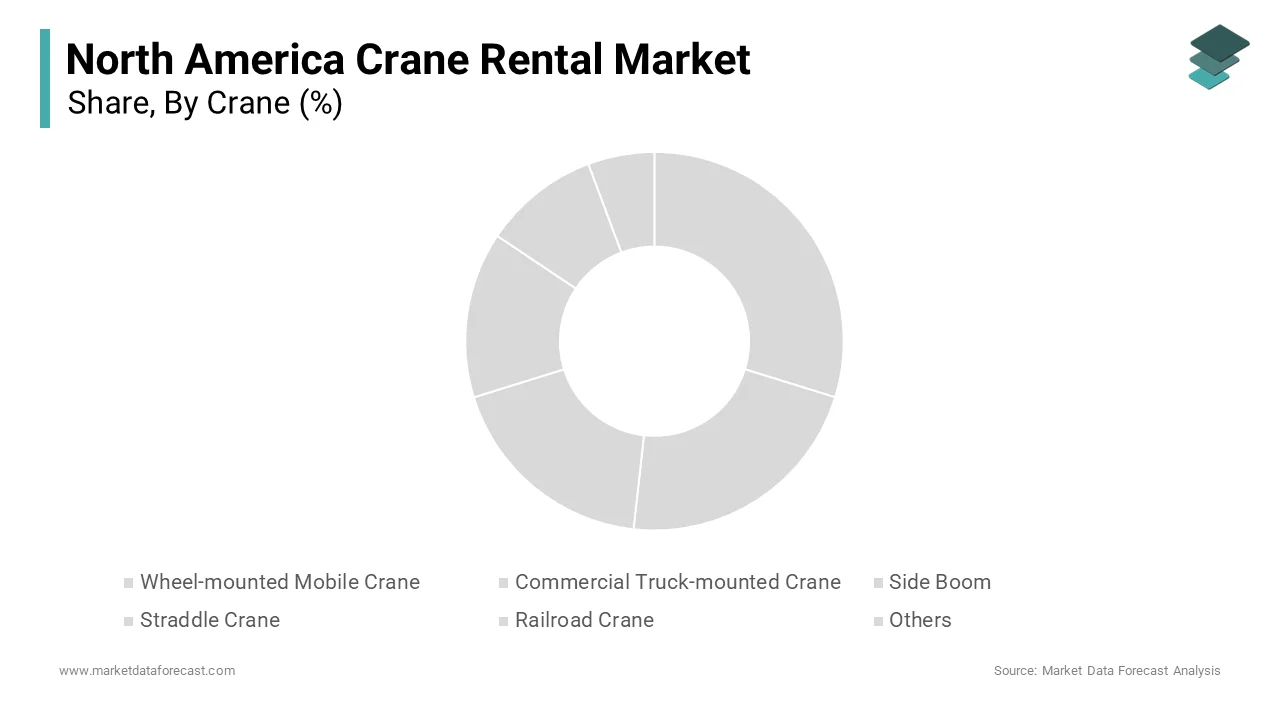
The wheel-mounted mobile cranes segment dominated within the North America crane rental market by commanding a 45.4% of the total share in 2025. This segment's lead position is due to the exceptional versatility, mobility, and operational efficiency that wheel-mounted cranes provide across diverse construction and industrial applications.
The exceptional mobility and rapid deployment capabilities of wheel-mounted mobile cranes make them indispensable for time-sensitive construction projects and multi-site operations throughout North America. These cranes can travel at highway speeds without requiring separate transport vehicles, significantly reducing mobilization time and transportation costs compared to crawler or truck-mounted alternatives. Construction project managers increasingly prefer these units for urban development projects where site access limitations and traffic considerations require quick setup and teardown operations. Additionally, the ability to self-propel between work sites eliminates the need for expensive transport services and specialized hauling permits, creating substantial cost savings for rental companies and end-users. These mobility advantages translate into higher rental demand, premium pricing opportunities, and enhanced operational efficiency that solidify wheel-mounted mobile cranes' market leadership position.
Wheel-mounted mobile cranes offer exceptional versatility in lifting applications and capacity ranges, making them suitable for diverse project requirements across multiple industry segments throughout North America. These cranes are available in lifting capacities ranging from 25 tons to over 500 tons, accommodating everything from small commercial construction tasks to major infrastructure projects requiring substantial lifting capabilities. The construction industry's preference for multi-purpose equipment has driven rental companies to expand their wheel-mounted mobile crane fleets. Urban construction projects particularly benefit from wheel-mounted mobile cranes' compact footprints and precise positioning capabilities, enabling operations in congested work environments where space limitations restrict larger crane installations. Additionally, these cranes' compatibility with various attachments and specialized lifting accessories enhances their application versatility, allowing single units to perform multiple lifting functions and reducing the need for equipment diversification.
Straddle Crane
The straddle crane rental segment represents the fastest-growing segment within the North America crane rental market and is projected to expand at a CAGR of 8.7% from 2025 to 2033. This remarkable growth trajectory reflects increasing demand for specialized container handling solutions and infrastructure development projects that require unique lifting capabilities.
The extensive expansion of container terminal facilities and port modernization initiatives across North America has created unprecedented demand for straddle crane rental services, driving remarkable market growth in this specialized segment. Major port authorities throughout the continent are investing heavily in container handling infrastructure to accommodate growing international trade volumes and larger vessel capacities that require enhanced crane capabilities. Additionally, the trend toward mega-ships and increased containerization has necessitated higher-capacity straddle cranes capable of handling multiple container rows and providing enhanced stacking capabilities. Port authorities increasingly prefer renting specialized straddle cranes rather than purchasing equipment due to the cyclical nature of cargo volumes and the substantial capital investment required for advanced container handling systems. These port modernization initiatives create long-term rental contracts and repeat business opportunities that provide stable revenue streams for straddle crane rental companies.
The development of intermodal transportation hubs and logistics centers throughout North America has created substantial growth opportunities for straddle crane rental services, as these facilities require specialized container handling capabilities to optimize cargo transfer operations. The convergence of rail, truck, and maritime transportation networks at strategic intermodal locations necessitates efficient container handling equipment that can rapidly transfer cargo between different transportation modes. Additionally, the e-commerce boom has accelerated the development of distribution centers and fulfillment facilities that require container-based cargo handling systems, with straddle cranes providing essential lifting capabilities for efficient operations. These intermodal facilities typically require multiple straddle cranes operating simultaneously to maintain efficient cargo flow, creating substantial equipment demand and extended rental contract opportunities. The specialized nature of straddle crane operations in intermodal environments also commands premium rental rates and creates barriers to entry that benefit established rental companies with appropriate equipment fleets and operator expertise.
By Application Insights
Construction
The construction segment led within the North America crane rental market by accounting for 64.6% of the total share in 2025. This overwhelming market leadership reflects the construction industry's extensive reliance on crane services for diverse project requirements and the sector's substantial contribution to overall economic activity.
The unprecedented expansion of commercial and residential construction activities across North America has created sustained demand for crane rental services, establishing construction as the primary application driver for crane rental market growth. Population growth, urbanization trends, and economic prosperity have combined to generate record construction activity levels that require extensive crane utilization for material handling, structural steel erection, and equipment installation. Commercial construction projects, particularly in the healthcare, education, and retail sectors, have demonstrated remarkable resilience and growth. High-rise construction projects, which require extensive crane utilization for extended periods, have become increasingly prevalent in major metropolitan areas. Additionally, infrastructure construction projects, including bridges, highways, and public facilities, create substantial demand for specialized crane services that command premium rental rates and extended contract durations. The construction industry's preference for equipment rental over ownership, driven by project-specific requirements and cost optimization considerations, has further intensified crane rental demand and solidified construction's market leadership position.
Massive public investment in infrastructure development projects throughout North America has created unprecedented demand for crane rental services, particularly in transportation, utility, and public facility construction that requires specialized heavy lifting capabilities. Federal, state, and municipal governments have committed substantial funding to modernize aging infrastructure systems, creating sustained project pipelines that drive long-term crane rental demand. Utility infrastructure modernization projects, including electrical grid upgrades, pipeline installations, and telecommunications tower construction, create additional crane rental demand through specialized lifting requirements and extended project timelines. Additionally, airport expansion projects create substantial demand for specialized crane services, including tower cranes and large mobile units. These infrastructure projects typically involve long-term contracts, repeat business opportunities, and premium pricing structures that provide stable revenue streams and enhanced profitability for crane rental companies with appropriate equipment capabilities and operational expertise.
Industrial Applications
The industrial applications segment represents the fastest-growing application segment within the North America crane rental market and is projected to expand at a CAGR of 9.3. This accelerated growth reflects the resurgence of domestic manufacturing, process plant expansion, and industrial facility modernization that creates substantial demand for specialized crane services.
The strategic reshoring of manufacturing operations and extensive industrial expansion initiatives across North America have created unprecedented demand for crane rental services in industrial applications, driving remarkable market growth in this segment. Companies are increasingly relocating production facilities from overseas locations to domestic sites, creating substantial investment in new manufacturing plants, process facilities, and industrial infrastructure that require extensive crane services for construction and ongoing operations. The reshoring trend has been particularly pronounced in sectors including automotive, electronics, and pharmaceutical manufacturing. Petrochemical industry expansion projects, including new refinery construction and pipeline development, require specialized lattice boom cranes and heavy-lift capabilities that command premium rental rates and extended contract durations. Additionally, the trend toward modular construction in industrial applications has created demand for specialized crane services capable of handling prefabricated modules weighing 200-500 tons, requiring advanced lifting capabilities and precision control systems that command premium rental pricing.
The extensive modernization of existing process plants and ongoing maintenance requirements throughout North America's industrial sector have created substantial growth opportunities for crane rental services, particularly those offering specialized heavy-lift capabilities and precision handling solutions. Aging industrial facilities require continuous upgrades, equipment replacements, and capacity expansions that necessitate specialized crane services for safe and efficient operations. Refinery turnaround activities, which occur every 3-5 years and require 12-18 months of intensive maintenance work, create substantial demand for specialized crane services including heavy-lift capabilities and precision positioning equipment. Additionally, the trend toward digitalization and automation in industrial facilities has created demand for crane services capable of handling sophisticated equipment, including control systems, sensors, and robotic installations that require precision placement and careful handling. Power generation facilities, including both conventional and renewable energy plants, require specialized crane services for turbine installation, generator maintenance, and equipment upgrades that create sustained rental demand and premium pricing opportunities. These industrial maintenance activities typically involve long-term contracts, specialized equipment requirements, and repeat business opportunities that provide stable revenue streams and enhanced customer relationships for qualified crane rental operators.
COUNTRY ANALYSIS
United States
The United States was the dominant force within the North American crane rental market by commanding a substantial portion of the total regional share in 2025. This overwhelming market growth reflects the country's massive construction industry, extensive infrastructure network, and advanced industrial base that creates substantial demand for diverse crane rental services.
The United States maintains its position as the premier market within North America due to its enormous construction industry scale, diverse economic base, and extensive infrastructure requirements that generate sustained demand for crane rental services across multiple application sectors. The country's vast geographic expanse and diverse topographical conditions create varied crane requirements that stimulate demand for specialized equipment configurations and comprehensive rental service capabilities. Additionally, the United States' advanced telecommunications infrastructure and regulatory environment support sophisticated crane operations, including remote monitoring, digital control systems, and integrated safety management platforms that require specialized rental company capabilities. The country's robust financial markets and project financing capabilities enable large-scale construction and industrial projects that require extensive crane rental services, while established supply chains and distribution networks facilitate rapid equipment mobilization and efficient service delivery. Furthermore, the United States' comprehensive regulatory framework and safety standards create demand for certified crane operators and compliant equipment rental services that command premium pricing and ensure market stability.
Canada
Canada is also a key market within North America's crane rental landscape. This significant market position reflects Canada's resource-rich economy, extensive infrastructure development programs, and growing construction sector that drives sustained demand for specialized crane rental services.
Canada maintains a prominent position within the regional market due to its resource-based economy, extensive natural resource extraction activities, and substantial infrastructure investment programs that create sustained demand for specialized crane rental services. The country's vast oil and gas reserves, extensive mining operations, and renewable energy development projects create unique crane requirements, including specialized units for Arctic conditions, remote location operations, and harsh weather environments. Additionally, Canada's commitment to infrastructure modernization through the Investing in Canada Plan has allocated CAD 180 billion for public infrastructure development, including transportation networks, water systems, and community facilities that require extensive crane rental services. Provincial governments across Canada have implemented various infrastructure initiatives, including bridge replacement programs, highway expansion projects, and public facility construction, that create sustained demand for diverse crane rental services. The country's bilingual requirements and diverse geographic conditions create opportunities for specialized rental companies with multilingual operator capabilities and equipment suitable for varied climatic conditions, supporting premium pricing and enhanced market positioning.
KEY MARKET PLAYERS
United Rentals, Inc., Maxim Crane Works, L.P., Caterpillar Inc., All Erection & Crane Rental Corp., Lampson International LLC, Buckner HeavyLift Cranes, Ahern Rentals Inc., and American Equipment Company, Inc. are the market players that are dominating the North America crane rental market.
Top Players In The Market
United Rentals Inc. United Rentals stands as the preeminent equipment rental company in North America, with extensive crane rental operations spanning the continent's major construction markets and industrial centers. The company's comprehensive fleet includes diverse crane types from mobile units to specialized heavy-lift equipment, serving contractors, industrial clients, and infrastructure developers across multiple sectors. Their strategic acquisition approach has consolidated numerous regional crane rental businesses, creating an extensive network of service locations and technical expertise centers. United Rentals' commitment to fleet modernization ensures access to cutting-edge crane technology while their certified operator programs maintain industry-leading safety standards. The company's digital platform integration enables seamless equipment reservation, real-time tracking, and comprehensive maintenance scheduling that enhances customer experience and operational efficiency. Their extensive distribution network and comprehensive service capabilities position them as the preferred rental partner for major construction projects and industrial operations throughout North America. Sunbelt Rentals represents a major force in the North American crane rental market through their extensive branch network and specialized heavy equipment rental capabilities. The company focuses on providing comprehensive crane rental solutions, including mobile cranes, tower cranes, and specialized lifting equipment for diverse construction and industrial applications. Their customer-centric approach emphasizes technical support, safety training, and customized rental solutions that address specific project requirements and operational challenges. Sunbelt's commitment to fleet investment ensures access to modern crane technology, while their regional service centers provide rapid equipment delivery and comprehensive maintenance support. The company's emphasis on operator training and safety certification programs creates competitive advantages through enhanced service quality and risk mitigation capabilities. Their strategic expansion into emerging markets and specialized application segments has strengthened their market position, while their focus on customer relationship management ensures long-term client retention and repeat business opportunities across diverse industry sectors.
HERC Rentals Inc. HERC Rentals maintains a strong presence in the North American crane rental market through their specialized heavy equipment rental services and comprehensive construction support solutions. The company's crane rental operations focus on providing reliable, well-maintained equipment for commercial construction, industrial projects, and infrastructure development initiatives. Their regional branch structure enables rapid response to customer requirements while their experienced technical staff provides comprehensive support, including equipment selection guidance, safety consultation, and operational training. HERC's commitment to fleet quality and maintenance excellence ensures optimal equipment performance and reliability for critical lifting operations. The company's emphasis on customer service and technical expertise has established strong relationships with major contractors and industrial clients throughout its service territories. Their strategic focus on key geographic markets and specialized equipment categories has enabled sustainable growth, while their investment in modern crane technology and safety systems maintains competitive positioning in the evolving rental market landscape.
Top Strategies Used By Key Market Participants
Strategic Acquisitions and Market Consolidation Leading players in the North America crane rental market actively pursue acquisition strategies to expand geographic reach, enhance equipment fleet diversity, and strengthen technical capabilities across specialized application segments. These companies target regional crane rental businesses, specialized equipment providers, and complementary service organizations to create comprehensive service networks and enhanced market penetration. Through carefully orchestrated acquisitions, established players can rapidly integrate advanced crane technologies, access new customer bases, and eliminate regional competition while maintaining operational efficiency and service quality standards. Market consolidation efforts also enable companies to achieve economies of scale in equipment procurement, maintenance operations, and administrative functions that improve profitability and competitive positioning. Additionally, strategic acquisitions provide access to specialized operator talent, certified maintenance facilities, and established customer relationships that accelerate market expansion and service capability development.
Technology Integration and Digital Transformation Market leaders consistently invest in digital technology integration to enhance operational efficiency, improve customer experience, and optimize equipment utilization across their crane rental operations. These companies develop sophisticated fleet management systems that provide real-time equipment tracking, predictive maintenance scheduling, and comprehensive utilization analytics that optimize fleet performance and reduce operational costs. Digital reservation platforms enable customers to easily select appropriate crane equipment, schedule deliveries, and access technical specifications while mobile applications provide real-time communication between operators and service teams. Advanced safety monitoring systems incorporate sensors, cameras, and data analytics to ensure compliance with safety regulations and reduce accident risks during crane operations. Companies also invest in training simulation technologies and virtual reality platforms that enhance operator certification programs and improve safety performance while reducing training costs and equipment wear during instruction periods.
Service Differentiation and Specialized Capabilities Successful market participants focus on developing specialized service capabilities and value-added solutions that differentiate their offerings from commodity rental services and command premium pricing. These companies invest in certified operator training programs, specialized maintenance facilities, and technical support services that ensure optimal equipment performance and customer satisfaction. Service differentiation strategies include offering comprehensive project support, including equipment selection consultation, lift planning assistance, and safety management programs that reduce customer risk and enhance project success rates. Companies also develop specialized equipment configurations and custom lifting solutions that address unique application requirements and challenging operational environments. Additionally, market leaders provide comprehensive insurance coverage options, equipment replacement guarantees, and 24/7 emergency support services that ensure continuous operations and customer confidence. These specialized capabilities create competitive advantages through enhanced service quality, reduced customer risk, and improved project outcomes that justify premium pricing and ensure long-term customer loyalty.
COMPETITION OVERVIEW
North American rental market exhibits highly competitive dynamics characterized by the presence of major national rental companies alongside numerous regional specialists and equipment dealers. The competitive landscape is dominated by large equipment rental corporations that leverage extensive branch networks, comprehensive equipment fleets, and sophisticated operational capabilities to capture significant market share across multiple geographic regions and application segments. However, specialized regional crane rental companies maintain competitive positions through localized expertise, personalized customer service, and specialized equipment capabilities that address unique regional requirements and challenging operational environments. The market's competitive intensity is further amplified by the convergence of traditional equipment rental companies with specialized crane service providers, creating hybrid business models that combine equipment rental capabilities with technical expertise and comprehensive project support services. Pricing competition remains intense, particularly for standard crane rental services, while specialized applications and technical support services command premium pricing and create differentiation opportunities for companies with advanced capabilities and proven performance records. Customer relationships and service quality have become critical competitive factors as end-users increasingly prioritize reliability, safety performance, and comprehensive support services over单纯的 single-price considerations. Market participants compete across multiple dimensions, including equipment availability, technical expertise, safety performance, and customer service quality. Strategic partnerships and acquisitions continue to reshape competitive positioning and market share distribution.
RECENT HAPPENINGS IN THE MARKET
- In February 2025, United Rentals Inc. acquired Western States Equipment's crane rental division to expand their heavy equipment rental capabilities in the western United States and strengthen its specialized crane service offerings.
- In December 2023, Sunbelt Rentals completed the acquisition of Industrial Rentals Inc., a specialized crane and heavy equipment rental company, to enhance their market presence in the Gulf Coast region and expand its industrial crane rental portfolio.
- In October 2023, HERC Rentals announced a strategic partnership with Terex Corporation to become an authorized dealer for their crane equipment line, expanding their rental fleet capabilities and technical support services.
- In July 2023, United Rentals Inc. launched its comprehensive crane operator certification program in partnership with the National Commission for the Certification of Crane Operators to enhance safety standards and service quality across its rental operations.
- In April 2023, Sunbelt Rentals invested in expanding its specialized crane maintenance facility in Houston, Texas, to provide comprehensive repair and overhaul services for large mobile cranes and tower crane systems serving the Gulf Coast energy sector.
MARKET SEGMENTATION
This research report on the North American crane rental market is segmented and sub-segmented into the following categories.
By Crane Type
- Wheel-mounted Mobile Crane
- Commercial Truck-mounted Crane
- Side Boom
- Straddle Crane
- Railroad Crane
- Others
By Application Type
- Construction
- Mining & Excavation
- Marine & Offshore
- Industrial Applications
By Country
- The United States
- Canada
- Mexico