- Product Description Description
- Table of Contents TOC
- List of Table & Figure LOT
- Get Free Sample PDF Sample PDF
Market Size, 2025
$32.99 BnMarket Estimate, 2026
$35.37 BnMarket Forecast, 2034
$61.73 BnCAGR, 2026–2034
7.21%Executive Summary: North America Dairy Herd Management Market
- Market Scope: Comprehensive regional analysis of the North American dairy herd management sector covering advanced hardware, software solutions, precision livestock farming (PLF) applications, and country-level adoption dynamics.
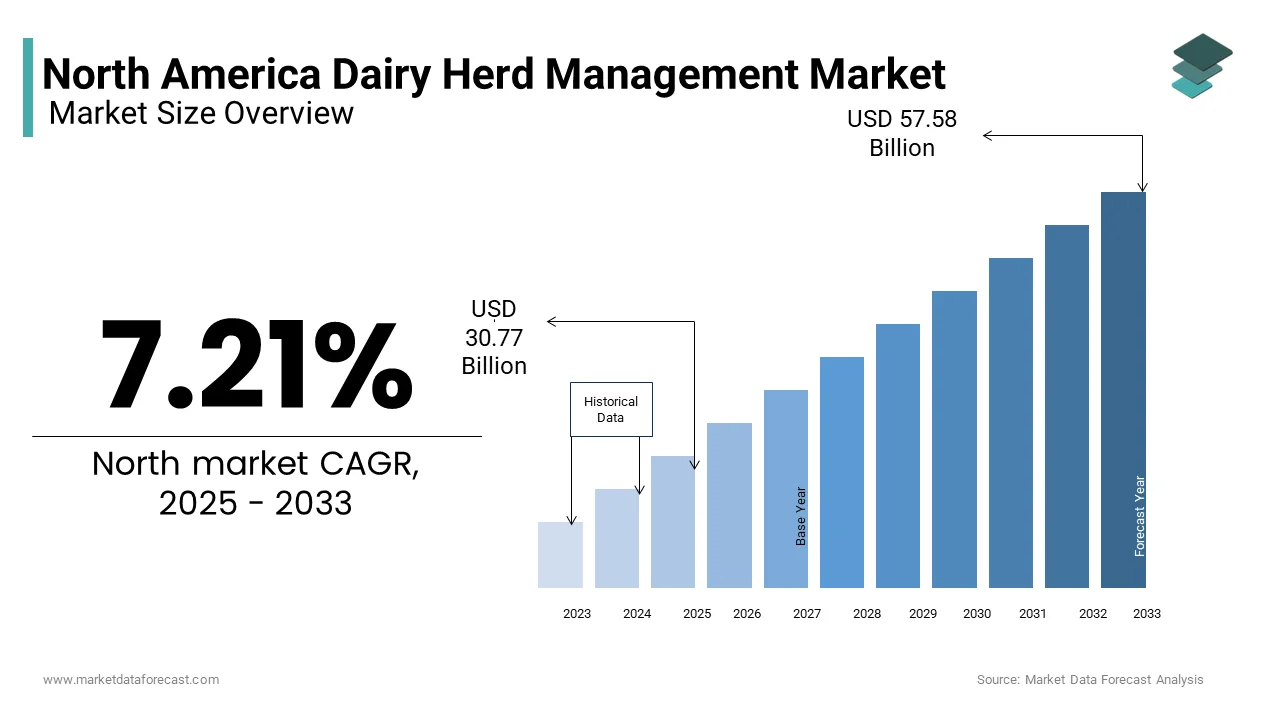
- Market Valuation: Valued at USD 32.99 billion in 2025, reaching USD 35.37 billion in 2026, and projected to hit USD 61.73 billion by 2034, expanding at a steady CAGR of 7.21% from 2026 to 2034.
- Primary Growth Drivers: Rising adoption of precision livestock farming (PLF) technologies (IoT sensors, RFID tagging, and automated milking); increasing consumer demand for high-quality milk and stringent animal welfare standards (e.g., FARM Program); and labor shortages pushing farms toward automation.
Key Market Segment Metrics (2026–2034)
| Category | Leading Segment / Core Focus | Fastest-Growing / Key Segments |
|---|---|---|
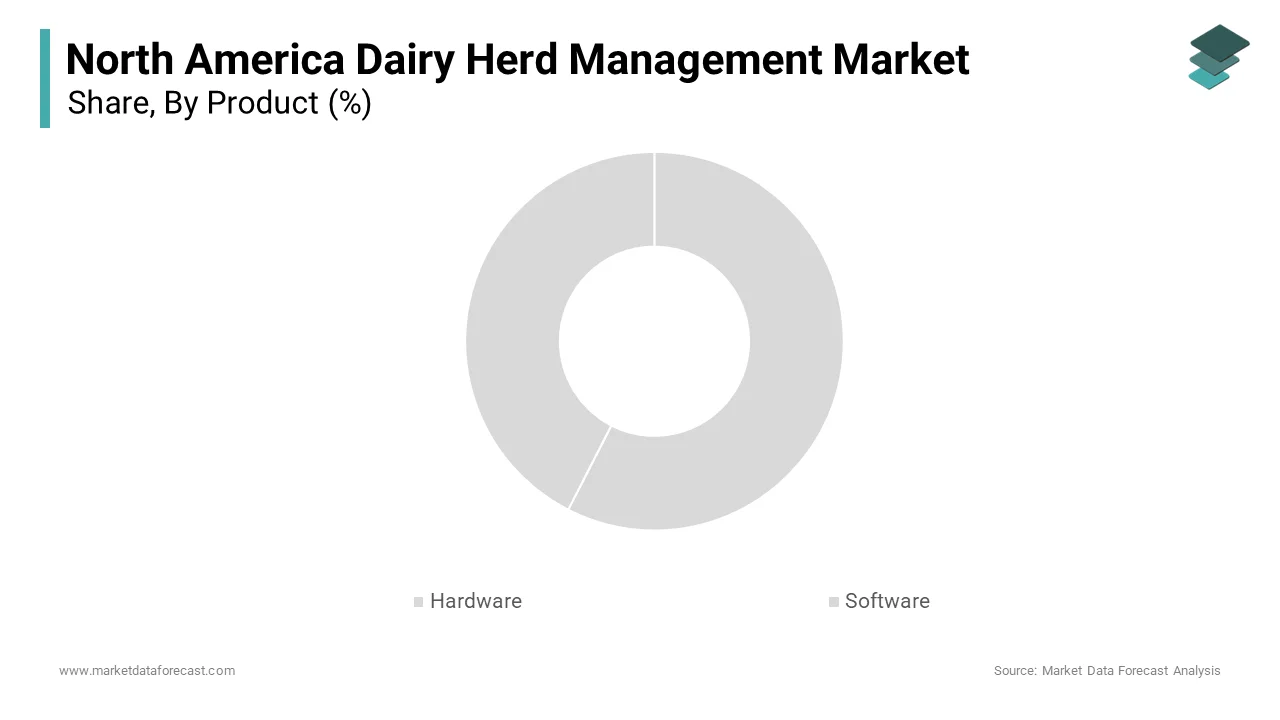
| By Product | Hardware (held the largest market share at 58.3% in 2025, driven by RFID tagging, sensors, and automated milking units) | Software (recording the fastest CAGR of 14.7%, fueled by cloud-based platforms and AI predictive analytics) |
| By Application | Milk Harvesting (accounted for the largest revenue share at 39.1% in 2025 due to robotic milking and yield optimization) | Reproduction (emerging as the fastest-growing application at a CAGR of 15.3%, driven by heat detection and fertility analytics) |
| By Country | United States (dominates the regional market with an estimated 68.1% share in 2025, backed by large-scale commercial dairy farming and high automation) | Canada & Mexico (steady growth supported by supply management regulations, government modernization grants, and agri-tech investments) |
Major Market Players & Market Structure
Market Structure: Highly competitive and evolving ecosystem characterized by a convergence of global tech corporations, agricultural equipment manufacturers, and specialized agritech startups focusing on AI, IoT integration, and cloud farm management.
Key Companies: Afimilk Ltd., BouMatic, DairyMaster, DeLaval, GEA Group AG, Infovet, Lely Holdings S.A.R.L., SCR Dairy Inc., Sum-It Computer Systems, Ltd, and Valley Agriculture Software.
North America Dairy Herd Management Market Size
The North American dairy herd management market size was valued at USD 32.99 billion in 2025 and is anticipated to reach a valuation of USD 35.37 billion in 2026 and USD 61.73 billion by 2034, growing at a CAGR of 7.21% from 2026 to 2034.
The North American dairy herd management market encompasses a range of technologies, software solutions, and services aimed at improving the efficiency, productivity, and health of dairy cattle through advanced monitoring, data analytics, and automated farm management systems. As the dairy industry evolves under increasing demand for high-quality milk products and growing pressure to optimize resource use, effective herd management has become essential for modern farms across the United States and Canada.
Dairy herd management tools include RFID tagging, automated milking systems, feeding optimization software, fertility tracking, and disease prevention technologies. These innovations enable farmers to make data-driven decisions that enhance animal welfare, increase yield, and reduce operational costs. According to the United States Department of Agriculture (USDA), the U.S. alone is home to over 34,000 commercial dairy farms, collectively producing more than 230 billion pounds of milk annually. This scale underscores the need for sophisticated management systems to ensure sustainable production practices.
In Canada, the dairy sector operates under a supply management system, which emphasizes quality control and efficient production. The integration of precision agriculture into livestock farming is accelerating adoption rates across both nations, driven by technological advancements and rising labor shortages on large-scale farms. With mounting global demand for dairy and heightened scrutiny around environmental impact and animal welfare, the market for innovative dairy herd management solutions continues to expand across North America.
MARKET DRIVERS
Rising Adoption of Precision Livestock Farming Technologies
Among the main drivers fueling the growth of the North American dairy herd management market is the rising adoption of precision livestock farming (PLF) technologies. PLF integrates real-time data collection, sensor-based monitoring, and predictive analytics to improve decision-making on dairy farms. According to the University of Wisconsin-Madison’s Center for Dairy Research, over 60% of large-scale U.S. dairy farms have implemented at least one form of PLF technology in recent years, including automated feeding systems and activity monitors for cows.
These technologies allow farmers to track individual animal health, reproduction cycles, milk yield, and nutritional needs with greater accuracy, leading to improved productivity and reduced waste. For instance, RFID ear tags combined with cloud-based analytics platforms help detect early signs of illness, enabling timely intervention and minimizing economic losses.
Moreover, the integration of artificial intelligence and machine learning in dairy management software enables predictive modeling for optimal breeding and feeding schedules.
Increasing Demand for High-Quality Milk and Animal Welfare Standards
Another significant driver of the North American dairy herd management market is the growing consumer demand for high-quality milk and improved animal welfare standards, which in turn compels dairy producers to adopt advanced herd management systems. Consumers across the United States and Canada are becoming more conscious about the origin and ethical treatment of dairy products.
This shift in consumer behavior has prompted regulatory bodies and industry associations to enforce stricter guidelines regarding animal health and well-being. The National Milk Producers Federation in the U.S., for example, has established comprehensive standards under its FARM (Farmers Assuring Responsible Management) Program, mandating regular audits and traceability measures. As per USDA data, participation in the FARM Program exceeded 90% of U.S. milk production in 2023, reinforcing the necessity for digital tracking and compliance tools.
To meet these expectations, dairy farms are investing in herd management technologies that monitor cow comfort, nutrition, and reproductive health. Automated milking systems, wearable sensors, and feeding optimization software not only enhance milk quality but also support compliance with welfare regulations. Consequently, the push for transparency and ethical sourcing is directly contributing to the expansion of the dairy herd management market in North America.
MARKET RESTRAINTS
High Initial Investment and Cost of Technology Integration
A major restraint affecting the North American Dairy Herd Management Market is the high initial investment required for technology adoption and system integration, particularly among small and medium-sized dairy farms. While precision livestock farming offers long-term benefits, the upfront costs associated with purchasing hardware such as RFID tags, automated milking machines, and cloud-based software platforms remain prohibitively expensive for many operators.
Also, integrating new technologies with existing farm infrastructure often necessitates additional expenses related to training, maintenance, and technical support. Many rural farms also face limited access to high-speed internet, further complicating the deployment of cloud-based or AI-driven systems.
Despite government incentives and grants offered through agricultural agencies like the USDA’s Environmental Quality Incentives Program (EQIP), the return on investment period for these technologies remains lengthy, discouraging widespread adoption. Consequently, the financial burden associated with implementation continues to limit market penetration, especially among independent and family-owned dairy operations.s
Limited Technical Expertise and Digital Literacy Among Farmers
An additional key restraint impacting the North America dairy herd management market is the limited technical expertise and digital literacy among dairy farmers, particularly in traditional and aging agricultural communities. Although herd management technologies offer substantial efficiency gains, their successful implementation requires a certain level of digital proficiency and adaptability.
Many older farmers were trained in conventional methods and may be hesitant to transition to complex software interfaces, mobile applications, and automated machinery. This knowledge gap extends to younger generations entering the industry, who often lack formal training in agricultural technology despite being more open to digital innovation. As per a report by the Canadian Agricultural Human Resource Council, there is a significant shortage of skilled labor capable of operating and maintaining advanced dairy management systems.
Furthermore, the absence of standardized training programs tailored to precision livestock farming creates inconsistencies in skill development across regions. Without adequate education and support structures, the adoption of digital herd management tools will continue to lag in many parts of North America.
MARKET OPPORTUNITY
Expansion of Smart Farming and IoT-Enabled Monitoring Systems
A major opportunity driving the North America dairy herd management market is the expansion of smart farming and IoT-enabled monitoring systems, which are revolutionizing how dairy producers manage livestock health and productivity. The integration of Internet of Things (IoT) devices such as wearable sensors, GPS trackers, and automated feeders allows farmers to collect real-time data on individual animals, facilitating proactive decision-making and optimized resource allocation.
These systems enable continuous tracking of vital indicators such as body temperature, movement patterns, and milk yield, allowing early detection of health issues and improved breeding outcomes.
Moreover, advancements in wireless communication and cloud computing have made it easier for farmers to access and analyze herd data remotely via smartphones and tablets. With increasing pressure to maintain sustainability and efficiency amid labor shortages, the proliferation of smart dairy technologies presents a compelling growth avenue for the market. As more farms embrace digital transformation, the demand for integrated IoT-based herd management solutions is expected to surge.
Growing Government Support and Agricultural Modernization Programs
An emerging opportunity for the North American dairy herd management market is the growing government support and funding initiatives aimed at promoting agricultural modernization, particularly in the dairy sector. Both the United States and Canada have introduced policy frameworks and financial incentives designed to encourage the adoption of advanced farm technologies, including herd management systems.
In Canada, Agriculture and Agri-Food Canada (AAFC) launched the Agricultural Clean Technology Program (ACT), which provides funding for the integration of digital monitoring and automation solutions on farms.
Apart from these, several state-level initiatives in the U.S., such as New York’s Climate Smart Farming Program and California’s Healthy Soils Program, emphasize the importance of sustainable dairy production through technology adoption. These policies not only reduce the cost burden on farmers but also align with broader environmental goals, making them attractive options for producers seeking to modernize their operations. As government-backed programs continue to expand, they are expected to drive substantial growth in the dairy herd management market across North America.
MARKET CHALLENGES
Data Security and Privacy Concerns in Digital Farming
One of the foremost challenges confronting the North American dairy herd management market is the increasing concern over data security and privacy in digital farming, particularly as more dairy producers rely on cloud-based and IoT-integrated systems. The digitization of farm operations generates vast amounts of sensitive information, including animal health records, milk production data, and financial metrics. However, concerns about unauthorized access, data breaches, and misuse of proprietary information have led some farmers to hesitate in adopting advanced herd management technologies.
According to a 2023 cybersecurity report by the Food and Agriculture Cybersecurity Alliance (FACA), over 35% of surveyed dairy farms experienced at least one cyber incident in the past two years, ranging from phishing attacks to unauthorized remote access to farm management software. As per the report, many smaller farms lack robust cybersecurity protocols, making them vulnerable targets for cybercriminals.
Moreover, the issue of data ownership remains contentious, with disputes arising between farmers and technology providers over who controls and benefits from collected data. A white paper published by the National Farmers Union (NFU) emphasized the need for clear legal frameworks governing agricultural data rights to build trust in digital systems. Until these concerns are adequately addressed, data security risks will continue to hinder widespread adoption of digital herd management solutions.
Fragmented Regulatory Landscape Across U.S. and Canadian Jurisdictions
Another critical challenge for the North American herd Management Market is the fragmented regulatory landscape across the U.S. and Canadian jurisdictions, which complicates the standardization and interoperability of herd management technologies. Unlike the European Union, where agricultural policies are harmonized under a centralized framework, North America lacks uniform regulations regarding data sharing, animal identification, and electronic recordkeeping, leading to inconsistencies in technology deployment and compliance requirements.
In the United States, each state maintains its own set of rules governing dairy farming practices, traceability, and food safety standards. Similarly, in Canada, provincial governments exercise considerable autonomy over agricultural policies, resulting in varied enforcement mechanisms and reporting formats.
The fragmentation in data format increases development and compliance costs for technology vendors, limiting their ability to scale efficiently. As the industry moves toward greater digitalization, resolving these regulatory disparities will be crucial for fostering innovation and ensuring smooth cross-border collaboration in the dairy herd management sector.
REPORT COVERAGE
| REPORT METRIC | DETAILS |
| Market Size Available | 2025 to 2034 |
| Base Year | 2025 |
| Forecast Period | 2026 to 2034 |
| CAGR | 7.21% |
| Segments Covered | By Application, Product, and By Country |
| Various Analyses Covered | Global, Regional & Country Level Analysis, Segment-Level Analysis, DROC, PESTLE Analysis, Porter’s Five Forces Analysis, Competitive Landscape, Analyst Overview on Investment Opportunities |
| Regions Covered | The US, Canada, and Country |
| Market Leaders Profiled | Afimilk Ltd., BouMatic, Dairy Master, DeLaval, GEA Group AG, Infovet, Lely Holdings S.A.R.L., SCR Dairy Inc., Sum-It Computer Systems, Ltd, and Valley Agriculture Software. |
SEGMENTAL ANALYSIS
By Product Insights
Hardware
The Hardware segment held the largest share of the North America dairy herd management market, accounting for 58.3% of total market revenue in 2025. This dominance is primarily attributed to the foundational role hardware plays in the on-farm implementation of dairy management systems.
One key driver behind this segment’s leadership is the widespread deployment of RFID tags and wearable sensors, which are essential for real-time monitoring of cow health, movement, and milk production. These devices enable precise identification and data collection at the individual animal level, forming the backbone of modern herd management strategies.
Besides, automated milking systems and feeding equipment have seen significant adoption, particularly in technologically advanced dairy operations. As per USDA data, the number of robotic milking installations in the U.S. increased between 2021 and 2023. These capital-intensive assets represent long-term investments that contribute substantially to the hardware segment’s market value, reinforcing its dominant position.
Software
The Software segment is growing at the fastest pace, recording a CAGR of 14.7%. This rapid expansion reflects the increasing reliance on data-driven decision-making across North American dairy farms. A primary growth driver is the rising demand for cloud-based farm management platforms, which allow farmers to access and analyze herd performance metrics remotely. These tools enhance operational efficiency while reducing labor dependency.
Moreover, advancements in AI-powered predictive analytics are fueling software adoption, particularly among mid-sized and large dairy enterprises. Cornell University’s Department of Animal Science notes that predictive models can increase breeding success rates by up to 12% through early heat detection algorithms. With growing emphasis on sustainability, traceability, and regulatory compliance, the software component of the dairy herd management market is poised for continued acceleration.
By Application Insights
Milk Harvesting
Milk Harvesting accounted for the maximum share, representing 39.1% of total market revenue in 2025. The prominence of this segment stems from the critical role milk production plays in dairy farm profitability and the increasing adoption of automated milking solutions.
One major factor contributing to its dominance is the rapid integration of robotic milking machines, which offer greater efficiency, consistency, and labor savings. According to the USDA Economic Research Service, the number of robotic milking systems installed in U.S. dairy farms grew in 2023 compared to the previous year. These systems not only reduce manual labor but also provide real-time milk quality assessments and udder health diagnostics.
Another key driver is the increasing focus on optimizing milk yield through precision monitoring technologies. Sensors embedded in milking equipment track milk flow, composition, and somatic cell count, allowing for early detection of mastitis and other health issues. Given these tangible benefits, the milk harvesting segment remains central to the broader dairy herd management landscape.
Reproduction
The Reproduction segment is emerging as the fastest-growing application in the North America dairy herd management market, registering a CAGR of 15.3%. This robust growth is driven by the increasing emphasis on improving breeding efficiency and ensuring consistent calving cycles to maximize milk production.
One of the key drivers is the adoption of heat detection and fertility monitoring systems, which leverage sensor technology and AI-based analytics to predict optimal breeding windows. These tools help reduce the economic losses associated with missed estrus cycles and extended calving intervals.
Also, integration of reproduction management software with IoT-enabled wearables has enhanced the accuracy and timeliness of reproductive health insights. With reproductive efficiency directly influencing farm profitability, this segment is expected to maintain its high-growth trajectory.
COUNTRY-LEVEL ANALYSIS
United States
The United States commanded the North American dairy herd management market, holding an estimated share of 68.1% in 2025. As the world’s largest milk producer, the U.S. has a vast and technologically advanced dairy industry that continues to drive demand for sophisticated herd management solutions.
One of the key factors supporting this leadership is the high level of automation and digital transformation within large-scale dairy farms. These include RFID tagging, automated milking systems, and fertility tracking software, all of which enhance productivity and animal welfare.
In addition, government-backed programs and private sector investment are accelerating technology adoption. Coupled with rising labor shortages and increasing consumer demand for sustainable practices, the U.S. remains the epicenter of innovation and growth in the regional dairy herd management sector.
Canada
Canada is another key market for dairy herd management technologies in North America. The country’s structured supply management system and emphasis on high-quality milk production have fostered a conducive environment for advanced herd management solutions.
A major growth driver is the strong regulatory framework promoting animal welfare and environmental sustainability. Under Canada’s supply management system, dairy producers must adhere to strict quality and traceability standards, encouraging the adoption of digital monitoring tools.
Furthermore, provincial and federal funding initiatives have played a crucial role in technology uptake. Programs like the Agricultural Clean Technology Program (ACT) facilitated the deployment of smart feeding systems and automated milking units across the country.
Mexico – Emerging Market with Growing Technological Interest
Mexico occupies a notable position in the North American Dairy Herd Management Market. While traditionally less developed in terms of digital agriculture adoption, Mexico is experiencing a gradual shift toward modern dairy management practices, particularly in commercial farming regions such as Jalisco and Guanajuato.
One of the primary growth enablers is the expanding dairy processing industry, which is driving upstream improvements in herd productivity and milk quality. To remain competitive, larger dairy farms are beginning to invest in RFID tagging, automated feeding systems, and reproductive tracking tools. Additionally, international partnerships and technology transfers from U.S.-based providers are facilitating the adoption of digital herd management solutions. With rising awareness and government support for agricultural modernization, Mexico represents a promising growth area in the regional dairy herd management landscape.
Rest of North America
The Rest of North America, including smaller territories and niche markets such as Puerto Rico, Bermuda, and parts of Central America, collectively accounted for a small share of the regional dairy herd management market. While these areas do not yet play a significant role in overall market dynamics, they present opportunities for future expansion.
One reason for the relatively low market penetration is the limited scale of commercial dairy operations in these regions. Many farms operate on a small or subsistence level, lacking the financial capacity to invest in advanced herd management technologies. However, as global trends push for improved food safety and traceability, even these smaller producers may begin adopting basic digital tools.
Another contributing factor is the lack of standardized infrastructure and connectivity, which hampers the deployment of cloud-based and IoT-integrated systems. Despite these challenges, targeted interventions and localized solutions could unlock potential in these underdeveloped markets over time.
KEY MARKET PLAYERS
The major North America Dairy Herd Management Market leaders are Afimilk Ltd., BouMatic, Dairy Master, DeLaval, GEA Group AG, Infovet, Lely Holdings S.A.R.L., SCR Dairy Inc., Sum-It Computer Systems, Ltd, and Valley Agriculture Software.
Top Players In The Market
DeLaval Inc.
DeLaval is a leading global provider of dairy farming equipment and herd management solutions, with a strong presence in North America. The company is known for its innovative robotic milking systems, automated feeding solutions, and comprehensive herd monitoring tools. DeLaval plays a pivotal role in advancing precision livestock farming by integrating digital technologies that enhance animal health, milk quality, and farm efficiency. Its long-standing reputation for reliability and continuous product innovation has made it a trusted partner for dairy producers seeking sustainable and scalable operations.
Lely Astronautics Corporation
Lely specializes in automated milking and feeding systems tailored for modern dairy farms. With its flagship Astronaut series of robotic milking machines, the company has significantly influenced the shift toward autonomous dairy operations in North America. Lely’s integrated approach to herd management emphasizes data-driven decision-making, optimizing both cow comfort and production output. Its commitment to sustainability and technological advancement has positioned it as a key player shaping the future of smart dairy farming across the region.
SCR Engineers Ltd. (A Subsidiary of GEI)
SCR Engineers is a prominent name in livestock monitoring technology, particularly known for its Heatime® system used for heat detection and health monitoring in dairy cows. The company's cutting-edge sensors and software provide real-time insights into reproductive cycles, activity levels, and early disease detection. In North America, SCR has been instrumental in promoting data-based breeding and health management strategies, enabling farmers to improve productivity and reduce operational inefficiencies through precision monitoring and analytics.
Top Strategies Used By Key Market Participants
One major strategy employed by leading players in the North American Dairy Herd Management Market is product innovation and technological integration, where companies continuously develop advanced hardware and software solutions to meet evolving farm needs. This includes introducing AI-powered analytics, IoT-enabled wearables, and cloud-based farm management platforms that enhance decision-making and operational efficiency.
Another crucial approach is strategic partnerships and collaboration, wherein market leaders engage with agricultural institutions, research bodies, and farm cooperatives to refine product offerings and expand their reach. These alliances help in aligning technological advancements with on-ground farming challenges, ensuring relevance and usability.
Lastly, customer education and after-sales support have become central to maintaining competitive advantage. Companies invest heavily in training programs, technical assistance, and customized advisory services to ensure smooth adoption of complex systems, fostering long-term customer relationships and encouraging repeat investments in upgraded solutions.
COMPETITION OVERVIEW
The competition in the North American Dairy Herd Management Market is marked by a convergence of global technology firms, established agricultural equipment manufacturers, and emerging agritech startups, all striving to capture a growing share of this digitally transforming sector. Major players leverage their brand strength, extensive distribution networks, and deep industry expertise to maintain leadership positions, while smaller innovators focus on niche applications such as fertility tracking, disease prediction, and feed optimization. The market is witnessing intensified rivalry as companies race to integrate artificial intelligence, machine learning, and automation into dairy management solutions that offer real-time insights and predictive analytics.
In addition to technological prowess, differentiation is being driven through user-friendly interfaces, interoperability with existing farm systems, and scalable deployment models suited for both large commercial farms and mid-sized operations. Strategic acquisitions are also playing a vital role in consolidating market power and expanding solution portfolios. As demand for sustainable and efficient dairy production rises, the competitive landscape continues to evolve, pushing companies to innovate rapidly and deliver value-added services that cater to the dynamic needs of North American dairy farmers.
RECENT HAPPENINGS IN THE MARKET
- In March 2023, DeLaval introduced an enhanced version of its DelPro Farm Management System, incorporating AI-driven analytics for improved herd health monitoring and feeding optimization, aiming to provide more actionable insights to North American dairy farmers.
- In July 2023, Lely launched a new mobile application linked to its Astronaut robotic milking systems, allowing farmers to monitor and manage their herds remotely, thereby enhancing user experience and strengthening its foothold in the digital dairy ecosystem.
- In November 2023, SCR Engineers expanded its partnership network with several U.S.-based dairy cooperatives to offer bundled herd monitoring packages, making its Heatime® technology more accessible to regional dairy producers.
- In February 2024, GEA Farm Technologies unveiled a new line of smart barn ventilation systems integrated with dairy herd management software to improve cow comfort and reduce heat stress-related productivity losses.
- In August 2024, BouMatic partnered with a leading agri-tech data platform to enable seamless integration of its milking systems with third-party farm management dashboards, supporting greater interoperability and ease of use for multi-vendor setups.
MARKET SEGMENTATION
This research report on the North American dairy herd management market is segmented and sub-segmented into the following categories.
By Product
- Hardware
- Milk
- Fertility
- Feeding
- Cattle Management Systems
- Software
- On-Premise
- Web-Based
By Application
- Milk Harvesting
- Reproduction
- Heat Stress
- Calf Management
By Country
- U.S
- Canada
- Mexico
- Rest of North America