- Product Description Description
- Table of Contents TOC
- List of Table & Figure LOT
- Get Free Sample PDF Sample PDF
Market Size, 2025
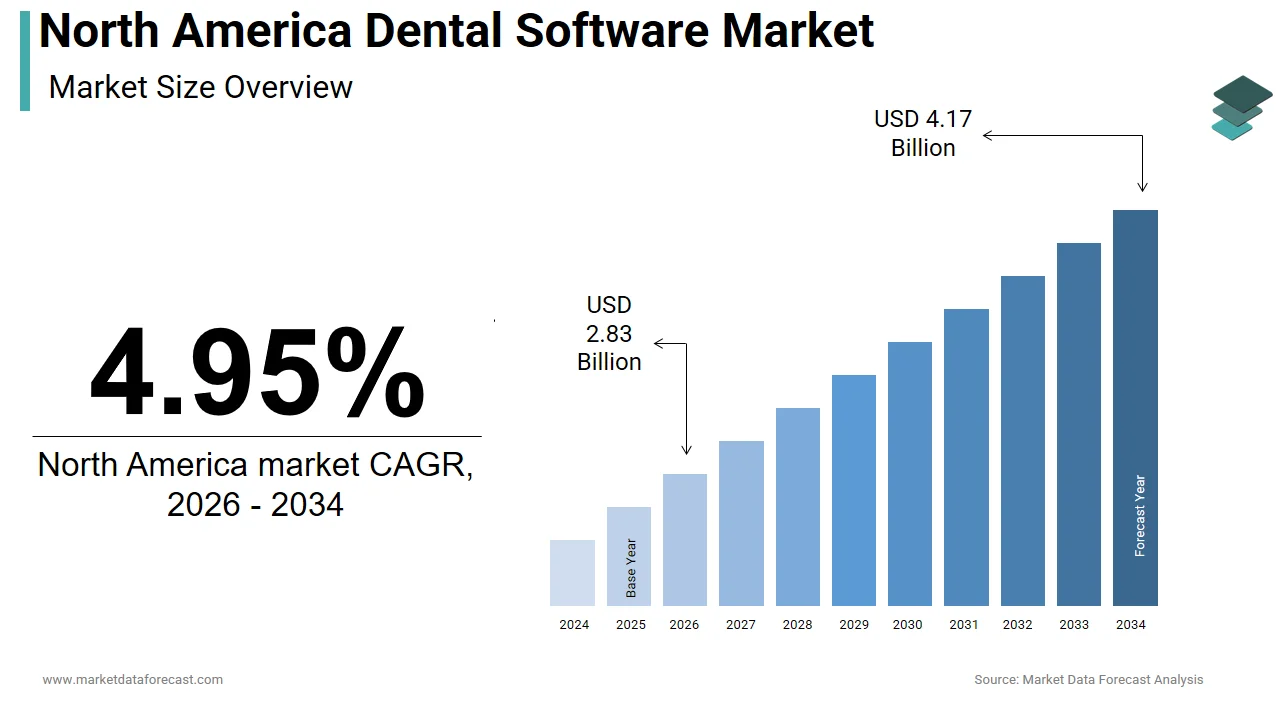
$2.70 BnMarket Estimate, 2026
$2.83 BnMarket Forecast, 2034
$4.17 BnCAGR, 2026–2034
4.95%North America Dental Software Market Summary
The North America dental software market size was USD 2.70 billion in 2025, is anticipated to be USD 2.83 billion in 2026, and is projected to reach USD 4.17 billion by 2034, registering a CAGR of 4.95% from 2026 to 2034. Dental software is a specialized suite of digital solutions designed to streamline clinical workflows, enhance patient care, and optimize administrative operations within dental practices.
Key Market Trends & Insights
- United States was the leading market in 2025.
- Canada is expected to showcase steady growth throughout the forecast period.
- Based on application, the clinical segment held the dominant share in 2025.
- Based on product type, the practice management software was the largest segment in 2025.
- Based on purchase model, the subscription-based segment remained the top segment in 2025.
Market Size & Forecast
- 2025 Market Size: USD 2.70 Billion
- 2026 Market Size: USD 2.83 Billion
- 2034 Projected Market Size: USD 4.17 Billion
- CAGR (2026–2034): 4.95%
- United States: Largest market in 2025
- Canada: Steady growth region
North America Dental Software Market Size
The North America dental software market was valued at USD 2.70 billion in 2024, is estimated to reach USD 2.83 billion in 2026, and is projected to reach USD 4.17 billion by 2034, growing at a CAGR of 4.95% from 2026 to 2034.
The dental software is a specialized suite of digital solutions designed to streamline clinical workflows, enhance patient care, and optimize administrative operations within dental practices. These software systems include electronic dental records (EDR), practice management platforms, imaging and radiology tools, treatment planning applications, and patient engagement modules. Unlike generic healthcare software, dental-specific platforms integrate functionalities such as intraoral imaging integration, tooth numbering systems, and prosthetic design interfaces tailored to the unique demands of dental care delivery. The adoption of digital dentistry has been accelerated by the increasing integration of intraoral scanners, CAD/CAM systems, and cone-beam computed tomography (CBCT), all of which generate data requiring specialized software for interpretation and management.
MARKET DRIVERS
Increasing Adoption of Digital Dentistry and Chairside CAD/CAM Technologies
The proliferation of digital dentistry tools, particularly chairside computer-aided design and computer-aided manufacturing (CAD/CAM) systems, is accelerating the growth of the North America dental software market. These technologies enable dentists to design and fabricate crowns, bridges, and veneers in a single visit, which eliminates the need for traditional impressions and external labs. As of 2023, over 45% of general dental practices in the United States have adopted CAD/CAM systems, according to the American Dental Association, creating a parallel demand for compatible software that manages design workflows, stores 3D scans, and interfaces with milling units. According to the National Institute of Dental and Craniofacial Research, digital impression systems reduce procedural time by up to 30% by enhancing patient throughput and practice efficiency. Additionally, the integration of cone-beam computed tomography (CBCT) in implant planning has surged, with over 60% of oral surgeons using 3D imaging for pre-surgical assessment, as reported by the American Association of Oral and Maxillofacial Surgeons. These imaging modalities rely on advanced dental software for rendering, measurement, and surgical guide design.
Expansion of Teledentistry and Remote Patient Monitoring Services
The role of dental software is transforming it from an office-bound administrative tool into a dynamic platform for remote care delivery is additionally to propel the growth of the North America dental software market. This shift necessitates software capable of secure video conferencing, digital consent collection, asynchronous messaging, and integration with intraoral camera feeds. The National Maternal and Child Oral Health Resource Center reported that over 1.2 million children received virtual dental screenings in 2023 through school-based telehealth programs, all reliant on specialized dental software for documentation and referral management. The American Association of Orthodontists noted in 2023 that 70% of orthodontic practices now use digital monitoring platforms, reducing in-person visits by up to 40%. These capabilities demand robust, HIPAA-compliant software with cloud-based accessibility and interoperability across devices. The integration of patient portals and mobile apps further enhances engagement, with the ADA finding that practices using digital communication tools experience a 25% reduction in missed appointments.
MARKET RESTRAINTS
High Initial Costs and Ongoing Maintenance Expenses for Advanced Software Systems
The financial burden associated with acquiring and maintaining advanced dental software remains a significant barrier for small and independent practices is restricting the growth of the North America dental software market. For solo practitioners and small clinics, this represents a substantial capital outlay, especially when factoring in recurring subscription fees, server maintenance, and IT support. The U.S. Census Bureau’s Annual Survey of Entrepreneurs revealed in 2023 that 62% of small dental practices operate with fewer than five employees, limiting their financial resilience and capacity to absorb such expenses. Additionally, the integration of third-party devices such as intraoral scanners and CBCT machines often requires costly middleware or custom APIs, further escalating implementation costs. A 2023 report by the National Bureau of Economic Research found that 41% of dentists delayed software upgrades due to budget constraints, opting instead to maintain outdated systems with limited functionality. The need for continuous staff training and cybersecurity updates adds to the total cost of ownership, with the American Dental Association estimating that IT-related expenditures now account for nearly 8% of average practice overhead.
Interoperability Challenges and Lack of Standardized Data Formats
The lack of interoperability between systems, which hinders data exchange across practices, insurers, and medical providers, is limiting the growth of the North America dental software market. Unlike the medical sector, which adheres to standards like HL7 and FHIR, the dental industry lacks a universally adopted data exchange framework, resulting in fragmented patient records and inefficient care coordination. The U.S. Office of the National Coordinator for Health Information Technology (ONC) reported in 2023 that only 38% of dental practices can electronically share clinical data with medical providers, limiting integrated care for patients with systemic conditions like diabetes and cardiovascular disease. The American Dental Association’s Health Policy Institute found that 54% of dentists cite data portability issues as a major obstacle when switching software platforms. Furthermore, insurance claims processing remains largely siloed; the ADA noted that 70% of dental claims are still submitted via non-integrated portals or paper forms due to incompatible systems. This inefficiency increases administrative burden and delays reimbursements, undermining the value proposition of digital transformation. The absence of federal mandates for dental data standardization, unlike HIPAA’s impact on medical records that allows vendor lock-in and stifles innovation.
MARKET OPPORTUNITIES
Integration of Artificial Intelligence in Diagnostic and Treatment Planning Software
The integration of artificial intelligence (AI) into dental software presents a transformative opportunity to enhance diagnostic accuracy, streamline treatment planning, and improve clinical outcomes with the sole to of creating new growth opportunities for the North America dental software market. AI-powered algorithms are increasingly being deployed to analyze radiographic images for early detection of caries, periodontal disease, and periapical lesions with precision rivaling experienced clinicians. In 2023, the U.S. Food and Drug Administration cleared multiple AI-based dental imaging tools, including those capable of detecting cavities in bitewing X-rays with over 90% sensitivity, as documented by the National Institute of Dental and Craniofacial Research. These tools reduce diagnostic variability and enable earlier interventions, improving long-term oral health. Additionally, AI is being used to automate treatment simulations in orthodontics and implantology, allowing practitioners to visualize outcomes and adjust plans in real time. A 2023 study published in the Journal of Dental Research found that AI-assisted implant planning reduced surgical time by 22% and improved accuracy in osteotomy positioning.
Growth of Dental Service Organizations (DSOs) and Centralized Practice Management Needs
The expanding influence of Dental Service Organizations (DSOs) across North America is additionally to propel the growth of the North America dental software market. DSOs, which provide business support to affiliated dental practices, now oversee over 15% of all dental offices in the United States, according to the American Dental Association’s 2023 survey, a figure that has doubled since 2015. These organizations require centralized software platforms that unify billing, scheduling, clinical documentation, and compliance monitoring across dozens or even hundreds of clinics. The National Association of Dental Plans reported that DSO-affiliated practices process 30% more claims annually than independent offices, necessitating automated insurance verification and denial management tools. Additionally, DSOs are early adopters of data analytics dashboards that track key performance indicators such as case acceptance rates, provider productivity, and patient retention. The U.S. Department of Labor projects a 12% increase in dental support staff employment through 2032, largely driven by DSO expansion, further amplifying demand for integrated workforce management within software platforms. This shift toward corporate dental models is redefining software requirements, favoring vendors that offer modular, secure, and centrally governed systems by positioning enterprise dental software as a strategic asset in the evolving dental care landscape.
MARKET CHALLENGES
Cybersecurity Vulnerabilities and Risks of Patient Data Breaches
The digitization of dental records and the increasing reliance on cloud-based software have exposed dental practices to escalating cybersecurity threats is impeding the growth of the North America dental software market. Dental offices store highly sensitive personal health information, including medical histories, imaging data, and financial details, yet many operate with limited IT expertise and outdated security protocols. According to the U.S. Department of Health and Human Services’ Office for Civil Rights, dental practices accounted for 14% of all reported HIPAA breaches in 2023, with ransomware attacks increasing by 37% compared to the previous year. Additionally, many dental software systems are built on legacy architectures that lack modern encryption standards or automatic patching, creating exploitable vulnerabilities.
Resistance to Technological Adoption Among Aging Practitioners
A widespread adoption of advanced dental software is the reluctance of a substantial segment of the dental workforce to transition from traditional, paper-based workflows to digital systems, which also inhibits the growth of the North America dental software market. The American Dental Association reports that as of 2023, over 31% of actively practicing dentists in the United States are aged 55 or older, a demographic that often exhibits lower comfort levels with complex digital interfaces and new technologies. A 2023 study by the Journal of the American Dental Association found that dentists over 60 are 2.3 times more likely to delay software implementation than their younger counterparts, citing concerns over workflow disruption, steep learning curves, and perceived lack of clinical benefit. This resistance is compounded by the absence of formal digital dentistry training in many dental school curricula before the 2010s, leaving mid-career and senior practitioners without foundational digital literacy. The National Board of Dental Examiners noted that only 44% of continuing education credits issued in 2023 were related to technology or informatics, indicating limited institutional support for upskilling. Furthermore, poorly designed user interfaces and non-intuitive navigation in some software platforms exacerbate frustration, leading to underutilization or abandonment.
REPORT COVERAGE
| REPORT METRIC | DETAILS |
| Market Size Available | 2025 to 2034 |
| Base Year | 2025 |
| Forecast Period | 2026 to 2034 |
| Segments Covered | By Application, Product Type, Purchase Model, and Region. |
| Various Analyses Covered | Global, Regional and Country-Level Analysis, Segment-Level Analysis, Drivers, Restraints, Opportunities, Challenges; PESTLE Analysis; Porter’s Five Forces Analysis, Competitive Landscape, Analyst Overview of Investment Opportunities |
| Countries Covered | United States, Canada, Mexico, Rest of North America |
| Market Leaders Profiled | Carestream Health, Inc., Abeldent, ACE Dental, Denti Max, Dexis, Henry Schein Dental, Open Dental, Sirona Dental Systems, and Clear Dent. |
SEGMENTAL ANALYSIS
By Application Insights
The clinical application segment accounted in holding 44.3% of the North America dental software market share in 2024, owing to the increasing reliance on digital tools for direct patient care, including treatment planning, diagnostic imaging, and intraoperative guidance. The widespread adoption of electronic dental records (EDR) integrated with clinical workflows is prompting the growth of the segment. According to the American Dental Association, over 87% of U.S. dental practices now use EDR systems to document procedures, track treatment histories, and manage patient charts digitally. These systems reduce clinical errors and enhance care continuity in multi-provider settings. The integration of imaging technologies such as intraoral scanners and cone-beam computed tomography (CBCT), which generate vast amounts of clinical data requiring specialized software for interpretation and storage, is also fueling the growth of the North America dental software market. The National Institute of Dental and Craniofacial Research reported in 2023 that over 60% of oral surgeons use 3D imaging for implant planning, all dependent on compatible clinical software. These clinical applications are no longer optional but essential components of modern dental care, directly influencing treatment outcomes, efficiency, and patient satisfaction.
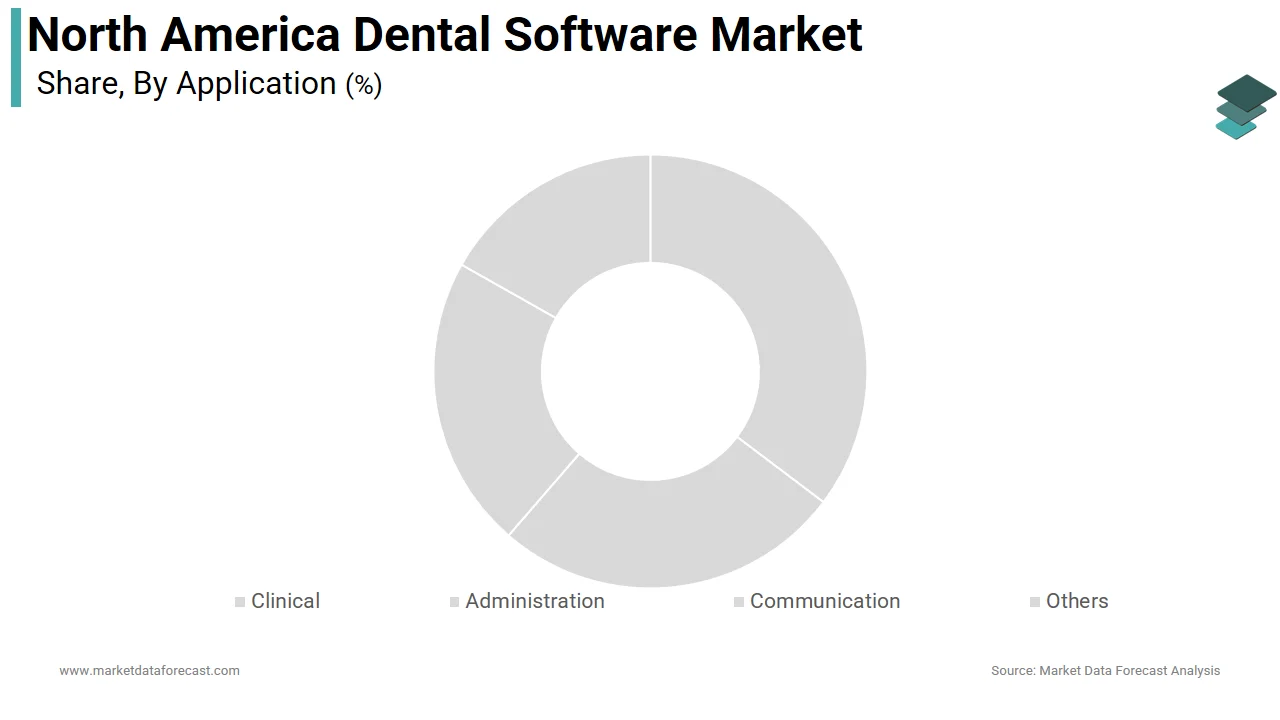
The communication application segment is likely to grow with an expected CAGR of 15.2% from 2026 to 2034, owing to the transformation of patient engagement models in dentistry through digital outreach and virtual care coordination. Practices are increasingly deploying software that enables automated appointment reminders, secure messaging, online scheduling, and teledentistry consultations. The Centers for Medicare & Medicaid Services reported in 2023 that over 1.2 million virtual dental visits were conducted in school and community health programs, all reliant on communication-enabled platforms. Additionally, patient portals and mobile applications are becoming standard, with 68% of patients preferring digital channels for billing, consent forms, and follow-up instructions, as per a 2023 survey by the Health Resources and Services Administration. The integration of AI-powered chatbots for triage and post-operative guidance further accelerates adoption. Moreover, Dental Service Organizations (DSOs) are standardizing communication tools across their networks to ensure brand consistency and centralized patient relationship management.
By Product Type Insights
The practice management software segment was the largest by occupying 41.2% of the North America dental software market share in 2024, owing to the operational viability of dental practices, encompassing scheduling, billing, insurance claims processing, and financial reporting. Nearly all dental offices, regardless of size or specialty, require a system to manage daily administrative functions, making practice management software a universal necessity. According to the American Dental Association, 96% of U.S. dental practices use some form of practice management platform, with integration to electronic health records now considered standard. Additionally, the rise of Dental Service Organizations (DSOs), which manage over 15% of dental clinics in the U.S., demands centralized platforms capable of consolidating financial data across multiple locations. The U.S. Department of Labor reported that dental support staff employment has grown by 11% since 2020, largely due to increased administrative demands, further reinforcing the need for efficient software solutions. Furthermore, real-time reporting features allow practice owners to monitor key performance indicators such as collections, case acceptance, and provider productivity, transforming practice management tools from clerical aids into strategic decision-making assets.
The dental imaging software segment is expected to witness a CAGR of 14.8% from 2026 to 2034, owing to the increasing integration of advanced imaging modalities such as intraoral scanners, digital X-rays, and cone-beam computed tomography (CBCT) into routine dental workflows. As of 2023, over 82% of U.S. dental practices use digital radiography, as reported by the American Dental Association, generating high-resolution images that require specialized software for viewing, annotation, and archiving. These scans produce volumetric data sets that can only be effectively managed and interpreted using dedicated imaging software. Additionally, the rise of CAD/CAM restorative dentistry has intensified demand for seamless integration between imaging and design platforms. The National Institute of Dental and Craniofacial Research in 2023 found that digital impression systems reduce procedural time by 25–30%, enhancing both efficiency and patient comfort. Furthermore, AI-powered imaging tools are emerging, capable of detecting caries and periodontal disease with over 90% accuracy, as validated by the U.S. Food and Drug Administration. These technological advancements are transforming imaging software from a diagnostic aid into a core clinical decision-support system, which is driving rapid adoption across general and specialty practices.
By Purchase Model Insights
The subscription-based purchase model segment was the largest by capturing a prominent share of the North America dental software market in 2025 owing to the shift toward cloud-based delivery and the growing preference for predictable, low-capital expenditure models among dental practices. Unlike traditional ownership, which requires a large upfront investment in licenses and servers, subscription models offer monthly or annual payments that include software access, updates, technical support, and cloud hosting. According to the National Bureau of Economic Research, 71% of small dental practices cite cash flow preservation as a primary reason for choosing subscription services. A key factor is the reduced IT burden; the American Dental Association reported in 2023 that 58% of practices lack dedicated IT staff, making cloud-managed solutions highly attractive. Additionally, subscription platforms enable automatic updates, ensuring compliance with evolving regulatory standards such as HIPAA and data security protocols. The U.S. Department of Health and Human Services noted that cloud-based systems reduced software-related security incidents by 34% compared to on-premise installations in 2022. Furthermore, the scalability of subscription models allows practices to add users, locations, or modules as needed, which is making them ideal for expanding clinics and Dental Service Organizations (DSOs).
The ownership model is projected to grow at a CAGR of 8.6% from 2026 to 2034, over data sovereignty, cybersecurity, and long-term cost control in specific segments of the market. Large dental institutions, academic clinics, and government-operated facilities are increasingly opting for perpetual licenses and on-premise installations to maintain full control over patient data and system customization. The Department of Veterans Affairs reported in 2023 that 83% of its dental clinics use locally hosted software to comply with federal data residency requirements and minimize exposure to third-party cloud vulnerabilities. Additionally, some advanced imaging and surgical planning systems, particularly those integrated with CAD/CAM and CBCT hardware, require dedicated servers and low-latency processing, which are better supported by on-premise infrastructure. The National Institute of Standards and Technology recommends isolated networks for high-fidelity medical imaging to prevent latency and data corruption.
COUNTRY-LEVEL ANALYSIS
United States Dental Software Market Insights
The United States was the top performer in the North America dental software market by accounting for 95.3% of share in 2024. The country is home to over 200,000 licensed dentists and more than 150,000 dental practices, creating a vast ecosystem for digital solutions. According to the American Dental Association, 96% of U.S. practices use some form of dental software, with integration of electronic records and digital imaging now considered standard. The expansion of Dental Service Organizations (DSOs), which manage over 15% of clinics, has accelerated demand for centralized, scalable platforms. Additionally, the U.S. Food and Drug Administration’s clearance of AI-powered diagnostic tools has catalyzed innovation in imaging and planning software.
Canada Dental Software Market Insights
Canada held 5.3% of the North America dental software market share in 2024. Canada is characterized by a high concentration of private dental practices and a strong emphasis on patient privacy and data protection. The Personal Information Protection and Electronic Documents Act (PIPEDA) establishes strict guidelines for handling personal health information, encouraging practices to adopt compliant, auditable software solutions. The cross-border collaboration with U.S.-based Dental Service Organizations and technology vendors, which facilitates the transfer of proven software models, is propelling the growth of the North America dental software market. The Canadian Dental Association has endorsed digital dentistry initiatives, including the integration of intraoral scanners and cloud-based practice management tools. Academic institutions like the University of Toronto and McGill University are also advancing digital dentistry research, fostering innovation in AI-driven diagnostics and treatment planning.
COMPETITIVE LANDSCAPE
The competitive landscape of the North America dental software market is defined by a dynamic interplay between established healthcare technology providers, agile cloud-native startups, and vertically integrated distributors, all striving to capture a share of an increasingly digital practice environment. Incumbents leverage their brand trust, extensive customer bases, and hardware integration to maintain dominance, while newer entrants disrupt with intuitive interfaces, mobile accessibility, and subscription-based models that lower entry barriers. Differentiation is no longer limited to functionality but extends to user experience, implementation support, and adaptability to evolving care models such as teledentistry and value-based care. The rise of Dental Service Organizations (DSOs) has intensified demand for centralized, multi-location management capabilities, favoring vendors with enterprise-grade scalability.
KEY MARKET PLAYERS
Noteworthy companies dominating the North America dental software market profiled in the report are
- Carestream Health, Inc.
- Abeldent
- ACE Dental
- Denti Max
- Dexis
- Henry Schein Dental
- Open Dental
- Sirona Dental Systems
- Clear Dent
TOP LEADING PLAYERS IN THE MARKET
- CareStack has emerged as a transformative force in the North America dental software market by delivering an integrated, cloud-based platform that unifies practice management, imaging, patient engagement, and billing into a single intuitive interface. The company’s strength lies in its user-centric design and seamless interoperability with a wide range of dental hardware, making it particularly appealing to small and mid-sized practices seeking efficiency without complexity. CareStack’s platform supports end-to-end digital workflows, from appointment scheduling to e-claim submission and patient communication, reducing administrative overhead and enhancing clinical productivity.
- Henry Schein One is a subsidiary of the global healthcare distributor Henry Schein, Inc., plays a pivotal role in bridging clinical practice and technology through its comprehensive dental software solutions, including the widely adopted Dentrix and EasyPractice platforms. The company leverages its vast distribution network and deep relationships with dental professionals to deliver not only software but also integrated hardware, training, and support services. This holistic approach ensures smooth implementation and sustained adoption, particularly among independent practitioners who rely on trusted vendors for end-to-end solutions. Henry Schein One’s software is designed to support the full spectrum of dental care, from front-office administration to clinical documentation and imaging integration. Its global influence extends through partnerships with dental schools, professional associations, and international distributors by enabling the dissemination of standardized digital workflows across diverse markets.
- Curve Dental has distinguished itself in the North America market through its agile, cloud-native platform that emphasizes real-time collaboration, remote accessibility, and rapid deployment. Designed for modern, digitally fluent practices, Curve Dental offers a fully integrated suite encompassing electronic health records, treatment planning, imaging, and secure patient communication, all accessible via web and mobile devices. The company’s strength lies in its minimal setup requirements and intuitive interface, enabling practices to transition from legacy systems with minimal disruption. Curve Dental’s architecture supports automatic updates and built-in compliance features, ensuring that users remain aligned with evolving regulatory standards without additional overhead. Its focus on user experience and continuous feedback loops with clinicians has fostered a reputation for innovation and responsiveness. Curve Dental’s model has influenced the design of next-generation dental software in regions adopting cloud-based healthcare infrastructure.
TOP STRATEGIES USED BY KEY MARKET PARTICIPANTS
A primary strategy employed by leading dental software providers is the development of fully integrated, end-to-end platforms that unify clinical, administrative, and patient engagement functions into a single ecosystem, which eliminates data silos and improves workflow continuity. This holistic approach enhances user adoption and reduces reliance on third-party add-ons. Another key tactic is strategic partnerships with dental hardware manufacturers, insurance networks, and Dental Service Organizations (DSOs), enabling seamless interoperability and expanding market reach through embedded distribution channels. The emphasis on cloud-based delivery with automated updates, remote support, and cybersecurity management caters to practices with limited IT resources while ensuring compliance and scalability. These approaches collectively enable vendors to transition from software suppliers to comprehensive practice enablement partners, strengthening client loyalty and long-term value.
RECENT MARKET DEVELOPMENTS
- In January 2023, CareStack launched an AI-powered treatment plan generator that automates insurance coding and patient presentation workflows by enhancing clinical efficiency and case acceptance rates for dental practices.
- In April 2023, Henry Schein One integrated its Dentrix platform with leading intraoral scanner manufacturers by enabling seamless transfer of 3D scans directly into patient records without third-party software.
- In August 2023, Curve Dental introduced a real-time collaborative dashboard for multi-provider practices, which allows dentists and hygienists to coordinate care plans and treatment notes within a unified interface.
- In February 2024, CareStack expanded its platform to support multilingual patient communication, targeting diverse urban markets and improving accessibility for non-English-speaking patients.
- In May 2024, Henry Schein One partnered with a national dental insurance network to enable instant eligibility verification and automated claim adjudication within its practice management ecosystem.
MARKET SEGMENTATION
This North America Dental software market research report is segmented and sub-segmented into the following categories.
By Application
- Clinical
- Administration
- Communication
- Others
By Product Type
- Communications
- Dental Imaging
- Planning
- Practice Management
By Purchase Model
- Subscription
- Ownership
By Country
- United States
- Canada
- Mexico
- Rest of North America