North America Deodorants Market Size, Share, Trends & Growth Forecast Report By Product Type (Spray, Cream, Gel, And Other), Distribution Channel, and Country (The United States, Canada and Rest of North America), Industry Analysis From 2026 to 2034
Market Size, 2025
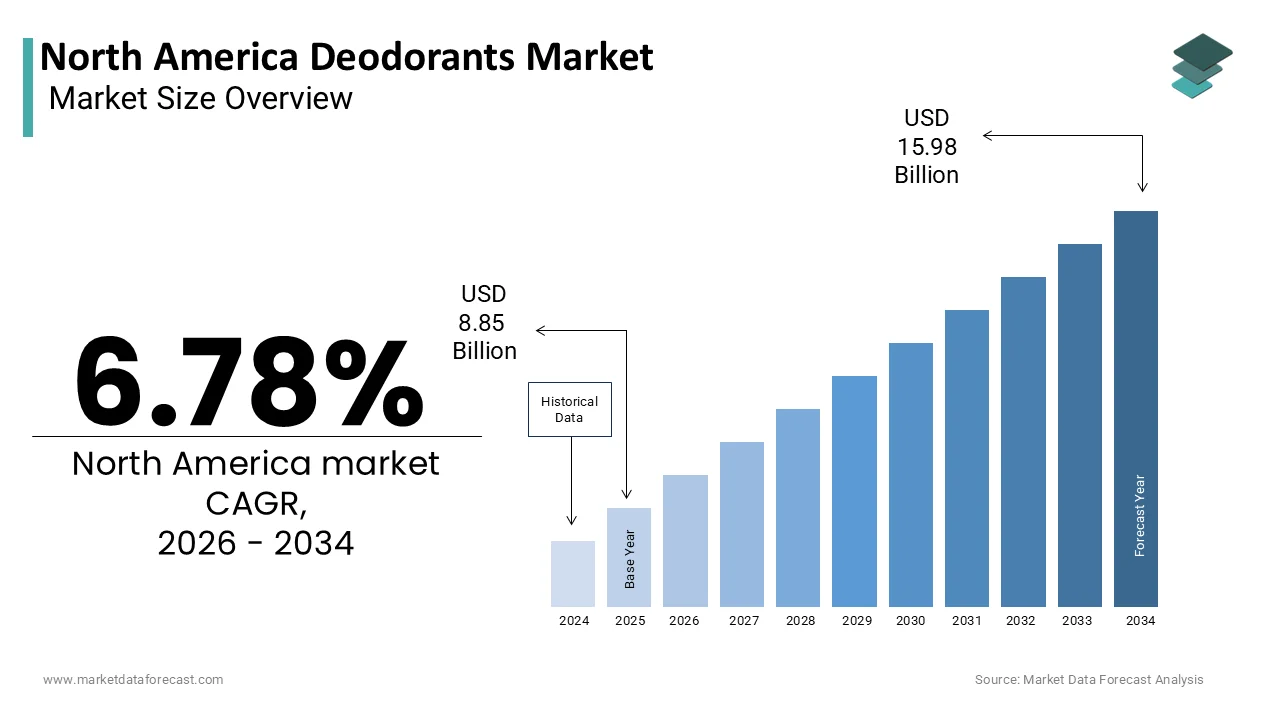
$8.85 BnMarket Estimate, 2026
$9.45 BnMarket Forecast, 2034
$15.98 BnCAGR, 2026–2034
6.78%North America Deodorants Market Size
The Deodorants market size in North America was valued at USD 8.85 billion in 2025 and is predicted to be worth USD 15.98 billion by 2034 from USD 9.45 billion in 2026 and grow at a CAGR of 6.78% from 2026 to 2034.
Deodorants are personal care products designed to control body odor resulting from bacterial breakdown of perspiration, primarily used in the underarm area. Unlike antiperspirants, which reduce sweat production through aluminum-based compounds, deodorants neutralize odor using antimicrobial agents and fragrances without obstructing sweat glands. The market spans various formats,s including sticks, sprays, roll-ons, gels, and soft solids, catering to diverse consumer preferences across gender and age groups. In recent years, the distinction between deodorants and antiperspirants has gained regulatory and consumer scrutiny, particularly in the United States, where the Food and Drug Administration (FDA) classifies antiperspirants as over-the-counter drugs due to their physiological effect, while deodorants remain categorized as cosmetics. This regulatory bifurcation has influenced product development and labeling practices. Additionally, Environment Canada has identified aerosol propellants used in certain spray deodorants as contributors to volatile organic compound emissions, prompting formulation adjustments. The market is also shaped by regional climatic variations, with higher usage frequency observed in warmer regions such as the Southern United States, as indicated by behavioral studies conducted by the National Center for Health Statistics.
 MARKET DRIVERS
Growing Health Consciousness and Demand for Clean-Label Products
The escalating consumer preference for clean-label, natural, and non-toxic personal care formulations is a pivotal driver shaping the North American deodorants market. Increasing awareness about potential health risks associated with aluminum, parabens, and synthetic fragrances has catalyzed a shift toward plant-based, cruelty-free, and dermatologist-tested deodorants. This behavioral shift is particularly pronounced among millennials and Gen Z, who prioritize ingredient transparency and sustainability. Brands such as Native, Schmidt’s, and Puracy have capitalized on this sentiment, reporting double-digit growth in sales over the past three years. Regulatory scrutiny has also played a role; in 2022, the California Safe Cosmetics Program expanded its disclosure requirements, compelling brands to report hazardous ingredients. These converging factors have incentivized major manufacturers like Unilever and Procter & Gamble to reformulate legacy products and launch clean-label sub-brands, reinforcing market expansion driven by health-centric consumerism.
Urbanization and Evolving Lifestyle Norms
The transformation of urban lifestyles and rising standards of personal grooming is another significant driver of the NorAmericanica deodorants market. As urban populations in the U.S. and Canada continue to grow, proximity in workplaces, public transit, and social environments has heightened sensitivity to body odor. Professional environments, particularly in corporate and service sectors, increasingly enforce grooming standards that include daily deodorant use. Moreover, the proliferation of fitness culture has amplified demand, as regular gym attendance and active lifestyles lead to increased perspiration. This active demographic often seeks long-lasting, motion-compatible deodorant solutions, favoring formats like sprays and sticks. Additionally, social media platforms such as Instagram and TikTok have normalized daily grooming routines, with influencers frequently endorsing deodorant products as part of “self-care” regimens. Urban dwellers also exhibit higher disposable incomes, enabling premium product adoption. These socio-behavioral dynamics underscore how urbanization and lifestyle evolution are fundamentally reshaping consumption patterns in the deodorants sector.
MARKET RESTRAINTS
Regulatory Uncertainty Surrounding Product Classification
The evolving regulatory landscape that blurs the line between cosmetics and over-the-counter (OTC) drugs, particularly in the United States, is one of the most pressing restraints in the North American deodorants market. While deodorants are classified as cosmetics by the FDA, products claiming to reduce sweating, such as antiperspirants, are regulated as OTC drugs, requiring rigorous clinical testing and labeling compliance. However, many brands market hybrid products that straddle this boundary, creating confusion and potential legal exposure. This has led to delays in product launches and increased compliance costs for manufacturers. Additionally, states like California and New York have enacted stricter chemical disclosure laws under the Toxin-Free Skincare Act and the Chemical Transparency Act, respectively, mandating full ingredient transparency. These overlapping regulations increase operational complexity, especially for small and mid-sized brands lacking in-house regulatory teams. Furthermore, class-action lawsuits targeting aluminum-based products have made companies cautious. This regulatory ambiguity not only stifles innovation but also erodes consumer trust, constraining market growth.
Environmental Impact of Propellant-Based Aerosols
The environmental footprint of aerosol-based products, particularly those utilizing hydrocarbon propellant,s is a critical restraint affecting the North America deodorants market. While aerosol sprays account for a notable share of deodorant sales in the U.S., they contribute significantly to volatile organic compound (VOC) emissions, which react with sunlight to form ground-level ozone, a key component of smog. Environment Canada identifies personal care aerosols as a growing source of VOCs, estimating that they contributed tons of emissions in 2022 across Canada alone. In the U.S., the Environmental Protection Agency (EPA) has tightened regulations under the Clean Air Act, prompting states like California to enforce stricter limits on VOC content in consumer products. Companies such as Dove and Arm & Hammer have begun transitioning to compressed air or pump-spray technologies, but these alternatives often entail higher production costs and consumer re-education. With growing pressure from eco-conscious consumers and regulators, the sustainability of aerosol formats remains a significant market constraint.
MARKET OPPORTUNITIES
Expansion of E-Commerce and Direct-to-Consumer (DTC) Channels
A transformative opportunity within the North American deodorants market lies in the rapid expansion of e-commerce and direct-to-consumer (DTC) sales models. Digital platforms have lowered entry barriers for niche and indie brands, enabling them to bypass traditional retail gatekeepers and engage directly with consumers through personalized marketing and subscription services. Brands like Native and PiperWai have leveraged DTC strategies to achieve exponential growth. Amazon’s marketplace alone accounted for a notable share of online deodorant sales. Social commerce is further accelerating this trend. TikTok’s “Get Ready With Me” videos have driven viral product launches, with some deodorants selling out within hours of influencer endorsements. Additionally, subscription models offering auto-replenishment have enhanced customer retention. This digital shift allows brands to collect first-party data, refine product development, and test limited editions with minimal risk. Moreover, the integration of augmented reality (AR) try-on tools on platforms like Sephora’s website is improving online trial experiences.
Rise of Gender-Neutral and Inclusive Product Formulations
An emerging opportunity in the North American deodorants market is the growing demand for gender-neutral and inclusive personal care products, reflecting broader societal shifts toward fluid identity expression and diversity. Traditional gendered marketing, such as “for men” or “for her” labeling, is increasingly viewed as outdated, particularly among younger demographics. Like, a portion of Gen Z Americans know someone who uses gender-neutral pronouns, fostering a cultural environment where inclusive branding resonates strongly. Brands like Public Goods, Fenty Skin, and Each & Every have launched unisex deodorants with minimalist packaging and scent profiles that avoid stereotypical masculine or feminine notes. These products often emphasize universal values such as sustainability, transparency, and simplicity. Furthermore, inclusive branding aligns with corporate diversity, equity, and inclusion (DEI) initiativethat s were designed with inclusivity as a core criterion. This shift is not merely symbolic. As societal norms continue to evolve, deodorant manufacturers that embrace gender neutrality stand to capture a loyal, values-driven customer base, positioning themselves at the forefront of a cultural transformation in personal care.
MARKET CHALLENGES
Intensifying Ingredient Safety Scrutiny
The intensifying public and scientific scrutiny over ingredient safety, particularly concerning aluminum, phthalates, and synthetic fragrances, is one of the foremost challenges confronting the North American deodorants market. Despite decades of use, aluminum compounds, common in antiperspirants, have come under renewed examination due to alleged links with breast cancer and neurodegenerative diseases. Although the National Cancer Institute states there is no conclusive evidence linking aluminum to cancer, public perception remains influenced by advocacy groups and media coverage. This has forced manufacturers to invest heavily in clinical testing and third-party certifications to reassure consumers. In addition, the Fragrance Safety Act was introduced in Congress to mandate full disclosure, potentially disrupting formulation secrecy. Additionally, the FDA’s ongoing review of antiperspirant ingredients has created uncertainty, delaying product approvals. Smaller brands face disproportionate burdens, as safety testing can cost. This environment of skepticism demands continuous investment in research, transparency, and consumer education, making ingredient safety a persistent operational and reputational challenge.
Supply Chain Vulnerabilities in Raw Material Sourcing
Supply chain fragility in sourcing key raw materials, particularly natural and organic ingredients, is another significant challenge in the North American deodorants market. The surge in demand for plant-based formulations has led to increased reliance on botanical extracts such as shea butter, coconut oil, and essential oils, many of which are imported from regions vulnerable to climate change and geopolitical instability. For instance, the Philippines, a major supplier of coconut derivatives, experienced a drop in coconut yield in 2022 due to prolonged drought, as reported by the Philippine Coconut Authority. Similarly, Madagascar, the world’s largest producer of vanilla, faced export disruptions in 2024 due to cyclones and civil unrest, causing prices to spike. These fluctuations directly impact production costs and pricing stability for natural deodorant brands. Additionally, the U.S. relies heavily on imported essential oils; a notable share of lavender oil used in cosmetics comes from Bulgaria and France. Any disruption in these supply routes, such as those caused by the Red Sea shipping crisis in 2025, can delay product launches and inventory restocking. Furthermore, certification standards for organic ingredients vary globally, complicating compliance. These supply chain vulnerabilities expose manufacturers to cost volatility, operational inefficiencies, and reputational risks, particularly when brands fail to meet sustainability claims due to sourcing compromises.
REPORT COVERAGE
| REPORT METRIC | DETAILS |
| Market Size Available | 2025 to 2034 |
| Base Year | 2025 |
| Forecast Period | 2026 to 2034 |
| Segments Covered | By Product Type, Distribution Channel, and Region |
|
Various Analyses Covered | Regional & Country Level Analysis, Segment-Level Analysis, DROC, PESTLE Analysis, Porter’s Five Forces Analysis, Competitive Landscape, Analyst Overview on Investment Opportunities |
| Regions Covered | The United States, Canada, Mexico, anthe restst of North America |
| Market Leaders Profiled | Unilever PLC, Beiersdorf AG, Revlon Inc., Procter & Gamble Co., Colgate-Palmolive Company, and others |
SEGMENTAL ANALYSIS
By Product Type Insights
The spray format dominated the North American deodorants market by capturing an estimated 47.4% share in 2025. This commanding share is underpinned by consumer preference for convenience, rapid application, and even coverage, particularly among active urban populations. The dominance of sprays is primarily driven by their deep integration into daily grooming rituals and superior performance in high-sweat environments. A further factor reinforcing this leadership is the entrenched use of aerosol sprays in athletic and fitness communities. Spray deodorants offer immediate refreshment post-workout, aligning with on-the-go lifestyles. Additionally, technological advancements in propellant systems have enhanced the user experience. Moreover, brand-led marketing campaigns emphasizing freshness and confidence, such as Degree’s “MotionSense” technology,y have strengthened consumer loyalty. This combination of functional efficacy, behavioral alignment, and continuous product innovation solidifies the spray segment’s preeminence.
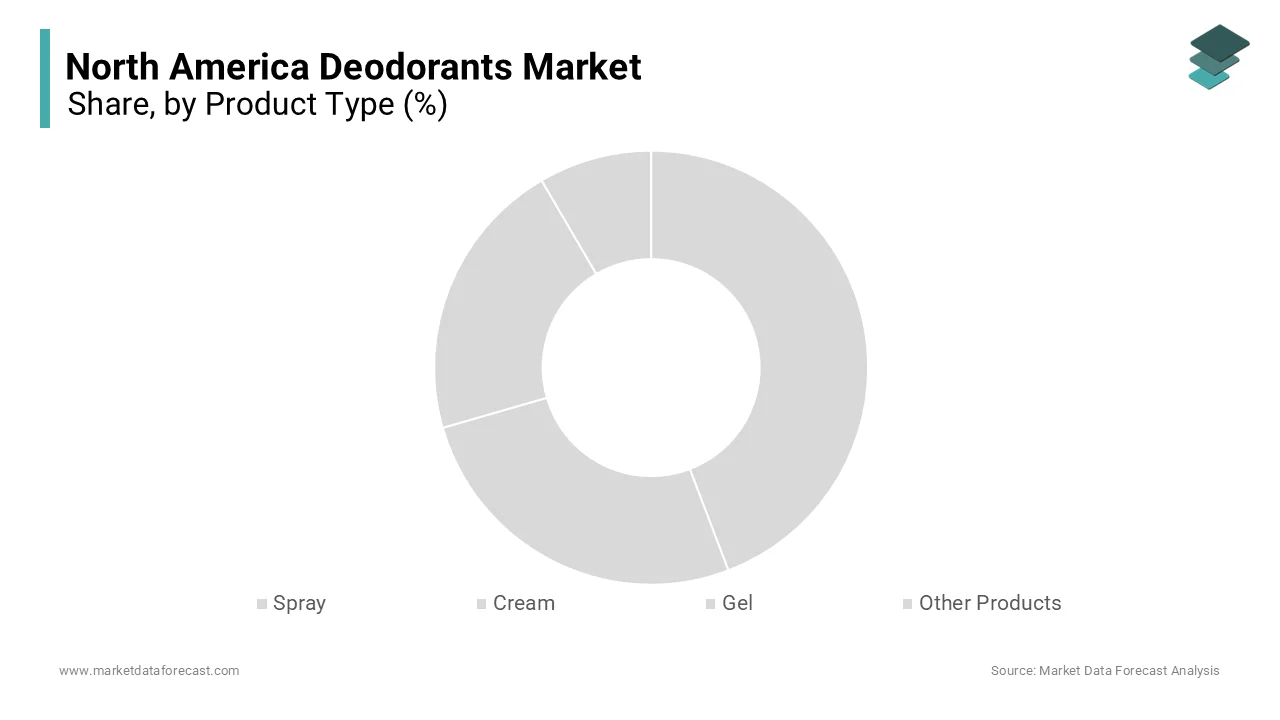
The gel deodorants segment is expanding at the fastest pace and is registering a CAGR of 7.3% from 2025 to 2033. This acceleration is fueled by shifting consumer demand for residue-free, skin-friendly formulations that align with clean beauty standards. A primary driver is the rising incidence of underarm sensitivity and irritation linked to traditional antiperspirants. Brands such as Oars + Alps and Tom’s of Maine have introduced dermatologically tested gel formulas with soothing ingredients like aloe vera and witch hazel, appealing to health-conscious users. Another contributing factor is the format’s compatibility with men’s grooming routines, particularly among younger demographics. Additionally, gels are increasingly being packaged in eco-conscious materials such as aluminum-free tubes and recyclable plastics, responding to sustainability imperatives. These converging health, sensory, and environmental advantages are propelling the gel segment into a position of dynamic growth.
By Distribution Channel Insights
The Supermarkets and hypermarkets segment represented the largest distribution channel for deodorants in North America with 45.3% share in 2025. This dominance is due to the channel’s unparalleled reach, one-stop shopping convenience, and strategic product placement that directly influences purchase decisions. A further critical factor sustaining this leadership is the high foot traffic in major retail chains such as Walmart, Kroger, and Superstore, which serve as primary procurement hubs for household essentials. Deodorants are typically positioned in proximity to complementary categories like oral care and skincare, enhancing cross-category sales. Furthermore, promotional strategies such as multi-pack discounts and end-cap displays significantly boost volume. The channel also benefits from strong relationships with mass-market brands like Dove, Old Spice, and Secret, which invest heavily in shelf visibility and trade marketing. Additionally, private-label expansion has strengthened supermarket competitiveness. This blend of accessibility, promotional agility, and trusted brand availability ensures supermarkets remain the cornerstone of deodorant distribution.
The online retail channel is growing at the fastest rate and is recording a CAGR of 14.6% between 2025 and 2033. This surge is propelled by evolving consumer behavior, digital infrastructure maturity, and the rise of direct-to-consumer (DTC) models. A further driver is the increasing preference for personalized shopping experiences and access to niche, premium, and clean-label brands not widely available in physical stores. The success of digitally native brands like Native and PiperWai exemplifies this shift, primarily throughtheir websitese and Amazon. Another contributing factor is the proliferation of subscription models that ensure product continuity and enhance customer retention. Additionally, the integration of augmented reality (AR) tools and AI-driven recommendations on platforms like Sephora and Ulta has improved virtual trial experiences, reducing purchase hesitation. These elements collectively position online retail as the most dynamic and transformative distribution force in the market.
REGIONAL ANALYSIS
United States
The United States held a commanding position in the North American deodorants market by accounting for 89.4% share in 2025. As the largest and most mature market, the U.S. exhibits a highly developed personal care ecosystem driven by cultural norms, high disposable income, and widespread product innovation. Daily deodorant use is nearly universal, with most Americans aged 12 and above using deodorizing products regularly. The market is characterized by intense brand competition, with multinational players like Procter & Gamble, Unilever, and Edgewell Personal Care dominating shelf space. Additionally, the U.S. leads in DTC e-commerce penetration, with online channels capturing a notable share of total deodorant sales. The country’s regulatory environment, shaped by the FDA and state-level initiatives like California’s Safe Cosmetics Act, also influences formulation standards. Urbanization and fitness culture amplify demand.
Canada
Canada occupies a smaller but strategically significant share of the North American deodorants market. While its market size is modest compared to the U.S., Canada demonstrates steady growth, particularly in premium and eco-conscious segments. The country’s deodorant consumption is shaped by a high standard of living and strong environmental awareness. Major retailers like Loblaws and Shoppers Drug Mart have expanded their clean beauty sections, featuring brands such as Native and Weleda. Health Canada’s stringent ingredient disclosure rules have further elevated consumer trust, particularly in natural products. Additionally, urban centers like Toronto and Vancouver exhibit higher per capita usage, influenced by dense populations and active lifestyles.
KEY MARKET PLAYERS AND COMPETITIVE LANDSCAPE
Company are key players in the North American deodorants market.
- Unilever PLC
- Beiersdorf AG
- Revlon Inc.
- Procter & Gamble Co.
- Colgate-Palmolive
The competitive landscape of the North American deodorants market is marked by a dynamic interplay between legacy corporations and agile niche players, each vying for consumer attention through differentiation and innovation. Established multinationals leverage their extensive distribution networks, brand equity, and R&D capabilities to maintain dominance, particularly in mass retail channels. However, they face increasing pressure from independent and digitally native brands that emphasize transparency, sustainability, and authenticity. These challenger brands often originate from grassroots movements advocating for chemical-free living and ethical production, quickly gaining traction through social media and influencer partnerships. The result is a fragmented yet highly responsive market where consumer preferences shift rapidly in response to health narratives, environmental concerns, and cultural trends. Competition is no longer solely about odor protection but extends to values such as eco-consciousness, inclusivity, and ingredient integrity that define brand identity. Companies are compelled to innovate beyond functionality, investing in storytelling, packaging design, and community engagement. Mergers and acquisitions have become common as larger firms absorb emerging brands to stay relevant. The market thrives on constant reinvention, where agility, responsiveness, and cultural insight often outweigh sheer scale, creating a fiercely contested arena where both heritage and novelty hold strategic advantage.
TOP PLAYERS IN THE MARKET
Procter & Gamble
Procter & Gamble holds a prominent position in the North American deodorants market through its extensive portfolio of trusted personal care brands, particularly Old Spice and Secret. The company has consistently shaped consumer preferences by combining innovative product development with high-impact marketing campaigns that resonate across demographics. Known for its strong R&D capabilities, Procter & Gamble emphasizes performance-driven formulations, including long-lasting odor protection and skin-safe technologies. Its dominance is further reinforced by wide distribution networks spanning mass retail, pharmacies, and e-commerce platforms. The brand’s ability to reinvent itself through humor, inclusivity, and digital engagement has sustained relevance in a competitive landscape. Globally, the company leverages its North American success as a blueprint for international expansion, maintaining a leadership stance in deodorant innovation and brand loyalty.
Unilever
Unilever maintains a strong foothold in the market with leading brands such as Degree (known as Rexona internationally) and Dove Men+Care. The company distinguishes itself through a dual focus on efficacy and ethical responsibility, aligning product development with sustainability and skin health. Unilever has been instrumental in advancing clean-label initiatives, introducing aluminum-free and plant-based variants that cater to evolving consumer demands. Its integrated global strategy allows regional insights from North America to influence formulations and marketing in other markets. The company’s commitment to reducing environmental impact extends to packaging innovation and carbon-neutral manufacturing. Through purpose-driven branding and inclusive messaging, Unilever has strengthened emotional connections with consumers, positioning its deodorant lines as part of a broader wellness narrative that transcends geography.
Edgewell Personal Care
Edgewell Personal Care stands out as a key player through its flagship brand, Schick, and its strategic acquisition of the natural deodorant brand, Jack Henry. The company has successfully bridged the gap between mainstream appeal and premium clean beauty, leveraging Jack Henry’s artisanal positioning to capture discerning urban consumers. Edgewell emphasizes minimalist design, dermatological testing, and sustainable sourcing, differentiating its offerings in a crowded market. Its agility allows for rapid response to shifting trends, particularly in the gender-neutral and eco-conscious segments. In North America, the company has built a reputation for authenticity and transparency, values that resonate strongly with younger demographics. Globally, Edgewell uses its North American innovations as a testing ground for new formats and claims, enabling scalable rollouts in Europe and select Asian markets, thereby enhancing its international footprint through localized relevance.
TOP STRATEGIES USED BY KEY PLAYERS
Shift Toward Clean and Transparent Formulations
One major strategy employed by leading players is the shift toward clean and transparent formulations, emphasizing natural ingredients, the absence of aluminum, and non-toxic chemistry. This approach responds to rising consumer skepticism toward synthetic additives and aligns with broader wellness trends. Companies are reformulating legacy products and launching sub-brands that highlight purity, safety, and dermatological testing, fostering trust and brand loyalty.
Expansion into Direct-to-Consumer (DTC) Channels
Another key strategy is the expansion into direct-to-consumer (DTC) channels and digital-first branding. By bypassing traditional retail intermediaries, companies engage directly with consumers, gather behavioral insights, and offer personalized experiences. This model supports subscription services, rapid product iteration, and targeted marketing through social media, enhancing customer retention and brand authenticity.
Pursuit of Inclusivity in Branding and Product Design
A third critical strategy is the pursuit of inclusivity in branding and product design. Companies are moving away from gender-specific marketing, introducing unisex fragrances, neutral packaging, and campaigns that reflect diverse identities. This cultural alignment strengthens emotional resonance, particularly with younger, socially conscious consumers, positioning brands as progressive and socially responsible actors in the personal care space.
RECENT HAPPENINGS IN THE MARKET
- In March 2024, Unilever launched a new line of aluminum-free, 100% recyclable packaging deodorants under the Degree brand, emphasizing skin-safe formulas and sustainable design to appeal to eco-conscious consumers.
- In August 2022, Edgewell Personal Care acquired Jack Henry, a premium clean-label deodorant brand, to expand its presence in the natural personal care segment and tap into the growing demand for minimalist, dermatologist-tested products.
- In January 2025, Procter & Gamble introduced a gender-neutral fragrance collection under the Secret brand, reflecting evolving consumer preferences for inclusive personal care and broadening its appeal beyond traditional gendered marketing.
- In November 2024, Native, a fast-growing DTC deodorant brand, partnered with major retailers, including Target and Walmart, to expand its physical footprint while maintaining its digital-first engagement model.
- In May 2022, Dove Men+Care enhanced its product line with clinically tested sensitive skin variants, reinforcing its commitment to skin health and expanding its reach within the men’s grooming category.
MARKET SEGMENTATION
This research report on the North America deodorants market has been segmented and sub-segmented based on the following categories.
By Product Type
- Spray
- Cream
- Gel
- Other Products
By Distribution Channel
- Supermarkets and Hypermarkets
- Convenience Stores
- Pharmacies and Drug Stores
- Online Retail
- Other Distribution Channels
By Country
- The United States
- Canada
- Rest of North America
Frequently Asked Questions
1. What factors are driving the growth of the deodorants market in North America?
Rising consumer awareness about personal hygiene and lifestyle changes are key growth drivers.
2. Which product types dominate the North America deodorants market?
Sprays, creams, gels, and other products like roll-ons and sticks are commonly used.
3. Which distribution channel is most popular for deodorant sales in North America?
Supermarkets and hypermarkets lead, followed by online retail and convenience stores.
4. Who are the major players in the North America deodorants market?
Key players include Unilever, Procter & Gamble, Beiersdorf AG, Colgate-Palmolive, and Revlon Inc.
5. How is e-commerce impacting the deodorants market in North America?
Online sales are rising due to convenience, wider options, and frequent discounts.
6. Are natural or organic deodorants gaining traction in North America?
Yes, increasing demand for chemical-free and sustainable products is boosting this segment.
7. Which age group contributes most to the deodorants market in North America?
Young adults and working professionals are the largest consumer base.
8. What are the key challenges facing the deodorants market in North America?
Market saturation, intense competition, and health concerns over certain ingredients.
9. How are manufacturers innovating in the deodorants market?
Companies are introducing eco-friendly packaging and aluminum-free, gender-neutral products.
10. Which country leads the deodorants market in North America?
The United States holds the largest market share in the region.
Related Reports
Access the study in MULTIPLE FORMATS
Purchase options starting from
$ 2000
Didn’t find what you’re looking for?
TALK TO OUR ANALYST TEAM
Need something within your budget?
NO WORRIES! WE GOT YOU COVERED!
Call us on: +1 888 702 9696 (U.S Toll Free)
Write to us: sales@marketdataforecast.com