- Product Description Description
- Table of Contents TOC
- List of Table & Figure LOT
- Get Free Sample PDF Sample PDF
Market Size, 2025
$30.53 BnMarket Estimate, 2026
$32.43 BnMarket Forecast, 2034
$52.58 BnCAGR, 2026–2034
6.25%Executive Summary: Global Deodorants Market
- Market Scope: Comprehensive global overview of personal care formulations designed to mitigate body odor and regulate perspiration, segmented by product type, packaging material, and end user across key regional markets.
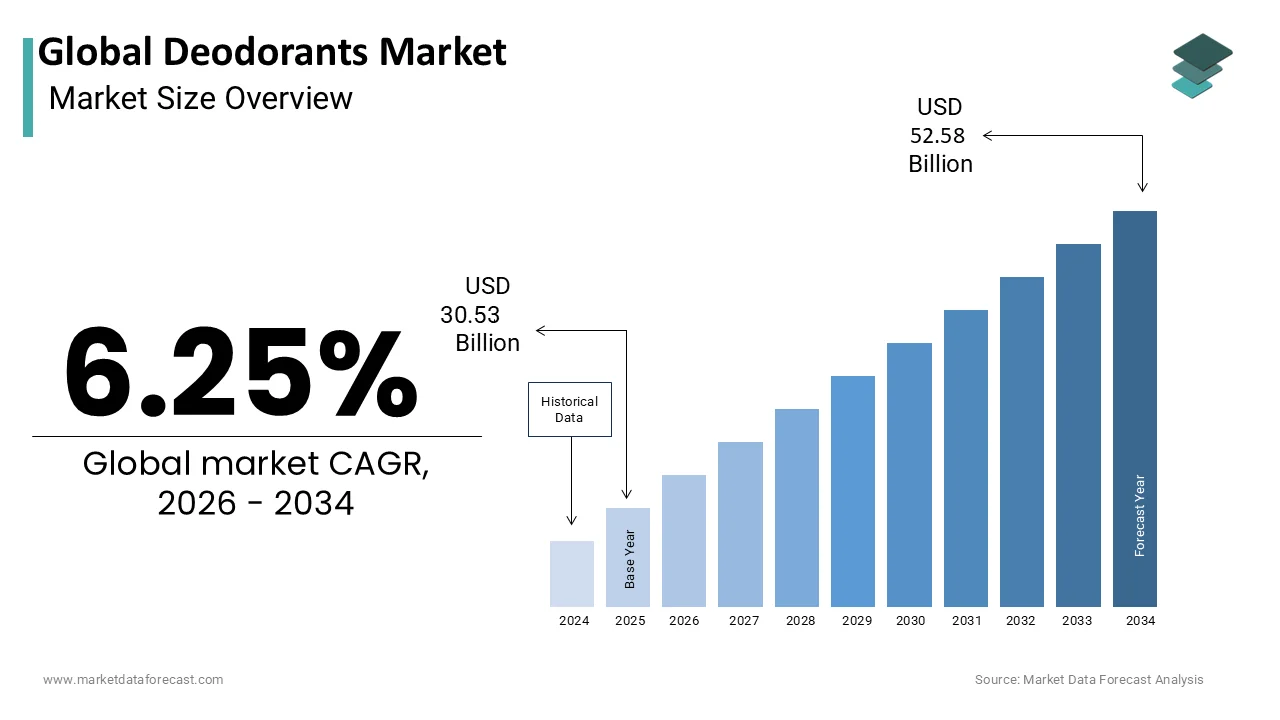
- Market Valuation: Valued at USD 30.53 billion in 2025, reaching USD 32.43 billion in 2026, and projected to expand to USD 52.58 billion by 2034, registering a compound annual growth rate (CAGR) of 6.25% from 2025 to 2033/2034.
- Primary Growth Drivers: Rapid urbanization and evolving lifestyle norms, growing health consciousness accelerating the shift toward clean-label and aluminum-free solutions, and rising demand for personal freshness in developing regions.
Key Market Segment Metrics
| Category | Segments / Core Focus | Key Highlights |
|---|---|---|
| By Product Type | Spray, Stick, Roll-on, Others | Stick deodorants lead the market share (38.2% in 2025), while spray deodorants are growing at the highest CAGR (7.8%) driven by fast-drying, cooling tech for humid regions. |
| By Packaging Material | Metal, Plastic, Others | Plastic holds the largest share (56.5% in 2025) due to cost-efficiency, while metal packaging is expanding at a notable 9.1% CAGR for eco-conscious luxury and aerosol designs. |
| By End User | Men, Women | The women segment commands the majority share (54.7% in 2025), while the men segment is the fastest-growing at an 8.3% CAGR propelled by male grooming and self-care movements. |
| By Region | North America, Europe, Asia Pacific, Latin America, Middle East & Africa | North America leads with 33.5% of the market share in 2025, closely followed by Europe, while Asia-Pacific emerges as a high-growth epicenter driven by urbanization. |
Major Market Players & Industry Landscape
Competitive Structure: Intensifying competition between global multinational corporations leveraging extensive R&D and agile, clean-label digital-native brands disrupting legacy distribution channels.
Key Companies Profiled: Unilever PLC, The Procter & Gamble Company, Beiersdorf AG, Henkel AG & Co. KGaA, L'Oréal SA, Kao Corporation, Sky Organics, Speick Natural Cosmetics, Truly's Natural Products, and Erbaviva.
Global Deodorants Market Size
The global deodorants market size was valued at USD 30.53 billion in 2025. The global market is expected to exhibit a CAGR of 6.25% from 2025 to 2033 and be worth USD 52.58 billion by 2034 from USD 32.43 billion in 2026.
Deodorants are personal care formulations designed to mitigate body odor caused by bacterial decomposition of sweat, with products broadly classified into antiperspirants, which reduce sweat secretion, and deodorants, which neutralize odor without affecting perspiration. Unlike general hygiene items, modern deodorants integrate advanced odor-control technologies, including encapsulated fragrances, microbiome-balancing actives, and alcohol-free bases to suit sensitive skin. As per the study, a large number of people globally practice daily underarm hygiene routines, forming the foundational behavioral shift driving product adoption. According to research, a portion of urban populations in emerging economies now incorporate deodorants as part of essential grooming, reflecting evolving personal care standards.
MARKET DRIVERS
Rising urbanization and changing lifestyle norms are fundamentally reshaping deodorant consumption patterns across developing regions, which surges the growth rate of the deodorant market. Populations are migrating to cities due to which exposure to enclosed workspaces, public transportation, and formal employment environments has intensified. This increases the need for sustained personal freshness. According to a study, the global urban population surged, with a portion of this growth occurring in Asia, Africa, and Latin America. In India, it points out that a portion of the population resides in urban centers, an increase over the past decade, correlating with a surge in personal care product penetration. This behavioral shift is further amplified by globalization and media influence, where personal grooming is increasingly associated with professionalism and social acceptability, particularly among younger demographics.
The growing health consciousness and demand for clean label products is accelerating the expansion of the deodorants market. These are surging the shift toward safer and transparently formulated deodorants. Consumers are increasingly scrutinizing ingredients due to concerns over aluminum, parabens, and synthetic fragrances, which have been linked in some studies to hormonal disruption and skin irritation. As per a study, a share of EU consumers actively avoid antiperspirants containing aluminum salts, favoring natural alternatives. This has led to a surge in demand for plant-based, baking soda-infused, and probiotic deodorants. In the U.S., sales of aluminum-free deodorants grew annually. Brands have capitalized on this trend, with a portion of their customer base citing ingredient safety as the primary purchase driver, as per research. This shift reflects a broader movement toward wellness-integrated personal care, where deodorants are no longer seen as mere odor blockers but as components of holistic health regimens.
MARKET RESTRAINTS
The regulatory scrutiny and ingredient safety concerns are hampering the growth of the deodorants market. This impacts the growth of conventional antiperspirant formulations, particularly those containing aluminum compounds and synthetic preservatives. In addition, France recommended limiting aluminum concentrations in antiperspirants, down from previous allowances, influencing product reformulations across Europe. Similarly, Health Canada has mandated enhanced disclosure of fragrance allergens on deodorant labels, increasing compliance costs for manufacturers. These regulatory shifts have delayed product launches and increased R&D expenditures, with reformulating a single antiperspirant variant to meet EU standards costing, which significantly affects profit margins and innovation timelines.
The environmental impact of packaging and product waste is a primary hindrance to the growth of the deodorants market. Most deodorant sticks and aerosol cans are composed of mixed plastics and metals that are difficult to recycle, contributing to landfill accumulation. As per research, only a portion of plastic packaging in personal care products is effectively recycled globally, with deodorant containers being among the least recyclable due to composite materials. This has led to public backlash and retailer burden, with major chains like Boots and Carrefour delisting non-recyclable formats. Apart from these, aerosol propellants such as butane and propane contribute to volatile organic compound emissions, which draw scrutiny under climate regulations like the U.S. EPA’s Clean Air Act. This further constrains traditional product formats.
MARKET OPPORTUNITIES
The expansion into emerging markets with affordable and culturally tailored products provides a major growth possibility for the deodorants market. Companies are developing cost-effective and locally resonant formulations due to rising disposable incomes and expanding middle classes in regions like Southeast Asia, Africa, and South America. According to research, the continent’s middle class grew, which creates a vast consumer base for personal care essentials. In Nigeria, it recorded an increase in deodorant imports, driven by urban youth adoption. Similarly, Beiersdorf introduced a halal-certified NIVEA deodorant line in Malaysia and the Gulf, aligning with religious and cultural norms. These localized strategies are unlocking previously underserved segments in hot, humid regions where sweat and odor control are daily necessities.
The innovation in sustainable and refillable formats is fuelling new opportunities and the expansion of the deodorants market. It is opening new commercial pathways as brands respond to environmental imperatives and circular economy principles. Companies are pioneering modular deodorant systems that separate applicators from refill cartridges, reducing plastic waste. As per the study, a portion of consumers in Germany, Japan, and Australia are willing to pay a premium for refillable personal care products. Retailers have dedicated shelf space to such eco-innovations, signaling industry-wide endorsement. This shift not only meets regulatory demands but also strengthens brand loyalty among environmentally conscious consumers, particularly Millennials and Gen Z.
MARKET CHALLENGES
Navigating ingredient efficacy and consumer sensory expectations poses a challenge for the growth of the deodorant market. It is especially in the natural deodorant segment where performance inconsistencies affect trust. Many plant-based formulations fail to provide long-lasting odor protection, particularly in high-sweat conditions, while consumers demand aluminum-free and eco-friendly options. According to a study, a portion of users discontinued natural deodorants within months due to inadequate efficacy, with complaints of residue, skin irritation, and odor breakthrough. The absence of standardized testing protocols for natural claims further complicates consumer decision-making. Apart from these, sensory attributes such as texture, dry time, and scent longevity are important purchase determinants. Balancing clean ingredients with functional performance remains a complex formulation hurdle, which requires substantial investment in biotechnology and microbiome science.
Intensifying competition from direct-to-consumer (DTC) and Indie Brands is disrupting the dominance of traditional multinational players, fragmenting the market and compressing margins, which severely impacts the deodorants market. Digitally native brands leverage social media, influencer marketing, and subscription models to build rapid customer loyalty with minimal overhead. These brands often emphasize transparency, ethical sourcing, and niche positioning. In contrast, legacy manufacturers face slower innovation cycles and higher distribution costs. Moreover, e-commerce platforms like Amazon and Shopify lower entry barriers, enabling micro-brands to gain visibility. This hyper-fragmented landscape forces incumbents to increase marketing spend and accelerate product launches, often at the expense of profitability, while struggling to maintain shelf space in both physical and digital retail environments.
REPORT COVERAGE
| REPORT METRIC | DETAILS |
| Market Size Available | 2025 to 2034 |
| Base Year | 2025 |
| Forecast Period | 2026 to 2034 |
| Segments Covered | By Product Type, Packaging Material, End User, and Region |
| Various Analyses Covered | Global, Regional,d Country-Level Analysis, Segment-Level Analysis, DROC, PESTLE Analysis, Porter’s Five Forces Analysis, Competitive Landscape, Analyst Overview on Investment Opportunities |
| Regions Covered | North America, Europe, Asia Pacific, Latin America, Middle East & Africa |
| Market Leader Profiled | Unilever PLC, The Procter & Gamble Company, Beiersdorf AG, Henkel AG & Co KGaA, L'Oreal SA, Sky Organics, Speick Natural Cosmetics, Truly's Natural Products, and Erbaviva |
SEGMENTAL ANALYSIS
By Product Type Insights
The stick deodorant segment dominated the deodorants market by accounting for 38.2% of the global market share in 2025. Superior convenience, portability, and mess-free application, attributes that align with fast-paced urban lifestyles, are primarily driving the growth of the stick deodorant segment in the global market. Consumer preference for solid formats that minimize leakage and are travel-compliant, especially under international aviation regulations f, further propels the expansion of the stick deodorants segment. As per research, a large number of passengers flew, an increase from 2022, amplifying demand for non-liquid personal care products. Apart from these, stick formats are perceived as more hygienic than roll-ons, particularly in shared environments. Major brands have optimized wax-resin matrices to enhance glide and reduce residue, which further strengthens consumer trust and repeat usage.
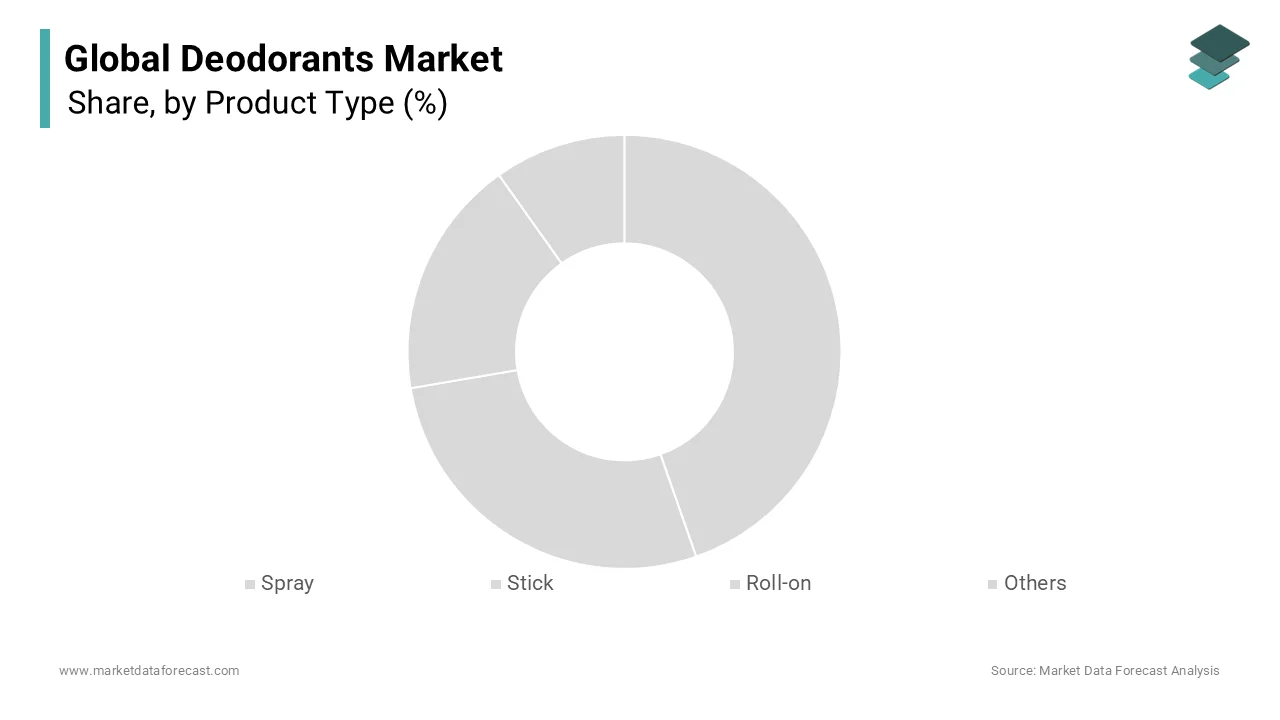
The spray deodorant segment is predicted to witness the highest CAGR of 7.8% from 2025 to 2033 due to its rapid application, even coverage, and cooling sensation, qualities particularly valued in hot and humid regions. Sprays are increasingly formulated with fast-drying, alcohol-based systems that provide immediate freshness, appealing to younger, active demographics. According to a study, spray formats captured a portion of incremental sales growth in Southeast Asia, where high humidity drives demand for instant sweat control. Innovations in fine-mist technology and eco-propellant alternatives, such as compressed air and hydrocarbons with lower global warming potential, have also improved sustainability profiles.
By Packaging Material Insights
The plastic packaging segment was the largest segment of the deodorants market by capturing 56.5% of the global market share in 2025. The growth of the plastic packaging segment is due to cost-efficiency, moldability, and lightweight properties, which reduce transportation emissions and manufacturing complexity. High-density polyethylene (HDPE) and polypropylene (PP) are widely used due to their durability and compatibility with various deodorant formulations. In emerging markets like Indonesia and Nigeria, where affordability is important, plastic-based stick and roll-on containers allow mass-market pricing. Furthermore, advancements in monolayer plastic designs have improved recyclability.
The metal packaging segment is expected to exhibit a noteworthy CAGR of 9.1% from 2025 to 2033, owing to the rising demand for premium, eco-conscious formats, particularly in aerosol sprays and refillable systems. Aluminum, being infinitely recyclable without quality loss, aligns with circular economy goals. According to research, aluminum cans have a recycling rate of a portion in the U.S. and up to a percentage in the EU, significantly higher than most plastics. Brands have introduced aluminum-bodied aerosols by citing consumer demand for sustainable luxury. Apart from these, metal’s superior barrier properties prevent fragrance degradation and leakage, which enhances product integrity.
By End-User Insightswomen'sn segment led the deodorants market by accounting for 54.7% of the global market share in 2025. Long-standing cultural norms around feminine grooming and a broader integration of deodorants into daily beauty routines have contributed to the expansion of the women's segment in the global market. Women are more likely to use multiple personal care products in combination, including antiperspirants, body mists, and scented lotions, creating a higher frequency of use. Apart from these, marketing strategies have historically targeted women with emotional and aesthetic messages, and fragrance variants like floral, fruity, and musky dominate female-focused lines.
The men segment is on the rise and is expected to be thfathe fastest-growingment in the global market by witnessing a CAGR of 8.3% during the forecast period. The acceleration of the omen'sen segment is propelled by shifting gender norms and the masculinization of personal care, where grooming is increasingly associated with confidence and professionalism. The rise of the metrosexual and self-care movements has normalized men’s use of fragranced and functional deodorants beyond basic hygiene. Social media influencers and celebrity endorsements have played a pivotal role in destigmatizing male grooming. Brands are responding with bold scents, matte-finish packaging, and performance claims like 24-hour sweat defense, which resonates with active and image-conscious male consumers.
REGIONAL ANALYSIS
North America Deodorants Market Insights
North America outperformed other regions in the deodorants market in 2025 by accounting for 33.5% of the global market share. The U.S. dominates this landscape, which is supported by high per capita spending, advanced retail infrastructure, and a deeply ingrained culture of daily personal care. According to a study, Americans spent a notable amount on antiperspirants and deodorants. The prevalence of air-conditioned environments and sedentary office work has not diminished usage. Instead, social expectations around freshness persist. Moreover, the U.S. leads in product innovation, with brands like Degree and Secret pioneering clinical-strength variants and smart packaging. E-commerce platforms like Amazon and Ulta have further accelerated access, particularly for niche and clean-label brands.
Europe Deodorants Market Insights
Europe is another key region in the deodorants mark,et with 28.5% share of the global market share due to a balanced blend of tradition, regulation, and sustainability dominance. Germany, France, and the UK form the core of demand, where personal hygiene is tightly interwoven with social etiquette. The European Commission’s stringent chemical regulations under REACH have pushed manufacturers to reformulate products, eliminating allergens and endocrine disruptors. This has caused the rise of natural and dermatologically tested brands like Weleda and Lavilin. Apart from these, the region’s strong retail pharmacy network, including chains like Boots and DM, ensures widespread product availability. The growing popularity of unisex fragrances and gender-neutral branding further diversifies consumer choice, which positions Europe as a trendsetter in ethical and inclusive personal care.
Asia Pacific Deodorants Market Insights
Asia Pacific is expected to be the most lucrative region in the deodorants market because of rapid urbanization and evolving consumer aspirations. India and China are at the forefront, where rising disposable incomes and exposure to global lifestyles are transforming grooming habits. Heat and humidity in tropical countries like Indonesia and Thailand further amplify demand for sweat-control products. Local brands such as Mamaearth and Biotique are gaining traction by combining Ayurvedic ingredients with modern formats. Meanwhile, Japanese consumers prioritize subtlety and skin compatibility, driving demand for alcohol-free and hypoallergenic variants. Thus, digital channels are accelerating product discovery and trial.
Latin America Deodorants Market Insights
Latin America is expanding in the deodorants market, with Brazil and Mexico serving as primary growth hubs due to youthful populations and increasing health awareness. The region’s warm climate makes deodorants a daily necessity, particularly in densely populated urban centers. Cultural emphasis on physical appearance and social interaction fuels demand, especially during festivals and summer months. Local players like O Boticário and international brands such as Dove have introduced affordable, tropical-scented variants to capture mass-market appeal. Apart from these, rising female workforce participation has increased demand for long-lasting, reliable products. Retail expansion through supermarkets and drugstores, combined with aggressive promotional campaigns, has deepened market penetration across both urban and semi-urban areas.
Middle East & Africa Deodorants Market Insights
The Middle East & Afriare is likely to grow in the global market, with the Gulf Cooperation Council (GCC) countries leading in per capita consumption. In the UAE and Saudi Arabia, high temperatures and cultural emphasis on hospitality and personal presentation drive consistent deodorant usage. Traditional use of oud and amber has seamlessly transitioned into modern deodorant formulations by blending heritage with convenience. Meanwhile, in Sub-Saharan Africa, growth is emerging from urban centers like Lagos and Nairobi, where a rising middle class is adopting Western hygiene practices.
COMPETITIVE LANDSCAPE
KEY MARKET PLAYERS
Some of the notable players in the global natural hair care products market are
- Unilever PLC
- The Procter & Gamble Company
- Beiersdorf AG
- Henkel AG & Co KGaA
- L'Oréal SA
- Sky Organics
- Speick Natural Cosmetics
- Truly's Natural Products
- Erbaviva
TOP STRATEGIES USED BY THE KEY MARKET PLAYERS
Key players in the Deodorants Market are deploying product innovation, sustainability integration, digital engagement, regional customization, and strategic retail partnerships to consolidate their presence. Companies are reformulating products to exclude aluminum, parabens, and synthetic fragrances in response to health-conscious demand. Eco-packaging initiatives, including refillable systems and recyclable materials, are being prioritized to meet environmental regulations and consumer expectations. Brands are launching climate-specific variants, such as sweat-activated or humidity-resistant formulas, for tropical markets. Digital transformation is evident through social media marketing, influencer collaborations, and e-commerce optimization.
COMPETITION OVERVIEW
The competition in the Deodorants Market is intensifying as multinational corporations, regional manufacturers, and digitally native brands converge on innovation, sustainability, and cultural relevance. Incumbents leverage R&D scale and global distribution, while challenger brands disrupt with clean formulations and agile marketing. The Asia-Pacific region has become a battleground for market share, with localization of scent, texture, and functionality determining success. Product differentiation now extends beyond fragrance to include skincare benefits, microbiome compatibility, and environmental impact. Retail channels are evolving, with e-commerce and convenience stores reshaping accessibility. Regulatory burdens in Europe and North America are influencing global formulations, while consumer demand for transparency and efficacy is raising performance standards. This multifaceted competition is driving rapid iteration by forcing companies to balance cost, compliance, and consumer trust in an increasingly discerning global marketplace.
TOP PLAYERS IN THE MARKET
Unilever
Unilever has strengthened its dominance in the Asia-Pacific deodorants market through a diversified portfolio spanning mass-market and premium segments. Brands like Rexona, Dove, and Axe are tailored to regional preferences, incorporating cooling actives for tropical climates and natural extracts such as green tea and aloe vera. The company has intensified its digital outreach via e-commerce partnerships with Flipkart, Lazada, and Tmall, while leveraging AI-driven consumer insights to refine scent profiles. Apart from these, Unilever’s Sustainable Living Plan has driven the introduction of recyclable packaging for Dove deodorants across Australia and Japan, which aligns with regional environmental expectations anstrengthensng brand equity among eco-conscious urban consumers.
Procter & Gamble (P&G)
Procter & Gamble (P&G) exerts significant influence in the Asia-Pacific deodorants landscape through its flagship brand, Old Spice, and its clinically proven Secret line. P&G has localized its offerings to meet diverse consumer needs. P&G has also expanded distribution through modern trade and convenience stores in urban centers like Manila and Ho Chi Minh City. Its investment in omnichannel marketing, including TikTok campaigns and influencer collaborations, has enhanced engagement with younger demographics. Furthermore, P&G’s R&D center in Singapore enables rapid formulation adjustments based on regional microbiome and climate data, which ensures product efficacy and consumer trust.
Kao Corporation
Kao Corporation stands as a dominant regional force in the Asia-Pacific deodorants market, leveraging deep cultural understanding and advanced Japanese formulation science. Through its Biore and Deo Vive brands, Kao has pioneered sweat-activated and odor-neutralizing technologies suited for humid environments. Kao’s strategic alliances with convenience store chains like 7-Eleven across Southeast Asia have enhanced last-mile accessibility. Kao has differentiated its offerings in a crowded market by integrating skincare benefits into deodorant formulations, which appeals to consumers seeking multifunctional personal care solutions.
MARKET SEGMENTATION
This research report on the global deodorants market has been segmented and sub-segmented into the following categories.
By Product Type
- Spray
- Stick
- Roll-on
- Others
By Packaging Material
- Metal
- Plastic
- Others
By End User
- Men
- Woman
By Region
- North America
- Europe
- Asia Pacific
- Latin America
- The Middle East and Africa