North America Disposable Thermometer Market Size, Share, Trends & Growth Forecast Report By Type (Digital Thermometers, Strip Thermometers), Target Area (Oral, Axilla, Rectal, Other Target Areas), End Use (Hospitals, Diagnostic Centers, Homecare, Other End Use), and Country (United States, Canada, Mexico, Rest of North America) – Industry Analysis, 2026 to 2034
North America Disposable Thermometer Market Summary
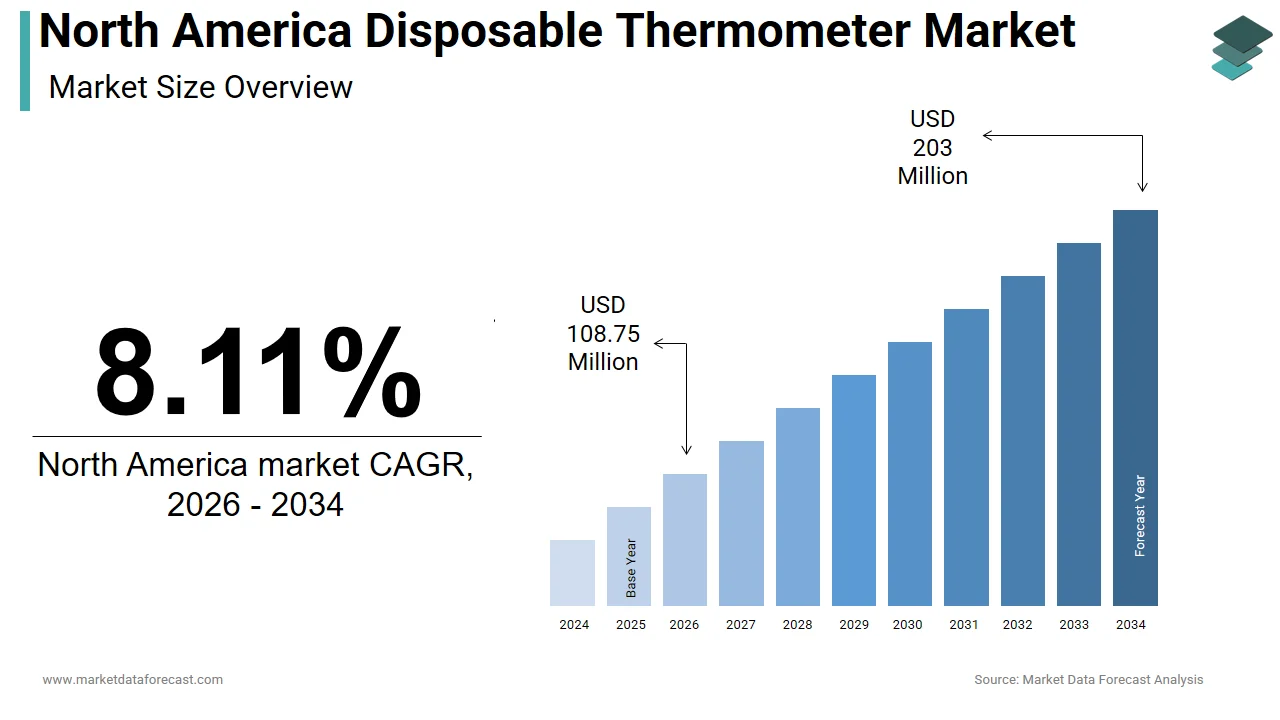
The North America disposable thermometer market was valued at USD 100.59 million in 2025, is estimated to reach USD 108.75 million in 2026, and is projected to reach USD 203 million by 2034, growing at a CAGR of 8.11% from 2026 to 2034. The market is primarily driven by infection control requirements in healthcare settings, demand for pharmaceutical cold chain monitoring, and growing home healthcare trends.
Key Market Trends & Insights
- United States dominated the North America disposable thermometer market in 2025.
- Canada is emerging as a key market driven by universal healthcare standards and growing infection control focus.
- Based on type, digital thermometers led the market in 2025.
- Based on the target area, the oral thermometers segment held the largest market share in 2025.
- Based on end-use, hospitals remained the top segment in 2025.
Market Size & Forecast
- 2025 Market Size: USD 100.59 Million
- 2026 Estimated Market Size: USD 108.75 Million
- 2034 Projected Market Size: USD 203 Million
- CAGR (2026 to 2034): 8.11%
- United States: Largest market in 2025
- Canada: Emerging growth region
North America Disposable Thermometer Market Size
The North America disposable thermometer market was valued at USD100.59 million in 2025, is estimated to reach USD 108.75 million in 2026, and is projected to reach USD 203 million by 2034, growing at a CAGR of 8.11% from 2026 to 2034.
Disposable thermometers represent essential single-use temperature measurement devices designed for clinical, industrial, and consumer applications where hygiene, cross-contamination prevention, and cost-effectiveness are paramount considerations. These instruments utilize various sensing technologies, including liquid crystal, infrared, and chemical indicator systems, to provide accurate temperature readings without requiring cleaning, calibration, or sterilization between uses. The market encompasses diverse product categories, including single-use digital probes, disposable infrared thermometers, chemical temperature indicators, and adhesive strip thermometers designed for specific application requirements. The fundamental design principle of disposability eliminates the risk of pathogen transmission between patients while reducing healthcare facility operational costs associated with cleaning, maintenance, and equipment replacement. The pharmaceutical industry extensively utilizes disposable thermometers for cold chain monitoring, vaccine storage verification, and temperature-sensitive product handling where accuracy and contamination prevention are critical. Industrial applications include food processing quality control, HVAC system monitoring, and manufacturing process temperature verification, where disposable sensors provide cost-effective solutions for routine monitoring requirements.
MARKET DRIVERS
Healthcare Infection Control Requirements and Patient Safety Standards
The escalating emphasis on healthcare infection control and patient safety standards serves as the primary catalyst driving demand for disposable thermometers across North American healthcare facilities. The fundamental shift toward single-use medical devices reflects healthcare systems' recognition of cross-contamination risks associated with reusable temperature measurement equipment and the critical importance of preventing healthcare-associated infections. The Joint Commission has established stringent infection control standards requiring healthcare facilities to demonstrate risk mitigation strategies for medical equipment, with single-use thermometers providing clear compliance advantages over reusable alternatives. Besides, the increasing prevalence of antibiotic-resistant pathogens, including MRSA and C. difficile, has heightened awareness of device-related transmission risks, making disposable thermometers essential components of comprehensive infection prevention protocols. The trend toward outpatient procedures and ambulatory care settings has particularly favored disposable thermometer adoption due to simplified infection control protocols and reduced cleaning infrastructure requirements.
Pharmaceutical Cold Chain Monitoring and Temperature-Sensitive Product Requirements
The expanding pharmaceutical industry and increasing demand for temperature-sensitive product monitoring represent significant drivers for the disposable thermometer market growth across North America. The pharmaceutical sector's reliance on precise temperature control for vaccine storage, biologic product handling, and cold chain logistics has created substantial demand for reliable, cost-effective temperature monitoring solutions. The complexity of modern biologic medications and personalized therapies requires continuous temperature monitoring throughout manufacturing, storage, and distribution processes, creating opportunities for disposable thermometer applications. Also, the expansion of mRNA vaccine production and distribution capabilities following pandemic response initiatives has established new market segments for single-use temperature monitoring devices. The Food and Drug Administration requires comprehensive temperature documentation for pharmaceutical products throughout their lifecycle, with disposable thermometers providing cost-effective compliance solutions for routine monitoring requirements. The trend toward decentralized clinical trials and home-based patient care has further increased demand for portable, single-use temperature monitoring devices that ensure product integrity while maintaining patient safety standards.
MARKET RESTRAINTS
Environmental Concerns and Waste Management Requirements
The growing environmental consciousness and increasing regulatory pressure regarding medical waste management present significant constraints on disposable thermometer market across North America. The fundamental single-use nature of these devices generates substantial waste volumes that contribute to healthcare facility environmental footprints and create disposal compliance challenges. The disposal of electronic components and battery-powered disposable thermometers creates additional environmental compliance requirements and disposal costs that healthcare facilities must address. The American Hospital Association pointed out that medical waste management costs have increased over the past three years, with single-use device waste representing a growing portion of these expenses. Besides, the development of extended producer responsibility regulations and medical device take-back programs has created new compliance requirements for manufacturers and healthcare facilities utilizing disposable thermometers. The trend toward sustainable healthcare practices and green facility certifications has prompted some healthcare systems to explore reusable alternatives and hybrid monitoring solutions that reduce environmental impact while maintaining infection control standards. The requirement for specialized disposal protocols and waste segregation procedures adds operational complexity and cost burdens for healthcare facilities implementing comprehensive single-use device programs.
Cost Considerations and Budgetary Constraints in Healthcare Facilities
The ongoing cost pressures and budgetary constraints facing North American healthcare facilities present significant limitations on disposable thermometer market growth, particularly in resource-constrained environments where cost-effectiveness becomes a primary decision-making factor. The fundamental expense of single-use devices compared to reusable alternatives creates financial accessibility challenges for facilities operating within tight budgetary parameters and seeking to optimize operational expenditures. The requirement for continuous replacement and inventory management of disposable devices adds ongoing operational costs and supply chain complexities that healthcare administrators must consider when evaluating temperature monitoring solutions. Moreover, the economic impact of healthcare budget cuts and reimbursement reductions has forced many facilities to prioritize essential equipment purchases over convenience-based single-use alternatives. The trend toward value-based care and outcome-focused reimbursement models has particularly influenced disposable thermometer adoption, as facilities seek to demonstrate cost-effective care delivery while maintaining quality standards.
MARKET OPPORTUNITIES
Technological Advancement and Smart Device Integration
Technological innovation in disposable thermometer design and functionality presents substantial market opportunities through enhanced accuracy, connectivity capabilities, and integrated data management features that address previous limitations of basic single-use devices. Advanced materials science and miniaturized electronics have enabled the development of sophisticated disposable thermometers with wireless connectivity, real-time data transmission, and cloud-based monitoring capabilities that enhance clinical workflows and patient care coordination. The development of Bluetooth-enabled disposable thermometers allows for real-time temperature monitoring and automatic data recording, reducing manual documentation requirements and improving clinical workflow efficiency. Besides, the integration of artificial intelligence algorithms and predictive analytics in disposable thermometer platforms enables early detection of temperature trends and automated alert systems that enhance patient monitoring capabilities. Furthermore, the development of multi-parameter monitoring capabilities that combine temperature measurement with other vital signs creates opportunities for comprehensive patient monitoring solutions that expand the addressable market beyond basic temperature measurement applications.
Expansion into Consumer and Home Healthcare Markets
The broadening scope of disposable thermometer applications beyond traditional healthcare settings into consumer and home healthcare markets presents significant growth opportunities through increased accessibility and self-monitoring capabilities for patients and caregivers. The fundamental shift toward patient-centered care and home-based health monitoring has created new market segments for convenient, accurate, and user-friendly disposable temperature measurement solutions. The aging population and increasing prevalence of chronic conditions requiring routine temperature monitoring have particularly favored disposable thermometer adoption in home care environments. Additionally, the expansion of telehealth services and remote patient monitoring programs has increased demand for reliable home-based temperature measurement devices that enable healthcare provider oversight and clinical decision-making. The development of smartphone-integrated disposable thermometers and mobile health applications has enhanced user experience and data sharing capabilities that support coordinated care delivery models. The trend toward preventive healthcare and wellness monitoring has further expanded the addressable market beyond traditional medical applications to include fitness tracking, environmental monitoring, and occupational health applications.
MARKET CHALLENGES
Regulatory Compliance and Quality Assurance Requirements
The complex regulatory landscape and stringent quality assurance requirements for medical devices present significant implementation challenges for disposable thermometer manufacturers seeking market expansion and product innovation. Healthcare facilities and regulatory bodies demand comprehensive validation, testing, and documentation for temperature measurement devices used in clinical applications, creating extensive compliance burdens and development timelines. The Food and Drug Administration requires comprehensive clinical validation studies, biocompatibility testing, and sterility assurance documentation for disposable thermometers used in patient care applications, significantly extending product development cycles and increasing costs. Besides, the requirement for ongoing post-market surveillance and adverse event reporting creates long-term compliance obligations that manufacturers must maintain throughout product lifecycles. The American Society for Testing and Materials has established comprehensive standards for medical thermometer accuracy and performance, with compliance testing requiring specialized equipment and expertise that add to development costs and timelines. The trend toward international regulatory harmonization has created additional complexity as manufacturers seek to comply with varying regional requirements while maintaining global market access and competitive positioning.
Supply Chain Disruptions and Component Availability Issues
The vulnerability of disposable thermometer supply chains to global disruptions and component availability challenges presents significant operational risks that can impact market stability and healthcare facility operations. The fundamental reliance on specialized electronic components, battery technologies, and precision manufacturing materials creates exposure to supply chain volatility that can affect product availability and pricing stability. The concentration of key component manufacturing in specific geographic regions creates single points of failure that can impact entire market segments during geopolitical tensions or natural disasters. Besides, the requirement for specialized materials, including medical-grade plastics, biocompatible adhesives, and precision electronic components, creates dependency on limited supplier networks that can constrain production capacity and increase costs. The trend toward just-in-time manufacturing and lean inventory management in healthcare supply chains has exacerbated the impact of supply disruptions, creating urgent demand fulfillment challenges during shortage periods.
REPORT COVERAGE
| REPORT METRIC | DETAILS |
| Market Size Available | 2025 to 2034 |
| Base Year | 2025 |
| Forecast Period | 2026 to 2034 |
| Segments Covered | By Type, Target Area, End Use, and Country. |
| Various Analyses Covered | Global, Regional and Country-Level Analysis, Segment-Level Analysis, Drivers, Restraints, Opportunities, Challenges; PESTLE Analysis; Porter’s Five Forces Analysis, Competitive Landscape, Analyst Overview of Investment Opportunities |
| Countries Covered | United States, Canada, Mexico, Rest of North America |
| Market Leaders Profiled | 3M, Acme United Corporation, Advanced Meditech International (AMI), American Diagnostics Corporation, FIRST AID ONLY, Graham-Field, H-B Instrument, Hopkins Medical Products, LCRHallcrest, Medical Indicators, Medline, Microlife Corporation, ProtonTek, Tempagenix, and Zeal. |
SEGMENTAL ANALYSIS
By Type Insights
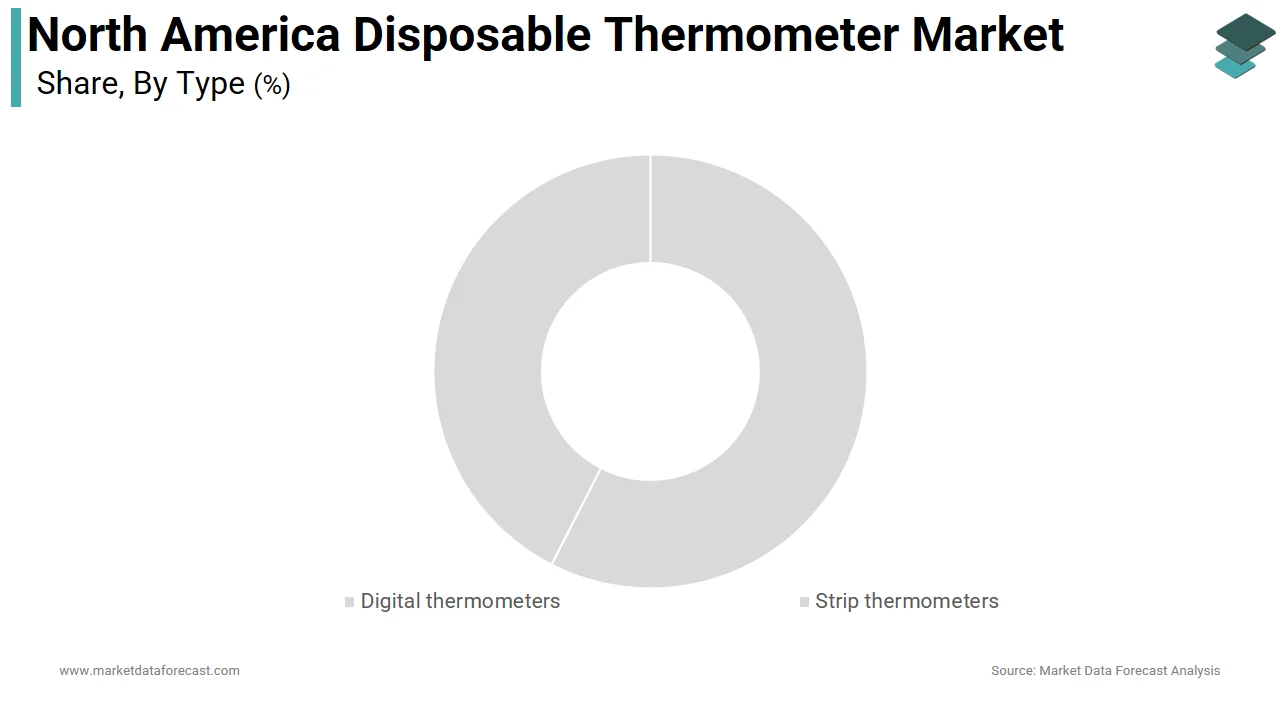
The digital thermometers segment represented the dominant type in the North American disposable thermometer market by commanding a substantial portion of the total share as of 2025. The key driver behind digital thermometers' dominance is their superior accuracy and clinical reliability compared to strip thermometer alternatives, making them essential for critical healthcare applications where precise temperature measurement directly impacts patient care decisions. These devices typically provide accuracy within ±0.1°C, significantly outperforming chemical strip thermometers that often exhibit variations of ±0.5°C or greater. Additionally, the ability to provide immediate digital readouts and eliminate subjective interpretation requirements enhances clinical workflow efficiency and reduces documentation errors. The integration of memory storage and data logging capabilities in advanced digital models provides healthcare facilities with comprehensive temperature monitoring documentation that supports regulatory compliance and quality assurance requirements.
The advanced functionality and connectivity features integrated into modern digital thermometers represent another critical factor supporting their market dominance across North America. These devices incorporate sophisticated technologies, including wireless data transmission, cloud-based monitoring capabilities, and integration with electronic health record systems that enhance clinical workflow efficiency and patient care coordination. The integration of Bluetooth and Wi-Fi technologies allows for seamless integration with hospital information systems and mobile health applications, reducing manual documentation requirements and improving data accuracy. Moreover, the development of multi-parameter monitoring devices that combine temperature measurement with other vital signs creates opportunities for comprehensive patient monitoring solutions that expand the value proposition beyond basic temperature measurement. The trend toward smart hospital initiatives and Internet of Medical Things integration has particularly favored digital thermometer adoption, as healthcare facilities seek to modernize their monitoring infrastructure and improve operational efficiency.
The strip thermometers segment represented the fastest-growing segment in the North American disposable thermometer market by exhibiting a CAGR of 9.7% from 2026 to 2034. The primary catalyst for strip thermometers' rapid expansion is their exceptional cost-effectiveness and economic accessibility compared to digital alternatives, making temperature monitoring solutions available to broader market segments, including resource-constrained healthcare facilities and consumer applications. These devices typically cost less than equivalent digital thermometers while still providing adequate accuracy for non-critical temperature monitoring requirements. The simplified manufacturing process and reduced component requirements enable strip thermometer manufacturers to achieve significant economies of scale and competitive pricing structures that benefit both healthcare facilities and consumer markets. In addition, the absence of electronic components and battery requirements eliminates ongoing maintenance costs and disposal complexities associated with digital devices. The expansion of home healthcare and self-monitoring applications has particularly favored strip thermometer adoption, as consumers seek affordable and convenient temperature monitoring solutions for routine health assessment and wellness monitoring purposes.
The inherent simplicity and user-friendly operation characteristics of strip thermometers represent a significant growth catalyst for this market segment, particularly in applications where ease of use and minimal training requirements are essential for successful implementation. These devices operate through straightforward visual interpretation methods that eliminate the need for technical expertise or complex operating procedures, making them accessible to diverse user populations, including patients, caregivers, and non-clinical personnel. The absence of electronic components and power requirements eliminates concerns regarding battery life, device calibration, and technical malfunctions that might affect measurement reliability. Additionally, the compact size and lightweight construction of strip thermometers enable convenient storage and portability, making them ideal for emergency response applications and field healthcare deployments. The development of color-coded temperature indication systems and easy-to-read scales has further enhanced user experience and measurement accuracy for non-professional users seeking reliable temperature monitoring solutions.
By Target Area Insights
The oral thermometers led the North American disposable thermometer market by commanding a 44.2% of the total share in 2024. The main driver behind oral thermometers' dominance is their extensive clinical acceptance and integration into standardized temperature measurement protocols across North American healthcare facilities. Decades of clinical use and validation have established oral temperature measurement as a reliable and accurate method for patient assessment, creating strong institutional preferences and established workflow integration. Besides, the correlation between oral temperature measurements and core body temperature has been extensively validated through clinical research, establishing confidence among healthcare providers in measurement accuracy and clinical relevance. The development of specialized oral thermometer designs with ergonomic features and safety mechanisms has enhanced user comfort and reduced cross-contamination risks, supporting continued market preference and adoption.
The superior patient comfort and acceptability associated with oral thermometer use represent another critical factor supporting their market dominance across North America. The non-invasive nature of oral temperature measurement and familiar application method create positive patient experiences and improved compliance with monitoring requirements. The absence of discomfort and privacy concerns associated with oral measurement makes these devices particularly suitable for conscious patients and routine monitoring applications where patient cooperation is essential. Besides, the quick measurement time and minimal positioning requirements enhance patient convenience and reduce procedural stress, particularly important in pediatric and geriatric populations. The development of flavored and child-friendly oral thermometer designs has further improved patient acceptance and cooperation, particularly in pediatric healthcare settings where measurement compliance can be challenging.
The axilla thermometers segment depicts the fastest-growing target area in the North American disposable thermometer market by demonstrating a compound annual growth rate of 11.3% from 2026 to 2034. The primary catalyst for axilla thermometers' rapid market expansion is their inherently non-invasive nature and enhanced patient safety profile compared to alternative temperature measurement methods, making them particularly suitable for vulnerable patient populations, including infants, elderly patients, and those with compromised immune systems. The external measurement approach eliminates concerns regarding mucosal trauma, cross-contamination risks, and patient discomfort associated with oral and rectal measurement methods. Also, axilla temperature measurement is the preferred method for infants under three months of age, representing a significant patient population requiring these devices for safe and accurate temperature assessment. The reduced infection transmission risks associated with external measurement methods have particularly favored axilla thermometer adoption in immunocompromised patient populations and infection control protocols. Additionally, the absence of mucosal contact eliminates concerns regarding gag reflex activation and patient discomfort, making axilla measurement suitable for patients with swallowing difficulties or altered consciousness levels.
The expanding application of axilla thermometers in pediatric and geriatric care settings represents a significant growth catalyst for this market segment, as healthcare providers increasingly recognize the benefits of external temperature measurement for vulnerable patient populations. The safety profile and patient comfort advantages of axilla measurement make these devices particularly suitable for routine monitoring in pediatric wards and long-term care facilities where patient cooperation and safety are paramount considerations. The development of specialized pediatric axilla thermometer designs with enhanced comfort features and accurate measurement capabilities has improved clinical outcomes and patient satisfaction in pediatric healthcare settings. Additionally, the compatibility of axilla measurement with continuous monitoring applications and wearable technology integration has enhanced appeal for modern healthcare delivery models focused on patient-centered care and comfort optimization.
By End Use Insights
The hospitals segment represented the dominant end-use in the North American disposable thermometer market by commanding a 55% of the total share in 2024. The main driver behind hospitals' dominance in the disposable thermometer market is their comprehensive healthcare infrastructure and substantial patient volumes that create continuous demand for reliable temperature monitoring solutions across diverse clinical applications. Hospital facilities encompass extensive patient populations, including critical care units, emergency departments, surgical suites, and general medical wards that require routine temperature monitoring for patient assessment and treatment decision-making. The complexity of hospital operations and diverse patient acuity levels necessitate different thermometer types and measurement methods, supporting broad product portfolio adoption and regular replacement cycles. In addition, the 24-hour operational nature of hospital facilities creates continuous demand for temperature monitoring devices, unlike other healthcare settings with more limited operational hours. The Joint Commission requires comprehensive temperature monitoring protocols for all hospitalized patients, with documentation requirements that support disposable thermometer adoption due to simplified data collection and reduced cross-contamination risks. The trend toward electronic health record integration and automated documentation systems has particularly favored disposable thermometer adoption in hospital settings where workflow efficiency and data accuracy are critical operational requirements.
The stringent infection control requirements and regulatory compliance mandates within hospital environments represent another critical factor supporting the disposable thermometer market dominance. Healthcare facilities must demonstrate comprehensive infection prevention protocols and cross-contamination risk mitigation strategies to maintain accreditation and regulatory compliance status. Additionally, the Joint Commission requires healthcare facilities to document infection control measures and demonstrate risk mitigation strategies, with single-use thermometers providing clear compliance advantages over reusable alternatives. The development of specialized disposable thermometer designs with enhanced safety features and contamination prevention mechanisms has further supported hospital adoption and regulatory compliance requirements. The trend toward value-based care and outcome-focused reimbursement models has particularly influenced disposable thermometer adoption, as hospitals seek to demonstrate quality care delivery while preventing complications that might affect reimbursement rates.
The homecare segment represents the fastest-growing end-use segment in the North America disposable thermometer market by demonstrating a CAGR of 14.8% from 2026 to 2034. The primary catalyst for home care's rapid market expansion is the fundamental shift toward patient-centered care models and home-based health monitoring initiatives that prioritize patient convenience, independence, and cost-effective healthcare delivery. The growing preference for home-based care and self-monitoring solutions has created substantial demand for user-friendly, accurate, and affordable disposable thermometer solutions that enable patients to participate actively in their healthcare management. The aging population and increasing prevalence of chronic conditions requiring routine monitoring have particularly favored disposable thermometer adoption in home care environments. Additionally, the expansion of telehealth services and remote patient monitoring programs has increased demand for reliable home-based temperature measurement devices that enable healthcare provider oversight and clinical decision-making. The development of smartphone-integrated disposable thermometers and mobile health applications has enhanced user experience and data sharing capabilities that support coordinated care delivery models.
The enhanced consumer accessibility and over-the-counter availability of disposable thermometers represent a significant growth catalyst for the homecare market segment, as manufacturers and retailers expand distribution channels and develop consumer-focused product offerings. The fundamental shift toward self-care and preventive health monitoring has created new market opportunities for convenient, affordable, and reliable temperature measurement solutions that consumers can purchase and use independently. The expansion of pharmacy chains, online retailers, and mass merchandiser distribution channels has increased consumer access to disposable thermometers while reducing purchase barriers and enhancing affordability. Besides, the development of consumer-friendly packaging, multilingual instructions, and simplified operating procedures has enhanced user experience and adoption rates among diverse consumer populations. The trend toward wellness monitoring and preventive healthcare has further expanded the addressable market beyond traditional medical applications to include fitness tracking, environmental monitoring, and occupational health applications.
COUNTRY-LEVEL ANALYSIS
United States Disposable Thermometer Market Insights
The United States maintained an overwhelming dominance in the North American disposable thermometer market by commanding a 94.3% of the total regional share in 2024. This commanding position is supported by the country's extensive healthcare infrastructure, robust medical device innovation ecosystem, and substantial patient population requiring routine temperature monitoring across diverse healthcare settings. The United States' position as the largest healthcare market in North America naturally translates to significant medical device adoption and technological advancement opportunities.
The United States disposable thermometer market is characterized by mature healthcare delivery systems, extensive research and development capabilities, and significant investments in infection control technologies and clinical monitoring solutions. The country's diverse healthcare landscape, encompassing academic medical centers, community hospitals, and specialized ambulatory care facilities, creates substantial demand for advanced temperature monitoring solutions. Besides, the presence of major medical device manufacturers, including 3M, Welch Allyn, and Brau,n within domestic borders further strengthens the market ecosystem. Regional variations exist, with states like California, Texas, and New York leading in new product adoption due to healthcare concentration and technological innovation trends.
Canada Disposable Thermometer Market Insights
Canada represents a key market in North America for disposable thermometers. The country's position is strengthened by its universal healthcare system, significant healthcare infrastructure, and growing emphasis on infection control and patient safety standards. Canada's healthcare integration with international standards and regulatory frameworks has enhanced its importance in regional medical device markets.
The Canadian disposable thermometer market is driven by the country's universal healthcare system approach to patient monitoring, expanding private healthcare sector, and ongoing clinical research initiatives focused on infection prevention technologies. Canada's universal healthcare system emphasizes infection prevention and patient safety standards, creating opportunities for disposable thermometer adoption in both public and private healthcare sectors. Provincial initiatives, particularly in Ontario and British Columbia, focus on expanding access to advanced monitoring technologies and reducing infection transmission risks in healthcare environments. Canada's participation in North American clinical research networks and medical device evaluation programs further supports market expansion through coordinated development initiatives and technology transfer opportunities.
COMPETITIVE LANDSCAPE
The North American disposable thermometer market is characterized by consolidation among major players and strategic partnerships aimed at enhancing technological capabilities and geographic reach. This consolidation trend is reshaping market dynamics and influencing adoption patterns across all participating countries.
Major global manufacturers such as 3M, Welch Allyn, and Braun have established significant manufacturing and clinical support capabilities across North America. Strategic acquisitions have accelerated. The integration of digital health technologies has prompted partnerships between traditional medical device manufacturers and software companies. Regional healthcare providers have adopted strategic sourcing agreements with major suppliers, ensuring supply chain stability and technology standardization. The emergence of specialized temperature monitoring companies and joint ventures has introduced competitive innovation pressures while maintaining quality standards. The trend toward comprehensive monitoring solutions has encouraged manufacturers to expand their service offerings beyond device supply to include clinical support, training programs, and patient management services. This evolution has created new revenue streams and strengthened customer relationships, contributing to market stability and growth across all North American countries.
KEY MARKET PLAYERS
Noteworthy Companies dominating the North America Disposable thermometer market profiled in the report are
- 3M
- Acme United Corporation
- Advanced Meditech International (AMI)
- American Diagnostics Corporation
- FIRST AID ONLY
- Graham-Field
- H-B Instrument
- Hopkins Medical Products
- LCRHallcrest
- Medical Indicators
- Medline
- Microlife Corporation
- ProtonTek
- Tempagenix
- Zeal
TOP LEADING PLAYERS IN THE MARKET
- 3M Company maintains a prominent position in the North American disposable thermometer market through its comprehensive portfolio of medical sensing technologies and commitment to innovation in temperature measurement solutions. The company's extensive product range encompasses both traditional chemical strip thermometers and advanced digital temperature monitoring devices designed for diverse healthcare applications. Their 3M Littmann electronic stethoscope integration and connected health platforms incorporate sophisticated temperature measurement capabilities that provide seamless data collection and clinical workflow enhancement. 3M has consistently invested in research and development to create next-generation disposable thermometer technologies with enhanced accuracy, connectivity, and user experience features. The company's strong global presence and localized manufacturing capabilities enable rapid response to healthcare provider requirements and regulatory compliance needs. Their focus on evidence-based clinical research and regulatory compliance has positioned them as a trusted partner for healthcare systems seeking reliable temperature monitoring solutions. 3M's commitment to sustainability and environmental responsibility has established them as a leader in developing eco-friendly disposable thermometer technologies.
- Welch Allyn, now part of Hill-Rom, has established itself as a key player in the North American disposable thermometer market through innovative temperature monitoring technologies and comprehensive healthcare solutions. The company specializes in developing advanced digital thermometer systems that provide rapid, accurate temperature measurements with sophisticated data management capabilities. Their proprietary SureTemp technology and Genius thermometer platforms incorporate cutting-edge infrared sensing and predictive measurement algorithms that optimize clinical workflow efficiency and patient comfort. Welch Allyn's commitment to developing integrated healthcare solutions has resulted in successful clinical outcomes and strong healthcare provider relationships. The company's strong focus on clinical research and evidence-based product development has enabled successful market penetration and long-term customer loyalty. Their comprehensive service network and training programs support healthcare provider success and patient treatment optimization. Welch Allyn's continuous investment in research and development has resulted in advanced technologies that improve measurement accuracy and reduce procedural time requirements.
- Braun GmbH, operating under Procter & Gamble, holds a significant position in the North American disposable thermometer market through its established consumer healthcare heritage and comprehensive temperature monitoring product portfolio. The company's disposable thermometer offerings integrate seamlessly with their broader health and wellness product lines, creating synergistic solutions for healthcare providers and consumers. Their commitment to developing accurate, user-friendly temperature measurement solutions encompasses both clinical and consumer applications with emphasis on reliability and convenience. Braun's extensive global distribution network and strong brand recognition enable rapid market penetration and healthcare provider adoption. The company's robust clinical research infrastructure supports comprehensive safety and efficacy studies that build confidence among medical professionals and regulatory bodies. Their focus on patient-centered design and ergonomic innovation has positioned them as a reliable supplier in the competitive disposable thermometer therapy market. Braun's commitment to quality assurance and regulatory compliance has established them as a trusted partner for comprehensive temperature monitoring initiatives.
TOP STRATEGIES USED BY KEY MARKET PARTICIPANTS
Innovation and Product Development Excellence Leading players in the North American disposable thermometer market actively pursue comprehensive innovation strategies focused on developing next-generation temperature measurement technologies and enhanced user experience solutions. These initiatives encompass advanced materials science research, miniaturized electronics integration, and sophisticated sensing technologies that improve measurement accuracy and clinical workflow efficiency. Companies invest heavily in developing wireless connectivity features, cloud-based data management systems, and artificial intelligence-powered predictive algorithms that enhance temperature monitoring capabilities and clinical decision-making support. The focus on user-centered design and ergonomic innovation enables manufacturers to create products that improve patient comfort and healthcare provider efficiency. Collaborative research partnerships with academic institutions and healthcare organizations accelerate innovation and provide access to diverse clinical environments and user feedback. Publication of peer-reviewed research findings and presentation at major medical conferences enhances scientific credibility and thought leadership positioning in the marketplace.
Strategic Partnerships and Healthcare System Integration Key players pursue strategic partnership strategies that involve collaboration with healthcare systems, integrated delivery networks, and technology companies to enhance market penetration and solution adoption. These partnerships enable access to established patient populations, shared clinical expertise, and coordinated care delivery models that improve product utilization and clinical outcomes. Collaborations with electronic health record vendors and healthcare information technology companies facilitate seamless integration of temperature monitoring data with broader clinical workflows and decision support systems. Joint development initiatives with sensor technology companies and materials science organizations accelerate innovation in measurement accuracy and device functionality. Geographic partnerships and distribution agreements enable market expansion into new regions while maintaining local presence and support capabilities. Strategic alliances with professional medical societies and clinical guideline development organizations enhance scientific credibility and treatment standardization efforts that support broader market acceptance and adoption.
Regulatory Compliance and Quality Assurance Excellence Major Market participants emphasize comprehensive regulatory compliance and quality assurance strategies that focus on meeting stringent international standards and maintaining consistent product quality across diverse market segments. These approaches involve extensive customer engagement to understand regulatory requirements and quality expectations across different healthcare environments and geographic regions. Companies establish dedicated regulatory affairs teams that work closely with government agencies and standards organizations to ensure timely product approvals and compliance with evolving requirements. The development of comprehensive quality management systems and continuous improvement processes enables consistent manufacturing excellence and product reliability. Integration with international quality standards and certification programs facilitates global market access and customer confidence in product performance. Regional compliance capabilities allow manufacturers to adapt quality standards and regulatory submissions to local market requirements while maintaining global technology platforms and manufacturing excellence.
RECENT MARKET DEVELOPMENTS
- In February 2024, 3M Company launched their new TempTrend Plus digital disposable thermometer featuring wireless connectivity and real-time data transmission capabilities for North American hospital market deployment.
- In November 2023, Welch Allyn announced a strategic partnership with Epic Systems to integrate their disposable thermometer data directly into electronic health record platforms across North American healthcare facilities.
- In September 2023, Braun GmbH received FDA approval for their next-generation ThermoScan disposable infrared thermometer with enhanced accuracy algorithms and pediatric safety features for North American consumer market expansion.
- In June 2023, 3M Company acquired Medline's temperature monitoring division to expand their disposable thermometer portfolio and enhance their connected health platform capabilities in the North American market.
- In April 2023, Welch Allyn introduced their SureTemp OneTouch disposable thermometer system with single-use probe technology and automated documentation features for ambulatory care settings across North America.
MARKET SEGMENTATION
This North America disposable thermometer market research report is segmented and sub-segmented into the following categories.
By Type
- Digital thermometers
- Strip thermometers
By Target Area
- Oral
- Axilla
- Rectal
- Other target areas
By End Use
- Hospitals
- Diagnostic centers
- Homecare
- Other end use
By Country
- United States
- Canada
- Mexico
- Rest of North America
Frequently Asked Questions
1. What types of products are included in the North America Disposable Thermometer Market?
Key products are digital disposable thermometers, disposable oral thermometers, strip thermometers, axilla and rectal disposable devices, and rapid-read single-use solutions
2. Which market segment dominates the North America Disposable Thermometer Market?
Hospitals are the leading segment, accounting for over 36% of revenue share in 2024, as infection prevention protocols drive adoption
3. Who are the main end users for disposable thermometers in North America?
Primary end users are hospitals, diagnostic centers, homecare settings, clinics, and travel/consumer health segments
4. What are the key growth drivers for the North America Disposable Thermometer Market?
Drivers include rising health awareness, post-pandemic infection control measures, increased prevalence of chronic disease management at home, and growing home healthcare markets
5. Why are disposable thermometers preferred over traditional ones in North America?
Disposable thermometers minimize cross-contamination risks, support infection control, are mercury-free, easy to use, and require no cleaning or reprocessing after use
6. How has COVID-19 affected demand in the North America Disposable Thermometer Market?
COVID-19 greatly increased demand for disposable thermometers for both public health screening and routine healthcare, leading to higher adoption in hospitals, clinics, and households
7. What technology trends are shaping the North America Disposable Thermometer Market?
Innovations include rapid-read digital sensors, Bluetooth-enabled disposable thermometers, improved accuracy, and app-connected solutions for patient monitoring
8. Who are the key manufacturers in the North America Disposable Thermometer Market?
Notable companies include Medical Indicators, GF Health Products, 3M, and other firms innovating in single-use medical devices and infection prevention tools
9. How are disposable thermometers contributing to hospital infection control in North America?
By preventing cross-contamination and removing the need for cleaning/reuse, single-use thermometers align with infection prevention protocols targeting MRSA, C. diff, and other nosocomial threats
10. What are the main challenges in the North America Disposable Thermometer Market?
Challenges include environmental concerns over single-use waste, competitive pricing pressures, and the need for further accuracy in some low-cost or strip thermometer designs
Related Reports
Access the study in MULTIPLE FORMATS
Purchase options starting from
$ 2000
Didn’t find what you’re looking for?
TALK TO OUR ANALYST TEAM
Need something within your budget?
NO WORRIES! WE GOT YOU COVERED!
Call us on: +1 888 702 9696 (U.S Toll Free)
Write to us: sales@marketdataforecast.com