- Product Description Description
- Table of Contents TOC
- List of Table & Figure LOT
- Get Free Sample PDF Sample PDF
Market Size, 2025
$26.38 BnMarket Estimate, 2026
$30.65 BnMarket Forecast, 2034
$101.65 BnCAGR, 2026–2034
16.17%Executive Summary: North America ePharmacy Market
- Market Scope: Comprehensive North American ePharmacy market analysis covering online prescription services, telemedicine integration, specialty chronic disease management, and AI-driven medication adherence tools.
- Market Valuation: Valued at USD 26.38 billion (2025), estimated at USD 30.65 billion (2026), and projected to reach USD 101.65 billion by 2034, registering a robust CAGR of 16.17% (2026–2034).
- Primary Growth Drivers: Rising internet penetration, convenient online healthcare demand, post-pandemic contactless solutions, aging populations with chronic conditions, and digital health infrastructure investments. Key challenges include complex cross-jurisdictional compliance, cybersecurity threats, and supply chain disruptions.
Key Market Segment Metrics (2026–2034)
| Category | Leading Segment (Position) | Fastest-Growing Segment |
|---|---|---|
| By Product Type, Drug Type & Region | Skincare products (dominated product type segment in 2025) & Prescription medicines (led drug type categories due to chronic disease prevalence) & United States (commanded 89.1% regional market share in 2025) | Over-the-counter products (anticipated to grow at a CAGR of 18.4% driven by consumer self-care trends) & Canada (supported by digital health infrastructure investments) |
| By Regional Leadership | United States (89.1% share as top performer driven by extensive digital health adoption) | Canada (11.3% share supported by government digital infrastructure initiatives and consumer demand) |
Major Market Players & Market Structure
Market Structure: Highly competitive North American digital pharmacy and retail healthcare landscape featuring major retail pharmacy chains, e-commerce giants, and pharmacy benefit managers driving same-day delivery expansions and integrated telehealth platforms.
Key Companies: CVS Health Corporation, Walgreens Boots Alliance Inc., Amazon Pharmacy, Lloyds Pharmacy Ltd., PlanetRx, Medisave, Express Scripts Holding Company, Sanicare AB, Optum Rx Inc., and DocMorris Rowlands Pharmacy.
North America ePharmacy Market Size
The size of the North America ePharmacy market was worth USD 26.38 billion in 2025. The regional market is anticipated to grow at a CAGR of 16.17% from 2026 to 2034 and be worth USD 101.65 billion by 2034 from USD 30.65 billion in 2026.
The e-pharmacies operate through sophisticated digital ecosystems that integrate secure payment processing, electronic prescription management, regulatory compliance systems, and logistics networks that ensure safe, convenient, and timely delivery of pharmaceutical products to patients across diverse geographic regions. As per the U.S. Food and Drug Administration (FDA), over 34,000 licensed pharmacies operate within the United States, with approximately 8,500 having established legitimate online dispensing capabilities that comply with federal telepharmacy regulations and state-level licensing requirements. The market's evolution has been significantly influenced by technological advancements in secure data transmission, electronic health record integration, artificial intelligence-driven medication management, and blockchain-based supply chain verification that have enhanced patient safety and operational efficiency.
MARKET DRIVERS
Consumer Preference for Convenience and Accessibility
The fundamental shift in consumer preferences toward convenience, accessibility, and 24/7 service availability is substantially propelling the growth of the North America e-pharmacy market forward, as patients increasingly expect healthcare services to be available whenever and wherever they need them without the constraints of traditional pharmacy operating hours or geographical limitations. Modern consumers, particularly those managing chronic conditions or requiring regular medication refills, recognize the value of digital platforms that eliminate time-consuming trips to physical pharmacies and provide seamless access to prescription medications through mobile applications and web-based interfaces. According to the Consumer Reports National Research Center, 68% of North American prescription medication users cited convenience as the primary factor influencing their choice of e-pharmacy services over traditional brick-and-mortar pharmacies in 2023, with time savings and reduced travel requirements being particularly important for elderly patients and individuals with mobility limitations. The integration of mobile pharmacy applications with biometric authentication, one-touch ordering, and automated refill scheduling has created seamless user experiences that align with contemporary lifestyle expectations and digital behavior patterns. Remote work trends and geographical mobility have intensified demand for pharmacy services that can be accessed from any location and device, particularly among professionals who travel frequently or work in distributed environments. The integration of artificial intelligence-powered virtual assistants and chatbots has enabled instant customer support and personalized medication guidance that operates continuously without human intervention. Consumer expectations for real-time order tracking, delivery notifications, and immediate access to pharmacists for consultation have driven e-pharmacy providers to invest heavily in logistics infrastructure and customer service capabilities. The ability to conduct complex pharmacy activities, including prescription transfers, insurance verification, and medication history management through digital channels, has eliminated the need for time-consuming in-person interactions and paperwork submission. Social media influence and digital marketing have amplified awareness of innovative pharmacy features and services, creating competitive pressure for traditional pharmacies to enhance their digital offerings.
Chronic Disease Management and Aging Population Trends
The escalating prevalence of chronic diseases due to the rising aging population is additionally prompting the growth of the North America e-pharmacy market. According to the Centers for Disease Control and Prevention (CDC), approximately 60% of North American adults live with at least one chronic disease, while 40% manage two or more chronic conditions that require ongoing medication therapy and regular pharmaceutical interventions. Cardiovascular disease prevalence has particularly intensified medication management needs, with the American Heart Association reporting that 121.5 million North Americans have some form of cardiovascular disease, necessitating complex medication regimens including anticoagulants, blood pressure medications, and cholesterol-lowering agents that require reliable supply chains and adherence monitoring. Mental health medication management has gained prominence, with the National Institute of Mental Health reporting that 21% of North American adults experience mental health conditions annually, requiring regular access to psychiatric medications and confidential pharmaceutical services that digital platforms can provide effectively. The integration of medication adherence technologies with e-pharmacy services has enabled comprehensive chronic disease management solutions that include automated refill reminders, dosage tracking, and health outcome monitoring that improve patient compliance and clinical outcomes. Healthcare cost containment pressures have intensified focus on medication adherence and chronic disease management, with the Agency for Healthcare Research and Quality noting that non-adherence to prescribed medications costs the North American healthcare system approximately $300 billion annually in avoidable hospitalizations and complications.
MARKET RESTRAINTS
Regulatory Compliance and Safety Concerns
The complex regulatory compliance requirements and persistent safety concerns are restraining the growth of the North America e-pharmacy market. The regulatory landscape encompasses multiple federal agencies, including the Food and Drug Administration (FDA), Drug Enforcement Administration (DEA), and state pharmacy boards, each with distinct requirements and supervisory approaches that must be navigated simultaneously to maintain legal operations and patient safety standards. Consumer trust remains a factor in e-pharmacy adoption, with the Pew Research Center reporting that only 54% of North American adults feel confident about the safety and authenticity of medications purchased through online pharmacy platforms, indicating substantial knowledge gaps and safety concerns that must be addressed through education and regulatory enforcement. The cost of regulatory compliance, including legal fees, certification processes, and technology investments, can be particularly burdensome for smaller e-pharmacy operators and startup companies that may lack the resources of larger competitors.
Insurance Integration and Payment Processing Complexities
The insurance integration and payment processing complexities that create operational inefficiencies, increased costs, and consumer frustration for digital pharmacy providers are additionally hampering the growth of the North America e-pharmacy market. The fragmentation of insurance coverage, formulary restrictions, and prior authorization requirements across multiple payers creates complex administrative burdens that e-pharmacy platforms must navigate to ensure accurate pricing, coverage verification, and reimbursement processing for prescription medications. According to the Kaiser Family Foundation, North American prescription drug plans maintain an average of 4.2 formulary tiers with varying copayment structures, prior authorization requirements, and step therapy protocols that create significant complexity for e-pharmacy providers seeking to provide accurate pricing and coverage information to consumers. The real-time benefit verification process required for insurance integration necessitates sophisticated technology infrastructure and extensive payer network connections that smaller e-pharmacy operators may struggle to implement and maintain effectively.
MARKET OPPORTUNITIES
Specialty Pharmacy and Rare Disease Medications
The expansion of specialty pharmacy services and the growing market for rare disease medications are creating new opportunities for the growth of the North America e-pharmacy market. According to the Alliance for Safe Biologic Medicines, specialty medications represented 52% of total prescription drug spending in North America in 2023, with average annual costs exceeding $60,000 per patient and creating substantial revenue opportunities for e-pharmacy providers that can demonstrate expertise in complex medication management and patient care coordination. Oncology medication management has emerged as a significant opportunity segment, with the American Cancer Society noting that cancer drug spending reached $204 billion in North America in 2023, with many treatments requiring cold chain storage, specialized administration protocols, and comprehensive patient monitoring that digital pharmacy platforms can support through integrated technology solutions.
Integration with Telemedicine and Digital Health Platforms
The integration of e-pharmacy services with telemedicine platforms and digital health ecosystems is also expected to enhance the growth of the North America e-pharmacy market. Chronic disease management programs have particularly benefited from integrated telemedicine and e-pharmacy services, with the American Diabetes Association reporting that patients using integrated digital health platforms demonstrated 23% better medication adherence and 18% fewer hospital readmissions compared to traditional care models in 2023. The integration of artificial intelligence and machine learning capabilities with telemedicine-e-pharmacy ecosystems has enabled predictive medication adherence modeling, drug interaction alerts, and personalized treatment recommendations that enhance clinical outcomes and reduce healthcare costs. Mental health telemedicine services have gained significant traction, with the National Institute of Mental Health noting that 42% of mental health consultations in 2023 included integrated e-pharmacy services for psychiatric medication management, which is creating opportunities for comprehensive behavioral health care delivery that addresses both consultation and medication needs through single digital platforms.
MARKET CHALLENGES
Supply Chain Disruptions and Medication Shortages
The supply chain disruptions and medication shortages are significantly restricting the growth of the North America e-pharmacy market. The complexity of pharmaceutical supply chains, involving multiple manufacturers, distributors, wholesalers, and logistics providers, creates vulnerability points that can be exacerbated by manufacturing issues, transportation delays, regulatory actions, and global supply chain disruptions that affect medication availability and delivery timelines. Cold chain logistics requirements for specialty medications and biologics have intensified supply chain complexity.
Cybersecurity Threats and Data Privacy Risks
The cybersecurity threats and data privacy risks that create operational vulnerabilities, regulatory compliance burdens, and consumer trust issues for digital pharmacy also hinder the growth of the North America e-pharmacy market. Consumer trust factor in e-pharmacy adoption, with the Pew Research Center reporting that only 48% of North American adults feel confident about the security of their health data when using digital pharmacy services, indicating substantial concerns about privacy protection and data misuse that can impact market growth and customer retention. The complexity of regulatory compliance requirements under frameworks such as the Health Insurance Portability and Accountability Act (HIPAA), state privacy laws, and international data protection regulations creates operational burdens and compliance costs for e-pharmacy providers seeking to maintain legal operations and customer confidence. Cross-border data transfers and international operations present additional security challenges, as e-pharmacy providers must comply with varying regulatory requirements and security standards across different jurisdictions while maintaining consistent protection for customer data and prescription information.
REPORT COVERAGE
| REPORT METRIC | DETAILS |
| Market Size Available | 2025 to 2034 |
| Base Year | 2025 |
| Forecast Period | 2026 to 2034 |
| Segments Covered | By Product, Type, Drug Type, and Region. |
| Various Analyses Covered | Global, Regional & Country Level Analysis, Segment-Level Analysis; DROC, PESTLE Analysis, Porter's Five Forces Analysis, Competitive Landscape, Analyst Overview of Investment Opportunities |
| Countries Covered | United States, Canada, and the Rest of North America. |
| Market Leader Profiled | Lloyds Pharmacy Ltd., PlanetRx, CVS Health, Medisave, Express Scripts Holding Company, com Inc., Sanicare AB, Optum Rx, Inc., DocMorris, Rowlands Pharmacy, and Others. |
SEGMENTAL ANALYSIS
By Product Type Insights
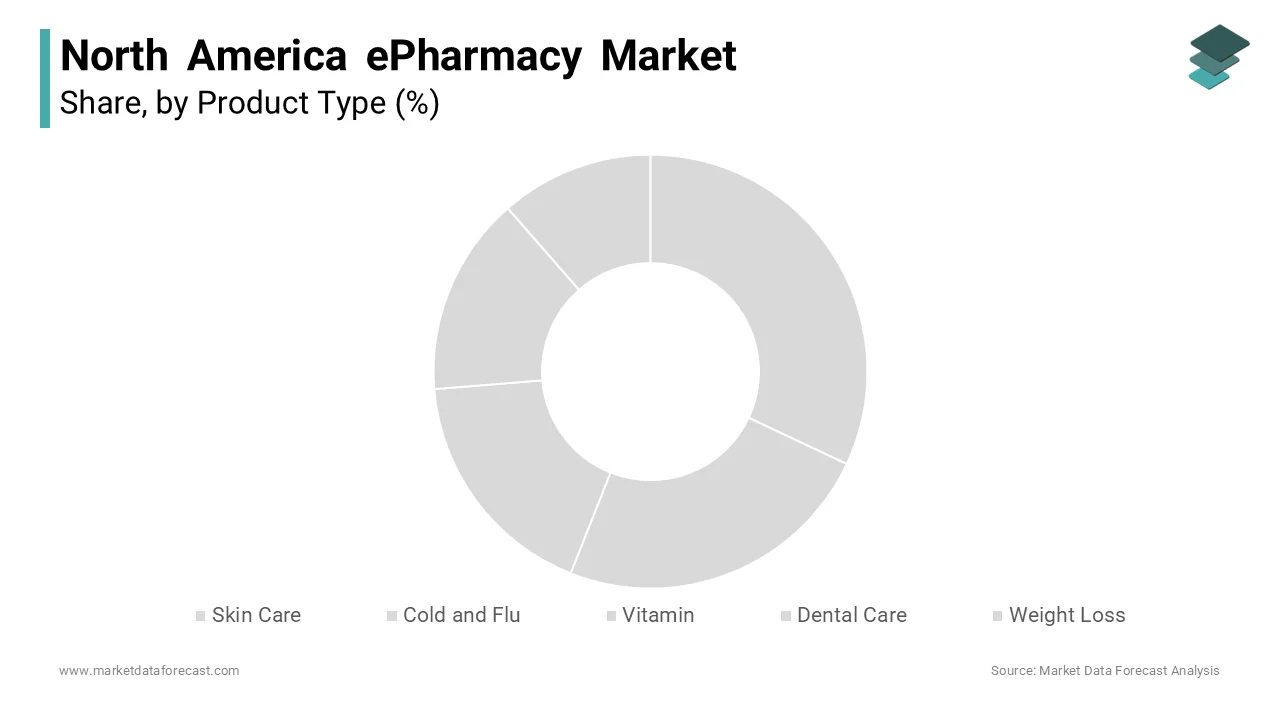
The skincare segment dominated the ePharmacy market in the North American region in 2025. The cold and flu segment is gaining traction as these are common concerns each person has in recent years. As many prefer vitamin supplements, the vitamin and weight loss segments are projected to grow significantly over the forecast period.
By Drug Type Insights
The prescription medicine segment dominated the North America e-pharmacy market share in 2025. With the escalating prevalence of chronic diseases. The Centers for Disease Control and Prevention reports that 60% of American adults suffer from at least one chronic condition, with 40% managing multiple chronic illnesses that require ongoing pharmaceutical intervention. This patient population generates sustained demand for consistent medication access, refills, and adherence support that traditional pharmacy models struggle to provide efficiently. Healthcare systems increasingly recognize medication adherence to managing chronic conditions effectively.
The over-the-counter products segment is anticipated to grow with a CAGR of 18.4% during the forecast period. Consumer health awareness and self-care trends constitute primary catalysts for the rapid growth of over-the-counter products within the North America e-pharmacy market. The Council for Responsible Nutrition reports that 77% of American adults use dietary supplements regularly, with online purchasing representing 45% of total supplement sales in 2023. The integration of health and wellness information through digital platforms has empowered consumers to make informed decisions about over-the-counter medications and supplements. Social media influence, health blogging, and digital wellness communities contribute to product awareness and purchasing decisions that favor convenient online access.
COUNTRY-LEVEL ANALYSIS

United States ePharmacy Market Insights
The United States was the top performer of the North America e-pharmacy market with 89.1% of the share in 2025. The integration of the telemedicine expansion and e-pharmacy services has accelerated the market growth, with the American Telemedicine Association reporting that 75% of virtual healthcare consultations in 2023 included prescription fulfillment components. This integration creates seamless healthcare delivery pathways that enhance patient convenience while supporting comprehensive medication management. The U.S. healthcare system's emphasis on patient-centered care aligns with e-pharmacy capabilities that provide personalized services, medication adherence support, and direct-to-patient delivery options that improve healthcare outcomes while reducing system costs.
Canada ePharmacy Market Insights
Canada e-pharmacy market held 11.3% of the share in 2025, with the government investments in digital health infrastructure and consumer demand for convenient medication access. Provincial healthcare systems have implemented comprehensive digital prescription management programs, with Statistics Canada reporting that 78% of Canadian pharmacies offer online prescription renewal services as of 2023. The integration of provincial health insurance plans with e-pharmacy platforms creates streamlined reimbursement processes that enhance consumer adoption and market penetration. Canada's regulatory framework supports innovative healthcare delivery models while maintaining stringent quality standards that ensure patient safety and medication authenticity.
KEY MARKET PLAYERS
A few noteworthy players operating in the North America ePharmacy market profiled in the report are Lloyds Pharmacy Ltd., PlanetRx, CVS Health, Medisave, Express Scripts Holding Company, com Inc., Sanicare AB, Optum Rx, Inc., DocMorris Rowlands Pharmacy, and Others.
TOP LEADING PLAYERS IN THE MARKET
CVS Health Corporation
CVS Health Corporation operates as a leading integrated healthcare company with extensive e-pharmacy capabilities through its digital platforms and retail pharmacy network. The company's e-pharmacy division leverages its vast physical presence and established healthcare relationships to provide comprehensive medication management services. Their digital platform integrates prescription fulfillment, health plan administration, and clinical services to create seamless healthcare experiences for consumers. CVS Health's competitive advantage stems from its ability to combine traditional pharmacy services with advanced digital technologies by offering patients convenient access to medications while maintaining clinical oversight and insurance integration capabilities that support comprehensive healthcare delivery.
Walgreens Boots Alliance Inc
Walgreens Boots Alliance represents a global pharmaceutical retail giant with significant e-pharmacy operations across North America through its integrated digital and physical infrastructure. The company's e-pharmacy platform emphasizes medication accessibility, patient education, and healthcare convenience through innovative digital solutions. Their strategy focuses on expanding telehealth services, enhancing medication adherence programs, and developing personalized healthcare experiences that leverage customer data and artificial intelligence. Walgreens' extensive retail footprint and established supplier relationships enable efficient last-mile delivery and comprehensive inventory management that supports diverse consumer needs while maintaining competitive pricing and service quality standards.
Amazon Pharmacy
Amazon Pharmacy operates as a disruptive force in the North America e-pharmacy market, leveraging Amazon's extensive logistics network and e-commerce expertise to revolutionize medication access and delivery. The company's approach emphasizes convenience, competitive pricing, and seamless integration with existing Amazon services to create comprehensive healthcare shopping experiences. Their platform utilizes advanced data analytics, artificial intelligence, and supply chain optimization to provide efficient prescription fulfillment and medication management services. Amazon Pharmacy's competitive positioning benefits from brand recognition, technological sophistication, and logistics capabilities that enable rapid delivery and comprehensive customer service while challenging traditional pharmacy models through innovative pricing strategies and service delivery mechanisms.
TOP STRATEGIES USED BY KEY MARKET PARTICIPANTS
Strategic Technology Integration and Digital Platform Enhancement Leading companies in the North America e-pharmacy market prioritize comprehensive technology integration to enhance user experience and operational efficiency. This strategy involves developing sophisticated digital platforms that seamlessly integrate prescription management, insurance verification, and medication tracking capabilities. Companies invest heavily in artificial intelligence and machine learning technologies to provide personalized recommendations, predictive inventory management, and automated customer service solutions. Mobile application development enables consumers to manage prescriptions, schedule deliveries, and access healthcare information through intuitive interfaces. These technological enhancements create competitive differentiation while improving operational scalability and customer satisfaction through streamlined processes and enhanced accessibility.
Strategic Partnerships and Healthcare Ecosystem Integration Key market participants actively pursue strategic partnerships with healthcare providers, insurance companies, and technology vendors to expand service offerings and market reach. These collaborations enable e-pharmacies to integrate with electronic health records systems, telemedicine platforms, and clinical decision support tools that enhance care coordination and medication management. Partnerships with pharmaceutical manufacturers facilitate direct-to-consumer marketing programs and specialty medication distribution capabilities. Insurance company relationships support streamlined reimbursement processes and formulary management integration. Additionally, collaborations with logistics providers and technology companies enhance delivery capabilities and platform functionality, creating comprehensive healthcare ecosystems that address diverse stakeholder needs while maintaining competitive service standards.
Customer Experience Optimization and Service Differentiation Market leaders focus intensively on customer experience optimization through personalized service offerings and value-added healthcare solutions. This strategy encompasses developing comprehensive medication management programs, adherence support services, and clinical consultation capabilities that extend beyond basic prescription fulfillment. Companies implement loyalty programs, subscription-based services, and proactive health management tools that create sustained customer relationships and recurring revenue streams. Service differentiation includes same-day delivery options, specialized packaging for temperature-sensitive medications, and multilingual customer support that addresses diverse population needs. Additionally, companies invest in patient education resources, health monitoring integration, and preventive care services that position e-pharmacies as comprehensive healthcare partners rather than simple medication distributors.
COMPETITIVE LANDSCAPE
The North America e-pharmacy market exhibits intense competition characterized by diverse participant categories, including traditional retail pharmacy chains, pure-play digital platforms, healthcare technology companies, and major e-commerce retailers. Established pharmacy chains leverage their existing customer relationships, physical infrastructure, and insurance partnerships to maintain competitive positions while expanding digital capabilities. Technology-focused entrants utilize innovative platforms and logistics advantages to challenge traditional models through enhanced convenience and competitive pricing structures.
Market competition intensifies through continuous innovation in service delivery, customer experience enhancement, and strategic partnerships that expand market reach and service capabilities. Companies compete based on delivery speed, pricing transparency, medication availability, and value-added healthcare services that differentiate offerings beyond basic prescription fulfillment. Regulatory compliance capabilities and security measures represent fundamental competitive requirements that influence market positioning and consumer trust.
The competitive landscape evolves rapidly as participants adapt to changing consumer preferences, technological advancements, and regulatory developments that reshape market dynamics. Consolidation activities, strategic acquisitions, and partnership formations characterize the market as companies seek to expand capabilities and achieve operational synergies. Competition extends beyond national boundaries as international players explore market opportunities while navigating complex regulatory environments and established competitor advantages.
RECENT MARKET DEVELOPMENTS
- In February 2024, CVS Health Corporation launched an integrated telehealth and e-pharmacy platform that combines virtual consultations with immediate prescription fulfillment, enabling patients to receive medications within hours of virtual appointments and strengthening their digital healthcare ecosystem.
- In November 2023, Walgreens Boots Alliance acquired a specialized medication adherence technology company to enhance its digital platform capabilities, incorporating advanced reminder systems and patient engagement tools that improve medication compliance rates and customer retention.
- In September 2023, Amazon Pharmacy expanded its same-day delivery service to 50 additional metropolitan areas across North America, implementing dedicated pharmacy fulfillment centers and specialized delivery vehicles to ensure rapid medication access for time-sensitive prescriptions.
- In June 2023, CVS Health partnered with a leading health insurance provider to develop integrated formulary management tools within their e-pharmacy platform, enabling real-time insurance verification and cost transparency features that streamline the prescription fulfillment process for patients.
- In March 2023, Walgreens Boots Alliance launched a comprehensive digital wellness platform that integrates over-the-counter product recommendations with personalized health assessments, creating a unified digital health marketplace that combines preventive care products with prescription medication services.
MARKET SEGMENTATION
This research report on the North America ePharmacy market has been segmented and sub-segmented based on product, type, drug type, and region.
By Product Type
- Skin Care
- Cold and Flu
- Vitamin
- Dental Care
- Weight Loss
- Others
By Drug Type
- Prescription Drugs
- Over The Counter (OTC)
By Country
- The U.S.
- Canada
- Rest of North America