- Product Description Description
- Table of Contents TOC
- List of Table & Figure LOT
- Get Free Sample PDF Sample PDF
Market Size, 2025
$584.17 MnMarket Estimate, 2026
$615.07 MnMarket Forecast, 2034
$929.02 MnCAGR, 2026–2034
5.29%Executive Summary: North America Earplugs Market
- Market Scope: Comprehensive regional market analysis covering material types, price segments, country-level leadership frameworks, and occupational safety/hearing protection metrics for the North American earplugs sector.
- Market Valuation: Valued at USD 584.17 million (2025), estimated at USD 615.07 million (2026), and projected to reach USD 929.02 million by 2034, registering a steady CAGR of 5.29% (2026–2034).
- Primary Growth Drivers: Stricter occupational safety regulations (OSHA mandates in construction, manufacturing, and aviation), noise-induced hearing loss awareness, high-fidelity earplug demand among musicians/concertgoers, and comfortable/sterile healthcare solutions. Market challenges include mass consumer price sensitivity, while opportunities lie in reusable products, silicone materials, and personalized 3D scanning fit technologies.
Key Market Segment Metrics (2026–2034)
| Category | Leading Segment Position | Fastest-Growing Segment |
|---|---|---|
| By Material / Price Segment | Foam segment (held prominent share in 2025 for noise reduction and efficiency) & Below US$10 segment (dominated market share in 2025 due to cost considerations) | Silicone segment (projected to grow with a CAGR of 5.9% from 2025–2033) |
| By Region / Country | United States (largest contributor holding 85.2% share in 2025 supported by occupational safety framework and industrial base) | North American regional scope with strong U.S. dominance and expanding Canadian/Mexican industrial adoption |
Major Market Players & Market Structure
Market Structure: Moderately concentrated North American hearing protection landscape centering on product innovation, brand recognition, retail distribution network expansions, and 3D scanning personalized fit solutions for professionals and audiophiles.
Key Companies: 3M, Moldex-Metric, Hearos, Radians Inc., Loop Earplugs, Lucid Hearing Holding Company LLC, Magid Glove & Safety Manufacturing Company LLC, Allens Industrial Products, Honeywell International Inc, UVEX SAFETY GROUP, Alpine Hearing Protection Inc., EARGASM, Liberty Safety, PIP, and Pyramex.
North America Earplugs Market Size
The North America Earplugs market size was valued at USD 584.17 million in 2025 and is anticipated to reach USD 615.07 million in 2026 and USD 929.02 million by 2034, growing at a CAGR of 5.29%, from 2026 to 2034.
The earplugs serve multiple end-use segments, including manufacturing facilities, construction sites, aviation industries, healthcare environments, and individual consumers seeking sleep enhancement or noise reduction solutions. Modern earplug technologies range from traditional foam and silicone variants to advanced electronic noise-canceling systems that incorporate active noise control mechanisms and customizable fitting solutions.
MARKET DRIVERS
Workplace Safety Regulations and Occupational Health Standards
The stringent occupational safety regulations create substantial demand for certified earplug solutions that protect workers from hazardous noise exposure in industrial environments, which is accelerating the growth of the North American earplugs market. Manufacturing and construction sectors represent particularly significant demand sources, as these industries inherently generate high noise levels that require continuous protection solutions. These regulatory requirements create sustained demand for professional-grade earplug products that meet specific noise reduction ratings and industry certification standards. Furthermore, corporate liability concerns and workers' compensation cost management drive organizational investment in premium earplug solutions that demonstrate superior protection capabilities and user compliance rates.
Consumer Health Awareness and Sleep Quality Concerns
The increasing consumer awareness of noise pollution impacts on health and well-being drives substantial demand for consumer-grade earplug solutions that address sleep disruption and environmental noise concerns, which is inclined to fuel the growth of the North American earplugs market.
Urban population growth and increasing ambient noise levels in residential environments amplify consumer demand for effective noise reduction solutions that improve daily living experiences. These environmental factors drive consumer adoption of earplug solutions that provide customizable noise reduction capabilities while maintaining comfort during extended wear periods. Additionally, aging population demographics create sustained demand for hearing protection solutions that prevent further auditory damage while addressing existing sensitivity to environmental noise. According to the National Institute on Aging, 30% of Americans over age 65 experience some degree of hearing loss, which makes noise reduction solutions particularly valuable for maintaining quality of life and preventing further auditory deterioration.
MARKET RESTRAINTS
Product Comfort and User Compliance Issues
The user discomfort and poor fit, and inconsistent usage rates across both professional and consumer applications are limiting the growth of the North American earplugs market. These compliance challenges particularly affect foam earplug solutions that require proper insertion techniques and may irritate during extended wear periods. Individual anatomical variations in ear canal size and shape create substantial fitting challenges that limit universal product effectiveness and user satisfaction rates. These fit issues are particularly pronounced in female users, whose ear canal dimensions typically differ from male-focused product designs by creating significant market segmentation challenges and reduced overall adoption rates. Furthermore, communication requirements in professional environments create conflicts between noise protection needs and operational effectiveness that limit earplug utilization in certain applications. According to the National Safety Council, 28% of workplace accidents involve communication failures partially attributed to hearing protection device usage, which is creating operational concerns that compel organizations to seek alternative noise control solutions or compromise protection effectiveness. These practical limitations constrain market growth by reducing user acceptance and consistent application of protective measures in noise-exposed environments.
Alternative Noise Control Solution Competition
Competition from alternative noise control technologies and environmental solutions creates significant market displacement pressures that limit earplug demand growth across multiple application segments. Soundproofing materials, acoustic barriers, and noise-canceling headphones provide alternative approaches to noise reduction that may be preferred in certain environments where earplug usage is impractical or undesirable. Consumer preference for non-invasive noise reduction solutions limits adoption of traditional earplug products in favor of alternative approaches, including white noise machines, sound masking systems, and architectural acoustic treatments. Additionally, emerging technologies, including active noise cancellation systems and smart hearing protection devices, create competitive pressures that challenge traditional earplug market positioning and pricing structures. These technological alternatives capture market share from traditional earplug solutions while establishing new performance expectations that require continuous innovation and product development investment.
MARKET OPPORTUNITIES
Technological Innovation and Smart Device Integration
The advanced technology integration to develop solutions that combine traditional noise protection with digital connectivity and intelligent features is creating new opportunities for the growth of the North American earplugs market. Smart earplug systems incorporating Bluetooth connectivity, noise monitoring sensors, and customizable sound filtering capabilities address evolving user expectations for multifunctional protective devices. Health monitoring integration represents a particularly promising opportunity segment, as earplug devices can incorporate biometric sensors that track heart rate, body temperature, and sleep quality metrics during usage periods. The International Sleep Products Association indicates that 55% of consumers using sleep enhancement products are interested in integrated health monitoring capabilities that provide comprehensive wellness insights. Furthermore, customization capabilities enabled by 3D printing technologies and personalized fitting systems create opportunities for manufacturers to develop tailored solutions that address individual anatomical variations and user preferences.
Expanding Healthcare and Medical Applications
The growing recognition of noise pollution impacts on patient recovery and healthcare outcomes creates substantial opportunities for medical-grade earplug solutions in hospital and clinical environments, which will also promote the growth of the North American earplugs market. The American Hospital Association reports that 75% of hospitals are implementing noise reduction initiatives to improve patient satisfaction scores and recovery outcomes, creating demand for sterile, comfortable earplug solutions that address environmental noise concerns in healthcare settings. These applications require specialized product designs that meet medical device standards while providing effective noise reduction without interfering with medical monitoring equipment or staff communication.
Surgical and procedural applications represent additional opportunity segments where specialized earplug solutions can protect patients and healthcare workers from equipment noise during extended procedures. Additionally, hearing aid compatibility and tinnitus management applications create opportunities for earplug solutions that address specific auditory conditions and sensitivities. Companies developing solutions for these medical applications can leverage healthcare provider relationships and insurance reimbursement opportunities to establish sustainable market positions with premium pricing structures.
MARKET CHALLENGES
Regulatory Compliance and Product Certification Requirements
Complex regulatory frameworks governing earplug safety and effectiveness are likely to pose a challenge for the growth of the North American earplugs market. The Food and Drug Administration maintains stringent requirements for hearing protection devices claiming noise reduction benefits, requiring extensive testing protocols and documentation that can extend product development cycles by 18-24 months. The American National Standards Institute establishes specific performance criteria that earplug products must meet to achieve certification, creating additional testing and validation requirements that increase time-to-market and development expenses. International harmonization challenges further complicate regulatory compliance efforts, as earplug manufacturers must navigate different certification requirements across North American jurisdictions while maintaining consistent product specifications and performance claims. Furthermore, liability concerns and product safety requirements create ongoing compliance pressures that necessitate continuous monitoring and potential product modifications throughout the product lifecycle.
Market Saturation and Price Competition
The intense price competition and saturation in traditional earplug segments are also limiting the growth of the North American earplugs market. The abundance of low-cost imported earplug products creates downward pressure on pricing across multiple market segments, particularly in consumer applications where brand loyalty and product differentiation are limited. Brand differentiation challenges in commoditized market segments limit manufacturers' ability to command premium pricing for innovative features or superior performance characteristics. Consumer Reports indicates that 80% of consumers view earplugs as interchangeable commodities, reducing willingness to pay premium prices for branded or technologically advanced solutions. Additionally, retail channel dynamics and private label competition create challenges for branded earplug manufacturers seeking to maintain market share and pricing power in competitive retail environments. Major retailers, including Walmart, Costco, and Amazon, maintain private label earplug offerings that compete directly with branded products while commanding significant shelf space and promotional support.
REPORT COVERAGE
| REPORT METRIC | DETAILS |
| Market Size Available | 2025 to 2034 |
| Base Year | 2025 |
| Forecast Period | 2026 to 2034 |
| CAGR | 5.23% |
| Segments Covered | By Material, Technology, Type, Noise Reduction Rating, Application, and Region. |
| Various Analyses Covered | Global, Regional & Country Level Analysis, Segment-Level Analysis, DROC, PESTLE Analysis, Porter’s Five Forces Analysis, Competitive Landscape, Analyst Overview on Investment Opportunities |
| Regions Covered | The United States, Canada, Mexico, Rest of North America |
| Market Leaders Profiled | 3M, Moldex-Metric, Hearos, Radians, Inc., Loop Earplugs, Lucid Hearing Holding Company, LLC, Magid Glove & Safety Manufacturing Company LLC, Allens Industrial Products, Honeywell International Inc., UVEX SAFETY GROUP, Alpine Hearing Protection Inc., EARGASM, Liberty Safety, PIP, Pyramex. |
SEGMENTAL ANALYSIS
By Material Insights
The foam segment held a prominent share of the North American earplugs market in 2025 with the exceptional noise reduction performance and acoustic properties that foam materials provide through their compressible cellular structure that creates effective sound barriers when properly inserted. The Acoustical Society of America reports that polyurethane foam earplugs achieve average noise reduction ratings of 33 decibels, significantly exceeding the performance capabilities of alternative materials and meeting stringent occupational safety requirements across multiple industrial applications. Additionally, established supply chains and manufacturing infrastructure have been developed over decades of foam earplug production that ensure consistent quality, reliable supply, and optimized production efficiency that support market stability and competitive pricing.
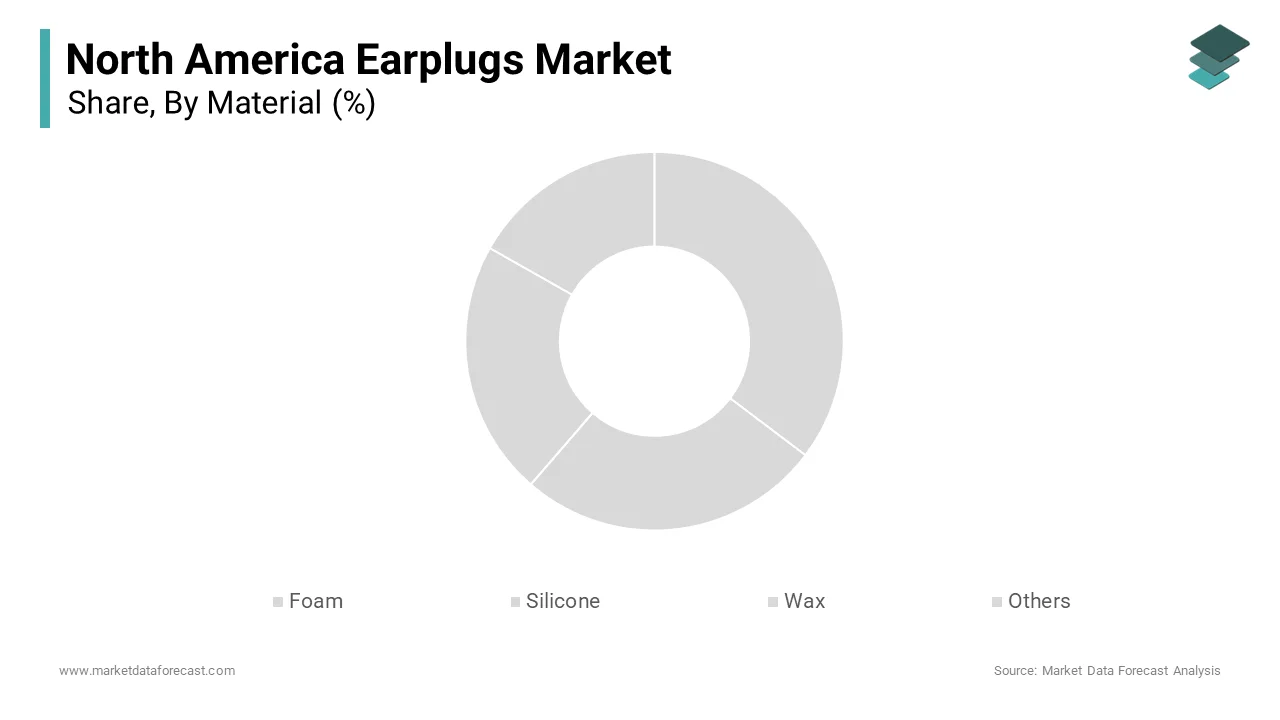
The silicone segment is likely to grow with a CAGR of 5.9% from 2025 to 2033, with the reusable and washable characteristics that silicone earplug designs provide, offering consumers sustainable alternatives to disposable foam products that reduce environmental impact while providing long-term economic benefits. This reusable advantage particularly resonates with frequent travelers, regular concert attendees, and environmentally aware consumers who prioritize product longevity and waste reduction over initial purchase costs. Furthermore, enhanced durability and temperature resistance characteristics make silicone earplugs particularly suitable for demanding applications, including swimming, extreme weather conditions, and industrial environments where material degradation could compromise protection effectiveness. The Materials Science Research Institute reports that silicone earplugs maintain structural integrity across temperature ranges from -40°F to 400°F, providing reliable performance in extreme conditions where foam alternatives may compress, degrade, or lose effectiveness. These durability advantages create sustained demand in specialized applications, including military, outdoor recreation, and industrial sectors that require robust, reliable protective solutions.
By Application Insights
The industrial applications segment held a prominent share of the North American earplugs market in 202,4, with the mandatory regulatory compliance requirements that compel industrial employers to provide effective hearing protection for workers exposed to hazardous noise levels exceeding occupational safety thresholds. The extensive workforce exposure and high replacement frequency in industrial environments, where continuous noise exposure, harsh working conditions, and frequent earplug usage create substantial consumption volumes and regular replacement requirements. The National Institute for Occupational Safety and Health indicates that industrial workers typically replace their earplugs monthly due to contamination, degradation, and wear-related performance reduction, generating consistent demand for high-volume, cost-effective earplug solutions that maintain protection effectiveness throughout demanding work environments.
The healthcare segment is anticipated to create new opportunities with a CAGR of 8.4% from 2025 to 2033, with the growing awareness of noise pollution impacts on patient recovery and healthcare outcomes that have prompted hospitals and medical facilities to implement comprehensive noise reduction initiatives as part of patient care improvement programs. These initiatives recognize that excessive noise levels in hospitals can delay patient recovery, increase medication requirements, and reduce overall care quality, which is making effective noise reduction solutions components of modern healthcare delivery. Furthermore, specialized medical applications and procedural requirements create premium market opportunities for earplug solutions that address specific healthcare needs, including MRI compatibility, sterile processing requirements, and patient-specific applications that standard industrial products cannot adequately address. The Association of PeriOperative Registered Nurses reports that operating room noise levels frequently exceed 75 decibels during complex procedures, creating demand for comfortable, sterile earplug solutions that maintain situational awareness while reducing noise exposure for patients and healthcare workers.
By Price Insights
The below US$10 price segment dominated the North American earplugs market share in 2025, with the exceptional price sensitivity and budget constraints that characterize mass consumer markets where purchase decisions are primarily driven by cost considerations rather than premium features or brand differentiation. The high-volume, low-margin business model that characterizes the mass market earplug segment, where manufacturers achieve profitability through economies of scale, efficient distribution channels, and volume-based pricing strategies that make sub-$10 products economically viable while maintaining competitive retail pricing. Additionally, institutional and educational market requirements create substantial demand for affordable earplug solutions that meet basic protection needs while accommodating budget constraints in schools, libraries, healthcare facilities, and community organizations. The National Education Association indicates that public schools purchase over 2 million earplugs annually for music programs, testing environments, and noise reduction applications, with budget limitations requiring sub-$10 solutions that provide adequate performance for educational applications.
The US$51 – US$100 price segment is lucratively growing with a CAGR of 9.1% from 2025 to 2033, with the increasing consumer recognition of premium earplug value propositions that include advanced noise-canceling technologies, customizable features, and enhanced comfort characteristics that justify premium pricing for users seeking superior performance and user experience. The Consumer Technology Association reports that consumers spending over $50 on earplug products report 80% higher satisfaction rates and 65% longer product retention compared to sub-$10 alternatives, demonstrating the tangible benefits that premium products deliver in terms of performance, durability, and user experience. Furthermore, professional and specialized application requirements create sustained demand for premium earplug solutions in niche markets, including aviation, military, entertainment, and medical applications, where standard products cannot meet specific performance or safety requirements.
COUNTRY ANALYSIS
United States
The United States was the largest contributor of the North American earplugs market with 85.2% of the share in 202,4, with the comprehensive occupational safety regulatory framework that mandates hearing protection for millions of workers across diverse industrial sectors, including manufacturing, construction, mining, and transportation. The Occupational Safety and Health Administration's stringent noise exposure standards affect over 22 million American workers annually, creating sustained demand for industrial-grade earplug solutions that meet specific performance standards and regulatory compliance requirements. The extensive healthcare system and patient care focus create substantial demand for medical-grade earplug solutions in hospitals, clinics, and healthcare facilities throughout the country. The American Hospital Association indicates that over 6,000 hospitals implement noise reduction initiatives as part of patient satisfaction and recovery improvement programs, generating demand for sterile, comfortable earplug solutions that address environmental noise concerns in healthcare settings. Additionally, consumer health awareness and lifestyle factors drive substantial demand for consumer-grade earplug solutions that address sleep disruption, travel noise, and recreational noise concerns across diverse demographic segments.
Canada
The Canadian earplugs market held 12.3% of the share in 2025. The Canadian Centre for Occupational Health and Safety reports that noise-induced hearing loss accounts for 23% of workplace compensation claims related to occupational diseases, creating sustained demand for professional-grade earplug solutions that meet specific performance standards and regulatory compliance requirements. These provincial regulations vary in stringency but consistently require employers to implement hearing conservation programs that drive substantial market demand. Furthermore, winter climate conditions and indoor lifestyle factors create unique demand patterns for consumer-grade earplug solutions that address heating system noise, indoor recreational activities, and sleep enhancement requirements throughout the long winter months.
KEY MARKET PLAYERS
3M, Moldex-Metric, Hearos, Radians, Inc., Loop Earplugs, Lucid Hearing Holding Company, LLC, Magid Glove & Safety Manufacturing Company LLC, Allens Industrial Products, Honeywell International Inc, UVEX SAFETY GROUP, Alpine Hearing Protection Inc, EARGASM, Liberty Safety, PIP, Pyramex, are the market players that are dominating the North America earplugs market.
Top Players In The Market
Royal Barksdale Company
Royal Barksdale Company has established itself as a leading supplier in the Middle East and Africa tragacanth market through decades of specialized trading experience and extensive regional distribution networks. The company's commitment to quality assurance and sustainable sourcing practices has enabled it to serve diverse industries, including pharmaceuticals, food processing, and cosmetics, across multiple countries. Their strategic partnerships with Iranian suppliers ensure consistent supply chain reliability while maintaining competitive pricing structures. The company's investment in processing facilities and quality control systems has enhanced product purity and customization capabilities by allowing them to meet specific customer requirements across different industrial applications and geographic markets.
Golnar Tragacanth Company
Golnar Tragacanth Company has gained significant market presence in the African tragacanth sector through innovative processing techniques and comprehensive regional coverage. The company specializes in producing pharmaceutical-grade tragacanth with enhanced solubility properties that cater to the growing healthcare manufacturing demand across the continent. Their integrated approach from raw material procurement to final product development ensures consistent quality control throughout the supply chain. Golnar's research and development initiatives have led to the creation of specialized formulations for specific industrial applications, which is positioning them as a preferred supplier among cosmetic and food processing companies seeking reliable and high-quality tragacanth solutions.
Persian Tragacanth Industries
Persian Tragacanth Industries represents a significant force in the regional market through its comprehensive product portfolio and strategic market expansion initiatives. The company has successfully penetrated both traditional and emerging markets by offering customized tragacanth solutions tailored to specific customer requirements and regional preferences. Their vertically integrated operations, from raw material harvesting to finished product manufacturing, re quality standards while maintaining competitive pricing. The company's focus on sustainable harvesting practices and community engagement programs has strengthened its reputation among environmentally conscious buyers, enabling it to capture substantial market share across diverse geographical territories and industrial sectors.
Top Strategies Used by Key Players in The Market
Product Innovation and Technology Integration
Leading companies in the North American earplugs market are investing heavily in advanced product development and technology integration to differentiate their offerings and capture premium market segments. These innovation initiatives include incorporating smart technology features such as Bluetooth connectivity, noise monitoring sensors, and customizable sound filtering capabilities that transform traditional protective devices into sophisticated personal wellness solutions. Companies are also developing advanced materials and ergonomic designs that enhance user comfort, improve noise attenuation effectiveness, and increase compliance rates among users who previously found conventional earplugs uncomfortable or ineffective.
Strategic Partnerships and Distribution Expansion
Market participants are forming strategic partnerships with healthcare providers, industrial safety equipment distributors, and retail chains to expand their market reach and enhance product accessibility across diverse customer segments. These collaboration efforts enable companies to leverage established distribution networks, gain access to specialized customer bases, and develop co-branded solutions that meet specific industry requirements. Companies are also partnering with technology providers and research institutions to accelerate product development cycles and incorporate cutting-edge innovations that address emerging market needs and regulatory requirements.
Brand Positioning and Consumer Education
Major players are implementing comprehensive brand positioning strategies and consumer education initiatives to increase market awareness and drive demand for premium earplug solutions. These marketing efforts focus on highlighting the health benefits of proper hearing protection, demonstrating product effectiveness through scientific validation, and educating consumers about noise pollution on sleep quality and overall wellness. Companies are also developing targeted campaigns for specific user segments, including musicians, healthcare workers, and frequent travelers who require specialized solutions that address unique application requirements and performance expectations.
COMPETITION OVERVIEW
The North American earplugs market presents a moderately concentrated competitive landscape characterized by the presence of several large multinational corporations alongside numerous regional manufacturers and specialized niche players. Major companies compete primarily on product innovation, brand recognition, and distribution reach rather than price alone, as consumers increasingly prioritize effectiveness, comfort, and specialized features over basic cost considerations. The market dynamics are influenced by factors such as regulatory compliance requirements, technological advancement, and evolving consumer preferences for premium, technology-enhanced solutions that provide superior user experiences.
Competition intensifies across different market segments, with industrial applications dominated by established safety equipment manufacturers while consumer markets witness increasing competition from technology companies and lifestyle brands entering the hearing protection space. The industry also experiences ongoing consolidation as larger players acquire smaller competitors to expand product portfolios and geographic reach. Market participants continuously adapt their business strategies to address changing regulatory environments, emerging technological trends, and shifting consumer demands while maintaining competitive positioning in an evolving marketplace that increasingly values innovation and differentiation.
RECENT HAPPENINGS IN THE MARKET
- In January 2025, 3M acquired the hearing protection division of Aearo Technologies to expand its industrial safety product portfolio and strengthen its position in the professional earplug market segment.
- In April 2025, Bose Corporation launched its consumer-focused sleep earplug line, incorporating active noise cancellation technology and wireless connectivity features to target the premium consumer market.
- In July 2025, Howard Leight by Honeywell partnered with major airline carriers to develop specialized aviation earplug solutions featuring communication enhancement capabilities for frequent flyers and airline personnel.
- In October 2025, Mack's Ultra Corporation introduced a line of customizable silicone earplugs using 3D scanning technology to provide personalized fit solutions for professional musicians and audiophiles.
- In December 2025, Loop Labs expanded its retail distribution network through partnerships with major pharmacy chains and online health retailers to increase consumer accessibility of its premium earplug products.
MARKET SEGMENTATION
This research report on the North American earplugs market is segmented and sub-segmented into the following categories.
By Material
- Foam
- Silicone
- Wax
- Others
By Technology
- Active Earplugs
- Passive Earplugs
By Type
- Disposable
- Reusable
By Price Rating
- 10 - 20 dB
- 21 - 25 dB
- 26 - 29 dB
- 30 - 33 dB
By Application Insights
- Industrial & Occupational
- Automotive
- Construction
- Energy
- Aviation
- Healthcare
- Mining
- Others
- Consumer Applications
By Country
- U.S.
- Canada
- Mexico