- Product Description Description
- Table of Contents TOC
- List of Table & Figure LOT
- Get Free Sample PDF Sample PDF
Market Size, 2025
$4.01 BnMarket Estimate, 2026
$4.25 BnMarket Forecast, 2034
$6.73 BnCAGR, 2026–2034
5.92%North America Electric Submersible Pump Market Size
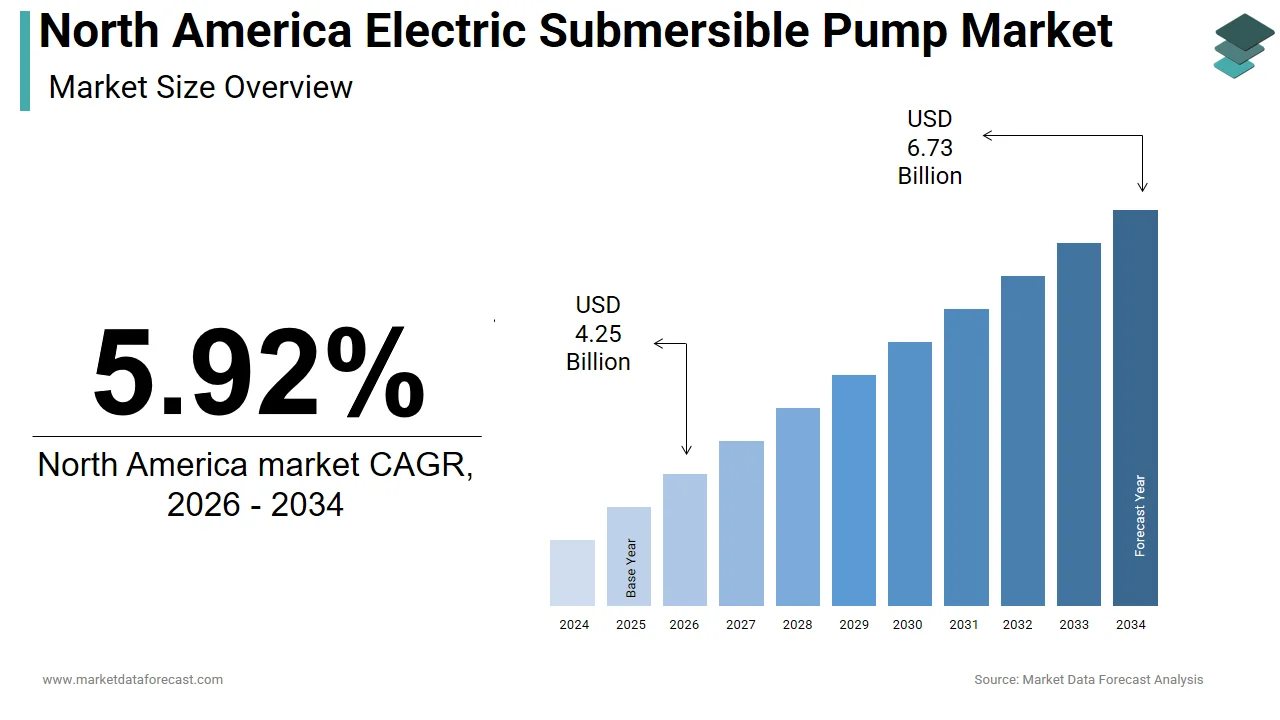
The North America electric submersible pump market was valued at USD 4.01 billion in 2025, is estimated to reach USD 4.25 billion in 2026, and is projected to reach USD 6.73 billion by 2034, growing at a CAGR of 5.92% from 2026 to 2034.
An electric submersible pump is a category of pumps that are designed to operate underwater, utilizing electric motors sealed within watertight casings. These pumps are widely used across oil and gas production, water supply systems, wastewater management, mining, and industrial applications due to their efficiency in moving fluids from deep wells or submerged environments. Unlike traditional centrifugal or jet pumps, submersible pumps push liquid to the surface rather than pulling it, which significantly enhances operational efficiency and reduces mechanical wear.
In recent years, the market has evolved with advancements in motor efficiency, materials engineering, and digital monitoring capabilities. The increasing deployment of these pumps in unconventional oil and gas extraction, particularly in shale plays such as the Permian Basin and Bakken Formation, has driven demand.
Apart from these, municipal infrastructure modernization efforts, particularly in the U.S., have contributed to growth. As aging water and sewage systems require upgrades, electric submersible pumps are increasingly being adopted for flood control, stormwater drainage, and wastewater transfer. Canada, too, has seen increased use in groundwater extraction and environmental remediation projects.
MARKET DRIVERS
Growth in Unconventional Oil and Gas Production
The expansion of unconventional oil and gas production, particularly in shale formations such as the Permian Basin, Eagle Ford, and Bakken, is one of the primary drivers of the North America electric submersible pump market. Electric submersible pumps (ESPs) play a crucial role in artificial lift systems by efficiently extracting hydrocarbons from deep, low-pressure wells where natural flow is insufficient. This surge in output has directly fueled demand for high-performance ESPs capable of handling high volumes of fluid under challenging downhole conditions.
Moreover, technological advancements in ESP design, including variable frequency drives and real-time telemetry systems, have improved reliability and operational efficiency. Companies like Schlumberger and Baker Hughes have introduced smart ESP systems that allow remote monitoring and predictive maintenance, reducing downtime and increasing overall productivity. Besides, Canada’s oil sands and deep-well conventional fields have also seen growing adoption of ESPs, supported by Natural Resources Canada’s initiatives promoting energy-efficient extraction technologies.
Increasing Demand for Water Management and Wastewater Infrastructure Modernization
The rising demand for efficient water management and the modernization of wastewater infrastructure are other critical drivers fueling the North America electric submersible pump market. With aging water systems in many urban centers, there is an urgent need to upgrade pumping stations, stormwater drainage networks, and sewage treatment facilities to ensure reliable service and prevent environmental contamination. This has led to increased procurement of high-efficiency electric submersible pumps for municipal water supply, groundwater extraction, and wastewater lifting applications.
In addition, federal and state governments have allocated substantial funds toward infrastructure development. The Bipartisan Infrastructure Law (BIL) includes significant funding dedicated to water infrastructure improvements, facilitating the deployment of advanced pumping solutions, including submersible models equipped with energy-saving features and digital controls. Furthermore, the increasing frequency of extreme weather events and urban flooding has heightened the need for robust dewatering and flood control systems, further expanding the application base for electric submersible pumps across North America.
MARKET RESTRAINTS
High Maintenance and Operating Costs
The high maintenance and operating costs associated with these systems, particularly in demanding applications such as deep oil well extraction and continuous wastewater handling, is a significant restraint affecting the North America electric submersible pump market. While electric submersible pumps (ESPs) offer superior efficiency compared to other lift methods, their complex construction and exposure to harsh environments result in frequent servicing requirements and costly repairs. In highly abrasive or corrosive environments, such as those found in heavy oil extraction or industrial effluent handling, pumps must be replaced more frequently, adding to long-term operational expenses.
Additionally, power consumption remains a major concern. Like, electric submersible pumps account for approximately 67% of total electricity usage in oil fields, making energy efficiency a critical factor in cost management. Many operators, especially smaller independent producers, find it financially challenging to invest in premium-grade pumps with built-in energy-saving features. Moreover, the complexity of installation and retrieval processes contributes to higher labor and equipment costs. In offshore or deep-well applications, specialized rigging and deployment tools are required, further escalating project budgets.
Technical Complexity and Operational Limitations
The technical complexity and operational limitations associated with these systems, particularly in demanding environments such as high-temperature wells, sandy formations, and deep-water extractions, are another key challenge impeding the growth of the North America electric submersible pump market. Despite their efficiency, ESPs are susceptible to performance degradation under adverse conditions, leading to frequent failures and unplanned downtime. In sand-laden wells, fine particulate matter can erode impellers and bearings, necessitating costly interventions.
Additionally, the reliance on electrical components presents challenges in high-temperature environments. Also, pumps operating above 180°C often experience insulation breakdown and motor failure, limiting their applicability in geothermal and deep-well settings without specialized modifications. Moreover, troubleshooting and repair procedures for submersible pumps are inherently complex. Unlike surface-mounted pumps, ESPs require complete removal from the wellbore for inspection and servicing, resulting in extended production stoppages and increased labor costs.
These technical constraints make alternative lift methods, such as progressive cavity pumps or hydraulic jet pumps, more attractive in certain applications, thereby limiting the widespread adoption of electric submersible pumps despite their inherent advantages.
MARKET OPPORTUNITIES
Integration of Smart Technologies and Digital Monitoring Systems
The integration of smart technologies and digital monitoring systems into pump operations is one of the most promising opportunities in the North America electric submersible pump market. As industries move toward greater automation and data-driven decision-making, manufacturers are developing intelligent submersible pumps equipped with real-time telemetry, predictive analytics, and remote diagnostics to enhance performance and reduce downtime. These smart systems utilize sensors to track parameters such as pressure, temperature, vibration, and flow rate, enabling early detection of anomalies before they lead to failures.
Additionally, utility providers and municipal agencies are adopting digital pump control systems to improve energy efficiency and reduce operational costs. Moreover, companies such as Schlumberger, Baker Hughes, and Grundfos have launched cloud-connected pump systems that allow operators to monitor performance remotely via mobile apps and web-based dashboards. These innovations not only enhance system longevity but also support sustainability goals by minimizing unnecessary energy use.
Expansion of Renewable Energy and Geothermal Applications
The expanding use of these systems in renewable energy applications, particularly in geothermal and solar-enhanced water pumping systems, is an emerging opportunity for the North America electric submersible pump market. As the region intensifies its focus on clean energy generation and carbon neutrality, the demand for efficient fluid-handling solutions in alternative energy projects is growing.
These plants rely heavily on submersible pumps to circulate water through underground reservoirs and extract heat for electricity generation. In Canada, Natural Resources Canada has been supporting pilot programs that utilize electric submersible pumps in closed-loop geothermal systems for district heating in residential and commercial buildings. These systems offer a sustainable alternative to conventional heating fuels, leveraging deep earth temperatures for year-round thermal regulation.
Additionally, off-grid solar-powered submersible pumping systems are gaining traction in remote agricultural and rural water supply applications.
MARKET CHALLENGES
Supply Chain Disruptions and Component Shortages
The ongoing disruption in global supply chains and shortages of critical components such as motors, cables, sensors, and specialty metals is a significant challenge impacting the North America electric submersible pump market. These disruptions, exacerbated by geopolitical tensions, trade restrictions, and pandemic-related manufacturing delays, have led to prolonged lead times and increased production costs for pump manufacturers.
The shortage of semiconductor chips, which are essential for digital pump controllers and variable frequency drives, has particularly impacted the production of smart and automated submersible pump systems. Additionally, the scarcity of raw materials such as copper, steel, and rare earth elements has resulted in price volatility. Moreover, logistics bottlenecks at major ports and transportation hubs have further delayed the import of key parts from Asia and Europe.
Regulatory Compliance and Environmental Restrictions
A further critical challenge facing the North America electric submersible pump market is the increasing complexity of regulatory compliance and environmental restrictions governing industrial equipment and fluid handling systems. Governments and regulatory bodies across the region are imposing stricter standards on energy efficiency, emissions, and chemical discharge limits, compelling manufacturers and end users to adapt their products and operations accordingly.
Alao, in Canada, Environment and Climate Change Canada (ECCC) has introduced stricter regulations under the Canadian Environmental Protection Act (CEPA), mandating reductions in fugitive emissions and promoting the use of energy-efficient pumping systems. These changes have prompted manufacturers to invest in redesigning products to meet evolving compliance requirements, often at significant cost.
Additionally, in states such as California, the Air Resources Board (CARB) has imposed stringent energy efficiency mandates for industrial pumps, influencing purchasing decisions and pushing operators to adopt high-efficiency models that may come with higher upfront costs.
REPORT COVERAGE
| REPORT METRIC | DETAILS |
| Market Size Available | 2026 to 2034 |
| Base Year | 2025 |
| Forecast Period | 2026 to 2034 |
| Segments Covered | By Type, Application, End-user, and Region. |
| Various Analyses Covered | Global, Regional and Country-Level Analysis, Segment-Level Analysis, Drivers, Restraints, Opportunities, Challenges; PESTLE Analysis; Porter’s Five Forces Analysis, Competitive Landscape, Analyst Overview of Investment Opportunities |
| Countries Covered | United States, Canada, Mexico, Rest of North America |
| Market Leaders Profiled | Baker Hughes Company, General Electric Company, Borets International Limited, Sulzer Ltd., Crompton Greaves Consumer Electrical Ltd., Schlumberger Limited, Halliburton, ZENIT ITALIA - S.R.L., Novomet, Atlas Copco AB, and others. |
SEGMENTAL ANALYSIS
By Type Insights
The Borewell submersible pumps segment remained dominant in the North America electric submersible pump market by accounting for 45.1% of total revenue in 2024. The dominance of this segment is primarily attributed to their widespread use in deep water extraction applications across municipal, agricultural, and industrial sectors. The increasing reliance on groundwater sources for potable and irrigation purposes, particularly in arid regions such as Texas, California, and Arizona, is also a key driver of this segment’s growth. According to the U.S. Geological Survey (USGS), over 79 billion gallons of groundwater were withdrawn daily in the United States. Besides, municipal water supply systems have increasingly adopted borewell submersible pumps to replace aging surface pumping infrastructure. Moreover, agricultural expansion in the Midwest and Great Plains has spurred demand for high-capacity borewell pumps used in center pivot and drip irrigation systems.
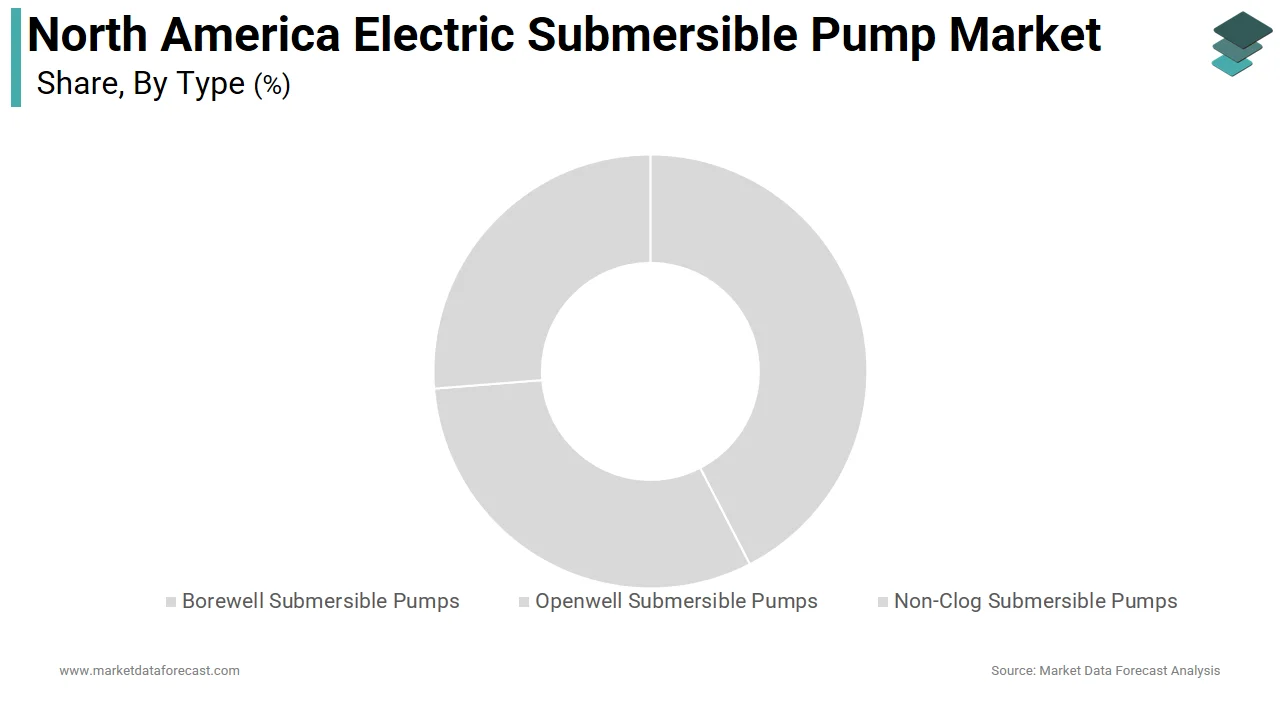
The Non-Clog submersible pumps segment is projected to grow at the fastest CAGR of 8.6% from 2026 to 2034 in the North America electric submersible pump market. The rapid expansion of this segment is driven by increasing demand for efficient handling of solids-laden fluids in wastewater, stormwater, and sewage applications. A further growth driver is the aging sewer infrastructure in major urban centers, which has led to increased investments in modern pumping solutions capable of handling debris-laden flows without frequent clogging. According to the American Society of Civil Engineers (ASCE), the United States received a D+ grade for its wastewater infrastructure in 2023, prompting municipalities to upgrade pumping stations with non-clog submersible models to reduce maintenance costs and improve system reliability. Additionally, the rising construction of commercial and residential buildings equipped with basement plumbing systems has boosted demand for sump and sewage ejection pumps. Furthermore, stormwater management initiatives are gaining traction in coastal and flood-prone areas, particularly in states like Florida, Louisiana, and New Jersey. With growing emphasis on resilient urban infrastructure and environmental compliance, the non-clog submersible pump segment is poised for sustained growth in North America.
By Application Insights
The onshore application segment held the largest share of the North America electric submersible pump market in 2025. Extensive use of submersible pumps in oil and gas production, water supply, wastewater treatment, and mining operations located on land is driving the overwhelming dominance of this segment. Also, among the notable contributors to this segment’s rise is the expansion of unconventional oil and gas drilling activities in shale-rich basins such as the Permian Basin, Eagle Ford, and Bakken Formation. Additionally, municipal and industrial water supply systems continue to rely heavily on onshore submersible pumps for groundwater extraction and distribution. Moreover, wastewater management remains a significant application area, particularly in expanding urban centers where underground sewage networks require reliable lifting solutions. With continued energy exploration and infrastructure modernization efforts underway, the onshore segment is expected to remain the cornerstone of the North America electric submersible pump market.
The offshore application segment is anticipated to grow at the fastest CAGR of 7.9% in the North America electric submersible pump market between 2025 and 2033. Increasing offshore oil and gas production, expansion of offshore wind farms, and the need for efficient dewatering and fluid transfer solutions in marine environments are among the main reasons behind the growth of this segment. Moreover, the resurgence of offshore oil exploration and production activities in the Gulf of Mexico, which remains one of the most active hydrocarbon basins in North America, also fuels the growth of this segment. Besides, offshore wind farm development is gaining momentum, particularly along the Atlantic coast. As per the U.S. Department of Energy (DOE), over 30 gigawatts of offshore wind capacity were under development in 2023, requiring advanced pumping systems for foundation cooling, turbine maintenance, and subsea cable trenching operations. Further, coastal desalination and marine infrastructure projects are driving demand for submersible pumps designed for saltwater environments. With rising investments in offshore energy and maritime infrastructure, the offshore segment is positioned for robust growth in the North America electric submersible pump market.
By End User Insights
The Oil and Gas segment was at the forefront of the North America electric submersible pump market by accounting for 43.3% of total revenue in 2024. This dominance is primarily attributed to the widespread use of electric submersible pumps (ESPs) in artificial lift systems for crude oil extraction, particularly in unconventional shale plays and mature fields requiring enhanced recovery methods is largely propelling the dominance of this segment. A different key driver of this segment’s growth is the continued expansion of U.S. shale oil production, which relies heavily on ESPs for efficient fluid removal and pressure maintenance. Additionally, Canadian oil sands and conventional wells have also seen increased adoption of ESPs, supported by Natural Resources Canada’s initiatives promoting energy-efficient extraction techniques. Moreover, technological advancements in ESP design, including variable speed drives and real-time telemetry, have improved reliability and operational efficiency in harsh downhole conditions. Companies such as Schlumberger and Baker Hughes introduced smart ESP platforms in 2023 that allow remote monitoring and predictive maintenance, reducing downtime and increasing overall productivity.
The Water and Wastewater segment is projected to grow at the fastest CAGR of 8.3% in the North America electric submersible pump market. This rapid growth is driven by increasing investments in municipal water supply infrastructure, wastewater treatment, and stormwater management systems aimed at addressing aging networks and improving service reliability. A further key growth enabler is the urgent need for infrastructure modernization across North American cities, particularly in the United States. Additionally, rising urbanization and population growth have intensified demand for reliable water supply and sewage handling solutions. As per the U.S. Census Bureau, over 2.5 million new housing units were authorized in 2023, necessitating expanded water distribution and wastewater collection networks equipped with submersible pumping technology. Moreover, climate change-induced extreme weather events have heightened the need for robust flood control and dewatering systems, particularly in coastal and low-lying regions. In Canada, Environment and Climate Change Canada (ECCC) supported several municipal water and wastewater upgrade programs in 2023, encouraging the adoption of energy-efficient submersible pumps in both urban and rural settings. With growing emphasis on sustainability and resilience, the water and wastewater segment is positioned for strong growth in the North America electric submersible pump market.
COUNTRY-LEVEL ANALYSIS
United States Electric Submersible Pump Market Insights
The United States spearheaded the North America electric submersible pump market at 69.4% in 2024 and is reflecting its dominant position as a major consumer and manufacturer of these systems across diverse industries. As the largest producer of crude oil and natural gas in the world, the U.S. heavily relies on electric submersible pumps (ESPs) for artificial lift in both conventional and unconventional oil wells. A key growth driver is the continued expansion of shale oil production in major basins such as the Permian, Eagle Ford, and Bakken, where ESPs play a crucial role in maintaining well productivity. Additionally, municipal water and wastewater infrastructure modernization efforts have significantly contributed to market growth. Moreover, the construction boom and expansion of commercial and residential developments have increased demand for dewatering and basement sewage pumping solutions. With strong industrial activity and government-backed infrastructure investments, the United States remains the cornerstone of the North America electric submersible pump market.
Canada Electric Submersible Pump Market Insights
Canada is positioning it as a key player in the regional industry. While smaller in scale compared to the U.S., Canada's market benefits from strong resource extraction activities, growing investments in municipal infrastructure, and increasing focus on energy-efficient pumping technologies. A major driver of pump demand in Canada is the ongoing development of oil sands and deep-well conventional oil fields, particularly in Alberta and Saskatchewan. Additionally, municipal water and wastewater infrastructure upgrades have contributed to increased procurement of submersible pumps across Canadian cities. Moreover, the mining sector has been a significant contributor to market growth, particularly in provinces such as Ontario, Quebec, and British Columbia. With continued support from government policies and industry modernization efforts, Canada’s electric submersible pump market is expected to maintain steady growth in the coming years.
Mexico Electric Submersible Pump Market Insights
Mexico is reflecting its emerging role in the regional industry. While still in the early stages of adoption compared to the U.S. and Canada, Mexico is witnessing gradual growth driven by expanding industrial activity, oil and gas development, and municipal infrastructure investments. One of the key growth drivers is the revitalization of Mexico’s oil and gas sector, particularly in offshore exploration projects in the Gulf of Mexico. Additionally, urban infrastructure modernization efforts have spurred demand for submersible pumps in municipal water supply and wastewater management. Moreover, the agricultural sector remains a significant user of submersible pumps, particularly in northern states like Sinaloa and Chihuahua, where large-scale irrigation depends on groundwater extraction.
COMPETITIVE LANDSCAPE
The North America electric submersible pump market is highly competitive, characterized by the presence of both global leaders and regionally focused manufacturers. Competition is driven by technological differentiation, application-specific customization, and the ability to provide integrated solutions that combine hardware, software, and after-sales support. Major players leverage their engineering expertise, extensive distribution networks, and brand reputation to maintain a strong foothold in core markets such as oil and gas, water and wastewater, and mining.
In the oil and gas sector, Schlumberger and Baker Hughes dominate due to their deep technical knowledge and long-standing relationships with upstream operators. In contrast, companies like Grundfos and Xylem hold significant influence in the municipal and industrial water segments, where energy efficiency and reliability are paramount. Emerging players are increasingly entering the market with cost-effective, modular pump systems tailored for niche applications.
As demand for smart, digitally enabled pumping solutions rises, vendors are investing heavily in automation and data analytics to differentiate their offerings. However, challenges such as supply chain constraints, fluctuating raw material costs, and regulatory compliance continue to shape the competitive dynamics. To stay ahead, companies are focusing on sustainability, customer-centric design, and agile business models that allow them to respond swiftly to evolving market demands.
KEY MARKET PLAYERS
Noteworthy Companies dominating the North America electric submersible pump market profiled in the report are
- Baker Hughes Company
- General Electric Company
- Borets International Limited
- Sulzer Ltd.
- Crompton Greaves Consumer Electrical Ltd.
- Schlumberger Limited
- Halliburton
- ZENIT ITALIA – S.R.L.
- Novomet
- Atlas Copco AB
TOP LEADING PLAYERS IN THE MARKET
- Schlumberger is a global leader in oilfield services and holds a prominent position in the North America electric submersible pump market. The company is known for its advanced artificial lift solutions, particularly electric submersible pumps (ESPs) used in oil and gas production. Schlumberger’s contribution to the global market includes continuous innovation in ESP technology, integration of digital monitoring systems, and development of energy-efficient pumping solutions tailored for challenging downhole conditions.
- Baker Hughes is a key player in the electric submersible pump industry, offering a comprehensive portfolio of ESP systems designed for both onshore and offshore applications. The company plays a critical role in supporting unconventional oil production in North America by delivering high-performance pumping solutions that enhance well productivity. Baker Hughes is also recognized for its smart field technologies that enable real-time diagnostics and predictive maintenance, contributing significantly to global advancements in artificial lift efficiency.
- Grundfos is a leading manufacturer of water-focused electric submersible pumps and has a strong presence in the North American municipal and industrial water management sectors. While primarily known for its expertise in clean water and wastewater handling, Grundfos contributes to the global market by setting benchmarks in energy efficiency, durability, and intelligent pump control systems. Its innovations are instrumental in advancing sustainable water infrastructure worldwide.
TOP STRATEGIES USED BY KEY MARKET PARTICIPANTS
Product Innovation and Digital Integration Leading companies are continuously investing in research and development to introduce next-generation electric submersible pumps equipped with smart technologies such as IoT-enabled sensors, variable frequency drives, and remote monitoring capabilities. These innovations improve operational efficiency, reduce downtime, and support predictive maintenance strategies across oil and gas, water, and industrial applications.
Expansion into Niche Applications and Geographies To diversify their market reach, key players are expanding into emerging applications such as geothermal energy, offshore wind farms, and agricultural dewatering. Additionally, they are strengthening their regional presence through localized manufacturing, distribution centers, and service networks, particularly in underserved areas within North America.
Strategic Partnerships and Collaborations Major market participants are forming strategic alliances with energy operators, utility providers, and technology firms to co-develop customized submersible pump solutions. These partnerships help align product development with end-user requirements and facilitate faster adoption in regulated and capital-intensive industries.
RECENT MARKET DEVELOPMENTS
- In February 2023, Schlumberger launched a new line of ultra-compact electric submersible pumps, specifically designed for use in horizontal wells and tight formations, aiming to improve extraction efficiency in shale oil operations across the Permian Basin.
- In August 2023, Baker Hughes announced a strategic partnership with a U.S.-based digital oilfield solutions provider to integrate real-time telemetry into its ESP systems, enhancing performance monitoring and reducing unplanned downtime for operators.
- In January 2024, Grundfos expanded its North American footprint by opening a new regional distribution and service center in Texas, aimed at improving logistics and technical support for water and wastewater customers across the southern United States.
- In May 2024, Xylem introduced an AI-powered pump analytics platform, allowing municipal utilities to optimize energy consumption and predict equipment failures in submersible pump installations, particularly in stormwater and sewage applications.
- In November 2024, a leading Canadian pump distributor partnered with a European submersible pump manufacturer to bring high-efficiency, non-clog pump models to the Canadian market, targeting growth in flood control and industrial drainage sectors.
MARKET SEGMENTATION
This North America electric submersible pump market research report is segmented and sub-segmented into the following categories.
By Type
- Borewell Submersible Pumps
- Openwell Submersible Pumps
- Non-Clog Submersible Pumps
By Application
- Onshore
- Offshore
By End User
- Oil and Gas
- Water and Wastewater
- Mining
- Others
By Country
- United States
- Canada
- Mexico
- Rest of North America