- Product Description Description
- Table of Contents TOC
- List of Table & Figure LOT
- Get Free Sample PDF Sample PDF
Market Size, 2025
$296.93 MnMarket Estimate, 2026
$334.94 MnMarket Forecast, 2034
$877.9 MnCAGR, 2026–2034
12.8%Executive Summary: North America Epigenetics Market
- Market Scope: In-depth industry evaluation of the North American epigenetics sector, categorized by product types (enzymes, instruments & consumables, kits, reagents), specific enzyme and kit subtypes, research areas (oncology, developmental biology, drug delivery), and country frameworks (U.S., Canada, Rest of North America).
- Market Valuation: Valued at USD 296.93 million in 2025, reaching USD 334.94 million in 2026, and projected to expand to USD 877.90 million by 2034, registering a robust compound annual growth rate (CAGR) of 12.8% from 2026 to 2034.
- Primary Growth Drivers: Escalating cancer prevalence and mortality rates, rising research and development investments, expanding clinical applications in non-oncology illnesses, and advancements in personalized medicine and targeted therapies.
Key Market Segment Metrics & Regional Outlook (2026–2034)
| Segment Category | Key Classifications / Scope | Market Context & Dynamics |
|---|---|---|
| By Product & Subcategories | Products: Enzymes, Instruments & Consumables, Kits, Reagents; Enzymes: DNA/Protein/RNA-Modifying; Kits: Bisulfite Conversion, ChIP-Seq, RNA-Seq, Whole-Genome Amplification, 5-HMC/5-MC Analysis |
Kits and reagents form the high-consumption baseline for daily laboratory assays, while advanced instruments (sequencers and mass spectrometers) power genomics discovery. |
| By Research Area | Oncology, Developmental Biology, & Drug Delivery | Oncology remains the dominant research domain due to epigenetic modifications playing a critical role in tumor genesis and cancer diagnostics. |
| By Country & Region | The U.S., Canada, & Rest of North America | The U.S. captures the largest regional share driven by high cancer incidences and extensive funding, while Canada emerges as a lucrative growth hub supported by research collaborations and rising obesity-driven chronic illness studies. |
Major Market Participants & Competitive Landscape
Market Structure: Highly innovative and technology-driven landscape led by prominent global life science enterprises, specialized genomic assay providers, and biotechnology reagent manufacturers.
Key Companies: Abcam plc, Illumina, Inc., QIAGEN N.V., Merck & Co., New England Biolabs, Inc., Sigma-Aldrich Corporation, Thermo Fisher Scientific, Inc., Active Motif, Diagenode, Inc., and Zymo Research Corporation.
North America Epigenetics Market Size
The North America Epigenetics Market is projected to grow from USD 296.93 million in 2025 to USD 334.94 million in 2026 and reach USD 877.9 million by 2034, registering a CAGR of 12.8% from 2026 to 2034.

The epigenetics are molecular technologies, specialized enzymes, assay kits, and next-generation sequencing instruments dedicated to analyzing heritable changes in gene expression without altering underlying DNA sequences. North America accounts for over 38% of global industry revenue, driven by robust institutional funding and advanced biotechnology infrastructure. Industry stakeholders increasingly rely on bisulfite conversion kits, chromatin immunoprecipitation assays, and high-throughput mass spectrometers to map DNA methylation and histone modification patterns. Heavy capital allocations toward biomarker discovery and non-oncology disease research further reinforce regional commercial expansion.
MARKET DRIVERS
Surging Prevalence of Oncological Malignancies and Chronic Pathologies
The escalating burden of cancer and complex metabolic disorders is greatly influencing the growth of the North America epigenetics market. According to the study, federal research appropriations dedicated to cancer biology and molecular pathology exceed 7 billion dollars annually, driving intense institutional demand for high-precision assay kits. This high disease incidence directly expands the market by requiring specialized diagnostic tools capable of identifying aberrant DNA methylation and histone modifications unique to tumor microenvironments. Furthermore, the American Cancer Society reports that cancer accounts for nearly 25% of all deaths in the United States, underscoring the critical clinical dependency on early-stage molecular screening. Consequently, biotechnology firms continuously scale up their manufacturing output of specialized reagents to support large-scale oncology research initiatives.
Expansion of Precision Medicine and Genomic Sequencing Infrastructure
The rapid integration of personalized medicine frameworks and advanced next-generation sequencing platforms fundamentally transforms therapeutic development pathways and is another factor amplifying the growth of the North America epigenetics market. According to the National Human Genome Research Institute, federal investments in genomic sequencing technologies have catalyzed a 30% annual increase in clinical trial protocols utilizing companion diagnostics. This technological shift directly drives market growth because targeted therapies and epigenetic drug candidates require comprehensive gene expression profiling to match patients with effective treatments. Additionally, data published by the Personalized Medicine Coalition indicates that customized therapies represent over 65% of recent pharmaceutical approvals, heavily relying on epigenetic target identification. Therefore, life science enterprises consistently allocate substantial capital toward upgrading their sequencing and bioinformatics infrastructure.
MARKET RESTRAINTS
Prohibitive Costs of Advanced Analytical Instruments
The extreme financial investment required to purchase, calibrate, and maintain next-generation sequencers and mass spectrometers is restricting the growth of the North America epigenetics market. The capital expenditure for outfitting a modern molecular research laboratory with high-throughput epigenetic instruments frequently exceeds millions of dollars. This high financial hurdle directly restricts market penetration by forcing academic centers with limited budgets to curtail sample processing scopes or abandon multi-sample genomic studies. Consequently, tight budgetary constraints compel facility directors to delay necessary technological acquisitions, restraining broader market growth.
Complex Technical Standardization and Data Analysis Disruptions
The intricate nature of biological sample preparation and the lack of universally standardized protocols for epigenetic assays introduce severe reproducibility challenges for laboratory operators, which is additional factor limiting the growth of the North America epigenetics market. According to the National Institute of Standards and Technology, inter-laboratory variations in bisulfite conversion efficiency and chromatin immunoprecipitation steps account for over 20% of experimental assay failures. This technical friction directly impacts market velocity by complicating regulatory submissions for newly developed diagnostic tests that rely on consistent epigenetic signatures. Moreover, technical evaluations published in the Journal of Molecular Diagnostics promotes that managing massive bioinformatics datasets generated by epigenetic sequencers requires specialized computational expertise that remains scarce in standard clinical settings. Therefore, technical complexities force organizations to divert valuable resources toward workflow validation rather than primary research.
MARKET OPPORTUNITIES
Integration of Artificial Intelligence in Epigenetic Biomarker Discovery
The rapid emergence of machine learning algorithms, cloud computing architecture, and multi-omic datasets opens transformative commercial avenues for modern biotechnology enterprises, which is substantially to elevate the growth of the North America epigenetics market. According to the National Institutes of Health, federal grants supporting artificial intelligence applications in genomic and epigenetic data analytics have expanded by over 40% over the past three years. This technological synergy directly enhances market potential by enabling researchers to rapidly screen millions of methylation loci, drastically reducing drug target identification timelines. Furthermore, market analytics published by the Healthcare Information and Management Systems Society demonstrate that AI-driven bioinformatics platforms improve data processing efficiency by nearly 45%. Consequently, software developers and diagnostic manufacturers are heavily investing in proprietary machine learning tools to capture high-value contracts with major pharmaceutical corporations.
Rise of Strategic Industry Collaborations and Academic Partnerships
The strategic alliances between contract research organizations, academic medical centers, and biopharmaceutical corporations create robust commercial pathways for rapid epigenetic drug development. According to the study, collaborative life science research agreements generate over 5 billion dollars in shared project funding annually across North America. This collaborative trend directly drives market expansion by pooling financial resources and technical expertise to accelerate the clinical translation of novel histone deacetylase inhibitors. Additionally, data from the Biotechnology Innovation Organization reveals that cooperative drug discovery ventures achieve a 30% higher rate of successful candidate identification compared to isolated institutional efforts.
MARKET CHALLENGES
Acute Shortage of Skilled Bioinformatics Professionals
The severe deficit of trained computational biologists and specialized technicians capable of interpreting complex epigenetic datasets for research facilities is a huge challenge for the growth of the North America epigenetics market. According to the Bureau of Labor Statistics, job openings for specialized bioinformatics scientists and genomic data analysts outpace qualified job seekers by a margin of 25% across North America. Furthermore, workforce surveys published by the American Society for Clinical Laboratory Science indicate that over 40% of clinical laboratories struggle to maintain optimal staffing levels for advanced molecular testing.
Severe Regulatory Uncertainty and Complex Reimbursement Frameworks
The absence of clear regulatory pathways and standardized medical reimbursement codes for epigenetics-based diagnostic tests introduces substantial commercial risk is to impede the growth of the North America epigenetics market. According to the Centers for Medicare and Medicaid Services, formal reimbursement coverage for novel epigenetic liquid biopsy assays remains restricted, complicating commercial adoption. This regulatory barrier directly curtails market expansion by discouraging venture capital investments in early-stage diagnostic start-ups attempting to commercialize proprietary methylation biomarkers. Moreover, health policy evaluations published by the Brookings Institution highlight that navigating evidentiary standards for clinical utility reviews delays product commercialization timelines by an average of 3 years.
REPORT COVERAGE
| REPORT METRIC | DETAILS |
| Market Size Available | 2025 to 2034 |
| Base Year | 2025 |
| Forecast Period | 2026 to 2034 |
| Segments Covered | By Product, Research Area, Reagents, and Region |
| Various Analyses Covered | Global, Regional, and Country-Level Analysis, Segment-Level Analysis, Drivers, Restraints, Opportunities, Challenges; PESTLE Analysis; Porter’s Five Forces Analysis, Competitive Landscape, Analyst Overview of Investment Opportunities |
| Countries Covered | The U.S., Canada, Rest of North America |
| Market Leaders Profiled |
|
SEGMENTAL ANALYSIS
By Product Insights
The reagents segment held a significant share of the North America epigenetics market in 2025 with the indispensable naturdue to itsly laboratory workflows. According to the research, the U.S. epigenetics market was valued at 5.13 billion dollars, driving heavy continuous procurement of chemical solutions required for sample preparation. This product dominance directly correlates with the high consumption frequency of specialized buffers, modifying enzymes, and labeling compounds needed to execute complex chromatin immunoprecipitation assays. Furthermore, annual rise in academic grant allocations directed toward high-throughput molecular screening assays.
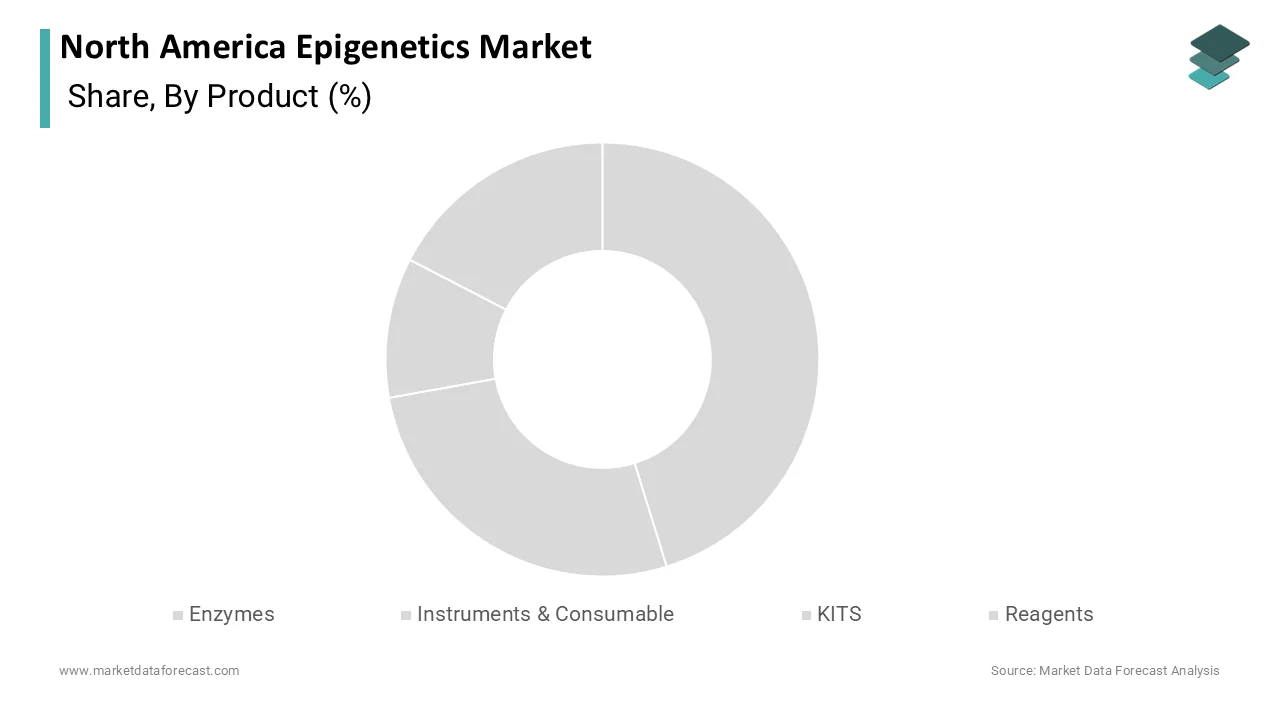
The services segment is expanding at a fastest CAGR of 14.2% during the forecast period, with the prohibitive capital costs of next-generation sequencers compelling smaller biology firms to outsource complex bisulfite sequencing and bioinformatics data interpretation to specialized contract research organizations. Additionally, according to the research, 22% annual surge in outsourced clinical biomarker profiling contracts across North America. Therefore, contract analytical providers are scaling up their technical capacity to capture lucrative long-term pharma partnerships.
By Research Area Insights
The oncology segment was the largest by accounting for 21.2% of the North America epigenetics market share in 2025, as aberrant gene silencing remains a central hallmark of cancer biology. According to the American Cancer Society, over 2 million new cancer diagnoses are recorded annually in the United States, intensifying research focus on tumor-specific DNA methylation. This dominant research focus directly correlates with the massive influx of venture capital and federal appropriations aimed at discovering epigenetic biomarkers for early tumor detection. Consequently, laboratories heavily prioritize oncology-focused epigenetic assay kits to accelerate the development of targeted cancer therapeutics.
The developmental biology segment is swiftly emerging at a fastest CAGR of 11.5% from 2026 to 2034. The growth of the segment is driven by the breakthroughs in stem cell differentiation mapping and the understanding of hereditary congenital disorders governed by non-genetic heritage factors. Moreover, scientific data published in the Journal of Cell Science indicates a 17% annual increase in academic publications examining chromatin remodeling dynamics during early mammalian development. As a result, specialized research facilities are continuously expanding their molecular toolkits to support complex developmental epigenetic studies.
By Reagents Insights
The antibodies segment held a prominent share of the North America epigenetics market in 2025 with the executing chroexecution of chromatin immunoprecipitationlotting procedures. The growth of the segment is likely to grow with the necessity of utilizing highly specific monoclonal and polyclonal antibodies to isolate modified histones and map transcription factor binding sites accurately. The reagent manufacturers focus heavily on improving antibody purity and binding is also drivin, whichg, the growth of the segment.
The magnetic beads segment is growing at a fastest CAGR of 12.1% from 2026 to 2034. According to the research, automated sample extraction workflows utilizing functionalized magnetic particles have experienced a 30% adoption surge across high-throughput molecular laboratories. This rapid expansion directly links to the transition from manual centrifugation to automated robotic separation platforms that require uniform magnetic bead suspensions for DNA and protein isolation. Additionally, laboratory automation analytics published by the Society for Laboratory Automation and Screening report an 18% annual increase in automated liquid handler integration with magnetic separation modules. Therefore, specialty chemical suppliers are ramping up production lines to meet the surging demand for high-performance separation matrices.
COUNTRY LEVEL ANALYSIS
United States Epigenetics Market Analysis
The United States epigenetics market was the top performer by capturing a 91.1% of share in 2025 backed by peer academic institutions and robust venture capital financing. According to the National Institutes of Health, annual federal allocations for genomic and epigenomic research exceed 30 billion dollars, establishing an unrivaled foundation for commercial biomarker discovery. This prominent national status directly correlates with the heavy concentration of multinational biotechnology corporations and advanced clinical testing laboratories operating within domestic technology hubs. Furthermore, regulatory frameworks administered by the U.S. Food and Drug Administration actively encourage the commercialization of companion diagnostics, accelerating clinical adoption.
Canada Epigenetics Market Analysis
Canada's epigenetics market was ranked second by holding 10.1% of the share,,in 2025, with centralized public health databases and nationally funded genomic consortia. According to Genome Canada, federal and provincial investments in precision health initiatives surpass 500 million dollars, fostering strong collaborative networks among regional academic medical centers. This established market position directly correlates with integrated single-payer health data systems that allow researchers to conduct population-wide epigenetic epidemiology studies with exceptional efficiency. Additionally, economic development metrics published by Statistics Canada indicate an 8% annual rise in private biotechnology sector expenditures dedicated to molecular assay development. Therefore, Canadian life science facilities provide a stable, highly regulated ecosystem that attracts major international pharmaceutical research partnerships.
COMPETITIVE LANDSCAPE
The competitive landscape of the North American epigenetics market is characterized by intense rivalry among established multinational life science conglomerates and agile biotechnology innovators striving for analytical precision and technological differentiation. Strategic positioning heavily relies on instrument reliability, assay sensitivity, and the ability to offer scalable modular solutions that adapt to fluctuating institutional sample volumes. High research and development expenditures, complex data analysis bottlenecks, and stringent regulatory validation hurdles compel companies to continuously optimize their manufacturing processes and expand their bioinformatics service models. Furthermore, smaller specialized firms frequently challenge traditional equipment manufacturers by introducing disruptive single-molecule sequencing methods and targeted liquid biopsy assays that uncover novel epigenetic biomarkers.
KEY MARKET PLAYERS
Some of the companies that are playing a dominating role in the North America Epigenetics Market include:
- Abcam plc
- Illumina, Inc.
- QIAGEN N.V.
- Merck & Co., Inc.
- New England Biolabs, Inc.
- Sigma-Aldrich Corporation
- Thermo Fisher Scientific, Inc.
- Active Motif
- Diagenode, Inc.
- Zymo Research Corporation
TOP LEADING PLAYERS IN THE MARKET
- Thermo Fisher Scientific delivers comprehensive analytical instruments, high-throughput sequencers, and specialized chemical reagents that support complex epigenetic research across North America. The corporation contributes extensively to the market by providing robust laboratory infrastructure and advanced assay kits necessary for mapping DNA methylation and histone modifications. To strengthen its commercial position, the enterprise continuously invests in research and development to introduce automated sample preparation systems and integrated bioinformatics software. Furthermore, the organization actively pursues strategic partnerships and technological acquisitions to broaden its molecular biology product portfolio and streamline clinical research workflows for pharmaceutical clients.
- Illumina epigenetics market: Illumina drives the market through the development and commercialization of advanced next-generation sequencing platforms and microarray technologies optimized for methylation analysis. The enterprise contributes deeply to the market by enabling high-resolution genome-wide profiling of epigenetic alterations associated with various oncology and complex metabolic conditions. To reinforce its competitive posture, the organization prioritizes collaborative agreements with leading academic medical centers and clinical research networks to validate novel sequencing applications. Additionally, the firm focuses on enhancing data output speed and reducing per-sample sequencing costs through continuous hardware improvements. These dedicated operational advancements enable the business to remain a vital technological enabler for large-scale population genomics.
- Agilent Technologies provides specialized target enrichment workflows, custom target capture libraries, and precision analytical instruments tailored for epigenetic and genomic investigations. The enterprise contributes significantly to the sector by offering high-performance reagents and software solutions that improve the accuracy of chromatin immunoprecipitation and DNA methylation assays. To strengthen its market standing, the organization actively executes strategic acquisitions of emerging life science tool providers and expands its specialized manufacturing footprint. Moreover, the firm focuses on integrating cloud-based data analysis tools with its physical instruments to help researchers interpret complex epigenetic datasets efficiently.
TOP STRATEGIES USED BY KEY MARKET PARTICIPANTS
Key market participants operating within the North American epigenetics industry deploy sophisticated commercial and technological strategies designed to maintain a competitive advantage amid rapid scientific advancements and evolving diagnostic demands. Major life science corporations heavily prioritize strategic mergers, corporate buyouts, and licensing agreements to acquire proprietary sequencing technologies and innovative biomarker assays. Organizations routinely establish robust research partnerships with academic medical centers and clinical research organizations to co-develop automated sample processing workflows and next-generation diagnostic tools. Furthermore, leading entities execute aggressive product diversification strategies, integrating artificial intelligence software, cloud-based bioinformatics platforms, and real-time data analysis tools directly into their instrument portfolios. Companies also focus intensely on regulatory compliance fortification, ensuring their assay kits and reagent lines meet stringent clinical validation standards to support high-value oncology trials and companion diagnostic developments. Additionally, active customer support initiatives, specialized technical training programs, and flexible service-level agreements for outsourced genomic services remain central tactics utilized to secure long-term contracts and drive consistent revenue growth across all target customer segments.
MARKET SEGMENTATION
This research report on the North America Epigenetics Market has been segmented & sub-segmented into the following categories
By Product
- Enzymes
- Instruments & Consumable
- KITS
- Reagents
By Research Area
- Developmental Biology
- Oncology
- Drug Delivery
By Reagents
- Antibodies
- Buffers
- Histones
- Magnetic Beads
- Primers
By Country
- The U.S.
- Canada
- Rest of North America