North America Ethylene Dichloride (EDC) Market Research Report - Segmented By Product Type (Technical Grade, Pharma Grade), Application & By Country (the U.S., Canada and Rest of North America) - Industry Analysis From 2024 to 2033
North America Ethylene Dichloride (EDC) Market Size
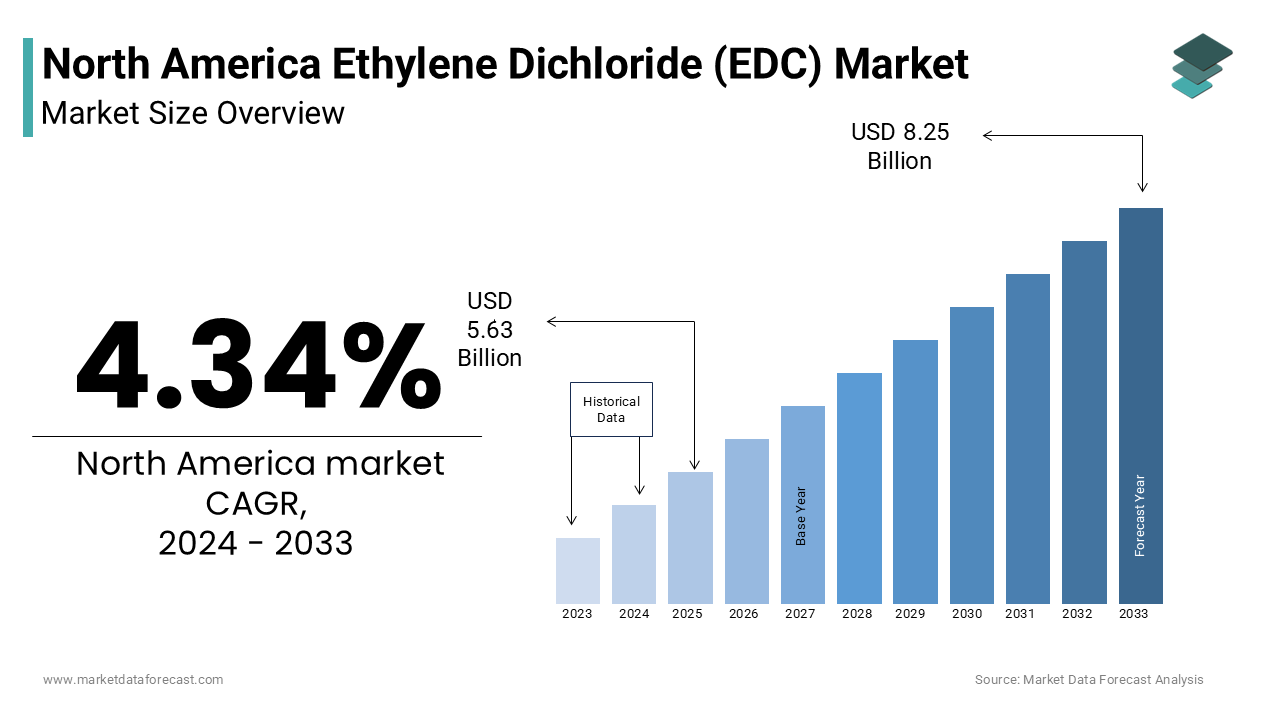
The North America Ethylene Dichloride (EDC) Market is projected to grow from USD 5.63 billion in 2024 to USD 8.25 billion by 2033, at a CAGR of 4.34%.
Ethylene dichloride is synthesized through the chlorination of ethylene and is further processed via thermal cracking to produce vinyl chloride monomer (VCM), the precursor to PVC. In North America—particularly in the United States—the EDC market benefits from robust industrial infrastructure, abundant feedstock availability due to shale gas expansion, and strong downstream demand from construction, automotive, and packaging sectors. According to the American Chemistry Council, the U.S. remains a leading global producer and exporter of EDC, leveraging its cost-advantaged ethylene supply derived from shale-based feedstocks. As per the U.S. Energy Information Administration, the growth in domestic natural gas liquids has directly supported the competitiveness of chlor-alkali industries, including EDC producers. Apart from these, the Gulf Coast region hosts a significant portion of EDC manufacturing facilities, reinforcing regional dominance.
MARKET DRIVERS
The expanding demand for polyvinyl chloride (PVC) in the construction industry is one major driver of the North America ethylene dichloride (EDC) market. PVC remains a preferred material for pipes, fittings, flooring, window profiles, and insulation due to its durability, cost-effectiveness, and low maintenance requirements. According to the Vinyl Institute, more than 75% of all vinyl produced in the U.S. is used in construction applications, with PVC piping alone accounting for over half of this usage. The growing emphasis on energy-efficient building materials and infrastructure modernization projects across North America has further fueled PVC consumption. This surge in construction activity directly translates into increased demand for VCM and, consequently, EDC. Leading chemical manufacturers such as Olin Corporation and Westlake Chemical have expanded their EDC production capacities to meet upstream needs. Besides, the lightweight nature of PVC makes it a favored alternative to traditional materials like metal and concrete, especially in green building initiatives, reinforcing the long-term growth trajectory of the EDC market in the region.
The availability of low-cost ethylene feedstock derived from shale gas extraction is another key driver of the North America ethylene dichloride (EDC) market. The shale revolution in the United States has significantly enhanced the competitiveness of domestic chemical producers by providing a reliable and economical supply of ethylene, a primary raw material in EDC synthesis. According to the U.S. Energy Information Administration, U.S. ethane production exceeded 2 million barrels per day in 2023, much of which is sourced from the Marcellus and Utica shale basins. This cost differential has led to substantial capital investments in new and expanded EDC and PVC production units along the Gulf Coast. For instance, companies like Formosa Plastics and Occidental Petroleum have undertaken multi-billion-dollar expansions to capitalize on favorable feedstock economics. Moreover, as per the U.S. Department of Commerce, exports of EDC and downstream PVC products have grown steadily, bolstered by trade agreements and global demand for affordable plastic alternatives. This sustained feedstock advantage positions North America as a dominant player in the global EDC value chain.
MARKET RESTRAINTS
The stringent regulatory environment governing the handling, transportation, and emissions associated with chlorine-based chemicals is one major restraint affecting the North America ethylene dichloride (EDC) market. EDC production involves chlorine, a hazardous substance that poses environmental and health risks if not managed properly. Regulatory agencies such as the U.S. Environmental Protection Agency and the Occupational Safety and Health Administration impose strict guidelines on chemical manufacturing processes, requiring extensive compliance measures. According to the EPA’s Risk Management Program, numerous EDC production sites fall under high-risk categories due to potential chlorine releases, necessitating costly mitigation strategies. Also, there were multiple reported incidents involving chlorine-related leaks and chemical spills at industrial facilities in recent years, prompting regulators to tighten oversight. Compliance with these rules increases capital expenditures and operational costs for manufacturers. Further, as per the Toxic Release Inventory database, EDC producers must report annual emissions and waste management activities, adding administrative burdens. These regulatory constraints create barriers to rapid market expansion and require continuous investment in safety and environmental controls, limiting the sector's growth potential despite strong downstream demand.
The volatility in chlorine supply and pricing, which directly affects production costs and profitability is another key restraint impacting the North America ethylene dichloride (EDC) market. Chlorine is a critical input in EDC manufacturing, and fluctuations in its availability or price can disrupt operations and impact margins. According to the American Clean Power Association, chlorine prices have experienced upward pressure due to rising energy costs, particularly electricity, which constitutes a major portion of chlorine production expenses. The U.S. Geological Survey notes that chlorine production is heavily dependent on electrolysis, making it sensitive to power grid stability and energy tariffs. Furthermore, geopolitical tensions affecting raw material imports and export restrictions on caustic soda—a co-product of chlorine manufacturing—also contribute to supply-side challenges. These factors complicate procurement planning for EDC producers and introduce financial uncertainty, discouraging aggressive capacity expansions.
MARKET OPPORTUNITIES
The growing adoption of circular economy principles and chemical recycling initiatives aimed at reducing plastic waste and enhancing resource efficiency is one major opportunity within the North America ethylene dichloride (EDC) market. With increasing scrutiny on plastic pollution and mounting pressure to reduce landfill waste, chemical companies are exploring innovative ways to recycle PVC and other chlorine-based polymers back into valuable feedstocks such as EDC. According to the Ellen MacArthur Foundation, less than 15% of global plastic waste is currently recycled, highlighting the vast potential for improvement. As per the U.S. Department of Energy, emerging pyrolysis and solvolysis technologies can convert post-consumer PVC waste into reusable hydrocarbons, including EDC, creating a closed-loop system. Several major chemical firms, including BASF and Dow Inc., have launched pilot programs focused on chemical recycling of PVC to reintegrate chlorine compounds into the production cycle. Apart from these, government-backed initiatives such as the REMADE Institute support research into sustainable materials recovery, promoting industry collaboration. These developments offer EDC producers a dual benefit: securing alternative feedstock sources while aligning with corporate sustainability goals.
The expansion of downstream specialty chemical applications beyond traditional PVC production is another promising opportunity for the North America ethylene dichloride (EDC) market. While EDC is predominantly used for vinyl chloride monomer (VCM) generation, it also serves as a key intermediate in the synthesis of various chlorinated solvents, herbicides, and industrial intermediates. Companies such as Olin Corporation and Occidental Petroleum have diversified their EDC utilization strategies to include specialty chemical derivatives, allowing them to tap into higher-margin segments. Besides, the U.S. Food and Drug Administration and Environmental Protection Agency regulate the use of chlorinated compounds in agrochemical formulations, ensuring safe and compliant application.
MARKET CHALLENGES
The increasing complexity of supply chain logistics and transportation constraints is a major challenge facing the North America ethylene dichloride (EDC) market. EDC is classified as a hazardous chemical, requiring specialized handling, storage, and transport protocols to comply with safety regulations. As per the Bureau of Transportation Statistics, delays at chemical terminals and congestion in intermodal freight networks have become more frequent in recent years, disrupting delivery schedules and increasing inventory costs. Moreover, as per the U.S. Chemical Safety and Hazard Investigation Board, several incidents involving EDC transportation have prompted regulatory agencies to impose stricter routing and emergency response mandates. These logistical hurdles make it difficult for producers to maintain consistent supply flows to downstream PVC and chemical manufacturers. Moreover, as per the National Tank Truck Carriers association, driver shortages and rising fuel costs have further compounded transportation inefficiencies.
The intensifying competition from alternative materials and substitute feedstocks in the plastics industry is another pressing challenge for the North America ethylene dichloride (EDC) market. As concerns over environmental sustainability and plastic waste grow, industries are increasingly exploring biodegradable polymers, aluminum composites, and engineered thermoplastics as replacements for PVC-based products. Also, agricultural and food packaging sectors are shifting toward plant-derived polymers that do not rely on chlorine chemistry, potentially reducing long-term demand for EDC. Moreover, advancements in metathesis and olefin conversion technologies are enabling the production of synthetic rubber and polymer resins from non-chlorinated feedstocks, further eroding EDC’s traditional market base. Companies like LyondellBasell and ExxonMobil have been actively developing alternative polyolefin-based materials that offer similar performance characteristics without chlorine dependency. This shift threatens to diminish EDC’s role in future polymer supply chains unless the industry adapts by diversifying into high-performance specialty chemicals or adopting greener production methods that align with evolving consumer preferences.
SEGMENTAL ANALYSIS
By Product Type Insights
The Technical Grade segment held the largest market share in 2024. Its extensive use in industrial applications, particularly in the production of vinyl chloride monomer (VCM), which is further processed into polyvinyl chloride (PVC), is driving the dominance of Technical Grade segment. According to the Vinyl Institute, PVC remains one of the most widely used plastics globally, with over 75% of all vinyl produced in the U.S. dedicated to construction and infrastructure applications. As per data from the American Chemistry Council, North America's strong chemical manufacturing base, particularly along the Gulf Coast, supports high volumes of EDC consumption for VCM synthesis. Further, Technical Grade EDC is utilized in chlorinated solvents and agrochemical formulations, expanding its industrial footprint. As per the U.S. Energy Information Administration, the shale gas boom has provided a cost-advantaged feedstock environment, enabling large-scale EDC production at competitive prices.

The Pharma Grade EDC segment in the North America ethylene dichloride market is growing at the fastest rate and is projected to expand at a CAGR 6.3% over the next decade. While smaller in volume compared to Technical Grade, Pharma Grade EDC is witnessing increased adoption due to its critical role in pharmaceutical intermediates and fine chemical synthesis. Pharma Grade EDC is used in synthesizing antibiotics, antivirals, and other active pharmaceutical ingredients (APIs) where precise chlorine chemistry is essential. Companies like Olin Corporation and Occidental Petroleum have expanded their capabilities in supplying high-purity EDC for life sciences applications.
By Application Insights
The Vinyl Chloride Monomer (VCM) segment dominated by capturing a substantial portion of total market share in 2024. The overwhelming dominance is due to VCM being the primary derivative of EDC and the direct precursor to polyvinyl chloride (PVC), one of the most widely consumed plastics globally. According to the Vinyl Institute, PVC is extensively used across construction, automotive, healthcare, and consumer goods industries, with North America maintaining a leading position in both production and consumption. As per data from the American Chemistry Council, over 15 million metric tons of PVC were produced annually in the U.S., directly translating into significant EDC demand. The region benefits from abundant ethylene feedstock derived from shale gas, ensuring cost-effective VCM and PVC production. Apart from these, Chemical manufacturers such as Westlake Chemical and Formosa Plastics have invested heavily in integrated EDC-VCM-PVC complexes, reinforcing vertical integration and operational efficiency.
The Ethyleneamines segment in the North America ethylene dichloride (EDC) market is experiencing the fastest growth and is projected to expand at a CAGR 7% through 2033. The increasing use of ethyleneamines in specialty chemical applications such as surfactants, corrosion inhibitors, and agrochemicals is rapid expanding the Ethyleneamines segment. Besides, the agricultural sector relies on ethyleneamine derivatives for herbicide and pesticide formulation, aligning with rising food security concerns and sustainable farming practices. As per the U.S. Department of Agriculture, crop protection chemical usage in North America has seen steady growth, supporting upstream demand for EDC-derived intermediates. Companies like BASF and Dow Inc. have expanded their ethyleneamine production capacities to meet this evolving demand. Furthermore, advancements in bio-based surfactant development are opening new avenues for ethyleneamine utilization, reinforcing the segment’s robust growth trajectory within the broader EDC market.
REGIONAL ANALYSIS
The United States led the North America ethylene dichloride (EDC) market by commanding a 80.5% of total regional demand in 2024. As a global hub for chemical manufacturing, the U.S. benefits from abundant feedstock availability, particularly low-cost ethylene derived from shale gas reserves. According to the U.S. Energy Information Administration, domestic ethane production surpassed 2 million barrels per day in 2023, providing a stable foundation for EDC producers. The Gulf Coast region serves as the epicenter of EDC manufacturing, hosting major production facilities operated by companies such as Olin Corporation, Westlake Chemical, and Occidental Petroleum. These firms leverage integrated supply chains to convert EDC into vinyl chloride monomer (VCM) and polyvinyl chloride (PVC), which are then distributed across construction, automotive, and packaging sectors. There has been strong export growth in PVC and related intermediates, further reinforcing EDC demand. Government policies promoting domestic chemical production and infrastructure modernization continue to support sustained market expansion.
Canada holds a notable position in the North America ethylene dichloride (EDC). Though smaller in scale compared to the U.S., Canada plays a strategic role in the EDC value chain, particularly in downstream PVC processing and specialty chemical manufacturing. According to Natural Resources Canada, the country’s chemical industry contributes over $30 billion annually to GDP, with Quebec and Ontario serving as key production centers. Canadian EDC consumption is primarily linked to vinyl chloride monomer (VCM) production, supporting domestic PVC demand in construction and industrial applications. Moreover, Canadian chemical producers are increasingly investing in green chemistry initiatives, aligning with national sustainability goals.
Mexico represents a growing segment of the North America ethylene dichloride (EDC) market. Although relatively modest compared to the U.S. and Canada, Mexico’s market is expanding due to increasing investment in petrochemical infrastructure and downstream PVC manufacturing. As per the National Hydrocarbons Commission, Mexico’s refining and petrochemical industries have undergone modernization efforts aimed at enhancing feedstock availability for chemical producers. PEMEX, the state-owned oil company, has initiated capacity expansions in ethylene production to support local EDC and VCM operations. Further, proximity to the U.S. offers logistical advantages for cross-border chemical trade, allowing Mexican producers to participate in integrated supply chains. With government incentives promoting industrial development and environmental regulations encouraging resource efficiency, Mexico’s EDC market is positioned for gradual but steady growth.
The remaining territories in North America—including Puerto Rico, Central America, and the Caribbean—collectively account for smaller share of the regional ethylene dichloride (EDC) market. While small in volume, these markets exhibit emerging opportunities due to increasing industrial activity and infrastructure development. In Central America, nations such as Costa Rica and Panama are integrating more sustainable building practices, influencing demand for chlorine-based polymers. The Economic Commission for Latin America and the Caribbean (ECLAC) notes that regional trade agreements and logistics corridors are facilitating access to North American chemical products. Also, some island nations are adopting resilient construction materials to mitigate climate change impacts, indirectly supporting EDC-linked applications. Though current consumption levels remain limited, partnerships between multinational chemical suppliers and local distributors are helping introduce PVC-based solutions tailored to regional needs, signaling future growth potential.
The U.S. Gulf Coast region plays a central role in shaping the North America ethylene dichloride (EDC) market, given its concentration of petrochemical production facilities and integrated chemical complexes. According to the U.S. Energy Information Administration, the Gulf Coast accounts for over 50% of U.S. ethylene production capacity, directly supporting EDC manufacturing. Major chemical producers including Chevron Phillips Chemical, Shell Chemical, and INEOS operate large-scale EDC plants in Texas and Louisiana, benefiting from access to low-cost feedstock and established transportation infrastructure. The Gulf Coast’s strategic location facilitates efficient distribution of EDC and its derivatives to both domestic and international markets. Apart from these, the region’s proximity to major ports enhances export capabilities. Environmental agencies such as the Texas Commission on Environmental Quality monitor emissions and waste management practices, ensuring compliance with federal and state regulations. As North America continues to strengthen its position in the global chemical industry, the Gulf Coast remains a pivotal hub for EDC production and downstream value addition.
KEY MARKET PLAYERS AND COMPETITIVE LANDSCAPE
Key players operating in the North America Ethylene Dichloride (EDC) market include Olin Corporation, Westlake Chemical Corporation, Formosa Plastics Corporation, Occidental Petroleum Corporation, Dow Inc., Shintech Inc., Axiall Corporation, and INEOS Group.
The North America ethylene dichloride (EDC) market is characterized by a highly consolidated yet intensely competitive landscape dominated by a few large, vertically integrated chemical producers. These companies leverage economies of scale, deep industry expertise, and well-established supply chains to maintain strong market positions. As demand for chlorine-based products like polyvinyl chloride (PVC) remains steady, competition revolves around operational efficiency, technological advancements, and compliance with increasingly stringent environmental and safety regulations. Companies are continuously investing in cleaner production methods, energy-saving technologies, and waste minimization strategies to enhance their sustainability profiles while ensuring cost-effective output. Besides, firms are expanding into specialty chemical applications beyond traditional PVC production to diversify revenue streams and reduce dependency on commodity cycles. Strategic collaborations, capacity expansions, and innovation in chemical recycling are also becoming central to maintaining a competitive edge. With shifting consumer preferences toward greener alternatives and growing scrutiny around hazardous chemical handling, market participants must balance profitability with responsible production practices to sustain long-term growth in this capital-intensive sector
Top Players in the North America Ethylene Dichloride Market
Olin Corporation
Olin Corporation is a leading player in the North America ethylene dichloride (EDC) market, with a strong presence in chlorine and derivatives production. The company plays a crucial role in supplying EDC for downstream applications such as vinyl chloride monomer (VCM) and PVC manufacturing. Through its vertically integrated operations, Olin ensures a stable supply chain that supports both domestic and global markets. Its commitment to operational efficiency and sustainability has positioned it as a key contributor to the advancement of chlorine-based chemical industries worldwide.
Westlake Chemical Corporation
Westlake Chemical is a major participant in the EDC market, operating extensive facilities that support the full value chain from ethylene to PVC. The company integrates upstream feedstock availability with downstream processing, enhancing cost-efficiency and competitiveness. Westlake’s strategic investments in capacity expansion and technology upgrades have reinforced its leadership position in North America while supporting global demand for chlorine-based products. Its continuous focus on innovation and environmental stewardship contributes significantly to the evolution of the global EDC landscape.
Occidental Petroleum Corporation (OxyChem)
Occidental Chemical Corporation, a subsidiary of Occidental Petroleum, is a key producer of EDC in North America. The company operates large-scale chlor-alkali plants that supply EDC for industrial and chemical synthesis applications. OxyChem's expertise in chlorine chemistry and long-standing relationships with downstream manufacturers make it an essential player in the regional and global markets. Its emphasis on safety, sustainability, and process optimization enhances its influence across the broader chemical industry.
Top Strategies Used by Key Market Participants
Key players in the North America ethylene dichloride (EDC) market employ several strategic approaches to maintain and strengthen their competitive positions. One major strategy is vertical integration, where companies control multiple stages of the supply chain—from ethylene sourcing to VCM and PVC production ensuring cost efficiency and supply stability. Another critical approach is technology-driven process optimization, which involves investing in advanced chlorination techniques, energy-efficient manufacturing, and emission reduction systems to comply with environmental regulations and improve operational performance. Lastly, strategic partnerships and joint ventures are widely used to expand production capacities, access new markets, and share R&D initiatives aimed at developing sustainable chlorine-based solutions that align with evolving industry demands and regulatory expectations.
RECENT MARKET DEVELOPMENTS
- In February 2024, Olin Corporation announced the completion of a major modernization project at its Louisiana chlor-alkali facility, enhancing production efficiency and reducing environmental impact. This upgrade supports the company’s long-term strategy to maintain leadership in the North America ethylene dichloride market.
- In June 2023, Westlake Chemical initiated construction on an expanded PVC production unit in Calvert City, Kentucky, aimed at increasing downstream integration and securing a larger share of the U.S. chlorine derivatives market.
- In November 2023, Occidental Chemical (OxyChem) launched a new research initiative focused on circular economy applications for chlorine-based chemicals, aiming to develop advanced recycling methods for PVC and related materials derived from ethylene dichloride.
- In September 2023, a leading North American chemical logistics provider entered into a long-term agreement with major EDC producers to enhance transportation infrastructure, ensuring safer and more efficient distribution of ethylene dichloride across the region.
- In January 2024, a consortium of North American EDC manufacturers collaborated on a sustainability certification program designed to standardize best practices in responsible chemical management, reinforcing industry credibility and regulatory alignment.
MARKET SEGMENTATION
This research report on the North America Ethylene Dichloride (EDC) Market has been segmented and sub-segmented into the following categories.
By Product Type
- Technical Grade
- Pharma Grade
By Application
- Vinyl Chloride Monomer
- Ethyleneamines
- Others
By Country
- The United States
- Canada
- Rest of North America
Frequently Asked Questions
What drives the growth of the EDC market in North America?
The market is driven by increasing demand for PVC across construction, automotive, and packaging sectors, along with advancements in chemical manufacturing infrastructure.
What are the key challenges facing the EDC market?
Key challenges include environmental regulations, health concerns related to EDC toxicity, and fluctuating raw material prices such as ethylene.
What is the market outlook for EDC in North America?
The market is expected to grow steadily, supported by PVC demand and infrastructure development, although environmental regulations may moderate the pace.
Are there any significant technological advancements in EDC production?
Yes, innovations such as oxychlorination and catalytic cracking are improving process efficiency and reducing environmental impact.
Related Reports
Access the study in MULTIPLE FORMATS
Purchase options starting from
$ 2000
Didn’t find what you’re looking for?
TALK TO OUR ANALYST TEAM
Need something within your budget?
NO WORRIES! WE GOT YOU COVERED!
Call us on: +1 888 702 9696 (U.S Toll Free)
Write to us: sales@marketdataforecast.com