- Product Description Description
- Table of Contents TOC
- List of Table & Figure LOT
- Get Free Sample PDF Sample PDF
Market Size, 2025
$260.76 BnMarket Estimate, 2026
$272.16 BnMarket Forecast, 2034
$383.20 BnCAGR, 2026–2034
4.37%Executive Summary: North America Fast Food Market
- Market Scope: North American fast food market analysis covering food types, distribution channels, regional leadership frameworks, and consumer demographic metrics.
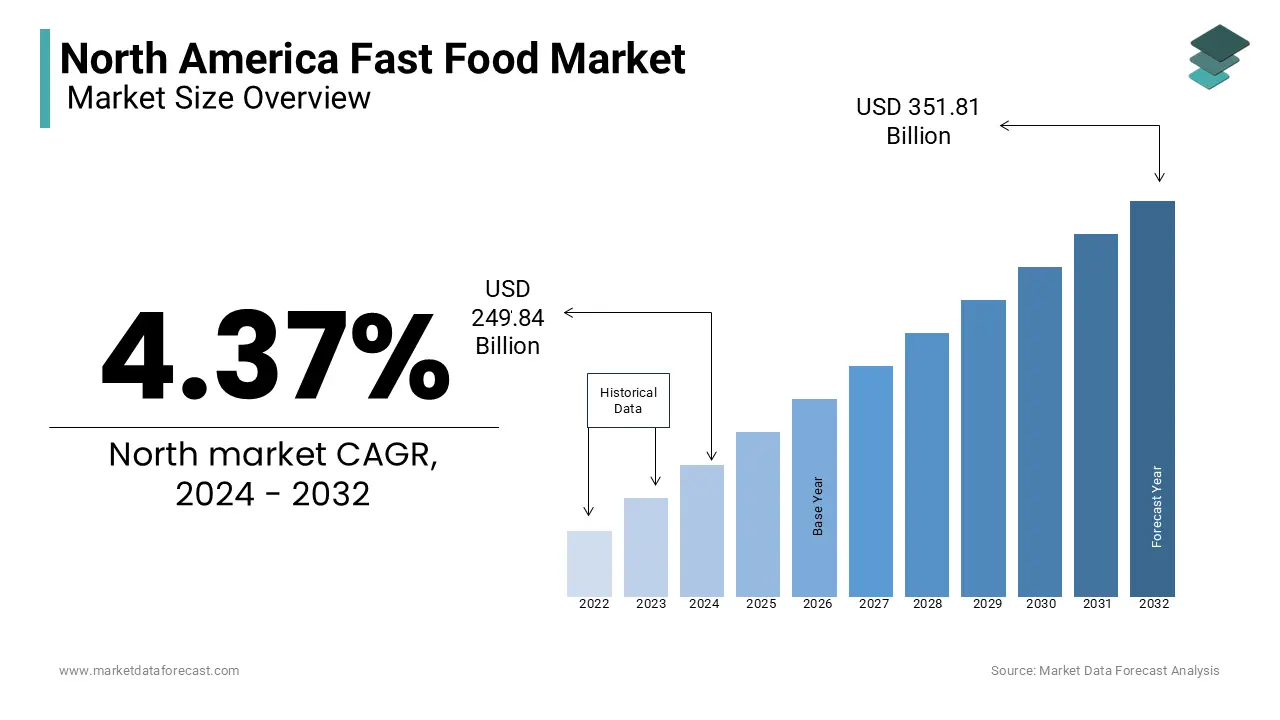
- Market Valuation: Valued at USD 260.76 billion (2025), estimated at USD 272.16 billion (2026), and projected to reach USD 383.20 billion by 2034, growing at a steady CAGR of 4.37% (2026–2034).
- Primary Growth Drivers: Deep lifestyle integration (>36% of U.S. adults consuming fast food daily, rising to 45% among adults aged 20–39), digital ordering expansion, labor automation, plant-based menu options, and relentless convenience demands (highlighted by 9,168 industrial robots ordered by North American companies in Q1 2023).
Key Market Segment Metrics (2026–2034)
| Category | Leading Segment (2025 Position) | Fastest-Growing Segment |
|---|---|---|
| By Food Type | Burgers and Sandwiches (dominated with 35.2% of total sales in 2025, supported by high consumer familiarity and average U.S. beef consumption of 57 pounds per capita annually) | Asian and Latin American Food (identified as the fastest-growing category at a projected 9.6% CAGR from 2026 to 2034) |
| By Distribution Channel | Quick Service Restaurants (QSRs) / Dine-in & Drive-thru (accounted for 54.1% of fast-food transactions in 2025) | Online Food Delivery (projected to grow at a rapid 12.4% CAGR through 2034 driven by mobile apps and third-party delivery infrastructure) |
| By Region / Country | United States (dominated with 84.3% of North American market revenue in 2025, supported by extensive fast-food chains and heavy urban/suburban foot traffic) | United States (primary growth engine driven by technological integration and digital loyalty platform expansion) |
Major Market Players & Market Structure
Market Structure: Highly competitive North American fast food landscape featuring 10 prominent market leaders—such as McDonald’s operating over 13,000 locations across the U.S. and Canada—competing on mobile app ordering, AI-driven personalization, kitchen automation, delivery logistics, menu diversification, plant-based items, customer loyalty programs, and sustainable operations.
Key Companies: Domino's Pizza, Burger King, KFC, Subway, Dunkin' Donuts, McDonald's, Hardee's, Pizza Hut, Firehouse Subs, and Auntie Anne's.
North America Fast Food Market Size
The North America Fast Food Market size was calculated to be USD 260.76 billion in 2025 and is anticipated to be worth USD 383.20 billion by 2034 from USD 272.16 billion in 2026, growing at a CAGR of 4.37% during the forecast period.
Fast Food refers to the sale of ready-to-eat meals from quick-service restaurants (QSRs), drive-thrus, delivery platforms, and limited-service outlets across the United States, Canada, and Mexico. Characterized by speed, affordability, and convenience, this sector has become deeply embedded in daily life, particularly in urban and suburban settings. According to the Centers for Disease Control and Prevention, more than 36% of adults in the United States consume fast food on any given day, with intake rising to 45% among individuals aged 20–39. The ubiquity of car culture further amplifies demand. These behavioral and infrastructural patterns underscore the entrenched role of fast food in North American lifestyles.
MARKET DRIVERS
The increasing prevalence of dual-income households and time-constrained lifestyles, which elevate demand for convenient meal solutions, is a primary driver of the North America Fast Food Market. Fast food chains have responded with extended operating hours, mobile ordering, and rapid drive-thru service. This alignment with modern time poverty ensures sustained consumer dependency on quick-service dining.
The integration of digital platforms and delivery ecosystems, which have expanded access and purchasing frequency, is another critical driver. The adoption of AI-driven personalization, such as Taco Bell’s predictive ordering algorithm, has increased average order value. Mobile apps offering loyalty rewards, geofenced promotions, and subscription models further entrench consumer engagement, transforming fast food into a digitally mediated habit.
MARKET RESTRAINTS
The rising public health burden linked to frequent consumption of high-calorie, nutrient-poor meals is one major restraint in the North America Fast Food Market. According to the Centers for Disease Control and Prevention, a high percentage of U.S. adults were obese, with fast food intake strongly correlated with weight gain and metabolic disorders. These health implications have prompted regulatory scrutiny, including menu labeling laws in several U.S. states and proposed taxes on sugar-sweetened beverages in Ontario, discouraging habitual consumption and pressuring chains to reformulate products.
The growing consumer skepticism toward labor practices and ethical sourcing within the fast food industry is another significant restraint. Like, more than half of fast food workers in the U.S. rely on public assistance programs due to low wages. In the USA, only a small share of fast food employees receive employer-sponsored health insurance, undermining brand reputation. These social accountability pressures constrain growth by eroding consumer trust and increasing operational costs.
MARKET OPPORTUNITIES
The expansion of plant-based and alternative protein offerings, which cater to evolving dietary preferences and sustainability concerns, is a significant opportunity. Fast food chains have capitalized on this trend. As innovation reduces cost and improves taste, alternative proteins are transitioning from novelty to mainstream menu staples.
The adoption of automation and artificial intelligence to enhance operational efficiency and reduce labor dependency is another transformative opportunity. Also, 9,168 industrial robots were ordered by North American companies in Q1 2023, with Hospitality robots seeing an increase globally. White Castle partnered with Miso Robotics to install Flippy the robot in 100 locations. With workforce shortages persisting, automation offers a scalable solution to sustain service levels amid rising wage pressures.
MARKET CHALLENGES
The escalating cost of ingredients and supply chain volatility, which compresses profit margins and forces price adjustments, is a major challenge facing the North America Fast Food Market. In Mexico, corn price fluctuations, due to climate stress and export demand. These pressures have led to widespread menu price inflation. Consumers are increasingly sensitive to value, threatening premiumization strategies.
The intensifying competition from fast-casual and meal-kit providers, which offer higher perceived quality at competitive price points, is another pressing challenge. Meal-kit services saw large number of North American subscribers. This shift reflects a broader consumer reevaluation of convenience versus nutrition, forcing traditional fast food chains to innovate rapidly or risk losing relevance among health- and quality-conscious demographics.
REPORT COVERAGE
| REPORT METRIC | DETAILS |
| Market Size Available | 2025 to 2034 |
| Base Year | 2025 |
| Forecast Period | 2026 to 2034 |
| CAGR | 4.37% |
| Segments Covered | By Type, Distribution Platform And Region |
| Various Analyses Covered | Global, Regional & Country Level Analysis; Segment-Level Analysis; DROC, PESTLE Analysis; Porter’s Five Forces Analysis; Competitive Landscape; Analyst Overview of Investment Opportunities |
| Regions Covered | Us, Canada, and the Rest of North America |
| Market Leaders Profiled | Domino's Pizza, Burger King, KFC, Subway, Dunkin' Donuts, McDonald's, Hardee's, Pizza Hut, Firehouse Subs, and Auntie Anne's |
SEGMENTAL ANALYSIS
By Type Insights

The Burger/Sandwich segment held the largest share of the North America Fast Food Market at 35.2% of total sales in 2025. This dominance is rooted in deep cultural embedding and widespread consumer familiarity with hamburger-centric dining. According to the U.S. Department of Agriculture, beef remains the most consumed protein in the United States, with an average per capita intake of 57 pounds annually, providing a strong foundation for burger demand. McDonald’s alone operates thousands of locations in the U.S., serving millions of burgers daily. The format’s adaptability, spanning value menus, premium offerings, and plant-based alternatives like the McPlant, enables broad demographic reach. A further key driver is the integration of burgers into national food culture and marketing ecosystems. In Canada, Tim Hortons and Harvey’s have localized the sandwich model with regional variations like the “Maple Burger,” tapping into national identity. With drive-thru optimization, limited-time innovations (e.g., Travis Scott Meal), and strategic bundling, the burger segment maintains its centrality in the fast food hierarchy through both nostalgia and continuous reinvention.
The Asian/Latin American Food segment is the fastest-growing category and is projected to expand at a CAGR of 9.6% from 2026 to 2034. This growth is fueled by demographic shifts and rising consumer appetite for bold, diverse flavors. According to the U.S. Census Bureau, Hispanic and Asian populations are the fastest-growing ethnic groups, with the Hispanic population expected to reach about 128.8 million by 2060. This has catalyzed demand for authentic, regionally inspired offerings. In Canada, chains have expanded rapidly in multicultural cities such as Toronto and Vancouver. A different pivotal factor is the perception of freshness, customization, and perceived healthfulness associated with these cuisines. With chains leveraging cultural authenticity, digital engagement, and ingredient transparency, Asian and Latin American formats are redefining fast food beyond the American classic.
By Distribution Platform Insights
The Quick Service Restaurant (QSR) segment commanded the the distribution platform category by accounting for 54.1% of total fast food transactions in 2025. This lead position is because of the extensive physical footprint of branded outlets and their integration into daily commuting and urban infrastructure. Like, a vast number of fast food establishments operate across the United States, with the majority classified as QSRs offering drive-thru, walk-in, and curbside service. An additional driving force is operational standardization and brand consistency, which build consumer trust. The Food and Drug Administration confirms that QSRs adhere to federally regulated food safety protocols, including HACCP compliance, reducing contamination risks. Also, QSRs generate a significant portion of industry revenue through repeat customers, supported by loyalty programs and app-based rewards. With optimized kitchen workflows, digital menu boards, and real-time inventory systems, QSRs deliver speed, predictability, and scalability, cornerstones of sustained consumer reliance in a time-pressed society.
The Online Food Delivery segment is growing at the fastest rate and is projected to achieve a CAGR of 12.4% between 2026 and 2034. This surge is driven by digital adoption, urbanization, and changing consumer expectations for convenience. Another key driver is the expansion of virtual brands and cloud kitchens, which allow chains to operate delivery-only concepts at lower costs. With Gen Z and millennials accounting for a major portion of frequent delivery users, the model aligns with digital-native behaviors. As last-mile logistics improve and subscription models enhance affordability, online delivery is transforming from supplemental to central in the fast food ecosystem.
REGIONAL ANALYSIS
The United States dominated the North America Fast Food Market by capturing a 84.3% of regional revenue in 2025. The country’s lead position is anchored in its vast consumer base, deeply ingrained car-centric culture, and the global headquarters of most major QSR chains. Also, the U.S. has the highest density of quick-service restaurants per capita in North America.
Canada is functioning as a mature yet evolving fast food landscape shaped by multiculturalism and regulatory caution. Canadians spend a notable amount on fast food, with urban centers like Toronto and Vancouver driving premiumization trends. The country has seen strong growth in plant-based and globally inspired menus. However, public health regulations are tightening, Quebec has introduced restrictions on children’s fast food marketing. Despite smaller scale, Canada serves as a testing ground for sustainable and health-conscious innovations.
LEADING PLAYERS IN THE MARKET
McDonald’s Corporation remains the most influential player in the North America Fast Food Market, operating over 13,000 locations across the United States and Canada and serving as a benchmark for operational efficiency and brand consistency. The company has reinforced its dominance through continuous innovation in digital infrastructure, including the widespread rollout of mobile ordering, self-service kiosks, and AI-driven drive-thru optimization. The company also invested in automation, piloting AI voice ordering with Google’s Duplex at select locations, reducing service time by 15 seconds per transaction. McDonald’s sustainability initiatives, such as transitioning to fiber-based packaging and committing to net-zero emissions by 2050, align with evolving consumer expectations and regulatory trends.
Yum! Brands, Inc., the parent company of KFC, Taco Bell, and Pizza Hut, exerts significant influence across multiple fast food segments, leveraging its diversified portfolio to capture varied consumer preferences. Taco Bell has emerged as a key innovator, introducing digital-only “Go Mobile” stores and leveraging data analytics to launch culturally resonant products like the Mexican Pizza, which saw a 200% sales surge after its 2022 relaunch. KFC’s partnership with Beyond Meat and its rollout of plant-based fried chicken in over 500 U.S. locations in 2023 reflect its strategic pivot toward alternative proteins. The company also expanded its delivery footprint through exclusive partnerships with DoorDash and Uber Eats. Its multi-brand strategy enables agile responses to shifting dietary trends and regional demand.
Chipotle Mexican Grill has redefined the fast-casual segment, blurring the lines between quick service and restaurant-quality dining while maintaining scalability. Known for its transparent sourcing and “Food With Integrity” ethos, Chipotle reported in 2023 that 90% of its beef, 100% of its pork, and all chicken were raised without antibiotics or added hormones, appealing to health- and sustainability-conscious consumers. The company operates over 3,200 North American locations, with a growing number of digital-only “Chipotlanes” dedicated to drive-thru and delivery, contributing to over 50% of total sales. Its loyalty program, with over 36 million members, drives repeat visits and personalization. By combining ethical sourcing, digital efficiency, and culinary differentiation, Chipotle has carved a unique position that challenges traditional fast food paradigms.
TOP STRATEGIES USED BY THE KEY MARKET PARTICIPANTS
Key players in the North America Fast Food Market are deploying strategies centered on digital transformation, menu innovation, labor optimization through automation, expansion of delivery and cloud kitchen models, and sustainability integration. Companies are investing heavily in mobile apps, AI-driven personalization, and loyalty programs to enhance customer retention. Menu diversification—especially in plant-based, global, and health-conscious offerings—responds to shifting consumer preferences. Automation technologies, including robotic kitchen assistants and voice-ordering systems, are being adopted to mitigate labor shortages and improve consistency. Delivery-only formats and virtual brands are reducing overhead while expanding geographic reach. Additionally, brands are prioritizing eco-friendly packaging, carbon footprint reduction, and ethical sourcing to align with regulatory demands and consumer values, ensuring long-term brand resilience.
KEY MARKET PLAYERS AND COMPETITION OVERVIEW
Major Players of the North America Fast Food Market include Domino's Pizza, Burger King, KFC, Subway, Dunkin' Donuts, McDonald's, Hardee's, Pizza Hut, Firehouse Subs, and Auntie Anne's
The competitive landscape of the North America Fast Food Market is marked by intense rivalry among global giants, regional chains, and emerging fast-casual players, all vying for consumer attention in a saturated yet evolving sector. Established QSRs like McDonald’s and Wendy’s compete on speed, value, and digital engagement, while chains such as Chipotle and Panera Bread challenge with perceived quality and transparency. The rise of delivery platforms and virtual brands has lowered entry barriers, enabling niche players to gain traction without physical storefronts. Labor costs, ingredient volatility, and public health scrutiny are reshaping operational models, pushing companies toward automation and sustainable practices. Consumer preferences are increasingly fragmented, with demand spanning affordability, health, convenience, and ethics. This dynamic environment rewards innovation, agility, and brand authenticity, making differentiation the key to sustained market relevance.
RECENT HAPPENINGS IN THE MARKET
- In January 2023, McDonald’s expanded its AI-powered drive-thru voice ordering system in partnership with Google, launching pilot programs across 100 U.S. locations to reduce wait times and improve order accuracy through natural language processing.
- In May 2023, Taco Bell introduced 200 digital-only “Go Mobile” stores across suburban and high-density urban areas, designed exclusively for drive-thru and app-based pickup, increasing delivery radius efficiency by 30%.
- In September 2023, Chipotle launched its “Chipotlane” concept in over 150 new locations, featuring dual-lane drive-thru setups optimized for digital orders, contributing to a 52% increase in digital sales compared to traditional outlets.
- In February 2025, KFC partnered with Beyond Meat to relaunch its plant-based fried chicken in 600 U.S. locations, supported by a national marketing campaign that increased foot traffic by 18% during the promotional period.
- In July 2025, Wendy’s deployed Miso Robotics’ Flippy AI assistant in 200 high-volume restaurants to automate fry station operations, reducing cooking errors by 27% and improving kitchen throughput during peak hours.
MARKET SEGMENTATION
This research report on the North America fast food market has been segmented and sub-segmented based on type, distribution channel and region.
By Type
- Burgers & Sandwiches
- Pizzas & Pasta
- Asian/Latin American Food
- Chicken/Seafood
By Distribution Channel
- Quick Service Restaurant (QSR)
- Street Vendors
- Food Delivery Services
- Online Food Delivery
By Region
- US
- Canada
- Mexico