- Product Description Description
- Table of Contents TOC
- List of Table & Figure LOT
- Get Free Sample PDF Sample PDF
Market Size, 2025
$31.20 BnMarket Estimate, 2026
$31.95 BnMarket Forecast, 2034
$38.62 BnCAGR, 2026–2034
2.40%North America Feed Premix Market Size, Growth, Trends & Forecast (2026–2034)
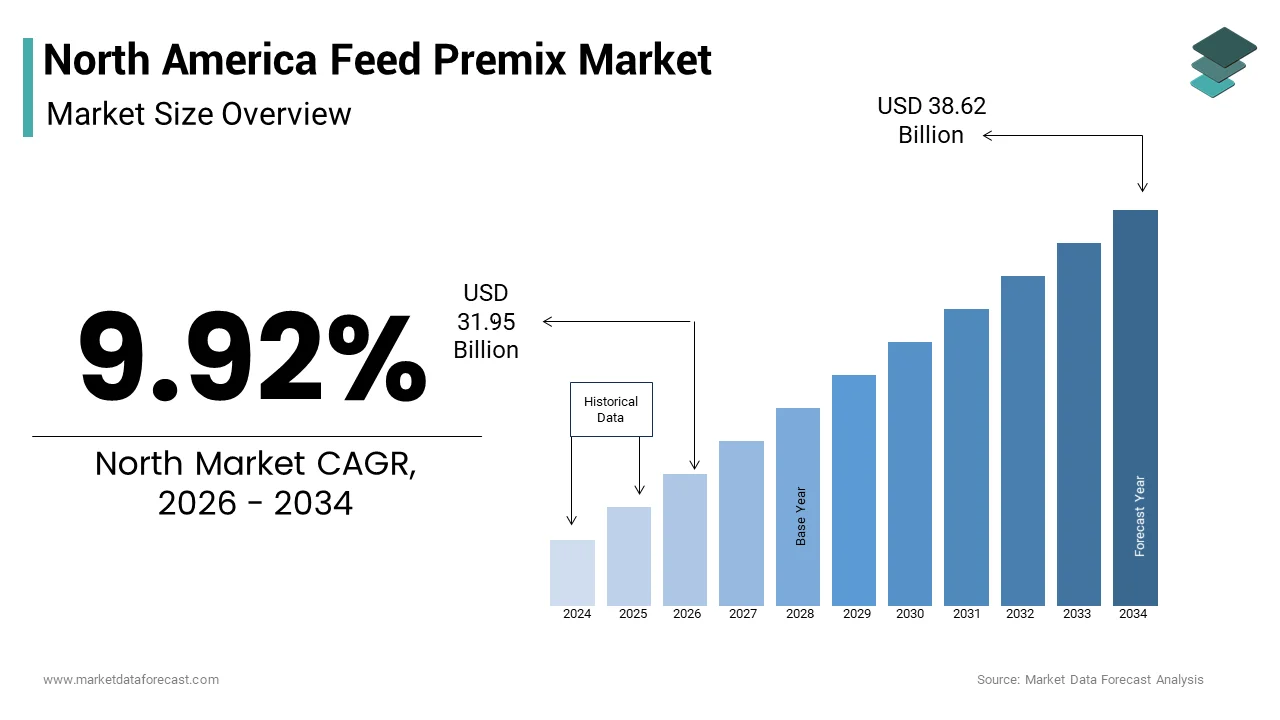
The North American feed premix market size was valued at USD 31.20 billion in 2025, stands at USD 31.95 billion in 2026, and is projected to reach USD 38.62 billion by 2034, registering a compound annual growth rate (CAGR) of 2.40% during the forecast period from 2026 to 2034. Propelled by the rising consumer demand for high-quality animal proteins, increased focus on sustainable livestock farming, precision nutrition technologies, and the shift toward organic and antibiotic-free farming practices, the North American market continues stable and resilient expansion.
Key Executive Metrics (At-a-Glance)
- 2025 Base Valuation: USD 31.20 Billion
- 2026 Current Valuation: USD 31.95 Billion
- 2034 Forecast Valuation: USD 38.62 Billion
- Compound Annual Growth Rate (CAGR): 2.40% (2026–2034)
- Dominant Ingredient Segment: Vitamins (holding ~35% market share as a core component for animal health, productivity, and fortified products)
- Fastest-Growing Ingredient Segment: Organic Acids (projected at an impressive CAGR of 8.2% through 2030, driven by gut health and natural alternatives to antibiotics)
- Dominant Livestock Segment: Poultry (holding nearly 40% market share backed by massive broiler production and consumer consumption)
- Fastest-Growing Livestock Segment: Aquatic Animals (projected at a high CAGR of 9.5% driven by sustainable aquaculture and demand for eco-friendly feed)
- Dominant Country Market: United States (commanding ~65% market share due to advanced agricultural infrastructure and large-scale industrial livestock farming)
Core Market Drivers
- Rising Demand for Animal Protein: Increasing consumption of poultry, beef, and pork requiring nutrient-enhanced diets to ensure optimal growth and lean meat quality.
- Sustainable Agriculture Mandates: Growing pressure from the EPA and FDA to reduce greenhouse gas emissions, minimize phosphorus and nitrogen runoff, and support antibiotic-free farming.
Primary Market Restraints & Challenges
- High Production & Customization Costs: Substantial R&D investments and expensive raw materials (such as chelated minerals) making bespoke formulations cost-prohibitive for smaller operations.
- Complex Regulatory Frameworks: Prolonged compliance timelines and rigorous safety standards mandated by agencies like the FDA and EPA.
North America Feed Premix Market Segmentation Breakdown
| Segment Category | Largest (Dominant) Sub-Segment | Fastest-Growing Sub-Segment |
|---|---|---|
| By Ingredient Type | Vitamins (~35% share in 2025 for overall immunity and productivity) | Organic Acids (8.2% CAGR through 2030 for gut health and natural preservation) |
| By Livestock | Poultry (nearly 40% share supported by massive broiler production) | Aquatic Animals (9.5% CAGR driven by sustainable aquaculture expansion) |
| By Country | United States (~65% share via advanced industrial agriculture and large herds) | Canada and Mexico (driven by modernizing farming and aquaculture growth) |
Major Industry Players Profiled
Key corporations shaping the North American feed premix market include Cargill, Incorporated, Koninklijke DSM N.V. (DSM), BASF SE, Nutreco N.V., Archer Daniels Midland Company (ADM), and InVivo Nutrition et Santé Animales.
 Download Free Sample Report
North America Feed Premix Market Size
The North American feed premix market size was valued at USD 31.20 billion in 2025 and is anticipated to reach USD 31.95 billion in 2026 to reach USD 38.62 billion by 2034, growing at a CAGR of 2.40% during the forecast period from 2026 to 2034.
Current Scenario Of The Global Feed Premix Market
Feed premix refers to a concentrated blend of essential nutrients, including vitamins, minerals, amino acids, and other additives, designed to enhance the nutritional profile of animal feed. In North America, the feed premix market plays a pivotal role in modern livestock farming by enabling precise nutrient delivery tailored to specific animal species and growth stages. According to the United States Department of Agriculture, livestock production contributes approximately 40% of the total agricultural output in North America, underscoring the critical need for high-quality feed solutions. The growing emphasis on precision nutrition has further amplified the demand for feed premixes, which ensure balanced diets while addressing deficiencies that may arise from conventional feeding practices.
The use of feed premix aligns with broader trends such as sustainable agriculture and improved animal health. As per the Environmental Protection Agency, livestock operations account for nearly 10% of greenhouse gas emissions in the United States, prompting farmers to adopt practices that minimize environmental impact. Feed premixes contribute to this goal by optimizing nutrient utilization and reducing waste excretion. Additionally, the Food and Drug Administration emphasizes the importance of feed premixes in supporting antibiotic-free farming practices, promoting healthier livestock without compromising productivity. These factors collectively position feed premix as a cornerstone of advanced animal nutrition strategies in North America.
MARKET DRIVERS
Rising Demand for High-Quality Animal Protein
The increasing consumer preference for high-quality animal protein is a key driver propelling the North American feed premix market. As per the National Chicken Council, poultry remains the most consumed meat in the United States, with annual per capita consumption exceeding 98 pounds. This trend extends to other livestock sectors, including beef and pork, where consumers seek leaner, healthier, and sustainably produced options. To meet these expectations, livestock producers rely on feed premixes to enhance the nutritional value of animal diets, ensuring optimal growth rates and meat quality. For instance, vitamin and mineral premixes are crucial for maintaining muscle development and reducing fat content in livestock, aligning with consumer preferences for premium cuts. Furthermore, the University of California, Davis highlights that feed premixes improve the bioavailability of essential nutrients, reducing the risk of deficiencies that could compromise animal health or productivity. By addressing these demands, feed premix manufacturers play a vital role in bridging the gap between consumer expectations and livestock production capabilities.
Emphasis on Sustainable Livestock Farming
Sustainability has become a cornerstone of modern agriculture, driving the adoption of feed premixes in North America. According to the Environmental Protection Agency, agriculture accounts for 10% of greenhouse gas emissions in the United States, with livestock contributing significantly to methane and nitrous oxide emissions. Feed premixes address these challenges by improving feed efficiency and reducing waste excretion. For example, trace mineral premixes optimize nutrient absorption, minimizing the environmental impact of excess phosphorus and nitrogen runoff into water bodies. Additionally, the American Veterinary Medical Association underscores the role of feed premixes in supporting antibiotic-free farming practices, which align with regulatory mandates and consumer demand for eco-friendly food systems. By enhancing nutrient utilization and reducing dependency on synthetic additives, feed premixes enable farmers to adopt more sustainable practices without sacrificing productivity, thereby reinforcing their importance in the agricultural ecosystem.
MARKET RESTRAINTS
High Costs Associated with Customization and Production
One of the primary obstacles hindering the growth of the North American feed premix market is the substantial cost associated with customization and production. Developing bespoke premix formulations tailored to specific animal species, growth stages, or regional dietary requirements involves extensive research, testing, and quality assurance processes. According to the Biotechnology Innovation Organization, the cost of developing a single customized feed premix formulation can exceed $500,000, making it financially unfeasible for smaller companies. Moreover, the reliance on high-quality raw materials, such as chelated minerals and synthetic vitamins, further escalates production expenses. For instance, Cornell University notes that the cost of sourcing premium-grade trace minerals can increase overall premix costs by up to 30%. These financial barriers limit accessibility for small-scale farmers, particularly in rural areas, where budget constraints often dictate purchasing decisions. Consequently, the high upfront investment required for feed premix development stifles innovation and market penetration, particularly among price-sensitive segments.
Regulatory Compliance Challenges
Navigating the complex web of regulatory frameworks poses another significant restraint for the feed premix market in North America. Each premix formulation must comply with stringent safety and efficacy standards set by agencies such as the Environmental Protection Agency (EPA) and the Food and Drug Administration (FDA). According to the Federal Register, obtaining regulatory approval for a new premix product can take up to five years, depending on the complexity of the application process. This prolonged timeline delays market entry and increases uncertainty for manufacturers. Furthermore, discrepancies in state-level regulations add another layer of complexity, requiring companies to tailor their compliance strategies to multiple jurisdictions. For example, California’s Proposition 65 mandates strict labeling requirements for substances deemed harmful, potentially affecting premix marketing efforts. These regulatory hurdles not only escalate operational costs but also stifle innovation, as smaller firms may lack the resources to navigate such intricate processes effectively.
MARKET OPPORTUNITIES
Expansion into Organic Livestock Farming
The surge in organic livestock farming presents a lucrative opportunity for the North American feed premix market. According to the Organic Trade Association, sales of organic livestock products in North America have grown by 12% annually over the past five years, reflecting rising consumer demand for chemical-free and sustainably produced food. Feed premixes play a vital role in supporting organic farming practices by providing essential nutrients without relying on synthetic additives or genetically modified organisms (GMOs). For instance, organic-certified premixes containing natural sources of vitamins and minerals help maintain balanced nutrition for animals fed diets rich in roughage. Additionally, the absence of antibiotics in organic farming necessitates alternative solutions to support immune function and overall well-being, which premixes can address through tailored formulations. By targeting this burgeoning sector, manufacturers can diversify their customer base and capitalize on the projected expansion of organic livestock farming, positioning themselves as enablers of sustainable and ethical agricultural practices.
Growing Focus on Precision Nutrition Technologies
Advancements in precision nutrition technologies offer another promising avenue for growth in the North American feed premix market. The integration of data analytics and artificial intelligence into livestock farming enables producers to customize feed premix formulations based on real-time insights into animal health and performance. According to Purdue University, precision nutrition can improve feed conversion ratios by up to 15%, significantly enhancing farm profitability. For example, feed premixes fortified with amino acids and enzymes can be fine-tuned to match the metabolic needs of individual animals or groups, ensuring optimal nutrient delivery. Additionally, the adoption of digital platforms for monitoring nutrient intake and animal health allows farmers to make informed decisions about premix usage, reducing waste and improving outcomes. By aligning with the precision agriculture trend, feed premix manufacturers can differentiate themselves in a competitive market while addressing the growing demand for efficient and data-driven farming solutions.
MARKET CHALLENGES
Limited Awareness Among Farmers
A significant challenge facing the North American feed premix market is the limited awareness and understanding among farmers regarding the benefits and applications of premixes. Despite their proven efficacy, many livestock producers remain unfamiliar with how premixes work or their potential to improve farm profitability. A survey conducted by the National Farmers Union revealed that nearly 40% of respondents had limited knowledge about feed additives, including premixes, and their role in animal nutrition. This knowledge gap is exacerbated by insufficient outreach programs and educational initiatives targeting grassroots-level farmers. Additionally, misinformation or skepticism about premix effectiveness persists in some regions, deterring adoption. The absence of clear guidelines or standardized protocols for premix use further complicates matters, leaving farmers uncertain about optimal dosages or application methods. Without adequate education and training, even those willing to invest in premix technology may struggle to implement it effectively, thereby impeding market expansion across North America.
Supply Chain Vulnerabilities
Supply chain disruptions represent another pressing challenge for the feed premix market in North America. The production of premixes relies heavily on raw materials like vitamins, minerals, and amino acids, which are often sourced globally. Disruptions caused by geopolitical tensions, pandemics, or natural disasters can severely impact availability and pricing. For example, during the COVID-19 pandemic, the Council of Supply Chain Management Professionals reported a 30% increase in shipping costs and delays exceeding six weeks for critical imports. Such disruptions directly affect premix manufacturers’ ability to maintain consistent supply levels, leading to shortages and price hikes. Additionally, the reliance on specific raw materials makes the industry susceptible to contamination risks, as highlighted by a case study from Purdue University detailing a 2021 outbreak that halted premix production at a major facility. To mitigate these risks, companies must invest in diversified sourcing strategies and robust inventory management systems, though these measures come at a considerable expense, further straining profitability.
REPORT COVERAGE
| REPORT METRIC | DETAILS |
| Market Size Available | 2025 to 2034 |
| Base Year | 2025 |
| Forecast Period | 2026 to 2034 |
| CAGR | 2.40% |
| Segments Covered | By Ingredients, Livestock and Country |
| Various Analyses Covered | Global, Regional and Country Level Analysis, Segment-Level Analysis; DROC, PESTLE Analysis; Porter’s Five Forces Analysis; Competitive Landscape; Analyst Overview of Investment Opportunities. |
| Regions Covered | US, Canada and the Rest of North America |
| Market Leaders Profiled | Cargill, Koninklijke DSM N.V, Nutreco N.V, Archer Daniels Midland Company, InVivo Nutrition et Sante Animales. |
SEGMENTAL ANALYSIS
By Ingredient Type Insights
Vitamins dominate the North American feed premix market, accounting for approximately 35% of the total market share, as per data from the United States Department of Agriculture (USDA). This segment's prominence is driven by its critical role in supporting animal health and productivity. One of the primary factors fueling this dominance is the growing awareness of vitamin deficiencies among livestock, which can lead to reduced growth rates and compromised immune systems. According to Cornell University research, vitamin supplementation in poultry diets improves egg production by up to 20%, underscoring its importance in high-yield farming practices. Another significant driver is the increasing consumer demand for fortified animal products, such as omega-3 enriched eggs and vitamin-rich dairy. The National Dairy Council highlights that milk fortified with vitamins like A and D commands a premium price, encouraging farmers to invest in vitamin-rich feed premixes. Additionally, the shift toward antibiotic-free farming has amplified the role of vitamins in maintaining livestock health. As per the American Veterinary Medical Association, vitamin-based premixes reduce the incidence of metabolic disorders in ruminants by up to 25%. These factors collectively ensure vitamins remain the backbone of the feed premix industry in North America.
Organic acids represent the fastest-growing segment in the North America feed premix market, with a projected compound annual growth rate (CAGR) of 8.2% through 2030, according to the Environmental Protection Agency (EPA). This rapid expansion is attributed to the growing emphasis on gut health and disease prevention in livestock farming. A major factor driving this growth is the ban on antibiotics as growth promoters, which has created a surge in demand for natural alternatives like organic acids. Purdue University reports that organic acids improve gut microbial balance, reducing pathogenic bacteria by up to 40% in poultry and swine. Additionally, organic acids play a crucial role in preserving feed quality by inhibiting mold and bacterial growth. The USDA estimates that incorporating organic acids into feed premixes extends shelf life by up to 6 months, addressing concerns about feed spoilage and waste. Another contributing factor is the rising adoption of precision nutrition strategies, which leverage organic acids to optimize nutrient absorption and improve feed efficiency. With these dynamics at play, organic acids are poised to become a cornerstone of innovation within the feed premix sector.
By Livestock Insights
Poultry holds the largest share of the North American feed premix market, capturing nearly 40% of the total market, as confirmed by the USDA. The segment's leadership stems from the region's robust poultry production capabilities, which supply over 9 billion broilers annually to domestic and international markets. One of the key drivers of this dominance is the critical role of feed premixes in enhancing poultry growth rates and meat quality. According to the University of Georgia, supplementing poultry diets with premixes containing essential vitamins and minerals improves feed conversion ratios by up to 15%, directly enhancing profitability for producers. Another significant factor is the growing consumer demand for leaner, healthier protein sources. The National Chicken Council notes that poultry accounts for nearly 40% of all meat consumed in the United States, underscoring its economic importance. Furthermore, the shift toward antibiotic-free poultry farming has amplified the role of premixes in maintaining gut health and preventing diseases. Data from the American Veterinary Medical Association indicates that premix-based solutions have reduced mortality rates in poultry farms by up to 10%. These trends collectively reinforce poultry's central position in the feed premix market.
Aquatic animals are the fastest-growing segment in the North America feed premix market, with a CAGR of 9.5%, as per the National Oceanic and Atmospheric Administration (NOAA). This surge is fueled by the rising demand for seafood and the need for sustainable aquaculture practices. A key driver is the inefficiency of traditional fishmeal-based diets, which are both costly and environmentally unsustainable. Oregon State University research shows that premixes containing amino acids and enzymes can replace up to 30% of fishmeal without compromising growth performance, offering a viable alternative for producers. Additionally, premixes enhance nutrient absorption, reducing waste excretion by up to 25%. This aligns with EPA regulations aimed at minimizing aquaculture's ecological footprint. Another critical factor is the expansion of inland aquaculture systems, particularly for species like salmon and tilapia. NOAA data shows that inland aquaculture production grew by 18% between 2018 and 2022, creating new opportunities for premix manufacturers. With aquaculture poised to become a cornerstone of sustainable food systems, its premix requirements are set to grow exponentially.
COUNTRY ANALYSIS
Top Countries in the Market
United Kingdom Feed Premix Market Analysis
The United States leads the North American feed premix market, commanding a market share of approximately 65%, as reported by the USDA. Its dominance is rooted in the country's advanced agricultural infrastructure and innovative livestock practices. One of the primary drivers is the nation's focus on sustainability. According to the EPA, U.S. agriculture contributes nearly 10% of the country's greenhouse gas emissions, prompting farmers to adopt premix-based solutions that reduce nutrient runoff and improve feed efficiency. Another significant factor is the large-scale industrialization of livestock farming. The American Farm Bureau Federation states that the U.S. produces over 9 billion chickens, 32 million cattle, and 120 million hogs annually, creating immense demand for cost-effective feed additives. Furthermore, government incentives for organic farming have spurred premix adoption. The Organic Trade Association notes that organic livestock production in the U.S. grew by 12% annually over the past five years, with premixes playing a critical role in meeting certification standards. These dynamics ensure the U.S. remains at the forefront of the feed premix market.
Canada Feed Premix Market Analysis
Canada ranks second in the North American feed premix market, holding a market share of 20%, as per Statistics Canada. The country's strong emphasis on sustainable agriculture drives premix adoption, particularly in regions like Alberta and Saskatchewan. According to the Canadian Food Inspection Agency, premix usage in livestock feed has increased by 25% over the past decade, primarily due to its ability to reduce phosphorus excretion and improve nutrient utilization. Another key factor is the rise of aquaculture in British Columbia and Nova Scotia. Fisheries and Oceans Canada reports that aquaculture production in these provinces grew by 15% between 2017 and 2022, creating new demand for premix-based aquafeed solutions. Additionally, Canada's cold climate necessitates high-energy diets for livestock, which premixes help optimize. The University of Guelph highlights that premix supplementation in cattle diets has improved feed efficiency by up to 10% in northern regions. These factors position Canada as a vital player in the regional feed premix market.
Mexico Feed Premix Market Analysis
Mexico accounts for 10% of the North American feed premix market, driven by its rapidly expanding livestock sector, according to the Mexican Ministry of Agriculture. The country's poultry industry, in particular, has seen remarkable growth, with chicken production increasing by 20% over the past five years. This surge creates a strong demand for premixes to enhance feed efficiency and animal health. Another significant factor is the government's push for modernized farming practices. The National Institute of Forestry, Agriculture, and Livestock Research emphasizes that premix adoption has reduced feed costs for small-scale farmers by up to 15%, improving profitability. Additionally, Mexico's proximity to the U.S. facilitates access to advanced premix technologies, fostering innovation. As per the Inter-American Development Bank, cross-border collaborations have accelerated premix adoption in Mexican livestock operations, ensuring steady market growth.
Brazil Feed Premix Market Analysis
Brazil, though geographically outside North America, is a rising player in the feed premix market due to its massive agricultural output. According to the Brazilian Agricultural Research Corporation, the country is the world's largest exporter of poultry and beef, driving premix adoption to meet international quality standards. One key driver is the focus on reducing feed costs. The Brazilian Feed Industry Association reports that premix usage has cut feed expenses by up to 12%, benefiting large-scale producers. Another factor is the expansion of sustainable farming practices. The Brazilian Ministry of Environment highlights that premix-based solutions have reduced phosphorus runoff by 30%, aligning with global environmental goals. These initiatives position Brazil as a strategic contributor to the broader feed premix ecosystem.
Other emerging markets in North America, including Caribbean nations and Central American countries, collectively hold a 5% market share, as noted by the Food and Agriculture Organization. These regions are characterized by small-scale livestock farming, where premix adoption is gradually increasing. According to the Caribbean Agricultural Research and Development Institute, premix usage has improved feed efficiency by up to 20% in poultry and swine operations, boosting farm incomes. Additionally, partnerships with international organizations have facilitated technology transfer, enabling wider premix adoption. For instance, the World Bank has funded initiatives to introduce premix-based solutions in Haiti and Jamaica, promoting sustainable livestock practices. While these markets are nascent, their potential for growth makes them noteworthy contributors to the regional feed premix landscape.
COMPETITIVE LANDSCAPE
The North American feed premix market is highly competitive, characterized by the presence of established multinational corporations and niche players specializing in innovative premix technologies. Leading companies leverage their extensive R&D capabilities and global networks to maintain dominance, while smaller firms focus on innovation and targeted solutions to carve out their niches. The competitive landscape is shaped by a strong emphasis on sustainability, as companies strive to meet regulatory requirements and consumer preferences for eco-friendly practices. Differentiation is achieved through product quality, customization, and customer support, with firms investing heavily in educational initiatives to promote premix adoption. Strategic mergers, acquisitions, and partnerships further intensify competition, enabling companies to consolidate their positions and expand their reach. As the market evolves, participants must balance innovation with affordability to stay ahead, creating a dynamic environment marked by continuous advancements and shifting market dynamics.
KEY MARKET PLAYERS
A few of the market players that are dominating the North America feed premix market are
- Cargill
- Koninklijke DSM N.V
- BASF SE
- Nutreco N.V
- Archer Daniels Midland Company
- InVivo Nutrition et Sante Animales
- DSM
- Nutreco
Top Players In the Market
- Cargill is a global leader in the feed premix market, renowned for its innovative solutions tailored to meet the nutritional needs of diverse livestock species. The company’s commitment to sustainability and precision nutrition has positioned it as a trusted partner for farmers seeking high-quality premixes. By leveraging advanced research and development capabilities, Cargill develops formulations that address specific challenges such as nutrient deficiencies and feed efficiency. Its strong distribution network and customer-centric approach enable widespread adoption of its products, contributing significantly to the global feed premix ecosystem.
- ADM is a key player in the feed premix market, offering a comprehensive range of products designed to enhance animal health and productivity. The company focuses on delivering customized premix solutions that cater to regional dietary requirements and farming practices. ADM’s emphasis on sustainability aligns with regulatory mandates and consumer preferences for eco-friendly agricultural practices. Through strategic collaborations with farmers and industry stakeholders, ADM ensures its premixes meet evolving market demands while promoting efficient resource utilization globally.
- BASF SE stands out for its cutting-edge innovations in the feed premix sector, driven by its expertise in biotechnology and chemistry. The company prioritizes developing premixes that optimize nutrient delivery and support antibiotic-free farming practices. BASF’s focus on education and technical support helps bridge knowledge gaps among farmers, fostering trust and long-term relationships. By addressing critical challenges such as environmental impact and animal health, BASF continues to play a pivotal role in advancing feed premix technologies on a global scale.
Top Strategies Used By Key Market Participants
Strategic Partnerships and Collaborations
Key players in the North America feed premix market prioritize partnerships with agricultural organizations, universities, and research institutions to drive innovation. These collaborations facilitate the development of advanced premix formulations tailored to specific livestock species and regional farming practices. By pooling resources and expertise, companies can address complex challenges such as improving feed efficiency and reducing environmental impact. Such alliances also enhance credibility and foster trust among farmers, accelerating the adoption of premix-based technologies.
Expansion of Product Portfolios
To cater to diverse customer needs, leading firms are consistently expanding their product portfolios by introducing novel premix solutions. This strategy involves developing specialized formulations for emerging segments like aquaculture and organic livestock farming. By diversifying their offerings, companies can tap into new revenue streams and strengthen their market presence. Additionally, these innovations help differentiate brands in a competitive landscape, ensuring sustained growth and relevance in the evolving agricultural sector.
Focus on Education and Awareness Campaigns
Educating farmers about the benefits of feed premixes is a critical strategy adopted by market leaders. Companies invest in workshops, training programs, and digital platforms to disseminate knowledge about premix applications and their role in sustainable farming. This approach not only addresses knowledge gaps but also builds long-term relationships with customers. By positioning themselves as thought leaders, companies enhance brand loyalty and ensure higher adoption rates of premix-based solutions across North America.
RECENT MARKET NEWS
- In March 2024, Cargill, Incorporated launched a new line of organic-certified feed premixes specifically designed for dairy cattle. This initiative aimed to support the growing demand for organic milk production while enhancing farm profitability.
- In June 2023, Archer Daniels Midland Company (ADM) partnered with a major poultry producer in the United States to co-develop customized premix formulations for antibiotic-free farming. This collaboration helped ADM demonstrate the efficacy of its products and build trust among key stakeholders.
- In January 2024, BASF SE acquired a small biotech firm specializing in enzyme-enhanced premix technologies. This acquisition expanded BASF’s capabilities in developing advanced formulations that improve nutrient absorption and feed efficiency.
- In September 2023, Cargill initiated a farmer outreach program across North America to educate livestock producers about the role of premixes in reducing environmental impact. This initiative increased awareness and adoption of Cargill’s sustainable premix solutions.
- In November 2023, ADM introduced an online platform offering personalized premix recommendations based on farm-specific data. This digital tool improved customer engagement and streamlined the decision-making process for farmers, strengthening ADM’s market position.
MARKET SEGMENTATION
This research report on the North American feed premix market has been segmented and sub-segmented into the following categories.
By Ingredient Type
- Vitamins
- Minerals
- Amino acids
- Antibiotics
- Preservatives
- organic acids
- antioxidants
- enzyme
- pigments
- flavors
By Livestock
- Poultry
- Ruminants
- Swine
- Aquatic animals
- pet animals
- birds
- reptiles
By Country
- The U.S.
- Canada
- Rest of North America