- Product Description Description
- Table of Contents TOC
- List of Table & Figure LOT
- Get Free Sample PDF Sample PDF
Market Size, 2025
$30.90 BnMarket Estimate, 2026
$32.82 BnMarket Forecast, 2034
$53.10 BnCAGR, 2026–2034
6.2%Executive Summary: Global Feed Premix Market
- Market Scope: Comprehensive global feed premix market analysis covering ingredient types, livestock categories, physical forms, regional leadership frameworks, key growth drivers, regulatory trends, and competitive landscape.
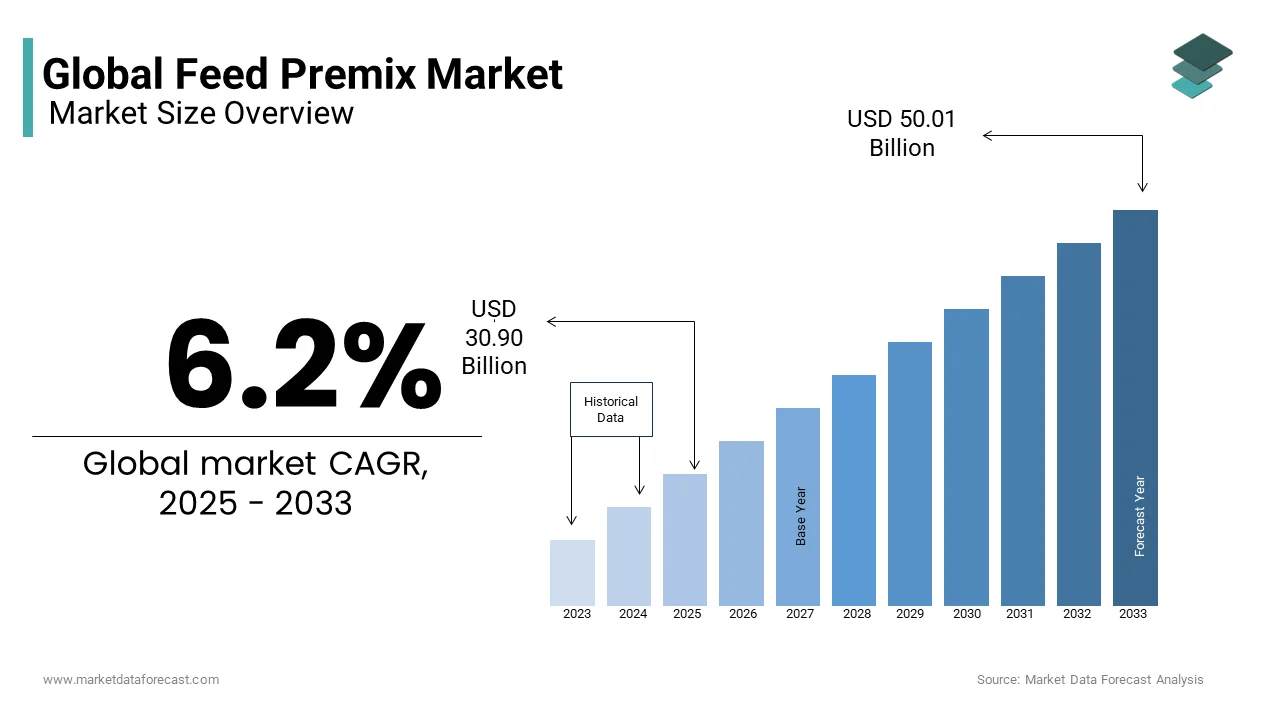
- Market Valuation: Valued at USD 30.90 billion (2025), estimated at USD 32.82 billion (2026), and projected to reach USD 53.10 billion by 2034, registering a steady CAGR of 6.2% (2026–2034).
- Primary Growth Drivers: Increasing demand for high-quality animal protein, expanding commercial livestock farming, and growing adoption of nutritionally balanced feed additives. Notable trends include uniform nutrient distribution, immunity enhancement, and modernized feed formulation technologies.
Key Market Segment Metrics (2026–2034)
| Category | Leading Segment (2025 Position) | Fastest-Growing Segment |
|---|---|---|
| By Ingredient Type, Livestock & Form | Amino Acids segment (largest share for protein synthesis), Poultry segment, and Dry form segment (longer shelf life and storage ease) | Customized precision vitamin and mineral premix formulations |
| By Region & Geography | North America (accounted for the largest market share in 2025) | Asia-Pacific (fastest growth via expanding livestock populations and commercial farming in China, India, and Japan) |
Major Market Players & Market Structure
Market Structure: Highly competitive global animal nutrition and feed technology landscape featuring major international enterprises competing through nutritional innovation, precision feed formulations, product quality enhancements, and strategic capacity expansion.
Key Companies: Koninklijke DSM N.V., Nutreco N.V., Cargill, Archer Daniels Midland Company (ADM), BEC Feed Solutions, DLG Group, Charoen Pokphand Foods PCL, Land O’Lakes, AB Agri Ltd., and Phibro Animal Health Corporation.
Global Feed Premix Market Size
The global feed premix market was valued at USD 30.90 billion in 2025 and is anticipated to reach USD 32.82 billion in 2026 to reach USD 53.10 billion by 2034, growing at a CAGR of 6.2% during the forecast period from 2026 to 2034.
Current Scenario of The Global Feed Premix Market
Feed premix, also known as complex premix, trace mineral premix, and vitamin premix feed, is a type of feed additive made up of two or more types of nutritional feed additives blended with a carrier or diluents in a certain proportion. The feed premixes consist of vitamins, minerals, amino acids, antibiotics, and antioxidants and are consumed by livestock such as poultry, swine, aqua animals, equine, and pets. Feed Premix enables more precise mixing and distribution of these additives throughout the feed, ensuring adequate homogeneity of the feed additives in the finished product. The feed premixes help in improving the immunity of the animals. For instance, amino acids play a vital role in building protein blocks in animals' bodies and also enhancing fertility in animals. Hence, the addition of such nutritional additives in the feed will lead to an increase in the demand for feed premixes in the forecast period between 2023 and 2028.
MARKET DRIVERS
The growing demand and consumption of livestock-based products such as dairy and dairy-based meats and eggs are majorly propelling the growth of the feed premix market.
Livestock farmers are using feed additives for the growth and development of farm animals. According to the FAO data, the demand for global meat production will increase by 16% by 2025. Poultry meat is the primary driver of this market due to its high demand, low-cost production,n and lower product prices in both developed and developing countries. Additionally, the modernization of livestock farms in developing regions to meet the demand for animal protein is driving the growth of this market.
Moreover, the demand for quality livestock protein products is increasing, which encourages livestock farmers to feed their livestock with superior-quality feed products to enhance productivity and quality output. Also, consumers across the world are becoming more conscious about the quality of animal protein products they purchase and consume, and hence, they expect a high level of transparency in the supply chain of livestock products from the point of production to consumption. As a result, it is critical to improve feed nutrition by adding vitamins, minerals, amino acids, and other nutrients to ensure healthy livestock animal performance, which drives the growth of the feed premix market. In addition, increased consumer awareness of healthy food and the desire for export-quality meat products are predicted to fuel robust demand for feed premixes between 2022 and 2027, according to the estimate.
MARKET RESTRAINTS
The restrictions on the use of antibiotics as a growth promoter in the feed premix in countries like the EU, China, India, and the U.S act as a major restraint in the growth of the feed premix market.
REPORT COVERAGE
| REPORT METRIC | DETAILS |
| Market Size Available | 2025 to 2034 |
| Base Year | 2025 |
| Forecast Period | 2026 to 2034 |
| CAGR | 6.2% |
| Segments Covered | By Ingredient Type, Livestock, Form, and Region |
| Various Analyses Covered | Global, Regional, and Country-Level Analysis; Segment-Level Analysis; DROC, PESTLE Analysis; Porter’s Five Forces Analysis; Competitive Landscape; Analyst Overview of Investment Opportunities |
| Regions Covered | North America, Europe, APAC, RoW |
| Market Leaders Profiled | Koninklijke DSM N.V.(Netherlands), Nutreco N.V. (Netherlands), Cargill (US), Archer Daniels Midland Company (ADM) (US), BEC Feed Solutions (Australia), DLG Group (Denmark), Charoen Pokphand Foods PCL (Thailand), Land O’Lakes (US), AB Agri Ltd. (UK), Phibro Animal Health Corporation (US) |
SEGMENTAL ANALYSIS
By Ingredient Insights
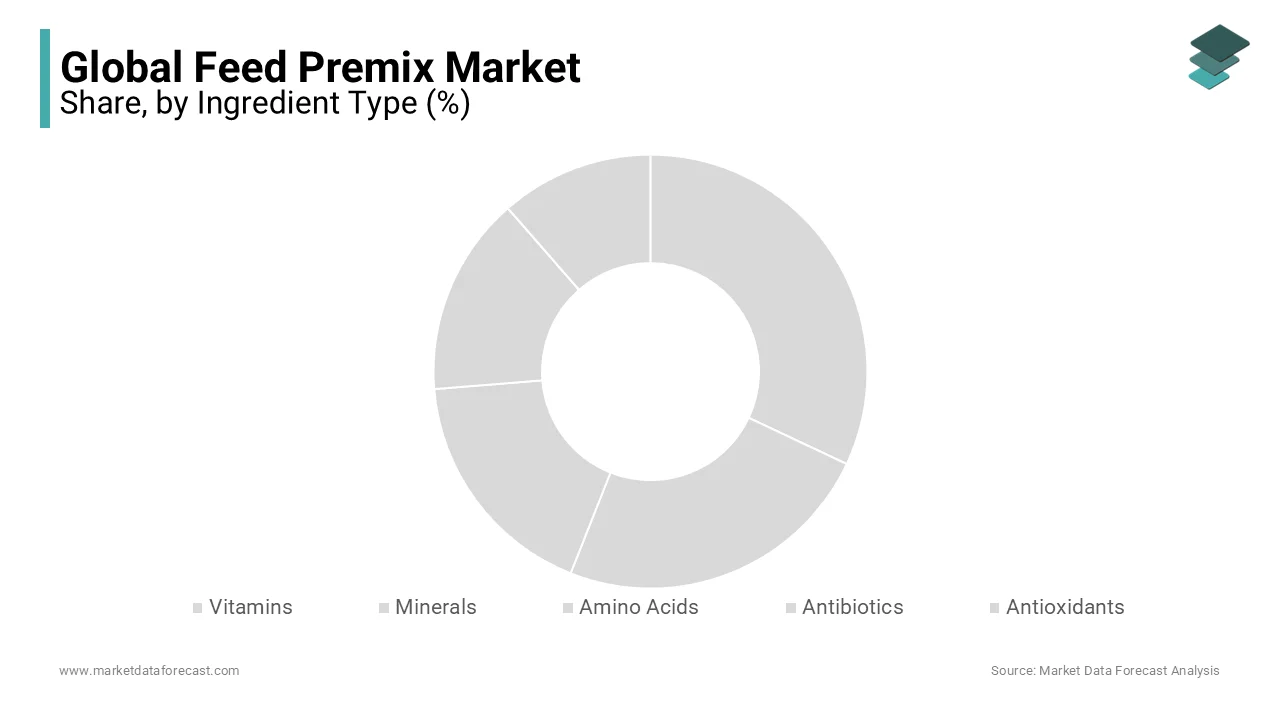
The amino acids segment is expected to hold the largest share of the feed premix market during the forecast period. Amino acid helps in building blocks for protein development in animals and hence increase the quality of the meat. Amino Acids are widely used in feed premixes to provide the required nutrients to overcome dietary deficiencies. In addition to being building blocks of body protein, amino acids play a vital role in various biochemical and metabolic processes in the cells of animals. So, from growth to production and reproduction, amino acids play a large part in the productivity of farm animals and can contribute significantly to the profitability of a farm. A variety of amino acids are fed to livestock as supplements to increase their efficiency. Owing to these benefits, amino acids drive the growth of the feed premix market in the forecast period.
By Livestock Insights
The poultry segment is going to dominate the market in the forecast period. The poultry industry consists of four main areas of production: broilers, egg, pullets, and breeders. Poultry is the fastest-growing industry because of the rapid increase in demand for poultry products. In some countries, the consumption of porcine and livestock meat is projected to be low due to religious beliefs, which in turn drives the demand for poultry meat. Moreover, there will be a rise in the demand for poultry meat in the coming years due to the increased cost of other livestock meat as compared to poultry meat.
By Form Insights
The dry segment is projected to hold the largest share of the feed premix market because the dry form of feed premix can be easily handled and stored, and has a wide range of usages in livestock applications. The dry form is easier to mix with the feed and has a longer shelf life compared to the liquid form. Owing to these reasons, it is mostly preferred by livestock farmers.
REGIONAL ANALYSIS
North America Market Analysis
North America is the largest contributor to the feed premix market and is projected to remain the second-largest dominant region of this market in the forecast period due to the rapid adoption of efficient and technologically advanced farm management practices by livestock farmers. The United States is the major market for the feed premix industry in this region, as the US is focused on innovating cost-effective production processes. Poultry is the largest consumer of the feed premix in this region. Moreover, the Companies in the North American region are committed to research, sourcing, quality, and education in providing nutritional technologies that are focused on the success of the consumer.

Asia Pacific Market Analysis
Asia-Pacific is expected to hold the largest market share of the feed premix market during the forecast period. The key markets in the Asia-Pacific region are China, India, Japan, Australia, Thailand, New Zealand, Vietnam,amnd others. In the Asia Pacific region, the presence of a large livestock population is driving the market of feed premixes in the near future. Additionally, the increasing number of feed mills and feed production, particularly in Japan and India, is driving the growth of the market. Moreover, the Asia-Pacific region has a large population, and the demand for animal protein is increasing, which, in turn, supports the growth of livestock farming that will further increase the demand for feed premix tooo meet the demand. Furthermore, the commercialization of livestock farming in countries such as India and China is expected to fuel the feed premix market in the forecast period.
Europe is expected to have steady growth in this market during the projected period due to the increasing importance of animal health and wellness in the animal husbandry industry.
COMPETITIVE LANDSCAPE
KEY MARKET PLAYERS
Some of the leading companies operating in the global feed premix market are
- Koninklijke DSM N.V. (Netherlands)
- Nutreco N.V. (Netherlands)
- Cargill (US)
- Archer Daniels Midland Company (ADM) (US)
- BEC Feed Solutions (Australia)
- DLG Group (Denmark)
- Charoen Pokphand Foods PCL (Thailand)
- Land O’Lakes (US)
- AB Agri Ltd. (UK)
- Phibro Animal Health Corporation (US)
RECENT MARKET NEWS
- In November 2021, Royal DSM announced that it had signed an agreement to acquire Norway-based Vestkorn Milling (one of the Leading producers of pea and bean-derived ingredients for plant-based protein products. This acquisition is a significant step in DSM’s strategy to build an alternative protein business in the future and will provide synergy with DSM's innovative “Canola PRO,” which is a rapeseed protein isolate and will be commercially launched in 2022.
- BEC Feed Solutions, established in Australia, inaugurated its new premix production facility in Carole Park, Brisbane, Queensland, in April 2021. According to BEC, its new plant would feature manufacturing space equipped with integrated technology, as well as a new warehouse and two-story office block. This new plant allows the BEC company to improve production capacity, accuracy, efficiency, traceability, and hygiene standards.
MARKET SEGMENTATION
This research report on the global feed premix market has been segmented & sub-segmented based on the product type, type, and region.
By Ingredient Type
- Vitamins
- Minerals
- Amino Acids
- Antibiotics
- Antioxidants
By Livestock
- Poultry
- Swine
- Aqua Animals
- Equine
- Pets
By Form
- Dry
- Liquid
By Region
- North America
- Europe
- Asia-Pacific
- Latin America
- Middle East and Africa